Can You Read the Reader from a Magazine of Nothing but Ads?
My notebook said: ask someone to buy a random magazine, cut out the ads and throw the rest away — what can you tell about the readers from the ads alone? Starting from Pompeii's election notices and a Song-dynasty needle-shop printing plate, I follow how advertising came to know its audience: the 1893 ten-cent magazine that began selling readers to advertisers, Listerine inventing an anxiety, Goffman reading a society's gender script from ad photos, banner ads that started counting clicks, and a 2012 study that reconstructed users from the ads on their screens. Then I look at how AI is changing how ads are made (the $2,000 commercial, Coca-Cola, full automation), the ad market (agency consolidation, algorithmic buying) and the people who see ads (AI summaries eating clicks, ads inside chatbots, distaste for AI ads, deepfake scams). An interactive lets you clip ads from imaginary magazines to guess the reader, and build a magazine for one from your own behaviour. The twenty-seventh piece in A Page for Today.
The notebook fell open to this line today:
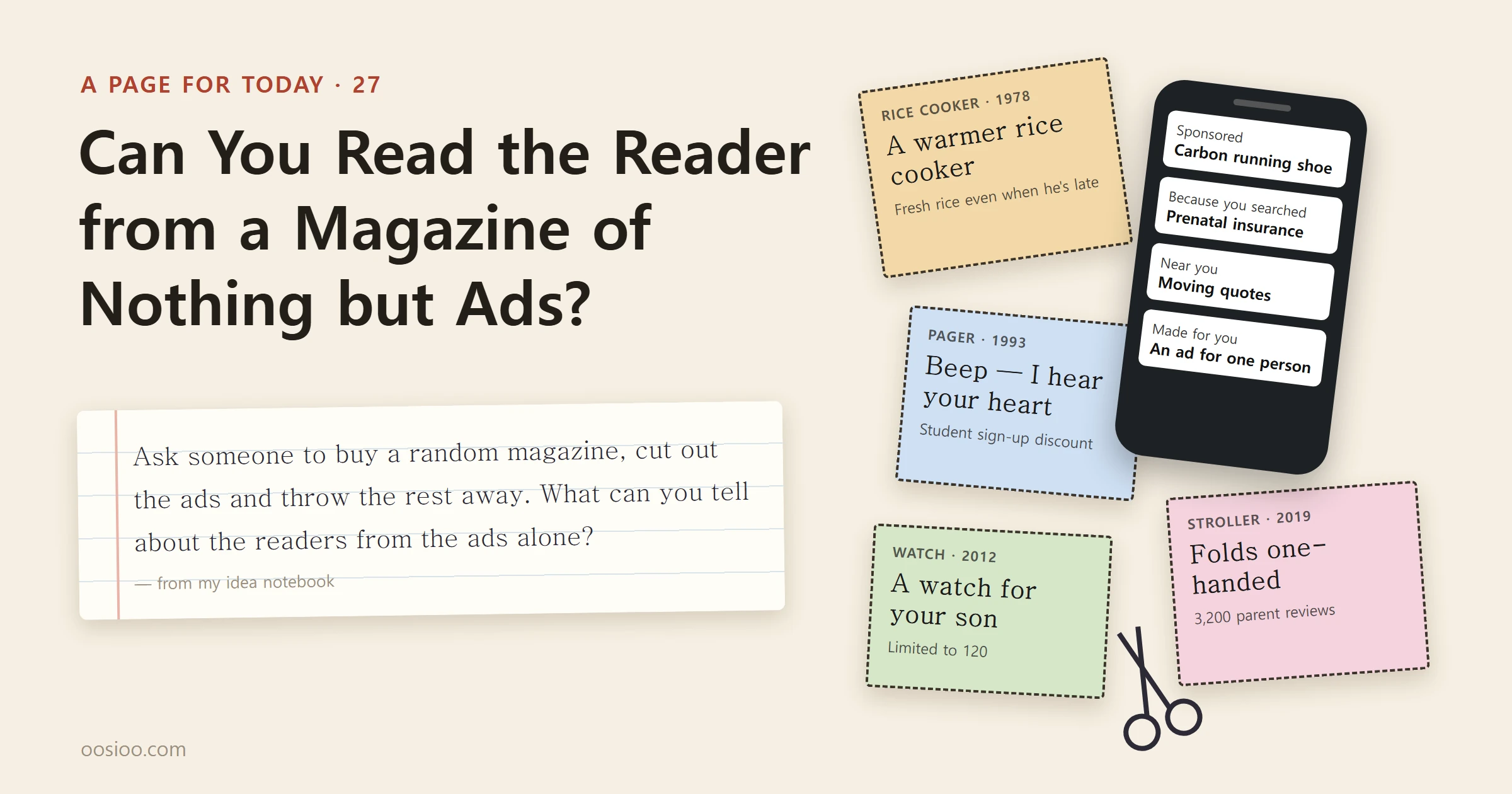
Ask someone to buy a random magazine, cut out the ads and throw the rest away. What can you tell about the readers from the ads alone?
The person I ask will pick up any magazine from a bookshop. They throw away every article and photo and keep only the ads. I take the pile without knowing the magazine's name and have to guess who reads it.
I suspect a lot would show. If strollers and postnatal care centres make up half the pile, the reader is probably a parent-to-be. Import sedans, watches, private banking and dental implants side by side suggest a high earner in their fifties. A pager ad tells you it's the 1990s. Ads don't land anywhere at random. Advertisers pay for the pages read by people who might buy their product. So the pile of ads is a record of how advertisers saw that magazine's readers.
With that question in hand I ran back through the history of advertising, and arrived at a point where the question turns itself inside out. Once, you guessed the reader from a magazine's ads. Now the ads pick the reader first. And AI is changing that once more.
Walls and handbills: where the ad hung was the audience
Pompeii was buried in ash in AD 79. Its walls have yielded more than 2,500 election notices painted in red. A set formula gives the candidate's name and asks you to "elect him aedile," often adding the group backing him, from fruit sellers to ball players. Professional sign-writers were paid to paint them, and they cluster on house fronts along the main streets. In this era an ad chose its readers by place, not by page. The busy street was the audience.
China preserves a bronze plate the Liu family's needle shop in Jinan used to print its ads during the Northern Song. It shows a white rabbit and the words "look for the white rabbit at our door," along with a quality guarantee and wholesale terms. It is often called the world's oldest printed advertisement, though that is closer to a claim than a settled fact. In English, the oldest surviving printed ad is a handbill William Caxton printed in Westminster around 1476–1479, selling a priest's service book. It ends in Latin: "please don't tear this notice down." Where it was posted mattered.
Pasqua Rosée, who opened London's first coffee house, handed out a sheet called "The Vertue of the COFFEE Drink" around 1652, claiming coffee prevented gout and scurvy. It is often introduced as the first newspaper coffee ad, but it was a handbill, not a newspaper. Korea's first newspaper ad ran on 22 February 1886 in issue 4 of the Hanseong Jubo: a notice from the German trading house Sechang (E. Meyer & Co.). Instead of the word for "advertisement" it used gobaek, "announcement." It offered to buy tiger and otter pelts and cowhides, and to sell clocks, matches and glass. Cut it out and the readers appear: people with hides to sell, people who could afford imports, and people who read classical Chinese.
1893: the reader becomes the product
The notebook's question really starts to work at the end of the 19th century. In 1893 Munsey's Magazine in the US cut its price from 25 cents to 10, less than it cost to produce. Ads made up the difference. Circulation jumped to around half a million within two years (figures vary by source). Some magazines, like the Ladies' Home Journal, already charged ten cents, so it wasn't entirely new, but around this time the business model set hard: sell cheaply to readers, then sell the readers you've gathered to advertisers.
From then on a magazine had a second customer besides its readers: the advertiser. Publishers produced documents telling advertisers "this is who reads us," what we now call a media kit — a kind of invoice listing gender, age, income and location. The pile of ads shows you the reader for a reason. Advertisers paid after reading that invoice.
Buying a page also meant buying readers in a rough bundle. "Half the money I spend on advertising is wasted; the trouble is I don't know which half." The line is widely credited to the American department-store magnate John Wanamaker. But there is no record of him saying it. According to Quote Investigator, a similar sentence first appeared unsigned in an advertising trade journal in 1890, and Wanamaker's name was attached from 1919. Whoever said it, the line has lasted over a century for a reason. With magazine ads there was no way to know who saw them or which of those people bought. It isn't far off to say the subsequent history of advertising has been an effort to find out "which half."
Aiming at the mind
In the early 20th century, advertising began to study not just readers' wallets but their minds. Listerine started as an antiseptic. From around 1921 the company pulled halitosis, a medical term hardly anyone used, into its ads: you have bad breath, even your friends won't tell you, and that's why you never marry. According to material compiled by George Mason University, sales rose from about $100,000 in 1921 to over $4 million in 1927. Cut those ads out and what do you learn about the readers? Less that they worried about their breath than that the ads planted the worry. The ad didn't reflect its reader; it made one.
On 31 March 1929, during the Easter Parade on Fifth Avenue in New York, about ten young women lit cigarettes at once. The stunt was staged by publicist Edward Bernays for the American Tobacco Company. Dressing women's smoking up as "freedom," it became famous as the "Torches of Freedom," though some research argues the press coverage and the sales effect were inflated later. The J. Walter Thompson agency hired behaviourist psychologist John B. Watson in 1920. In the 1950s, Ernest Dichter's "motivation research," which brought psychoanalysis into consumer studies, was all the rage, and in 1957 Vance Packard denounced such techniques in The Hidden Persuaders.
The same year, James Vicary announced that flashing "Eat Popcorn" and "Drink Coca-Cola" for 1/3000 of a second during a film had raised popcorn sales by 57.5%. The fear of subliminal advertising spread from there. But in a 1962 interview with an advertising trade journal, Vicary admitted it had been a gimmick and the data too thin to mean anything. The belief that ads can steer minds at will is as old as advertising, and usually much bigger than the reality.
Some ads went the other way. In 1959 the agency DDB's "Think Small" for Volkswagen led with smallness when everyone else bragged about big cars. Ad Age named it the best campaign of the 20th century in 1999. The Marlboro Man, third on the same list, sold cigarettes with a rugged cowboy. In 1947 De Beers turned the engagement ring into a custom with "A Diamond Is Forever." Clip the ads of this period and what comes into focus is less who the readers really were than who the advertisers wanted them to be.
A distorted mirror
Someone did try reading readers from ads as scholarship. In Gender Advertisements, first published as a journal issue in 1976 (and as a book in 1979), the sociologist Erving Goffman gathered nothing but magazine ad photos and read off his society's gender script. Women touch objects lightly with their fingertips, tilt their heads, sit lower than men. Men explain; women listen. He showed that a few hundred ad photos, without a single article, could tell you how an era saw men and women.
In 1986 the advertising scholar Richard Pollay published a paper calling advertising a "distorted mirror": it reflects society, but bent, amplifying certain desires and anxieties and leaving the rest out. The next year Morris Holbrook replied that advertising merely reflects values already there. That debate gives the notebook's question an important clue. What the pile of ads shows is not the reader but the reader the advertisers drew, and that drawing has gaps.
Clip every ad from a 1970s housewives' magazine and you'll see a married woman in her thirties. But the people who leafed through it at the hair salon, the readers with jobs, the readers living alone don't appear, because the ads didn't see them as buyers. In the first tab of the interactive below you can clip the ads from six imaginary magazines and guess the readers. When you reveal the answer, "what the ads don't tell you" appears too.
Counting clicks
The internet was the first thing that could count Wanamaker's "which half." On 27 October 1994 the web magazine HotWired launched with an AT&T banner: "Have you ever clicked your mouse right HERE? YOU WILL." Legend says 44% clicked, but that figure comes from a participant's recollection, and since another site that opened three days earlier also carried banners, even "first" is disputed. What matters is that from here on, ads could count who clicked.
In 1998 GoTo.com began letting advertisers bid on search terms and pay only when someone clicked. In October 2000 Google AdWords opened with 350 advertisers. The ad space was no longer a page in a magazine but the words a person had just typed into a search box. Show a stroller ad to whoever types "stroller," and you barely need to guess who the reader is.
Korean ad spending shows the shift in numbers. By Cheil Worldwide's count, digital ad spending first overtook broadcast in 2018. According to a survey released in January 2026 by Korea's Broadcasting and Media Communications Commission and KOBACO, online took ₩10.10 trillion, or 59%, of the ₩17.13 trillion total in 2024. Broadcast had 18.8%, and broadcast spending was estimated to fall below ₩3 trillion in 2025. Magazine ads came to ₩298 billion in 2024, just 1.7% of the total. Ask someone today to buy a random magazine and clip its ads, and they'll come back with a much thinner pile.
The ads pick me
Online advertising didn't stop at clicks; it began gathering behaviour wholesale. In 2007 Facebook's "Beacon" broadcast what people bought on other shopping sites to their friends' feeds. After a backlash and a class action, it was shut down in 2009. In 2012 The New York Times Magazine reported that the US retailer Target scored customers' likelihood of pregnancy from purchases of about 25 products. The famous anecdote — Target knew a teenager was pregnant before her father did — rests on an anonymous source and has never been verified. In 2018 came Cambridge Analytica: data from 270,000 people who installed a personality-quiz app spread through their friend networks to as many as 87 million.
The study that turned the notebook's question fully around also appeared in 2012. In a paper titled "Betrayed by Your Ads!", researchers in France gathered nothing but the Google ads shown on someone's screen and inferred that person's interests with over 79% precision, rebuilding about 58% of the ad profile Google held on them from the ads alone. In the magazine era, a pile of ads showed you a readership of tens of thousands. Now the ads on one person's screen show you that one person.
To feel this for myself I built "a magazine for one" in the second tab of the interactive. Tick things you might have done in the past week — read stroller comparisons, checked your phone a lot before dawn — and you'll see the ads likely to land in your feed, and what someone glancing over your shoulder could guess about you. Combine just two behaviours and the guess sharpens fast. Strollers plus flat prices in another district yields "moving somewhere bigger before the baby comes." On the other hand, running-shoe reviews plus late-night phone use could mean a dawn runner or someone who can't sleep. The same signals can point to opposite people.
There has been pushback. In 2021 Apple required apps to ask before tracking users, and Meta estimated the change would cut its revenue that year by about $10 billion. Google, on the other hand, announced it would remove third-party cookies from Chrome, abandoned the plan in 2024, and in April 2025 dropped even the idea of asking users to choose.
What AI changes, part one: how ads are made
If everything so far is the story of advertising slicing its audience ever thinner, AI is changing the making side.
In June 2024 Toys"R"Us premiered a brand film of just over a minute, made with OpenAI's video model Sora, at the Cannes Lions festival. That November Coca-Cola remade "Holidays Are Coming," its Christmas ad since 1995, with generative AI, and was called "soulless." It tried again in November 2025. The production studio said five AI specialists generated 70,000 raw clips and cut a production that used to take close to a year down to 30 days.
The ad that prediction-market company Kalshi ran during the NBA Finals in June 2025 was made by one person in two or three days with Google's video model Veo 3. He generated 300 to 400 times and picked 15 usable clips; the AI generation cost under $2,000. That figure excludes the creator's fee, though, so it shouldn't be read as the cost of the whole ad. In Korea, Cheil Worldwide made an AI-only TV ad for Samsung Life in 2023, and LG Uplus released a "100% AI-generated TV commercial" in 2024, saying it cost 40% less and took 70% less time than 3D animation.
At the Super Bowl in February 2026, 15 of 66 ads were made with AI or promoted AI services. Viewers said they were sick of AI ads before the first quarter was over, and Anthropic ran an ad promoting "AI without ads" aimed at a rival.
The platforms want to take over ad-making entirely. In June 2025 The Wall Street Journal reported that Meta planned, by the end of 2026, to let advertisers supply just a product image and a budget while AI handled the copy, video, targeting and budget allocation. The same car ad would show a snowy mountain road or a city street depending on where the viewer lives. According to reports, nine million advertisers were using Meta's AI ad-creative tools by the second quarter of 2026. Where the second tab of the interactive shows ads being picked, we're heading toward ads made on the spot for whoever is looking.
What AI changes, part two: the ad market
As making moved to machines, the companies that used to make ads were shaken. In November 2025 Omnicom completed its acquisition of IPG to become the world's largest advertising holding company, and promptly folded names like DDB — the agency behind "Think Small" — into other networks. A name that symbolised advertising in 1959 effectively disappeared in 2025. WPP was reported to have cut about 11,000 jobs since early 2025.
The money, meanwhile, grew. In its mid-year forecast of June 2026, WPP Media projected global advertising revenue would rise 8.9% this year to about $1.3 trillion, citing the AI investment boom. Dentsu predicted that by 2028, 75% of all ad spending would be placed by algorithms. Ad budgets keep growing, but the side receiving them is shifting from people at agencies to machines at platforms.
What AI changes, part three: the people who see ads
The changes are big on the viewing side too. The first thing to shrink is the click. When the Pew Research Center analysed the real browsing of 900 US adults in 2025, people clicked a result link in 8% of searches where Google showed an AI summary, versus 15% where it didn't. Only 1% clicked a source link inside the summary. The marketing firm Seer Interactive found paid-ad click-through rates on searches with AI summaries fell from 19.7% to 6.34%.
With clicks shrinking, ads are trying to move inside the answer. Google is testing ads marked "Sponsored" inside AI Mode answers, and in January 2026 OpenAI announced ads for free ChatGPT users, promising they wouldn't influence answers and that conversations wouldn't be shared with advertisers. Going the other way, the AI search service Perplexity stopped taking new advertisers around October 2025. An executive explained that "ads make users doubt everything."
There are signs that the party to be persuaded is shifting from people to machines. In 2023 researchers from Princeton and elsewhere proposed "generative engine optimization" (GEO), editing text so AI answers cite it more. Simply adding quotations and statistics raised visibility in AI answers by up to 40%. In Seer's study, too, brands cited in AI summaries got more clicks. But the age of AI assistants doing our shopping is arriving more slowly than predicted. ChatGPT opened in-chat checkout in September 2025, then in March 2026 handed payment back to merchants and retreated to product discovery.
Nor are people welcoming AI-made ads. In a 2024 NielsenIQ study of over 2,000 people, about 150 of whom had their brain activity measured, participants rated AI ads "annoying," "boring" and "confusing," and even AI ads judged high-quality were weak at sticking in memory. In a 2025 survey of 3,000 people by the ad company Raptive, content perceived as AI-made lost about half its trust, and purchase consideration for the ads beside it fell 14%.
The same tools make scams
Technology that makes ads cheap makes fake ads cheap too. In Korea in 2024, investment ads imitating celebrities' faces and voices lured people into "stock-tip rooms." Reports citing the National Police Agency put the damage at 6,143 cases and ₩534 billion in January–August 2024 alone. Celebrities formed their own group to demand action from platforms. In November 2025 Reuters reported internal documents showing Meta had estimated about 10% of its 2024 revenue would come from ads for scams or banned goods. Meta called the estimate overly inclusive.
So more countries are writing "say it was made by AI" into law. Korea's AI Basic Act took effect on 22 January 2026 with a labelling duty for generative-AI output, and the EU AI Act's deepfake labelling duty applied from August 2026. The US Federal Trade Commission put a rule into force in 2024 banning fake reviews, including AI-written ones. Just as the US reined in patent-medicine ads touting baseless cures with a 1906 law, the history of advertising has always been new technology running ahead with a "tell us what's real" rule chasing behind.
Five shifts from the history of advertising
Lining the cases up again, a few currents stood out.
| Shift | Then | Now |
|---|---|---|
| How ads know readers | where they're posted, a magazine's readership | search terms, behaviour logs, real-time generation |
| People seeing the same ad | tens of thousands to millions | one person |
| Cost of making an ad | agencies, shoots, months | generative models, days, thousands of dollars |
| What's scarce | page space and airtime | people's trust and clicks |
| Who must be persuaded | the human mind | the human mind, and the AI's judgement |
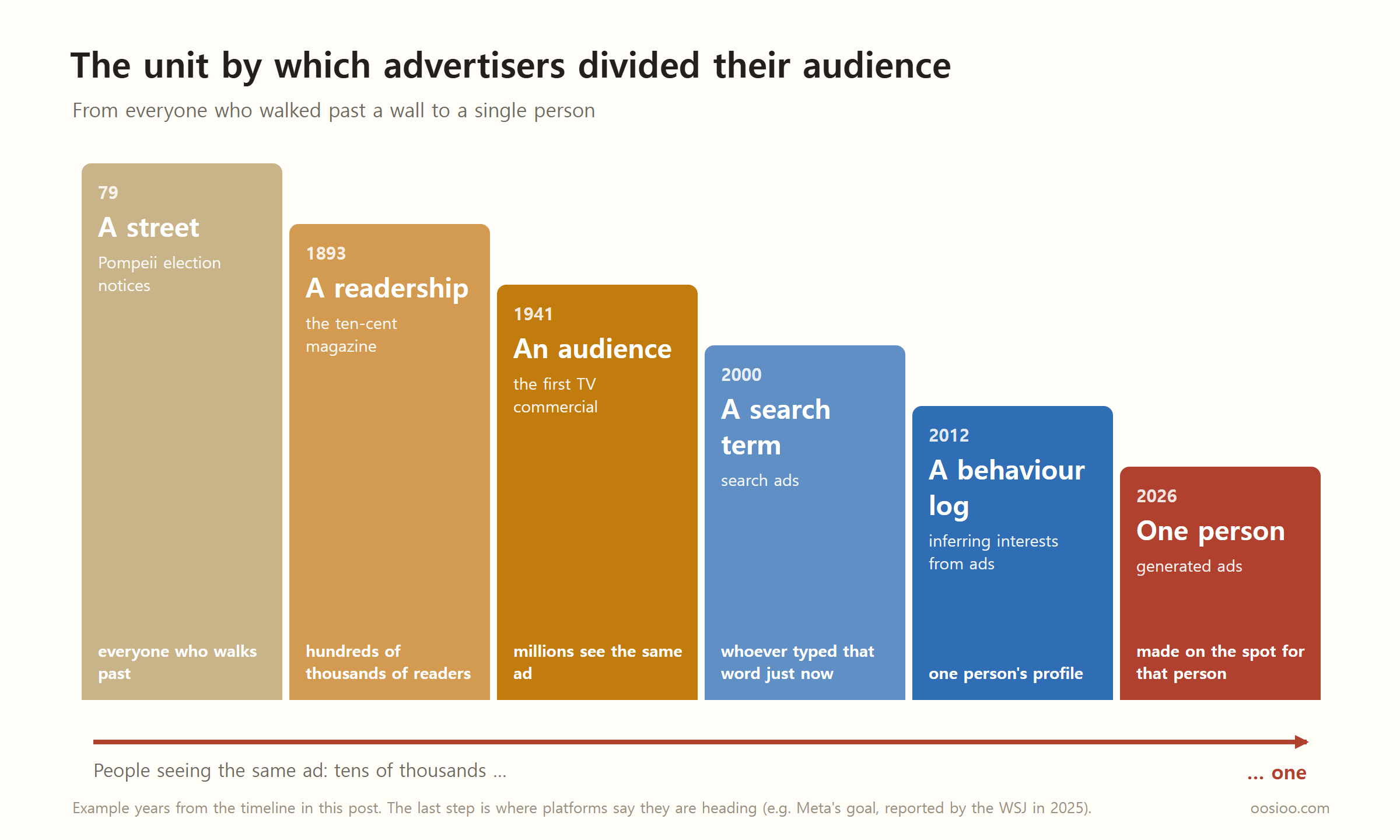
First, the unit by which advertisers divide their audience keeps shrinking: from the street to a magazine's readership, to viewers, to search terms, to one person's behaviour log. All that remains is making an ad for one person on the spot.
Second, ads are less a mirror than an order form. Listerine ordered up anxiety; De Beers ordered up a custom. Today's recommendation algorithms likewise reflect what I want while also choosing what I will want.
Third, as the cost of making ads falls, the cost of being believed rises. In an age when $2,000 buys you a TV ad, people grow irritated by AI ads, and Perplexity dropped ads altogether over trust.
Fourth, once the unmeasurable "which half" became measurable, the measuring itself became the problem. Target's pregnancy score, Cambridge Analytica and Apple's tracking block all came from knowing too much.
Fifth, rules have always followed new technology with a lag: patent medicine and the 1906 law, fake reviews and the 2024 FTC rule, deepfakes and the 2026 labelling duties.
Back to the notebook
What happens if I ask someone today to buy a random magazine and clip only the ads? The pile will be thinner than it once was, and the reader it suggests less distinct, because advertisers have already left magazines to look for readers elsewhere.
Instead, the question comes back much sharper on a phone screen. Clip and collect the ads in my feed, and you won't find a readership of tens of thousands but me alone. Someone looking through that pile could guess things about me I've never said. Yet, as Goffman and Pollay reminded us, that picture isn't me reflected as I am; it's how advertisers see me as someone who might buy. When I look at the ads on my screen, it's worth asking now and then: what kind of person did this ad decide I was?
A Page for Today is a series in which I open my idea notebook to a random page and lay that day's thoughts on the line I find there. Today a line about clipping magazine ads became the twenty-seventh piece. If you spot an error in any figure or example, let me know and I'll fix it.