oosioo
Read in English
How Much Does a Delivery App Take From One Order?
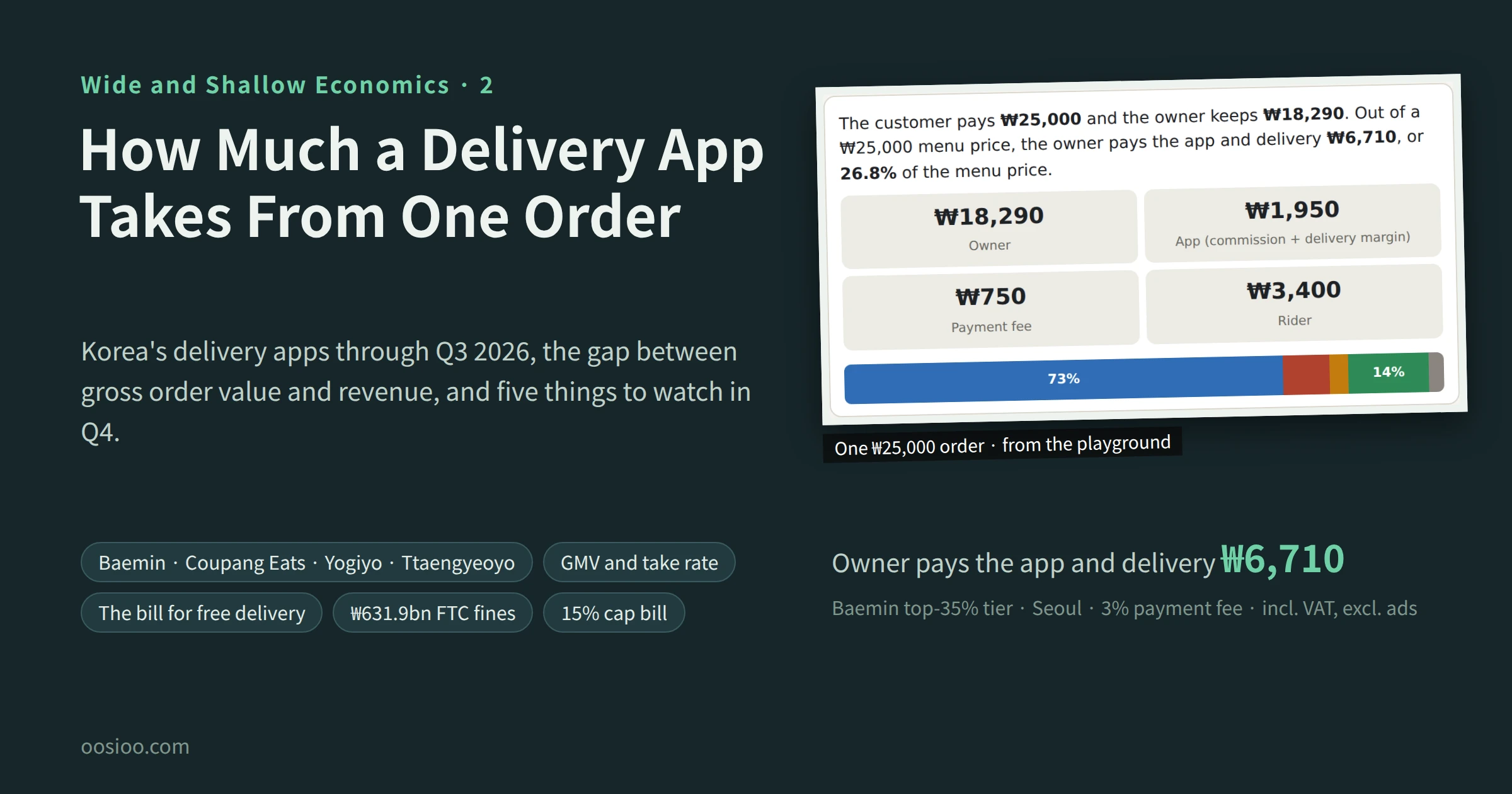
This episode of Wide and Shallow Economics follows a single 25,000-won delivery order in Korea as it splits between the restaurant owner, the app, the rider, card payment and tax. Online food service transactions reached 11.39 trillion won in Q3 2026, up 7.6% from a year earlier, and in 2025 Baemin and Coupang Eats together took 92.89% of the market by order value. On November 9 the Fair Trade Commission imposed provisional fines of 631.9 billion won on the two, and a bill to cap combined fees and delivery charges at 15% is pending in the National Assembly. The accounting concept this time is GMV, revenue and take rate: in Delivery Hero's Asia segment, which includes Baemin, revenue divided by GMV rose from 18.1% to 21.8% while GMV barely moved. I look at why that ratio grows when an app takes over delivery, and where the cost of "free delivery" lands on the income statement. In the playground you can change the app, sales tier, delivery fees and rider pay to split one order yourself. At the end are five checkpoints to score against Q4 2026 and Q1 2027 results.
Looking Inside the Puck with CT
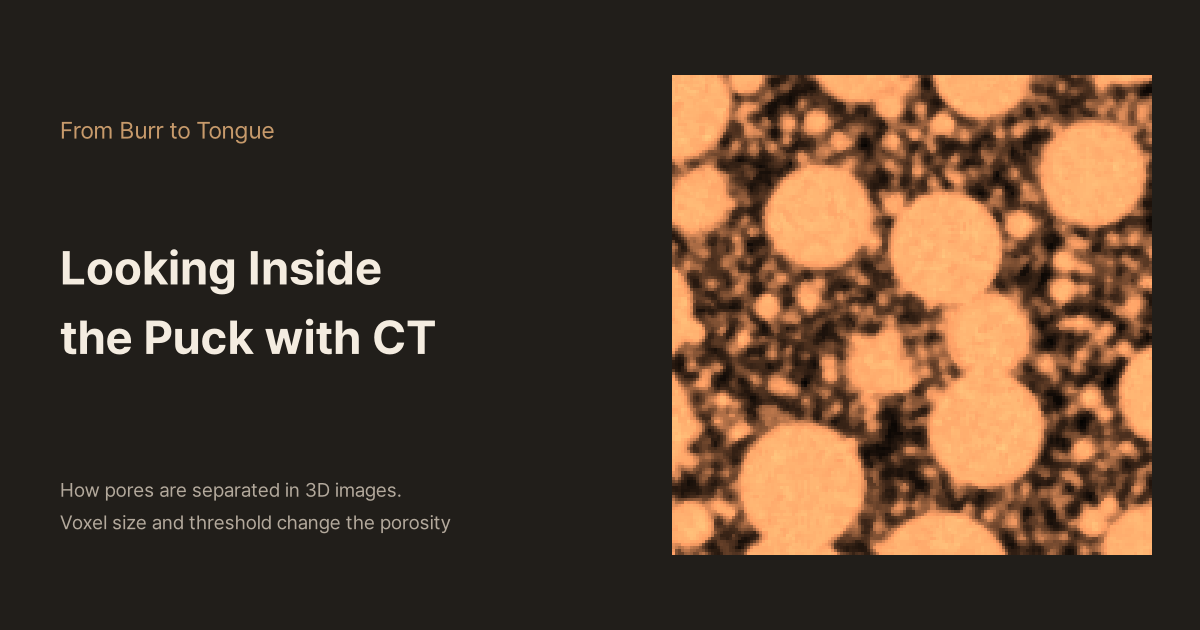
When CT images a puck, much of the conclusion is decided when each voxel is classified as coffee or space. Mo et al.'s (2023) 16.8 µm images had a single-peaked histogram, so porosity was set to the literature value of 0.17. Scanning a virtual puck of known porosity 0.31 at 16 µm and segmenting with Otsu's method gave 0.49, only 13% of the fines were detected, and the permeability from that image was 66 times the truth. Includes a virtual CT slice tool.
Does Barbecue Add Up? — I Ran a 5 cm Pork Belly Through a Microwave, Air Fryer, Charcoal Grill, and Open Flame in a Simulator
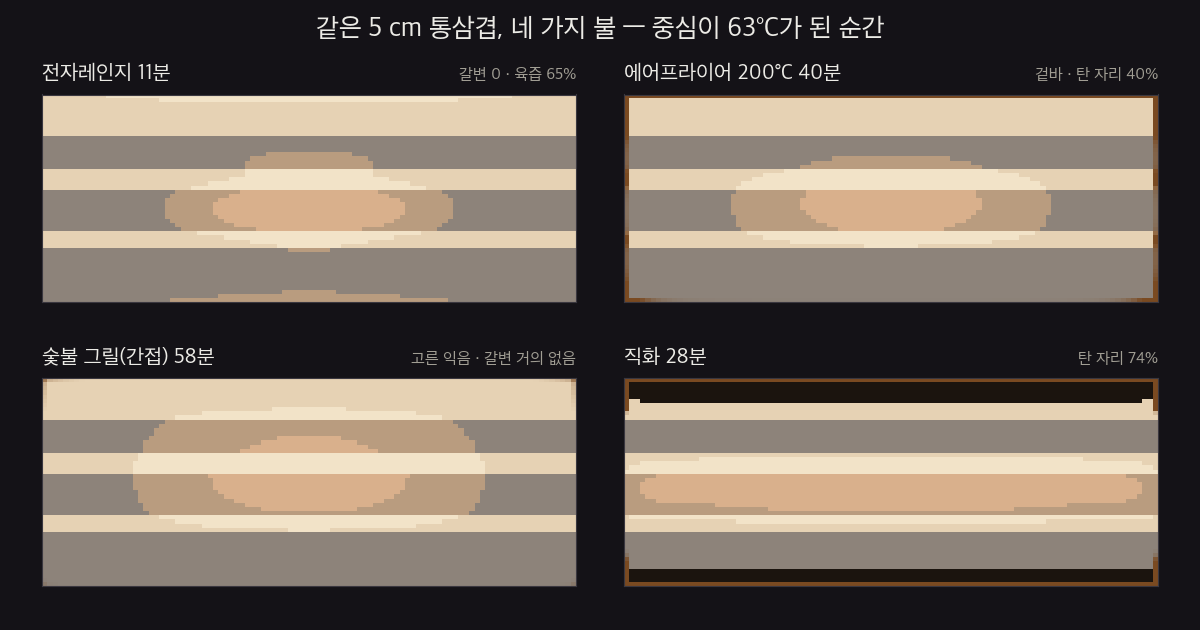
The same meat becomes a completely different food depending on where you cook it. I sliced the cross-section of a 5 cm pork belly roast into a 1 mm grid and built a simulator that jointly computes heat conduction, surface evaporation, juice loss, Maillard browning, and collagen softening. Cooking to a 63°C core took 11 minutes in the microwave, 28 over direct fire, 40 in the air fryer, and 58 in a lidded charcoal grill. The microwave kept 65% of the juice but produced zero browning; direct fire charred 74% of the surface — the calculation itself explains why Koreans slice pork belly thin for grilling. A search over 32 two-phase recipes that switch appliances mid-cook crowned 'microwave to 50°C, finish in a 200°C air fryer' (19.5 minutes), with the barbecue community's reverse sear re-emerging near the top. Also covered: the people who compute cooking for real — baking simulation in graphics (UCLA), meat-as-polymer food engineering (Wageningen), computational gastronomy (IIIT-Delhi), and AI recipe exploration at Sony AI, IBM, and NotCo.
Footsteps from Above
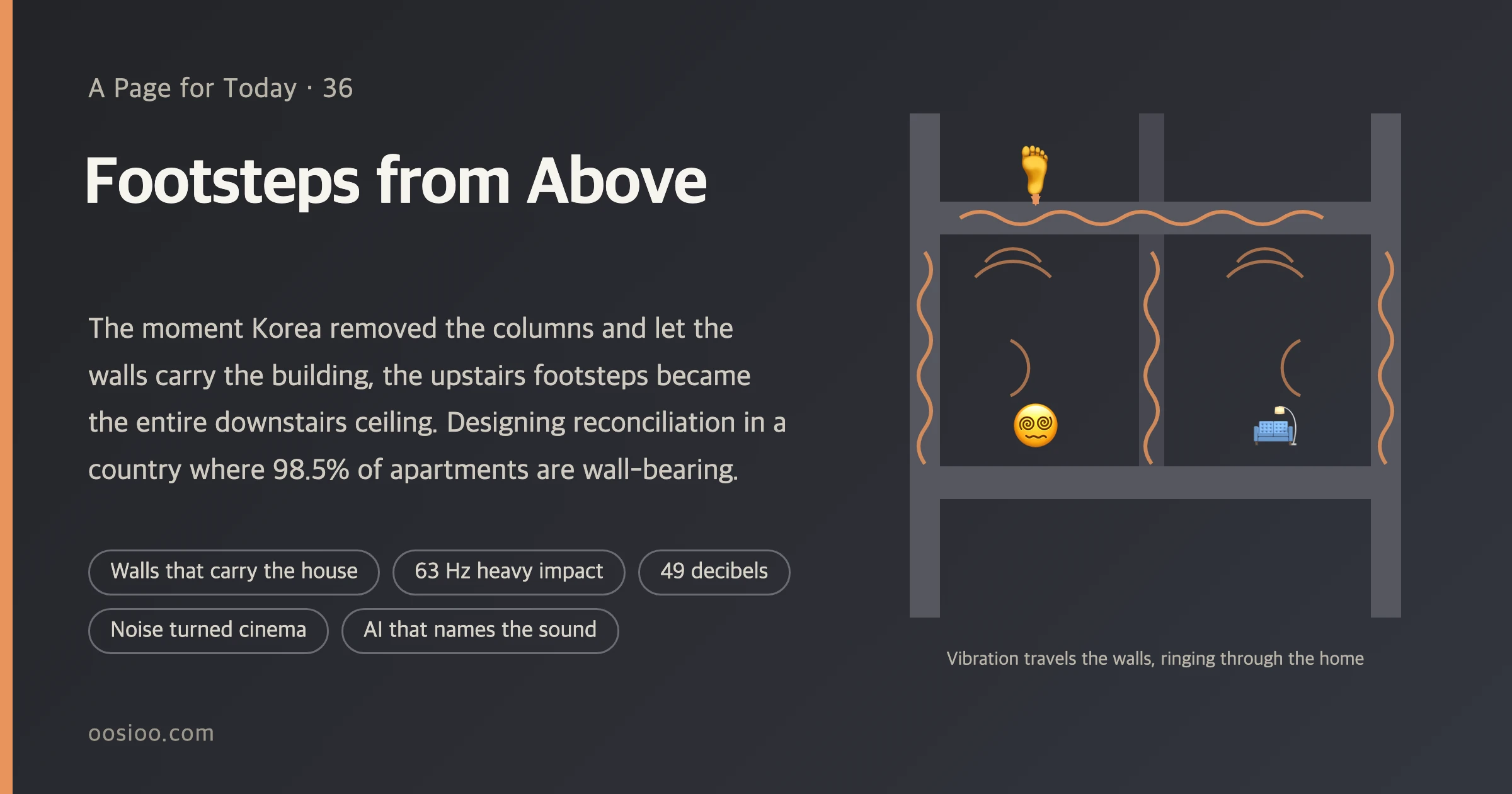
The notebook asked: what would be the wisest way to reconcile two households at war over inter-floor noise? Korean apartments saved storey height and construction cost by removing the columns and letting the walls carry the building — and those walls became roads for the upstairs footsteps, which now ring from the entire downstairs ceiling. 98.5% of large apartment complexes completed over a decade were wall-bearing. I trace why cushioning layers fail against a child's 63 Hz footfall, how much a thicker slab actually buys, how the floor-impact rules chased the noise for twenty years and where they have stalled; the wave of inter-floor noise films that filled Korean screens last year; the grade-1 floors the builders are racing to make; and the AI research that names a noise with 95% accuracy, locates it, and measures it with vibration sensors instead of microphones. A floor-lab playground lets you rebuild the floor and hear the difference. The thirty-sixth piece in A Page for Today.
Where Does the Price of a Chicken Go?
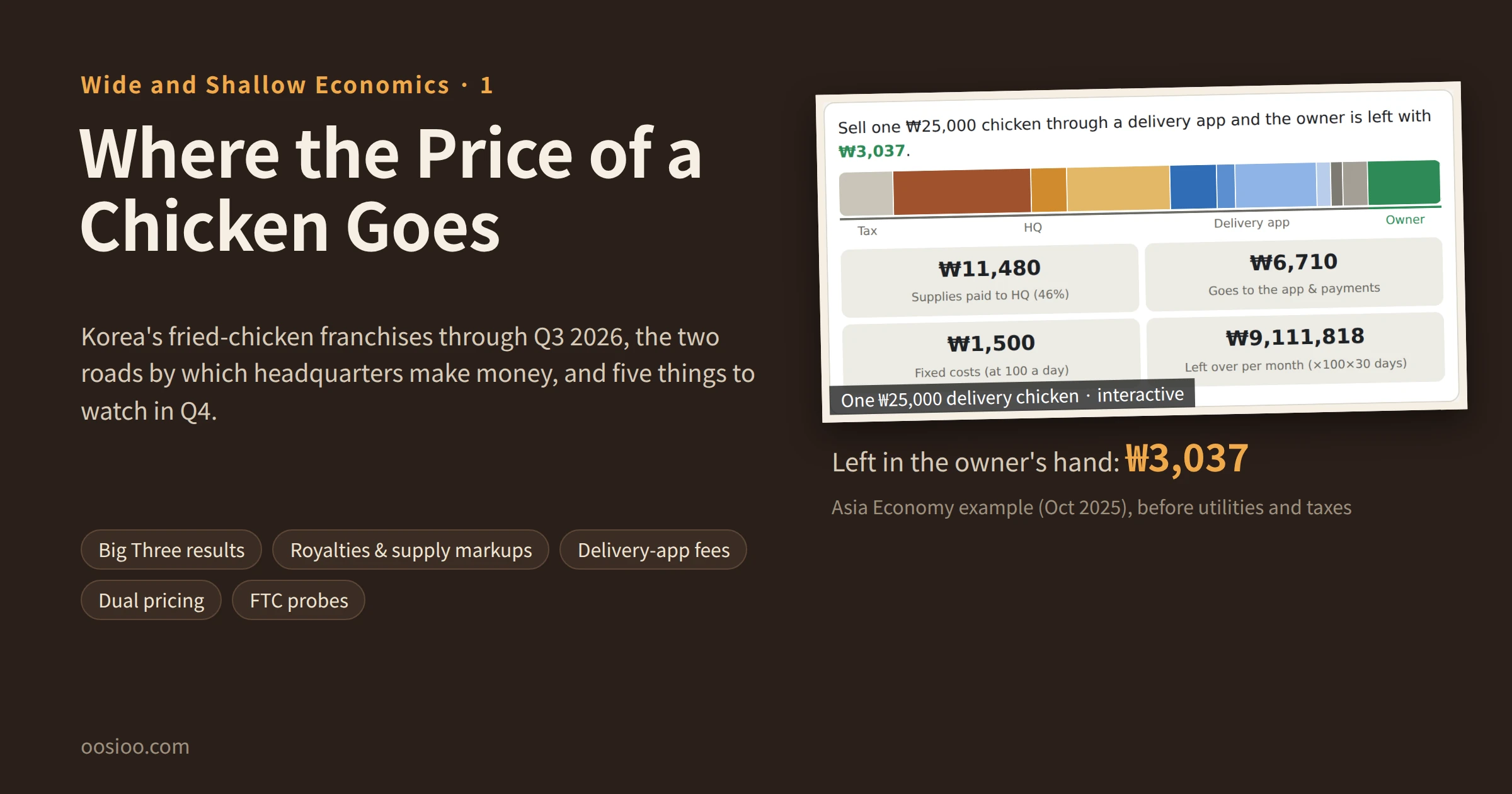
₩25,000 on a delivery app, ₩23,000 in the shop. The same chicken now has two prices. The first installment of “Wide and Shallow Economics” looks at chicken franchises. Three numbers sum up where the sector stood through Q3 2026: 28,750 franchise outlets, a 9.5% supply-markup ratio, and chicken prices down 37.7% in six months. bhc, BBQ and Kyochon all post head-office revenue of ₩500–600 billion, yet their operating margins are 26.8%, 13.1% and 6.7%, a fourfold spread. We explain why through the two ways a franchisor makes money: royalties and supply markups. We also cover the franchisee lawsuits that followed the Supreme Court's Pizza Hut ruling, the FTC's October 2026 on-site inspection of the Big Three, and the Franchise Business Act amendment that takes effect on December 31. In the playground, you can split the price of a chicken into taxes, head-office ingredients, the delivery app, rent and labor, and work out how much is left in the owner's hand. At the end are five predictions to be scored against Kyochon's Q4 results in February 2027 and other data.
First Steps
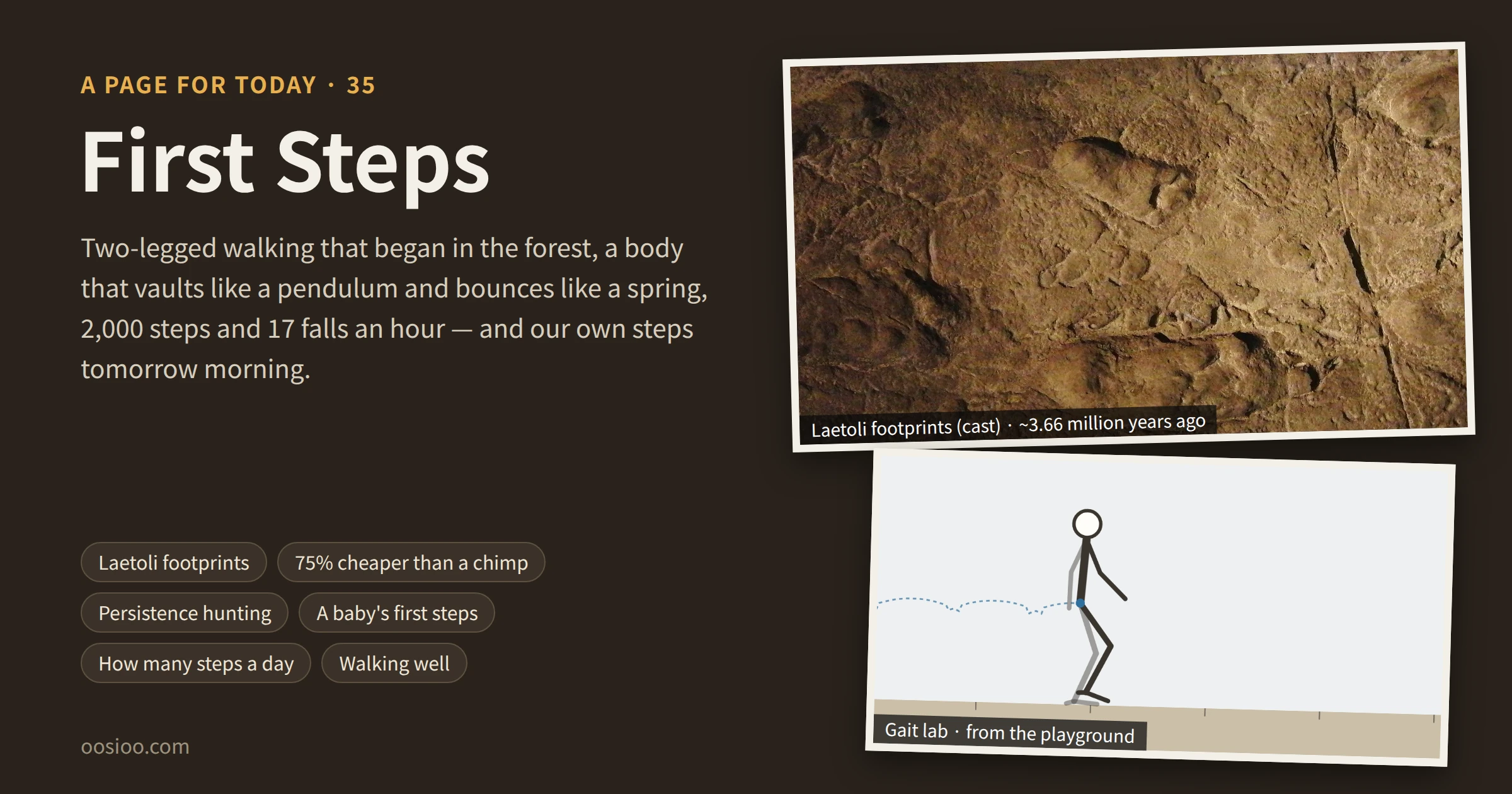
My notebook held a single word: geoleumma, a toddler's first steps. Only humans stride on two legs. I follow two papers that read the same seven-million-year-old thigh bone in opposite ways, the recent turn towards standing up in the forest while still climbing trees, and the footprints pressed into volcanic ash at Laetoli, with a different gait beside them. Then the body that lets us walk a given distance on 75% less energy than a chimpanzee, walking as a pendulum and running as a spring, the persistence hunt in which sweating hunters ran down antelope, and toddlers who take 2,000 steps and fall seventeen times an hour. Finally: how many steps a day are enough, how fast you need to walk for it to count as exercise, and which claims about walking correctly have evidence behind them. Playgrounds include a gait lab, a persistence hunt and a walking plan. The thirty-fifth piece in A Page for Today.
One Photo to 3D, Now on a MacBook — Scoring Idol on the Same Test as Episode 39's TRELLIS
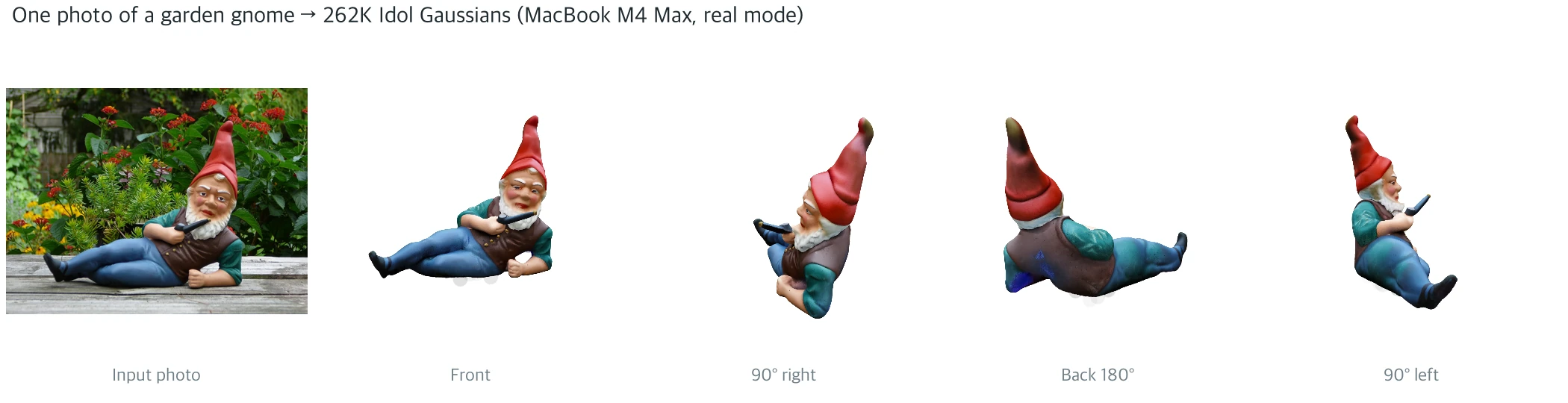
I took the problem from episode 39, where TRELLIS ran on a laptop GPU, and solved it with Idol on a MacBook (M4 Max) with no NVIDIA GPU. Idol, released in April, is a 660-million-parameter model that turns one photo into a bundle of 3D Gaussians, and it has a port to Apple's MLX. I rendered episode 39's five ground-truth objects at the same angle and scored them with the same code. On the three public models it stayed within 1 mm like TRELLIS (0.77–0.95 mm). On my custom little house it was 1.79 mm, better than TRELLIS (2.98 mm): where TRELLIS copied the front door onto the back wall, Idol left the wall blank. It still did not invent the mug handle missing from the photo. Each object took 227–289 seconds, more than ten times slower than the episode 39 laptop, and MLX memory peaked around 8.6 GB. Increasing the Gaussian count 16-fold barely changed the time. The output is splats, so I extracted meshes with Poisson reconstruction and ran them through episode 39's print conversion; all seven became single watertight STL files. Re-scoring as meshes did not change the order.

Porous Media 101
Looking at the espresso puck through Darcy's law and permeability. Solving a typical shot backwards gives about 2.3×10⁻¹⁵ m², but running Kozeny–Carman on Grind Simulator v1's dry distributions gives one to two thousand times more, so 36 g would run through in under a second. Adding 10% fines cuts permeability to 28%, and 2.3 g more in the same cell cuts it three- to fourfold. I go through the candidates for the thousandfold gap (swelling, compression, fines migration) and include a calculator.
Light a Fire Before You Buy the Fire Pit — Running Six Popular Fire Pit Designs Through a Combustion Simulator
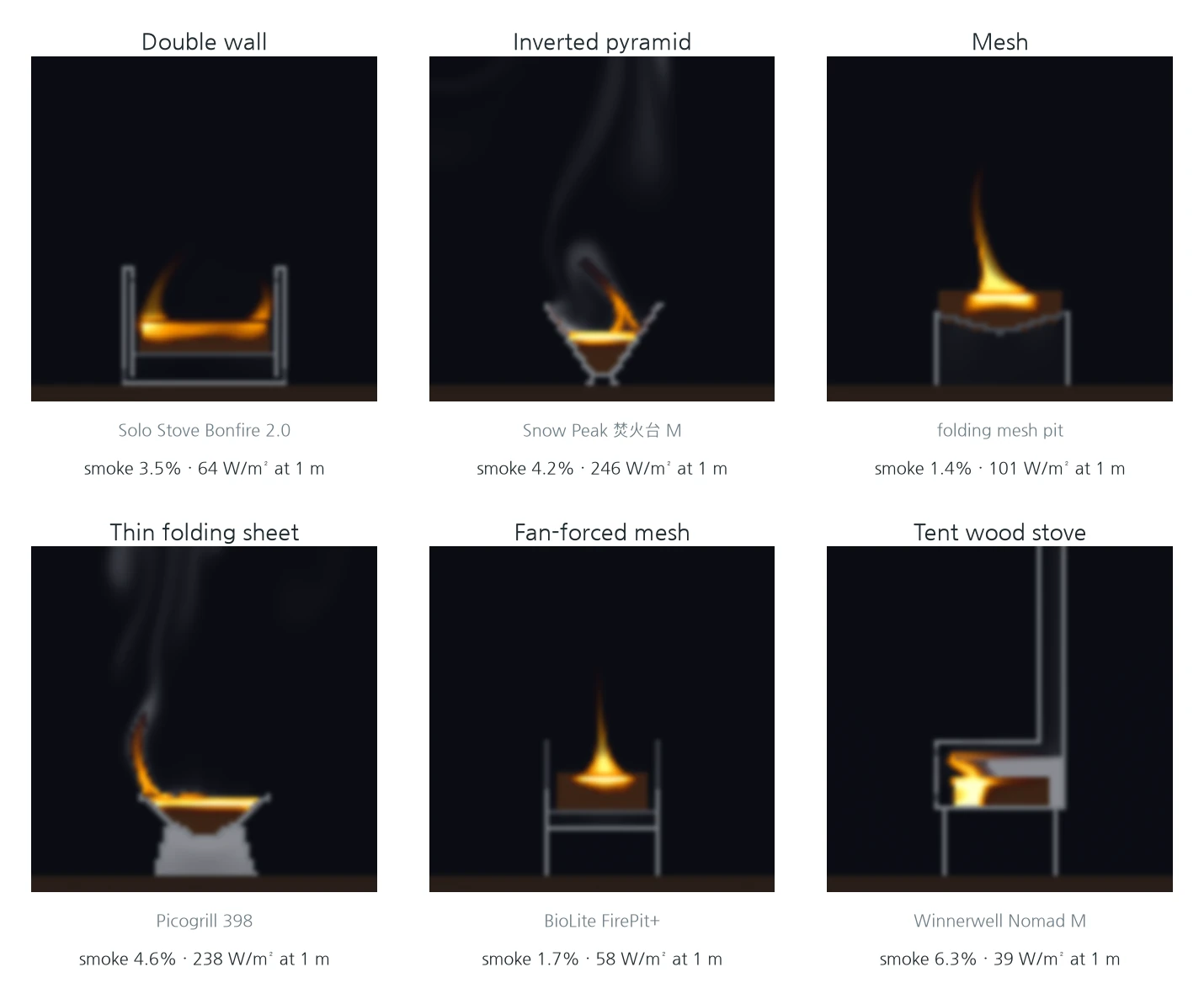
The best part of winter camping is staring into a wood fire. But fire pits differ in smoke, flames and where the heat goes. Can you see that in advance from shape and structure alone? I drew the published dimensions of a double-wall cylinder (Solo Stove Bonfire 2.0), an inverted pyramid of solid plates (Snow Peak Takibi M), a mesh pit, a thin folding sheet (Picogrill 398), a fan-forced pit (BioLite FirePit+) and a tent wood stove (Winnerwell Nomad M) into a cross-section grid, and ran 60-odd trials of a 2D simulator that computes airflow, the burning of wood gas and charcoal, and radiant heat rays together. With the same wood (3 kg per hour), radiant heat on a person 1 m away was 246 W/m² for the inverted pyramid and 64 W/m² for the double wall, a fourfold gap. Unburned smoke was 1.4% for mesh, 1.7% fan-forced, 3.5% double wall and 4.2% inverted pyramid. Widening the double wall's gap from 1.25 to 3.75 cm dropped its outer wall from 314°C to 79°C, while the top secondary-burn holes only cut smoke (3.6% to 2.6%) when the wood was tripled. I also summarize the history of calculating fire (Franklin stove, Rumford fireplace, rocket stoves, EPA rules) and how well-known simulators work (FDS, Rothermel, Stable Fluids, EmberGen).
Grind Simulator v1
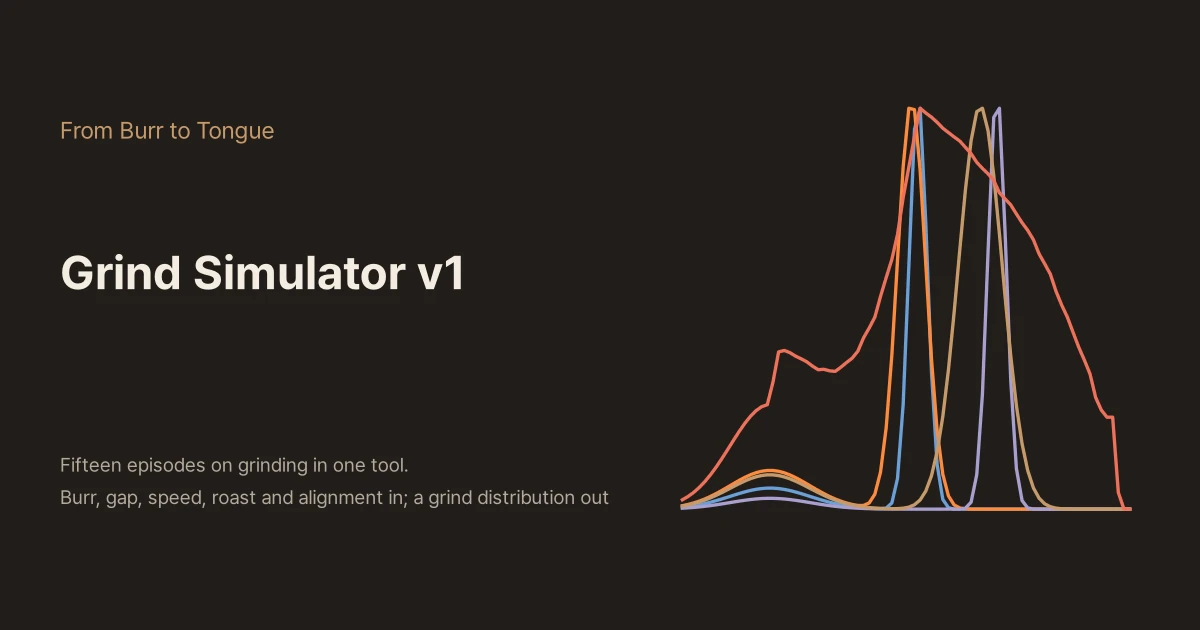
I gathered the results of fifteen episodes on how beans break inside a grinder into one tool. Put in burr type, gap, speed, alignment and roast, and it returns a mass distribution combining a fines peak (cell size, 38 µm) and a gap-set coarse peak; blades run the population balance model as is. I note what is measured and what is a model trend, and the distribution can be downloaded as a CSV.

Music That Lived With a Dynasty
My notebook asked: have you ever heard the music that lived with a dynasty? After seeing the stone chimes and bronze bells at the Story of King Sejong exhibition in Gwanghwamun, I followed that music through the Annals: Bak Yeon making pitch pipes and chimes from Haeju millet and Namyang stone, King Sejong hearing that one stone was a little high, and his question about hearing native music in life but Chinese ritual music in death, which led to new music that King Sejo made into Jongmyo Jeryeak. Then how nearly a thousand court musicians shrank to 57 after the dynasty fell and carried on into the National Gugak Center, why school gugak stopped at the danso, where and how to hear court music today, and the musicians rewriting gugak, from Leenalchi and Song Sohee to SsingSsing, HAEPAARY and CHUDAHYE CHAGIS. A playground lets you strike the stone chimes, find the off stone as Sejong did, hear the eight sounds and write a tune in jeonggan-bo. The thirty-fourth piece in A Page for Today.

What Happens When AI Makes a Short Film Alone? — Shooting a 5-Minute Film on One MacBook, From Script to Edit
We gathered where AI has actually been used in film and fiction, then handed a 5-minute short over to AI entirely. Netflix said it used generative AI in about 300 titles this year, but most of that was post-production filling in crowd and background shots that were never in the budget. Two films billed as "Korea's first AI features" each drew audiences in the 600-700 range. In fiction, studies show AI catching up to humans on sentence quality, but readers still price in who wrote it. In our MacBook experiment, the script came out in 54 seconds. Once we told the AI director the equipment's limits, it rewrote all 26 lines of dialogue to play off-screen in a 59-shot shooting script. Faces were cast by rule, voices by description, and the three music tracks took 26 minutes. Instead of the full film, four scenes are shown as GIFs. The script works in one click — the screen doesn't, yet.
Bulgama: Sweating in a Charcoal Kiln
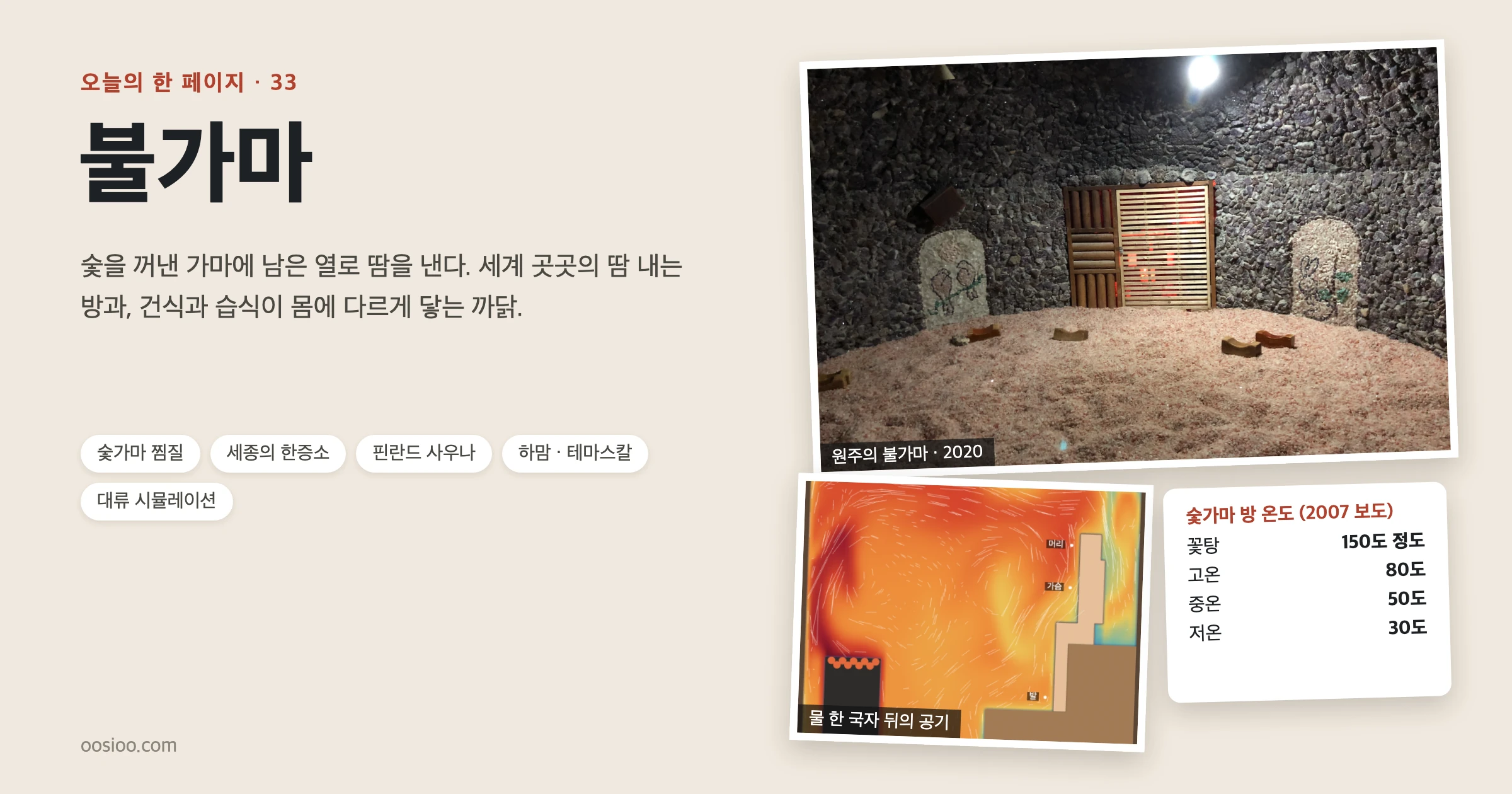
The notebook said only "bulgama" — fire kiln. It traces how a charcoal kiln's leftover heat, once the charcoal was pulled out and used for sweat bathing, became the round room of today's jjimjilbang, then reaches back 600 years to King Sejong's state-funded hanjeungso even as he doubted their benefit, and on to Finland's smoke sauna, Russia's banya, the hammam, Japan's ishiburo, the temazcal, and Ireland's sweat house, sorting the world's sweat rooms into three branches. It then explains, through a single idea — the dew point — how dry and wet heat differ in the way they put heat into the body, and runs two-dimensional convection calculations on cross-sections of a sauna, a steam room, and a charcoal kiln. It separates, with notes on which claims are backed by evidence and which are still anecdote, why some people struggle especially with dry heat and others with wet. A playable panel for spinning the air inside the room yourself, plus a temperature-humidity map, are included. The thirty-third piece of A Page for Today.
Blade vs Burr
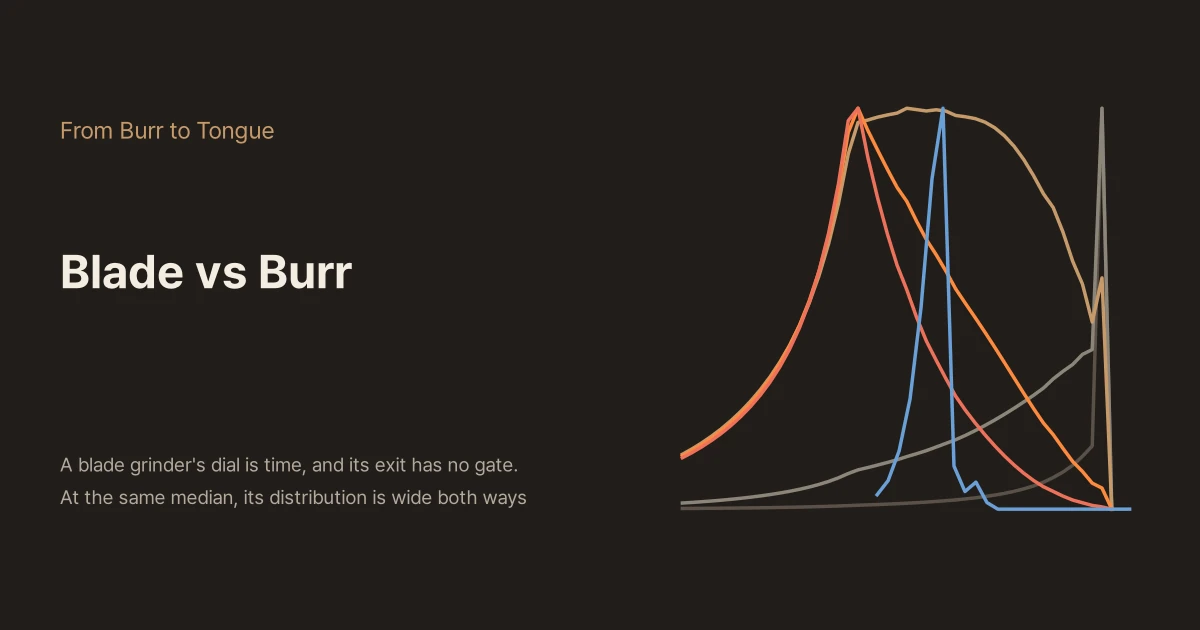
No peer-reviewed study backs up "buy a burr grinder, not a blade". What exists is one blade grinder tested at different grind times and sieve-based product tests (27–44% in the target band versus over 60% for burrs). A population balance model shows a blade grinder's dial is time, and with no gate at the exit its distribution is wide both ways even at the same median (D10 138, D90 2,941 µm). Shaking trims the coarse tail. With a calculator.

How to Notice Happiness (5) — Not Something You Find, but Something You Notice
Happiness wasn't some distant destination — it was noticing what's already here, right now. You can't see it if you never stop. Sometimes you have to stop.

A Warm Meal
The notebook said only “A warm meal.” This piece follows the 15 years in which Noryangjin's cupbap went from around 2,000 won to 4,500 won and the cupbap street dwindled to just four open stalls, then sets Seoul dining-out prices against the minimum wage to work out how many minutes of work it takes to buy a meal. The burden comes less from how fast prices are rising now than from how high they've piled up over the years. After looking at the numbers on young people waiting for their first jobs, it revisits the ways communities have paid the difference in meal costs: the 1,000-Won Breakfast and 3,000-won kimchi stew, free meal centers where hundreds line up every day, meal cards for children at risk of going hungry, and Japan's children's cafeterias and the langar at India's Golden Temple. It also includes an interactive that converts the price of a meal into working time, and another that counts how many meals' worth of the difference your contribution would cover at each table. The thirty-second installment of A Page for Today.
Can a Harbour Pilot Be Replaced by One Click? — Building an Autopilot That Berths a 300,000-Tonne Tanker in a Simulator
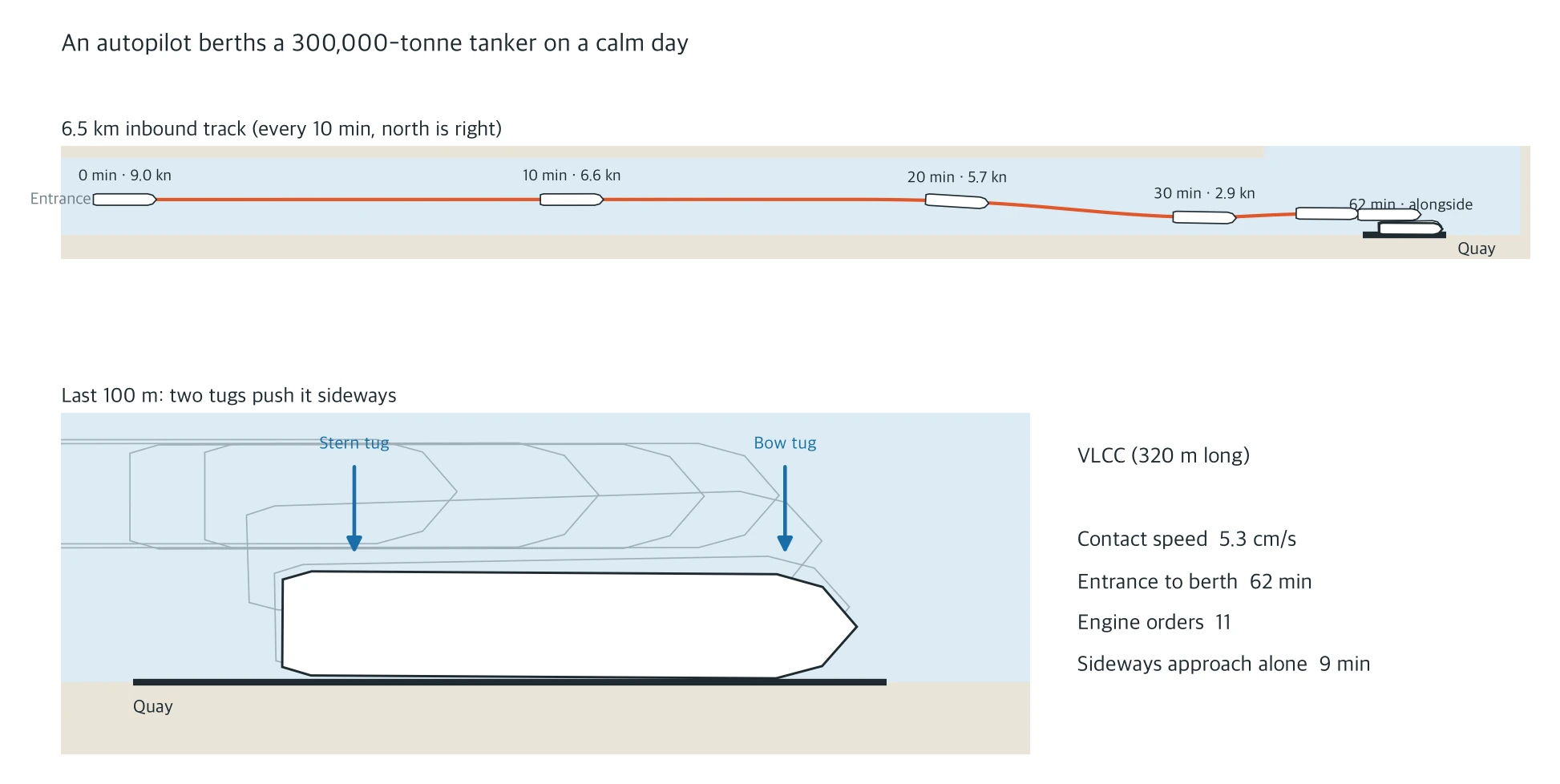
A harbour pilot boards a big ship and brings it from the port entrance to the berth, and the job is famously well paid. Can it be automated? I built a made-up port around the manoeuvring model of a 320 m, 300,000-tonne tanker (KVLCC2), wrote an autopilot that uses engine orders, rudder and three tugs, and ran more than 1,100 trials while changing wind, tug power, radio delay and position sensor. On a calm day it took 62 minutes and 11 engine orders to go from the entrance to the berth, touching the quay at 5.3 cm/s, close to a Singapore terminal's 0.1-knot (about 5.1 cm/s) guide. With box-ship windage, an 11 m/s beam wind pushed the contact speed to 12.8 cm/s. From 13 m/s the wind outpushed two 60-tonne tugs and half the runs hit something other than the berth first. It also broke when tug orders ran more than 45 seconds late or the wind force was not computed in advance. Much of the calculation that moves the ship can be automated. What remains is deciding whether to go in at all, the talk with tugs and traffic control, and responsibility.
Do Dark Roasts Grind More Evenly?
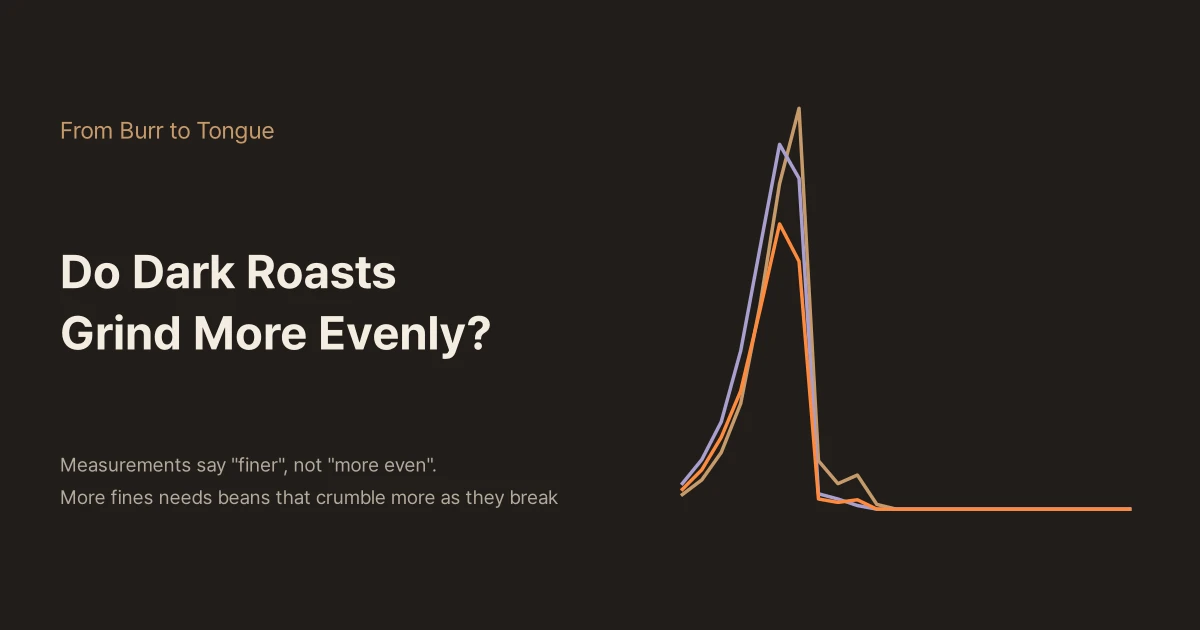
"Dark roasts grind evenly" or "dark roasts make more fines"? Measurements say that at the same setting dark roasts grind finer with more fines (over 10% more fines on sieves, a mean size about 100 µm smaller by laser); the case for "more even" is weak. In the virtual grinder, more fines required beans that crumble more as they break, and depending on how clumps are handled, different methods can read the difference differently. With a comparison tool.

How to Notice Happiness (4) — The Seven Before Erase Unhappiness, One by One
Happiness turned out not to be a special state but also a process of removing the causes of unhappiness one by one. And what remained strongest at the end of it all was, in the end, relationships.
Putting an AR HUD on a Table Tennis Broadcast — Computing Speed, Landing Spots and Forehands from Public Match Footage
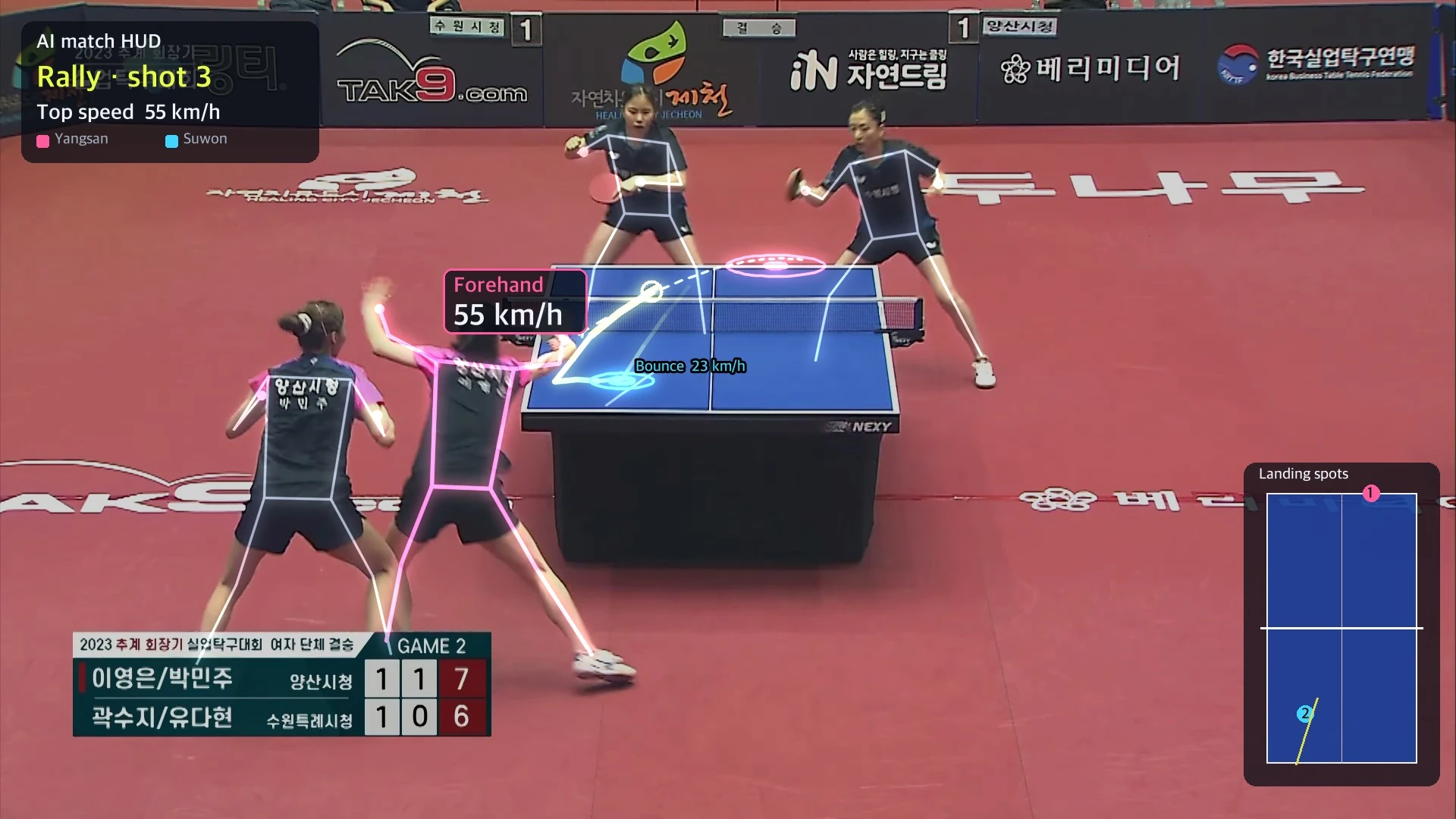
Table tennis and badminton clips on social media now carry a ball trail, speed, landing spot and stroke type drawn over the match. I built the same overlay on a freely licensed (CC BY) broadcast of a Korean corporate league women's team final, played in doubles. Six points, the table corners and the net-post tops, gave the camera position (17 m behind the end line, 4.4 m up). Ball candidates came from background difference, YOLO and a small neural network, and a ballistic model with air drag plus player pose gave 3D paths and speed. In the reviewed rally, the four shots left the racket at 33–55 km/h and bounced at 23–35 km/h. Without drag, the same ball came out inflated to 77 km/h. Fully automatic tracking, though, found the ball only 36% of the time, because the two near players cover the table in doubles and at 30 fps the ball smears into a streak.

Jobs That Will Survive the Age of AI
All my notebook said was “Jobs that will survive the age of AI.” This piece starts with former colleagues who say they have nothing left to do after handing all their work to agents. It then uses company cases and 2026 research to look at what is actually being replaced right now. Next, it follows the market that sells anxiety and the prophecy that “machines will take our work,” repeated for 200 years, from the Luddites through telephone operators, ATMs, spreadsheets and radiology, and shows how each turned out. It also looks at how agents scored in tests that handed them whole pieces of real work. The conclusion: tasks change hands, not jobs. People who go into the field and solve problems with AI, and people who make new things, are still far better at it than AI. Also included: a playground for breaking your job into tasks and estimating the agent's share, 14 jobs that were supposed to disappear with the predictions and what actually happened, and a record of the new work that emerged. The thirty-first installment of A Page for Today.
Static and Clumping
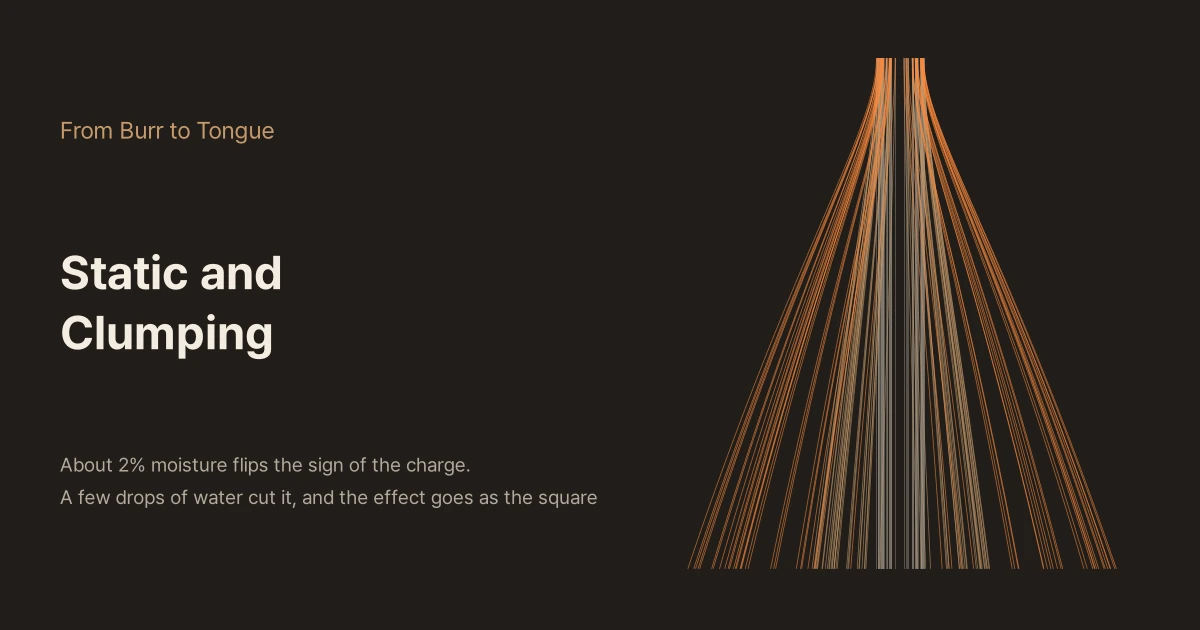
Is a drop of water on the beans (RDT) a myth? Measurements show ground coffee carries tens of nanocoulombs per gram, flips sign at about 2% bean moisture, and has large chunks and 100–300 µm particles of opposite sign. A few drops of water cut the charge from half to almost zero and grinder retention from 12% to 2.5%; effects on extraction and taste vary. Treated as a whole stream, same-sign charge pushes the grounds apart with a force that goes as the square of the charge. With a stream simulator.

How to Notice Happiness (3) — Standing on Several Pillars
When you rest the full weight of your life on a single pillar, everything collapses the moment it wobbles. On having more than one track to hold you up besides your main job.

Is There Really a CSAT Cold Snap?
Every November Koreans say it is always cold on the day of the CSAT, the national university entrance exam. I checked the temperature on all 33 exam days, from the 1994 to the 2026 CSAT, against the normal for each date. In Seoul, exam day was 2℃ or more below normal 9 times (27%), almost exactly as often as any day picked at random between 5 and 25 November (29%). At six other stations, exam day was below normal 13 to 16 times out of 33, never more than half. Yet there are reasons we remember it as cold: the exam falls in the ten days of the year when the weather cools fastest, so exam day was colder than the week before in two years out of three; memory counts the day before and the day after; and students leave home before dawn. An interactive chart lets you pick the station and the year. The thirtieth piece in A Page for Today.