Porous Media 101
Looking at the espresso puck through Darcy's law and permeability. Solving a typical shot backwards gives about 2.3×10⁻¹⁵ m², but running Kozeny–Carman on Grind Simulator v1's dry distributions gives one to two thousand times more, so 36 g would run through in under a second. Adding 10% fines cuts permeability to 28%, and 2.3 g more in the same cell cuts it three- to fourfold. I go through the candidates for the thousandfold gap (swelling, compression, fines migration) and include a calculator.
A shot of espresso is water forcing its way through a bed of ground coffee. Everyone knows that finer grounds make water pass more slowly and coarser grounds more quickly. But how do you calculate how much slower? The fields that deal with groundwater and water filters already have a tool for this question: Darcy's law and permeability.
This time I borrowed that tool as it is and calculated shot times from the grind distributions produced by Grind Simulator v1. Following the textbook formula, an espresso would run through in under a second, about a thousand times off from a real shot. Where that difference comes from is what this post is about.
A sand column in Dijon
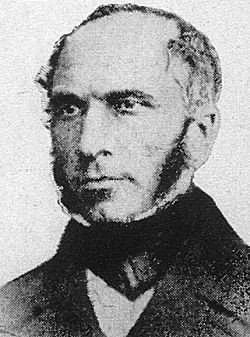
Henry Darcy (1803–1858) · Photo: unknown author, Wikimedia Commons, public domain
In 1856 Henry Darcy, a water engineer in Dijon, France, published Les fontaines publiques de la ville de Dijon ("The public fountains of the city of Dijon"). The book documents the works that brought clean water to the city, and an appendix (Note D) describes experiments with sand filters. He filled a pipe 2.5 m tall and 0.35 m across with sand from the Saône (about 38% voids), measured the pressure at the top and bottom with mercury manometers, and recorded the flow per minute at a constant head. The conclusion was simple: the volume of water coming out is proportional to the pressure difference and inversely proportional to the thickness of the sand. Darcy called the constant of proportionality "a coefficient depending on the permeability of the layer".
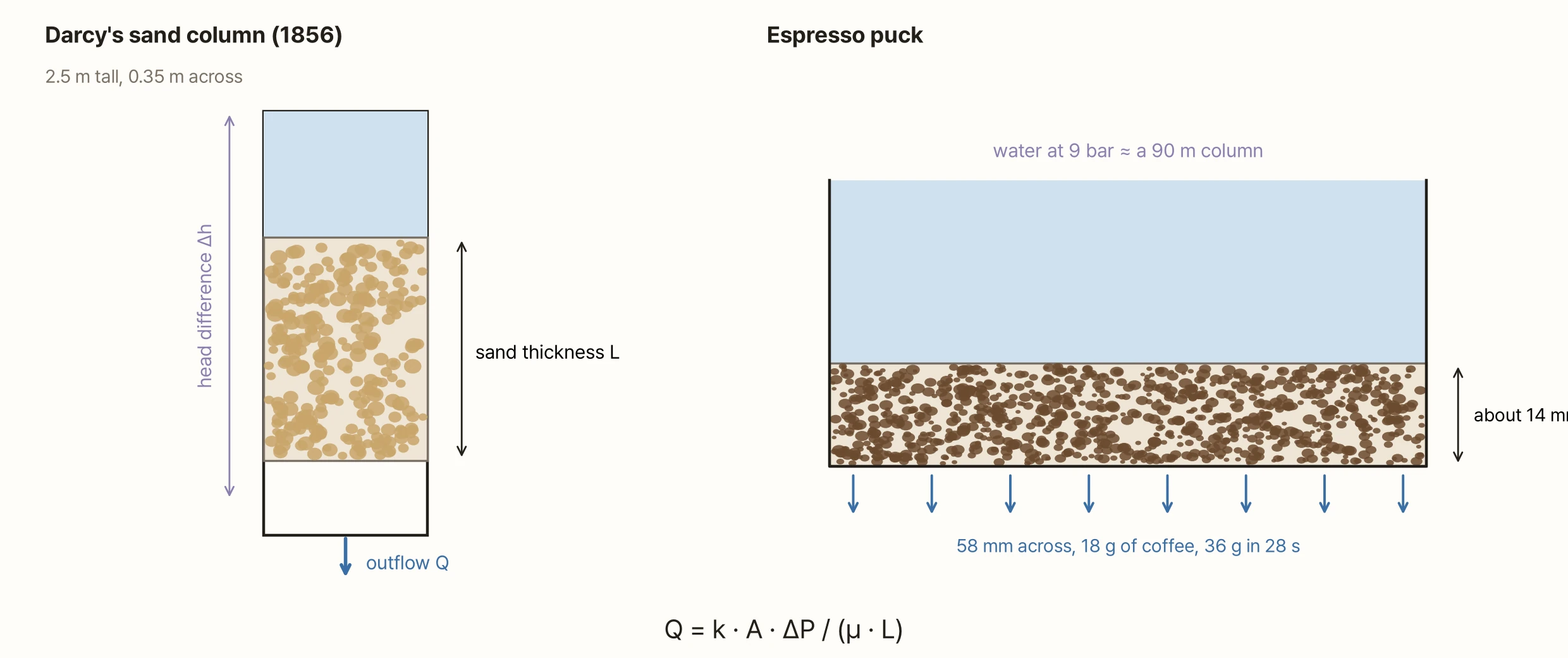
In today's notation it reads:
Q = k · A · ΔP / (μ · L)
Q is the flow rate, A the cross-sectional area, ΔP the pressure difference across the layer, L its thickness and μ the viscosity of water. The remaining k is the permeability, a value belonging to the layer itself that describes how readily it lets water through. Its unit is an area (m²). Because the properties of the water (μ) and of the layer (k) are separated, k is the same whether you run hot or cold water through a given puck. Water viscosity is 1.0 mPa·s at 20 °C and 0.31 mPa·s at 92 °C, so the same puck drains about three times more slowly with cold water.
Solving a typical shot backwards
Let's put espresso into Darcy's equation. Say 18 g of coffee in a 58 mm basket gives 36 g in 28 s at 9 bar. For the puck thickness, I scaled from Waszkiewicz and colleagues (2026), who reported that 18.5 g tamped in the same basket made a 14 mm puck, giving 13.6 mm. The viscosity of water at 92 °C is 0.307 mPa·s (NIST). Solving for k gives about 2.3×10⁻¹⁵ m². Using the constants Waszkiewicz and colleagues fitted on a real café machine (1.90 g/s at 12 bar) gives around 2.7×10⁻¹⁵ m², not much different.
Laboratory measurements are larger. Corrochano and colleagues (2015) packed grounds into a cell 37 mm across and 18.5 mm long, ran hot water through it until the flow was steady, and measured the permeability of espresso beds: 2.6×10⁻¹⁴ to 3.4×10⁻¹³ m², ten to a hundred times larger than the value from a typical shot. They used low pressures, 0.5 to 4.5 bar, and measured after running water for 600 s, when the soluble material had washed out, so the conditions differ from a short shot at 9 bar.
Calculating permeability from the grind
There is also a formula that calculates permeability from particle size instead of measuring it: the equation of Kozeny (1927) and Carman (1937). It treats the bed as a bundle of narrow, winding tubes and applies the formula for flow in a tube.
k = ε³ · d² / [180 · (1 − ε)²]
ε is the porosity, the fraction of the bed not occupied by particles. d is a representative particle diameter, taken as the Sauter mean diameter (d32), an average weighted by surface area. The 180 is a constant that comes from how winding the tubes are (tortuosity) and the surface area of a sphere (5 × 36). Small particles carry far more surface area than large ones, so d32 is pulled strongly toward the fines.
I ran the numbers with distributions from Grind Simulator v1. An espresso grind from a flat burr has an x50 of 321 µm but a d32 of 126 µm; the 17% of fines drag the average down. With a porosity of 0.30, k comes out at 4.8×10⁻¹² m².
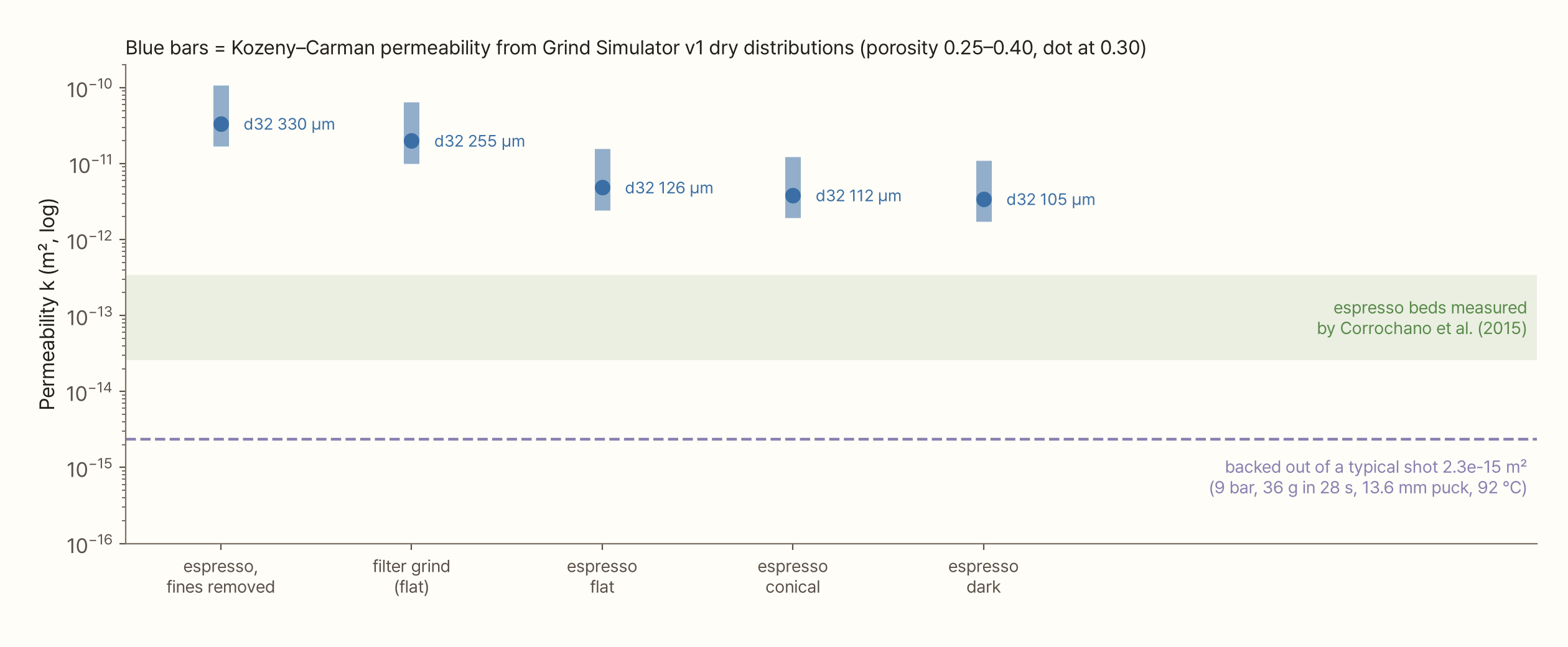
Permeability calculated from the dry grind distribution is more than ten times the measured values, and one to two thousand times the value backed out of a shot. Calculating shot time from it, all 36 g runs through in under a second. To match a real shot with Kozeny–Carman, the porosity would have to fall to 0.029, meaning the puck would be 97% particles.
Corrochano and colleagues saw a similar mismatch. Corrochano's thesis (2017), which reports the same study, shows that Kozeny–Carman permeability calculated from the dry particle sizes was off by 30% for the finest grind and 520% for the coarsest. They set the tortuosity as a power of porosity (τ = (1/ε)ⁿ) and fitted n between 0.27 and 1.01 for each grind to match the measurements, which is equivalent to replacing the constant 180 with 189 to 1,330. This correction fits laboratory beds, though. The gap to a real shot is much larger.
Fines and voids
Even so, the Kozeny–Carman equation shows well what sets permeability. There are two knobs. Particle size enters squared, and voids nearly cubed.
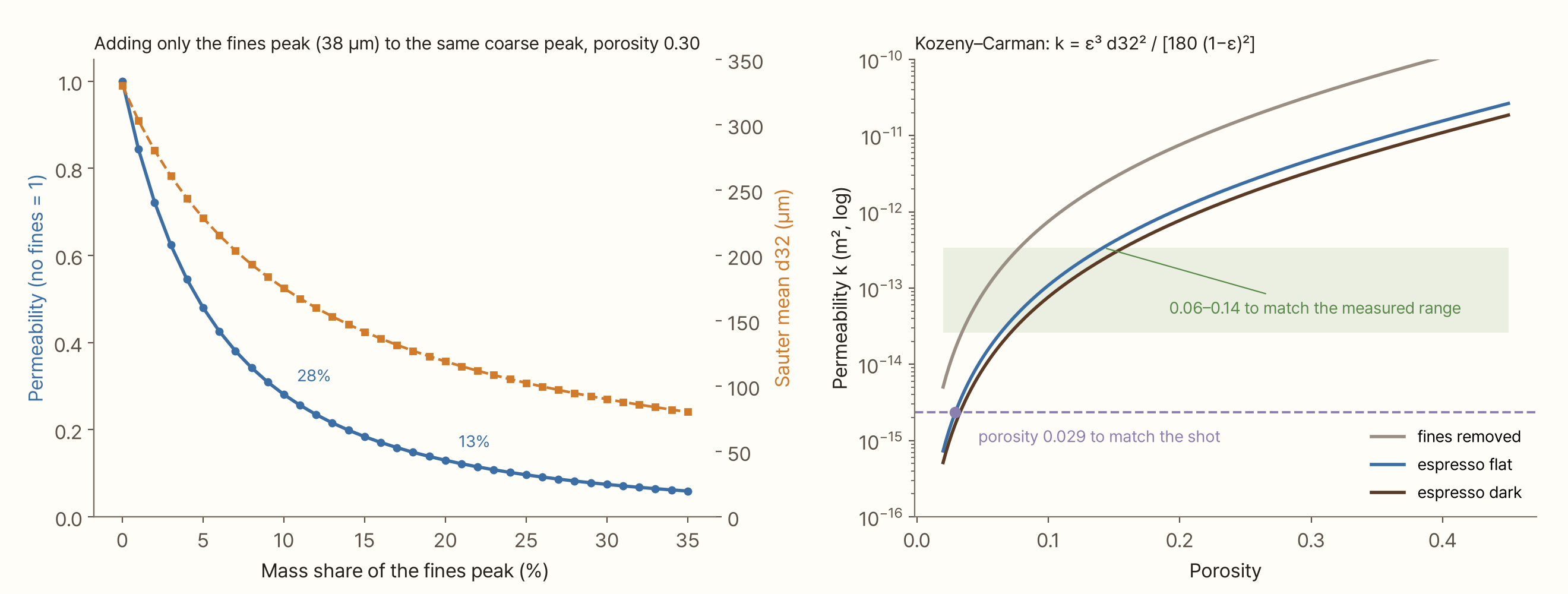
Adding fines to the same coarse particles cuts permeability to 28% of its fines-free value at 10% fines, and to 13% at 20%. Fines are only a small share by mass, but they set the water paths. When Smrke and colleagues (2024) added 1, 2 or 4 g of fines to espresso doses, more fines likewise meant lower permeability and longer shots.
Voids hit even harder. Dropping porosity from 0.30 to 0.20 cuts permeability to under a quarter. That is why putting a little more coffee into the basket matters more than you might think.
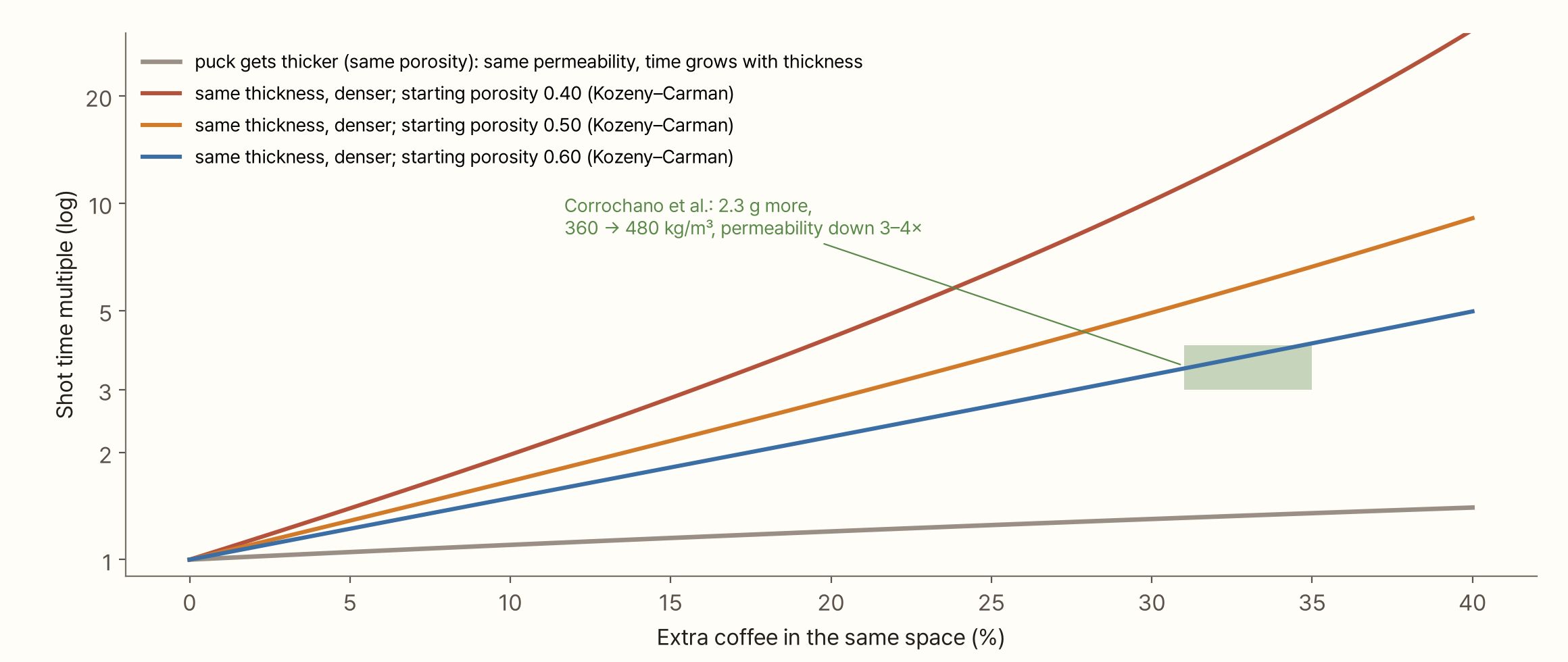
If more coffee only makes the puck thicker while the share of voids stays the same, permeability does not change and the shot time grows only with thickness: 33% more coffee gives 1.33×. But pushing more into the same space shrinks the voids and lowers permeability. Corrochano and colleagues added 2.3 g to a cell that held 7.2 g, raising the bed density from 360 to 480 kg/m³, and permeability fell three- to fourfold. For Kozeny–Carman to give the same result, the starting porosity would have to be around 0.6. Coffee particles are themselves full of holes (particle porosity 0.50–0.57), so even deciding how to count the voids in a bed is not simple.
Where does a thousandfold come from?
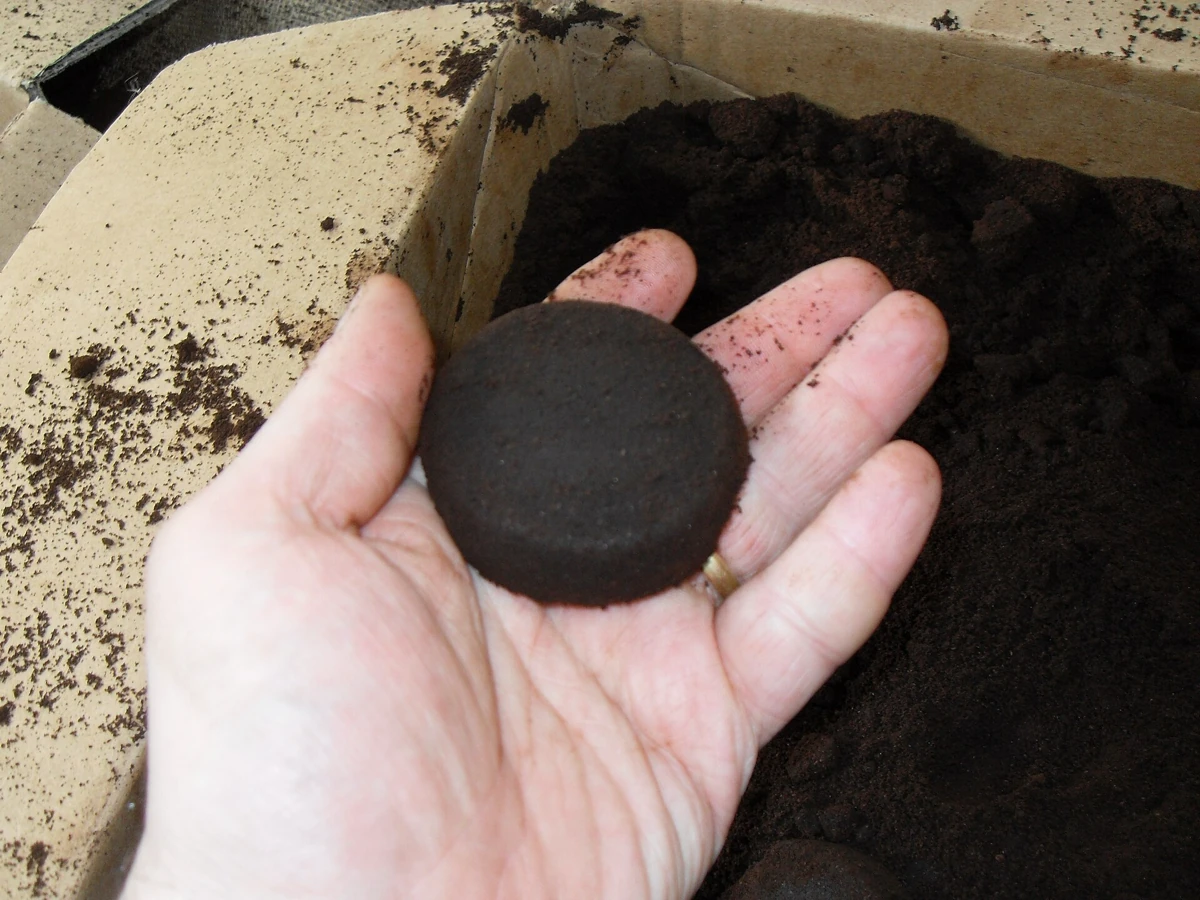
A spent espresso puck. Unlike dry grounds, it keeps its shape · Photo: Shanegenziuk, Wikimedia Commons, CC BY 3.0
Several candidates could explain the thousandfold gap between permeability from dry grounds and a real shot.
- The particles swell. Coffee particles have been reported to grow about 15% in diameter when wetted with hot water. Swelling inside a fixed space shrinks the voids
- The bed is squeezed. 9 bar is the weight of a 90 m column of water. Waszkiewicz and colleagues found that flow stops rising with pressure above about 5 bar, and explained it as the puck compressing like an elastic body so that its pores close. Pointing to swelling and compression together, they estimated that a thirtyfold reduction in effective pore diameter (to about 6 µm) would explain a thousandfold fall in permeability
- Fines move. Fines washed down by the water can collect near the basket screen and block the paths
- The dry size is the wrong size from the start. The dry particle size a measuring instrument sees differs from the size that forms water paths when wet
Splitting the gap among these candidates is beyond the calculations in this post. Some studies have looked directly inside pucks. Mo and colleagues (2023) scanned illy capsule pucks with micro-CT and simulated water flowing through them. For the dry puck as it was, they found k = 5.5×10⁻¹³ m², porosity 0.17 and tortuosity 1.80. A dry puck sits near the measured range. The value from a real shot also carries everything that happens after the water gets in.
For the record, the flow in a real shot is within the range where Darcy's law holds: the Reynolds number based on particle size is about 0.03, far below 1.
Calculate it yourself
In the calculator below, change the grounds (five from Grind Simulator v1), porosity, dose, pressure and water temperature, and it gives the Kozeny–Carman permeability, the flow from Darcy's law, and the time to collect 36 g. "Permeability ÷" divides the permeability by 1 to 3,000, so you can see how much it has to shrink to match a real shot time. You can also choose whether a bigger dose makes the puck thicker or packs the same thickness more densely.
What this conclusion leaves out
- The puck thickness and shot conditions are assumptions. I used 13.6 mm for 18 g, 9 bar and 36 g in 28 s. Real puck thickness depends on the coffee, grind and tamp
- All the pressure is assumed to fall across the puck. Losses in the shower screen, basket and plumbing are left out
- I could not open the full text of Corrochano and colleagues (2015). The setup, the 2.3 g experiment and the tortuosity correction were checked in Corrochano's thesis (2017), which reports the same study
- The grind simulator's distributions contain nothing below 10 µm. Real grounds have smaller particles too, so d32 may be smaller
- The puck is assumed to stay the same throughout. Swelling, compression, fines migration and dissolution are not in the calculation
Summary
- Darcy's law splits flow into pressure difference, bed thickness, water viscosity and the bed's own property, permeability. Solving a typical espresso shot backwards gives a permeability of about 2.3×10⁻¹⁵ m²
- Espresso beds measured in the laboratory at low pressure have permeabilities of 2.6×10⁻¹⁴ to 3.4×10⁻¹³ m², ten to a hundred times the value from a shot
- Kozeny–Carman permeability from Grind Simulator v1's dry distributions is one to two thousand times the shot value, so 36 g would run through in under a second
- Fines and voids set permeability. Adding just 10% fines cuts it to 28%, and packing 2.3 g more into the same cell cut it three- to fourfold in experiments
- Candidates for the thousandfold gap are swelling of wet particles, compression under pressure and fines migration
References
- Darcy H (1856). Les fontaines publiques de la ville de Dijon. Paris: Victor Dalmont. Note D. Internet Archive
- Kozeny J (1927). Über kapillare Leitung des Wassers im Boden. Sitzungsberichte der Akademie der Wissenschaften in Wien, Abt. IIa 136, 271–306 — bibliographic details only
- Carman PC (1937). Fluid flow through granular beds. Transactions of the Institution of Chemical Engineers 15, 150–166 — bibliographic details only
- Corrochano BR, Melrose JR, Bentley AC, Fryer PJ, Bakalis S (2015). A new methodology to estimate the steady-state permeability of roast and ground coffee in packed beds. Journal of Food Engineering 150, 106–116. doi:10.1016/j.jfoodeng.2014.11.006 — abstract only
- Corrochano BR (2017). Advancing the engineering understanding of coffee extraction. EngD thesis, University of Birmingham. link — setup and correction of Corrochano et al. (2015) checked in Chapter 6
- Waszkiewicz R, Myck M, Białas Ł, Puciata-Mroczyńska M, Dzikowski M, Szymczak P, Lisicki M (2026). Under pressure: poroelastic regulation of flow in espresso brewing. Physics of Fluids 38(6), 063113. doi:10.1063/5.0319611 · arXiv:2512.21528
- Mo C, Johnston R, Navarini L, Liverani F, Ellero M (2023). Exploring the link between coffee matrix microstructure and flow properties using combined X-ray microtomography and smoothed particle hydrodynamics simulations. Scientific Reports 13, 16374. doi:10.1038/s41598-023-42380-y
- Smrke S, Eiermann A, Yeretzian C (2024). The role of fines in espresso extraction dynamics. Scientific Reports 14, 5612. doi:10.1038/s41598-024-55831-x
- Hargarten V, Kuhn M, Briesen H (2020). Swelling properties of roasted coffee particles. Journal of the Science of Food and Agriculture. doi:10.1002/jsfa.10440 — abstract only
- NIST Chemistry WebBook, thermophysical properties of water (viscosity, density). link
Image credits
- Portrait of Henry Darcy: unknown author, Wikimedia Commons, public domain
- Spent espresso puck: Shanegenziuk, Wikimedia Commons, CC BY 3.0
- All other charts, the cover and the calculator: made by me

