Grind Simulator v1
I gathered the results of fifteen episodes on how beans break inside a grinder into one tool. Put in burr type, gap, speed, alignment and roast, and it returns a mass distribution combining a fines peak (cell size, 38 µm) and a gap-set coarse peak; blades run the population balance model as is. I note what is measured and what is a model trend, and the distribution can be downloaded as a CSV.
Over the last fifteen episodes, I followed how beans break inside a grinder: from the force needed to break a single bean, to why fines are tied to cell size, to the paths beans take inside flat and conical burrs, to what speed, alignment, roast and static change. This time I gathered those results into one tool. Put in the burr type, gap, speed, alignment and roast, and it gives the mass distribution of the grounds, which you can take away as a file. When working out how water flows through the grounds, this distribution can serve as the input.
The tool does not run all the models at once. The 3D simulation takes minutes just to grind twelve beans. So I reduced each episode's results to simple formulas, a "surrogate model". Below, I note one by one what comes from measurements and what is a model trend.
What we have learned
| Episode | Question | What went into this tool |
|---|---|---|
| How Does a Coffee Bean Break? | The force to break one bean | 30–60 N (measured); the breakage threshold in the 3D model |
| Fines Are the Size of a Cell | Why is the fines peak always 30–40 µm? | The fines peak sits at 38 µm |
| A Distribution with Two Peaks | How to describe the distribution | As a mixture of two lognormals |
| The Path of a Bean Through a Flat / Conical Burr | How beans move inside burrs | Breaks bunch where the gap stops narrowing, and the finishing band's gap sets the size |
| Do Conical Burrs Really Make More Fines? | Burr type and fines | Conicals +1.8 pp fines (Gagné 2023 average); slow conicals have a wider coarse tail (model) |
| Burr Size, Alignment and Seasoning | Effects of small misalignments | Burr diameter does not change the distribution; D90 and fines grow with the square of error ÷ gap (model) |
| The RPM Mystery | Is faster finer or coarser? | Slower is coarser (model; measurements disagree). This tool includes only half of the model trend |
| Frozen beans, grinder heat, aroma, static | The state of beans and grinder | Not included: too few measurements, or the direction of the effect is uncertain |
| Do Dark Roasts Grind More Evenly? | Roast and distribution | Dark: coarse peak 5% smaller, fines 25% more (direction of sieve and laser measurements) |
| Blade vs Burr | Blade grinders | The population balance model is run as is |
How the tool calculates
A burr grinder's distribution is the sum of two peaks.
- Fines peak: a lognormal with a median of 38 µm and a width (geometric standard deviation) of 1.8. It is tied to the size of the bean's cells, so it forms in the same place whatever the burr or gap ("Fines Are the Size of a Cell")
- Coarse peak: D90 = 1.6 × gap. In the models, spherical particles gave 0.63 times the gap and flat discs 1.0 times, but real fragments are long and flat and slip out larger than the gap. Taking an espresso gap as 250 µm, I chose 1.6 so that the overall x50 lands in the middle of the espresso dial-in range (245–385 µm) of the 24 grinders Gagné (2023) reanalysed. This number is a calibration, not a measurement. Its width is 1.14 for flat burrs, and for conicals widens from 1.13 at 1,000 rpm to 1.38 at 100 rpm ("Do Conical Burrs Really Make More Fines?")
- Fines share: 18.4% for flat and 20.2% for conical at an x50 of 340 µm (Gagné 2023), decreasing as x50 to the power −0.5 for coarser grinds (model trend from episode 21)
- Speed: below 1,000 rpm, a flat burr's coarse peak grows. In the 3D model, D90 at 300 rpm was 51% larger, but particle stiffness makes that size hard to trust, so only half is included
- Alignment: with e = edge error ÷ gap, D90 is multiplied by 1 + k·e² (k 1.44 for tilt, 2.6 for runout) and fines rise slightly ("Burr Size, Alignment and Seasoning")
- Roast: dark shrinks the coarse peak by 5% and raises the fines share by 25%; medium is roughly halfway ("Do Dark Roasts Grind More Evenly?")
The blade grinder runs the population balance model from "Blade vs Burr" as is. That model makes almost nothing below 300 µm, so the same fines peak as the burrs is added at 12% (assumed).
A few examples
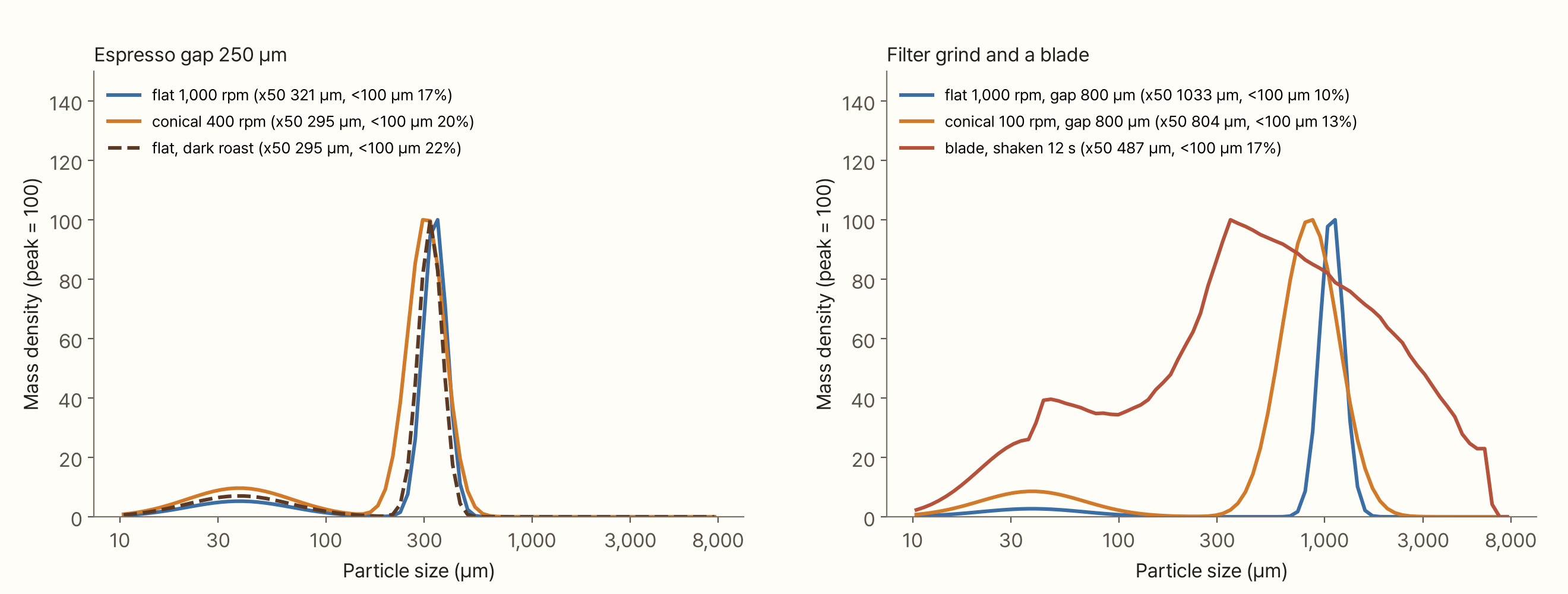
At espresso fineness (250 µm gap), the flat burr gave an x50 of 321 µm with 17% fines below 100 µm. A conical at 400 rpm with the same gap gave an x50 of 295 µm and 20% fines. Switching to a dark roast raised fines to 22% even in the flat burr. At filter fineness (800 µm gap), the flat burr packed narrowly around 1 mm, while a conical turning slowly at 100 rpm had a wide coarse tail and an x50 of 804 µm. The blade, shaken for 12 seconds, had an x50 of 487 µm but spread from 40 µm to 6 mm.
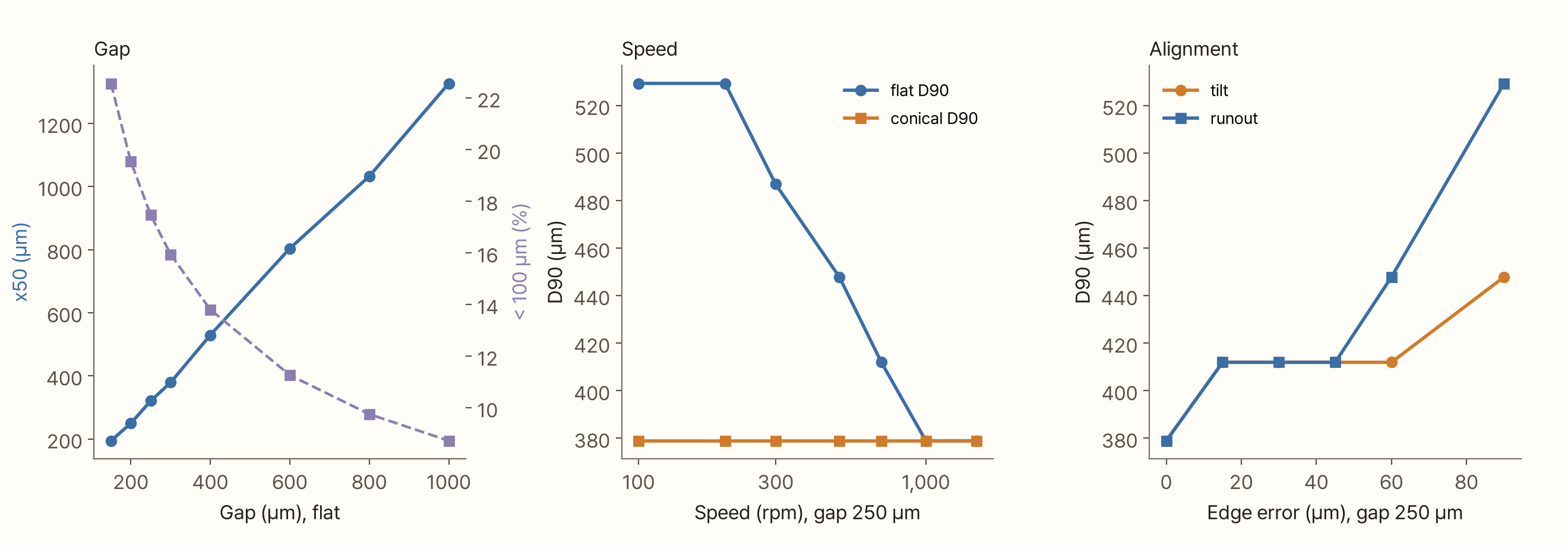
Each knob has a different reach. The gap moves x50 almost proportionally. Speed enlarges a flat burr's coarse end below 1,000 rpm. Alignment changes almost nothing up to 30 µm of edge error, then increases D90; a 60 µm error at an espresso gap made D90 a little over 8% larger.
Grind it yourself
In the simulator below, choose a grinder type and change the gap, speed, alignment and roast (or grind time and shaking for a blade), and it shows the mass distribution with D10, D50, D90, fines below 100 µm and the share above 1 mm. Press "Keep this one" to overlay it against other settings. "Download CSV" or "Copy CSV" gives you the distribution as size bins (µm) and mass fractions. Calculations of water flow can read this file directly.
What this conclusion leaves out
- It is a surrogate model. Each episode's results are reduced to simple formulas, and in many places results from one episode are carried over to another's conditions. In particular, the size of the coarse peak (D90 = 1.6 × gap) is a calibration to Gagné's dial-in range, not a measurement
- Gap and dial are different things. How many µm a grinder's setting corresponds to differs by model and is rarely published. The gap here is the actual distance between the burrs
- Many effects are model trends. Speed, alignment and the conical coarse tail come from 2D and 3D models and have not been confirmed by measurement. Speed is included at half its trend
- Bean temperature, heat, static and aroma are not included. They were covered earlier, but there were too few measurements to set the size or direction of their effects
- The fines peak has one fixed shape. If cell size differs between beans and roasts, the peak moves too
- The blade model's values are assumptions
Summary
- Gathering the results of fifteen episodes on grinding, I built Grind Simulator v1, which takes burr type, gap, speed, alignment and roast and returns the mass distribution of the grounds. Blade grinders run the population balance model as is
- A burr's distribution is the sum of a fines peak tied to cell size (38 µm) and a coarse peak set by the gap. The coarse peak is calibrated so that a 250 µm espresso gap gives an x50 of around 320 µm
- At espresso fineness, the flat burr had 17% fines, a conical at 400 rpm 20%, and a flat burr with a dark roast 22%. At filter fineness, a slowly turning conical had a wide coarse tail, and the blade spread from 40 µm to 6 mm
- The distribution can be downloaded as a CSV and used as input for calculating water flow
References
- Gagné J (2023). What I learned from analyzing 300 particle size distributions for 24 espresso grinders. Coffee ad Astra. link
- Episodes of this series: "How Does a Coffee Bean Break?", "Fines Are the Size of a Cell", "A Distribution with Two Peaks", "How to Simulate Breakage", "The Path of a Bean Through a Flat Burr", "The Path of a Bean Through a Conical Burr", "Do Conical Burrs Really Make More Fines?", "Burr Size, Alignment and Seasoning", "The RPM Mystery", "Do Frozen Beans Grind Finer?", "How Hot Does a Grinder Get?", "The Aroma That Escapes at Grinding", "Static and Clumping", "Do Dark Roasts Grind More Evenly?", "Blade vs Burr"
Image credits
- All charts, the cover and the simulator: made by me