How Much Does a Delivery App Take From One Order?
This episode of Wide and Shallow Economics follows a single 25,000-won delivery order in Korea as it splits between the restaurant owner, the app, the rider, card payment and tax. Online food service transactions reached 11.39 trillion won in Q3 2026, up 7.6% from a year earlier, and in 2025 Baemin and Coupang Eats together took 92.89% of the market by order value. On November 9 the Fair Trade Commission imposed provisional fines of 631.9 billion won on the two, and a bill to cap combined fees and delivery charges at 15% is pending in the National Assembly. The accounting concept this time is GMV, revenue and take rate: in Delivery Hero's Asia segment, which includes Baemin, revenue divided by GMV rose from 18.1% to 21.8% while GMV barely moved. I look at why that ratio grows when an app takes over delivery, and where the cost of "free delivery" lands on the income statement. In the playground you can change the app, sales tier, delivery fees and rider pay to split one order yourself. At the end are five checkpoints to score against Q4 2026 and Q1 2027 results.
Stand at the gate of a Korean apartment complex around seven in the evening and a motorbike rolls in every few minutes. The app logos on the riders' helmets come in only two or three kinds. The customer ordered after seeing "Delivery fee ₩0" in the app, and the restaurant cooked from the menu price printed on the ticket. But riders do not ride for free. Somebody is paying the delivery fee that says zero.
In episode 1 I covered chicken franchises and counted what was left in the owner's hand. This time I move to the line in the middle of that bill: the delivery app. I want to see how much an app takes from a single 25,000-won order, how that money is written into the company's books, and what to watch in the fourth quarter of this year, when a Fair Trade Commission ruling and a bill to cap fees in the National Assembly have landed at the same time.
First, the timing. Today is November 12, 2026, and most of the latest numbers in this piece are for the third quarter of 2026 (July to September). There are no fourth-quarter results yet. Woowa Brothers, which runs Baedal Minjok (Baemin), is not listed, so its annual results come out in an audit report the following April. Its latest standalone figures are therefore for 2025, and I read the quarterly trend from the filings of its German parent, Delivery Hero (DH).
The industry in three numbers
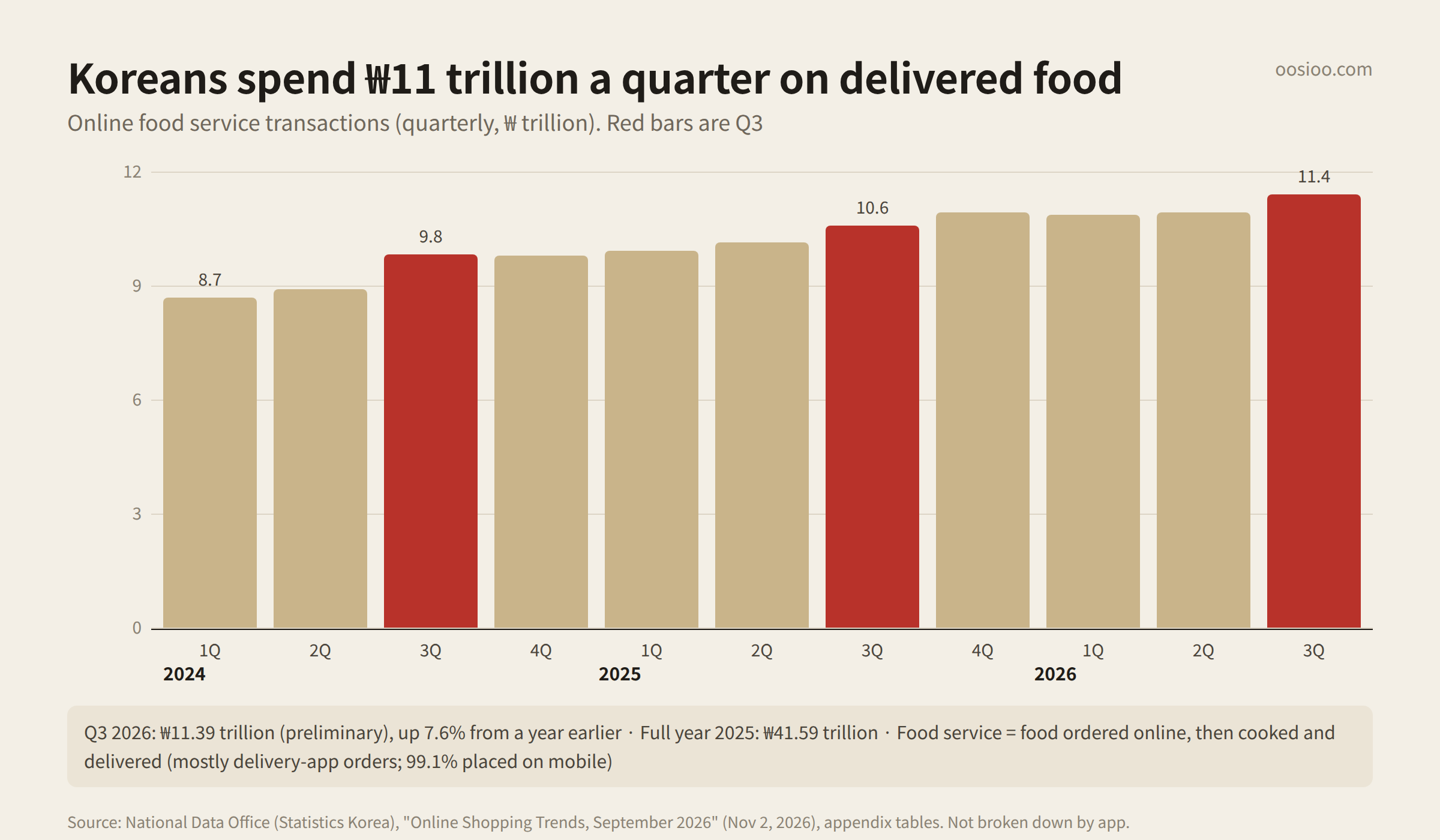
The first number is 11.39 trillion won. That is the preliminary figure for online food service transactions in the third quarter of 2026, from the National Data Office's "Online Shopping Trends, September 2026," released on November 2. It is up 7.6% from the same quarter a year earlier (10.59 trillion won). In this survey, food service means "food ordered online, then cooked and delivered," and 99.1% of it was ordered on a phone (September 2026). It does not break down by app, but it is almost the only official window onto the size of the whole delivery-app market. For the full year 2025 the figure was 41.59 trillion won, up 28% in two years from 32.37 trillion won in 2023.
The second number is 92.89%. According to the sanctions the Korea Fair Trade Commission (KFTC) announced on November 9, Baemin held 58.45% of the market by order value in 2025 and Coupang Eats 34.44% (as reported). Between them, the two take more than nine orders in ten. By number of users the order is the same but the gap is different. Mobile Index counted 24.4 million monthly active users (MAU) for Baemin in August 2026, 14.44 million for Coupang Eats and 3.98 million for Yogiyo (Asia Economy, Sep 6, 2026). Coupang Eats has grown 78% from two years earlier (8.1 million in August 2024). There is even data suggesting Seoul has already flipped. The office of Rep. Kim Nam-geun analyzed payment data from eight card companies and found that in August 2025 Seoul residents spent 211.3 billion won on Coupang Eats and 160.5 billion won on Baemin. But card spending can miss in-app wallet and points payments, so it is not enough on its own to say who leads nationwide.
The third number is 631.9 billion won, the provisional fines the KFTC imposed on Baemin and Coupang Eats. Woowa Brothers was fined 331.1 billion won (160.2 billion for demanding most-favored-nation terms, 155.4 billion for forcing a switch to its own delivery, and 15.4 billion for misleading estimated delivery times); Coupang, 300.8 billion won (for most-favored-nation terms). Most-favored-nation treatment here means demanding that listed restaurants offer prices and conditions "no worse than on any other app." The KFTC found that Coupang Eats demanded six such items, including menu prices, minimum order amounts, discounts and customer delivery fees, from July 2023 to January 2026, and that Baemin demanded three from May 2024 to October 2025. Both companies said they would consider legal action.
Gathering the figures each company discloses into one table looks like this. The periods and units differ, so they cannot be compared directly. That raggedness itself shows how little of this industry is visible.
| Company (app) | Period | Revenue | Profit | Note |
|---|---|---|---|---|
| Woowa Brothers (Baemin) | 2025, consolidated | about 5.283 trillion won (+22.2%) | operating profit about 592.9 billion won (−7.5%) | 2025 audit report, as reported |
| Delivery Hero Asia segment (incl. Baemin) | Q3 2026 | €1,188.2m (+10.8%) | not disclosed (quarterly) | GMV €5,448.0m; includes markets outside Korea |
| Coupang Developing Offerings (incl. Coupang Eats) | Q3 2026 | $1,588m (+23%) | adjusted EBITDA −$269m | includes Taiwan, Farfetch and others; Eats alone not disclosed |
| Great Imagination (Yogiyo) | 2025 | about 201.1 billion won (2024: 275.2 billion) | operating loss about 15.3 billion won (2024: 43.1 billion) | as reported by Herald Economy |
| Ttaengyeoyo (Shinhan Bank) | end of June 2026 | not disclosed | not disclosed | about 9.1 million cumulative sign-ups, 348,000 merchants (reported) |
For Baemin, 2025 was a year in which revenue rose by nearly a trillion won while operating profit fell. According to the reported audit figures, operating expenses rose by more than a trillion won, from 3.68 trillion to 4.69 trillion won, and most of that was outsourcing costs, the line that carries rider pay (2.24 trillion → 3.15 trillion won). Costs grew faster than revenue. Why that happens is this episode's accounting story.
Yogiyo has shrunk. Its revenue fell by more than a quarter in a year, while it narrowed its operating loss. The stake in Yogiyo that GS Retail bought for 307.6 billion won in 2021 (24%) was carried on its books at 53.8 billion won at the end of June 2026 (IB Tomato). Ttaengyeoyo, by contrast, is gathering users quickly. App analytics firm WiseApp counted 3.45 million MAU in October 2025, up 235% from a year earlier, and reports said much of that came from the government's consumption coupons, which could be spent on public delivery apps.
Where the money in this industry comes from: GMV, revenue and take rate
Open a delivery-app company's results for the first time and you meet two numbers: gross merchandise value (GMV) and revenue. They are in the same units, so they are easy to confuse, but they mean entirely different things.
GMV is the total amount of money that passed through the app. If a customer orders a 25,000-won chicken and pays a 3,000-won delivery fee, GMV is usually counted as 28,000 won (companies differ slightly in how they include delivery fees and tips). Most of that money does not belong to the app company. The app holds it briefly and then settles it to the restaurant.
Revenue is the part the app company books as its own: commission, payment fees, advertising and, if the app also handles delivery, the delivery fee. Revenue divided by GMV is called the take rate: the share the app keeps. It shows how much revenue a company squeezes out of the same flow of orders.
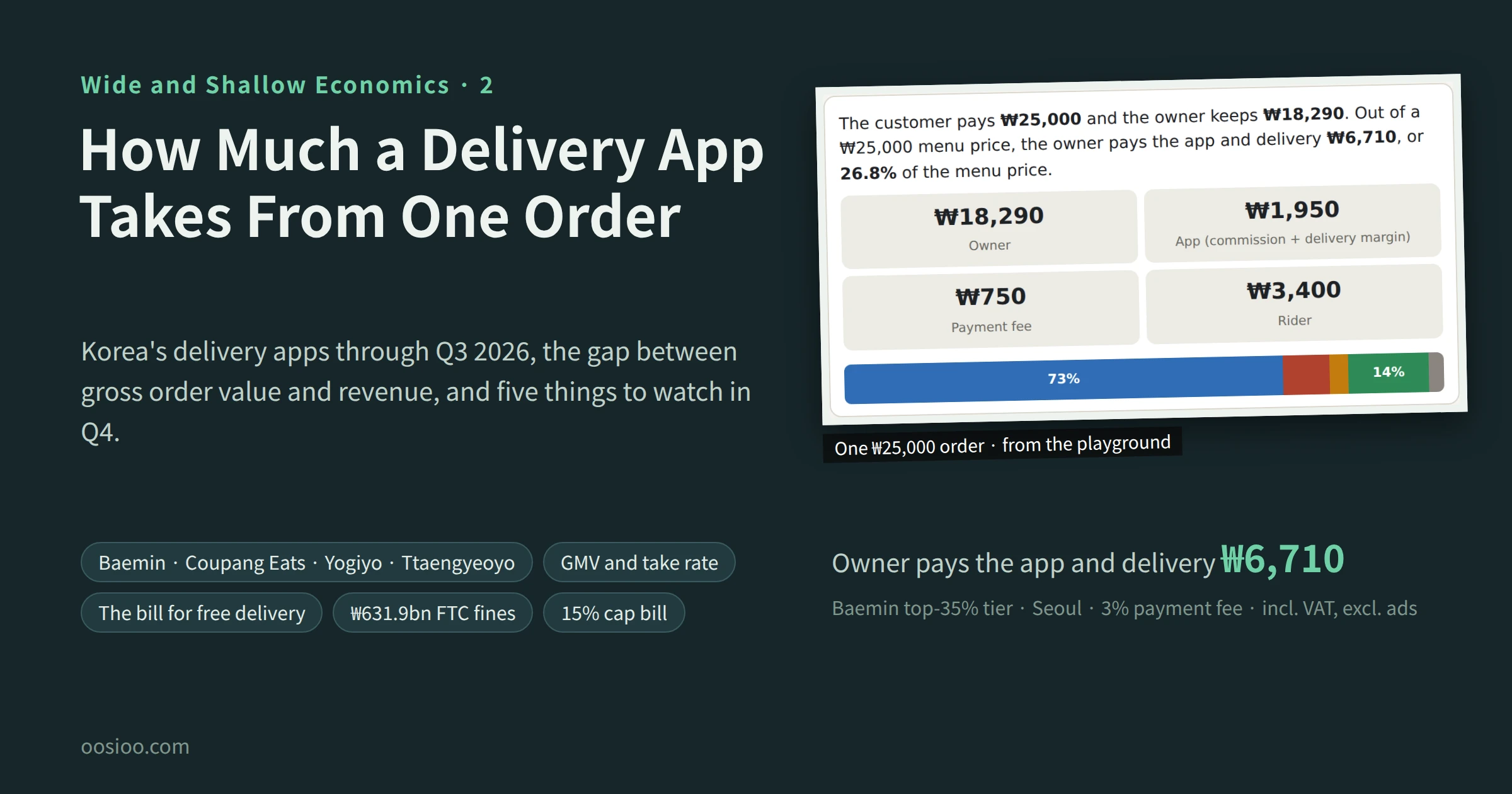
Let's run the numbers with the playground's defaults. Say a Seoul restaurant in Baemin's "top 35%" sales tier receives a 25,000-won order, and the customer paid nothing for delivery thanks to free delivery. According to Baemin's official guide, the commission in this tier is 7.8% and the delivery fee the restaurant pays is 3,400 won in Seoul (both before VAT). I set the payment fee at 3%, following an example given in press reports.
- What the customer paid (GMV): 25,000 won
- Commission 7.8%: 1,950 won
- Payment fee 3%: 750 won
- Owner-paid delivery fee: 3,400 won
- What the app can book: 1,950 + 750 + 3,400 = 6,100 won → 24.4% of GMV
Note that the 6,100 won is not all profit for the app. The 3,400 won goes to the rider. Part of the 750 won goes to card companies and payment processors. Even so, in accounting it is common to book the full 3,400-won delivery fee as revenue and record what was paid to the rider separately as a cost. If the app is recognized as the "principal" directly responsible for the delivery service, it books the whole delivery fee as revenue and records rider pay as an expense such as outsourcing costs. If it is only an "agent" brokering the transaction, it books just the commission. This distinction, set by the international accounting standard IFRS 15, changes the size of a delivery app's revenue a great deal.
So for the same order, the app's take rate depends on who delivers. If the owner calls a delivery agency on their own ("store delivery"), the app's revenue is only the commission and payment fee, 2,700 won (10.8%). If the app assigns the rider ("Baemin Delivery"), the delivery fee is added on top for 6,100 won (24.4%). According to the KFTC, the number of Baemin restaurants using store delivery fell from 256,000 in June 2021 to 91,000 in July 2025, while those using Baemin's own delivery rose from 64,000 to 271,000. The KFTC fined Baemin 155.4 billion won for putting store delivery at a disadvantage during this shift. In accounting terms, the shift was also a move toward booking more revenue from the same order (that reading is mine).
Now look at the Asia segment figures DH discloses. Baemin sits in DH's Asia segment. The segment also includes markets other than Korea, such as Taiwan, and DH does not disclose Korea's GMV on its own. Still, the trend can be read.
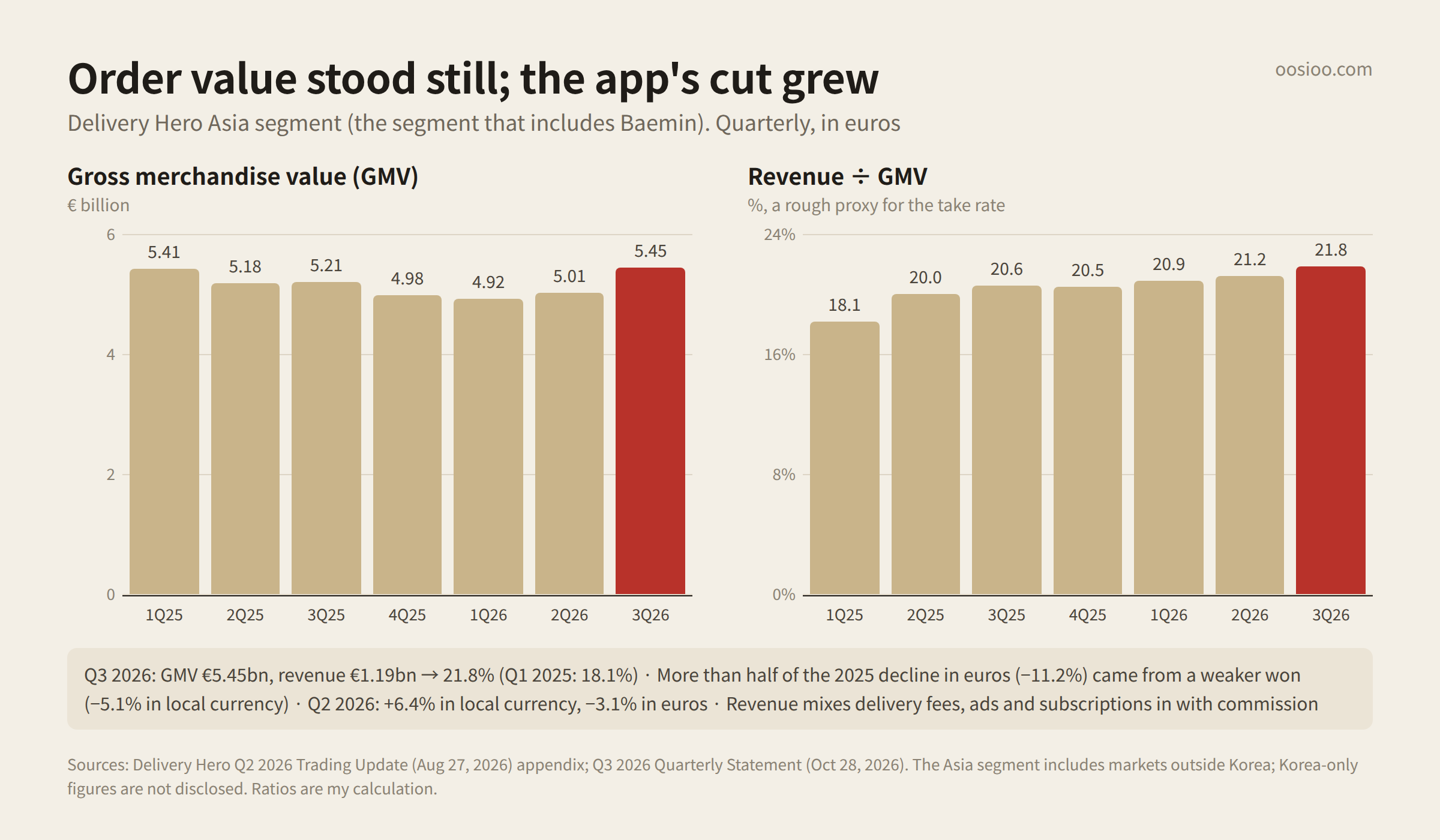
In the first quarter of 2025 the Asia segment's GMV was €5,414.9 million and its revenue €981.7 million. In the third quarter of 2026, GMV was €5,448.0 million and revenue €1,188.2 million. GMV barely moved while revenue rose 21%. Revenue divided by GMV went from 18.1% to 21.8% (my calculation from DH filings). The weak won played a big part in the euro-denominated drop in GMV in 2025: −11.2% in euros for the year but −5.1% in local currency. In its Q2 2026 materials DH attributed Asia's revenue growing faster than GMV to "the rapid expansion of subscription products and the continued expansion of own-delivery logistics." That fits the accounting structure worked out above.
The same exercise can be done roughly with Korean numbers. Multiply 2025's online food service GMV of 41.59 trillion won by Baemin's 58.45% share from the KFTC and you get about 24.3 trillion won. Divide Woowa Brothers' 2025 consolidated revenue of 5.283 trillion won by that and you get about 21.7%. This is an estimate. The KFTC's share and the National Data Office's transaction figure are drawn from different bases, and Woowa Brothers' revenue includes non-food-delivery income such as B Mart product sales and advertising. Still, it can at least be said that it does not stray far from the DH Asia segment's 2025 ratio (19.8%).
Where "free delivery" shows up in the books
Back to the opening scene. Where did the zero-won delivery fee on the customer's screen go?
Coupang Eats stopped charging delivery fees to its WOW members on March 26, 2024. Baemin countered with free budget delivery (Alddeul Delivery), and from September 2024 bundled free delivery into a 1,990-won-a-month subscription, Baemin Club. In May 2026 Coupang Eats temporarily opened free delivery to ordinary members who were not WOW subscribers, through August. Coupang Eats said at the time that "the company bears the full delivery fee and there is no additional cost to merchants."
A customer not paying for delivery does not make the rider's pay zero. The difference can land in the books in two ways.
First, less revenue is created. The delivery fee that would have been booked as revenue had the customer paid 3,000 won simply disappears. It does not show up as a "cost" on the income statement; it shows up as revenue failing to grow as fast as GMV. Under IFRS 15, money a company gives back to customers, such as discount coupons, is in principle deducted from revenue.
Second, the cost stays. What is paid to the rider still goes out as outsourcing costs. Recall that Baemin's outsourcing costs rose by more than 900 billion won in a single year in 2025, to about 60% of revenue (3.15 trillion ÷ 5.283 trillion). Most of the reason revenue rose 22% while operating profit fell 7.5% lies here.
Subscription fees fill the gap in between. Baemin Club at 1,990 won a month and Coupang WOW at 7,890 won a month (applied to existing members from August 2024) come in as revenue every month. DH said subscribers generated 51% of the whole group's GMV in the third quarter of 2026. Subscribers order more often, and the companies try to pay for free delivery with that frequency.
What about the owner's books? Even when the customer pays nothing for delivery, the delivery fee the owner pays (3,400 won in the example above) stays the same. Small-business groups argue that the cost of the free-delivery race ends up flowing back to owners through commissions, advertising and visibility rules. The companies deny it. Raise "Rider pay" in the playground and you can see where this fight turns. The moment what the rider receives exceeds the delivery fees paid by owner and customer combined, the app covers the difference with its own money. As long as free delivery lasts, who bears that difference, and for how long, decides profit and loss in this industry.
How much of that gap is Coupang absorbing? Coupang does not disclose Eats' revenue or profit separately. In its Q3 2026 results, the Developing Offerings segment that includes Eats posted revenue of $1,588 million (+27% at constant currency) and an adjusted EBITDA loss of $269 million, and the company said most of the loss came from investment in Taiwan. On the same call, the chief financial officer said "Eats is operating at around breakeven in both Korea and Japan" (per a published transcript). If that is true even with free delivery opened up, the cost is being covered by WOW subscription fees, merchant commissions and order volume.
The same order seen from the rider's side
The least visible person on this bill is the rider. The apps do not disclose how much they pay riders per order on average. So the playground's default for rider pay is the sum of the delivery fees paid by owner and customer, and readers can change it themselves. Only totals are public. Woowa Brothers' outsourcing costs of 3.15 trillion won for 2025 tell us that the money Baemin sends toward riders is well over half the company's revenue (outsourcing costs also include services other than rider pay).
Riders' share keeps getting pushed back in policy debates too. Among the cap bills in the National Assembly, Rep. Lee Kang-il's bill would set minimum and maximum limits on rider pay but names no amounts. The Delivery Platform Workers' Union agrees with a floor but opposes fixing a cap on delivery fees by law, on the grounds that a low cap would make it hard to raise base delivery fees. In June 2026, talks began on extending the minimum wage to contract workers such as delivery riders, and at the Minimum Wage Commission the labor side proposed 17,468 won an hour for parcel and delivery work (Newsis, Jun 4, 2026). Owners want to pay less for delivery, customers want zero, and riders want more. For all three to be met at once the app has to cover the gap, and the app looks for that money again in subscriptions and commissions.
The KFTC's sanction documents also show how this structure looked on the customer's screen. In the Baemin app, the actual average delivery time for store delivery, where the owner delivers, was 31.5 minutes but the screen showed 44.7 minutes; for Alddeul Delivery, which Baemin handles, it was 32.9 minutes actual against 31.7 displayed. The KFTC deemed this deceptive and imposed 15.4 billion won. Customers tapped the option that looked faster, and that was the option where the app books the delivery fee as revenue.
Playground: one 25,000-won order, who gets what
I built this so you can split a single order yourself by changing the app, sales tier, order amount, owner discount, owner and customer delivery fees, rider pay and payment fee.
Try a few things and you get a feel for it.
- With the defaults (Baemin top 35%, Seoul, 25,000 won), the owner pays the app and delivery 6,710 won including VAT, 26.8% of the menu price. Cut the same order to 15,000 won and the share goes above 30%. That is because the delivery fee is flat regardless of order size. This is where the saying that small orders hurt owners most comes from.
- Switch the sales tier to "Bottom 20%" and the commission drops to 2.0% and the delivery-fee ceiling to 2,900 won. The win-win rate plans use these four tiers for three years from February 26, 2025 (Baemin) and April 1, 2025 (Coupang Eats).
- Pick Coupang Eats and add a 3,000-won owner discount. Baemin charges commission on the post-discount amount, but at the October 2026 parliamentary audit it was alleged that Coupang Eats charges on the pre-discount amount. The calculation given was that on a 20,000-won menu item discounted by 5,000 won, a 7.8% commission comes to 1,560 won, or 10.4% of what was actually paid. On November 12, Baemin said it would change its terms so that delivery-tip discounts borne by owners are also excluded from the commission base.
- Pick Ttaengyeoyo and the commission is 2%. In return, the owner must call a delivery agency directly, and since agency fees vary by region, I set it equal to Baemin's Seoul amount for comparison. Under the same conditions, the owner keeps more than 1,000 won extra.
- Press "Pickup" and the delivery fee disappears. Baemin has charged a 6.8% commission on pickup orders since April 14, 2025, and Coupang Eats since April 2026.
Three companies with interesting strategies
Baemin: from delivery app to "everyday app," and a new owner
2025 was the first year Woowa Brothers' revenue passed 5 trillion won. But looking at the company's last two years through the flow of money, something else stands out. According to the reported audit figures, Woowa Brothers bought back and cancelled 537.1 billion won of its own shares in 2024 and 490 billion won in 2025. Since DH owns 99.98% of the company, one analysis noted that more than a trillion won effectively went up to the parent over two years (Junggi Economy, May 14, 2026).
That parent is changing hands. In July 2026 Uber offered DH shareholders a cash tender at €41.50 a share, and DH's management and its major shareholder Prosus backed it. The acceptance period ran to November 5, and the deal is expected to close in the second half of 2027. Korea's KFTC began a preliminary review in September. Uber entered the Korean delivery market with Uber Eats in 2017 and pulled out in 2019. Before this, there were also reports that DH had explored selling Baemin on its own.
On the operating side, the strategy is what DH calls the "everyday app." Beyond food delivery, it wants people to use groceries (B Mart) and shopping often within one app, tied together by a subscription. DH said Korean quick-commerce GMV grew 39% year on year (in local currency) in the second quarter of 2026. "Baemin Club Edition 2," launched on October 1 (3,990 won a month, 2 to 5% back depending on payment method), continues that line. The investment has a price, though. DH wrote that in the first half of 2026 the Asia segment's adjusted EBITDA as a share of GMV was 0.2 percentage points lower because of subscription and own-delivery investment in Korea. In 2025 the Asia segment's adjusted EBITDA was 1.6% of GMV.
Coupang Eats: not a delivery app but one slot in a membership
Coupang Eats' growth cannot be explained by looking at it as a delivery app alone. On WiseApp's count its MAU doubled from about 6.84 million in March 2024 to about 13 million in April 2026, a period that coincides with the start of free delivery for WOW members. Coupang had already bound its Rocket Delivery shoppers into the WOW membership, and free delivery simply added one more slot to it. From the customer's side, there was no new subscription fee to pay.
This structure caught the competition regulator's eye. According to the KFTC, the share of Coupang Eats restaurants that were "WOW stores" rose from 13% in July 2023 to 94% in January 2025. The KFTC found that the WOW-store conditions contained most-favored-nation demands. Coupang countered that its market share was 7% in early 2023 when the MFN terms began, and also took issue with a calculation that fined it about 1.9 times as much as Baemin (160.2 billion won) for the same conduct. The allegation of tying the WOW membership to Eats was left out of these fines and sent back for further review.
The next step is goods, not food. On the Q3 earnings call, Coupang founder and chairman Bom Kim said the company is expanding Eats into instant delivery of non-food items in Korea and partnering with convenience stores and neighborhood shops. What Baemin did with B Mart, Coupang wants to do with Eats' rider network.
Ttaengyeoyo: the 2% delivery app a bank built
Ttaengyeoyo, run by Shinhan Bank, advertises a 2% commission and no listing or advertising fees. It is a way of saying the app itself is not meant to make much money. For the bank, Ttaengyeoyo is closer to a channel that gathers small-business owners' sales data, settlement accounts and local-currency payments in one place (that reading is mine).
Ttaengyeoyo has grown by allying with local governments. "Seoul Delivery+ Ttaengyeoyo," a partnership with the Seoul Metropolitan Government, had sales of 154.4 billion won in 2025 and 81.9 billion won in the first half of 2026, 2.5 times the level a year earlier, according to the city. At the end of June 2026 it had 62,000 merchants and 2.91 million members in Seoul. On October 30, Yangyang County in Gangwon Province signed an agreement with Shinhan Bank, promising local-currency payment links and discount coupons. The weaknesses of public delivery apps remain, though. Owners have to find delivery separately, and customer perks like free delivery often depend on local-government coupons. In a market where, by KFTC figures, the two big apps hold 92.89% of order value, how far a 2% rate can spread is still unknown.
Three marketing moves worth a look
Baemin Club Edition 2 (October 1, 2026). Since September 2024 Baemin had sold Baemin Club, list price 3,990 won, at a discounted 1,990 won a month for more than two years. Edition 2 returns the price to list and adds points instead. Paying with Baemin Pay Money or a linked account earns 5% back, and the Baemin Pay card 2%, up to 3,000 won a month per person. The company explained that since delivery fees usually run 2,000 to 3,000 won, ordering just twice a month brings benefits worth more than the fee. New sign-ups to the old Baemin Club were closed. In effect, the price went up and was wrapped as "money back," and the 3,000-won cap is just a little more than the increase (2,000 won).
Coupang Eats' free delivery for ordinary members (May to August 2026). Free delivery, until then limited to WOW members, was opened to ordinary members for a limited time. Coupang Eats claimed sales per store rose 98% after free delivery was applied, while five groups including the Korea Federation of Micro Enterprise issued a joint statement criticizing the shifting of costs onto owners. It is a textbook funnel strategy, pulling customers outside the membership in for a taste, and it came a few months before the KFTC announced its sanctions.
Yogiyo's Unlimited Rewards and Yogi More Rewards (December 2025 and April 22, 2026). Having lost the free-delivery race, Yogiyo fought with points instead of delivery fees. In December 2025 it formally launched Unlimited Rewards, which returns part of the order amount as points, and in April 2026 added Yogi More Rewards for another 5%. The company said stacking the benefits could earn up to 18%. Yogiyo said subscribers to its Yogi Pass plan were up 24% year on year as of September 2026. Choosing the word "give back" instead of "free" looks like a practical choice for a third-place player without the strength to make delivery fees zero.
Will fees be capped by law?
Before turning to the fourth quarter, the policy landscape. In November 2024 the delivery-app win-win council, a government-brokered panel of platforms and merchant groups, agreed to cut the commission from 9.8% to between 2.0% and 7.8% depending on sales tier. In exchange, the owner-paid delivery fee in the top tier went up by 500 won per order. Analyses at the time pointed out that a "top 35%" restaurant taking an order under 25,000 won could end up paying more.
The council reconvened in April 2026, met once and stalled. According to BizWatch (May 7, 2026), Baemin proposed a "Lite plan" that would limit delivery distance to 1 km in exchange for a commission in the high 5% range and a delivery fee in the high 2,000s, along with a reform shrinking four tiers to two, and owner groups were divided. Baemin's official guide now carries a line saying that from August 31, 2026, the visibility radius will be up to 4 km and the company will try to keep it at 2 km or more. I could not confirm whether the Lite plan was actually put into effect.
Three bills are pending before the National Assembly's National Policy Committee. Rep. Park Jeong-hoon's (People Power Party) amendment to the Fair Trade Act would cap delivery fees, commission, payment fees and advertising combined at 15% of the order amount. Rep. Lee Kang-il's (Democratic Party) new law would cap commission, payment fees and advertising at 15% and set minimum and maximum rider pay, leaving the amounts to presidential decree. Rep. Kim Nam-geun's (Democratic Party) bill focuses on preferential rates for small shops rather than a cap. In September, the bill subcommittee failed to take them up because the parties disagreed.
Under the Park bill, the playground's default order comes to 6,100 won, 24.4% of the order amount. That is 2,350 won above the 15% line (3,750 won). Staying within 15% would mean cutting more than 2,000 won somewhere, whether from delivery fees or commission. This is why rider groups have asked for the bills to be reconsidered: if platforms make up for lost income through delivery rates, the riders' share gets cut. There are worries from the other side too. At a forum on November 6, a professor pointed out that capping fees does not make logistics costs disappear; they can migrate into other charges. What the cap limits is the owner's share, not the customer's delivery fee, and nothing in it stops customer fees from going up or discounts from shrinking.
What to watch next quarter
The five items below will be scored against real numbers in coming episodes. Right or wrong, I will write the result down as it is.
- [ ] The delivered-food market keeps growing in Q4. National Data Office online food service transactions for Q4 2026 will exceed Q4 2025 (10.92 trillion won). Scored with: "Online Shopping Trends, December 2026," early February 2027.
- [ ] Baemin's side keeps raising its take rate. DH Asia segment revenue ÷ GMV for Q4 2026 will be 21% or higher (Q4 2025: 20.5%; Q3 2026: 21.8%). Scored with: DH's Q4 results, February to March 2027.
- [ ] Coupang's new-business segment grows more than 20%. Coupang Developing Offerings revenue for Q4 2026 will rise 20% or more year on year at constant currency (Q3: 27%). Scored with: Coupang's Q4 results, February 2027.
- [ ] The fee-cap law slips past this year. None of the three bills containing a 15% cap on delivery-app fees will pass a plenary session of the National Assembly by December 31, 2026. Scored with: the National Assembly bill information system.
- [ ] The fines go to court. By March 31, 2027, there will be a report or disclosure that at least one of Woowa Brothers or Coupang has filed an administrative suit against the KFTC fines. Scored with: reports and disclosures checked in early April 2027.
One more worth watching: whether the KFTC's review of Uber's acquisition of DH, and any conditions attached, come out within the first quarter. Since there is no fixed schedule, I left it off the scored list.
Closing
The zero-won delivery fee on the customer's screen is not money that vanished; it is money that moved. In the app's books it shows up as revenue growing more slowly while outsourcing costs stay put; on the owner's settlement statement, as delivery fees and commissions that do not shrink; in the rider's bank account, as the rate per order. Look at where this money moved while the gap between GMV and revenue widened from 18% to 22%, and you can see what the delivery-app industry has been doing for the past two years.
Next time you see a motorbike at an apartment gate, it might be worth thinking of the numbers on the ticket rather than the logo on the helmet. From the 18,000-odd won left to the owner out of 25,000, ingredients, labor and rent still have to come out. That is why the previous episode followed a chicken shop owner's bill all the way to the end.
This piece summarizes public materials and does not recommend buying or selling any particular stock.
Sources
- National Data Office (Statistics Korea), "Online Shopping Trends, September 2026, and Q3 Online Cross-Border Sales and Purchases" (Nov 2, 2026; in Korean) · quarterly and annual food service transactions (appendix tables)
- Delivery Hero, Quarterly Statement Q3 2026 (Oct 28, 2026) · Q2 2026 Trading Update (Aug 27, 2026)
- Coupang, Form 8-K Ex. 99.1, Q3 2026 results (Nov 3, 2026) · Q3 earnings call transcript (as published by Webull)
- Uber Technologies, Form 10-Q, Q3 2026 · Korea JoongAng Daily, "Korea FTC reviews Uber's proposed acquisition of Baemin" (Sep 22, 2026)
- Baemin partner site, "Understanding Baemin Delivery" (in Korean) · commission and owner delivery-fee tiers, visibility radius (checked Nov 12, 2026)
- Seoul Metropolitan Government, "Seoul Delivery+ Ttaengyeoyo" policy page (in Korean)
- BusinessPost, report on Woowa Brothers' 2025 results (in Korean) · Junggi Economy, "Baemin, up for sale at 8 trillion won: 5 trillion in revenue, but profit plunges" (May 14, 2026; in Korean)
- Korea Economic Daily, "Owners smile, riders cry? Uproar over delivery-app fees" (Nov 11, 2026; in Korean) · "Commission charged even on discounts: will Baemin's overhaul spread to other apps?" (Nov 12, 2026; in Korean)
- Hankooki.com, "Baemin and Coupang Eats fined 631.9 billion won by the FTC" (Nov 10, 2026; in Korean)
- Maeil Shinmun, "Three delivery-app fee cap bills pending in the National Assembly" (Oct 11, 2026; in Korean)
- Newsis, "Minimum wage talks for delivery riders begin" (Jun 4, 2026; in Korean)
- ZDNet Korea, report on Coupang Eats at the parliamentary audit (Oct 23, 2026; in Korean)
- BizWatch, "Delivery-app win-win council spins its wheels again" (May 7, 2026; in Korean) · Baemin applies 6.8% commission to pickup (Mar 12, 2025; in Korean)
- Byline Network, Coupang Eats win-win rate plan (Feb 18, 2025; in Korean) · WiseApp delivery-app users, October 2025 (Nov 25, 2025; in Korean) · Yogiyo's Yogi More Rewards (Apr 22, 2026; in Korean)
- CEO Score Daily, Coupang Eats 6.8% pickup commission (Mar 13, 2026; in Korean) · the free-delivery race and owner backlash (May 30, 2026; in Korean) · Seoul card spending (Nov 12, 2025; in Korean)
- Asia Economy, Mobile Index delivery-app MAU, August 2026 (Sep 6, 2026; in Korean)
- Money Today, "Baemin launches new 3,990-won membership" (Oct 1, 2026; in Korean)
- Herald Economy, report on Yogiyo's 2025 results (Apr 3, 2026; in Korean)
- Economist (Korea), "A 2% commission and local-government alliances: Ttaengyeoyo's survival formula" (Jul 30, 2026; in Korean)