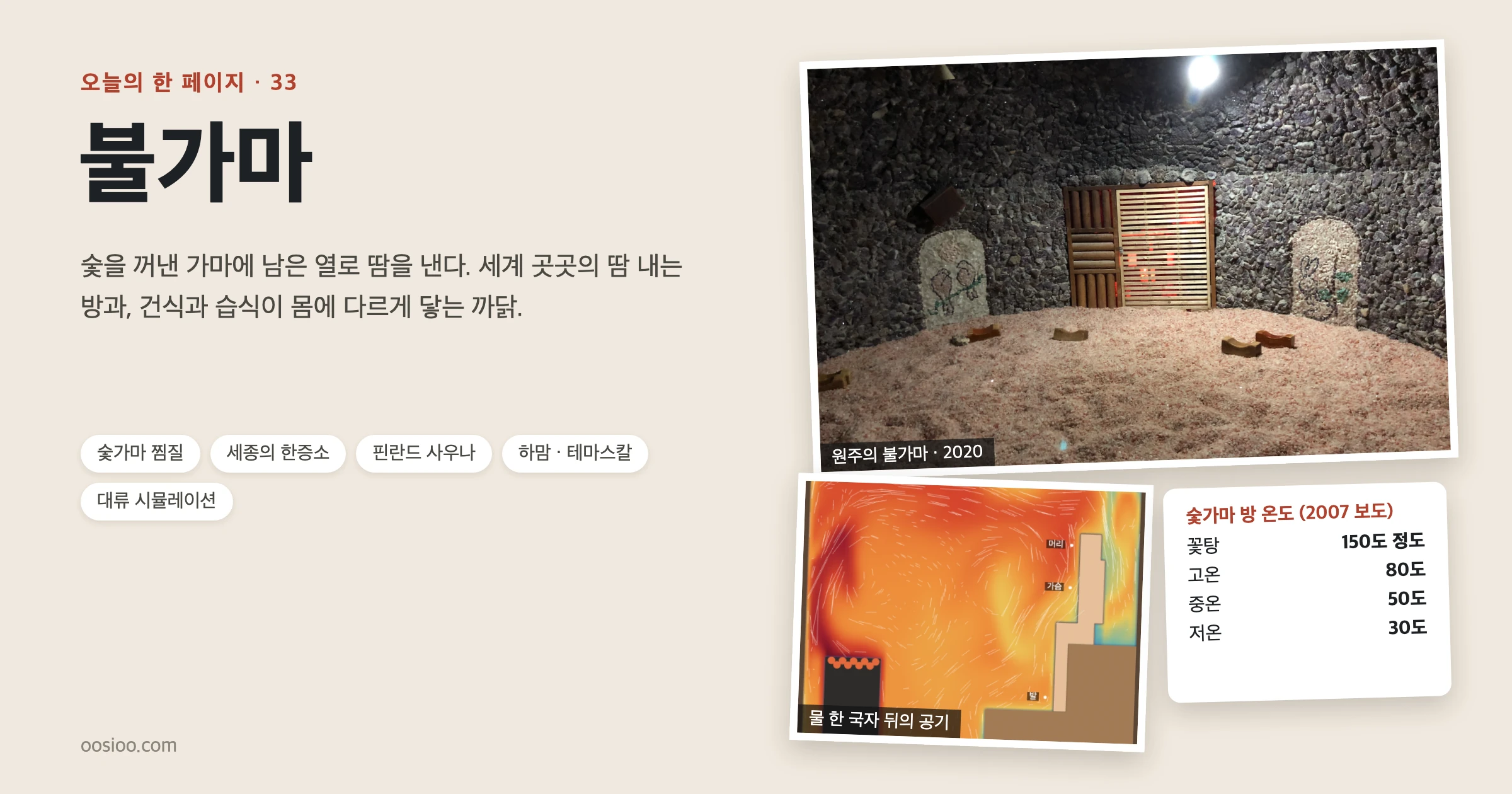
Bulgama: Sweating in a Charcoal Kiln
The notebook said only "bulgama" — fire kiln. It traces how a charcoal kiln's leftover heat, once the charcoal was pulled out and used for sweat bathing, became the round room of today's jjimjilbang, then reaches back 600 years to King Sejong's state-funded hanjeungso even as he doubted their benefit, and on to Finland's smoke sauna, Russia's banya, the hammam, Japan's ishiburo, the temazcal, and Ireland's sweat house, sorting the world's sweat rooms into three branches. It then explains, through a single idea — the dew point — how dry and wet heat differ in the way they put heat into the body, and runs two-dimensional convection calculations on cross-sections of a sauna, a steam room, and a charcoal kiln. It separates, with notes on which claims are backed by evidence and which are still anecdote, why some people struggle especially with dry heat and others with wet. A playable panel for spinning the air inside the room yourself, plus a temperature-humidity map, are included. The thirty-third piece of A Page for Today.
Today's notebook, opened at random, read like this:
Bulgama. Fire kiln.
At the end of a jjimjilbang corridor there's usually a room with a low, round opening cut into it, and above it the words "fire kiln." Duck in and your face catches heat right away; some people last a long time, others bolt out fast. As far as I knew, "fire kiln" came from using an actual charcoal-firing kiln for sweat bathing. It turns out that's about half right. Today I follow where the term came from, what sweat rooms exist around the world, and why — in rooms that are all equally hot — some people can't stand dry heat in particular, and others can't stand wet heat.
Entering a Kiln After the Charcoal Comes Out
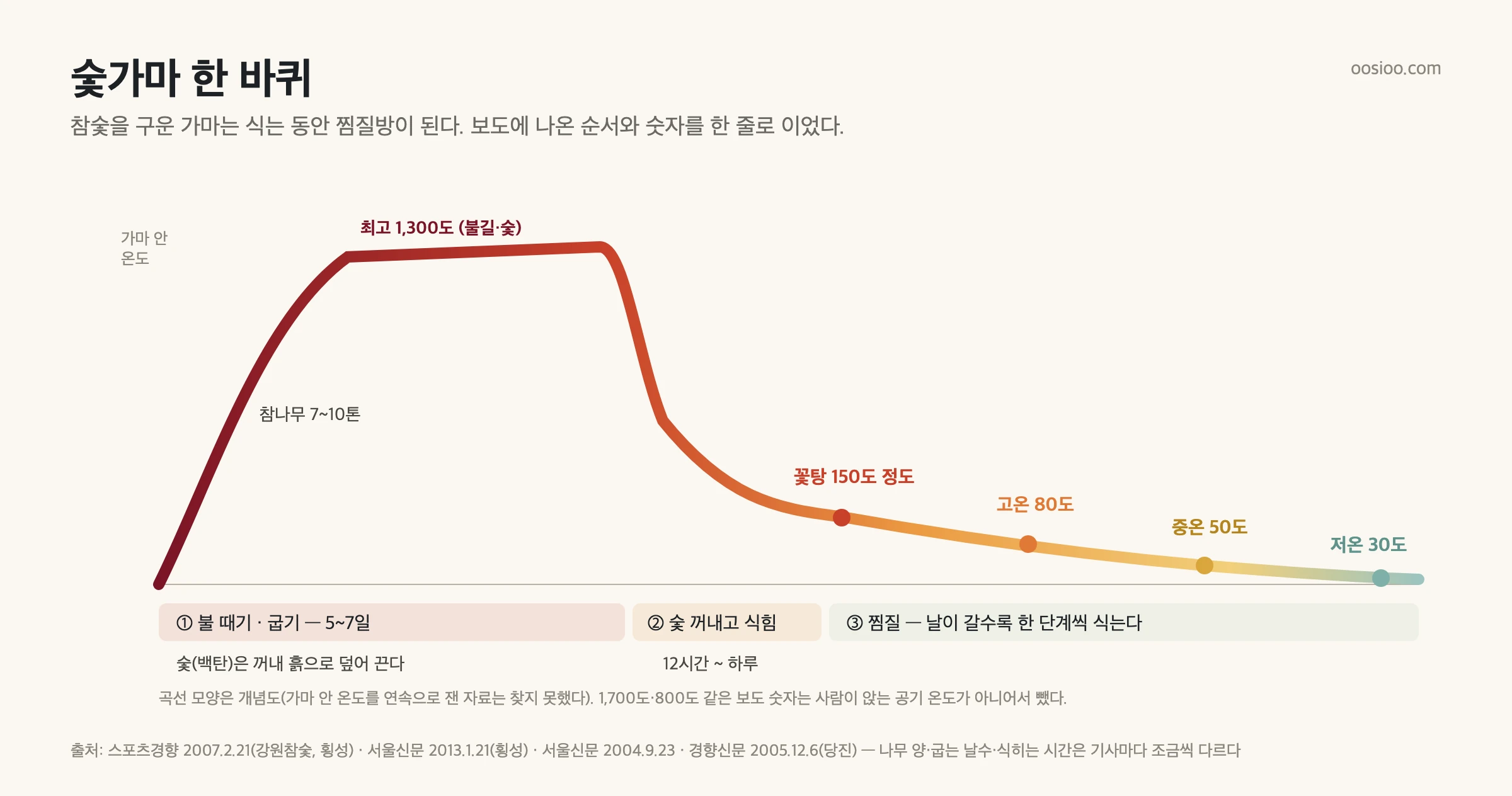
White charcoal is made by stacking oak in an earthen kiln and firing it for days. A 2013 Seoul Shinmun report on a kiln in Hoengseong, Gangwon Province, described about 10 tons of oak going in, fired for roughly a week. A 2007 Sports Kyunghyang article on the same region's Gangwon Charcoal said 7–8 tons went in and the fire burned for a full six days, with the kiln's interior reaching as high as 1,300°C. Once the white charcoal is done, the bottom of the kiln is opened to pull it out, then it's smothered with earth to put the fire out.
A kiln that's just had its charcoal removed stays tremendously hot for a while. Rather than let that heat go to waste, people started letting themselves in — this is charcoal-kiln bathing. The Hoengseong kiln let the heat cool for about 12 hours before opening to the public for a day, and a kiln profiled by Seoul Shinmun in 2004 said a full day had to pass after the charcoal was removed before anyone could enter. As one kiln cools, the room's name changes along with it. A kiln fresh out of charcoal is called the "flower bath," at around 150°C; the next day it drops to a "high" room at 80°C, then "medium" at 50°C, then "low" at 30°C. Some say the name "flower bath" means the best room, fresh off the charcoal; others say it's because the heat is so intense that red blotches bloom on the skin.
I found no record of when or where charcoal-kiln bathing first began. Gangwon Charcoal in Hoengseong is often called the "originator," but the four-plus decades the article cites are years of firing charcoal, not years of running it as a bathhouse. Several other places, including ones at the foot of Jirisan, also claim to be the original. One number does hint at the scale of its spread: a 2007 article said charcoal-kiln bathing, limited to 20–30 sites just four or five years earlier, had grown to some 300 across the country. Firing charcoal and bathing in the same kiln even made it into an academic journal — a 2018 paper in the Journal of the Korean Wood Science and Technology confirmed that white charcoal from a "dual-use thermal-bathing kiln" still met quality standards. That a kiln could be mainly in the charcoal business with bathing as a side trade had apparently become common enough to study.
Charcoal-kiln articles sometimes cite figures like 1,700°C, or 800°C for the upper chamber. That isn't the temperature of the air a person sits in — it appears to describe the flame, the charcoal, or the stones, and no measurement method is given. The hottest room a person actually enters runs around 150°C.
The Fire Kiln Inside the Jjimjilbang
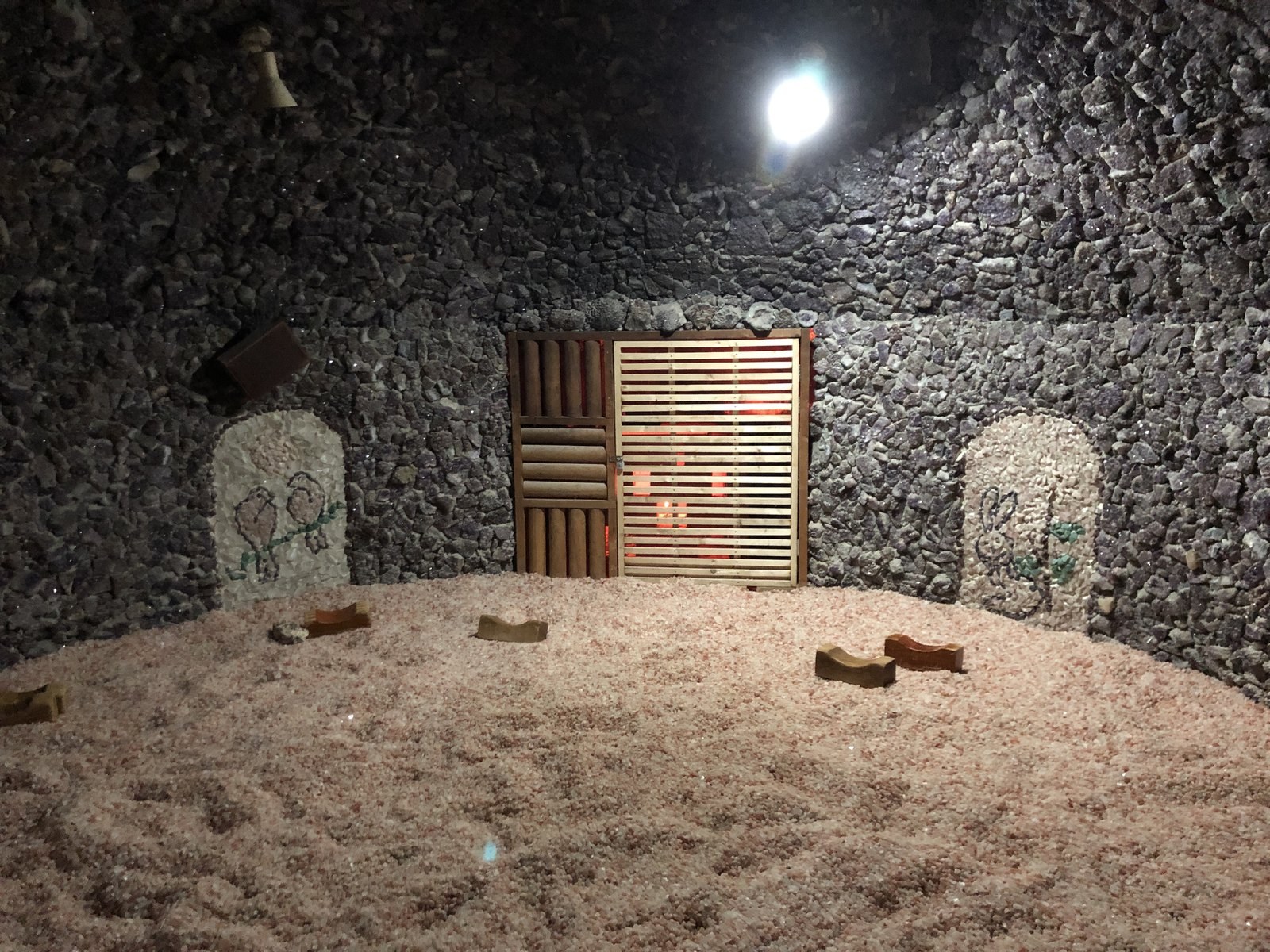
Urban jjimjilbang couldn't transplant an actual charcoal kiln. Instead they stacked a round room out of stone and loess, heated the floor or walls, and called it "bulgama" — fire kiln. A 2011 SBS Biz report said the modern jjimjilbang emerged in the early 1990s from a blend of ondol floor-heating culture and communal room culture; an industry source said the category of "jjimjilbang" as a business first appeared in 1993 and peaked around 2003. At the time the article ran, about 1,260 jjimjilbang were in operation. It's also commonly said that jjimjilbang exploded in number after the Asian financial crisis, but this time around I couldn't find an article or statistic to back that up.
The Hanjeungso Sejong Funded Even While Doubting It
A far older Korean sweat room than the charcoal kiln is the hanjeungmak. According to the Encyclopedia of Korean Culture, the traditional hanjeungmak heated its interior by burning pine branches in the middle of the room, with the floor covered in straw matting or, in earlier times, pine needles. People wrapped themselves up, went in to sweat for four or five minutes, then came out to cool off, repeating the cycle. In heating the room with fire and then entering that heat, it belongs to the same family as the charcoal kiln.
The Annals of the Joseon Dynasty preserve several records of hanjeungso during King Sejong's reign, and reading them, the state's posture is striking.
- In the eighth month of Sejong's fourth year (1422), after many people going to a hanjeungso to treat illness ended up dying there, the king ordered the Ministry of Rites to investigate whether the treatment actually worked. If it had no benefit, abolish it; if it did, have a physician attend daily and only let those fit for sweating do so. He also added: "Those who are gravely ill or weak should be made to stop."
- That same year, in the tenth month, the Ministry of Rites reported that the monks running the hanjeungso were making everyone sweat without even asking about their symptoms, to the point of killing people. In response, two physicians were assigned to examine patients.
- In Sejong's ninth year (1427), at the request of the monks Cheon-u and Eul-yu who ran a hanjeungso, the king granted a fund of 50 sacks of rice and 50 bolts of cotton, because poor patients could not afford firewood or gruel.
- In Sejong's eleventh year (1429), the bathing rooms at Donghwaryuwon were deemed too cramped, so three more were built, divided by sex and status.
- In Sejong's twenty-seventh year (1445), the king had the Mukssa, run by monks, torn down, stating that sweating and bathing originally had no particular medicinal effect (且其汗蒸沐浴, 本無異効).
Six hundred years ago, the state doubted that sweat treatment did any good, yet still funded the room so poor patients could use it — and when something went wrong, it assigned a physician. The worry that a sweat room could hurt someone was not so different then from now.
The World's Sweat Rooms, in Three Branches
Sweat rooms exist in nearly every culture. Sorted by where the fire is lit and how the heat reaches the body, most fall into one of three branches.
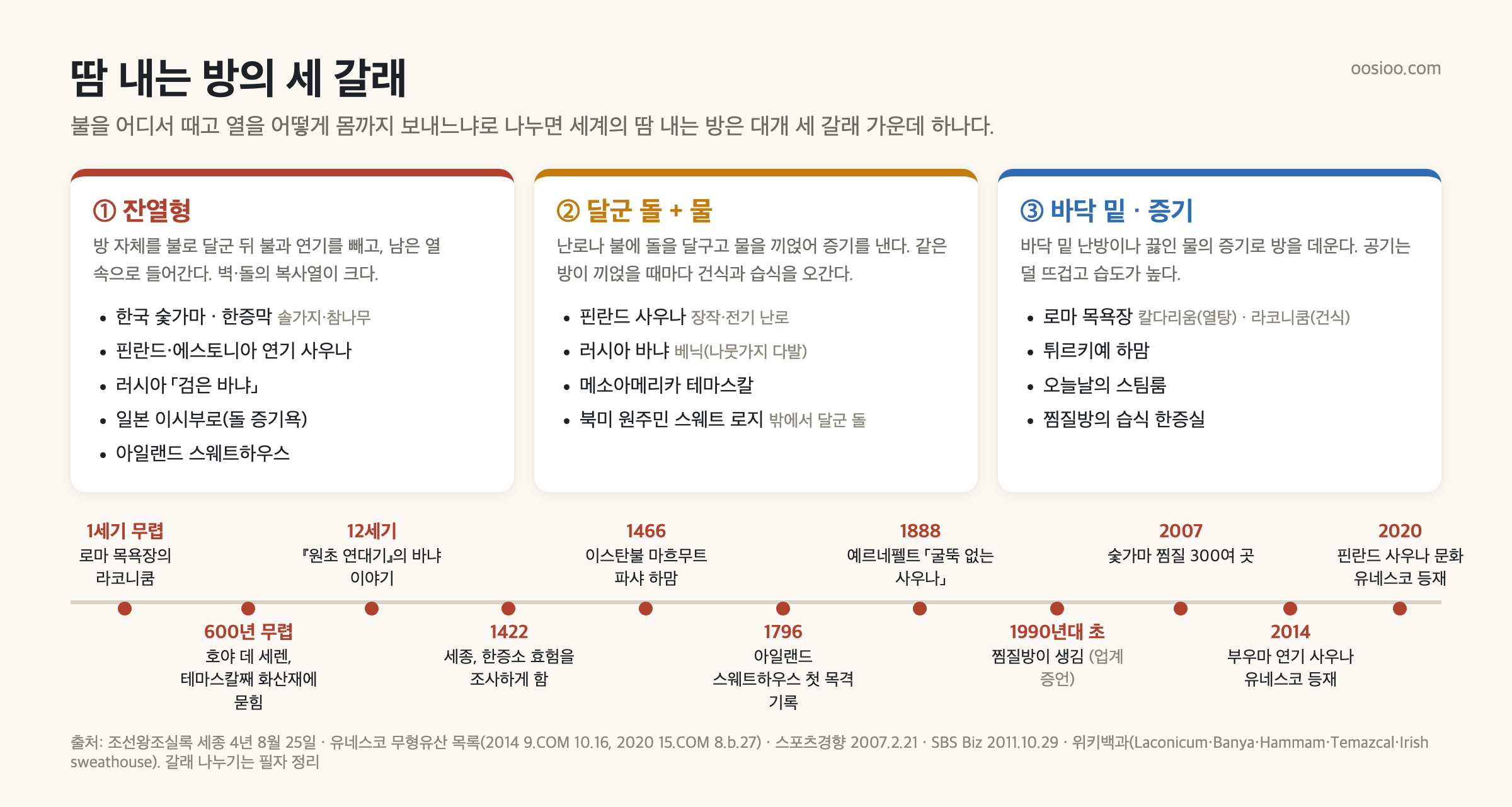
Residual-heat type. The room is first heated by fire, then entered once the fire and smoke have cleared. The charcoal kiln and hanjeungmak work this way, as do Finland's and Estonia's smoke saunas. A smoke sauna has no chimney. A large hearth is fired with wood, smoke fills the room, and once the stones are fully heated the smoke is vented out before anyone enters. The smoke sauna tradition of Võromaa in southern Estonia, inscribed on UNESCO's Intangible Cultural Heritage list in 2014, even includes smoking meat inside the sauna. Russia's chimneyless "black banya," which vented smoke through a hole in the ceiling, and Ireland's stone sweat houses, recorded from the late eighteenth century, work the same way. More than 300 survive across the island of Ireland, most sited beside a stream or lake for bathing afterward.
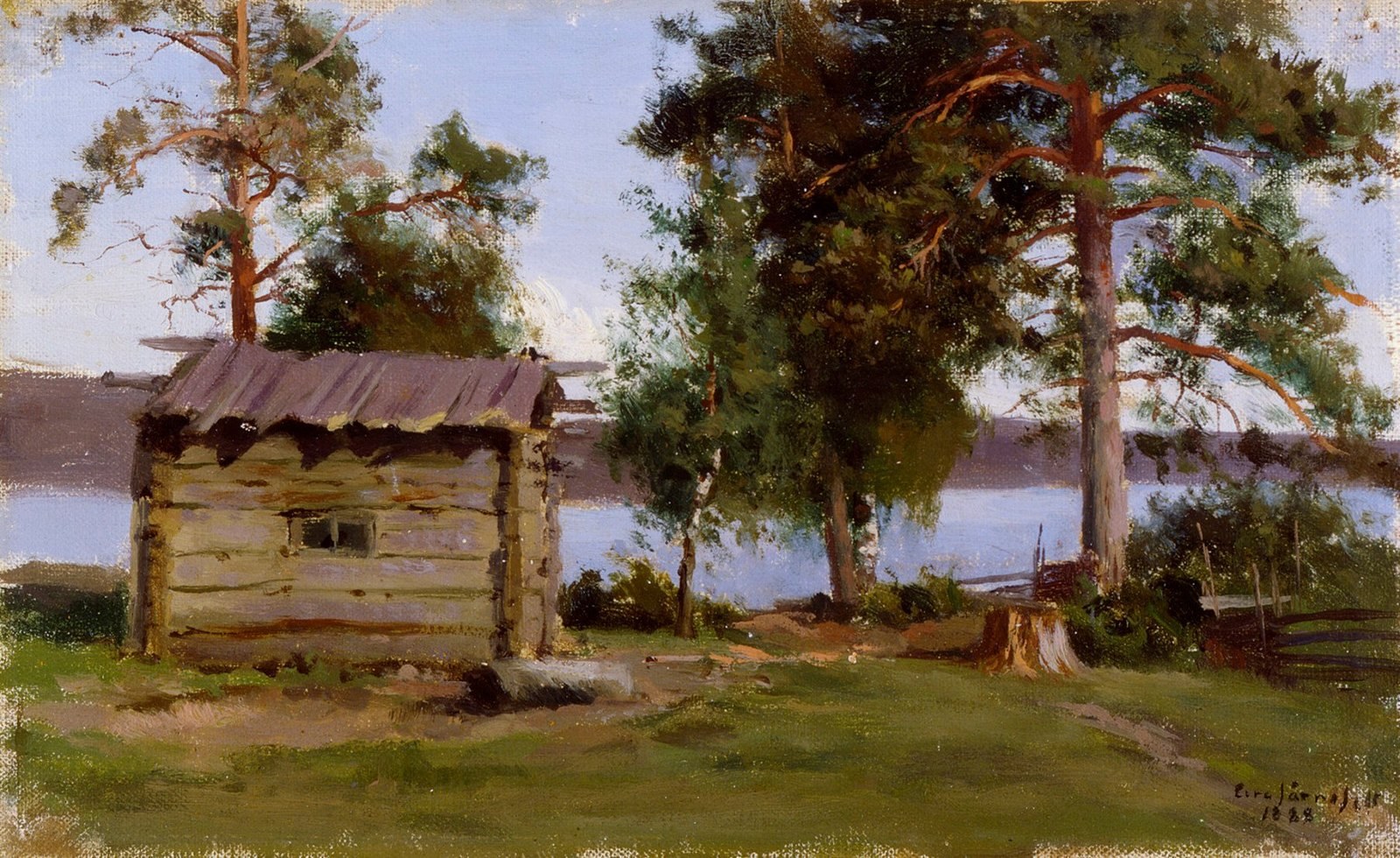
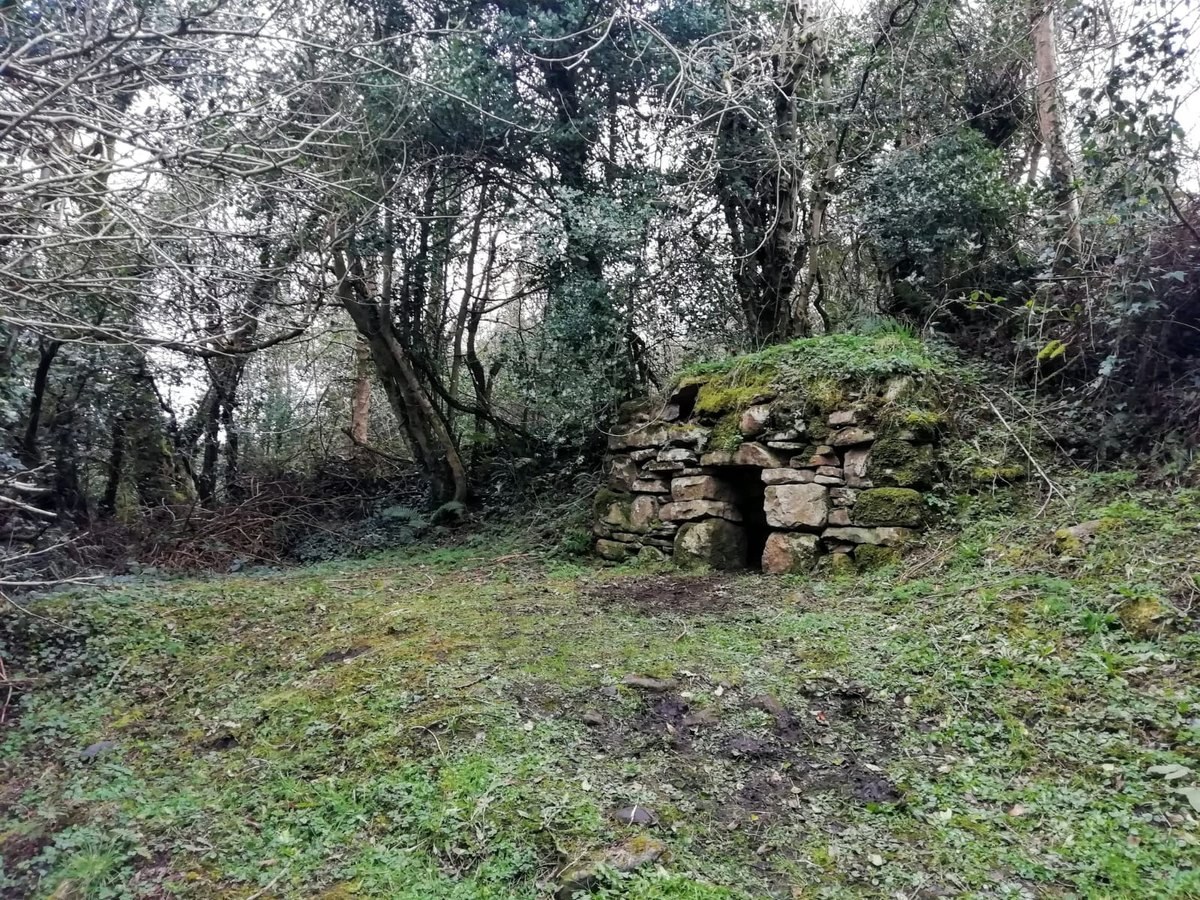
The closest match to Korea's charcoal kiln is Japan's ishiburo. The Kuka ishiburo of Suo-Oshima in Yamaguchi Prefecture was built as a granite stone chamber, its interior thickly plastered with clay. At 5.4 meters wide, 4.6 meters deep, and 2.5 meters tall, it reportedly held 17 people at once. A fire inside heated the stones, wet seaweed was laid down to raise steam, and bathers entered wrapped in water-soaked mats. Japan has designated five such stone steam baths as Important Tangible Folk Cultural Properties. I found no case of a Korean hanjeungmak being designated a cultural heritage site.
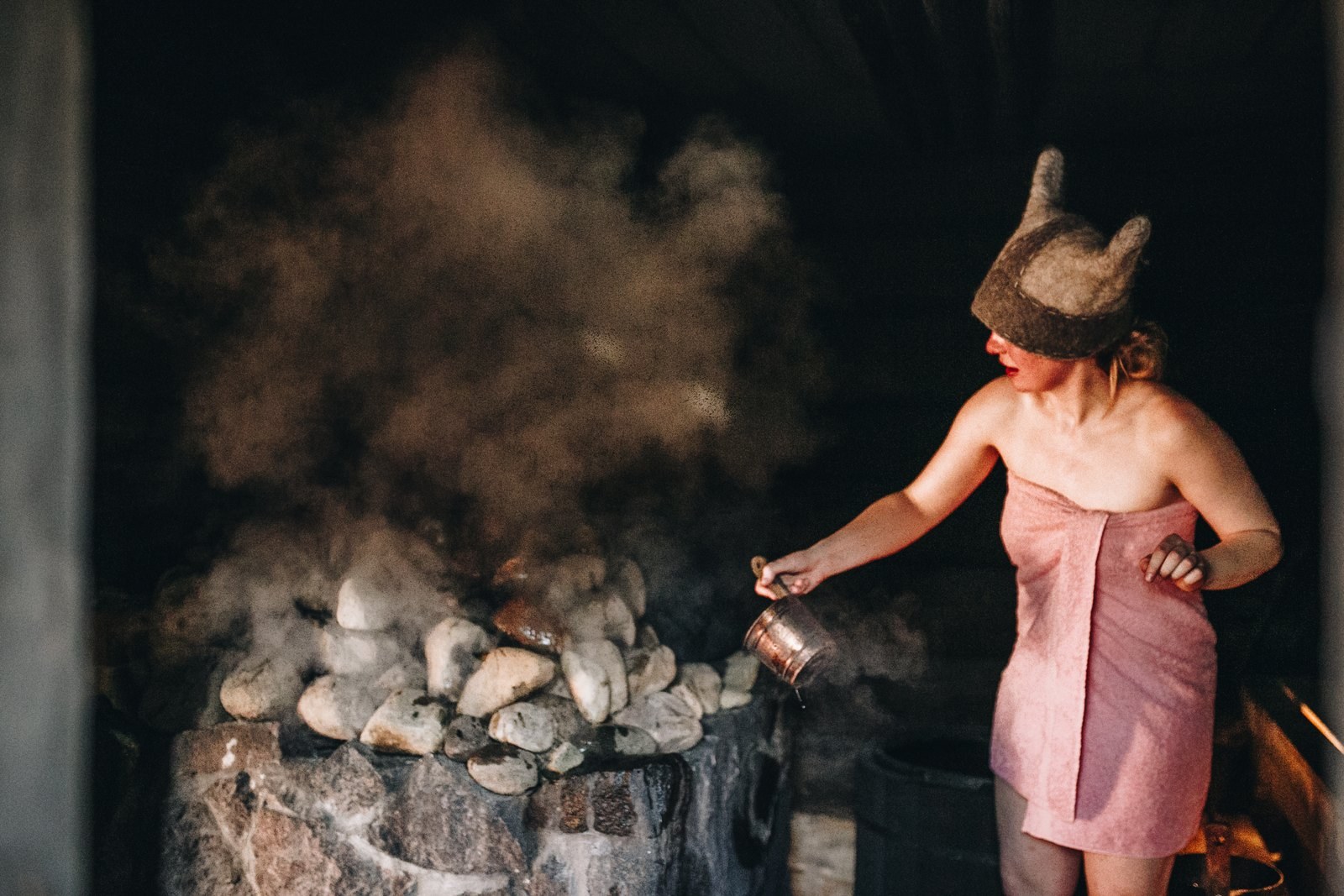
Rooms where water is poured on heated stones. Most Finnish saunas today belong here. Stones are piled over a wood or electric stove, and water is splashed on them to raise steam — called löyly in Finnish. When "Sauna Culture in Finland" was inscribed on UNESCO's list in 2020, the listing noted that a country of 5.5 million people has 3.3 million saunas. Finland's own government puts the figure at about 3.2 million, and AFP reported about 3 million. The numbers vary slightly, but it works out to roughly one sauna for every two people. Russia's banya works the same way, with bundles of birch or oak branches (venik) soaked in hot water and used to strike the body.
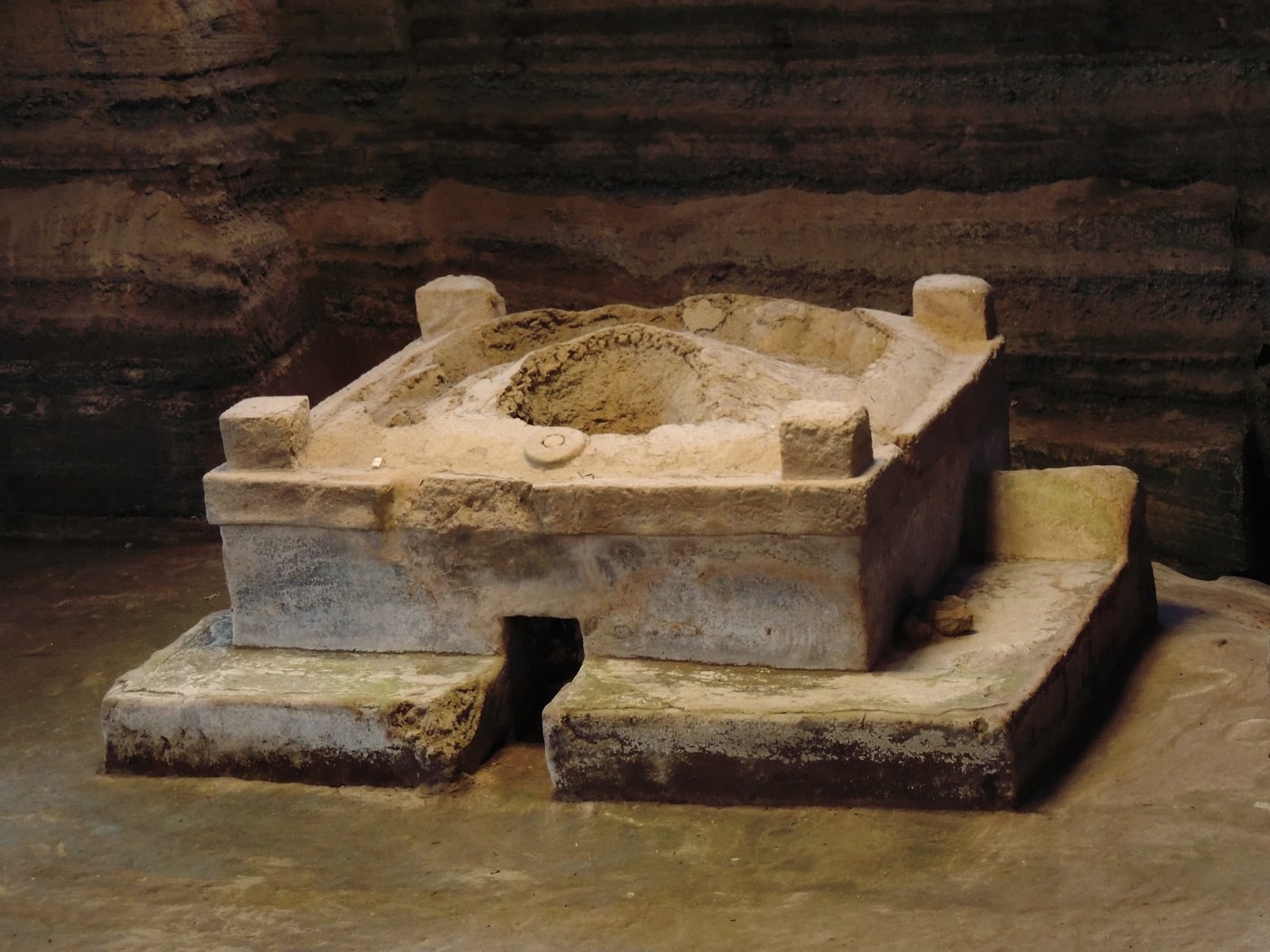
The Mesoamerican temazcal also pours water onto heated stones. The name means "house of heat" in Nahuatl. Joya de Cerén in El Salvador, a village buried whole in volcanic ash around 600, had a temazcal excavated from within it. Indigenous midwives still use the temazcal for care before and after childbirth. The North American sweat lodge, a low dome framed with young saplings and covered in blankets or hides, has heated stones brought in from outside and doused with water. In 2009, at an event in Sedona, Arizona where a self-help instructor imitated the tradition, about 60 people entered and three died; the autopsy found third-degree burns.
Rooms heated under the floor or by steam. Roman bathhouses circulated hot air beneath the floor to heat the room. Among their chambers, the laconicum was a room for sweating in dry heat, without a tub. It was usually round, and a bronze shield hung by a chain from an opening at the top of the conical roof could reportedly be raised or lowered to adjust the temperature. The structure of this bathhouse was passed down to Turkey's hammam. The Ottoman Empire built hammams in nearly every city — so many that in 1768 Mustafa III issued a decree banning the construction of new public baths in Istanbul. Today's hotel or gym steam room, and the jjimjilbang's wet hanjeungsil, also belong to this branch. The air is less hot, but humidity is high.
You Can Stand 90°C Air, But Not 90°C Water
Now for the body's side of the story. Finnish sauna guidance calls for air at face height of 80–100°C with relative humidity of 10–20% (Hannuksela & Ellahham, 2001). A steam room runs 40–50°C at near 100% humidity. A charcoal kiln's air ranges from 30 to 150°C depending on the room. The reason the body can tolerate this air is that air is a poor carrier of heat. Still air, with a 1°C difference from skin, transfers only about 3.3W per square meter. Water carries heat a hundred to several hundred times better. That's why you can sit in 90°C air for ten minutes but can't dip a finger into 90°C water. It's also why sauna benches are built of wood with the nails hidden: even at the same 100°C, wood passes heat to the skin slowly on contact, while metal passes it almost instantly.
Next comes sweat. When the air is dry, sweat evaporating off the skin carries heat away with it. Evaporating 1kg of sweat removes about 2,400kJ. This is what makes a dry sauna bearable.
This is where wet heat diverges, and the key is the dew point. Water vapor in the air condenses into droplets on any surface below a certain temperature — that's the dew point. Inside a sauna, skin temperature climbs to nearly 40°C within a few minutes. If the room's dew point is below that 40°C, sweat evaporates and cools the body. If the dew point is above 40°C, sweat can't evaporate at all — and instead, water vapor in the air condenses onto the skin, releasing the same amount of heat it would take to evaporate that much water. It's the same thing that happens to a pair of glasses fogging up in winter, just playing out on skin. A steam room at 45°C and 100% humidity has a dew point of 45°C; a wet sauna at 59°C and 60% humidity has a dew point around 49°C. Both sit above skin temperature.
What's surprising is that the Finnish sauna also hovers right around this boundary. The dew point across its recommended humidity range is 36–46°C, straddling the roughly 40°C skin temperature reached inside a sauna. Without water thrown on the stones, you're on the evaporating side; with it, you cross into the condensing side. In a roughly 10 cubic-meter sauna, splashing 250mL of water on heated stones can jump the dew point from around 32°C to around 42°C. The wave of heat that hits you isn't mainly from a rise in air temperature — it's this heat of condensation. One study actually measured this directly: German researchers poured isotope-labeled water onto the stones, then collected and analyzed the water running off bathers' bodies, finding that 30–54% of it was not sweat at all, but dew condensed on the skin (Zech et al., 2015). Not all the water running off you in a sauna is sweat.
What a Cross-Section of the Room's Air Looks Like
The air in a room isn't evenly hot. Air heated by the stove rises, spreads along the ceiling, cools along the walls, and sinks back down. Finland's own guidance sets face-height air at 80–100°C and floor level at 30°C. A 2026 study from the University of Jyväskylä in Finland, measuring a sauna set to 75°C, found an average of 51°C at sitting height and 69°C at head height. The same person's hips and head sit in air 18 degrees apart.
To see this visually, I ran two-dimensional fluid calculations on cross-sections of a sauna, a steam room, and a charcoal kiln. A room 2.4m wide and 2.2m high was divided into an 80×72 grid of 3cm cells, calculating buoyancy from hot rising air together with airflow, water vapor, and fog. Where the air saturates, fog condenses out and releases heat; where it dries again, the fog evaporates and takes heat with it.
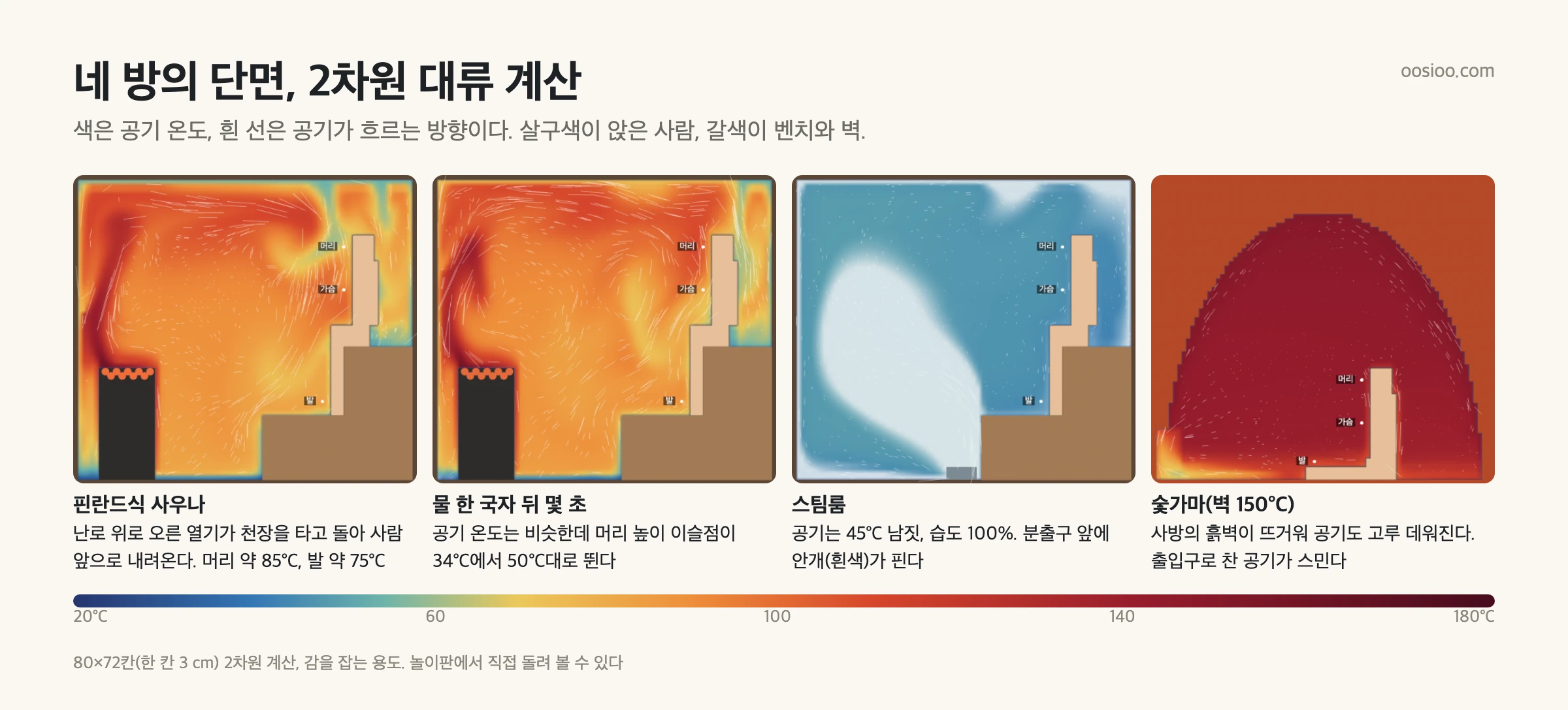
The calculations reveal a few things. In the sauna, heat rising off the stove curls along the ceiling and descends right in front of the face of whoever sits on the upper bench — this is why the upper and lower benches feel so different. When water is thrown, a mass of steam rises to the ceiling and spreads back down to head height a few seconds later; air temperature during this barely rises a few degrees, but the dew point jumps 15–20 degrees. In the steam room, air temperature is roughly uniform everywhere; in the charcoal kiln, the earthen walls on all sides are hot enough that the air heats evenly throughout. You can try spinning this yourself in the panel below.
Where the Heat Entering the Skin Comes From
Heat reaching the skin comes from three sources: convection, where the air itself touches and transfers heat; radiation, pouring off hot walls and stones; and the heat of condensation, released as vapor condenses. Subtract the heat that evaporating sweat carries away, and what's left is the heat the body actually absorbs. I calculated this the same way for all four rooms.
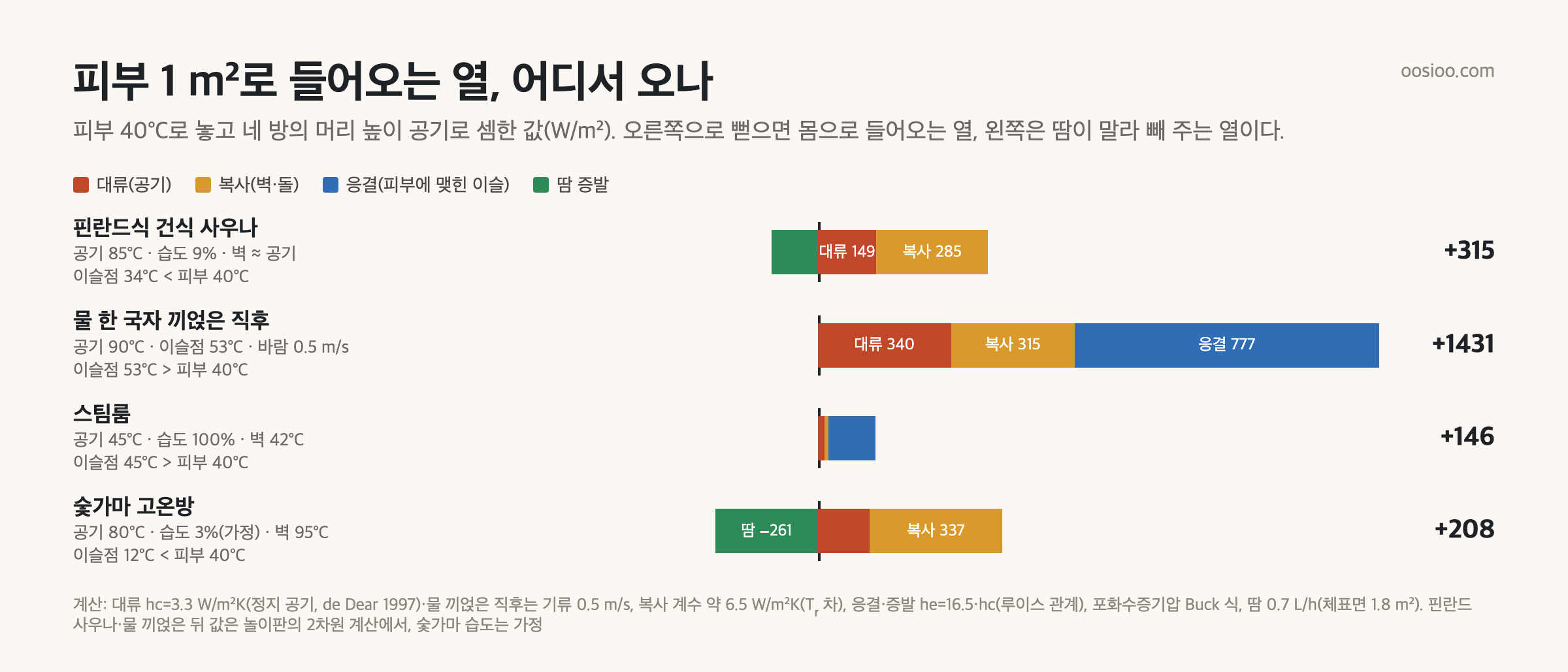
In the dry sauna, convection and radiation are large, and sweat subtracts a portion of that. In the steam room, air is less hot so convection and radiation are smaller, but condensation adds heat in while sweat has no way to escape. In the charcoal kiln, the walls are hotter than the air, so radiation dominates. I found no data measuring charcoal-kiln humidity, but if the air inside is simply outside air that's been heated, relative humidity would only run a few percent, letting sweat evaporate freely. A sauna right after water is thrown has all three at once: hot air plus a gust of wind, and a dew point that crosses the skin threshold, pouring in condensation heat.
The numbers don't map exactly onto how it feels. These figures describe the flow of heat into one square meter of skin; how bearable it feels depends on how fast that heat accumulates and raises core body temperature. There's an experiment that measured exactly that.
Wet Heat, 30 Degrees Cooler in the Air, Warmed the Body More
Polish researchers had ten men in their twenties, all first-time sauna-goers, sweat for 15 minutes three times each in a dry sauna (about 91°C, 5–18% humidity) and a wet one (59°C, 60.5% humidity) (Pilch et al., 2014).
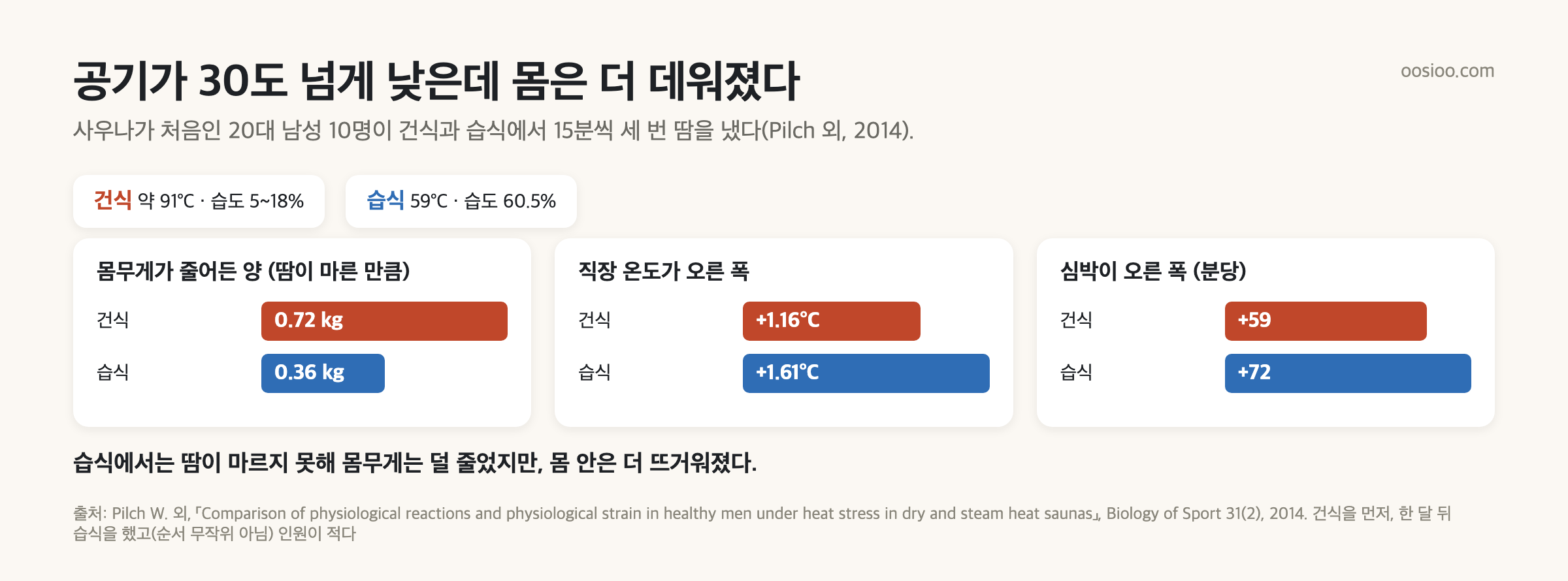
In the dry sauna, body weight dropped by 0.72kg; in the wet one, by half that, 0.36kg. It's more accurate to say the sweat didn't dry rather than that it wasn't produced. Yet rectal temperature rose more in the wet sauna (+1.61°C versus +1.16°C), and heart rate rose more as well (+72 versus +59). The room that was more than 30 degrees cooler in the air heated the body's interior more. The study has limitations — a small sample, and the dry session was done first with the wet session a month later, so order effects weren't controlled for. Even so, the direction matches a 2026 Jyväskylä study: in that research, which measured 50 adults, humidity raised heart rate and core temperature independently of air temperature.
Who Struggles with Dry Heat, Who Struggles with Wet
In the same jjimjilbang, some people handle the fire kiln fine but can't last a minute in the wet hanjeungsil, and others are the opposite. I found no research sorting people into "dry-heat types" and "wet-heat types" by constitution. But there's a fair amount that can explain why each one is hard for whom. The weight of the evidence varies, so I've noted it separately.
| Harder type | Reason | Evidence |
|---|---|---|
| Wet | Sweat can't evaporate, so the body has no way to cool itself, and dew condensing on the skin adds more heat. This lets core temperature rise quickly even when the air is less hot | Confirmed experimentally (Pilch 2014, Jyväskylä 2026, Zech 2015) |
| Wet | People who sweat heavily lose the advantage they'd have in dry heat. No matter how much they sweat, it just runs off without drying | Explained by physics |
| Wet | Blood pools toward the skin and blood pressure drops. Diastolic pressure fell more in wet heat (−20 vs. −15mmHg). People with orthostatic hypotension may feel dizzy or faint when standing | Experimental and medical review |
| Wet | Hot, humid air reaches deeper into the nose and airway before cooling, which can bring on a feeling of suffocation | A general principle from burn medicine. No study found that measured airway temperature in a sauna |
| Dry | Air and walls are much hotter, so convection and radiation are large. Anyone sitting on the upper bench, or anyone tall, has their head in the hottest air | Physics and direct measurement (head height runs 18 degrees hotter) |
| Dry | People who sweat little, or who aren't used to saunas, can't properly use evaporative cooling, dry heat's main defense | Physiological basis. Heart rate rises only to about 100 in experienced sauna-goers, versus up to 150 in newcomers (Hannuksela 2001) |
| Dry | Nose, throat, eyes, and lips sting. Dry air pulls water quickly from moist membranes, and places with no water left to evaporate, like chapped lips, take the heat directly | Explainable by physics, but no study found linking sauna use and dry eyes |
| Dry | It's commonly said that dry, hot air irritates the airway in people with rhinitis or asthma | Research results are mixed. Some small studies even found lung function temporarily improved |
Boiled down to one line: people who rely heavily on sweat to cool themselves tend to break down in wet heat. People whose skin and mucous membranes are sensitive to heat and dryness suffer in dry heat. Acclimatization also plays a large role — the body's adaptations to heat develop most in the first week and are largely complete within about ten days. A room that's easy for a regular can be brutal for a first-timer.
Using Sweat Rooms Safely
The concern from Sejong's time still holds today. In Finland, roughly fewer than 2 people per 100,000 die in or around saunas each year, but half of them had been drinking (1990–2002). Of 228 hyperthermia deaths in Finland between 1970 and 1986, 221 occurred in saunas, and 84% of those involved alcohol. At the 2010 World Sauna Championships in Finland, a Russian competitor who made it to the finals died; the autopsy found third-degree burns. The event hasn't been held since.
In Korea, of 303 jjimjilbang-related complaints filed with the Korea Consumer Agency between 2008 and October 2011, 44 involved burns. The agency recommended keeping high-heat sessions under 15 minutes at a time, and resting 10 minutes after every 20 minutes of heat exposure. Charcoal kilns carry other risks too. A 2010 Gyeonggi Province inspection found that three of five charcoal-kiln bathhouses exceeded standards for carbon monoxide and other gases, and in September 2025, a suspected gas explosion while lighting firewood at a charcoal-kiln bathhouse in Yangju, Gyeonggi Province injured 28 people.
There are favorable numbers too. In a study following 2,315 men in Kuopio, Finland for over 20 years, those who used a sauna 4–7 times a week had half the cardiovascular death risk of those who used one once a week (Laukkanen et al., 2015). But as an observational study, it can't establish that the sauna itself was the cause. The result came from a Finnish-style dry sauna averaging 79°C, and the researchers themselves cautioned that it shouldn't be assumed to apply to steam rooms or other types of rooms.
Putting it together, the old advice still holds. Don't go in after drinking. Take short sessions repeated several times rather than one long stretch, cooling off and drinking water in between. And it's worth remembering that sweat running down your body in wet heat doesn't necessarily mean you're cooling off.
Closing
The word "bulgama" carries the calculation of a kiln owner unwilling to waste the heat left behind after firing charcoal, and the far older hanjeungmak and sweat rooms found around the world grew out of the same idea: heat the room, clear the fire, and step into that heat. How the body withstands that heat depends on whether the air is dry or wet. In a dry room, sweat cools the body; in a wet one, water vapor in the air condenses on the skin and adds heat instead. That's also where the difference comes from in why the same room feels easy to one person and unbearable to another. So there's no reason to force yourself to endure a room just because the person next to you can.
A Page for Today is a series that opens an idea notebook at random and lays that day's thinking over whatever line happens to be there. Today's line was "bulgama" — fire kiln.
- Photos: Interior of a fire-kiln sauna in Wonju (2020, Choikwangmo9, CC03.jpg)) · Eero Järnefelt, "Chimneyless Sauna" (1888, Finnish National Gallery, public domain) · Sweat house at Cleighran More, Leitrim (2021, Jellyfish2023, CC0) · Steam from an Estonian smoke sauna (2018, Estoniansaunas, CC BY-SA 4.0) · Temazcal at Joya de Cerén (2011, BelenM, CC BY-SA 3.0) — all from Wikimedia Commons
- Key sources: Annals of the Joseon Dynasty, Sejong 4th year, 8th month 25th day · 10th month 2nd day, 9th year 4th month 24th day, 11th year 6th month 27th day, 27th year 11th month 8th day · Encyclopedia of Korean Culture, "Hanjeung" · Sports Kyunghyang, Feb. 21, 2007 · Seoul Shinmun, Sept. 23, 2004, Jan. 21, 2013 · Kwon Gu-jung et al., Journal of the Korean Wood Science and Technology 46(5), 2018 · SBS Biz, Oct. 29, 2011 · UNESCO Intangible Heritage decisions 9.COM 10.16, 15.COM 8.b.27 · Hannuksela & Ellahham, Am J Med 2001 · Pilch et al., Biology of Sport 2014 · Zech et al., Isotopes Environ Health Stud 2015 · Laatikainen-Raussi et al., Temperature 2026 · Laukkanen et al., JAMA Intern Med 2015 · Kenttämies & Karkola, J Forensic Sci 2008 · de Dear et al., Int J Biometeorol 1997


