Static and Clumping
Is a drop of water on the beans (RDT) a myth? Measurements show ground coffee carries tens of nanocoulombs per gram, flips sign at about 2% bean moisture, and has large chunks and 100–300 µm particles of opposite sign. A few drops of water cut the charge from half to almost zero and grinder retention from 12% to 2.5%; effects on extraction and taste vary. Treated as a whole stream, same-sign charge pushes the grounds apart with a force that goes as the square of the charge. With a stream simulator.
Grind coffee and the grounds cling to the grinder's outlet, spray around the dosing cup and form clumps. The culprit is static electricity. So many people spritz their beans with a drop or two of water before grinding, a trick called RDT (the Ross droplet technique) after the person said to have suggested it. Some say it clearly works; others call it a myth.
The short version: that a few drops of water reduce charge and retention inside the grinder is measured fact. It has also been shown that the sign of the charge flips at around 2% moisture inside the bean. Whether extraction and taste improve differs from grinder to grinder and coffee to coffee. Treating the whole stream of grounds as a single body of charge, same-sign charge pushes the stream apart, and the effect grows with the square of the charge. Halve the charge and the spreading drops by much more than half.
What has been measured
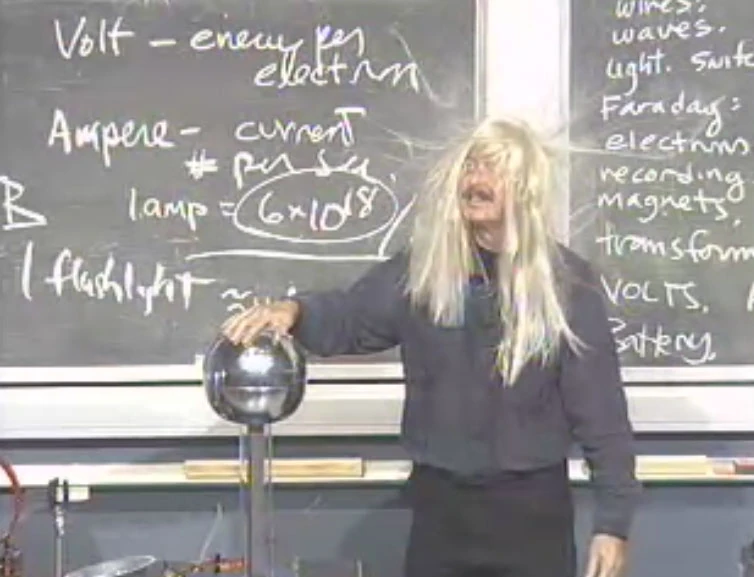
A Van de Graaff generator demonstration: hairs charged with the same sign push each other apart · Photo: Drbaker171, Wikimedia Commons, public domain
The most detailed measurements are by Méndez Harper and colleagues (2024), researchers who had used instruments for measuring the charge on volcanic ash, writing with the coffee chemist Hendon. They ground beans 1 g at a time on an EK43, caught the grounds in a Faraday cup (a metal can that collects and measures charge) under the outlet, and divided the collected charge by the mass.
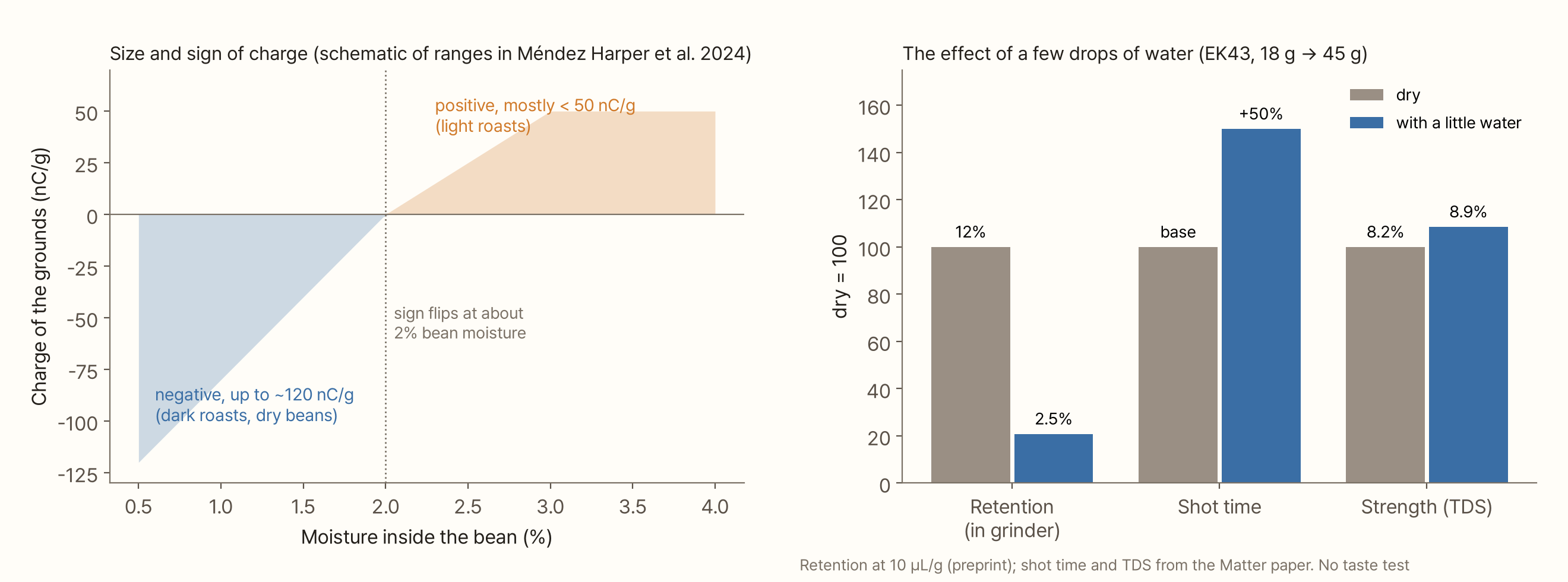
- Size: positively charged grounds were mostly below 50 nC (nanocoulombs) per gram, while negative charge reached 120 nC. The researchers wrote that this is similar to volcanic ash plumes or ice particles in thunderclouds
- Sign: below about 2% moisture inside the bean, the charge was negative; above, positive. Darker roasts hold less moisture, so their negative charge is larger. Moisture explained the sign better than roast colour
- Sign by size: within the same grounds, large chunks were negative and 100–300 µm particles positive. Particles of opposite sign mixed together attract each other
- Where it comes from: putting ground coffee through again at a coarser setting (so it did not break further) cut the charge by up to 90%. Most of the charge is created at the moment a bean breaks
- Humidity: room humidity only had an effect above 60% relative humidity
- Water: adding just 5 µL of water per gram of beans made the peak of fines and chunks stuck together vanish from the distribution, and 20 µL brought the charge close to zero. Salt water worked the same
A follow-up preprint by the same group (not yet peer reviewed) compared four ways of reducing charge. Adding 10 µL of water per gram cut the grounds left inside the grinder from about 12% to 2.5%. An ioniser cut the charge by 50–90% but hardly changed retention or extraction. Clumps that have already formed do not come apart when the charge is removed. Water stops the charge from forming at the moment of breakage, so clumps never form in the first place. Grinding and waiting took 15–65 seconds for the charge to drain.
Does extraction improve?
The Matter paper compared grounds made with and without water using the same recipe (18 g of beans to 45 g of espresso). With water, the shot ran about 50% longer and strength (TDS) rose from 8.2% to 8.9%. The authors interpret this as the clumps disappearing, so the puck packs more tightly with fewer channels for water to escape. No taste test was done. The follow-up preprint reported strength rising by more than 15% for a dark roast. Press coverage gives figures of 8%, 10% and 15–16%.
There is pushback. In a video by James Hoffmann testing several grinders, retention fell but changes in flow and extraction were reportedly inconsistent between grinders (I could confirm this only through secondhand summaries). "RDT is a myth" may be right about "extraction and taste always improve". It is wrong about "charge and retention go down", which has been measured.
How strong are the forces?
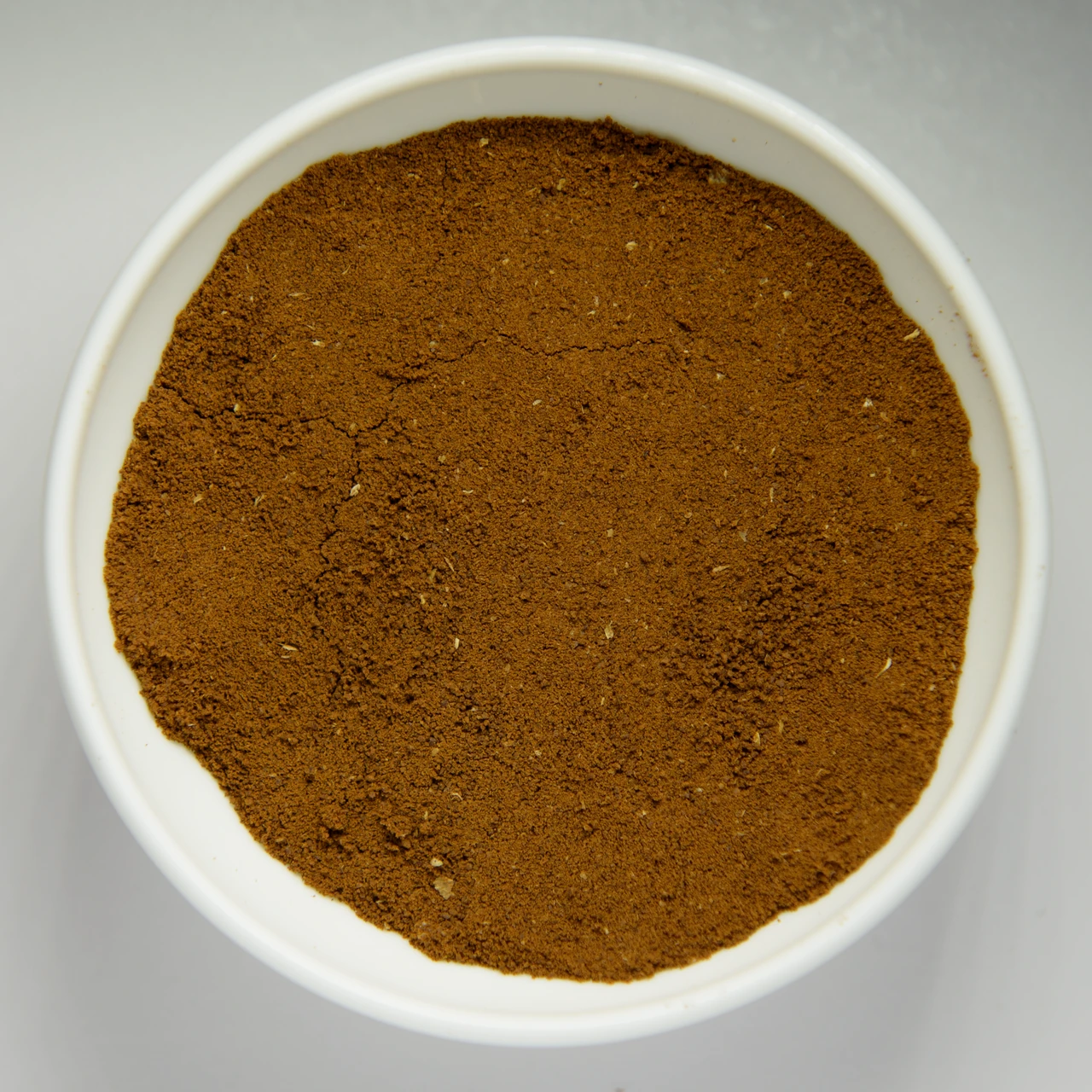
Finely ground coffee · Photo: Alorin, Wikimedia Commons, CC BY 4.0
For a single particle, static is weaker than you might think. With 50 nC per gram spread evenly, the electrostatic force between two touching particles is 0.6 times gravity at 100 µm, 1.7 times at 300 µm and 2.9 times at 500 µm. Fines smaller than 30 µm stick with van der Waals forces alone at thousands to tens of thousands of times gravity, charge or no charge. Fines stick to walls and clumps anyway. Static is an extra force pulling mid-sized particles towards fines and walls. With opposite signs mixed, the charge on individual particles is larger than the average.
But grounds don't fall one particle at a time. They pour out of the grinder in a stream. If the whole stream carries charge of the same sign, the electric field from the charge inside it can be far larger than the force between two particles. Like hairs pushing each other away, the stream pushes itself apart.
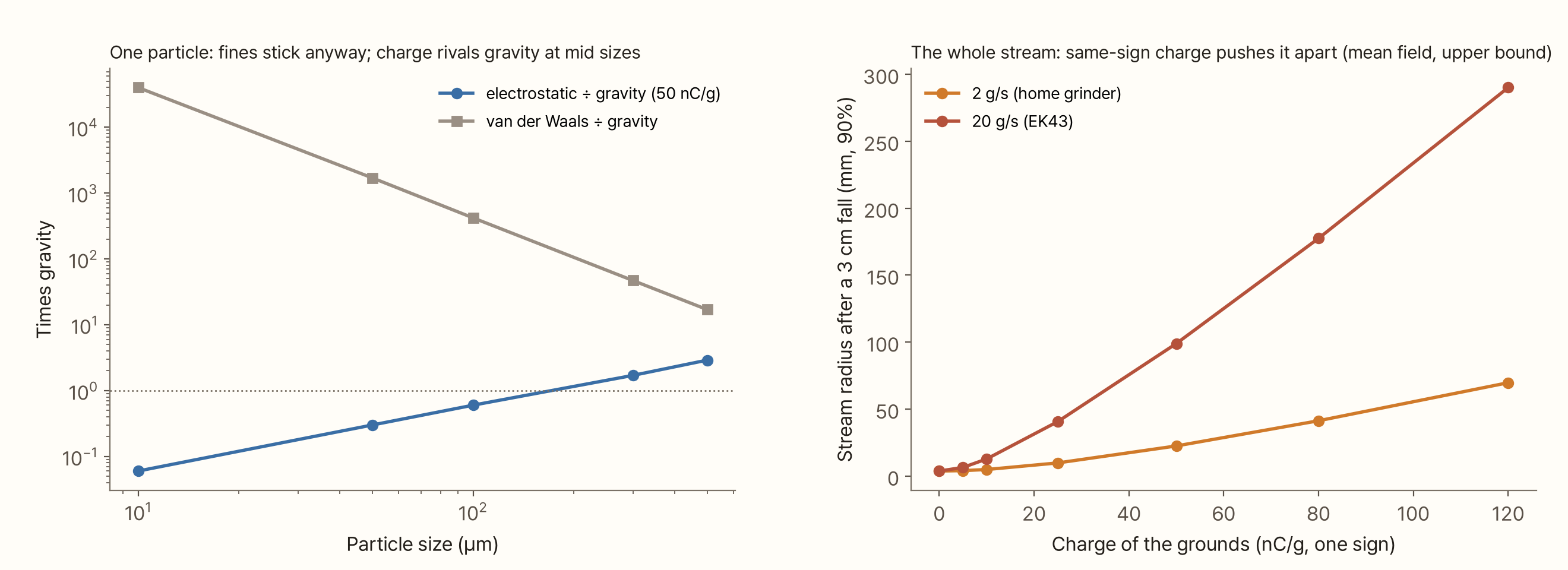
I calculated this with a simple model. The stream leaving a 4 mm-radius chute is treated as a cylinder, with only the electric field from the charge inside it (Gauss's law) and air drag. For a home grinder at 2 g per second, 50 nC per gram of same-sign charge spread the stream from a 3.7 mm radius to 23 mm over a 3 cm fall. For an EK43 at 20 g per second, the same charge would spread it to 10 cm. The more charge the stream carries, the stronger the field, and the force on each particle is that field times its own charge. So the spreading force goes as the square of the charge.
This model spreads more than reality. It leaves out particles of opposite sign cancelling each other, air moving down with the stream, and charge leaking into the air. Grounds from a home grinder do not actually spread 2 cm in every direction. Even so, the direction is clear. For a 2 g/s stream falling 4 cm, 40 nC per gram spread it to 21.6 mm; cutting the charge by 39% brought that to 11.8 mm, and by 63% to 7.1 mm. Even halving the charge with a few drops of water reduces spraying and clinging by much more.
Spread it yourself
The tool below uses the model above to draw the stream of grounds leaving the chute, seen from the side. Change the charge, water added, grind rate, fall height and particle size, and it shows how the stream spreads and its radius at the bottom.
What the industry does
Some grinders fit an ioniser at the outlet. According to retailers, the Fellow Ode Gen 2 and Opus have one built in, and Acaia sells a separate ioniser. By the preprint above, ionisers reduce charge but hardly change clumps already formed or retention. The researchers wrote that because coffee conducts electricity poorly, grounding the grinder is not enough on its own. There is also a story that a magnet at the outlet reduces static, but magnets exert no force on electric charge. Magnets in commercial grinder hoppers are there to catch stray metal.
What this conclusion leaves out
- Most measurements come from a single model, the EK43. There is little data on how charge and retention differ in other grinders, especially ones with different outlets
- The size of the water effect differs between sources. One measurement has charge near zero at 20 µL per gram; others have it roughly halved. Coffees and conditions seem to have differed
- The stream model is an upper bound. Leaving out mixed signs, air flow and charge leakage makes it spread more than reality. The relationship, "as the square of the charge", matters more than the numbers
- Taste was not measured. Higher strength was measured; whether it tastes better, nobody has measured
- I could not confirm who first proposed RDT or when. Accounts of an online forum around 2005 could not be checked in the original
Summary
- Ground coffee carries tens of nanocoulombs of charge per gram, with negative charge measured up to 120 nC. Below about 2% bean moisture the charge is negative; above, positive. Large chunks are negative and 100–300 µm particles positive, so within the same grounds they attract each other
- Most of the charge is created at the moment a bean breaks. Room humidity only matters above 60%
- A few drops of water (5–20 µL per gram) cut the charge from half to almost nothing and reduced retention in the grinder from 12% to 2.5%. That part is measured. With the same recipe, shots ran longer and strength rose, but other grinders gave mixed results, and taste was not measured
- For a single particle, electrostatic force is on the order of gravity. For the whole stream, same-sign charge pushes it apart with a force that goes as the square of the charge. Even halving the charge cuts spraying and clinging by much more
References
- Méndez Harper J, McDonald CS, Rheingold EJ, Wehn LC, Bumbaugh RE, Cope EJ, Lindberg LE, Pham J, Kim Y-H, Dufek J, Hendon CH (2024). Moisture-controlled triboelectrification during coffee grinding. Matter 7(1), 1–18. doi:10.1016/j.matt.2023.11.005
- Méndez Harper J, Hendon CH (2023). Chemical strategies to mitigate electrostatic charging during coffee grinding. arXiv 2312.03103 (preprint). doi:10.48550/arXiv.2312.03103
- Méndez Harper J, Hendon CH (2024). It's electric: understanding — and reducing — static electricity during grinding. SCA News 25. link
- APS Physics (2024). Commentary on the Matter paper, Physics 17, 2. link
Image credits
- Van de Graaff generator demonstration: Drbaker171, Wikimedia Commons, public domain
- Finely ground coffee: Alorin, Wikimedia Commons, CC BY 4.0
- All other charts, the cover and the tool: made by me

