From Textbook to Educational Material: Three Years of Korea's AI Textbooks
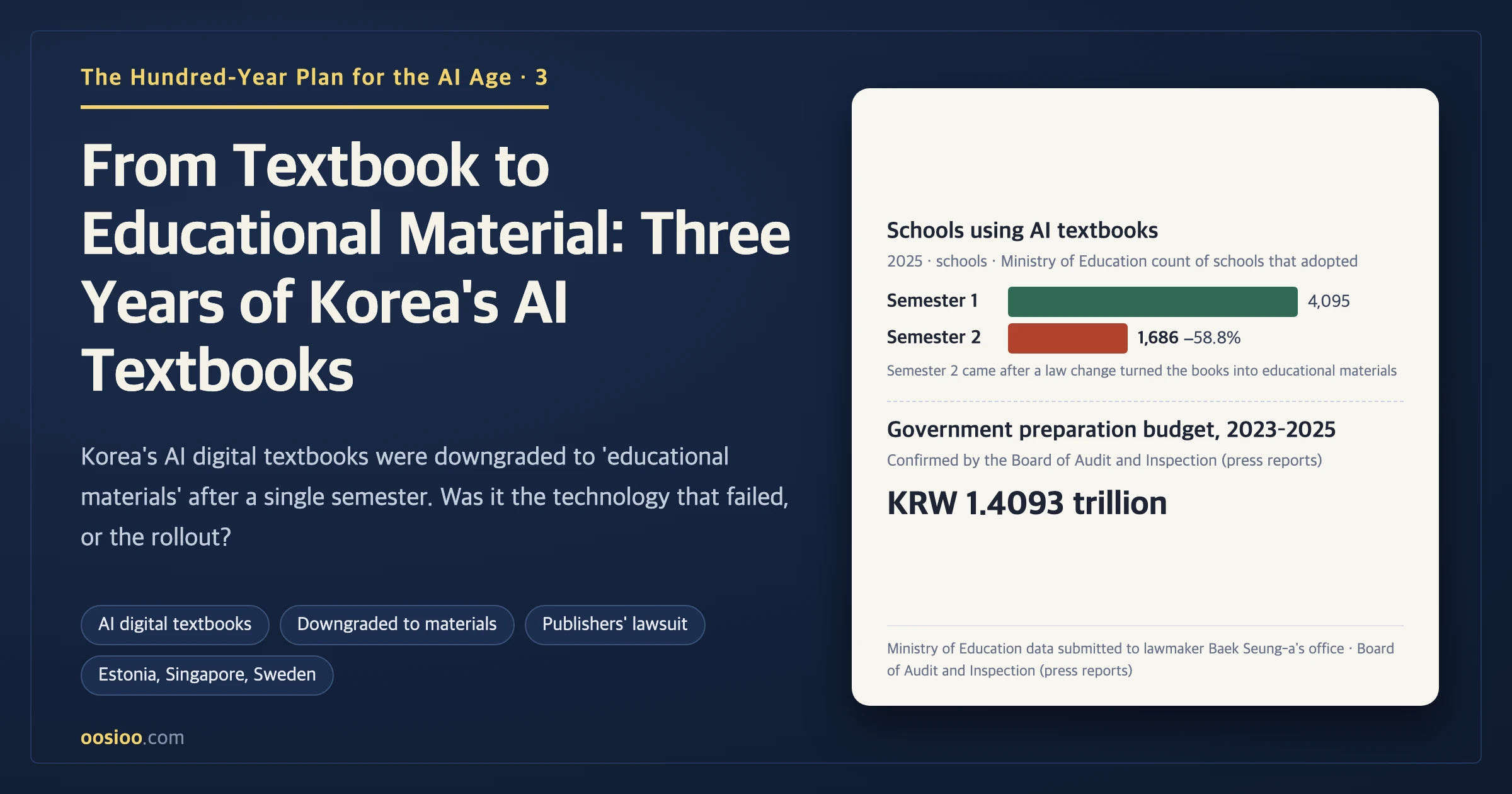
In March 2025, AI digital textbooks (AIDT) went into Korean classrooms for English, math and informatics in grades 3 and 4 of elementary school, the first year of middle school and the first year of high school. The screening results had been announced only three months earlier, on November 29, 2024, and no school had spent a single semester teaching with the finished books. The number of schools using them fell from 4,095 in the first semester of 2025 to 1,686 in the second, down 58.8% (Ministry of Education data), after a change in the law turned them into optional "educational materials," and in June 2026 about ten publishers sued the state for damages. The government's preparation budget for 2023 to 2025 confirmed by the Board of Audit and Inspection was KRW 1.4093 trillion. This episode of The Hundred-Year Plan for the AI Age follows the story in order from the February 2023 announcement to the lawsuit, and asks whether this was a failure of AI as a technology or a failure of how it was introduced. It compares Estonia, which had teachers use AI first, Singapore, which widened its use after a Primary 5 math pilot in 33 schools, and Sweden, which raised its budget for paper textbooks again, and sets out, for policy and for schools and families, what needs to be decided first so the next digital policy does not go the same way.
Picture a third-grade classroom in Korea in March 2025. There is a tablet on every desk, and an English textbook on every screen. When a child finishes a problem, one corner of the screen shows how many answers were right and which problem comes next. On the teacher's screen, the whole class's progress comes up as a bar chart. This is the scene the government described in 2023 when it announced the policy, as "giving every child an AI personal tutor."
Half a year later, in a good share of those classrooms, the textbook had gone from the screen. The law had changed, and the AI digital textbook (AIDT) was no longer a textbook but an "educational material" that each school could choose to use or not. The number of schools using it fell to less than half. A year after that, the publishers that had made the textbooks sued the state for damages. From the first announcement to the lawsuit took three years and four months. Counted from the day children first used the books in class, it was a little over a year and three months.
There is one question I want to ask in this episode. Was this a failure of AI, or a failure of how it was introduced? I will not settle it up front. But if you follow the story, one thing is clear: the policy collapsed before AI ever got a chance to be judged on what it did in the classroom. Before the technology could be tested, the schedule, the legal status and the budget ran into each other first. I go through that process in order, and then look at how other countries brought AI into their classrooms over the same period, and in what order.
Three years of AI textbooks in numbers
First, here are the numbers you need to follow this policy. Each is counted differently, so read the brackets alongside them.
| When | Number | Basis and source |
|---|---|---|
| November 29, 2024 | 76 of 146 titles passed screening | English, math and informatics; Ministry of Education screening results (press reports) |
| Mid-February 2025 | 7,616 of 11,785 elementary, middle and high schools (64.6%) did not adopt | Office of lawmaker Ko Min-jung, "Number of schools adopting AIDT" (press reports). Data from lawmaker Kang Kyung-sook's office put the per-school application rate at 32.4% |
| First semester 2025 | 4,095 schools using it | Data submitted by the Ministry of Education to lawmaker Baek Seung-a's office, counting "schools that adopted" |
| Second semester 2025 | 1,686 schools using it (−58.8%) | Same data, after the books became educational materials |
| 2023 to 2025 | Government preparation budget of KRW 1.4093 trillion (about USD 1.0 billion at KRW 1,400 per dollar) | Preparation budget confirmed by the Board of Audit and Inspection (press reports) |
| June 23, 2026 | About ten publishers file damages suits | Seoul Central District Court. The amount claimed varies by report |
One more number for the second semester of 2025 gets passed around: 2,095 schools. That is the number of "schools applying for the second semester" that lawmaker Kang Kyung-sook's office counted from provincial education office data, and it leaves out North Chungcheong and Jeju. The 1,686 figure is the Ministry of Education's count of "schools that adopted." They count different things over different areas, so you cannot set the two side by side and say which is right. In this piece I use only the ministry's figures (4,095 to 1,686), which count both semesters the same way.
The budget is the same story. Press reports in June 2026 mention both "KRW 1.4 trillion of taxpayers' money" and "about KRW 2 trillion." KRW 1.4093 trillion is the government's preparation budget for 2023 to 2025 confirmed by the Board of Audit and Inspection, the state's audit agency. It is public money for devices, teacher training, platforms and the like. About KRW 2 trillion is an industry-style sum that adds roughly KRW 1.2 trillion of government budget to roughly KRW 800 billion that the publishers say they spent on development. That KRW 800 billion is not taxpayers' money, and it is not the amount claimed in the lawsuit either.
What happened
2023: the announcement and the schedule
On February 23, 2023, the Ministry of Education released its "Plan for Digital-Based Education Innovation" and said it would introduce AI digital textbooks from 2025. Four months later, on June 8, the "AI Digital Textbook Implementation Plan" set out the concrete schedule. It would start in 2025 with math, English and informatics (plus Korean language for special education) in grades 3 and 4 of elementary school, the first year of middle school and the first year of high school, and widen to Korean, social studies, science and other subjects by 2028. The textbooks were to come with an "AI tutor" that would diagnose each student's level, repeat concepts for children who found them hard and give harder problems to those who were ahead.
A tight schedule was built into this plan from the start. In Korea, textbooks are made by publishers and have to pass national screening before schools can choose them. To get them into classrooms by March 2025, the sequence had to be screening in summer 2024, results in autumn and school selection in winter. The publishers had a little over a year to make, for the first time, textbooks with AI features in them.
2024: screening, fewer subjects, the National Assembly
Through 2024, opposition from schools grew louder. Some teachers' unions and parents' groups worried about literacy, personal data and screen time. The "digital leading schools" run by provincial education offices held trial lessons with AI courseware (learning software), but there was still no real AI textbook that had passed screening.
The screening results came out on November 29, 2024. Of the 146 titles submitted, 76 passed. Around the same time, the Ministry of Education decided to drop Korean language and technology and home economics, which had been in the original plan, from the subjects. For Korean, the reasons given were concern about declining literacy and about personal data leaking during writing activities; for technology and home economics, criticism that the subject is built around project work and was a poor fit. Social studies and science were pushed back. From then on, schools had to choose textbooks by looking at display copies the publishers had put out. The new school year started in March, three months away.
A month later, on December 26, the National Assembly passed an amendment to the Elementary and Secondary Education Act that defined AI textbooks as "educational materials" rather than textbooks. The government asked the Assembly to reconsider, in effect a veto. A textbook is fixed as the main teaching material for a class, goes through screening as quality control, and its supply is paid for by the state. Educational materials are supplementary resources a school picks up if it needs them. The Assembly and the government were trying to give the same product two different legal statuses.
2025: voluntary adoption, a change of status
In January 2025, in its annual work plan, the Ministry of Education said that in the first year only schools that wanted AI textbooks would use them. The status stayed "textbook," but the choice was left to schools for one year. Figures compiled by lawmaker Ko Min-jung's office in mid-February showed that 7,616 of the country's 11,785 elementary, middle and high schools (64.6%) had not chosen AI textbooks. That is two schools in three. Data that lawmaker Kang Kyung-sook's office received from the ministry put the per-school application rate at 32.4%. The bases differ, but they point the same way. Before the books even reached classrooms, most schools had already decided not to use them.
In March, 4,095 schools adopted AI textbooks for the first semester (data submitted by the Ministry of Education to lawmaker Baek Seung-a's office). In June the government changed, and commentators said the direction of the digital transition in public schools was moving from "private-sector led" to "public-sector led." On August 4 the National Assembly again passed an amendment to the Elementary and Secondary Education Act defining AI textbooks as educational materials. This time it became law. From the second semester of 2025, AI textbooks became educational materials that schools choose after review by their school steering committee (a school-level board of teachers, parents and community members), and the Ministry of Education halted the screening and approval process already under way for the 2026 school year.
In the second semester, 1,686 schools were using them. That is 2,409 fewer than in the first semester, a drop of 58.8%. Reports of confusion in schools kept coming right up to the start of the second semester. A textbook, once chosen, is normally used for a set period. Once the books became educational materials, each school had to decide again whether to keep using them, and many chose to stop.
On November 10 the Ministry of Education announced its "Plan for Developing AI Talent." It would expand AI-focused schools, which teach more hours of informatics, from 730 to 2,000 by 2028, and work with the National Education Commission, the body that sets Korea's national curriculum, on a curriculum revision that reflects AI. Reports said it also included a plan to gather scattered learning data and assessment materials into an integrated repository and use AI to recommend content. It reads as a shift from publishers' textbooks to a public platform. In 2026, 1,141 schools were actually designated as AI-focused schools.
2026: the lawsuit
On June 23, 2026, about ten publishers, including YBM, Dong-A Publishing, Visang Education, i-Scream Media and NE Neungyule, sued the state for damages at the Seoul Central District Court. The amount claimed differs from report to report. The first reports (June 24 to 26) said it was "reportedly in the hundreds of billions of won"; MTN reported on July 6 that it was "about KRW 122 billion in total"; and Herald Business wrote "about KRW 200 billion." No amount has yet been confirmed from court records. The publishers had earlier filed a constitutional complaint too, which has not been decided. A separate administrative suit was dismissed in July 2026. The lawsuit also came up as an issue at the 2026 parliamentary audit of the government by the National Assembly's education committee.
Put in one line: in 2023 the government fixed the date of 2025 first; it put the textbooks into classrooms three months after they were finished; while the National Assembly and the government argued over their status for almost a year, schools pulled out first; and at the end, what was left was a court.
Why it turned out this way
The date was set before the evidence
Take apart what this policy went through, piece by piece, and you notice the order was backwards. Normally a new teaching material or a new tool is tried in a few schools, its effects and side effects are measured, it is fixed, and then it is widened. AI textbooks fixed the date of full adoption in 2025 in the first half of 2023. To meet that date, development, screening and selection were squeezed into a year, a few months and three months. Not a single school had used the finished textbooks in class, even for one semester, beforehand.
Without a pilot you lose two things. One is the chance to fix things. Connection failures, how usable the teacher's screen is, how hard the diagnostic questions are: these only show up when you use them in a real classroom. The other is the evidence to persuade people. When someone on a school steering committee asked "Why should we use this?", the only material anyone could pull out was government publicity. I doubt it is unrelated that two schools in three did not choose the books in February 2025. But this is my inference, and I could not find any official data surveying each school's reasons for not choosing them.
What could a pilot have measured? It need not have been a grand study. Within the same grade, the unit test scores of classes using AI textbooks and classes using paper ones; how often teachers changed their lessons after looking at the diagnostic screen; how much time students actually spent solving problems in front of the screen; how much class time was lost to connection failures. Even one semester of data would have given a first answer to "Is it safe to widen this?" Good results would have been evidence to persuade schools; bad ones would have been a list of things to fix. Either way it would have been cheaper than full adoption.
There is one piece of research I could not find, however long I looked while putting together my notes: an empirical study comparing the learning of students who used AI textbooks with those who did not. Thousands of schools used them over 2025, but as of November 2026 I could not find any public analysis of the results. So neither "AI textbooks had no effect" nor "they worked, but politics blocked them" has any evidence behind it right now. Because no way of measuring the effect was designed in from the start, this question still cannot be answered three years on. To me, that is the biggest loss this policy left behind.
It set off before its status was settled
The second issue is legal status. A textbook is the main teaching material for a class. That is why it goes through screening and the government pays for its supply. Whether AI textbooks were textbooks or educational materials had already been in dispute since the Assembly's vote in December 2024 and the government's request for reconsideration. Yet the books went into classrooms before that dispute was over.
From the publishers' side, this difference is the cause of the lawsuit. With a textbook, once a school has chosen it, it is used for a set period, and subscription fees follow. As an educational material, a school can stop using it at any time. The publishers argue that they spent money on development on the premise of supplying textbooks, and that six months after launch the law changed that premise. Whether the state must take responsibility is for the court to decide. But whatever the result of the lawsuit, this much remains: a structure that had companies build a product whose legal status was not settled, to a fixed date, was where the dispute started.
The money went outside the classroom first
The third issue is where the budget went. Press reports said the KRW 1.4093 trillion preparation budget for 2023 to 2025 confirmed by the Board of Audit and Inspection covered device supply, teacher training and building platforms. I could not open the audit report itself, so I could not check the amounts for each item. Still, the broad picture is visible. The money went first to infrastructure outside the classroom, such as tablets, networks and platforms, and relatively less went to giving teachers time to design lessons with AI textbooks, try them and fix them.
The situation in schools at the same time matters too. When the Seoul Education Research and Information Institute surveyed 3,344 Seoul teachers in July 2025, 47.6% had taught students how to use generative AI. The most common reason for not doing so, at 37.7%, was "no time to spare because of other teaching" (as reported by Newsis). With half of teachers yet to bring AI into their lessons, the textbooks themselves were being turned into AI at the same time.
How far this was from the "AI skills" the youth job market asks for
Look at this policy from the side of jobs for young people and one more thing stands out. In a survey of hiring trends for the second half of the year released by the Korea Chamber of Commerce and Industry in September 2025, 69.2% of some 500 responding companies said they consider "AI skills" when hiring. From the press reports you cannot tell exactly what the survey meant by AI skills. But it is unlikely that companies expect new hires to have "experience using a device with AI installed." More likely they mean the ability to check whether what AI produces is right, to divide up work and hand parts of it over, and to fix what is wrong.
The AI textbook was less a tool for students to learn how to handle AI than a tool for AI to diagnose students' levels and pick problems for them. From the student's side, AI was not something to learn about but a mechanism working behind the screen. I am not saying that is bad. Recommending problems suited to each student can be useful in itself. But while more than KRW 1 trillion and the policy's attention were focused there for three years, teaching students how to think together with AI was pushed back into the long process of curriculum revision. The government's AI talent plan set a schedule to ask the National Education Commission for a curriculum revision in the first half of 2027, and reports expect it to reach classrooms in 2029 at the earliest.
Other countries
Korea is not the only country bringing AI into its classrooms. I picked three countries over the same period. The point of comparison is less "what they brought in" than "in what order."
Estonia: teachers first, students five months later
Estonia's Ministry of Education and Research announced its "AI Leap (TI-Hüpe)" programme on February 25, 2025. The first phase, which started on September 1, 2025, covers 20,000 students and 3,000 teachers in grades 10 and 11 (government announcement). The order stands out. Teachers got training and access to AI tools first. From October to December 2025 only about 900 students tried it as a pilot, and only after the relevant law was amended in December was the student app fully opened, at the end of January 2026 (according to a secondary case study). The student app was custom-built on ChatGPT Edu.
The other difference is evaluation design. The University of Tartu, Stanford University and OpenAI are running a study evaluating the programme with a randomized controlled design. A way of measuring the effect was attached at the same time as the rollout. But as of November 2026 I could not confirm whether the results have been published. Most of the evidence so far is reach and adoption metrics, such as how many teacher accounts are active. It is too early to say Estonia has succeeded. All one can say is that the order was different.
Singapore: pilot first, then expand; young children don't use it
Before widening the use of AI for learning, Singapore piloted an "Adaptive Learning System (ALS)" for Primary 5 math in 33 schools. It adjusts the next problem and explanation according to the problems a student works through, much like the features AI textbooks promised. In 2023 Singapore's Ministry of Education said it would widen the use of AI in schools on the basis of those results. Some reports put the pilot at "two years," but I could not confirm that from the ministry's own materials.
A reply to a newspaper reader's letter published by Singapore's Ministry of Education on April 13, 2026 shows its current principles. Students use AI directly in lessons only from Primary 4, and only in a structured, limited way under a teacher's supervision. Younger children do not use it directly and learn mainly from printed materials. The tools are not general-purpose AI but tools the ministry built inside the national learning platform, the Student Learning Space (SLS); a teacher has to switch them on, and the number of uses is limited. Singapore, too, has not published results showing that learning outcomes rose at the national level.
Sweden: less screen time, and paper bought back
Sweden is often cited as a case going the other way. In 2023 the Swedish government set aside a state grant of SEK 685 million for buying textbooks and teachers' guides. In 2024 it was SEK 658 million, and from 2025 it has been a little over SEK 500 million a year. The aim was to restock with paper textbooks classrooms that had leaned heavily toward digital devices.
Some argue that summing this up as "Sweden abandoned digital and went back to paper" goes too far. Swedish schools never got rid of paper books altogether, the argument goes, and this policy was a budget programme to make textbooks easier to get. Nor is there enough evidence to blame falling achievement on screens alone. Still, there is something to compare with Korea. When Sweden judged that the evidence for a device-centred policy was weak, it changed the direction of its budget and explained that judgment in public.
Put the starting points of the three countries and Korea in a table and the difference is plain.
| Who used it first | Initial scope | Way of measuring the effect | |
|---|---|---|---|
| Estonia | Teachers (students about five months later) | Grades 10 and 11, 20,000 students and 3,000 teachers | Randomized controlled evaluation under way |
| Singapore | A pilot in 33 schools | One subject, Primary 5 math | Decision to expand after seeing pilot results |
| Sweden | (A case of changing direction) | State grant for buying textbooks | Policy rationale explained in public |
| Korea | Students and teachers at the same time | Grades 3 and 4, middle school year 1, high school year 1; English, math and informatics; nationwide | No published comparative study |
None of the three countries has yet produced national-level results proving how much AI or digital teaching materials changed learning. So I cannot say "it would have worked if Korea had done it like Estonia." What I can say is this much. The other countries started with teachers, started small and attached a way to measure. Korea started with every school, a fixed date and no way to measure.
So what should be done
AI textbooks are already educational materials, and the lawsuit is in court. That cannot be undone. The question left is what has to be decided first so the next digital policy does not go down the same road. The government is already moving to its next steps: AI-focused schools, a public learning platform and a curriculum revision. I note the strength of the evidence behind each point.
On the policy side
Announce the pilot and evaluation schedule before the rollout date. (Policy proposal, based on overseas cases) Make it a rule that before a new digital teaching material or platform goes into every school, it is used in a few schools for at least a semester, the results are published, and only then is the decision made on whether to widen it. Singapore's 33-school pilot and Estonia's 900-student pilot are examples. A pilot is only a pilot if you can stop after seeing the results.
Keep the order even when the people in charge change. (Inference) Since the second half of 2025, the direction has moved from textbooks made by publishers to a public learning platform run by the government and to AI-focused schools. A change from private to public hands does not solve the problem of order. A public platform could go through the same thing if the date is fixed first and it goes into the whole country at once. If the plan is to gather students' data in one place, personal data problems come on top. The first test this time is whether the order can be kept: use it small first, publish the results, then widen.
Put the design for measuring effects into the budget. (Policy proposal) Estonia attached a randomized controlled evaluation to its rollout. In Korea thousands of schools used AI textbooks for a year, yet there is no published study comparing learning outcomes. The public learning platform and the AI-focused schools the government is pursuing should have comparison groups, measures and a publication schedule fixed from the start. Setting aside part of each programme's budget for independent evaluation is a realistic way to do it.
Settle the legal status before setting off. (Policy proposal) Have companies build, to a fixed date, a product for which nobody has decided whether it is a textbook or an educational material, who pays, and when a school can switch, and a dispute is only a matter of time. While the Assembly and the government are arguing over its status, holding off on full adoption is less risky for both schools and industry.
Publish the data that exists now. (Policy proposal) I could not find an official count of schools using AI textbooks in the 2026 school year. The item-by-item spending of the KRW 1.4093 trillion, the full audit report and an analysis of the 2025 usage records have not been published either. These are the only things there are to learn from money already spent. Publishing whatever can be published, separately from the lawsuit, is the least that should be done to tidy up before the next policy.
Teachers first. (Based on overseas cases and a domestic survey) Fewer than half of Seoul teachers had taught students about AI, and the biggest reason was lack of time. Rather than adding more hours of training, building time into teachers' working hours to design lessons with new tools, try them and fix them is closer to Estonia's order.
On the school and family side
Have the school steering committee settle on its questions in advance. (Practical suggestion) AI textbooks are now educational materials that schools choose. Other digital teaching materials are likely to come in through a similar process. There are not many things to ask when choosing. Are there results from other schools that have used this tool? Did our teachers have time to try it beforehand? Where is students' data stored, and when is it deleted? If it doesn't suit us after trying it, can we stop partway? Who pays?
Parents can ask "how is it used?" rather than "is it used?" (Practical suggestion) What role a teaching material plays in lessons matters more than whether your child's school uses AI materials at all. Whether the teacher looks at the diagnostic results and changes lessons, or the child spends the time alone solving problems on a screen, are entirely different things. It is worth asking once at a parent-teacher meeting. A separate body of research is building up on the conditions under which AI tools help learning and those under which they harm it, and it is a useful reference when asking this.
Read policy publicity and evidence separately. (Inference) Phrases like "AI personal tutor" and "personalized education" were around in 2023 too. When a new policy comes out, checking where the pilot ran, for how many semesters, and whether the results were published goes some way toward separating publicity from evidence.
What we don't know yet
- The number of schools using them in the 2026 school year. I could not find any official count after the 1,686 schools of the second semester of 2025. Some education offices cut their budgets, so the number may have fallen further, but that is only a guess. It may come out in parliamentary audit materials or data the Ministry of Education submits to the National Assembly.
- The amount claimed and the outcome of the lawsuit. Reports differ: hundreds of billions of won, KRW 122 billion, KRW 200 billion. When the first-instance ruling comes, the amount and the extent of the state's responsibility will be confirmed. The constitutional complaint has not been decided either.
- The full audit report. I have confirmed the KRW 1.4093 trillion only through press reports. The item-by-item spending can only be known once the full audit results are published.
- The learning effect of AI textbooks. If a study comes out comparing schools that used them in 2025 with schools that did not, the question of this piece, whether this was a failure of AI or of how it was introduced, can be answered with numbers for the first time.
- The results of the evaluation of Estonia's AI Leap. When the randomized controlled evaluation by the University of Tartu, Stanford and OpenAI is published, we will see what difference the teachers-first approach made to learning.
- The results of AI-focused schools. 1,141 schools were designated in 2026. I could not confirm from public materials whether there is a plan to compare these schools' learning outcomes with schools that were not designated. To avoid leaving the same question open twice, it needs to be decided now.
- The curriculum revision. If the government's plan holds, it will ask the National Education Commission for a revision in the first half of 2027. When it actually reaches classrooms will be decided after that.
If we look for the reason AI textbooks failed in AI, the next policy will steer clear of AI. If we look for it in how they were introduced, the next policy will change the order. The evidence left now leans toward the latter. The date, the status and the budget collided before there was any chance to measure what AI did in the classroom. To evaluate a technology, you first have to bring it in in a way that lets you evaluate it. For a lesson that cost three years and more than KRW 1 trillion, it is an ordinary one, but this all happened because that ordinary order was not kept.
Sources
- Kyunghyang Shinmun (2023-02-23), Plan for Digital-Based Education Innovation announced (in Korean)
- Seoul Shinmun (2023-06-08), AI Digital Textbook Implementation Plan (in Korean)
- Newsis (2024-11-29), AI textbook screening results (in Korean)
- Newsis (2024-11-29), Ministry of Education's AI textbook rollout plan (Korean language, technology and home economics dropped) (in Korean)
- NewDaily (2025-01-10), Ministry of Education 2025 work plan: adoption only at schools that want it (in Korean)
- Newspim (2025-02-19), Number of schools adopting AIDT (office of lawmaker Ko Min-jung) (in Korean)
- Newsis (2025-02-20), AIDT application rate (office of lawmaker Kang Kyung-sook) (in Korean)
- MTN (2025-06-04), Digital transition in public schools to be "public-sector led" (in Korean)
- Kyunghyang Shinmun (2025-08-04), Amendment making AIDT educational materials passes plenary session (in Korean)
- Korea Education News, Amendment making AIDT educational materials passes plenary session (in Korean)
- News Tomato (2025-10-31), Schools using AIDT in the first and second semesters of 2025 (Ministry of Education data to lawmaker Baek Seung-a's office) (in Korean)
- MTN (2025-09-22), Schools applying for the second semester (office of lawmaker Kang Kyung-sook) (in Korean)
- Korea Policy Briefing (2025-11-10), Minister's briefing on the Plan for Developing AI Talent (in Korean)
- Etoday (2025-11-10), Details of the Plan for Developing AI Talent (in Korean)
- Daum/Newsis (2026-01-11), Seoul Education Research and Information Institute survey on the use of generative AI (in Korean)
- Herald Business (2026-06-24), Publishers sue the state for damages (in Korean)
- Daum/Herald Business (2026-06-27), AI textbooks that took KRW 1.4 trillion of taxpayers' money head to court (in Korean)
- MTN (2026-07-06), Report on the size of the damages claim (in Korean)
- Money Today (2026-07-23), AIDT administrative suit dismissed (in Korean)
- Weekly Kyunghyang (2026-09-29), Issues at the parliamentary audit (in Korean)
- SBS Biz (2025-09-15), Korea Chamber of Commerce and Industry survey of second-half hiring trends (AI skills 69.2%) (in Korean)
- Estonian Ministry of Education and Research (2025-02-25), AI Leap announcement
- Apolitical, AI Leap case study
- Singapore Ministry of Education (2026-04-13), Reply on introducing AI in schools in an age-appropriate way
- Malay Mail (2023-09-21), AI to be expanded after Primary 5 maths adaptive learning pilot
- Government of Sweden (2024-10), Investment in reading and textbooks (in Swedish)
- SVT, SEK 685 million for textbooks (in Swedish)