How to Peel a Mandarin
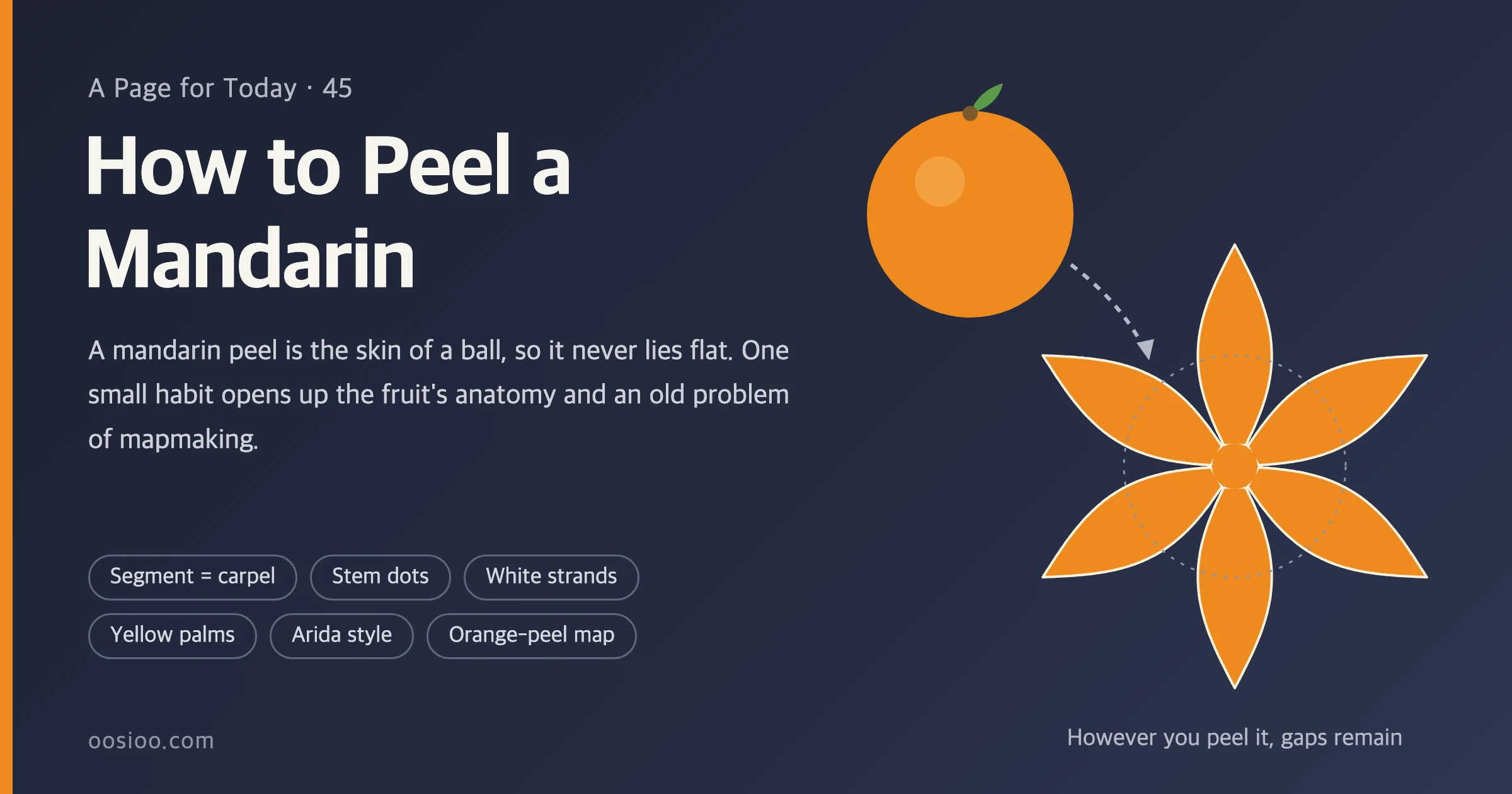
The notebook said: everyone peels a mandarin differently, and laid out flat each peel becomes a different map. Following that small habit of the hands, I look inside the fruit: each segment was once a carpel in the flower; how far the trivia that the dots under the stem cap match the number of segments holds up; what the white threads are and why palms turn yellow every winter; the Arida style of Wakayama, where nearly everyone splits the fruit with the peel on; and Jeju's "university trees," each of which once nearly paid a child's tuition. Finally, Gauss's remarkable theorem and map projections explain why a round peel will never lie flat. A playground lets you unfold the peel in different ways and guess the segment count from the stem dots. The forty-fifth piece in A Page for Today.
The page I opened today was about mandarins.
Everyone peels a mandarin differently. Lay the peel out flat and each one becomes a different map.
Tip a bag of mandarins onto the table on a winter evening and you see it at once. One person drives a thumb into the stem end; another sets a fingernail to the navel on the opposite side. Someone takes pride in peeling the whole skin off in one long ribbon, and someone else opens it into six petals like a flower and sets the fruit on top. A person who strips off every last white thread sits at the same table as a person who cannot understand why anyone would bother. When the fruit is gone, the peels are left on the table. No two have the same shape.
I think the second sentence in the note came from looking at those peels. The shape of something round, opened and laid out. That is the very problem mapmakers wrestled with for several hundred years. So today I started from one small habit of the hands and looked around the inside and the outside of a single mandarin.
Each segment is a room in the flower
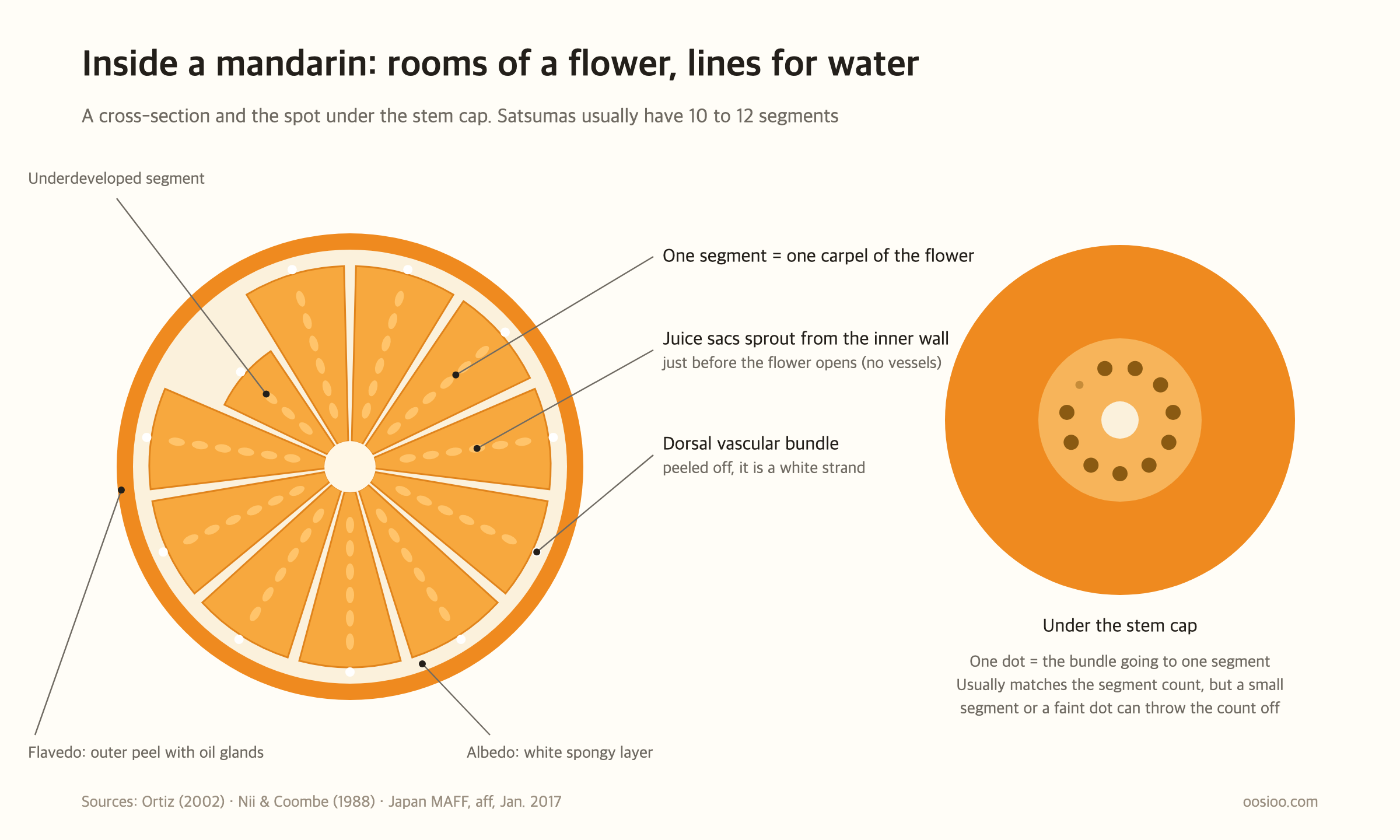
Cut a mandarin in half and the cross-section looks like a wheel. There is a white core in the middle, and thin membranes run out from it like spokes, dividing the segments. That pattern was settled when the mandarin was still a flower.
The base of the pistil at the centre of a citrus flower, the ovary, is made up of several chambers. Each chamber is a carpel. Botanists see the carpel as a seed-bearing leaf folded in on itself, and the citrus ovary forms when a number of these carpels join around a central axis. When the flower drops and the ovary swells, one chamber becomes one segment. Botanists give citrus fruit a name of its own, the hesperidium. The outer wall of the ovary becomes the peel, and the inner wall becomes the juice-filled flesh.
So peeling a mandarin and pulling off its segments one by one is also a way of taking it apart along the flower's blueprint. The satsuma mandarins most of us eat usually have 10 to 12 segments. Even fruit picked from the same tree differ a little in the count, because each flower formed a slightly different number of carpels.
The small grains that fill each segment are juice sacs. These also form in the flower. In 1988 Naosuke Nii of Meijo University in Japan and Bryan Coombe of Australia looked at satsuma juice sacs under the microscope. The sacs began to sprout like hairs from the inner wall of the carpel chamber just before the flower opened. What started as a bump of a few cells divided into a long stalk and a sac, and sugar filled in only after the sac had reached full size.
The interesting part was the stalk. It held no vascular tissue to carry water and nutrients. A vascular bundle runs along the outer back of each segment, but no vessel connects it to the juice sacs. Sugar reaches the sac by crossing, cell by cell, the thin-walled cells of the stalk. What the researchers saw was that the stalk was unusually full of the tiny channels that link one cell to the next. The sweetness that bursts out when you bite a segment was gathered that way, one cell at a time.
Count the stem dots, know the segments?
This is the most famous piece of mandarin trivia. Pull off the stem cap and you see small dots in a ring where it was, and the number of dots is said to match the number of segments. In Japan it has spread widely as a bit of children's science.
In a special feature in its public magazine in January 2017, Japan's Ministry of Agriculture, Forestry and Fisheries presented it as fact. The stem is the passage that links tree and fruit and carries nutrients and water, and since each segment has its own passage, the explanation goes, the dots behind the stem and the segments come out the same.
The anatomy makes it plausible. The juice sac study above took as its starting point the vascular bundle that runs along the back of every segment. If the bundles that come in through the fruit stalk branch inside the fruit and form one spine for each carpel, it is natural for their cross-sections to show up as dots just under the stem. If the dots tell you the number of segments, the flower's blueprint is stamped on the stem end as well.
Still, I decided not to write that it "always" matches, because I could not find a survey that counted hundreds of mandarins and reported how often the two agree. Plenty of articles repeat the claim; very few leave a number for how many out of how many matched when someone actually counted. And real fruit has things that throw the count off. Fairly often one segment is underdeveloped and tucked in very small, and the dots under the stem are not even in size or colour. Skip the small segment when counting segments, or miss a faint dot when counting dots, and the two will disagree.
So it seems more honest to take this one as "close to right in principle, though if you count for yourself you may be off by one now and then." Luckily, checking it costs a single mandarin. A fruit dries out faster once the stem cap is off, so try it only on one you are about to eat.
What the white threads are
When you peel a mandarin, white threads cling to the fruit. Whether you pull them off divides people as much as how you peel.
In Korean these threads are often called gyullak, roughly "mandarin threads." They are the vascular bundles mentioned above. The bundles that run along the back of each segment from stem to navel come away together with the soft white layer on the inside of the peel. That soft layer is called the albedo. It sits between the orange outer skin, the flavedo, and the flesh. Japanese sources often call every white part albedo without telling the two apart. Either way, this is the route that water and nutrients have travelled since the mandarin was a flower.
The claim that they are good for you comes from here. In the same feature, the ministry said these white strands are rich in dietary fibre and contain plenty of substances such as "vitamin P." Vitamin P is an old name, rarely used now, for a group of flavonoids that includes hesperidin. JA Mikkabi, an agricultural cooperative in Shizuoka, also says the albedo contains hesperidin and recommends eating it if the texture does not bother you. I could not confirm in a primary source any figure of the "several times more hesperidin than the flesh" sort, so I leave it out here. And most of what is said about what hesperidin is good for comes from studies of the compound itself, so it is hard to say that eating a few more threads will change anything in your body.
What is certain is that how much thread is left depends on how you peel. The ministry and JA Mikkabi both say the white threads come off more easily if you peel from the stem end. The stem end is where the bundles gather, so if you start there the threads come away with the peel. Start from the navel and more threads stay on the fruit. People who hate the threads and people who want to eat them should, in fact, peel from opposite ends.
Palms that turn yellow every winter
Every winter, when people eat mandarins by the box, someone says their palms have turned yellow. It really happens. Medicine calls it carotenemia; in Japan it is called kanpishō, "citrus-peel skin."
The orange of a mandarin comes from pigments called carotenoids. They dissolve in fat, so when you eat a lot of them they build up in the fatty layer and the outer horny layer of the skin. They show first on the palms and soles, where that horny layer is thick. The dermatology literature treats it as benign and as reversing on its own. It appears only some weeks after heavy eating begins, and when you cut back the colour fades over a few months. The ministry also wrote that it is temporary and not an illness.
There is one thing to tell it apart from: jaundice. In jaundice, from a liver problem, the whites of the eyes turn yellow first. Carotenemia leaves the whites of the eyes alone. Yellow palms with white eyes are likely the mandarins; if the eyes are yellow too, do not blame the fruit, see a doctor.
Among the carotenoids in satsumas, the one that stands out is beta-cryptoxanthin. It is a relative of the beta-carotene in carrots, and satsuma flesh holds an unusual amount of it. In Mikkabi, a mandarin-growing area of Shizuoka Prefecture, a team led by Minoru Sugiura followed local residents for years. The more often people ate mandarins, the higher the beta-cryptoxanthin in their blood, and the researchers considered this level usable as a marker of how much mandarin a person eats. Reports followed that people with higher blood levels had lower risk of several lifestyle diseases, but these are observational studies, so they cannot show that the mandarins prevented the diseases. The researchers themselves wrote that intervention studies are needed.
In short, the yellow on your palms in winter is something like a receipt for all the mandarins you ate. The blood keeps a copy of the same receipt.
Named for Wenzhou, born in southern Japan
Most of what Koreans call gyul is the satsuma mandarin, known in Korea as onju milgam. The "onju" is Wenzhou, a port city in China's Zhejiang Province. But the evidence that this mandarin came from Wenzhou is weak. In Japan the leading account is that it spread from a chance seedling around Nagashima in Kagoshima Prefecture. The horticulturist Chōzaburō Tanaka built that account from old records and field surveys, and it gained support when an old tree was found in the area in 1936. The reading is that the fruit borrowed the name of Wenzhou, a city famous for its citrus. Chinese scientists have proposed a Chinese origin on the basis of genetic analysis, so the question of its home is not fully closed.
That a satsuma has almost no seeds is part of its character too. It strongly tends not to set seed even when pollinated, and it can set fruit without pollination at all (parthenocarpy). Today that is a selling point, but in Edo-period Japan a seedless fruit was linked with the idea of a family line dying out and was avoided, so for a while it did not spread far.
How large a place this fruit once held in Japan shows in the numbers. According to an educational booklet from Ehime Prefecture, Japan's mandarin harvest peaked in 1975 at 3,665,000 tonnes. In the ministry's food balance sheets, mandarin consumption per person in Japan fell from 19.0 kg a year in 1965 to 4.4 kg in 2013. A basket of mandarins on the kotatsu, the heated low table, used to be the picture of a Japanese home in winter; that basket has become a good deal lighter.
The Arida style and two starting points
Now back to the first sentence in the note: the way people peel.
The biggest fork is where you start. The stem end, or the navel on the opposite side? In a survey reported by the Japanese weather company Weathernews, about 70% said they start from the navel end and about 30% from the stem end. The survey did not give a sample size, so the split should not be taken too seriously, but the sense that the navel end is the majority will fit many people's experience. The peel is thinner at the navel and a fingernail goes in easily. At the stem end, as we saw, the white threads come away easily, the hard core in the middle comes out too, and the peel can be used as a small dish just as it is. It is less a question of which is right than of what you want.
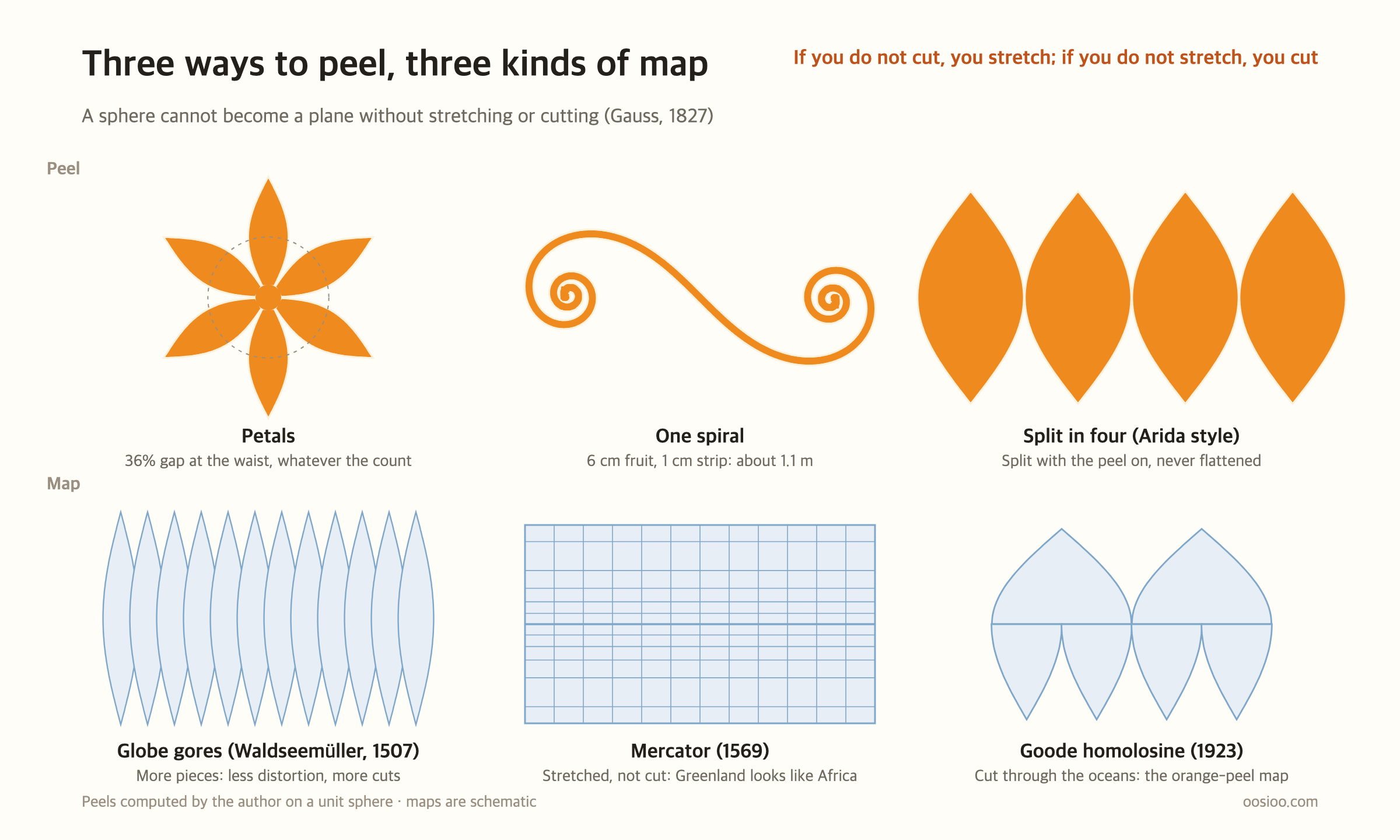
There is also a way that does not peel the skin off at all. It is called Arida-muki, the Arida style, and is said to be common in Wakayama Prefecture, Japan's largest mandarin-growing region; it is also called the Wakayama style. You knead the mandarin a few times by hand to loosen the peel, push your thumbs into the navel end, and split it in half with the peel still on. You split each half again to make four, then pull the fruit from the peel of each piece and eat it. There is no idea of taking the peel off; you split from the start.
JA Arida, the local cooperative, says nearly everyone in the Arida area peels this way. The explanation that comes with it is that it began as a quick way for farmers to wet their throats in the middle of the harvest, but the cooperative says the exact origin is unknown. Try it and you will soon see that it is fast.
The ministry described several other methods besides. Split the fruit into four and then peel each piece from the stem end. Cut off the stem and navel ends and lay the segments out in a single row. That last method treats the mandarin as a cylinder. Once the top and bottom are cut away, the remaining peel becomes a band that opens out almost flat.
I could not find any data showing which way people more often peel in Korea, China or the West. You hear things like "Koreans start at the stem" or "Westerners use a knife," but there are no numbers. Still, the fact that even within Japan there are ways of peeling named after places suggests that how you peel a mandarin is a habit of the hands and also a habit of the neighbourhood.
Why the peel won't lie flat
Whatever way you peel, one thing is shared. The opened peel never lies flat on the table. The edges lift, or it tears, or the gaps between the pieces gape. It is not clumsy hands. Mathematics settled it.
In 1827 Carl Friedrich Gauss proved a theorem in a paper on curved surfaces and named it himself the Theorema Egregium, the "remarkable theorem." It says this: the curvature that measures how a surface bends does not change when you only bend the surface without stretching or shrinking it. Paper has zero curvature, so you can roll it into a cylinder or a cone, but you cannot wrap a ball with it. In the other direction, the surface of a ball does not have zero curvature, so it cannot become a plane without stretching or tearing somewhere. A mandarin peel is the surface of that ball.
A simple calculation shows how badly it fails. Say you split a mandarin from the navel into several strips and open them like petals. If you keep the distance measured along the peel from the navel, the circle at the height of the equator, the mandarin's waist, ends up on the table with a radius π/2 times the fruit's radius. That circle's circumference is longer than the real waist of the peel. As a ratio, the peel can fill only a little over 64% of the circle on the table, and about 36% has to stay empty. That 36% is the same however many strips you cut. More strips make each petal thinner and less distorted, but the total gap stays the same; it is only divided more finely. Conversely, to leave no gap at all you would have to stretch the peel, by 57% at the waist. A mandarin peel does not stretch that far, so it tears.
The person who peels in one long ribbon has picked a different solution. The narrower the strip, the more it behaves like a plane. Divide the area of the peel by the width of the strip and you get its length: peel a mandarin about 6 cm across in a 1 cm strip and the ribbon is a little over a metre long. Lay it on the table and it takes a shape whose two ends curl up like whirlpools, joined by an S in the middle. How much the spiral strip curved across the ball carries over directly into how much it curves on the flat. There is almost no distortion, but the price is a picture broken into one line.
The orange-peel map
Mapmakers held on to this problem for centuries. The Earth is a ball too, and paper is flat. That is why textbooks and lectures on map projection so often bring out a mandarin or an orange peel. Peel it, press it flat, and see where it tears and where it overlaps.
The history of maps reads like a list of ways to peel a mandarin. In 1569 Mercator chose to wrap the globe in a cylinder and unroll it. He made it into a band, like a mandarin with the top and bottom cut off, and as the map stretched sideways toward the poles he stretched it just as much up and down, which kept angles true. It was an excellent map for navigation, but it badly distorts area. Greenland is about one-fourteenth the size of Africa, yet on a Mercator map they look about the same.
The opposite solution is to cut. In 1507 Martin Waldseemüller printed, along with the world map that first carried the name "America," a set of pieces to cut out and paste onto a globe. It is a map of several boat-shaped pieces, pointed at top and bottom, set side by side; in English they are called gores. They have the same shape as a mandarin peel opened into petals. The more pieces there are, the less each one is distorted, and the more the map is broken.
In 1923 the American geographer J. Paul Goode chose the middle way. He kept the continents whole and cut only through the oceans. He split the globe through the North and South Atlantic, the South Pacific and the Indian Ocean, opened it into a few petal-shaped lobes, and kept area exactly true within them. Because of its look, this Goode homolosine projection came to be nicknamed the "orange-peel map." Just as the Arida style splits the fruit into four with the peel on to keep the pieces whole, Goode split the oceans to keep the continents whole. The Dymaxion map that Buckminster Fuller first published in 1943 transfers the globe onto a polyhedron and then unfolds the faces. In the later icosahedral version, that is like carving the peel into twenty pieces and setting them out.
All of these maps live under the same theorem. Keep area and shape goes wrong; keep shape and area goes wrong; keep both and you have to cut somewhere. If you do not cut, you stretch; if you do not stretch, you cut. Whoever peels a mandarin and whoever makes a map chooses one of the two every time.
The island of university trees
Talk about mandarins in Korea and you end up on Jeju, the volcanic island off Korea's southern coast.
Jeju's citrus was long a tribute sent to the king. The Annals of King Sejong list names such as gamgyul, yuja, donggyeong-gyul and cheong-gyul sent up from Jeju, and the album Tamna Sullyeokdo, left by the Jeju magistrate Yi Hyeong-sang in 1702, includes a scene called "Gamgyul Bongjin," the sealing and sending of the citrus tribute. The more precious the fruit, the heavier the burden. Entries worrying about the hardship the tribute caused the people appear again and again in the annals under King Sejong and King Seongjong. When the tribute system was abolished in 1893, the old orchards disappeared quickly.
The satsuma, which now fills Jeju's orchards, arrived in the twentieth century. There is a record that Émile Taquet, a French priest (Korean name Eom Taek-gi) who did mission work and collected plants on Jeju from 1902, received a few satsuma seedlings from Japan in 1911 and planted them. In Korea the story is told that he got fourteen of them in return for sending Jeju's native cherry trees to an acquaintance in Japan, and that one of the fourteen still stands in Seohong-dong in Seogwipo.
Mandarins became Jeju's money after the 1960s. There was a time when the trees were called "university trees," meaning that if you grew a few of them well you could send a child to university. Jin Gwan-hun of the Jeju Cultural Heritage Research Institute left a calculation. In 1968, 10 kg of mandarins sold for 2,398 won and a mature tree yielded 60 to 70 kg, so one tree earned roughly 14,000 to 16,000 won a year. That year's tuition at Seoul National University was said to be around 14,000 to 30,000 won, so one tree nearly paid one round of university fees.
Things are different now. According to a survey by the Jeju Agricultural Research and Extension Services and the island's citrus outlook committee in August 2026, this year's open-field mandarin harvest was expected to come in at around 443,000 tonnes. Last year's harvest was 410,900 tonnes. Open-field orchards cover 13,972 hectares, down more than 40% from over 24,000 hectares around 2000. Even so, gross income from all of Jeju's citrus is said to have topped one trillion won three years running from the 2021 crop. The days when one tree paid for university are gone, but the mandarin is still the fruit that holds up the island's household budget.
Open-field mandarins are in season from late autumn through winter. Unlike greenhouse fruit they ripen in the open sun and wind, so their flavour and size shift each year with the summer weather. December, when this piece goes out, is the height of it.
Try it yourself
In the playground below you can open the peel yourself. The first tab, "Unfold the peel," offers three ways. With petals you can change the number of strips from 3 to 12, and see that as the strips multiply each petal is less distorted while the 36% gap at the waist stays the same. With one spiral, changing the strip width changes the length and shape of the opened ribbon. Split in four shows the shape of four pieces split with the peel on, as in the Arida style. In the second tab, "Count the stem dots," you count the dots at the stem end, pick a segment count, and then cut the fruit to check. Now and then a mandarin with a small underdeveloped segment turns up.
In closing
Back to the line in the note. Everyone peels a mandarin differently, and laid out flat each peel becomes a different map.
Following it today, the line turned out to be more exact than I expected. The person who opens the peel into petals has made globe gores; the person who peels in one long ribbon has reduced distortion at the cost of breaks; and the person who splits the fruit with the peel on, as they do in Arida, has kept the pieces whole and given up the rest. No method lays the peel flat. Gauss proved in 1827 that it cannot be done. So there is no right answer to how to peel a mandarin, only a choice of what to keep and what to give up. What mapmakers worried over for centuries, we settle in a few seconds every winter evening.
Inside the peel there was a blueprint too. A segment was a room in the flower, the white threads were the routes that carried water and nutrients to it, and the dots under the stem were the entrances to those routes. The yellow on your palms is the mark left in your own body by the pigment those routes carried. In the few seconds it takes to peel a mandarin, your hands touch the flower's blueprint and an old problem of maps at the same time.
Next time you peel one, it might be nice to lay the peel out on the table before throwing it away. Where did it gape, where did it lift? That shape is the map you chose that day. Then pull off the stem cap, count the dots, and count the segments. If they match, you have read the flower's blueprint; if not, a small segment is probably hiding somewhere.
A Page for Today is a series in which I open my idea notebook to a random page and lay that day's thoughts on the line I find there. Today's line was "Everyone peels a mandarin differently. Lay the peel out flat and each one becomes a different map."
- The body of the fruit: J. Janick, Citrus (Purdue Tropical Horticulture Lecture 32, 2005) · J. M. Ortiz, Botany: taxonomy, morphology and physiology of fruits, leaves and flowers, in G. Dugo, A. Di Giacomo (eds.), Citrus: The Genus Citrus (2002), pp. 16–35 · N. Nii, B. G. Coombe, J. Japan. Soc. Hort. Sci. 56(4), 1988, pp. 375–381
- Stem dots, white threads, yellow palms: Japan Ministry of Agriculture, Forestry and Fisheries, aff, January 2017 feature on mandarins · Weathernews, "Peel from the stem side or the bottom side?" (Jan. 12, 2025, quoting JA Mikkabi and JA Arida) · J. M. Haught, S. Patel, J. C. English, J. Am. Acad. Dermatol. 57(6), 2007 · N. Maharshak et al., Int. J. Dermatol. 42(3), 2003 · M. Sugiura et al., Mikkabi cohort studies (Nutr. Metab. Cardiovasc. Dis. 2016 and others)
- The satsuma and mandarins in Japan: Japanese Wikipedia, "Unshū mikan" (Tanaka Chōzaburō's Nagashima origin, the 1936 old tree) · Ehime Prefecture educational booklets on mandarin growing and daily life (citing MAFF food balance sheets)
- Spheres and maps: C. F. Gauss, Disquisitiones generales circa superficies curvas (1827) · J. P. Snyder, Flattening the Earth (1993) · J. P. Goode, Annals of the Association of American Geographers 15(3), 1925 · M. Waldseemüller, globe gores (1507) · R. B. Fuller, Dymaxion map (1943)
- Jeju citrus: Annals of King Sejong · Yi Hyeong-sang, Tamna Sullyeokdo, "Gamgyul Bongjin" (1702) · Jeju Agricultural Research and Extension Services and Citrus Outlook Committee, second open-field mandarin survey of 2026 (reported by Financial News, Sept. 8, 2026) · Jin Gwan-hun, column on the "university tree" (Jeju Nuri, Nov. 27, 2025)