How Hot Does a Grinder Get?
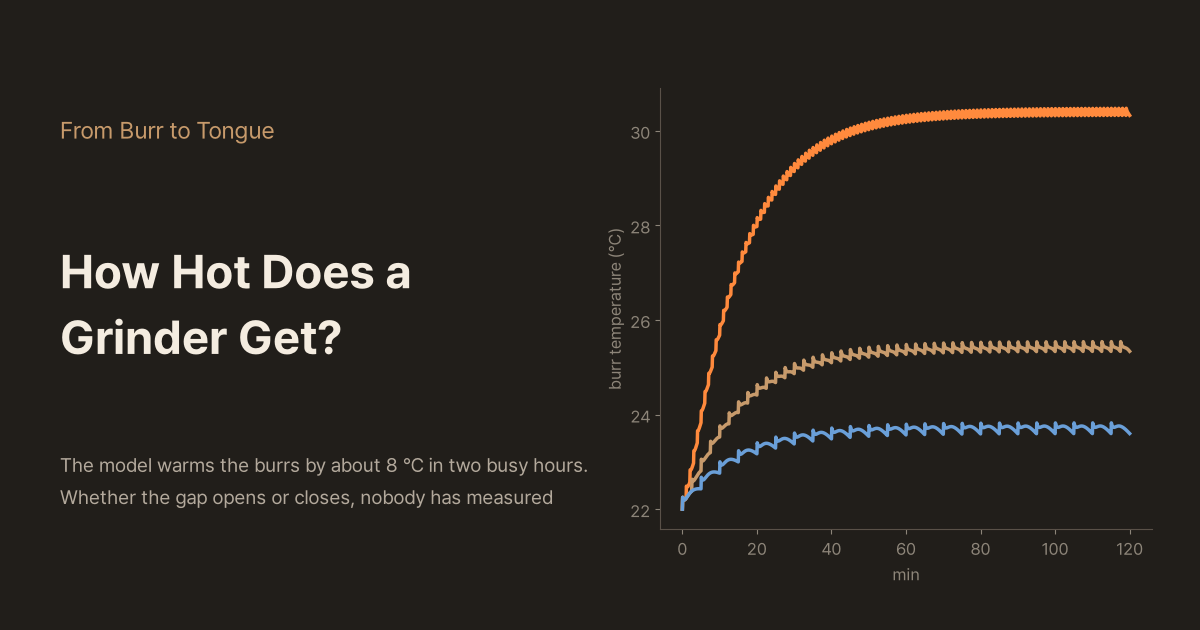
Cafés tighten the grind as the afternoon goes on: is a warm grinder the reason? I found no public record of burr temperature during service, nor of the gap on warm burrs. Fitting a thermal network to the only two measured points (+12 °C in the grounds after ten minutes of continuous grinding), a shot a minute for two hours warmed the burrs by about 8 °C. A 3 µm gap shift changes espresso shot time by a little over 2%, but whether the gap opens or closes depends on the grinder's build. With a heat calculator.
Baristas in busy cafés are said to tighten the grind little by little as the afternoon goes on, because shots start running faster. The usual reason given is that the grinder warms up. Some say hot burrs make coarser grounds; others say the steel expands and closes the gap. How hot does a grinder actually get, and how much does that change the grind?
The short version: there is surprisingly little measured data. I found no public record of burr temperature over time during service, and none of the gap measured on warm burrs. Fitting a thermal network to the two measured points that do exist, grinding a shot a minute for two hours warmed the burrs by about 8 °C. That could move the gap by about 3 µm and change espresso shot time by a little over 2%. But the direction depends on how the grinder is built, and nobody has measured it.
What has been measured
A coffee bar in Rome · Photo: Wilfredor, Wikimedia Commons, CC0
The most concrete measurement comes from a 2004 application note by Pico Technology. An unnamed roastery employee attached four thermocouples to an unnamed commercial grinder: at the grinding-chamber outlet (the grounds coming out), on the motor, on the case next to the motor, and in the beans in the hopper. In a room held at 28 °C, grinding non-stop for ten minutes raised the temperature of the grounds coming out by about 12 °C. Stopping after a little over 4.5 minutes (just under 1 kg) kept the rise to 4 °C. Commercial grinders are designed to rest about 70% of the time (a duty cycle of about 30%), but in the morning a kilogram may be ground in one go to fill the doser, which is why they measured it. The note also says that "most of the temperature rise in the motor case did not pass into the grinding chamber within the ten minutes".
Kaffeemacher in Switzerland tests grinders by grinding 18 g five times with 20-second pauses and measuring the temperature of the grounds. They rate below 30 °C as excellent, 30–35 °C as good, 35–39 °C as average and above 39 °C as poor, based on their own tasting. One grinder (the Zuriga G2) averaged 40.2 °C over six grinds 30 seconds apart. Uman and colleagues (2016) went the other way, cooling the grinder for ten minutes between grinds to remove the effect of burr temperature. The sentence in their conclusion that "tightening the grind through the day results from the burrs warming up" is a guess, not a measurement.
The industry has already built products that manage burr temperature. The Clima Pro version of the Victoria Arduino (Nuova Simonelli) Mythos, launched in 2013, uses a heater to bring the burrs to 35 °C in about ten minutes from cold and runs two rear fans above 45 °C, holding 35–45 °C. Rather than keeping the burrs cold, it keeps them warm and steady from the start.
How much heat is made?
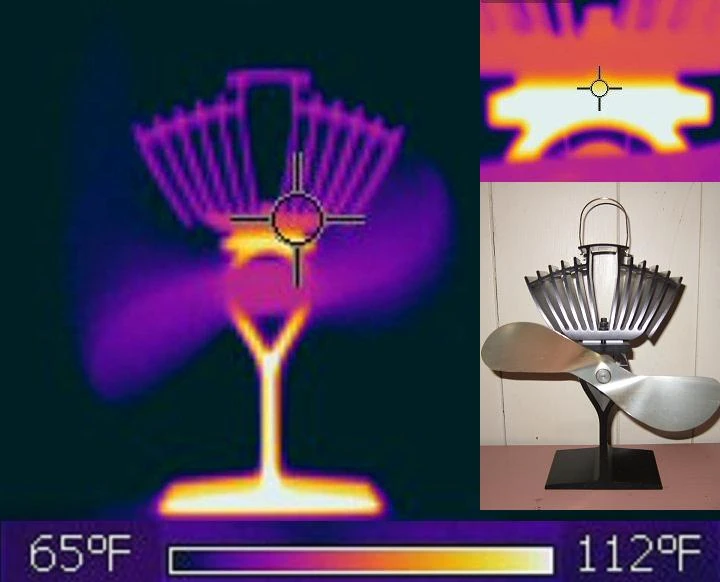
The temperature of an object seen through a thermal camera · Photo: Zaereth, Wikimedia Commons, CC0
Dividing a grinder's rated power by its grinding rate gives an upper limit on the energy that could go into each gram. An EK43 is rated at 1,300 W for 19–21 g per second, about 65 J per gram; a Mahlkönig E65S is 440 W for 4–7 g per second, 63–110 J. If all of that went into the grounds, they would warm by more than 40 °C (taking the specific heat of roasted coffee as about 1.4 J/K per gram). The grounds actually warm by only a few degrees, so either real power use is far below the rating or most of the heat goes into the motor and body.
The size of the vessel that holds the heat matters too. An EK43's 98 mm burr set weighs about 0.6 kg; multiplying by the specific heat of steel, it takes 290 J to warm it by 1 K. An 18 g dose of grounds takes 25 J. Warming the burr set takes as much heat as eleven doses of grounds. Add the burr carrier and body, and the grinder takes minutes to tens of minutes to warm up.
A model fitted to two points
I built a network in which heat flows between four nodes: motor, body, burrs and grounds. Each grind produces motor losses, and grinding work between burrs and beans. Half the grinding work goes straight into the grounds and half into the burrs. As grounds pass the burrs, they take away part of the temperature difference. The body and burrs lose heat to the air. The only measurements to set the values are the two points from the Pico case study (+4 °C at 4.5 minutes, +12 °C at 10 minutes), so the network's parameters are fitted to those two points.
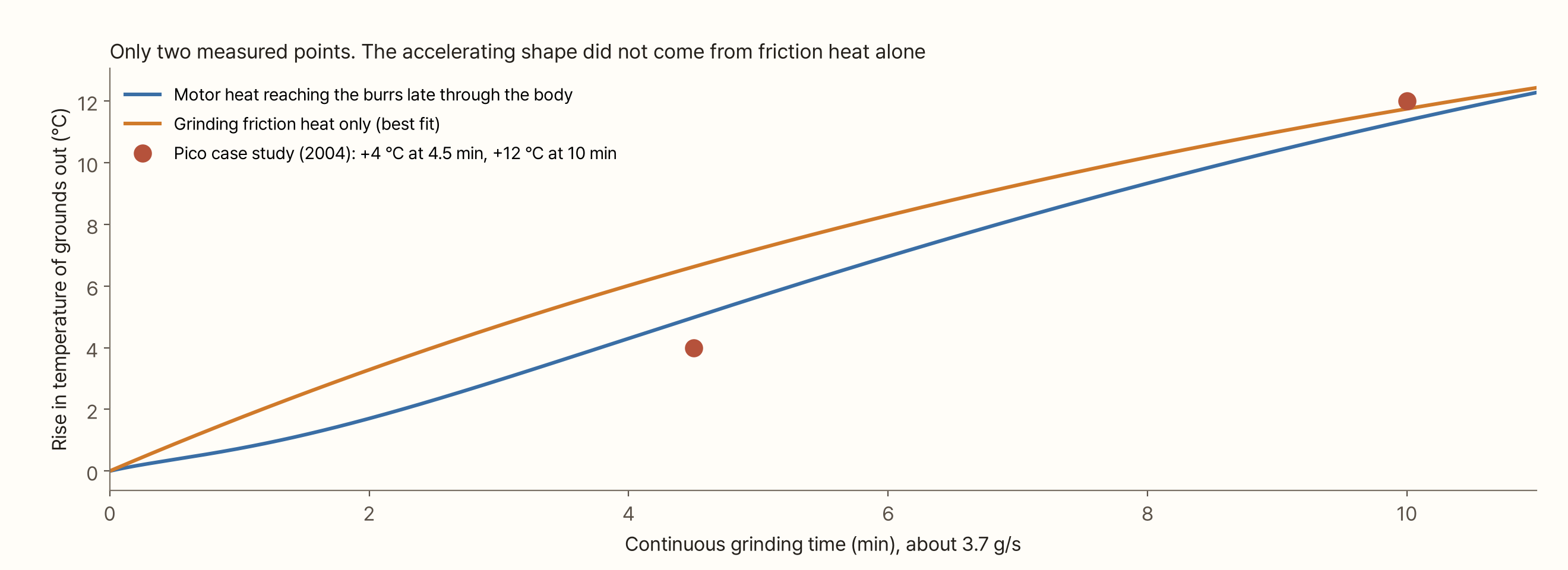
A network with only friction heat from grinding could not fit both points. Friction heat warming the burrs makes the temperature rise quickly at first and then level off, while the measurement went the other way: 4 °C at 4.5 minutes and 12 °C at 10, getting steeper. That shape needs a heat source that arrives late. A network in which motor heat reaches the burrs through the body did fit both points (5.0 °C and 11.4 °C). Yet the Pico note said most motor heat did not reach the grinding chamber within ten minutes. Two points are not enough to tell the heat sources apart. The calculations below use the network that fits both points, but its values are fitted to this one grinder and will differ between grinders.
Two hours in a café
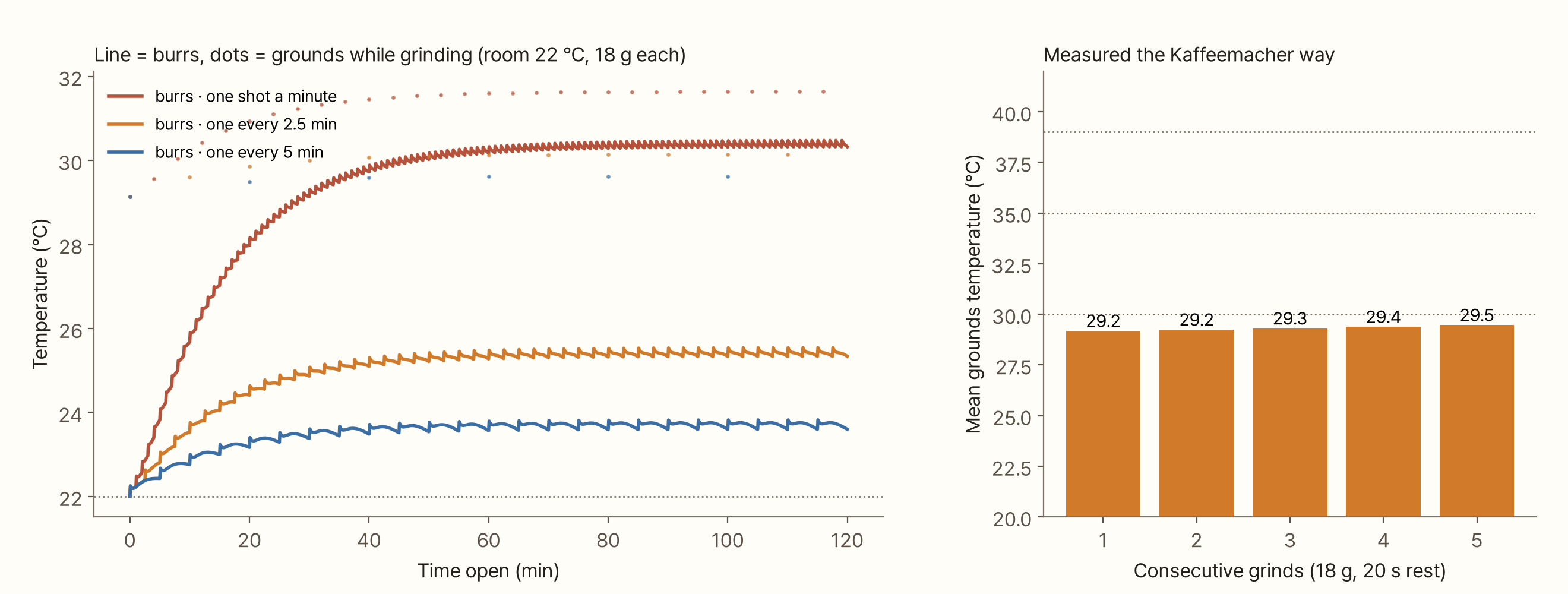
I ground 18 g at a time for two hours at a room temperature of 22 °C. At one shot a minute, the burrs warmed steeply for about 40 minutes and levelled off 8.3 °C up. At one every 2.5 minutes they rose 3.3 °C, and at one every 5 minutes 1.6 °C. At a shot a minute, the grounds coming out were about 31.6 °C. About 7 °C of that is the grinding work warming the grounds directly; the warm burrs add only a little over 2 °C. Grinding five times in a row the Kaffeemacher way warmed the grounds only slightly, from 29.2 to 29.5 °C. Five grinds are too few to warm the burrs; this test measures the heat made by grinding, not the burrs.
How much do warm burrs change the gap?
Steel expands 11–12 µm per metre per degree and aluminium about 23 µm. A single 10 mm burr warmed by 20 °C gets 2.3 µm thicker. What actually sets the gap, though, is not one burr but the whole loop of shaft, burr carrier, body and adjusting screw, and how it expands. If that loop had 30 mm of aluminium against 30 mm of steel, the difference in their expansion at 20 °C would be about 7 µm. Whether that difference opens or closes the gap depends on which material sits where.
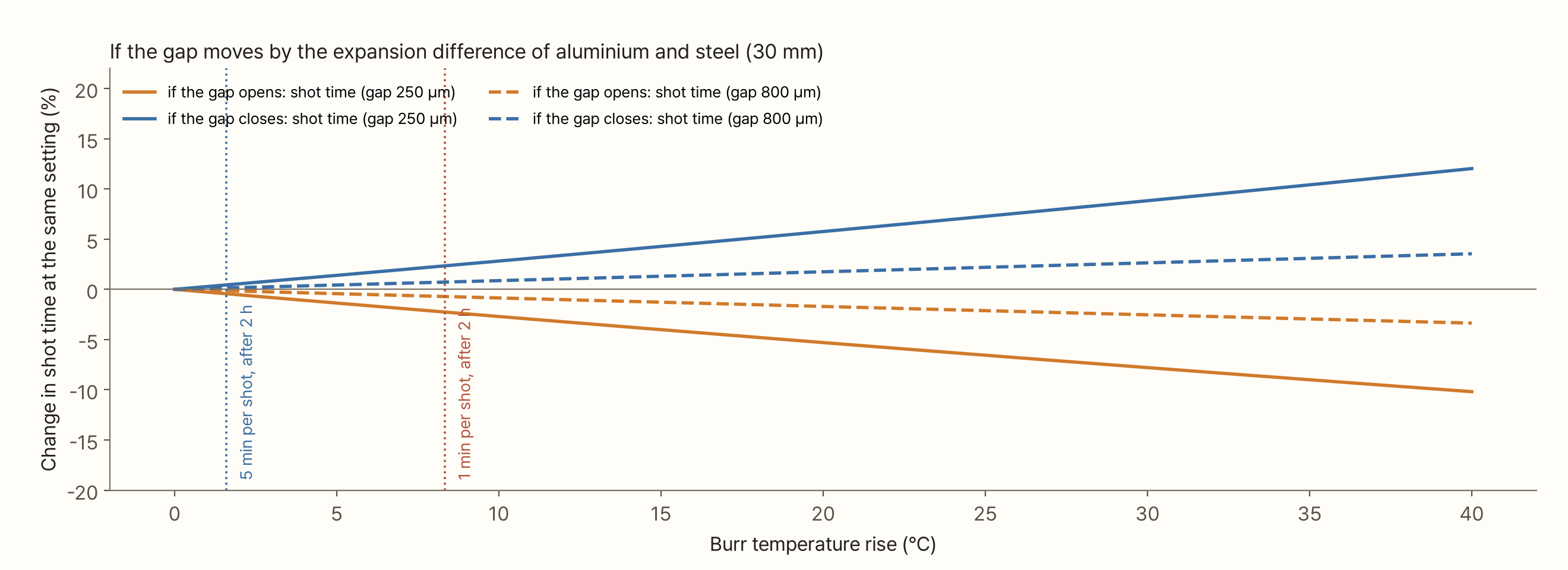
Assuming such a loop, burrs warmed by 8.3 °C after two hours of a shot a minute move the gap by 2.9 µm, 1.1% of a 250 µm espresso gap. If particle size scales with the gap and puck permeability with particle size squared, shot time at the same setting gets 2.3% shorter or longer: 0.6 seconds on a 25-second shot. Burrs warmed by 20 °C would move it 7 µm, changing shot time by 5–6%. At a filter gap (800 µm), the same movement matters three times less.
Baristas' experience is that "warm grinders run faster (coarser)". Others, from simple expansion arithmetic, say the burrs thicken and the gap closes. An article in Australia's Bean Scene reportedly argues that the gap stays the same and the distribution changes because beans break differently with temperature; I could not open it and confirmed it only through a search summary. Running last episode's observation by Uman and colleagues in reverse (cold beans grind finer), warm burrs might warm the beans and grind them coarser. Whether the moving gap or the changed breakage matters more can only be known by measuring the gap and the grounds together.
Calculate it yourself
The calculator below runs the network above. Change the time between shots, dose, grinding rate, room temperature, hours open and gap, and it shows the burr and grounds temperatures over time, the final change in gap and the resulting change in shot time.
What this conclusion leaves out
- There are only two measured points. The Pico grinder's model and raw data are unknown. The network's parameters are fitted to those two points, and I could not tell which heat source (motor or grinding friction) dominates
- There is no in-service record of burr temperature. The masses of the burr carrier and body and the heat transfer of the air inside the chamber are rough estimates
- The direction of the gap change is unknown. The 30 mm aluminium–steel loop is an assumption to get a sense of scale
- Changes in breakage with bean temperature are not included. As the last episode showed, their size and direction are still uncertain
- The shot-time calculation is simple. It assumes particle size scales with the gap and permeability with size squared, leaving out fines and puck compaction
- Aroma is not covered. Claims that hot-ground coffee loses more aroma are common, but I found no quantitative data
Summary
- Public measurements are scarce. In the Pico case study (2004), ten minutes of continuous grinding warmed the grounds by 12 °C, and 4.5 minutes by 4 °C. Kaffeemacher measures grounds temperature over five consecutive 18 g grinds and rates above 39 °C as poor
- The energy per gram from rated power (63–110 J) would warm grounds by more than 40 °C if it all went into them, but the real rise is a few degrees. A burr set holds as much heat as eleven doses of grounds
- Friction heat alone did not reproduce the measured "steeper later" shape; a heat source that arrives late is needed
- In the model fitted to the two points, a shot a minute for two hours warmed the burrs by 8.3 °C; a shot every five minutes, by 1.6 °C
- Assuming a 30 mm aluminium–steel loop, 8.3 °C moves the gap by 2.9 µm (1.1% of an espresso gap) and changes shot time by 2.3%. The direction depends on the grinder's construction, and nobody has measured it
References
- Pico Technology (2004). Espresso coffee grinder testing. link
- Kaffeemacher. Test protocol espresso grinders. link
- Uman E et al. (2016). The effect of bean origin and temperature on grinding roasted coffee. Scientific Reports 6, 24483. doi:10.1038/srep24483
- Sprudge (2013). Article introducing the Nuova Simonelli Mythos Clima Pro. link
- Mahlkönig EK43 specifications. link; Mahlkönig E65S product sheet
- Pignatone M et al. (2026). Effects of coffee bean thermal treatments on particle size distribution and espresso bioactive compounds. Applied Sciences 16(10), 4886. doi:10.3390/app16104886 — abstract only; grinder power figures not checked in the full text
Image credits
- Coffee bar in Rome: Wilfredor, Wikimedia Commons, CC0
- Thermal image: Zaereth, Wikimedia Commons, CC0
- All other charts, the cover and the calculator: made by me

