
The One Who Gives First (1) — Why People Start Out Guarded
Relationships come down to give and take. But people are wired to be wary of strangers. Let's talk about the first key to getting past that wall: the science of reciprocity.
After talking about how to convey value, I want to turn to relationships. Conveying value well doesn't make a relationship on its own. A relationship is give and take, and a good relationship is one where both sides come out ahead. In Korean we call this hohye (互惠): "mutual" plus "benefit." Reciprocity.
People start out guarded
There's a reason we care so much about shared schools, hometowns, and family ties. Learning that someone went to the same school or grew up in the same town makes us trust them a little more. Inside those circles, betrayal costs you your reputation, so people don't break relationships lightly. But most of the people we meet in real life come with no such guarantee. A new teammate, a new vendor, a gathering you're attending for the first time, the neighbors on a street you just moved to. You have to start a relationship with someone you have no connection to at all.
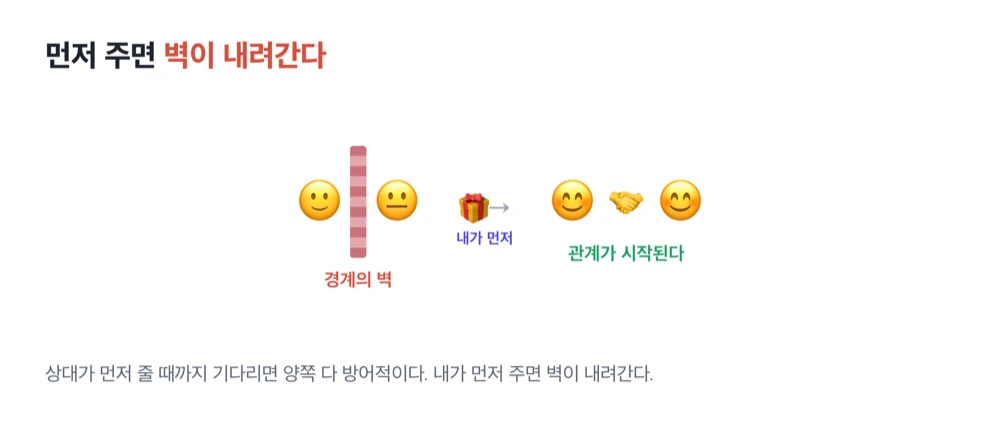
The trouble is that people are built to be wary of strangers. Ask for some data and you get a look that says, "You're just in it for yourself." Propose a collaboration and you can sometimes feel the suspicion: "What are they really after?" That wariness isn't a bad thing. It's natural. But if it lasts forever, nothing ever gets started.
Receive something, and you want to repay it
Still, this wall has an old crack in it. When people receive something first, they want to pay it back.
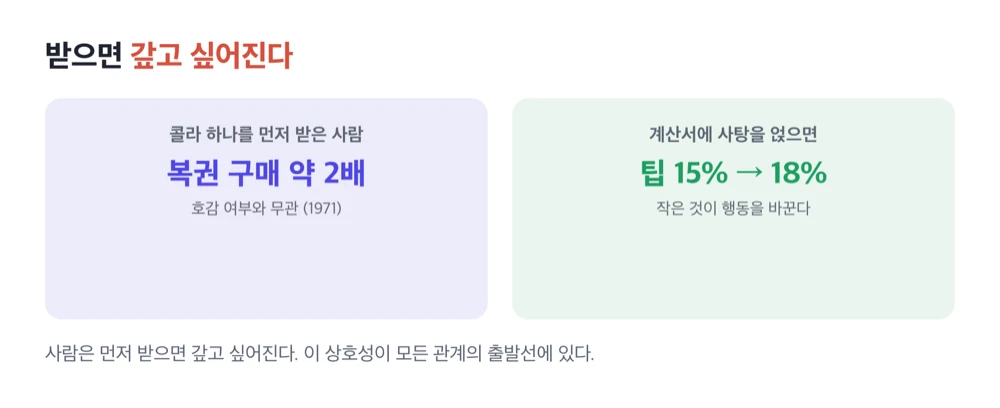
Consider an experiment from 1971. Partway through the study, one participant stepped out for a moment, came back with two Cokes, and handed one over. Later, when he asked for help selling raffle tickets, the people who had received a Coke bought about twice as many tickets as those who hadn't. Interestingly, it made no difference whether they liked him. It wasn't affection at work but reciprocity: "I received something, so I should give back." Another study found that placing a single piece of candy on a restaurant check raised tips from 15% to 18%. One small thing changes how people behave.
Some people have made reciprocity a principle for living. An American writer known for connecting people put it this way: the real currency of networking is generosity, not greed. Give before you try to get anything, and don't keep score of who gave what. With that one principle, he connected with countless people, and whenever he needed help, there was always someone ready to reach out first. In the end, the key that opened the door to relationships wasn't careful calculation. It was a hand extended first.
In fact, reciprocity isn't one person's strategy. It's a norm humanity has shared for a very long time. Handing your business card over first when meeting someone new, neighbors trading labor and returning the favor at harvest, remembering a gift and giving one back: customs like these exist across cultures. Giving first, then, isn't some unusual social tactic. It's simply taking the first step on a path that already runs between people.
Wariness and reciprocity. Both stand together at the starting line of every relationship. The other person is guarded at first, but once they receive something, they want to repay it. That narrows the answer down to one thing: I give first.
In the next post, I'll talk about what the cheapest yet most valuable thing to give first might be.