
Before Guessing at an Unsolved Murder
My notebook said: look into an unsolved murder where you live and guess how it unfolded. Speculating about a real case can wound victims' families all over again, so instead of guessing I followed the numbers, the timelines and the technology. Why 86% of Korea's 274 unsolved murders since 1998 date from 2000–2008, a study showing half of solved cases are solved within a week, cases cracked twenty years on by DNA and fingerprints, and a falsified forensic report that sent an innocent man to prison for nearly twenty years. I also weigh what digital forensics, CCTV and AI monitoring, genetic genealogy and face recognition add and what they cost, with an interactive fictional case that shows which evidence time erases and technology revives. The twenty-sixth piece in A Page for Today.
The page I opened today held this sentence:
Look into an unsolved murder that happened where you live. Guess how the case might have unfolded.
I hesitated for a long time after reading it. Seoul and the area around it have more than a few unsolved murders. Some are cases everyone knows by name. In some, there was a suspect but not enough evidence to bring them to trial; in others, the suspect left the country. A few searches bring up case summaries, scene photos and endless amateur theories.
But every one of those cases has a person who actually lost their life, and a family who still remembers them. The moment I write on a blog that "it probably happened like this," that guess becomes another wound for someone, and an unfounded suspicion hanging over some neighbour. So today I changed the assignment a little. Instead of guessing about a particular case, I decided to follow the numbers, the timelines and the technology behind how unsolved cases are made and how they get solved.
The rules I set before guessing
First I set myself a few rules.
One: I won't speculate about real cases that are still under investigation. Two: I won't use victims' names; cases are referred to only by place and year. Three: the cases I use as examples are ones settled by a court ruling, a confession or an official announcement. Four: when I want to imagine how a case might have unfolded, I use a made-up case, not a real one.
There is a reason to be this careful. Right after the 2013 Boston Marathon bombing, users of an online community set out to find the bombers by combing through photos. They pointed at the wrong people, and the community's managers ended up apologizing publicly. Even sleuthing that starts with good intentions can upend someone's life when it's wrong. Investigators get it wrong too; I'll come back to that.
How many murders go unsolved?
Korea is among the countries that solve murders well. Between 2011 and 2019, the clearance rate for completed murders reportedly averaged 98%. Japan's murder clearance rate was 95.6% in 2023. In the United States, by contrast, the murder clearance rate was 61.4% in 2024, after falling as low as 49.4% in 2021; in 1965 it was around 90%. The nonprofit Murder Accountability Project counts more than 250,000 homicides since 1980 for which no one has been charged. In England and Wales, of 522 homicides in the year to March 2025, 26% had no suspect charged as of December 2025 (including cases still under investigation).
Each country measures "solved" with a different yardstick, so the numbers can't simply be lined up. Still, unsolved murders in Korea are clearly rare. And because they are rare, they linger.
According to a news report on National Police Agency data submitted to the National Assembly, 274 murders committed since 1998 remain unsolved. What's interesting is when they happened. Of the 274, 235 (86%) occurred between 2000 and 2008. Only 6 occurred between 2013 and 2021. In 2019 figures, of 268 long-unsolved murders, 59 were in Seoul, 37 in southern Gyeonggi and 14 in northern Gyeonggi: 110 in Seoul and Gyeonggi combined, about 41% of the total. My notebook's hunch that there would be unsolved cases near where I live turns out to be right.
I can't pin the cluster in the early 2000s on any single cause. But the timing lines up. Korea's first crime-prevention CCTV was five cameras installed in Nonhyeon-dong, Gangnam, Seoul, in December 2002. The law creating a database of offenders' DNA only took effect in July 2010. Mobile phones were widespread, but smartphones hadn't arrived. People left far fewer digital traces than they do now.
Cases that get solved, get solved fast
I wanted to know the usual timeline on which cases get solved. Unfortunately, I couldn't find a Korean study of how long murders take to solve. The study cited most often is a 1999 study by Wellford and Cronin, supported by the US Justice Department's National Institute of Justice (NIJ).
The team followed 798 homicides from 1994–95 in four US cities. Of the 589 that were solved, half were solved within a week, and 93.2% within a year. Fewer than 7% were solved after more than a year. The researchers identified 51 factors associated with clearance, 37 of them within police control. For example, when detectives reached the scene within 30 minutes, the case was more likely to be solved. What gets collected in the first investigation, and how quickly, goes a long way toward deciding a case's fate.
You'll often see the claim online that "if a case isn't solved in 48 hours, the chance of solving it halves." I couldn't find the study behind that claim, so I'm not using it here.
An unsolved case, then, is one that missed its best time: the first few days and the first year. After that, time is not on the investigator's side.
What time erases, and what technology revives
Time erases evidence. Witnesses' memories fade and blend with what they heard from others. Neighbours move away; elderly witnesses die. CCTV footage is overwritten once its retention period ends. The call logs and cell-tower records that phone carriers keep disappear after 12 months.
Technology, on the other hand, revives some evidence. Traces that couldn't be read at the time can be read years later. There's a condition, though: the trace has to have been kept somewhere, not thrown away.
I built an interactive page so you can watch these two forces cross, using a made-up case. Late one night someone is found dead in an alley, and investigators collect a cigarette butt and bloodstains, a smudged partial fingerprint and statements from neighbours. It has nothing to do with any real case. Pick the year it happened (1995, 2003, 2012 or 2024) and when to look at it again, and the state of six clues changes.
Look at the 1995 case again in 2010, and none of the six items is usable. DNA can be extracted from the evidence, but there's no database to check it against, and above all, the 15-year statute of limitations runs out that very year. If the same case had happened in 2003, it's a different story. Look at it in 2026, and DNA re-extracted from the kept evidence can be checked against the database, the smudged fingerprint can be tried again with new methods, and there is no time limit.
Cases solved twenty years later
The rules of the interactive page come from cases that were actually solved.
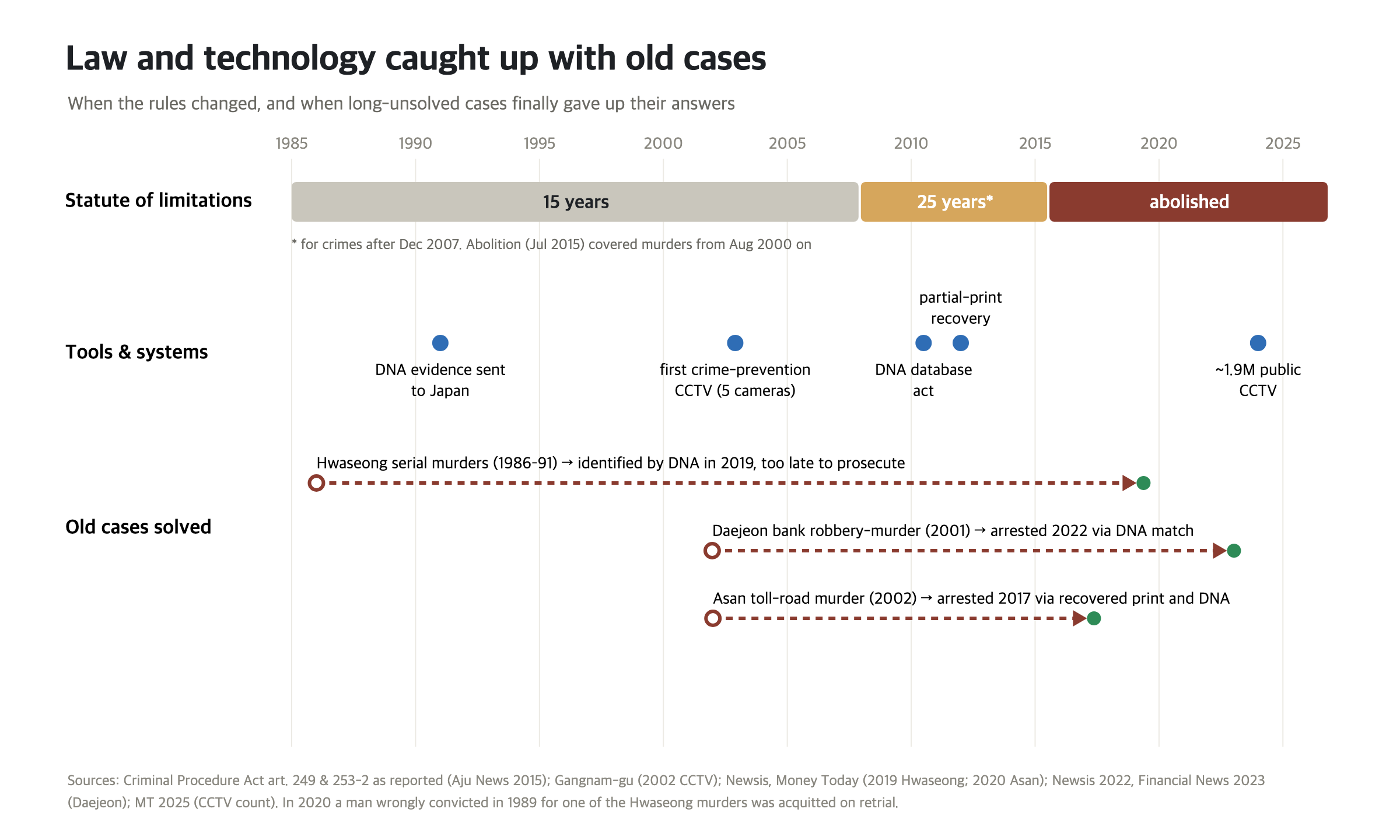
The Hwaseong serial murders (1986–1991). This was Korea's longest-unsolved case. Around 1991, investigators sent evidence to Japan for DNA testing, because such testing was still hard to do in Korea. In July 2019, police sent the stored evidence to the National Forensic Service again. The newly extracted DNA matched a man already serving a life sentence for another crime, and he confessed. But the statute of limitations had long expired, and he could not be put on trial.
The Asan Gaengti Pass murder (2002). Investigators had collected 62 highway toll tickets. The partial prints on four of them were too faint to read with the technology of the time. In 2012, improved fingerprint methods recovered a print from one of them. An accomplice's DNA matched DNA from blood on the victim's seatbelt and from a cigarette butt, and the killers were caught in 2017. It took 15 years.
The Daejeon bank robbery-murder (2001). A handkerchief and a mask were found in the car the robbers abandoned. When this evidence was re-tested in 2017, the DNA matched DNA found in 2015 at an illegal gaming room in North Chungcheong Province. Following that lead, the killers were arrested in August 2022, 21 years after the crime, and their sentences became final in 2023.
The three cases have something in common. One part is new technology. The other is less visible: someone kept the evidence. Because people held on to 62 toll tickets and a single handkerchief for nearly twenty years, the new technology had something to work on.
The law changed too. The statute of limitations for murder in Korea was originally 15 years. It was extended to 25 years in December 2007, and abolished in July 2015 by what's known as the "Taewan Act." The law also applied to cases whose limit had not yet run out, so murders committed on or after 1 August 2000 can still go to trial if the killer is found. The 1999 case the law was named after had already expired, so it never benefited. Police set up dedicated cold-case teams in December 2011 and said that by 2019 they had solved 52 serious violent cases, including murder, robbery and rape.
When technology gets it wrong
The same Hwaseong case has another side. A man convicted in 1989 of the eighth murder spent nearly twenty years in prison. After the real killer confessed to that murder too in 2019, a retrial was held, and in December 2020 the court acquitted him. It found that the forensic report used to convict him had been falsified. That, too, had been called "scientific investigation."
Technology still gets it wrong. In January 2020 in Detroit, a man was arrested in front of his wife and daughters on the strength of a false match from facial recognition software. It is known as the first publicly reported case of a wrongful arrest caused by a face recognition error. Under a 2024 settlement, Detroit police can no longer arrest anyone based on face recognition alone. The Los Angeles police dropped a program that claimed to predict where crime would happen in 2020; even an internal audit found too little data to judge whether it worked.
The more power a technology has to find the guilty, the more power it has to point at the innocent when it's wrong. That's why the procedures for double-checking its results matter as much as the technology itself.
Why crime isn't falling dramatically
With this many CCTV cameras and phones recording everything, why isn't crime falling more visibly? Figures from the Supreme Prosecutors' Office show murders, including attempts, falling from 1,390 in 2009 to 692 in 2021, then rising slightly to 801 in 2023 and 806 in 2024. About two-thirds are attempts; cases in which someone actually died number around 300 a year.
Look closely at the numbers and you see places technology struggles to reach. According to a news report, of the 276 people arrested on murder charges in 2024, 131 (47.5%) targeted family members or relatives such as a spouse, parent or child. In England and Wales, 40% of adult female homicide victims were killed by a current or former partner. Many murders happen not in alleys but at home, not between strangers but between people who know each other. In such cases the killer is usually found quickly, but CCTV can't prevent them.
On the other hand, "abnormal-motive crimes," in which people with no connection to the offender are targeted, shake society badly but are few in number. Since police defined the category in 2023, they have counted 46 such crimes in 2023, 42 in 2024 and 39 in 2025, of which 45 across the three years were murders or attempted murders. Compared with some 800 murders a year, that's a small share.
So investigative technology alone isn't enough to reduce crime. Reaching isolated people, families worn out by caregiving, and people whose treatment has lapsed is not something a camera can do for us.
What the tools add, and what they cost
Still, investigative technology keeps advancing. I've summarized eight of these tools in the third tab of the interactive page. A few stand out.
DNA databases. In the ten years after Korea's law took effect in July 2010, 6,221 cases were reportedly reopened because of DNA matches. But the database covers only about 0.5% of the population, far less than the roughly 5% in the US. Whose DNA should be kept, and for how long, is still debated.
Investigative genetic genealogy. In 2018 in the US, the "Golden State Killer," who murdered 13 people in the 1970s and 80s, was found when investigators uploaded crime-scene DNA to a public genealogy site, located distant relatives, and worked back through family trees to narrow down the killer. Since then, depending on the count, hundreds to more than a thousand US cold cases have been solved this way. But none of the relatives searched ever consented. In 2019 the US Justice Department issued a policy limiting the method to violent crimes and the identification of unidentified remains.
CCTV and AI monitoring. Korea's public CCTV cameras grew from 1.46 million in 2021 to about 1.9 million in 2024. Some 650,000 are linked to monitoring centers, where one operator reportedly watches about 480 screens. The government said it would switch all of them to "selective monitoring," in which AI flags suspicious scenes first, by 2027, but reports say the rollout is slow because performance falls short. A 2019 meta-analysis of forty years of CCTV research found a modest drop in crime, largest in car parks and residential areas; analyses also found no clear effect on violent crime.
Digital forensics. A person's day today is recorded in phone location, card payments, car dashcams and app logs. That likely has something to do with only 6 unsolved murders from 2013–2021. By the same token, investigations that reach into these records must stay within the fences of warrants and limits on scope.
Some tools are still at the research stage, such as estimating age from DNA: using chemical marks on DNA to estimate the age range of whoever left a trace. It doesn't reveal an identity, but it could help narrow a pool of suspects.
What deserves more attention
When I finished my research, what most deserves more investment turned out not to be flashy technology.
The first is keeping evidence. Every case solved twenty years later was possible because someone didn't throw the evidence away. No one knows what technology will exist in ten years. Storing traces we can't read today is how we give future technology a chance. Storage costs money, space and staff.
The second is people. Since they were set up, Korea's dedicated cold-case teams have stayed at around 70 people nationwide, about four per provincial police agency, and in 2024–25 even their separate headcount reportedly disappeared. Without people to reopen the files of 274 cases and try new technology on them, the technology is of no use.
The third is verification. Procedures for independently re-checking forensic results, for having people confirm what AI flags, and for quickly correcting wrongful convictions when they come to light need to grow alongside the technology. The nearly twenty years in prison from the eighth Hwaseong murder show why.
The fourth is prevention. If nearly half of murders happen among family and acquaintances, a system that notices the warning signs early matters as much as technology for catching killers.
Rereading the assignment
The notebook told me to guess. In the end I didn't pick a real case and guess. Instead, following why unsolved cases happen and how they're solved, I found things that matter more than guessing: not throwing evidence away, keeping people who will reopen the files, and remembering victims as people rather than as stories.
Someday someone will reopen an unsolved case file from my neighbourhood too. What will help then won't be a blogger's theory. It will be a single piece of evidence that someone kept that day.
A Page for Today is a series in which I open my idea notebook to a random page and lay that day's thoughts on the line I find there. Today a line about an unsolved case became the twenty-sixth piece. If you spot an error in the numbers or the cases, let me know and I'll fix it.