Is There Really a CSAT Cold Snap?
Every November Koreans say it is always cold on the day of the CSAT, the national university entrance exam. I checked the temperature on all 33 exam days, from the 1994 to the 2026 CSAT, against the normal for each date. In Seoul, exam day was 2℃ or more below normal 9 times (27%), almost exactly as often as any day picked at random between 5 and 25 November (29%). At six other stations, exam day was below normal 13 to 16 times out of 33, never more than half. Yet there are reasons we remember it as cold: the exam falls in the ten days of the year when the weather cools fastest, so exam day was colder than the week before in two years out of three; memory counts the day before and the day after; and students leave home before dawn. An interactive chart lets you pick the station and the year. The thirtieth piece in A Page for Today.
This time, A Page for Today is about the CSAT. Most Koreans remember sitting it. People say a university degree means less than it used to, but most still treat this exam as a very big deal.
Every year in mid-November, Korea repeats the same line: it's always cold on CSAT day.
The CSAT, or College Scholastic Ability Test (suneung in Korean), is the national university entrance exam. Around half a million students sit it on a single Thursday in November. The country bends around that day. Offices start late so the roads are clear, planes are held on the ground during the listening section, and younger students stand outside the gates with hot drinks and hand warmers. The weather gets its own name too: suneung hanpa, the "CSAT cold snap". Every year come the reminders to wear a padded coat, and the photos of hand warmers being passed out at school gates. I remember my own exam morning as cold. But I had never checked whether it was only that day that was cold.
So I decided to count. The CSAT has been held 33 times, from November 1993 to November 2025. Were those 33 mornings really unusually cold, or do we just remember them that way?
"CSAT cold snap" has no fixed meaning
The first snag is the phrase itself. "CSAT cold snap" is not a meteorological term. The Korea Meteorological Administration (KMA) has criteria for cold-wave warnings, but none for a "CSAT cold snap". So every article counts in its own way.
A 2022 column in the Kyungbuk Maeil said that "a CSAT cold snap came 8 times in the 29 exams held." An article in the same paper two days earlier said "twice in the last ten years, in 2014 and 2019." Neither is necessarily wrong. They were probably just drawing the line for "cold snap" in different places.
So I set the rules for this piece first.
- The yardstick is the normal. For each date I averaged the temperatures of the 7 days either side of it over the 30 years 1991–2020. That is 450 values per date.
- "Cold" means 2℃ or more below normal. This is a line I drew for this piece, not a KMA standard.
- The comparison is "any day in mid-November". I measured every day from 5 to 25 November, 1993–2025, the same way, and checked whether CSAT day was cold more often than those.
- The main measure is the daily mean temperature. The morning low would feel closer to experience, but many years were missing it in the observations I could get. The daily mean exists for all 33 exams.
The temperatures are KMA station observations, taken from NOAA's GHCN-Daily archive, for seven stations: Seoul, Chuncheon, Gangneung, Daejeon, Pohang, Busan and Jeju. Days missing from that archive, such as those since autumn 2025, I filled in from Meteostat. When I checked the Seoul morning lows on CSAT day for 2015–2024 against a table in a KMA press release, eight of the ten matched, and the other two were off by 0.1℃ and 0.2℃.
9 out of 33
Let's start with Seoul.
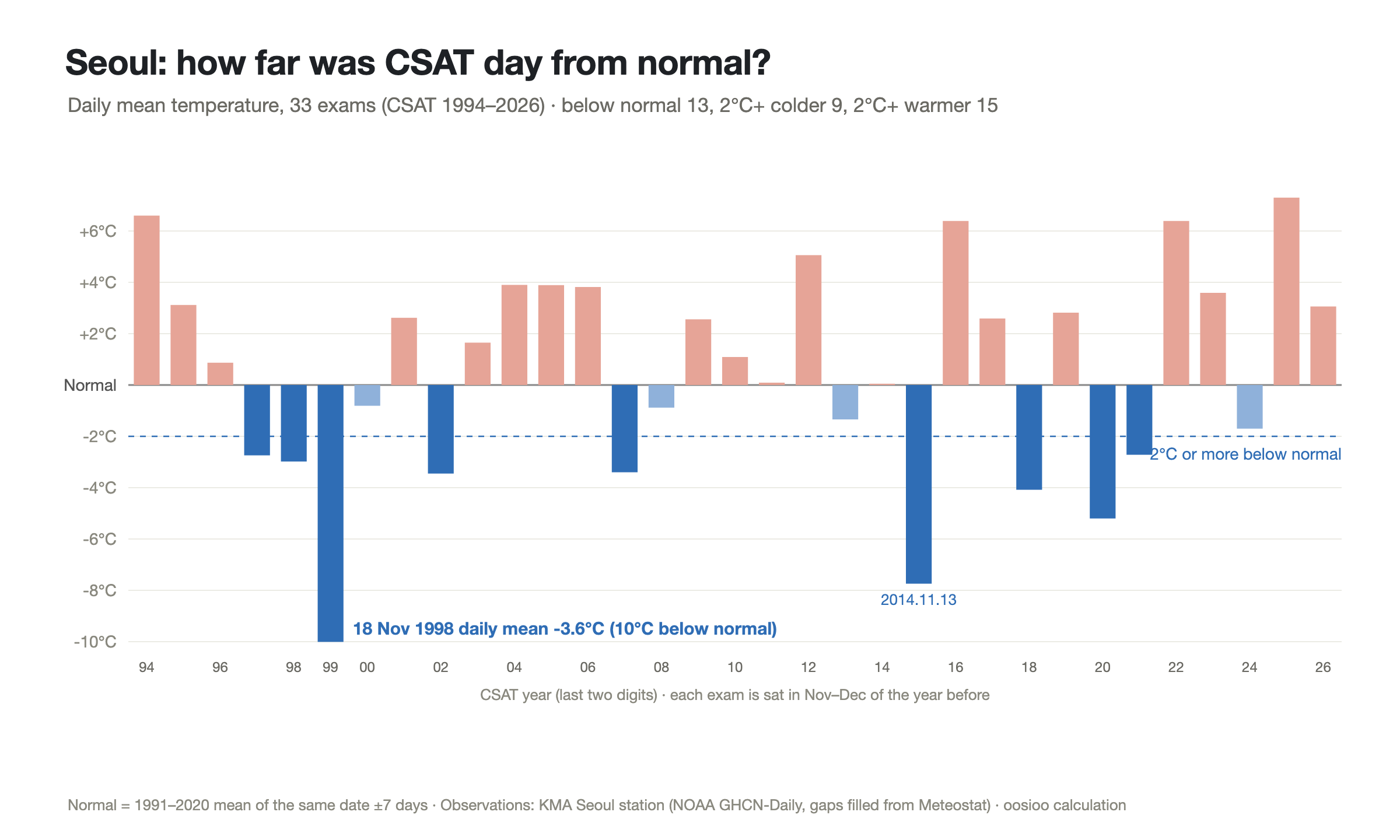
Of the 33 exam days, 13 were below normal. Nine (27%) were 2℃ or more below. Going the other way, 15 were 2℃ or more above normal, which is more. Averaged over all 33, CSAT day was 0.6℃ warmer than normal.
Whether 27% is a lot depends on what you compare it with. Of the 693 days from 5 to 25 November in Seoul, 1993–2025, 29% were 2℃ or more below normal. CSAT day was, if anything, slightly less often cold. There is no sign that it was colder because it was CSAT day.
The other stations tell the same story.
| Station | Below normal | 2℃+ below | 2℃+ above | "2℃+ below" on any day in mid-November |
|---|---|---|---|---|
| Seoul | 13/33 | 9/33 | 15/33 | 29% |
| Chuncheon | 14/33 | 10/33 | 8/33 | 27% |
| Gangneung | 15/33 | 10/33 | 12/33 | 26% |
| Daejeon | 13/33 | 10/33 | 12/33 | 26% |
| Pohang | 14/33 | 8/33 | 8/33 | 24% |
| Busan | 16/33 | 10/33 | 8/33 | 24% |
| Jeju | 15/33 | 7/33 | 8/33 | 21% |
Not one station had colder-than-normal exam days more than half the time. Chuncheon, Gangneung, Daejeon and Busan came out 3–6 percentage points above "any day" on the 2℃ test, but that is a difference of one or two exams out of 33, well within what chance can explain. As a cross-check, I pulled Seoul and Chuncheon from the European Centre for Medium-Range Weather Forecasts' ERA5 reanalysis and ran the same calculation. Seoul was below normal on 15 exam days by daily mean and 16 by morning low; Chuncheon on 14 and 15. The conclusion holds.
There were, of course, years that really were cold. On 18 November 1998 (the 1999 CSAT), Seoul's daily mean was -3.6℃, 10℃ below normal. Two days earlier, on the 16th, it had been 11.2℃, so the temperature fell by almost 15℃ in two days. According to press reports, Seoul dropped to -5.3℃ that morning. The 2015 CSAT, on 13 November 2014, was also 7.7℃ below normal. Years like these probably became the template for the "CSAT cold snap". But out of 33, you can count them on one hand.
So why do we remember it that way?
In the numbers, there is no CSAT cold snap. In memory, there clearly is. A few things fill the gap.
The ten days that cool fastest all year
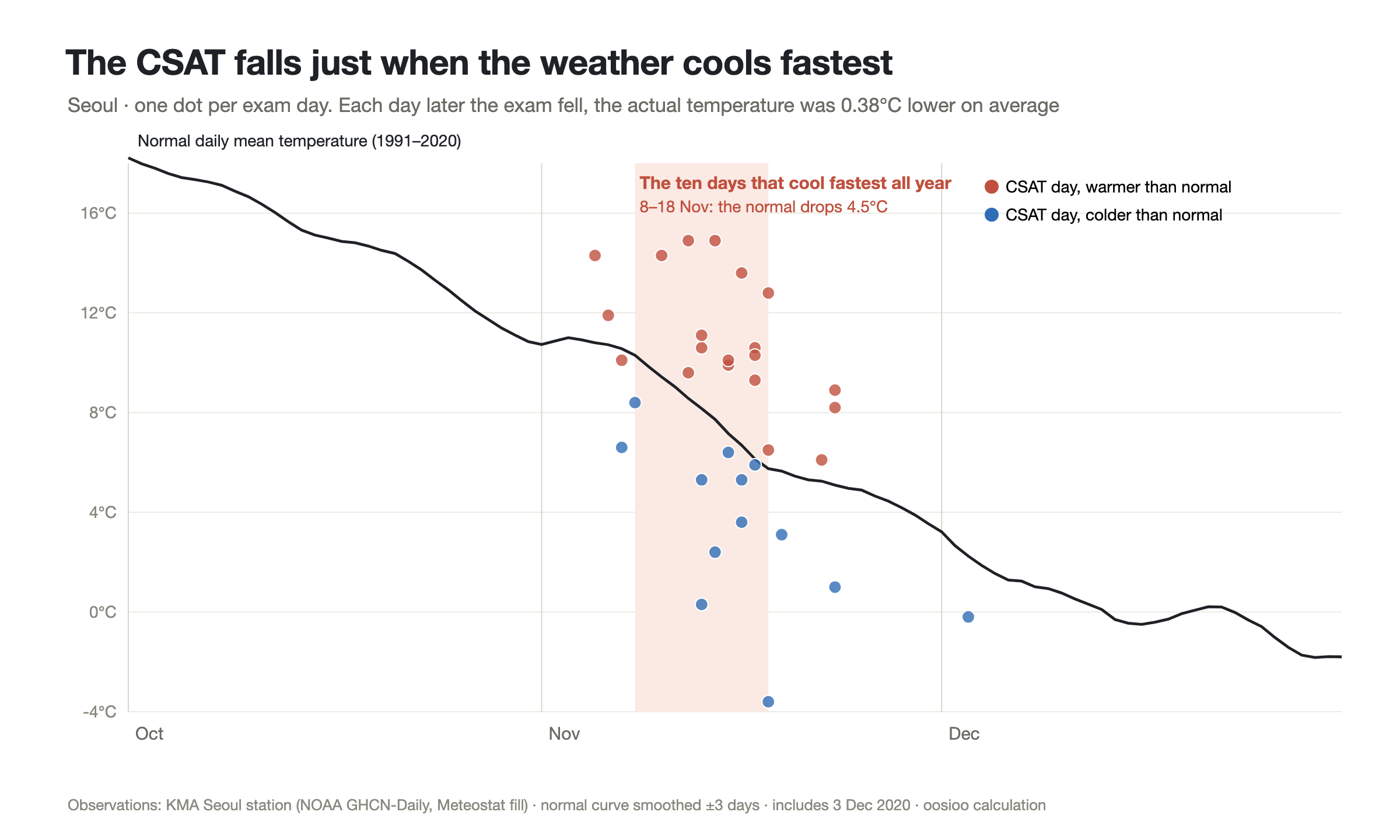
If you plot Seoul's normal daily mean temperature across the whole year, the ten days with the steepest fall run from 8 to 18 November. Over those ten days the normal alone drops 4.5℃. The CSAT has almost always been held inside that window or just after it. The Kyungbuk Maeil column's line, that "temperatures fall fastest in the ten-odd days just before the CSAT", holds up against the observations.
That means CSAT day is colder than the week before even in an ordinary year. In 22 of the 33 years (67%), exam day was colder than the same weekday a week earlier, by 2.1℃ on average. Following the normal curve alone, it should have been 2.4℃ colder. The season was simply moving at its usual pace. But people don't compare the day with the normal. They compare it with how their body felt last week. If you spent last week in a light jacket and open the door on exam morning, it is easy to feel that "it suddenly got cold", even in a year warmer than normal.
The exam date matters too. The CSAT has been held as early as 5 November and as late as 3 December. In Seoul, every day later the exam fell, the actual temperature on the day was 0.38℃ lower on average. The two postponed exams, 23 November 2017 (after the Pohang earthquake) and 3 December 2020 (COVID-19), were 4.1℃ and 2.7℃ below normal in Seoul. But the exams pushed back for APEC in 2005 and the G20 in 2010 were not.
Memory counts the days either side
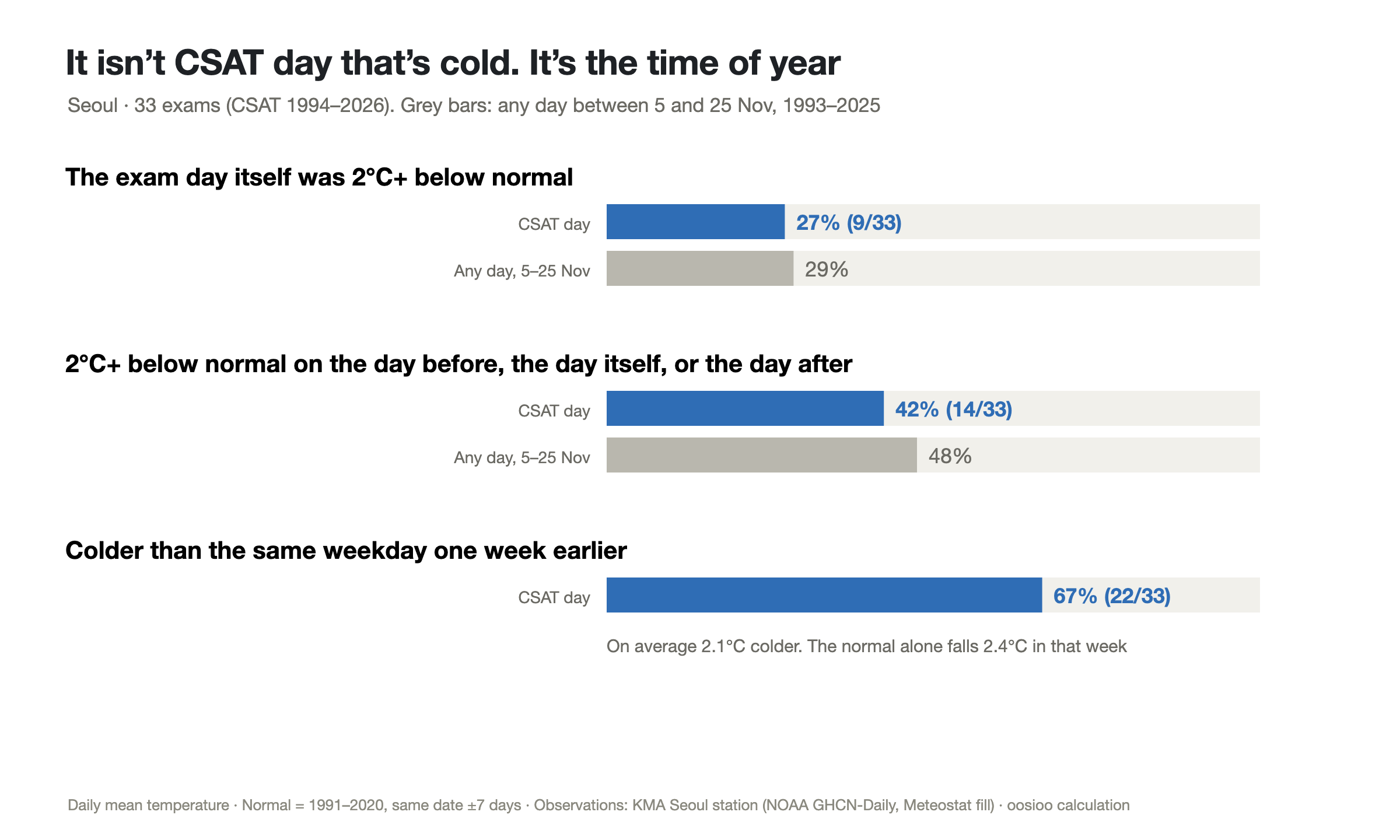
Stories of the CSAT cold snap tend to fold in the biting wind on the orientation day before, or the first snow the day after. Widen the window to three days, the day before, the day itself and the day after, and the number of years in which at least one of the three was 2℃ or more below normal rises to 14 (42%) in Seoul. Do the same for any day in mid-November and you get 48%. Widen the window enough and any day looks as if a cold snap came. That is not because CSAT day is special.
Leaving before dawn
For the 2026 CSAT, students had to be seated by 8:10 a.m. Students with a long way to travel, or who want to arrive early to settle in, leave home around sunrise. That is usually the coldest part of the day. In the KMA press release table for 2015–2024, Seoul's daytime high on CSAT day ranged widely, from 4℃ to 21℃, yet the morning low was below freezing in three of those years (2017, 2019 and 2020). Even on a day that is bearable by afternoon, the hours students actually live through are the coldest few of the day. People often say a tense body feels the cold more, but that is something I couldn't verify.
The same words every year
The last reason is the words themselves. "CSAT cold snap" makes the headlines every year. In a cold year it's "CSAT cold snap arrives"; in a mild one, "No CSAT cold snap this year". Even the KMA's 2025 press release was titled "Clear skies and a wide daily temperature range on CSAT day, with no cold snap." News of a cold snap that never came still makes everyone repeat the phrase once more.
When we judge how often something happens, we lean on the examples that come to mind most easily. Psychologists call this the availability heuristic (Tversky and Kahneman, 1973). The -5℃ morning of 1998 and the photos of students clutching hand warmers come to mind easily. A morning 3℃ warmer than normal leaves nothing to remember. That is how the CSAT cold snap of memory piles up.
Over the long run, if anything, warmer
Split the 33 exams in half and one more pattern appears. In Seoul, CSAT days from 1994 to 2010 averaged 0.3℃ above normal; those from 2011 to 2026 averaged 0.9℃ above. At all seven stations, the later half was warmer than the earlier, by anywhere from 0.3℃ in Busan to 1.3℃ in Gangneung. The normal is a 30-year average, so while the climate warms, recent years tend to sit above it. If there is a CSAT cold snap, it is fading. Still, 33 is a small number for talking about trends, so I'll only say it looks that way.
See for yourself
I made a chart where you can pick the station and the year. Each bar is one year's exam day, and the band shows the usual range of temperatures for that date (the 30-year normal values with the top and bottom 10% removed). Tap a bar to see the temperatures on the day before and the day after as well. Switch to "Morning low" and the years missing observations are left blank. The second tab draws the exam days on top of the normal curve for each station.
This year's CSAT day
The 2027 CSAT will be held on Thursday 19 November 2026. As I write this on 5 November, it is still beyond the forecast range.
By the normals, Seoul's daily mean around 19 November is 6.1℃, with a usual range of 0.8–11.3℃. Chuncheon's is 3.9℃ (-0.6–8.6℃) and Busan's 10.9℃ (6.2–15.4℃). Wherever in that range the day lands, the words "CSAT cold snap" will come up again this year, whether in a story saying it's cold or one saying it isn't.
Reading it again
The conclusion is an anticlimax. CSAT day was not cold more often than any other day in mid-November. Yet the memory of feeling cold isn't wrong either. The exam is held in the ten days of the year that cool fastest, and students leave home at the coldest hour of the day. Compared with the week before, two exams in three really were colder. It isn't that the weather picks CSAT day to turn cold. We pick the time of year it turns cold to hold the exam.
So the advice to bring a padded coat still stands. The third week of November is reason enough.
Sources
- CSAT dates: Korean Wikipedia, "College Scholastic Ability Test" and the per-year articles, cross-checked against the per-year articles on Namuwiki. The 2027 CSAT date is from press coverage (Etoday, Herald Economy) of the Korea Institute for Curriculum and Evaluation's basic plan (31 March 2026)
- Temperature observations: NOAA NCEI GHCN-Daily, KMA stations (Seoul 47108, Chuncheon 47101, Gangneung 47105, Daejeon 47133, Pohang 47138, Busan 47159, Jeju 47184), gaps filled from Meteostat daily data
- Cross-check: Open-Meteo historical weather data (ECMWF ERA5 reanalysis)
- KMA press release, "Clear skies and a wide daily temperature range on CSAT day, with no cold snap" (10 November 2025), Annex 1: CSAT-day weather in major cities over the last ten years
- Kyungbuk Maeil, "CSAT cold snap" (Hong Seok-bong, 16 November 2022), and its CSAT-day weather article (Kim Min-ji, 14 November 2022)
- Seating time: press coverage of the 2026 CSAT candidate instructions (November 2025)
- Tversky, A. & Kahneman, D. (1973). Availability: A heuristic for judging frequency and probability. Cognitive Psychology, 5(2), 207–232.
- Normals, comparisons and charts: calculations by oosioo (scripts and results are kept in the manuscript's data folder)