Read the Front Page Aloud in Two Minutes
My notebook said: buy a newspaper and spend two minutes reading every article on the front page out loud. The last time I opened a newspaper was in the waiting room of a vehicle inspection center. In Korea the share who read a print paper fell from 85% in 1996 to 8.4% in 2025, and news moved to portals and then to YouTube. I look case by case at how the press changed, from a circulation-inflation scandal and shrinking newsrooms to machine-written articles, follow how newspaper-based teaching and essay-exam prep gave way to media literacy education, and explain why reading aloud sticks in memory. A playground lets you read a fictional front page aloud for two minutes. The twenty-fifth piece in A Page for Today.
The page I opened today held this sentence:
Buy a newspaper. Spend two minutes reading every article on the front page out loud.
My first thought was: where would I even buy a newspaper? Then I tried to remember the last time I read one. It was probably at a vehicle inspection center. While I waited for my car, I leafed through a few papers lying on a table in the waiting room. I hadn't paid for them, and I hadn't opened them meaning to read. I had time to kill, and they happened to be there.
These days I see almost all my news on my phone: on a portal's front screen, in a link someone sends me, in a video YouTube recommends. So I never have a reason to hold a newspaper. People used to clip newspaper editorials to prepare for essay exams, and schools used newspapers in class. You don't hear much about that anymore. It also feels as though there are fewer good articles than there used to be.
So today I'm using my notebook's assignment as an excuse to follow where the newspaper went: the people who read it, the people who made it, and the classrooms that taught with it, and how each of them changed.
How much can you read in two minutes?
First I worked out the assignment. Can you read the whole front page in two minutes?
There is research on how fast people read Korean aloud. An average adult reads about 308 syllables a minute (Ahn Jong-bok et al., 2002). Television news anchors are faster, at around 340 to 360 syllables a minute (Choi Kwan-hae et al., 2017). So in two minutes you can read 600 to 700 syllables aloud.
How long is a front page? I couldn't find anyone who had counted every character on a Korean front page. But the Korea Press Foundation has a study of front-page articles in national dailies. From 1990 to 2007 the average front-page story ran 3.7 sheets of 200-character manuscript paper, and 4.8 sheets in 2006-07. That means a single story runs roughly 700 to 1,000 characters. If a front page carries three or four stories, two minutes gets you through about one. The assignment was built to be nearly impossible from the start.
That was probably the point. Once you know you can't finish, you have to choose what to read first: skim the headlines, or read the lead story to the end. And when you read aloud, your ears pick up how long the sentences you usually skim really are, and how much information is packed into them.
Where the newspaper used to be
How many fewer people open a newspaper? The Korea Press Foundation surveys news audiences every year. In 1996, 85.2 percent of people said they had read a print newspaper in the past week. More than eight in ten. The share fell to 52.6 percent in 2010 and 20.9 percent in 2016, and in 2025 it hit a record low of 8.4 percent. Of those who still read print, 60 percent read it for free, at work or somewhere similar. Not so different from me in the inspection center waiting room.
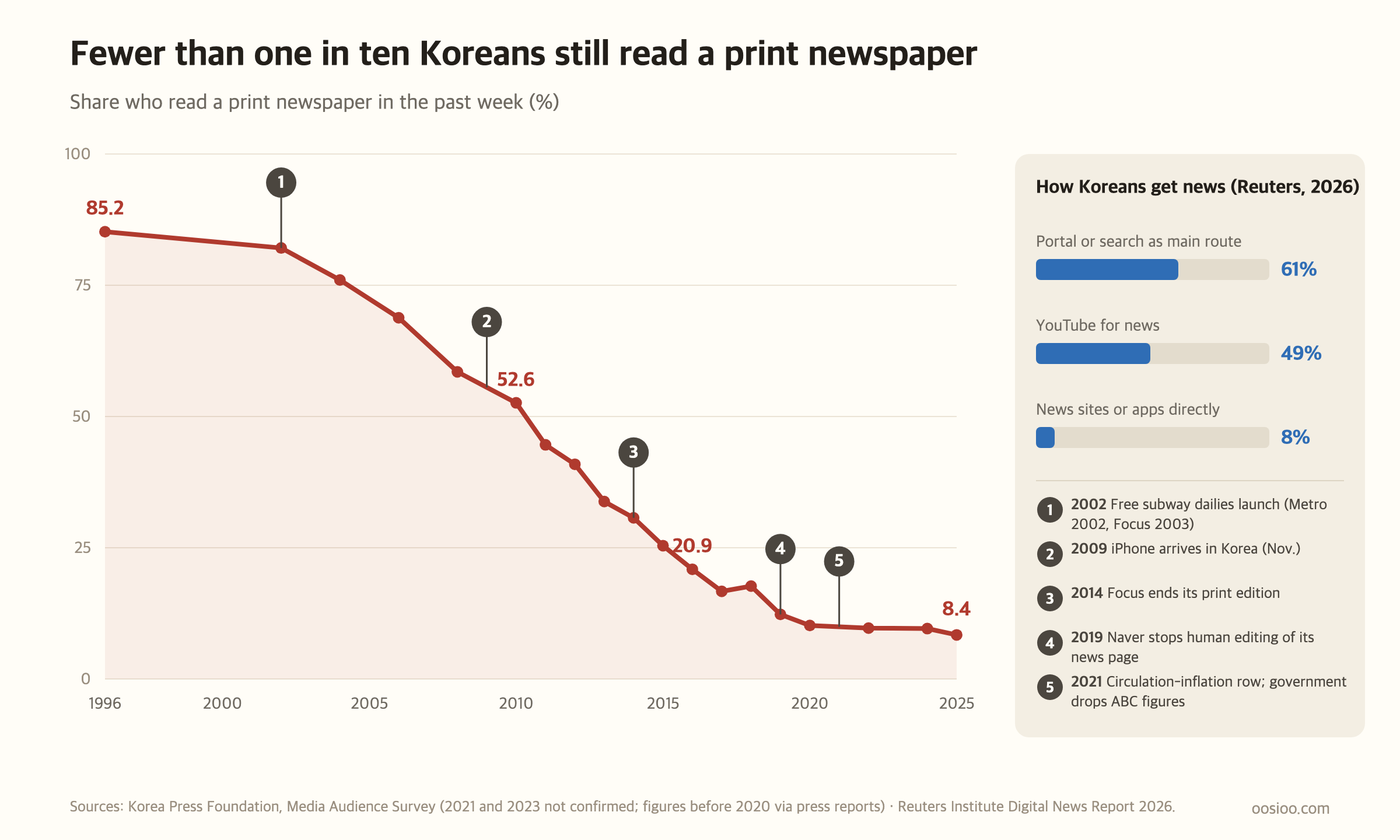
The places where you met a newspaper disappeared too. In the early 2000s free papers were stacked at every subway entrance. Metro launched in 2002 and Focus in 2003, each printing around 300,000 copies. The luggage racks on morning trains were piled with finished free papers. Focus stopped its print edition in April 2014. Seoul had about 3,300 street newspaper stands in 2009; by 2025, 531 were left. The share of households with a newspaper delivered fell from 51.3 percent in 2001 to 24.8 percent in 2011, halving in ten years.
I couldn't find numbers on how many newspapers have vanished from barbershops, banks and inspection center waiting rooms. But look around and in many places a television and a phone charger stand where the newspaper rack used to be. The time spent waiting hasn't changed. The writing that fills it has grown shorter.
News moved to portals, then to YouTube
People who put down the newspaper didn't stop following the news. They just follow it somewhere else.
Korea has long been a country of portals. In the Reuters Institute's Digital News Report 2026, 61 percent of Koreans named portals or search as their main route to news. That is down from 76 percent in 2019, but still overwhelming. Only 8 percent go straight to a news organization's site or app. While a newspaper agonizes over what to put on its front page, readers arrive not through the front page but through a single headline on a portal screen.
That portal screen has changed too. In May 2018 Naver announced it would step back from editing news, and from April 2019 the news on its front screen was chosen by AI recommendation rather than by people. In February 2021 it scrapped the real-time trending search list it had run for sixteen years, which had spawned a flood of near-identical articles retitled to chase whatever was trending. Now the front page is edited by my own click history. The topics I click most show up most.
And news is moving again, this time to video. In the same Reuters survey, 49 percent of Koreans used YouTube for news, against an average of 31 percent across 48 countries. Among those 60 and older it is 59 percent. The generation that read newspapers longest now watches the most news on YouTube. Fourteen percent of Koreans ask AI chatbots about the news, above the 10 percent average. And only 30 percent of Koreans say they trust the news, below the average of 37.
The sense that good journalism is scarcer
Where does the feeling that there are fewer good articles come from? It's hard to settle with numbers. But you can see how the conditions around the press have changed.
First, the numbers newspapers reported about themselves were shaken. In March 2021 the Ministry of Culture, Sports and Tourism audited the Korea Audit Bureau of Circulations and found that actual paid circulation at sampled distribution branches was only a little over half of what the bureau had reported (an average accuracy rate of 55.37 percent). In May that year MBC's investigative program Straight showed brand-new newspapers, still in their wrapping, being exported to Southeast Asia or sent to factories that make egg cartons. In July the ministry decided to stop using the bureau's figures for government advertising and other policy. Police dropped the criminal complaint over inflated circulation in 2023 without charges. Legal responsibility aside, the image of newspapers thrown away before anyone opened the front page stayed with people.
What about the people who write the articles? In the United States there are fewer of them. According to the Pew Research Center, newsroom employment at American newspapers fell 57 percent, from 71,000 in 2008 to 31,000 in 2020. In a 2025 study by Northwestern University's Medill School, the number of US newspapers fell from 7,325 in 2005 to 4,490, and 213 counties have become "news deserts" with no local news source. Korea went the other way: the number of journalists grew, to 32,240 in 2023, largely because of the spread of internet news outlets. If there are more journalists but it feels like fewer good stories, the question is what kind of stories those new jobs are spent on.
Machines write articles too. In 2014 the Associated Press began automating corporate earnings stories, going from about 300 a quarter to as many as 4,400. In 2017 Yonhap News Agency launched "Soccerbot," which writes up football results. When the job is turning numbers into sentences, machines were fast and accurate. With generative AI, though, things went wrong. The US tech site CNET corrected 41 of 77 articles it had written with AI. In May 2025 the Chicago Sun-Times ran an AI-generated summer reading list that turned out to include books that do not exist.
There are cases on the other side. The New York Times had 12.8 million digital subscribers in the second quarter of 2026 and about 550,000 print subscribers. In 2022 it bought the word game Wordle and began bundling news with games and cooking. Britain's The Independent printed its last paper edition in March 2016 and carried on online only. The disappearance of paper is not the same thing as the disappearance of good journalism. But the gap is growing between places where the habit of paying for good journalism survives and places where it doesn't.
When newspapers were textbooks
The newspaper was once a textbook. This is called NIE, Newspaper in Education. In the United States it began in the 1930s, when The New York Times sent papers to New York classrooms at teachers' request. It became a national program in 1957, and the name NIE was adopted in 1976. In Korea, the Korean Society of Newspaper Editors held an NIE seminar in 1994, and the JoongAng Ilbo created NIE pages in 1995. In 2011 the culture ministry announced a three-year, 38.5-billion-won plan to expand NIE model schools and send instructors to 1,000 schools. Looking back, that was the peak.
Essay exams went hand in hand with newspapers. For its 2008 regular admissions, Seoul National University used the national college entrance exam only as a qualifying threshold and raised the weight of its essay test to 50 percent. Reading and summarizing newspaper editorials became the way to study, and newspapers published separate sections for students. The Korea Economic Daily launched Saenggeul Saenggeul in 2005, and other papers started similar study sections. Plenty of people probably remember clipping editorials into a notebook and writing their own thoughts underneath.
Essay-based admissions haven't disappeared. The number of places fell from 12,146 for the 2020 admissions year to 11,162 for 2021, then rose again to about 12,600 for 2026. What changed is how students prepare. Past exam questions and cram-school lectures took the place of editorial clippings.
Meanwhile, worries about reading have grown. In the culture ministry's 2025 national reading survey, the share of adults who read at least one book (print, e-book or audiobook) in a year fell to 38.5 percent, the lowest on record. Korean students' PISA reading score peaked at 556 in 2006 and was 515 in 2022. In 2020 online comments mistaking sahul ("three days") for four days made headlines, and in 2022 so did reactions that read simsimhan sagwa ("deep apologies") as a "boring apology." Short-form video gets much of the blame, but I couldn't find a study showing that it causes lower literacy.
From reading newspapers to reading media
Education has set the newspaper aside and is trying to teach something broader: not how to read one medium, but how to read all of them. Media literacy.
Korea's 2022 revised national curriculum gave "media" its own strand within Korean language classes and created a high school elective called Media Communication. The Korea Press Foundation also shifted its weight from NIE to media education, and since 2022 it has run a certification exam for media education instructors. So far 762 people have qualified.
Abroad, Finland comes up often. Since the European Media Literacy Index was first published in 2017, Finland has never lost first place. In 2021 Illinois became the first US state to require media literacy instruction in high schools.
One study showed what needs teaching. In 2016 a Stanford team analyzed 7,804 responses from students in twelve US states and found that 82 percent of middle schoolers could not tell an ad labeled "sponsored content" from a real news story. Sam Wineburg and Sarah McGrew, from the same group, asked historians, professional fact-checkers and university students to evaluate unfamiliar websites. The historians and students read the sites carefully, top to bottom. The fact-checkers glanced at a site and immediately opened new tabs to look up who was behind it elsewhere. They reached the fastest and most accurate judgments. The researchers called this "lateral reading."
Reading a front page from top to bottom and opening a new tab look like opposite skills. One goes deep inside a single medium; the other steps outside it. But both ask the same thing: who wrote this, why, and what did they leave out?
Playground: The Front Page in Two Minutes
Trying it is faster than talking about it. I made a fictional front page, The Oosioo Daily for October 28. Every article and number is made up. Press start, read aloud for two minutes, then tap the last sentence you read. It tells you how many words you read per minute and how long it would take you to finish the page at that pace. There is also a button that reads it at news-reader pace (depending on your browser, there may be no voice). This fictional front page is much shorter than a real one, and it is still hard to finish in two minutes. The second tab shows the trends in print readership, portal news use and PISA reading scores.
Reading out loud
Still, why "out loud"? There is fairly solid evidence for it.
In 2010 Colin MacLeod's team at the University of Waterloo in Canada reported the "production effect." When people read part of a word list aloud and part silently, they remembered the words they had read aloud better. A 2018 follow-up found that memory was strongest when people read aloud themselves, better than hearing someone else read or listening to a recording. A sentence your eyes would slide past gets caught a second time when your mouth makes the sound and your ears hear it back.
Since 2011 Japan's Asahi Shimbun has sold notebooks for copying out Tensei Jingo, the short column on its front page. It isn't reading aloud, but it turns the habit of slowly reading a short front-page text, one character at a time by hand, into a product. It is a deliberately slow way of reading in an age of skimming.
Reading a front page aloud changes one more thing. Portals and YouTube choose news I'm likely to like. A front page lays out, in order, the stories an editor decided everyone should know about today. Stories outside my interests are there too. Reading a front page aloud for two minutes means running a world someone else chose through my own voice.
Back in the waiting room
The next time I go to the inspection center, I plan to pick up one of the papers on the table and read the front page aloud. It's a waiting room, so loud may be hard, but I can at least move my lips. I'm curious whether I can finish the lead story in two minutes, and whether I would have read it to the end if I'd seen it on my phone.
A Page for Today is a series in which I open my idea notebook to a random page and lay that day's thoughts on the line I find there. Today a newspaper became the twenty-fifth piece. Reading this one aloud to the end would take much more than two minutes. If you spot anything to fix, let me know.