Explain It to the Kids First
My notebook said: gather some kids, explain your idea to them, and watch how they react. Products aimed at one generation are harder to make than they look, because the people making them are rarely in that generation. I compare cases that asked and watched their audience, like Sesame Street and Lego, with cases that pretended to be a friend, like Facebook's Lifestage and Pepsi's protest ad, and look at today's numbers on how each generation's media are drifting apart. Then I cover how to use generational labels carefully, quick ways in such as reverse mentoring, and attempts to ease generational conflict from the other side, from care homes merged with nurseries to students sharing homes with older people. A playground lets you guess age, period and cohort effects. The twenty-fourth piece in A Page for Today.
The page I opened today held this sentence:
Gather some kids. Explain your idea to them, and watch how they react.
I nodded as soon as I read it. Anyone who has planned a product knows the moment. Everyone in the meeting room liked the idea, and the people who were supposed to use it shrugged. It happens most with products aimed at a particular generation: an app for teenagers, a drink for people in their twenties, a phone for older people. The people who build these are rarely in that generation. People in their thirties and forties make the teen app, and young engineers design the senior phone. I remember being that age, but my memory belongs to the years I grew up in. The world that people of that age live in now is a different one.
The gap seems to be getting wider. There was a time when the whole family watched the nine o'clock news together. Now, under one roof, the child watches TikTok, the parent watches YouTube, and the grandparents read Naver Band and KakaoTalk. Post the same news on the same day and it reaches one generation and never reaches another.
So the sentence in my notebook reads like old wisdom. If you are going to make something for people you do not know, bring them in, sit them down, and explain it to them. Today I gathered stories from people who actually did that. Some worked and some flopped. I start with ways to understand a generation quickly and end with attempts to close the gap between generations from the other side.
Children don't laugh to be polite
Explain an idea to adults and you usually get a polite reaction: "Nice," "Sounds fun." Children do not do that. When they are bored, they look away. The place that put this honesty to work most systematically was an American children's show that launched in 1969, Sesame Street.
Edward Palmer, head of research at the producer, the Children's Television Workshop, used a method called the distractor. A child sat in front of the TV, and next to it stood a second screen that changed slides every seven seconds or so. Researchers noted each moment the child's eyes left the show for the slides. Segments that held children's attention 80 to 90 percent of the time went on the air as they were. Segments that held it only about half the time were fixed or cut.
In July 1969, four months before the real launch, five test episodes aired in Philadelphia over a week. About 60 to 70 families watched. The result was clear. Children were absorbed by the scenes with Muppets and lost interest in the street scenes that had only human actors. The producers had originally decided, on the advice of consulting psychologists, to keep the street scenes human-only, on the grounds that mixing fantasy and reality would confuse children. After seeing how the children reacted, they reversed the rule. That is how Big Bird and Oscar came to live on the street. The look of a street that has lasted more than fifty years was set by children's eyes, not by experts' theories.
Toy companies had a room like this too. In 1961 Fisher-Price opened its Play Lab at its headquarters, a room where staff watched children play with new toys from behind a one-way mirror. The company calls it the first toy research playroom in the industry. Blue's Clues, which Nickelodeon launched in the US in 1996, went a step further. Its head of research, Alice Wilder, has said that every episode was tested three times in front of preschoolers. It was shown three times while it was being made and fixed after each one.
A worn pair of sneakers
In 2003 Lego posted a pretax loss of 1.4 billion Danish kroner, the largest in its history, and its sales fell by nearly 30 percent. At the time Lego believed the common wisdom that children today are busy and impatient. So it had moved into big pieces that snap together fast, video games and theme parks. While it was recovering, Lego went into children's homes with the consultancy ReD Associates. Instead of surveys, they watched how children actually played.
ReD's founders tell a story in their book The Moment of Clarity (2014). Asked for his most treasured possession, an eleven-year-old German boy brought out an old pair of sneakers. One side was worn down from skateboarding. To him those sneakers were a medal showing how hard he had practiced his tricks. Children did not want things to be easy. They wanted skills that took effort to learn and could be shown off to others. Lego went back to small, precise pieces and harder builds.
Lego used the same approach on a problem it had long failed to solve: girls bought much less Lego. It spent four years meeting and observing 4,500 girls and their mothers, and the result was Lego Friends in 2012. The girls wanted characters they could role-play with, the way they did with dolls, and carefully decorated indoor spaces. The line was criticized for too much pink, but first-year sales were double what the company expected, and sales to girls tripled.
Wearing an older body
Children are not the only strangers. To a young designer, old people are strangers too. This time the designer borrows the body of that generation.
In 2005 Joseph Coughlin's team at the MIT AgeLab built an aging suit called AGNES. Bands and braces around the knees and elbows stiffen the joints, and a neck collar limits how far the head turns. Earplugs cut hearing, yellow glasses cut vision, and thick gloves dull the fingertips. Young researchers and corporate designers put it on and try their own products again in an older body. Saying "make it easy for seniors" in a meeting room is very different from pressing a small button with gloved hands.
Japan's Raku-Raku Phone saw the problem at the naming stage. The first model came out in 1999, with large buttons, large type and simple functions. Anyone could tell it was a phone for older people, but its name did not say "senior phone." It said "easy phone" (raku-raku). Nobody wants to be treated as old. In 2011 NTT Docomo announced that the series, counting models from several manufacturers, had sold 20 million units.
Caught pretending to be a friend
On the other side are the many cases where companies believed they knew their target generation, pushed ahead, and got it badly wrong.
In August 2016 Facebook launched an app called Lifestage. It was for high school students, and only people 21 or younger could join. The product manager behind it was nineteen. Letting someone from the target generation build it looks almost like a model case. Yet the app was quietly pulled a year later, in August 2017. Just before it closed it ranked 1,392nd among free apps on the US App Store. One nineteen-year-old's instincts were not the instincts of a whole generation, and teenagers had already gathered on Snapchat and Instagram. Bringing in one person from a generation is not the same as explaining your idea to many of them.
In April 2017 Pepsi released an ad in which the model Kendall Jenner walks between protesters and police and hands an officer a can of Pepsi. It was aimed at a young generation that speaks up on social issues. That generation pushed back, saying the ad made the weight of real protests as light as a can of soda, and Pepsi pulled it within a day. The company's statement said: "Clearly we missed the mark."
Snapchat went wrong in the other direction. In 2018 an app that already had teenagers in hand redesigned its screens, and more than a million people signed a petition asking for the old design back. On February 21 Kylie Jenner tweeted, "sooo does anyone else not open Snapchat anymore? Or is it just me..." The next day Snap's stock fell about 6 percent, wiping out roughly 1.3 billion dollars in market value. An analyst downgrade landed the same week, so the tweet was not the only cause. Still, it showed how expensive a redesign can be when you don't show it to users first.
Products aimed at adults have failed too. In 1996 McDonald's launched the Arch Deluxe, promoted as a burger for grown-up tastes. Advertising alone cost between 100 and 200 million dollars, depending on the report. But adults did not come to McDonald's for a grown-up taste. They came because it was fast and familiar. The Arch Deluxe left the menu in 2000.
The American sitcom 30 Rock has a scene that sums up all of these failures. Steve Buscemi, a middle-aged actor, walks into a crowd of high school students in a backward cap and a band T-shirt, a skateboard over his shoulder, and says: "How do you do, fellow kids?" The scene is still the go-to meme under any brand ad that tries too hard to sound young.
Same day, different squares
One reason it keeps getting harder to aim at a generation shows up in the numbers. The media each generation spends time in are drifting apart.
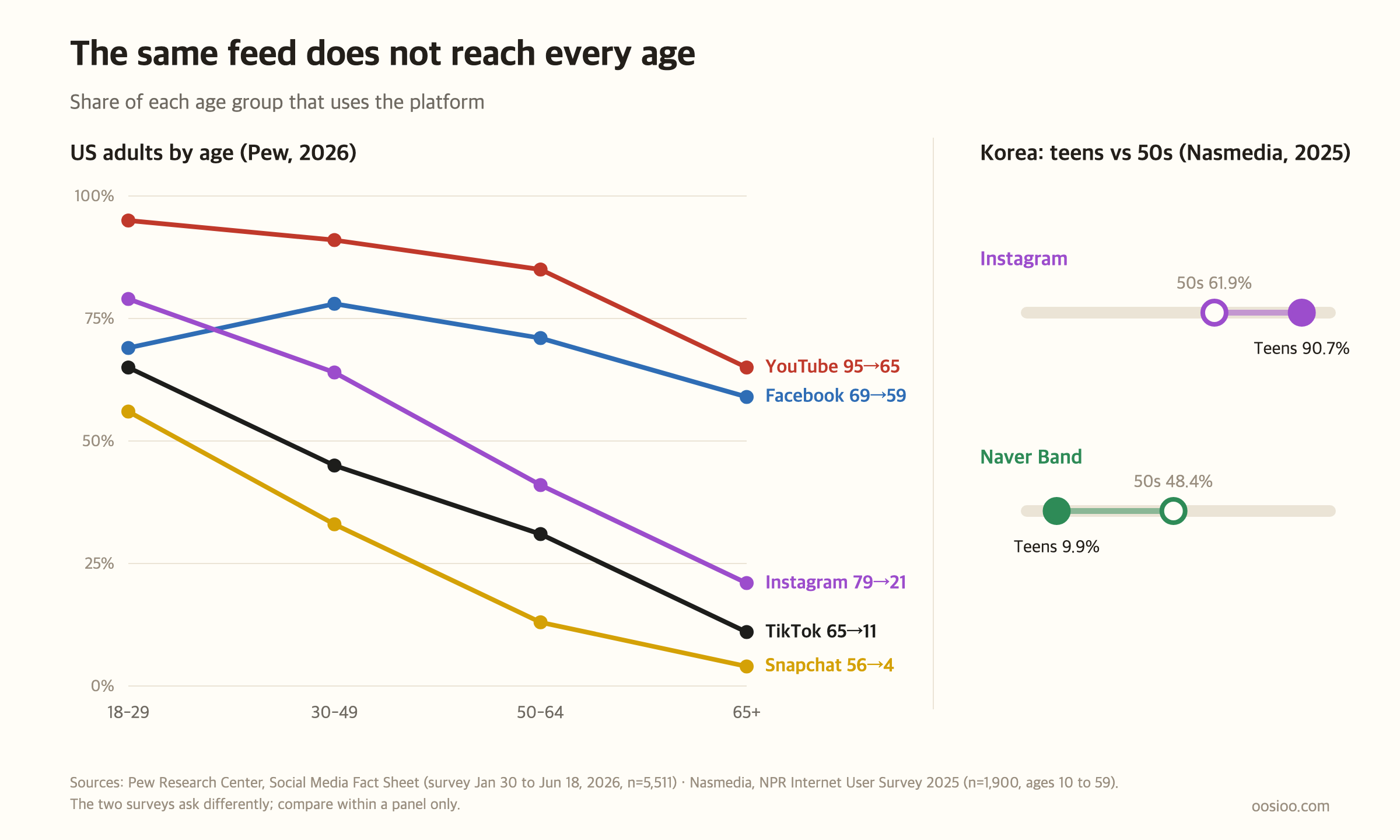
In a Pew Research Center survey of 5,511 US adults in the first half of 2026, YouTube and Facebook depend less on age: 95 percent of 18-to-29-year-olds and 65 percent of those 65 and older use YouTube. Snapchat, by contrast, is used by 56 percent of 18-to-29-year-olds and 4 percent of those 65 and older. TikTok drops from 65 percent to 11. Among US teens alone the change is even sharper. Facebook, used by 71 percent of teens in 2014-15, was down to 31 percent in 2025, while YouTube (92 percent) and TikTok (68 percent) took its place.
Korea is no different. In Nasmedia's 2025 survey, Instagram is used by 90.7 percent of teens and 61.9 percent of people in their fifties. Naver Band runs the other way: 9.9 percent of teens, 48.4 percent of people in their fifties. Asked which messenger they use first, 52.5 percent of teens named KakaoTalk and 41.6 percent named Instagram DMs. In every other age group KakaoTalk is above 90 percent. In the Korea Communications Commission's 2025 media use survey, 74.9 percent named the smartphone as the medium they need most in daily life and 23.0 percent named TV. Ask about emergencies such as disasters, though, and TV climbs again. In the 2024 survey, people in their seventies and older picked TV (65.7 percent) over the smartphone as the medium they need in a disaster.
For a planner this is frightening. My daily feed feels like the whole world, but it is only one square where my age group gathers. The squares where other generations gather never even appear on my screen.
Be careful with "kids these days"
Summing it up as "Gen Z is like this" or "Millennials are like that" leads to a different trap. Generational talk is convenient, and it is often wrong.
In May 2023 the Pew Research Center published "How Pew Research Center will report on generations moving forward." It said Pew would stop using standard labels like Millennial or Gen Z by default, and would analyze generations only when it had data that compares them at the same age. It gave three reasons. Survey methods change, which makes old data hard to compare. Differences caused by age and differences caused by the times are easily mistaken for generational differences. And the differences within a generation that spans 15 to 18 years are often bigger than the differences between generations.
In The Generation Myth (2021), Bobby Duffy of King's College London explains this confusion with three effects. An age effect is what happens to anyone who reaches a certain age. People in their twenties may change jobs often because they are in their twenties, not because they are today's twenty-somethings. A period effect is a change that everyone living at the time goes through together, like the smartphone. A cohort effect is a mark that people who grew up at a particular time carry for life. Duffy argues that popular generational talk greatly exaggerates the cohort effect.
Korea's "MZ generation" makes the problem bigger. It lumps people born in the early 1980s together with people born in the late 2000s, a span of nearly thirty years. When someone at work says "MZs hate company dinners," check whether it is about age, the times, or really a generation, and most of the time it is one of the first two.
Playground: Generation Lab
In words, the three are hard to tell apart, so I made a way to guess them yourself. The first tab hides one of the three effects behind the finding "teens these days use this app a lot." At first you see only this year's survey. Try it and you'll find that with a single year, the age effect and the cohort effect look identical. They only separate once you open earlier surveys. The panel below lets you mix the three effects yourself. The second tab puts the Pew and Nasmedia numbers above into a form you can click through by platform.
A few ways to understand faster
So how do you understand a target generation quickly? Here are the methods worth keeping from the cases above.
First, show a draft, not the finished thing. Sesame Street stood in front of children four months before air, and Blue's Clues while it was still being made. Reactions are only useful while you can still change things. Snapchat showed users the new design after it had already changed everything.
Second, watch instead of asking. Lego's sneaker story would never come out of a questionnaire. Children don't say "I like things that are hard." They just bring out worn sneakers. People are bad at putting what they want into words. Where they spend their time and what they treasure answer for them.
Third, get into their body. Like the AGNES suit, experience the target's conditions yourself. It doesn't have to be about old age. If you want to understand teenagers, installing their apps and living on only that feed for a week is a small aging suit of its own.
Fourth, learn from young people. In 1999 GE's Jack Welch paired around 500 executives with young employees as mentors to teach them the internet. It is often named as the start of reverse mentoring. From 2015 Gucci ran a "shadow committee" of employees under 30, who discussed the same agenda as the executive committee. Gucci's sales jumped from 3.5 billion euros in 2014 to 8.3 billion in 2018. There is no evidence, though, that the committee caused that growth; the two simply happened in the same period. In Korea, LG Uplus has run reverse mentoring since 2019, with new hires teaching executives, and in 2021 Shinhan Card had a task force of young employees present proposals directly to executives at a management strategy meeting.
Fifth, play where they play. In 2020 the ice cream maker Binggrae put a prince character called "Binggreus," drawn in the style of a girls' romance comic, on Instagram. With no ad spending it gained 17,000 followers in three weeks. The company had noticed that young people enjoy a brand account as a story. That May, Gompyo wheat beer put a flour company's sack logo on a beer can. It sold 100,000 cans in three days and 58.5 million cans by April 2023, when the trademark deal ended.
What's interesting is that generations don't only like things from their own generation. In spring 2023, sales of yakgwa, a traditional honey cookie, at the convenience store chain CU were 9.6 times higher than a year earlier. More than 80 percent of buyers were in their twenties and thirties, and fewer than 5 percent were 50 or older. This was the "halmaennial" trend, a play on the Korean word for grandmother, in which grandchildren's generation bought up grandmother snacks. The distance between generations isn't a one-way street.
The other way around: mixing generations
So far this has been about understanding another generation as a target. But the generation gap is not just a product-planning problem. The phrase "generational conflict" shows up in Korean news almost every day.
When Hankook Research asked 1,000 adults in February 2026, 83 percent said generational conflict was serious, and the figure has been above 80 percent every year since the survey began in 2021. When the Korea Institute of Public Administration's 2025 social integration survey asks people to score several conflicts side by side, though, generational conflict (2.7 out of 4) comes in below ideological conflict (3.2) and class conflict (2.9). Asked on its own, generational conflict sounds big; placed next to the others, it sits in the middle. Either way, the sense that we don't know each other well is real.
What I find interesting is that the best way to work on this looks a lot like the sentence in my notebook: put different generations in one room.
Kotoen, in Tokyo's Edogawa ward, started as a home for the elderly in 1962. In 1976 it opened a nursery school in the same building, and in 1987 it merged the two, so that children and elderly residents exercise and spend time together every day. There are about 100 of each. In Seattle, the care home Providence Mount St. Vincent opened a child care center inside its building in 1991. It became widely known through Present Perfect, a documentary filmed there in 2012-13.
In 2017 Britain's Channel 4 turned the idea into an experimental TV series, Old People's Home for 4 Year Olds. Ten four-year-olds and eleven older people spent six weeks together. By the end, mobility had improved for 80 percent of the older participants and mood for 70 percent. Those who had screened as depressed at the start no longer did six weeks later. It was a small TV experiment without a control group, so it is hard to call it scientific evidence. Still, the faces on screen said more than the numbers, and a version in the same format was made in Australia.
Around 2012 the Humanitas care home in Deventer, in the Netherlands, began offering university students free rooms. The condition: spend 30 hours a month being a "good neighbor." The students eat dinner with residents, celebrate their birthdays, and show them how to use smartphones. As of 2015, six students lived alongside about 150 older residents.
Seoul tried something similar. "One Roof, Generations Together" (Hanjibung Sedae Gonggam), which began with 14 households in Nowon district in 2013, is a home-sharing program in which a university student moves into an older person's spare room for half the market rent or less. In Nowon alone, 240 older households and 281 students lived together. It wasn't always easy. Citywide matches in 2017 totaled only 252, some arrangements broke down over clashing habits, and coordinators were brought in to mediate. Putting generations under one roof was not enough; they needed someone to carry words between them.
Germany made it a national program. Its Multi-Generation Houses (Mehrgenerationenhäuser), started in 2006, now support about 530 sites. Each is a kind of neighborhood living room where anyone from children to the elderly can drop in, share a meal, get help with homework or with filling in forms. Korea's Digital Learning Centers belong to the same family in a broad sense. Since 2020 nearly 4.3 million people have learned digital basics there, such as ordering at a kiosk or mobile banking. In 2026 they were renamed AI Digital Learning Centers.
There are attempts inside companies too. Lim Hong-taek's book Here Come the 90s-Born (2018) explained the young employees joining the workforce to the older generation. It became even better known in August 2019, when President Moon Jae-in gave a copy to every staff member at the presidential office. Reverse mentoring, too, changes character when it is used to ease conflict. It stops being a way to mine young people for trends and becomes a place where both sides confirm they have something to learn from each other.
Not test subjects, but people to sit with
Laid out side by side, these cases change how I read the sentence in my notebook. At first I read "gather some kids" as market research: call in the target generation and measure the reaction to my idea. Sesame Street's distractor and Lego's home visits were exactly that, and they worked.
But the efforts to ease generational conflict were doing the same thing. Put a different generation in the room, tell them your story, and watch their faces. The difference is that in market research the children's reactions are used to fix my idea, while at Kotoen or Humanitas both sides change a little. Lifestage and Pepsi failed less because they didn't bring that generation in than because they brought them in and didn't listen.
There are many ways to understand a generation quickly, but I think the order in my notebook is right. First, gather them. Then, explain. And then the last and most important step: watch how they react. Not how good my explanation was, but the moment they look away.
A Page for Today is a series in which I open my idea notebook to a random page and lay that day's thoughts on the line I find there. Today a single sentence became the twenty-fourth piece. I should have explained this one to someone before posting it too. If there was a passage where you looked away, let me know and I'll fix it.