Packing a Suitcase
The notebook said: my bag is always heavier than it needs to be, and the one thing I need is never in it. Seven in ten travellers bring something home unused, and people pack nine pairs of underwear for a week yet leave the toothbrush and charger behind. I follow the diversification bias that makes us choose more when we choose ahead, why the knapsack problem (what to bring) and bin packing (how to fit it) are mathematically hard, and the proof that 'biggest first' (FFD) never strays much beyond 11/9 of the best. Whose back the 23 kg limit comes from, which events rewrote the 100 ml rule and the power-bank rules, how the roll-your-clothes tip fared in a consumer test, and how far the checklist that began with a 1935 crash really worked in hospitals. A playground lets you pack a carry-on yourself and compare it with auto-fill. The thirty-eighth piece in A Page for Today.
The page I opened today held a line that sounded like a small complaint.
My bag is always heavier than it needs to be, and the one thing I need is never in it.
The night before a trip tends to look the same. Clothes spread across the bed, the case lying open, things going in one at a time until the zip won't close, and only then the question of what to take out. One more jacket in case the weather turns, an umbrella in case it rains, two books in case there's time. You drag that bag all the way there, and on the way home there is always something you never took out. And somehow the toothbrush got left behind.
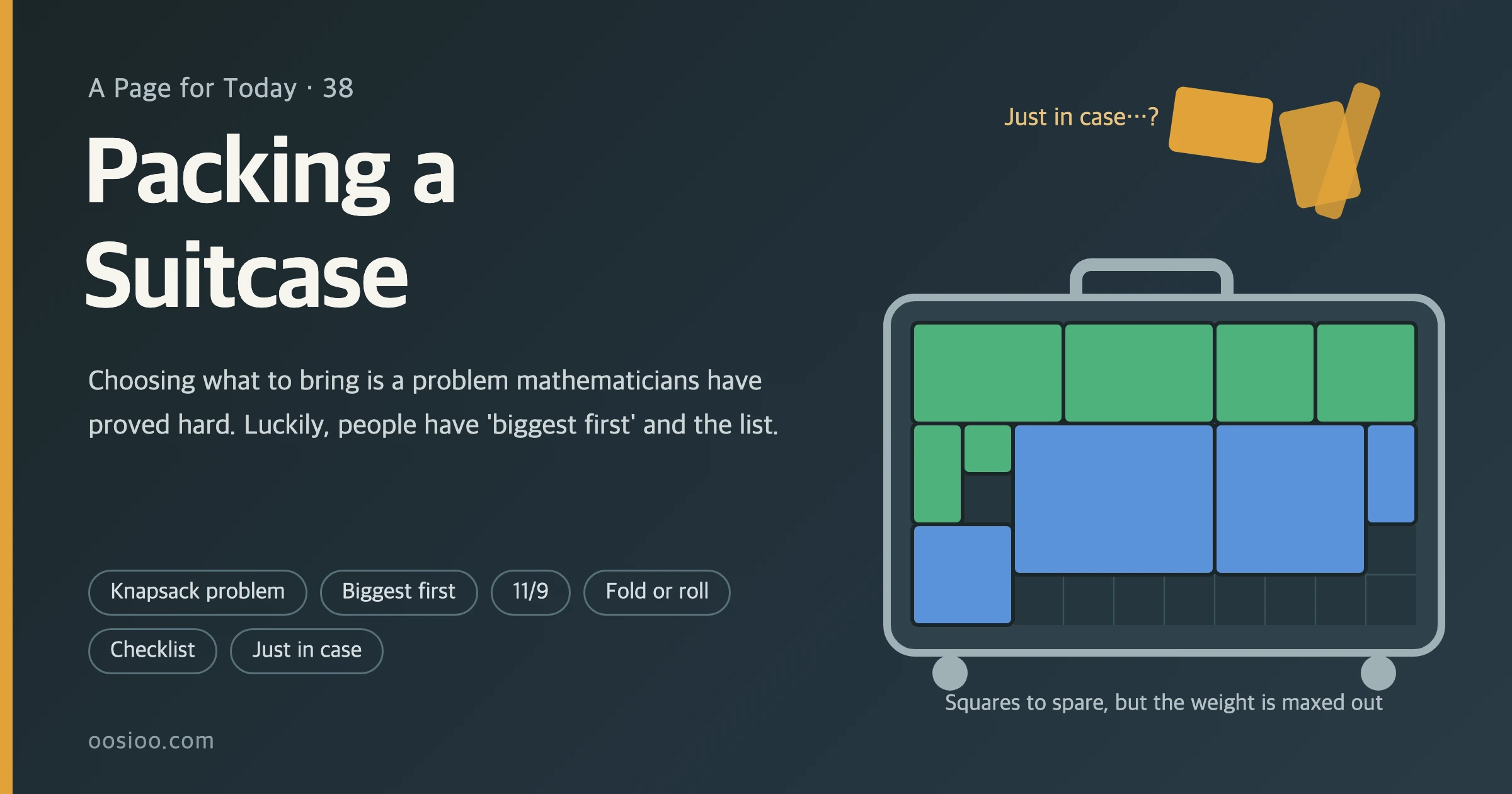
Packing is something everyone does, so it hardly seems worth thinking about. Look closer, though, and quite a lot overlaps in it. There is a problem mathematicians have proved hard, rules airlines have rewritten over decades, and a habit of misjudging our future selves. With the travel season about to start, I decided to put one suitcase on the table today and unpack those things one by one.
Everyone packs too much
Everyone knows people overpack, but when you look for numbers there is almost no academic research. The one scholarly book I found that takes packing head-on is Everyday Practices of Tourism Mobilities: Packing a Bag (2017), in which the cultural geographer Kaya Barry interviewed hostel travellers. Barry wrote that every everyday part of tourism had been studied except packing, the step where every journey begins. So most of the numbers come from surveys commissioned by travel-related companies. Samples and questions differ from one to the next, so it is better not to compare them and just read the direction.
When the British travel insurer InsureandGo asked 2,077 holidaymakers in January 2024, 74% said there was something they took on holiday and never used. The average was 3.4 items per person. The same year, the American travel site Upgraded Points asked 2,200 people what they pack for a week away: on average 8.4 tops, 9 pairs of underwear and 2.6 pairs of shoes. Nine pairs for seven days. One a day, with a few "just in case" on top. Forty percent of respondents said they "often" or "always" bring unworn clothes back home.
Does experience help? Global Rescue, a travel rescue and medical services company, asks its members, people who travel abroad a lot, for their "single biggest mistake" every year. In the summer 2026 survey, overpacking came first, named by 38%. It was 35% in 2023 and 2024, and 32% in 2025. The survey does not disclose its sample size, so the striking thing is less the number than the fact that the people who travel most still put this mistake at the top year after year.
Choosing ahead means choosing more
Why? I found no study that experiments on travel packing directly. But there is research on choices with a similar shape.
In 1990 the marketing scholar Itamar Simonson had students choose snacks for three upcoming class days. One group picked all three on the first day; the other picked one each day. Of those who chose all at once, 64% picked three different snacks. Among those choosing day by day, only 9% did. Daniel Read and George Loewenstein (1995) named this the "diversification bias" and confirmed it again on Halloween night. Of the children who chose two sweets at once at one of two neighbouring houses, all 13 chose two different ones; among children who got one at each house, only about half did.
One cause Read and Loewenstein point to is a habit of folding time up. When you choose today, in one sitting, things you will use over several days, the gaps between them shrink in your head. Eating the same thing twice in a row seems boring, so you build in variety ahead of time. Packing is exactly this kind of choice. You pick five days of clothes in one sitting the night before. In the living room, wearing the same trousers every day sounds dull; once you are there, you reach for the one comfortable pair. This link is my interpretation; the papers did not experiment on suitcases.
The shape of regret probably plays a part too. Marcel Zeelenberg and colleagues (1996) showed that people tend to choose whatever reduces the regret they expect to feel later, rather than the risk itself. In packing this asymmetry is stark. Something left at home is clearly missed the moment you need it. Something brought and never used leaves no trace except the memory of weight. Regret for packing too much is hard to feel and regret for leaving something out is vivid, so the bag only grows in one direction.
What overflows and what goes missing
The second half of the note, that the one thing I need is never in it, also shows up in the numbers.
In the InsureandGo survey, the item most often brought back unused was the first-aid kit (22%). Next came formal evening wear, umbrellas and raincoats, books, dress shoes and hair dryers. All things for "if that happens". Meanwhile, when the American luggage storage company Radical Storage asked 1,511 people in September 2024 what they had forgotten on a trip, toothbrush and toothpaste (22%), chargers (19%) and sunscreen (18%) led the list. The two surveys differ in country and wording, so the numbers cannot be compared. Still, the character of the lists splits clearly. What overflows is the stuff you rarely use; what goes missing is the stuff you use every day.
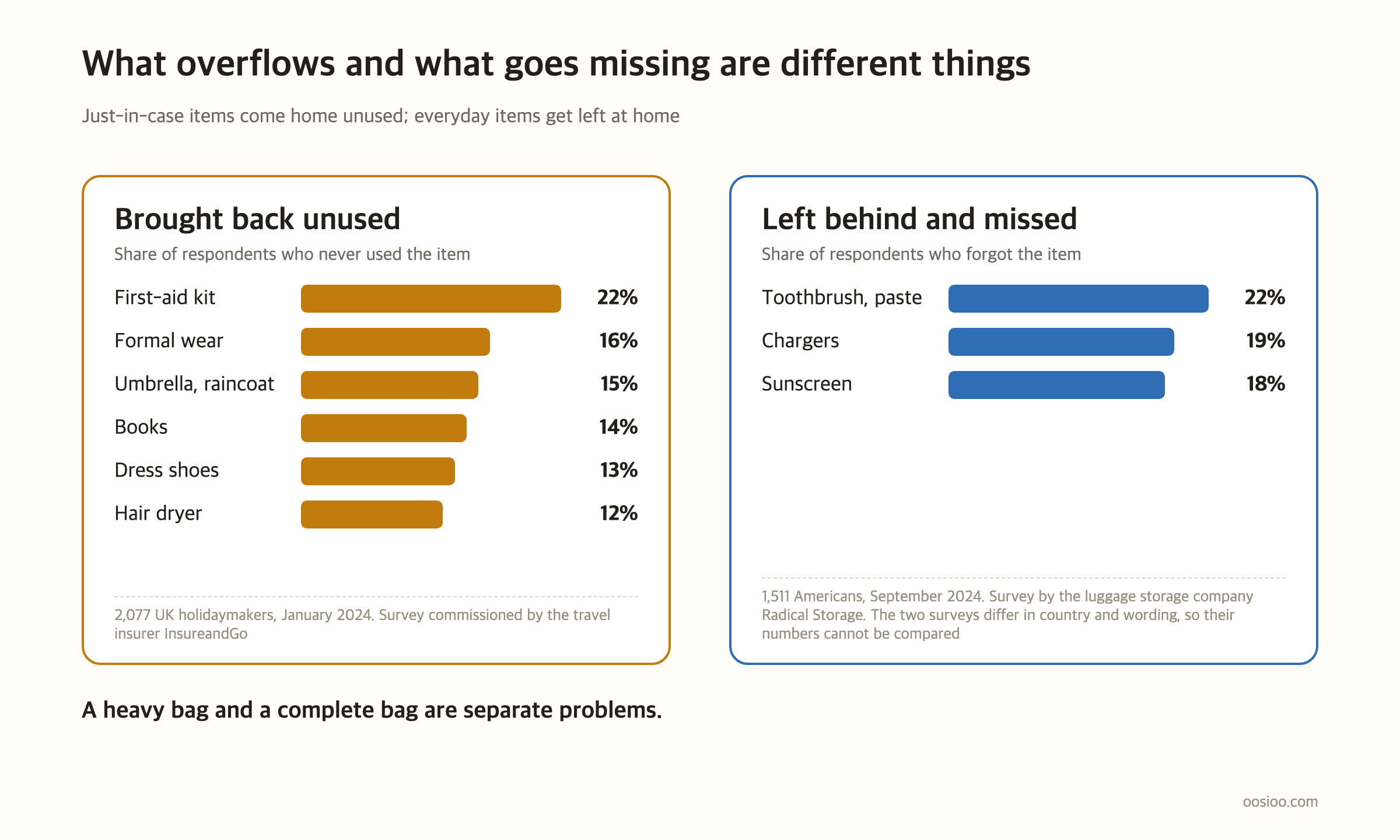
The usual explanation for why everyday items go missing is that you are still using them on the morning you leave, so you cannot pack them ahead. It sounds plausible, but I found no study confirming it. Either way, the two lists say one thing. A heavy bag and a complete bag are separate problems. Packing more does not mean forgetting less.
The problem that lent its name to a knapsack
Packing actually mixes two questions. Choosing what to bring, and fitting in what you chose. Mathematics calls the first the knapsack problem and the second the bin packing problem.
The knapsack problem looks like this. You have items, each with its own weight and usefulness, and the knapsack can carry only so much. Which combination gives the greatest total usefulness without going over the weight limit? It is exactly the dilemma in front of a carry-on weight limit. Who gave it this name is not certain. A story that it was Tobias Dantzig, father of the mathematician George Dantzig, is widely repeated, but even the researchers who survey the field call it "folklore". Even a single mathematical term can have a blurry origin.
In 1972 the computer scientist Richard Karp gathered 21 problems that probably have no fast method of solution into one paper, showing that if any one of them could be solved fast, all the others could be too. Number 18 on the list is KNAPSACK. Strictly speaking, Karp's knapsack asked "is there a combination that fills a given weight exactly, with no gap?" Can you fill the bag perfectly, with not a sliver of space to spare? Problems of this kind are called NP-complete.
A common misunderstanding is worth flagging here. NP-complete does not mean unsolvable in practice. It means that as the number of items grows and the numbers get very precise, there is (probably) no method guaranteed to finish quickly even in the worst case. If you measure weights in steps of about 100 g, the knapsack problem can be solved exactly by dynamic programming, filling in a single table. For a 7 kg carry-on that is a table 70 cells wide with one row per item. The difficulty begins when the numbers get large and conditions pile up one after another.
How do people solve it? In 2016 Carsten Murawski and Peter Bossaerts had twenty people solve eight knapsack problems on a computer screen. The more complex a problem was by computer-science measures, the worse people did. Few found the optimal answer, and many who found it did not know they had. It is not unlike zipping the case shut and then opening it again, thinking you could have done better.
Biggest first
Now the second question: how to fit things in. The bin packing problem asks how to split items of different sizes among bins of the same size using as few bins as possible. A survey of the field gives loading trucks with a weight limit as its first example application. A suitcase is the smallest version of that problem. And this problem too is NP-hard, in the class where no method is expected to guarantee a fast exact answer.
So we use heuristics, rules that give a good answer quickly instead of the exact one. The simplest is First Fit: take items in the order they come and put each in the first bin it fits. Even this has been proved never to use more than about 1.7 times the optimal number of bins in the worst case. Researchers noticed its weakness: when small items come first, they take up spots all over the bins and leave nowhere for big items. The fix is simple. Line everything up biggest first, then use First Fit. That is FFD, First Fit Decreasing.
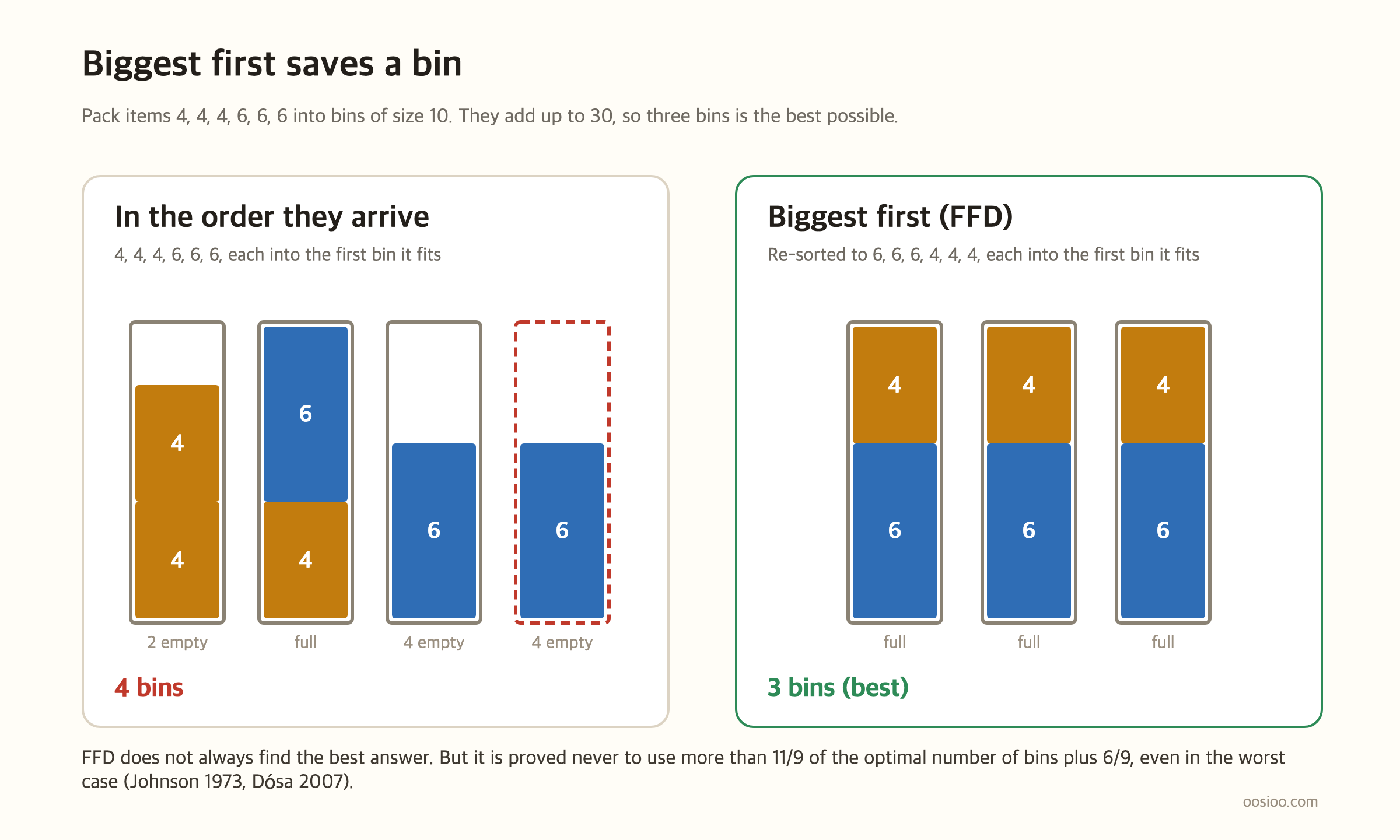
In his 1973 MIT doctoral thesis, David Johnson proved that even in the worst case FFD never uses more than 11/9 of the optimal number of bins, about 1.22 times, plus a small constant. The proof took 70 pages of case analysis. That constant started at 4, several people chipped away at it, and in 2007 the Hungarian mathematician György Dósa settled it by showing it is exactly 6/9. Pinning down the report card of a one-line rule, put the big things in first, took 34 years. In practice it does far better than that. In typical cases FFD was almost always optimal or one bin off.
"Put the big things in first and fill the gaps with socks" is packing advice you hear everywhere. There is no evidence it came from the algorithm. If anything, it is closer to what people do anyway. When a University of Washington team had 100 people pack objects into a box in a virtual space in 2019, they tended to put large objects in the corners first. Old household wisdom and a doctoral thesis point the same way.
Some readers will be thinking of Tetris. That game, created in the mid-1980s by Alexey Pajitnov at the Computing Centre of the Soviet Academy of Sciences, has also been proved mathematically hard. In 2002 Erik Demaine and colleagues showed that if you know every piece that will fall in advance, maximising the number of cleared lines is NP-complete, and even approximating it is hard. But that holds when the board can be made as large as you like. The paper notes that a fixed board such as 20×10 can be solved by dynamic programming. It is also nice that the proof starts from a cousin of bin packing (3-partition). Tetris borrows its hardness from filling boxes. Even so, saying packing is Tetris is only a metaphor. With luggage you see everything at once, rows don't vanish, and clothes fold.
Real loading has more conditions than the textbook. Reviewing container loading research, Bortfeldt and Wäscher (2013) started from the criticism that existing methods paid too little attention to practical constraints, and classified them one by one: weight limits, weight distribution, stacking strength, orientation, unloading order. A suitcase is the same. Heavy things by the wheels, breakables between clothes, the laptop you will pull out at airport security on top. The mathematician's bin counts only gaps; a person's bag counts order and centre of gravity too.
Whose number is 23 kg?
The limits on a bag are set by rules, not mathematics. And these rules each have a story too.
Start with 23 kg for checked bags. The International Air Transport Association (IATA) says that from an occupational health and safety perspective, international guidelines recommend individual checked bags should not exceed 23 kg (50 lb). And in many regions, including the EU and the United States, the maximum for a single bag is 32 kg. Asiana Airlines gives the same reason in its own notice: prepare every bag under 32 kg "to prevent damage and injury to baggage handlers". The weight limit is a number that comes not from the plane's centre of gravity but from the back of the person who lifts the bag.
Nor is there one way of counting. Routes to and from the United States and Canada are commonly counted by number of bags (the piece concept), and other routes by weight (the weight concept). A single Asiana page on checked baggage holds three systems at once. In economy, the Americas get two bags of 23 kg each, other international routes one bag of 23 kg, and domestic flights 20 kg by weight (checked November 2026). I could not find a primary record of when and how the piece concept took hold on transatlantic routes. IATA itself notes that baggage rules are set by airlines and that it plays no role in this.
Cabin bag sizes are even more uneven. In June 2015 IATA proposed 55×35×20 cm as the "optimal size" for a cabin bag and announced that bags made to fit it would carry an "IATA Cabin OK" logo. The backlash was strong. The size was smaller in volume than most airlines allowed, and North American carriers objected that they were investing in bigger overhead bins. Eight days later IATA paused the plan for reassessment. Even in that press release it said this was a guideline, not an industry standard. Cabin bag sizes and weights are still set airline by airline. Korea's full-service carriers broadly use 115 cm in total dimensions and 10 kg, but even with the same numbers, whether a personal item such as a laptop bag counts toward the 10 kg differs between airlines. Low-cost carriers vary by fare type, so it is hard to give a single number. In the end only one thing can be said: check your own airline's notice each time.
What changes rules is usually an event. The rule that liquids in the cabin must be in containers of 100 ml or less inside one clear one-litre bag came after a plot to blow up several airliners with liquid explosives was uncovered at London Heathrow in August 2006. The EU amended its rules that October, and Korea applied it to all international flights from 1 March 2007. The EU designed the measure from the start as temporary, to be lifted once screening technology arrived. And as CT scanners that can screen liquids spread, some airports, such as London Heathrow, began allowing up to two litres. But in September 2024 the EU reimposed the 100 ml limit even at airports using that equipment, citing technical issues, and was reported to have lifted it again for certain machines in summer 2025. Installing equipment does not immediately relax the rule either. Incheon Airport has brought in a number of CT scanners, yet as I write, Korean airports still keep the 100 ml rule on international flights.
The most recent change concerns power banks. Lithium batteries have long been banned from checked bags, because if one catches fire in the hold there is no one to deal with it. After a fire broke out on an airliner preparing for take-off at Gimhae Airport in Busan in January 2025, forcing 176 people to evacuate, Korea required from that March that power banks be kept on the person rather than in overhead bins. Then in March 2026 the International Civil Aviation Organization (ICAO) cut the allowance to two power banks per passenger and banned charging them in flight. A number that had been five units of 100 Wh or less a year earlier became two. I could not confirm the official finding on the fire's cause, so I note that accident only as the occasion for the change.
If there is a lesson in luggage rules, it is this. Limits are not fixed laws of nature but numbers that events, negotiation and technology keep rewriting. Last year's packing tips may be wrong this year. That is why "check the airline's rules" deserves a line on the checklist.
Fold or roll?
The packing tip you probably hear most is "roll your clothes to save space". But I found no experiment that measured it properly. The closest is a test by the British consumer group Which?. They packed the same clothes in the same order into four bags of budget-airline cabin size, filled the remaining gaps with socks, and compared four methods.
| Method | Clothes packed | Pairs of socks in the gaps |
|---|---|---|
| Folding | 129 | 47 |
| Rolling | 121 | 41 |
| Compression packing cubes | 118 | 66 |
| Vacuum compression bags | 113 | 38 |
Folding fitted the most. Rolling's advantage was not space but creases: rolled clothes came out least wrinkled. Compression cubes left gaps between the cubes, so more socks went in but fewer clothes, and vacuum bags fitted the fewest clothes and creased them badly. Which?'s conclusion was that you can forget the hype around vacuum packing and compression cubes.
Still, this was a single run with four bags and one set of clothes. A travel editor who did her own comparison found that rolling saved more space but creased the most, the exact opposite of Which?. The result seems to depend on whether the fabric is thin or thick, whether the case is hard or soft, and on how well you fold. This much can be said honestly: there is no evidence that rolling is always better. Roll the clothes you worry will crease, and fold the rest neatly.
The power of a sheet of paper
The tool people have used longest to stop things going missing is a list.
On 30 October 1935, at Wright Field in Ohio, Boeing's new bomber prototype, the Model 299, crashed just after take-off. The Army Air Corps test pilot Major Ployer Hill and Boeing's chief test pilot Leslie Tower were killed. The cause was not a mechanical fault. The elevator lock, set on the ground to stop the control surfaces flapping in the wind, had not been released. A plane carrying two of the most seasoned pilots fell because one lock was forgotten. Afterwards, checklists were drawn up with items to check before take-off, in flight, before landing and after landing. As the aviation historian Walter Boyne put it in his account of the event, the obstacle was not the size or complexity of the aircraft but human memory. The Model 299 went on to become the prototype of the B-17, of which more than 12,000 were built.
The person who made this story widely known is the surgeon Atul Gawande. In The Checklist Manifesto (2009) he carried the same principle into hospitals. A WHO study in which Gawande was a lead investigator (Haynes and colleagues, 2009) introduced a 19-item surgical safety checklist at eight hospitals, in Toronto, New Delhi, Amman, Auckland, Manila, Ifakara in Tanzania, London and Seattle. Comparing 3,733 patients before with 3,955 after, the death rate fell from 1.5% to 0.8%, and in-hospital complications from 11.0% to 7.0%. Earlier, Peter Pronovost and colleagues (2006) ran an intervention to reduce central-line infections in 103 intensive care units, mostly in Michigan. The median infection rate per 1,000 catheter-days fell from 2.7 to zero within three months.
There are things to be careful about here. Haynes's study was a before-and-after comparison, not a randomised one, so the paper itself does not say the checklist reduced deaths but that it was "associated with" the reduction. Pronovost's intervention bundled practices such as hand washing and skin antisepsis with a safety-culture programme, so reading it as the effect of one sheet of paper overstates it. And when a study (Urbach and colleagues, 2014) compared more than 210,000 operations at 101 hospitals after Ontario, Canada, effectively made checklists mandatory, neither deaths (0.71% to 0.65%) nor complications (3.86% to 3.82%) fell meaningfully. An editorial in the same issue pointed to the possibility that checklists were ticked without things actually being checked.
That counterpoint is, if anything, useful for packing. A checklist's power is not in the paper but in the habit of going through it one item at a time, out loud. When you have a travel checklist and still forget your toothbrush, it is usually because you did not look at the list. And a checklist can also cut down on "just in case". When you go to add something that is not on the list, you end up asking once why you need it.
You can try it yourself in the playground below. The first tab is a puzzle that divides a carry-on's cross-section into 10×6 squares. Twenty items are sorted into "must have", "nice to have" and "just in case", and you can choose a weight limit of 7 kg or 10 kg. When you are done, press "Auto-fill" and FFD, biggest first, packs the same case. The second tab sets the results of three orders, by size, by points per kilogram and needs first, beside your own bag, and uses dynamic programming to compute the best score possible if you ignore shape and count only weight. The third tab shows how quickly checking every combination balloons as the number of items grows.
Closing
Back to the note. My bag is always heavier than it needs to be, and the one thing I need is never in it.
As far as I followed it today, these are two different ailments with two different cures. A heavy bag comes from the knapsack problem of choosing what to bring. Choose ahead all at once and you choose more; the regret of leaving something out is sharper than the regret of bringing it, so the bag swells. The cure here is the habit of asking "just in case" one more question. How likely is that to happen, and if it does, can I get it there? The missing toothbrush, on the other hand, is a problem of memory. The pilots of 1935 forgot one lock too. The cure here is a list, and more than making the list, actually looking at it.
And space is less of a problem than it seems. That the simple rule of putting the big things in first never strays far from the best was proved half a century ago. As you will see if you try the playground, what the auto-filled bag lacks is not empty squares. It is someone who knows why each thing is needed on this particular trip. The algorithm fills the box; the person packing fills the trip. The next time clothes are spread across the bed the night before a trip, it might be worth running through the list once before putting the big things in. And each time the words "just in case" come up, asking one more question: will I really use it?
A Page for Today is a series in which I open my idea notebook at random and add the day's thoughts to the line written there. Today's line was "My bag is always heavier than it needs to be, and the one thing I need is never in it."
- People and packing: InsureandGo, 25 items we never unpack (January 2024, 2,077 respondents) · Upgraded Points, States with the most overpackers (2024, 2,200 respondents) · Radical Storage, Travel packing statistics (September 2024, 1,511 respondents) · Global Rescue, Traveler Sentiment and Safety Survey press release (August 2026) · K. Barry, Everyday Practices of Tourism Mobilities: Packing a Bag (Routledge, 2017)
- Choice and regret: I. Simonson, J. Marketing Research 27(2), 1990 · D. Read, G. Loewenstein, J. Experimental Psychology: Applied 1(1), 1995 · M. Zeelenberg et al., Organizational Behavior and Human Decision Processes 65(2), 1996
- Knapsack and bin packing: R. M. Karp, Reducibility among combinatorial problems (1972) · V. Cacchiani et al., Computers & Operations Research 143, 2022 · C. Murawski, P. Bossaerts, Scientific Reports 6, 2016 · D. S. Johnson, Near-Optimal Bin Packing Algorithms (MIT PhD thesis, 1973) · D. S. Johnson et al., SIAM J. Computing 3(4), 1974 · E. G. Coffman, M. R. Garey, D. S. Johnson, Approximation algorithms for bin packing: a survey (1996) · G. Dósa, ESCAPE 2007 (LNCS) · G. Lee, C. Mavrogiannis, S. Srinivasa, arXiv:1909.06527 (2019) · E. D. Demaine, S. Hohenberger, D. Liben-Nowell, Tetris is Hard, Even to Approximate, arXiv:cs/0210020 (2002) · A. Bortfeldt, G. Wäscher, European J. Operational Research 229(1), 2013
- Baggage rules: IATA, Passenger baggage rules · Check bag (checked November 2026) · IATA press release pausing Cabin OK (17 June 2015) · Asiana Airlines carry-on and checked baggage, restricted items notices (checked November 2026) · Commission Regulation (EC) No 1546/2006 · European Commission DG MOVE, Liquids, aerosols and gels · European Commission announcement of 31 July 2024 (Implementing Regulation (EU) 2024/2108) · GOV.UK, Hand luggage restrictions: liquids · Heathrow Airport hand baggage guidance · ICAO, New power bank restrictions (March 2026) · Korea.kr policy briefing card news (19 April 2024, 18 February 2025)
- Folding and rolling: Which?, How to pack a suitcase the most space-efficient way
- Checklists: W. J. Boyne, The Checklist, Air & Space Forces Magazine (August 2013) · A. Gawande, The Checklist Manifesto (2009) · A. B. Haynes et al., NEJM 360(5), 2009 · P. Pronovost et al., NEJM 355(26), 2006 · D. R. Urbach et al., NEJM 370(11), 2014