
Avalanches in a Pour-Over Bed
Putting numbers on a pour-over stream: wet coffee grounds are only slightly heavier than water, so even a gentle pour from 2 cm pushes them with tens of times the force needed to move them. Stirred grounds settle in order of size and leave a fines layer on top; the more is stirred up, the thicker the layer, and drawdown grew from 13 to 108 s in this calculation. Includes a stream-and-bed tool.
Pour-over brewing comes with plenty of advice about how to pour: thin, low, circling out from the centre, without disturbing the bed. After the last pour, you are told to spin the dripper to flatten the bed. A 2025 study told the other side of the story: the water stream churns the grounds and mixes them like an avalanche, and pouring from higher up improves extraction.
I put numbers on the stream's force. Even pouring gently from 2 cm, the stream pushes on the grounds with tens of times the force needed to start moving them, because wet coffee grounds are only slightly heavier than water. Grounds stirred up this way settle back in order of size and leave a layer of fines on top. The more grounds are stirred up, the thicker that layer, and the slower the water drains.
The stream stirs the grounds
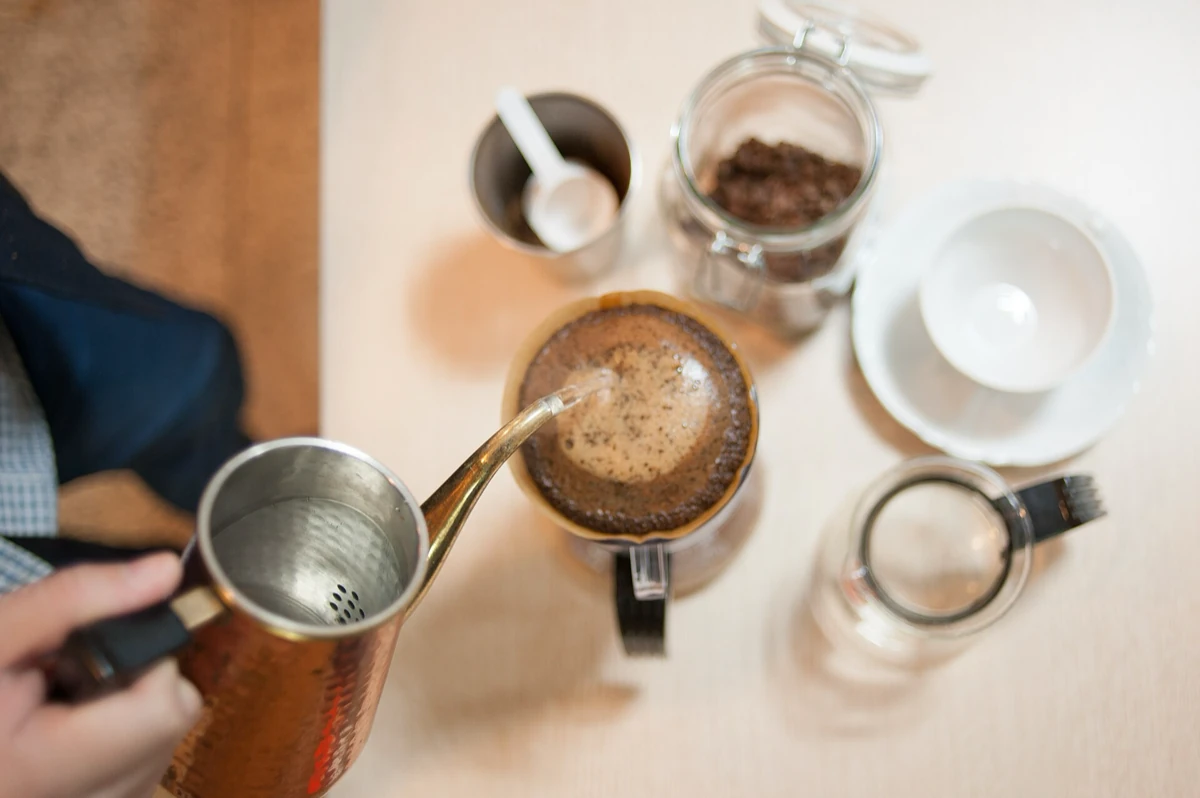
Pouring with a gooseneck kettle · Photo: Kim Sanso, Wikimedia Commons, CC0
Park, Young and Mathijssen (2025) filled a glass cone with silica-gel grains instead of coffee, lit a cross-section with a laser sheet, and filmed with a high-speed camera how the grains move under a falling stream. According to the abstract, there was "an avalanche effect that leads to strong mixing at various pour heights, even with a gentle pour-over jet", and a layer of floating grains did not much affect the mixing. Measuring extraction with real coffee, they found it could be tuned by prolonging the mixing with slower but more effective pours. The researchers told the press to pour "as high as possible, while still maintaining a laminar flow". I could not open the full text, so I have not checked their pour heights, flow rates or concentrations.
How strong is the stream?
Say you pour 6 mL per second from a kettle spout 4 mm across. The water speeds up and thins as it falls. It reaches the water surface at 0.79 m/s from 2 cm, 1.48 m/s from 10 cm and 2.04 m/s from 20 cm, thinning from 3.1 mm to 1.9 mm.
Once underwater, the stream drags surrounding water along, widening and slowing. A submerged round jet keeps its speed for about six stream diameters and then slows in inverse proportion to distance. That flow hits the bed, spreads sideways and pushes on the grounds.
The criterion for when sand on a riverbed starts to move is the Shields number: the force of the flow on the bed divided by the particle's underwater weight. Above about 0.045, particles start to move. I found no measured density for wet coffee particles, so I assumed 1,150 kg/m³, about 20% heavier than water (965 kg/m³). Sand (2,650 kg/m³) is 2.7 times heavier than water, so underwater, coffee grounds weigh a ninth as much as sand grains of the same size.
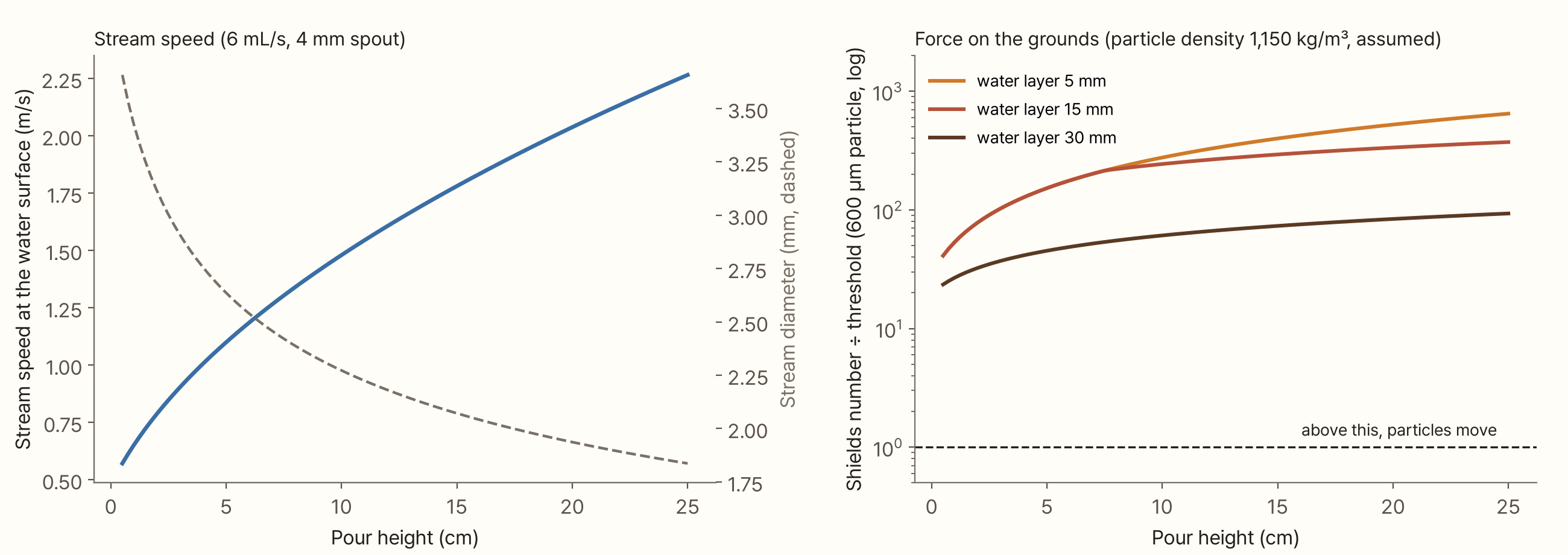
The margin was wide. For a 600 µm particle, even a gentle pour from 2 cm gave a Shields number 78 times the threshold (with a 15 mm water layer); 240 times at 10 cm and 340 times at 20 cm. Even with a 30 mm water layer slowing the stream a lot, it was 32 to 84 times. Wherever the stream lands, the grounds move, whatever the height. That fits Park and colleagues' finding of strong mixing "even with a gentle pour-over jet".
So what pour height changes is not whether the grounds move but how wide and deep the stream churns. A faster stream digs deeper, the walls of the crater it digs collapse (avalanche), and surrounding grounds flow in. That part needs experiments.
Stirred grounds settle in order of size
Grounds stirred up settle again, at speeds that differ greatly with size.
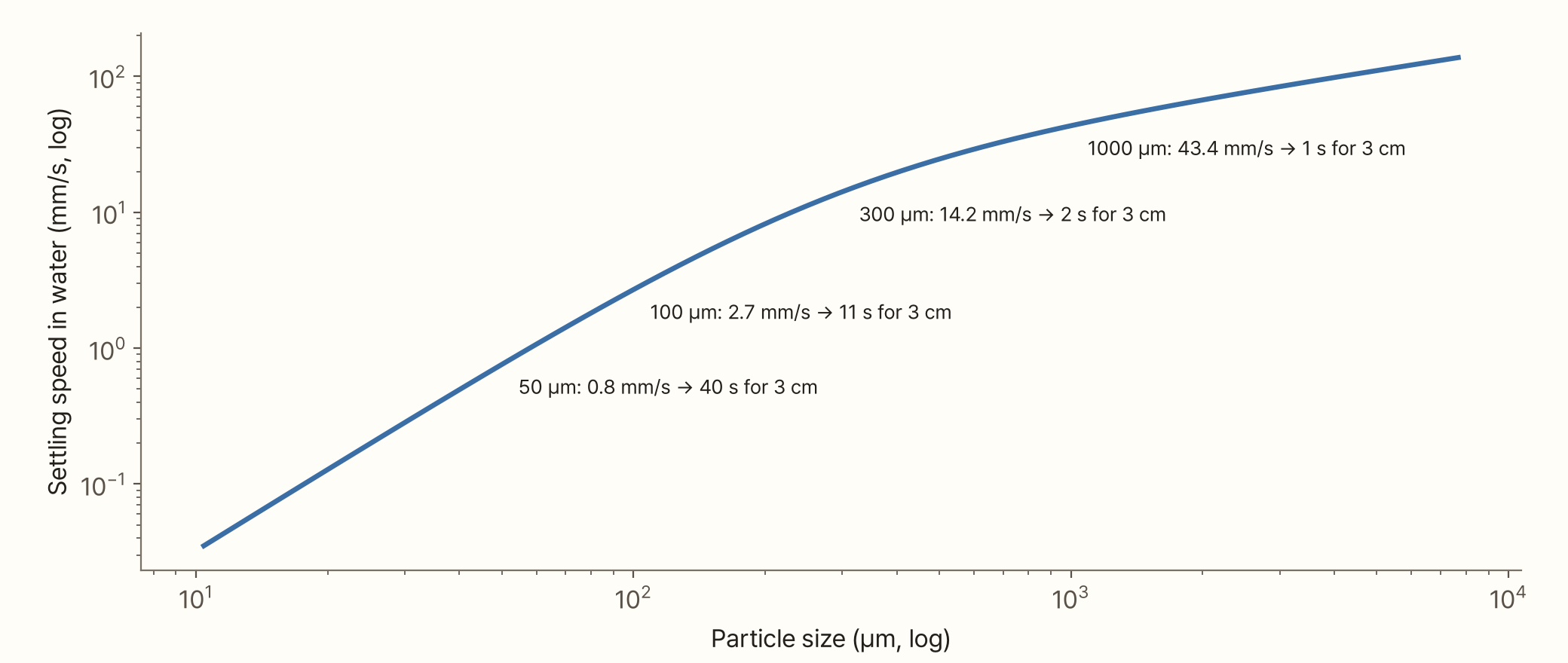
With a particle density of 1,150 kg/m³, a 1 mm particle sinks 3 cm in under a second and a 300 µm particle in 2 s. A 100 µm particle takes 11 s and a 50 µm fine 40 s. Within seconds of stirring, all the coarse particles reach the bottom, while fines hang in the water for a long time before landing on top. The settled bed ends up coarse at the bottom and fine at the top.
I calculated how this layering affects drainage. Fifteen grams of filter-grind coffee (800 µm gap) lie in a 6 cm cylinder with 220 g of water above. When part of it is stirred back up, the stirred grounds settle in order of settling speed. Giving each layer a Kozeny–Carman permeability from its Sauter mean size, I solved for the time for the remaining water to drain (drawdown).
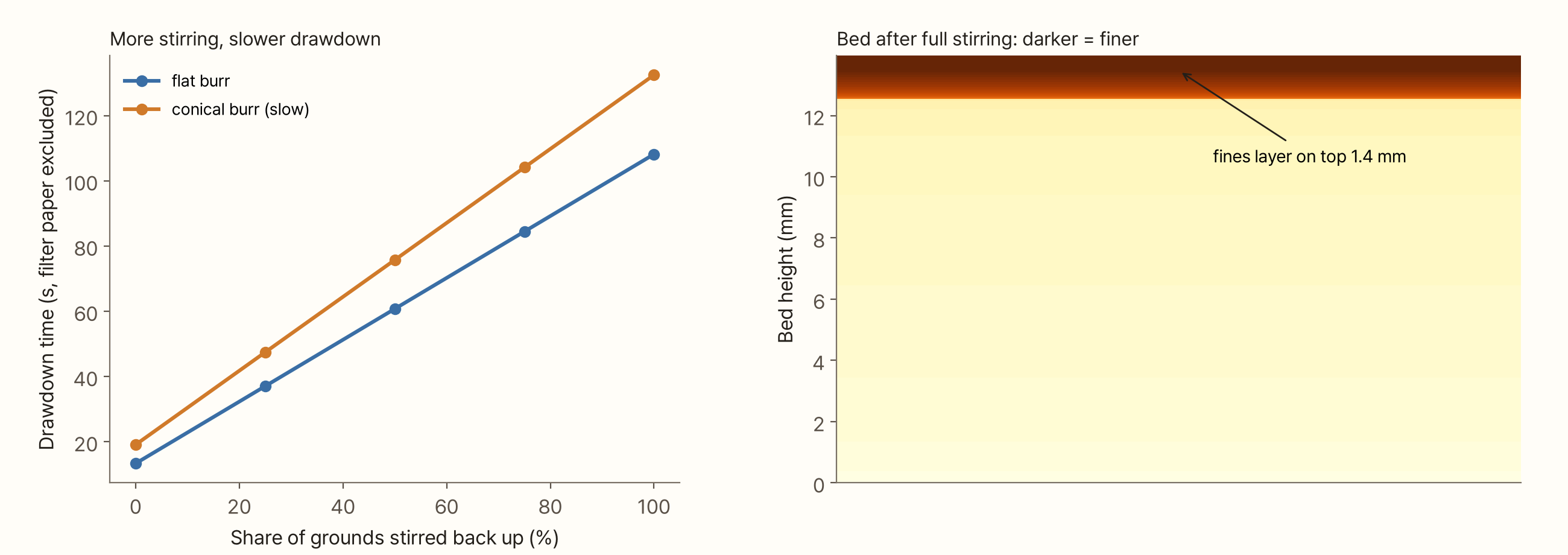
With nothing stirred up and the grounds evenly spread, the water drained in 13 s. Stirring up half took 61 s, and stirring up all of it 108 s, eight times longer. The fines layer on top is only 1.4 mm thick, but all the water has to pass through it. Fines gathered in one place block water far more than the same fines scattered evenly.
In a 2019 post with Scott Rao, Gagné wrote that spinning the dripper for 7 s gave a drawdown of 5:18, versus 4:28 for a 2 s spin. It was one person's single test, and he attributed the difference to fines clogging the filter paper. This calculation shows another route: the more you stir, the more fines gather on top and hold back the water. Which matters more is a question for experiment.
Pour it yourself
In the tool below, change the pour height, pour rate, water layer depth and wet particle density to see Shields numbers by particle size. Change the share of grounds stirred up and the grinder type to see the settled bed's cross-section and the drawdown time.
What this conclusion leaves out
- I found no measured density for wet coffee particles. 1,150 kg/m³ is an assumption. Freshly roasted coffee can even float at first because of CO₂
- The stream and bed flow are estimated with textbook formulas. The cone wall, flow from earlier pours and the foam layer are not included, and how wide and deep the stream churns is not calculated
- Settling treats particles one at a time. In reality particles collide and tangle, and water draining downward can carry fines into the bed. A cylinder stands in for the cone, and filter-paper resistance is excluded
- Every layer has the same porosity, 0.40. In an evenly mixed bed, fines fill the gaps between coarse particles and reduce the voids; leaving this out may understate the resistance of a mixed bed
- Only the abstract of Park and colleagues (2025) was read
Summary
- Park and colleagues (2025) filmed grains in a cone and reported strong, avalanche-like mixing even with a gentle stream
- Pouring 6 mL per second from a 4 mm spout, the stream reaches the water at 0.79 m/s from 2 cm and 2.04 m/s from 20 cm. Wet coffee grounds are only slightly heavier than water, so even from 2 cm the stream pushes them with tens of times the force needed to move them
- Stirred grounds settle in order of size: 1 mm particles in under a second, 50 µm fines in about 40 s, landing on top
- The more grounds are stirred up, the thicker the fines layer on top; in this calculation drawdown grew from 13 to 108 s. The experience that long stirring slows drainage can be explained by a route other than fines clogging the filter
References
- Park E, Young M, Mathijssen AJTM (2025). Pour-over coffee: mixing by a water jet impinging on a granular bed with avalanche dynamics. Physics of Fluids 37(4), 043332. doi:10.1063/5.0257924 — abstract only
- Gagné J, Rao S (2019). Why spin the slurry? Coffee ad Astra, blog post, 9 January 2019 — not peer-reviewed
- Gagné J (2021). The Physics of Filter Coffee. Scott Rao Coffee Books. ISBN 978-0-578-24608-6 — bibliographic details only
- Shields A (1936). Anwendung der Ähnlichkeitsmechanik und der Turbulenzforschung auf die Geschiebebewegung. Mitteilungen der Preußischen Versuchsanstalt für Wasserbau und Schiffbau 26 — bibliographic details only
- Ferguson RI, Church M (2004). A simple universal equation for grain settling velocity. Journal of Sedimentary Research 74(6), 933–937. doi:10.1306/051204740933 — bibliographic details only
Image credits
- Pour-over: Kim Sanso, Wikimedia Commons_coffee.jpg), CC0
- All other charts, the cover and the tool: made by me