While I logged meals for my AI coach, one injection changed the game: AI diet coaching, GLP-1 weight-loss drugs, and the AI used to make them
Feeding an AI your check-up results and logging meals and workouts so it can advise you like a personal trainer is already a crowded market at home and abroad. I sorted out, from papers and company announcements, whether people actually lost weight and where the AI gets it wrong. Meanwhile Wegovy and Mounjaro have arrived, and word is that gyms and the diet industry are reeling. I separated what the numbers confirm from rumour, and rounded up where AI is really used in developing these drugs, with examples from Korea and abroad.
A while back, as a personal project, I used AI as a kind of personal trainer. I fed it my health check-up results first, then regularly sent it what I ate and what exercise I did, and asked for advice. Was I short on protein? Given the numbers flagged as borderline in my check-up, what should I cut back on? Which muscle group should I train today? It was nowhere near as precise as paying for a real PT, but the feeling that someone was keeping an eye on my diet was unmistakable.
Then the world moved on. Wegovy and Mounjaro arrived, and people around me started saying "an injection instead of the gym". Headlines say gyms and personal training are in crisis. This episode puts the two stories side by side. Has anyone really lost weight with an AI coach? Are weight-loss drugs really killing gyms? And where does AI actually come in when these drugs are made?
What I set out to do
Normally this series has AI build something usable from a line or two of instructions, then records where it went wrong. That is hard this time. The heart of AI coaching is a conversation with a language model, and you can't drop that into an article as something you click and watch run. So I turned this into a round-up of cases.
I looked at three things. First, cases where using AI as a coach or dietitian actually improved weight or health markers, keeping company marketing figures apart from published results. Second, the shock GLP-1 weight-loss drugs have sent through personal training, gyms and the diet industry. Third, the AI used to research and develop those drugs, with examples from Korea and abroad. I split the research across three AI agents, made them attach a primary source to every number, and dropped anything without one.
Did anyone really lose weight with an AI coach?
Apps that log and coach
The oldest approach is an app where you log your food and weight, and coaching is based on that log.
- Noom: In 2016 a team of Korean researchers analysed the records of 35,921 Noom Coach users (Scientific Reports). 77.9% recorded a drop in weight, and 22.7% lost more than 10%. The behaviour that best predicted weight loss was logging dinner without fail. But it was a retrospective analysis with no control group, and weights were self-reported
- Lark: An AI coach that works purely through text chat, with no human coach. Seventy people in a diabetes prevention programme lost 2.38% over an average of 15 weeks (JMIR Diabetes, 2017). Only consistent users were analysed
Studies like these come closer to showing that people who used the app diligently lost weight than that the app works. A study published in JAMA in October 2025 broke that mould. Johns Hopkins and others randomly split 368 people with prediabetes and excess weight: one group got a remote diabetes prevention programme led by human coaches, the other an AI app with no human involved, plus a digital scale. After 12 months, the share who hit their weight, activity and blood-sugar goals was 31.7% with AI and 31.9% with humans. By the pre-set criterion, the AI was not worse than the humans. More people started the AI programme (93.4% vs 82.7%) and more finished it (63.9% vs 50.3%). With no coach's diary to fit around, fewer dropped out.
Two caveats. This AI was not a language model like ChatGPT; it was an app that used reinforcement learning to choose nudges and tasks. And the result is "as good as a human", not "better than a human".
Korean studies point the same way. Two randomised trials from 2020: in one, 70 women on a digital cognitive behavioural therapy programme lost 3.1% in eight weeks against 0.7% in the control group, with a psychologist giving daily feedback. The other compared a food-logging app with a paper diary over six weeks and found no difference in weight. Logging alone doesn't do it; someone has to look at the log and talk to you.
Personalising with your own body's data
The second approach feeds in data from your own body, such as blood sugar or test results, so the advice fits you.
- ZOE: British researchers fed 1,002 people the same meals and found blood-sugar responses varied widely from person to person (coefficient of variation 68%, Nature Medicine 2020). They built a personalised diet service on that data, and in an 18-week randomised trial with 347 people, it beat general dietary advice by 2.46 kg of weight loss (Nature Medicine 2024). The difference in the primary outcome, triglycerides, was small, and critics said the control group got a weaker intervention
- Virta Health: Doctors and coaches remotely managed people with type 2 diabetes on a low-carbohydrate diet. Of those who completed two years, 54% reached an HbA1c below 6.5% without medication (Frontiers in Endocrinology 2019). The study was not randomised and many authors worked for the company. It is closer to telemedicine than an AI coach
- Kakao Healthcare's Pasta: Combines a continuous glucose monitor with AI lifestyle coaching. The company says it gained about 200,000 users in a year and that 96% of its top 10% of users stayed within their glucose-variability target. A company announcement looking only at the keenest users
- Pilyze: Take a photo of your food and AI works out the nutrients and coaches you. The company says its paying users lost a combined 509 tonnes in 2025 and its top quarter lost 7.48 kg on average. It did not say how weight was measured, and there was no control group
General-purpose AI becomes a health coach
The third approach is what I did: feed health data to a general-purpose language model such as ChatGPT, Claude or Gemini and ask it questions. In 2025 and 2026 the big companies started turning this into products.
| Service | Launched | What it does |
|---|---|---|
| WHOOP Coach | September 2023 | Uses GPT-4 to read heart-rate and sleep data from the wearable and answer questions |
| Oura Advisor | March 2025 | Conversation based on sleep and activity data from the ring |
| Fitbit personal health coach | Preview October 2025, wider February 2026 | Built on Gemini. Plans workouts and coaches sleep |
| ChatGPT Health | January 2026 | Links to Apple Health, MyFitnessPal and others; in the US, medical records too |
| Samsung Health Assistant | US beta July 2026 | Combines sleep, activity, nutrition and vitals. Weight management to come |
I found no published data showing these services actually improved users' weight or health. Bloomberg reported in February 2026 that Apple had scaled back plans for an AI health coach service. Google published a paper showing that a Gemini model tuned on wearable data (PH-LLM) beat experts on multiple-choice sleep and fitness exams (Nature Medicine 2025). That is an exam score, not a change in anyone's body.
There are plenty of personal stories of losing weight with a general-purpose model as coach. In 2023 a US developer made headlines for losing about 12 kg in three months on a running habit plan written by ChatGPT. Day one's task was "put your running shoes by the front door". The coverage repeats his own account. I found no randomised trial comparing weight outcomes with general-purpose language-model coaching.
The most useful thing I did was have it read my health check-up results, and here there is research. In 2026 a Korean team tested Claude, Gemini, GPT-4o and Llama on data from Korea's National Health Insurance Service check-ups (npj Digital Medicine). Asked directly, the models averaged 0.69 accuracy; asked to reason step by step, 0.95, with the top three above 0.98. Blood markers such as glucose and cholesterol were judged almost perfectly. But blood-pressure judgements dropped to between 0.61 and 0.91, and there was a bias where the verdict changed with sex.
Where AI coaches get it wrong
This series is built on mistakes. Gathering cases, I found the places AI coaches go wrong cluster quite clearly.
- They can't count calories from photos. In a 2025 study, 52 food photos were shown to ChatGPT-4o, Claude 3.5 Sonnet and Gemini 1.5 Pro. Energy estimates were off by about 36% for ChatGPT and Claude and by 64–110% for Gemini (Current Developments in Nutrition). All three undercounted more as portions got bigger. The authors rated the accuracy as roughly that of a food diary people fill in themselves. In another 2026 study, giving every model the role of "a Japanese dietitian" made them all estimate fewer calories. The biggest errors came not from identifying the food but from judging the amount
- Their meal plans don't add up. Asked for 1,400–1,800 kcal weight-loss meal plans, Gemini missed the target by more than 20% in over half of them (Nutrients 2025). Of 54 weight-loss plans written by ChatGPT-4o, many were short on calcium, potassium and vitamin B1, and asking the same question again produced a different plan. Given teenagers' meal plans, five AI models set energy about 695 kcal lower on average than dietitians (Frontiers in Nutrition 2026). For dialysis patients, all four models undercounted phosphorus and potassium. For someone with failing kidneys, that is dangerous
- They give harmful advice. In 2023 the US National Eating Disorders Association took down its chatbot "Tessa" after it told people seeking help for eating disorders to cut 500–1,000 kcal a day and lose 0.5–1 kg a week. The same year, a campaign group tested six generative AI tools and found 41% of their responses promoted eating disorders
- They read the same data differently. In the check-up study above, blood pressure alone wobbled. Blood pressure has two numbers, systolic and diastolic, that must be read together, against several levels of thresholds. Unlike glucose, judged from a single number, it fails where a combination has to be read
A 2026 review (Frontiers in Endocrinology) sums up the field well: most evidence of an effect on weight or metabolic markers is the effect of "a whole digitally automated care programme", and reading it as an effect of AI alone is a mistake.
Meanwhile, along came an injection
Wegovy launched in Korea in October 2024 and Mounjaro in August 2025. Both are injections that mimic GLP-1, a gut hormone. GLP-1 is normally released after a meal; it helps insulin secretion, slows how fast the stomach empties, and tells the brain you are full. The body breaks the hormone down within minutes, but the drugs are modified to resist that, so one injection a week keeps working. Mounjaro also mimics a second hormone, GIP.
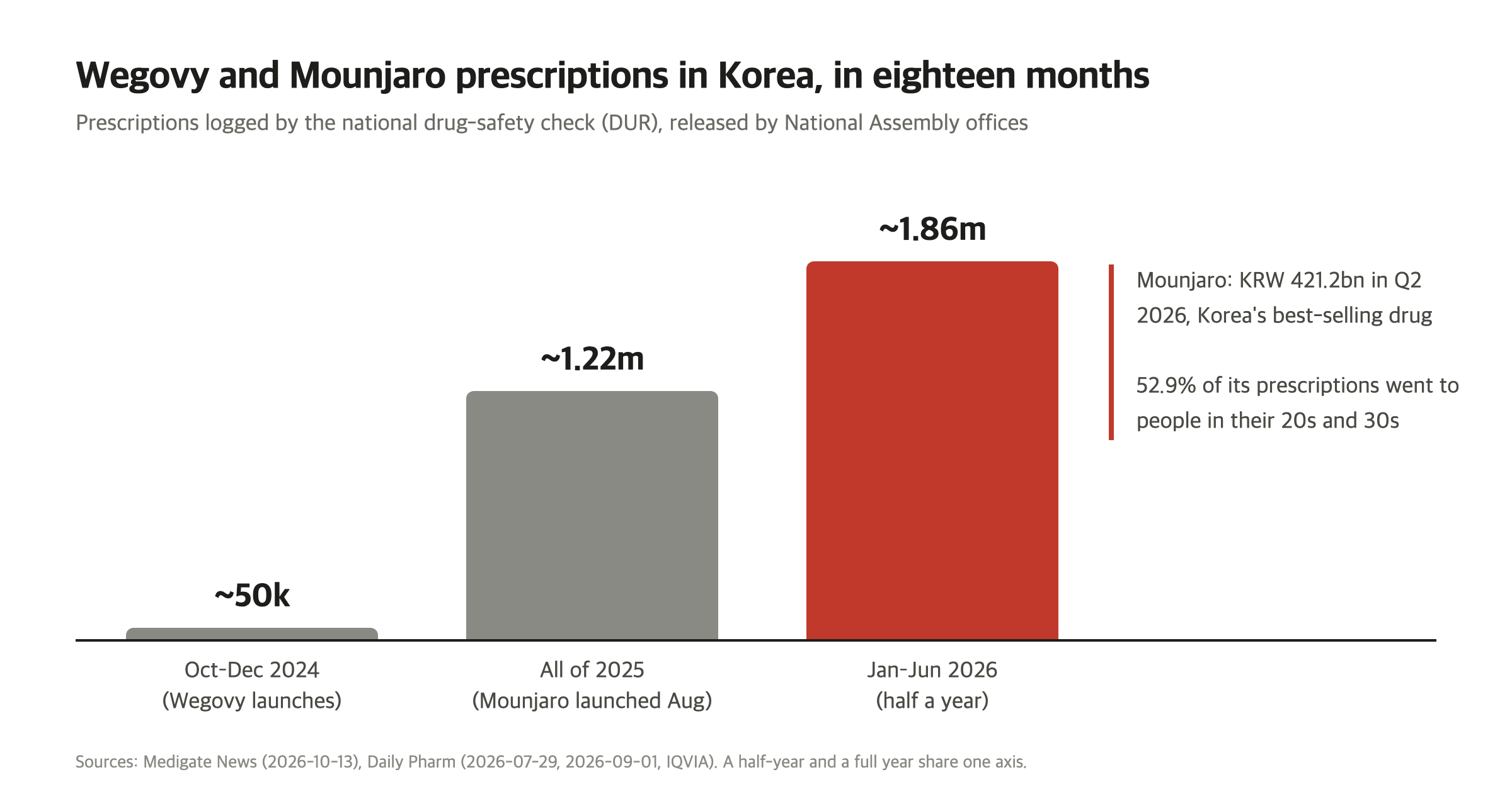
The numbers are steep. Prescriptions of the two drugs logged by Korea's drug utilisation review (DUR) system went from about 50,000 in the last three months of 2024 to about 1.22 million across 2025, then about 1.86 million in just the first half of 2026. In Q2 2026, Mounjaro sold KRW 421.2 billion, making it the best-selling drug in Korea. Of Mounjaro's prescriptions, 52.9% went to people in their 20s and 30s. One reporter with a normal body-mass index reported getting a prescription in five minutes, and in June 2026 Korea's drug regulator announced plans to designate these drugs as at risk of misuse (still under review as of October).
Are gyms really collapsing?
Plenty of articles say weight-loss drugs are shutting gyms down one after another. The numbers make that hard to claim.
Gym closures in Korea hit 553 in 2024, the most since records began in 1990 (Ministry of the Interior and Safety licensing data as queried in February 2025; later reports give 567, since the data is revised retroactively). But the peak was 2024, and Wegovy only launched that October. The Korea Herald article that first reported the closures did not name weight-loss drugs as a cause. A weak economy, cut-throat competition and losses from prepaid memberships are all mixed in. I found no official statistics showing Korean gym memberships have fallen.
What clearly did collapse is somewhere else. WeightWatchers, a pioneer of diet programmes, filed for bankruptcy protection in the US in May 2025. It shed about USD 1.15 billion of debt and emerged a month or so later, and is now a company whose fastest-growing business is prescribing weight-loss drugs. Its clinical subscribers reached 197,000 in Q2 2026, up 56% in a year. Total revenue is still shrinking. US telehealth firm Hims & Hers partnered with Novo Nordisk, split, went as far as litigation, and teamed up again in March 2026. Noom also sells a low-dose GLP-1 prescription programme.
The story from US gyms runs the other way. Upmarket chain Life Time opened GLP-1 prescribing clinics inside its clubs, and its chief executive called GLP-1 drugs a "home run" for the gym business. Planet Fitness also names GLP-1 users as a big customer base. The evidence they cite is a brokerage survey: William Blair asked 300 GLP-1 users and found the share with gym memberships rose from 24% to 35% in a year. Yet Planet Fitness's same-store sales grew only 1.7% in Q2 2026, all of it from price rises. The "tailwind" is, for now, management's hope.
The shopping basket did change. Cornell researchers analysed the purchases of about 150,000 US households: within six months of starting GLP-1 drugs, grocery spending fell 5.3% and spending on savoury snacks fell 10.1% (Journal of Marketing Research, 2025). When people stopped the drug, spending went back to normal.
Which is why coaches are still needed
The evidence that weight-loss drugs don't replace exercise and diet comes from the drugs' own trials.
- Some of the weight lost is muscle. In a semaglutide (Wegovy) trial, about 40% of the weight lost was lean mass (NEJM 2021, sub-study of 140 people). For Mounjaro it was about 25% (NEJM 2022). Lean mass includes water and organs as well as muscle, so "your muscles melt away" is an exaggeration. Still, it is why strength training and protein have become part of the prescription
- Stop, and it comes back. Wegovy trial participants lost 17.3% over 68 weeks; after they stopped both the drug and the lifestyle support, two-thirds of the lost weight returned within a year. In January 2026 Oxford researchers pooled 37 studies with 9,341 people and found weight came back at 0.4 kg a month on average after stopping. With semaglutide and tirzepatide (Mounjaro) it was 0.8 kg a month, back to the starting weight in about 18 months, faster than after finishing a behavioural programme (BMJ)
That is why people in Korea's gym industry say the market for managing rebound after people come off the drug will grow. While the drug dampens appetite, you need to protect muscle and build habits that hold after you stop. That is exactly the job the AI coach matched a human coach at earlier.
Where AI is used in making these drugs
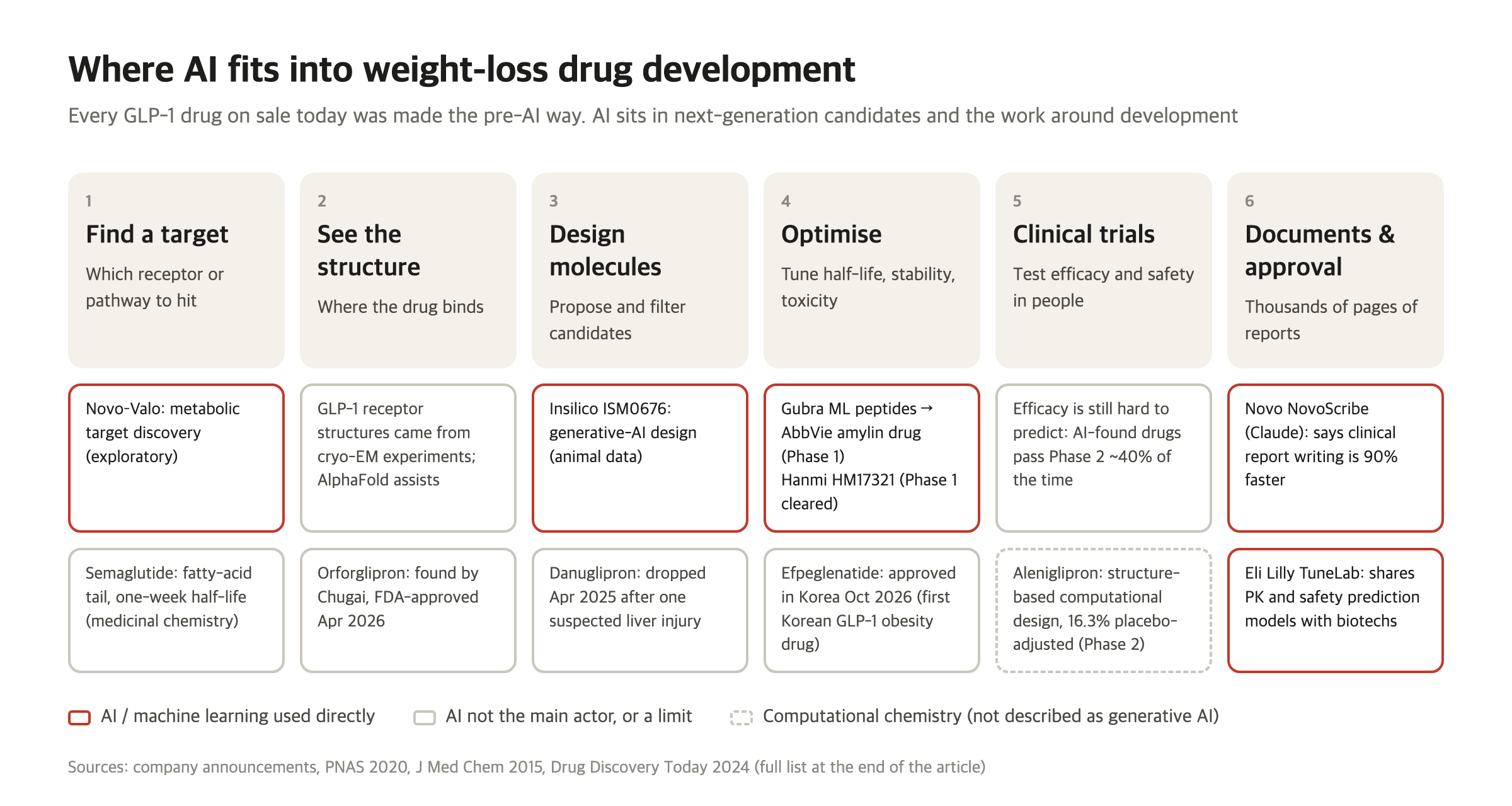
The conclusion first: none of the GLP-1 weight-loss drugs on sale today was designed by AI. Wegovy, Mounjaro, the oral drugs approved in the US in 2026, and the Korean drug approved this month were all made by people through repeated experiments. AI sits in the next generation of candidates and in the work around development. When you see "AI-developed weight-loss drug" in a headline, make that distinction first.
The baseline: drugs made without AI
- Semaglutide's fatty-acid tail. The body's own GLP-1 is broken down in minutes. Novo Nordisk's researchers swapped the amino acid at the spot where the enzyme cuts, and attached a fatty-acid tail to the chain. The tail sticks to albumin, a protein in the blood, and slowly lets go, giving a half-life of about 165 hours. That is where the once-a-week injection came from. The 2015 paper shows it was the result of synthesising and testing variants, changing tail length and linker one at a time
- Orforglipron. A pill instead of an injection. It is a small molecule, not a peptide, so the stomach doesn't break it down. Japan's Chugai discovered it and licensed it to Eli Lilly, and it won US FDA approval for obesity in April 2026. Where it binds on the receptor was confirmed by cryo-electron microscopy (cryo-EM). I found no evidence it was designed with AI
- Danuglipron. Pfizer's oral drug made in a similar way. When one of more than 1,400 trial participants showed a suspected drug-induced liver injury, Pfizer dropped it in April 2025. However good the design, safety is only known once the drug goes into people
- Efpeglenatide. Made by Hanmi Pharmaceutical with its own half-life-extension technology, it won approval from Korea's drug regulator on 7 October 2026, becoming the first Korean-made GLP-1 weight-loss drug. In the Korean Phase 3 trial, it took off 9.75% on average over 40 weeks (placebo 0.95%)
Where AI comes in
Structure prediction. AlphaFold is an AI that predicts protein structures. Because it lets you see the shape of the receptor a drug will bind to, it gets presented as the starting point of drug discovery. But for membrane proteins like the GLP-1 receptor (a GPCR), its limits are clear. Given the receptor alone, it mostly returns the switched-off shape, and the switched-on shape with a drug bound, or the exact shape of the binding pocket, often doesn't match experiments. In practice it is used as a hypothesis tool alongside experimental structures.
Peptide optimisation. This is where results are clearest. Denmark's Gubra trains machine-learning models on data from thousands of peptides it synthesised and measured itself, tuning potency, stability, solubility and half-life together. An amylin analogue made this way was licensed to AbbVie in March 2025 for USD 350 million up front, and is now in Phase 1. In Korea, Hanmi's HM17321, whose sequence was designed with the company's own AI platform, has clearance for a US Phase 1 trial. It aims to cut fat while building muscle and is not a GLP-1 drug. It is the clearest Korean obesity candidate where the company states AI was used in the design.
Generative molecular design. Insilico Medicine used generative AI to produce ISM0676, an oral GIP receptor blocker. It chose the candidate after synthesising fewer than 200 molecules in 14 months, and in obese mice, combined with semaglutide, it cut body weight by 31.3% over 27 days. There is no human data yet. Aleniglipron, an oral GLP-1 candidate from US company Structure Therapeutics, was designed with structure-based computational chemistry and took off 16.3% more than placebo over 44 weeks in Phase 2. The company does not call it generative AI.
Big companies' bets. Novo Nordisk expanded a deal with Valo Health to use AI to find obesity and diabetes targets, worth up to about USD 4.6 billion (January 2025), and works with NVIDIA on molecular design on Gefion, a Danish AI supercomputer. Eli Lilly opened TuneLab, prediction models built on drug data it spent more than USD 1 billion gathering, to biotech companies in September 2025, and installed a supercomputer with 1,016 NVIDIA GPUs. It also signed with Superluminal, an AI drug company targeting obesity-related receptors. None of these deals has produced a public obesity candidate in the clinic yet. "Up to billions" is mostly money paid only on success.
Korea. D&D Pharmatech signed a final agreement with LG AI Research in June 2026: LG's EXAONE Discovery designs peptide sequences, and D&D handles synthesis and oral formulation. Daewoong Pharmaceutical said in 2024 that its DAISY system, with a database of 800 million compounds, found a dual-acting substance for obesity and diabetes in two months, but did not disclose the target or the molecule. Ildong Pharmaceutical's oral GLP-1 candidate took off up to 9.9% on average over four weeks in Phase 1; the company hasn't said whether AI was used.
Documents, not molecules. Surprisingly, the writing involved in development is where the effect is big. Novo Nordisk built a clinical documentation tool with Claude and says it cut the time to write clinical study reports by 90%. A single new drug needs thousands of pages of regulatory documents. It isn't finding molecules, but it changes how fast drugs come out.
Do AI-designed drugs do better in trials?
A 2024 analysis (Drug Discovery Today) counted the clinical record of AI-discovered candidates. Of 24 that had completed Phase 1 by the end of 2023, 21 passed, higher than the industry average. But the Phase 2 success rate, where efficacy is tested, was about 40%, in line with the industry. AI helps choose molecules that are low in toxicity and last well in the body, but it still can't reliably predict whether a drug will actually work in people. Reports say no AI-discovered drug had received full FDA approval as of summer 2026.
How I used it
Back to my personal project. Set against the cases above, I can see a little more clearly which parts of what I did were doing the work.
One was sending updates regularly. In the Noom study, logging dinner was the strongest predictor; in the Korean studies, a logging-only app made no difference, but daily feedback from a person did. The effect comes less from how clever the AI is than from the structure: you log, and someone responds to the log.
The other was putting my check-up results in first. Because the AI knows your weak spots, the advice moves beyond generic tips. It is a rough imitation, using a check-up report, of what ZOE or Pasta do with glucose data. But as the research above shows, when you have it read a check-up report you should make it go step by step, and check items like blood pressure yourself.
If you want to try it
- Make it read your check-up step by step. As in the study above, accuracy rises sharply if it compares each number to its reference range in order. For items like blood pressure, where two values must be read together, check the verdict yourself
- Take direction, not calorie counts. Photo estimates are off by more than 30%. Comparisons and direction, like "less protein than yesterday" or "no vegetables", are more reliable. If you really need numbers, weigh the food and log it
- Don't stop logging. People who log lose weight, not because the app is good. Start by not skipping dinner
- If you are on a drug, tell your AI coach too. While on GLP-1, the task is not eating less but getting enough protein and strength training. The year after you stop is the real test
- If you are ill, don't ask AI. With kidney disease, diabetes medication or a history of eating disorders, AI meal plans can be dangerous. See a doctor and dietitian first
What this can't do
- There is nothing working in this article. AI coaching is a conversation, so it can't be run inside the page. This episode collects cases and numbers
- The effect of general-purpose AI coaching is unproven. I found no weight study randomly comparing people coached by ChatGPT or Claude with people who weren't. The AI in the JAMA study that matched human coaches was not a language model
- I could not verify company figures. Pilyze's 509 tonnes and Pasta's 96% are as the companies stated them
- I could not judge whether weight-loss drugs broke the gyms. The closure statistics and the launch dates don't line up, and there are no membership figures
- Drug news keeps changing. Novo Nordisk's next-generation drug CagriSema awaits an FDA decision, and Korea's misuse designation is still under review. This article is as of 17 October 2026
Even in an age when one injection dampens your appetite, the work left over is the same: write down what you ate and how much you moved each day, and have someone look at it and talk to you. Whether that someone is a human coach or an AI, that is where the effect comes from. So far, that is what the research adds up to.
If you enjoyed this, please leave a comment.
Sources
- AI coaching overall: structured review (Frontiers in Endocrinology, 2026)
- Logging and coaching apps: Noom, 35,921 users (Scientific Reports, 2016) · Lark (JMIR Diabetes, 2017) · AI diabetes prevention programme RCT (JAMA, 2025, Johns Hopkins press release) · Korean digital CBT RCT (JMIR mHealth, 2020) · food-logging app RCT (JMIR mHealth, 2020)
- Personalisation: ZOE PREDICT 1 (Nature Medicine, 2020) · METHOD RCT (Nature Medicine, 2024) · Virta two-year study (Frontiers in Endocrinology, 2019) · Pasta (Medigate News, Korean) · Pilyze (Venture Square, Korean)
- General-purpose AI coaches: WHOOP Coach · Oura Advisor · Fitbit personal health coach · ChatGPT Health · Samsung Health Assistant · Apple scaling back (9to5Mac, citing Bloomberg) · PH-LLM (Nature Medicine, 2025) · running weight-loss story (Tech Times, 2023)
- Reading check-ups: npj Digital Medicine, 2026
- Where it goes wrong: photo calories (Current Developments in Nutrition, 2025) · role-prompt bias (Nutrients, 2026) · weight-loss meal plans compared (Nutrients, 2025) · ChatGPT-4o meal plans (Food Science & Nutrition, 2025) · teenagers' meal plans (Frontiers in Nutrition, 2026) · dialysis meal plans (BMC Nephrology, 2026) · NEDA's Tessa (NPR, 2023) · CCDH report (2023)
- Korean prescriptions and sales (Korean): Medigate News (2026-10-13) · Daily Pharm (2026-07-29) · Daily Pharm (2026-09-01, IQVIA) · misuse report (MTN, 2026-10-07)
- Gyms and the diet industry: Korean closures (Asia News Network, from The Korea Herald) · industry reaction (Nocut News, 2026-03-21, Korean) · WeightWatchers bankruptcy (BNN Bloomberg, Q2 2026 results) · Hims & Hers (pharmaphorum) · Life Time (Athletech News) · William Blair survey (Athletech News) · Planet Fitness Q2 2026 · shopping baskets (Cornell, 2025)
- Muscle and rebound: STEP 1 (NEJM, 2021) · SURMOUNT-1 (NEJM, 2022) · STEP 1 extension (Diabetes, Obesity and Metabolism, 2022) · Oxford meta-analysis (University of Oxford, 2026-01-08)
- Drug development: semaglutide (Lau et al., J Med Chem 2015, PDB 4ZGM) · orforglipron binding structure (PDB 6XOX), FDA approval (Healio) · danuglipron discontinued (Pharmaceutical Executive) · efpeglenatide approval (MTN, Korean) · AlphaFold 3 (Nature, 2024)
- AI drug discovery: Gubra pipeline · Hanmi HM17321 (BioSpectator, Korean) · Insilico ISM0676 (Insilico) · aleniglipron (HCPLive) · Novo–Valo (Novo Nordisk) · Novo–NVIDIA (NVIDIA) · Lilly TuneLab · Lilly supercomputer (DCD) · Lilly–Superluminal (BioSpace) · D&D Pharmatech–LG (LG, Korean) · Daewoong DAISY (Newsis, Korean) · Ildong oral GLP-1 (BioSpectator, Korean) · Novo NovoScribe (Anthropic customer story)
- Clinical record of AI-discovered drugs: Jayatunga et al. (Drug Discovery Today, 2024)