When Does a Drama Become an Expense? Korean Streaming Through Q3 2026
Netflix's Korean subsidiary, Netflix Services Korea, booked KRW 1.054 trillion of revenue in 2025, then paid 81% of it, KRW 853.9 billion, to its US parent as "consideration for subscription memberships," keeping an operating profit of KRW 20.3 billion (1.9%). Its audit report contains not a single line of drama production costs. Content sits on the parent's balance sheet as an asset and, on average, more than 90% of it is written off within four years of launch. Under the same rules, TVING spent 78% of its KRW 406.0 billion of 2025 revenue on content amortization and usage costs, and Wavve impaired KRW 54.1 billion of goodwill and content rights and ended the year with its equity fully wiped out. Netflix, Inc. posted a 34.6% operating margin in Q3 2026. Using DART audit reports and Netflix's shareholder letters and 10-K, this episode of Wide and Shallow Economics asks whether content is an expense or an asset, and works through amortization, ARPU, churn and subscriber lifetime value. It looks at Coupang Play's sports strategy, the Naver Plus bundle and the stalled TVING–Wavve merger, and leaves five predictions to score in Q4 and Q1 2027. A playground calculates what an hour of your subscriptions costs, how a drama's budget is amortized, and how churn changes lifetime value.
At the end of the month, when I scroll through my card statement, the same names show up on roughly the same days. Netflix, 13,500 won. Coupang WOW, 7,890 won. TVING, 5,500 won. Each one is the price of two or three coffees, but together they come to well over 20,000 won a month. And when I try to remember how many hours I actually watched last month, the answer is a little embarrassing.
There is a question on the other side, too. Netflix's Korean subsidiary passed one trillion won in revenue for the first time in 2025. Its operating profit was 20.3 billion won. It sold a trillion won's worth of something and kept 2%. I have heard many times that a single Korean drama costs tens of billions of won to make. Where is that money in the Korean company's books? And when does the company that made a show worth tens of billions count that money as an expense? All at once in the month the show comes out, or spread over several years?
That is where this episode starts. I look at how Korean streaming (OTT, "over-the-top" subscription video) stands as of the third quarter of 2026, then work through one accounting question, "is content an expense or an asset?", by way of amortization, ARPU, churn and lifetime value. Fourth-quarter results are not out yet. I am writing as of November 12, 2026, with Netflix's Q3 shareholder letter (October 20) and CJ ENM's Q3 results (November 5) in hand.
The state of play in three numbers
Three numbers to start.
First, KRW 1.0542 trillion. That is the 2025 revenue of Netflix Services Korea, from its audit report posted to DART, Korea's electronic disclosure system, on April 10, 2026. It rose 17% from KRW 899.7 billion in 2024 and crossed a trillion won for the first time. But of its KRW 892.9 billion cost of revenue, KRW 853.9 billion went to the US parent, Netflix, Inc., under the heading "consideration for purchasing subscription memberships." That is 81% of revenue. After KRW 87.8 billion of marketing and KRW 53.1 billion of selling and administrative costs, operating profit was KRW 20.3 billion, a margin of 1.9%.
Second, 34.6%. That is the parent company's operating margin in Q3 2026. Revenue was $12.874 billion, up 11.8% year over year, and operating income was $4.459 billion, up 37%. A year earlier the margin was 28.2%. The Korean unit keeps 2%; the group as a whole keeps a third. That gap is the first clue in this story.
Third, 10.06 million. That is the estimated monthly active users (MAU) of Coupang Play in August 2026, according to the analytics firm Mobile Index. It was the first Korean streaming service to pass ten million (iNews24, September 6, 2026). In the same month Netflix had 16.21 million, TVING 8.15 million, Wavve 4.05 million and Disney+ 4.01 million. These are estimates from a smartphone-app panel, so people watching on TVs are left out, and they are not the same as paying subscribers. Still, the direction is readable. Coupang Play rose from 7.81 million in January 2026 to 10.06 million in August.
Here is the same picture by company. Netflix reports every quarter, but the Korean streamers are unlisted, so their once-a-year audit reports (fiscal 2025) are the latest full data. The year and quarter matter in every row.
| Company (service) | Period | Revenue | Operating result | Notes |
|---|---|---|---|---|
| Netflix, Inc. | Q3 2026 | $12.87B (+11.8%) | $4.46B (34.6%) | Q4 guidance: revenue $13.44B, margin 26.0% |
| Netflix, Inc. | FY2025 | $45.18B (+16%) | margin 29.5% | Passed 325M paid memberships in Q4 |
| Netflix Services Korea | FY2025 | KRW 1.0542T (+17%) | KRW 20.3B (1.9%) | KRW 853.9B (81%) paid to the parent |
| TVING | FY2025 | KRW 406.0B (−6.8%) | −KRW 69.8B | Net loss KRW 89.3B |
| TVING | Q3 2026 | KRW 120.5B (+22%, reported) | −KRW 7.2B (reported) | Back to a loss after a KRW 6.0B Q2 profit |
| Content Wavve (consolidated) | FY2025 | KRW 267.7B (−19.2%) | −KRW 12.2B | Net loss KRW 75.9B, equity fully wiped out |
| Coupang Play | — | not disclosed separately | not disclosed separately | August 2026 MAU 10.06M (Mobile Index) |
The Netflix figures come straight from its shareholder letters and annual report (10-K); the full-year figures for the three Korean companies come straight from their DART audit reports. TVING's 2026 quarterly figures come from press coverage of CJ ENM's earnings (MTN, November 5; Digital Daily, August 6). Coupang Play sits inside Coupang, Inc.'s results and cannot be separated out.
TVING and Wavve are still two companies
No account of Korean streaming is complete without the TVING–Wavve merger. The two signed a memorandum of understanding in December 2023, and on June 10, 2025 the Korea Fair Trade Commission approved the combination with conditions: keep current prices until the end of 2026, and when the services are merged, offer a combined plan at a price similar to what people pay now (Byline Network). Six days later, on June 16, a "Double" pass that lets you watch both services went on sale, priced up to 39% below the two subscriptions bought separately.
Wavve's 2025 audit report says it "was incorporated into the CJ business group during the year and is in the process of merging with TVING Co., Ltd." But as of November 12, 2026, the legal merger has not happened. The obstacle is KT Studio Genie, which owns 13.54% of TVING. The merger needs shareholder consent, and in July 2026 KT's CEO Park Yoon-young said, "Nothing has been decided yet, and no official request has come in" (MTN, July 23). CJ ENM said on its August Q2 call that it would talk to KT in the second half; coverage of its November Q3 call did not mention the merger at all. The price freeze set by the Fair Trade Commission ends in seven weeks, on December 31, 2026.
Where the money in this business comes from
Why the Korean company's books contain no dramas
The notes to Netflix Services Korea's audit report describe the company's job like this: it "promotes and resells subscription memberships to the Netflix service to members in Korea." On cost of revenue, it says that under a distribution agreement it "resells subscription memberships to the Netflix service on behalf of Netflix, Inc.," and that "the Company's operating profit is a routine operating profit based on the Netflix group's transfer pricing policy."
In plain terms: the Korean company books the 13,500 won I pay, minus VAT, as revenue. Then, as if it had "bought" the membership from the parent and resold it, it pays the parent for it. How much it keeps is set by the group's transfer pricing policy, the rules for pricing deals between affiliates. It works like a sales agency that keeps a reasonable commission. That is why the margin moves between 1% and 3% every year: 1.2% in 2019, 2.7% in 2021, 1.5% in 2023 and 1.9% in 2025.
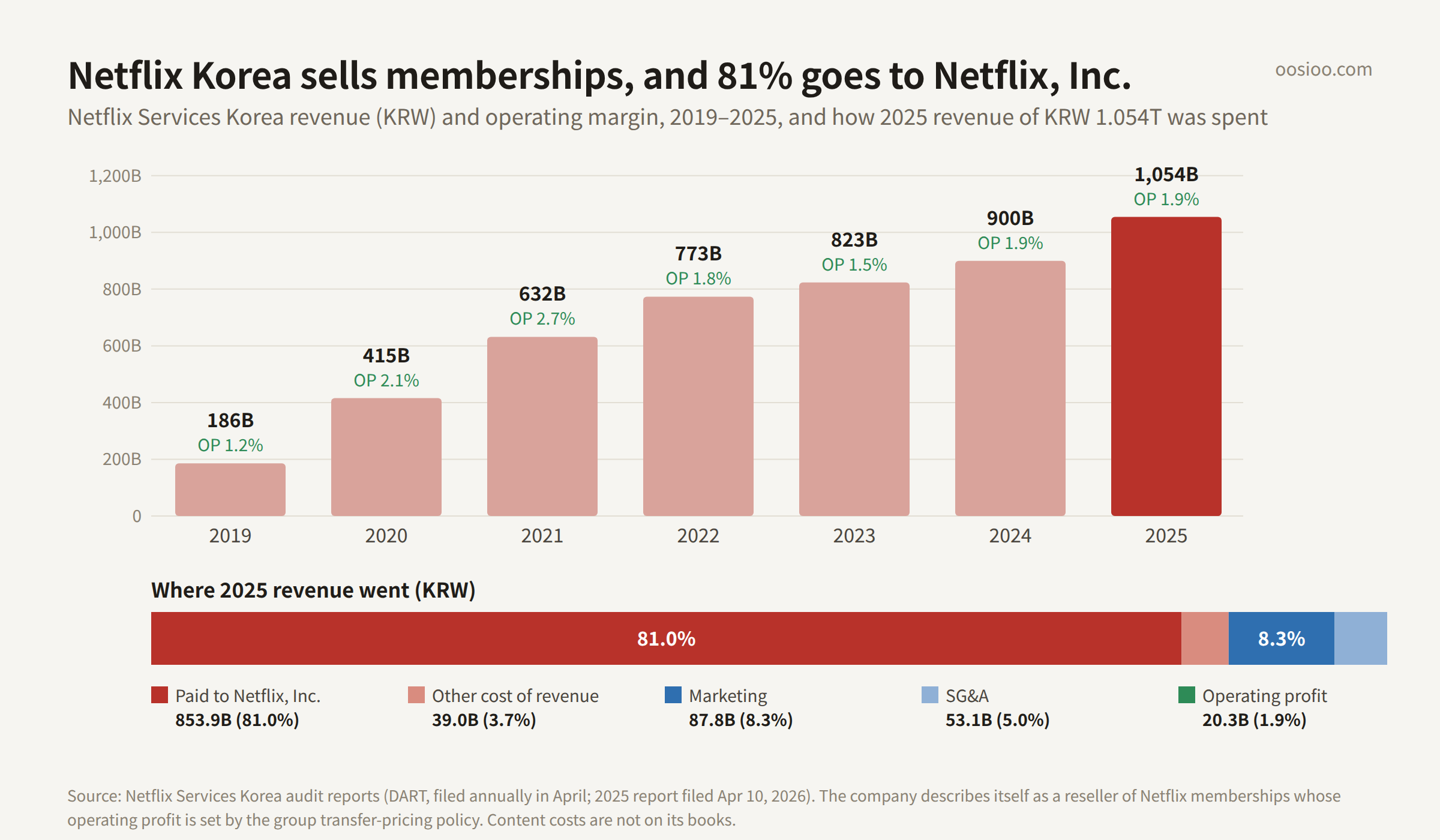
The cost of making dramas is not in these books. The money for Netflix's Korean originals is paid by the parent (or affiliates on the parent's side) and recorded on the parent's balance sheet as "content assets." It is fair to read the KRW 853.9 billion the Korean unit sends to the parent as including that value somewhere inside it.
One number helps with scale. On April 24, 2023, co-CEO Ted Sarandos said Netflix would invest $2.5 billion in Korean content over four years (CBS News). That is $625 million a year. At the 2025 average exchange rate (Bank of Korea, 1,422 won to the dollar) it is a little under KRW 890 billion a year, close to the KRW 853.9 billion the Korean unit paid the parent in the same year. These are different flows of money, and Netflix does not disclose how much of the pledge it spends each year, so the most this supports is a loose reading: "the money collected in Korea roughly goes back into Korean content." Others read it the opposite way. After a 2021 tax audit, the National Tax Service imposed about KRW 80 billion in taxes, and Netflix sued. On April 28, 2026, the Seoul Administrative Court cancelled about KRW 68.7 billion of the KRW 76.2 billion under dispute. It found that the overseas parent is the real provider of the service and that the payments from the Korean unit are fees for that service, not copyright royalties (CEO Score Daily). I could not confirm whether the ruling was appealed.
One more. Netflix's Asia-Pacific revenue in 2025 was $5.354 billion. The Korean unit's revenue at the same exchange rate is about $740 million, or roughly 14% of the region. That is an estimate using a simple average exchange rate.
Put it on the balance sheet, then write it off in pieces
Now to the parent's books. When Netflix makes a drama, the money does not become an expense right away. According to the 2025 annual report (10-K), development costs, direct production costs and production overhead are capitalized as they are incurred. They pile up as "content assets" on the balance sheet rather than flowing through the income statement. At the end of 2025 Netflix held $32.78 billion of content assets: $12.1 billion of licensed titles, $10.7 billion of its own productions already released, $9.2 billion in production and $0.7 billion in development and pre-production.
Assets turn into expense as they are used up. For machines and buildings this is called depreciation; for intangible assets it is called amortization. The 10-K describes Netflix's policy:
- Amortization starts in the month a title is first available.
- It runs over the shortest of the contractual window, the estimated period of use, or ten years.
- It is accelerated, because viewing is front-loaded, so more of the cost is expensed early. Films are amortized faster than series.
- On average, over 90% of a title is amortized within four years of first availability.
The same report gives a forward schedule. Of the $10.687 billion of unamortized cost of released original productions at the end of 2025, $4.309 billion (40%) is expected to be amortized in 2026, $2.784 billion (26%) in 2027 and $1.840 billion (17%) in 2028. Even in a pool mixing old titles with brand-new ones, 84% is gone within three years.
Amortization is the largest expense on Netflix's income statement. In 2025 content amortization was $16.422 billion, 36.3% of revenue of $45.183 billion. In Q3 2026 it was $4.235 billion, 32.9% of revenue. When revenue grows faster than amortization, that ratio falls and the margin rises. A good part of the move from a 29.5% margin in 2025 to 34.6% in Q3 2026 comes from this arithmetic.
The gap between cash and expense
Amortization separates the moment cash leaves from the moment expense is recorded. A drama's budget is spent one or two years before release, but the expense starts the month it launches. That is why Netflix tracks "cash content spend" and "content amortization" separately. In 2025, additions to content assets were $17.097 billion and amortization was $16.422 billion, a ratio of 1.04. The Q3 letter says the company expects about 1.1 for 2026. Through the first three quarters of 2026, additions were $14.934 billion and amortization $12.765 billion.
The ratio tells you whether a company is spending more now than it is writing off now. Above 1, the content on the books grows, and so does amortization for the next few years. Below 1, today's income statement gets lighter, but there is less to watch. Netflix went from 0.88 in 2023 (additions $12.555 billion, amortization $14.197 billion) to 1.06 in 2024 and 1.04 in 2025, holding close to 1.
Meanwhile, the cost of each show keeps rising. An MBC official told Star News (September 1, 2026) that a broadcast miniseries now costs around KRW 1.5 billion an episode on average, up from 600 to 800 million won ten years ago. Weekly Kyunghyang (July 21) wrote that Netflix has been investing KRW 3 billion per episode in Korean dramas and covering the full budget plus a margin of around 10%, which raised the benchmark for actors' fees; the article did not give a source for those figures. Over the same period, terrestrial TV's July ad revenue fell from KRW 125.3 billion in 2016 to KRW 54.0 billion in 2026 (Star News). The broadcasters' model of paying for shows with advertising has weakened, and the model of paying for them with subscription fees has taken more of its place. When budgets double, amortization doubles. The companies with enough subscribers to share that amortization come out ahead.
Same rules, different endings: TVING and Wavve
The Korean companies follow the same principle. TVING's 2025 audit report says rights "related to original productions and externally purchased rights are amortized over their estimated useful lives in a pattern that reflects how their economic benefits are expected to be consumed." In other words, like Netflix, it writes them off in the shape of the viewing. It does not disclose the period or the curve.
The numbers: of TVING's KRW 406.0 billion of 2025 revenue, amortization of content rights was KRW 184.2 billion (45.4%) and "content usage cost," the cost of using other companies' content, was KRW 133.2 billion (32.8%). Together that is 78% of revenue. The book value of its content rights fell during the year from KRW 167.3 billion to KRW 127.2 billion, because new rights (KRW 116.0 billion acquired plus KRW 28.2 billion transferred from work in progress) fell short of the KRW 184.2 billion amortized. In Netflix's terms, the additions-to-amortization ratio was 0.78. It was a year of getting by on less content spending.
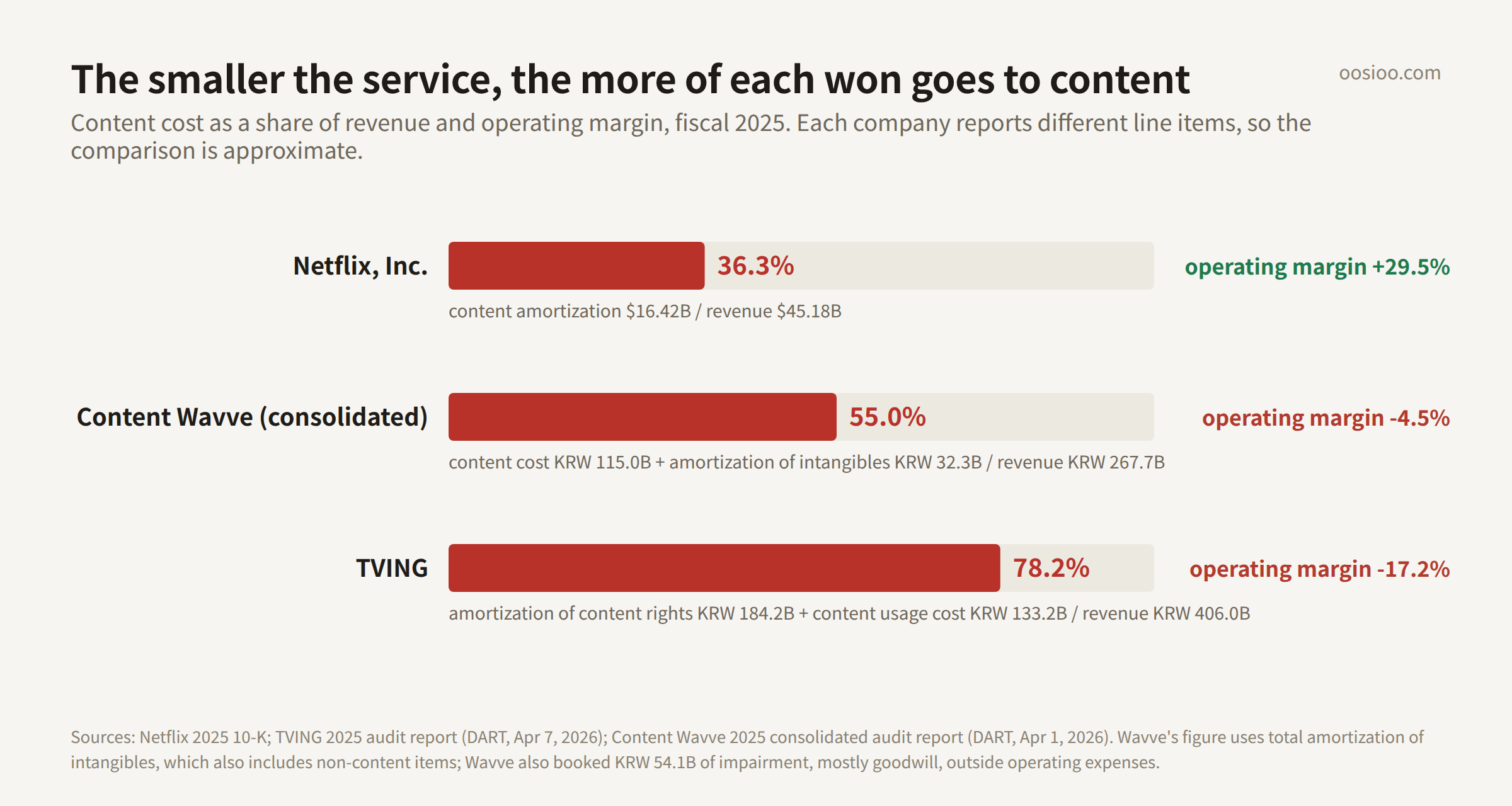
This chart is the economics of scale in streaming on one page. A drama costs the same whether a service has a million subscribers or a hundred million. The more subscribers, the more subscription fees share the cost of the same show. Netflix spends a little over a third of revenue on content and keeps close to 30%. TVING spends more than three-quarters of revenue on content and loses money. The companies report different line items, so this is not a perfectly level comparison, but the size of the gap is clear.
Wavve shows a different ending on the asset side. Intangible assets on Wavve's consolidated balance sheet fell from KRW 95.2 billion at the end of 2024 to KRW 20.0 billion at the end of 2025. Amortization took KRW 32.3 billion; impairment took KRW 54.1 billion. Impairment is not the same as amortization. Amortization writes an asset down a little at a time on a schedule. Impairment cuts it down all at once, the moment a company decides that the money the asset will earn in the future is less than its book value. Wavve impaired KRW 41.9 billion of goodwill tied to an acquired domestic business and overseas subsidiaries, its "Pure Original" content rights, and projects it had dropped in development. Its operating loss was KRW 12.2 billion, but the impairment, booked as a non-operating expense, took the net loss to KRW 75.9 billion. Total equity stood at minus KRW 146.8 billion, fully wiped out, and the audit report includes the sentence that these conditions "may cast significant doubt on the group's ability to continue as a going concern." One outlet reported these intangibles as "KRW 952 billion falling to KRW 199.6 billion," misreading the audit report's units by a factor of ten.
Capitalizing content is a way of writing down, as a number, the expectation that a show will hold on to subscribers for several years. If the expectation is right, the cost is written off slowly alongside the revenue. If it is wrong, it surfaces all at once one year as an impairment.
A history of price lists: ways to raise ARPU
Now the income side. Streaming revenue is simple: subscribers × average revenue per user per month (ARPU). Netflix calls its version ARM, average revenue per membership. Netflix stopped disclosing quarterly subscriber counts in 2025. The last Asia-Pacific ARM it published, for Q4 2024, was $7.34, almost unchanged from a year earlier. When subscribers grow in cheaper countries, the regional average barely moves.
Here is the Korean price history as confirmed through press reports.
| Date | Change to Netflix prices in Korea |
|---|---|
| January 2016 launch | Basic 9,500 won, Standard 12,000 won, Premium 14,500 won |
| November 18, 2021 | First increase: Standard 13,500 won (+12.5%), Premium 17,000 won (+17.2%) |
| November 4, 2022 | Ad-supported plan launched at 5,500 won a month (4 to 5 minutes of ads per hour on average) |
| November 2, 2023 | Paid sharing: someone outside the household costs 5,000 won a month as an extra member |
| December 12, 2023 | Basic closed to new sign-ups; cheapest ad-free price goes from 9,500 to 13,500 won |
| May 9, 2025 | With ads 5,500 to 7,000 won; Basic for existing members 9,500 to 12,000 won |
Over ten years, the list price of Standard rose only 12.5%, from 12,000 to 13,500 won. But the structure of what people actually pay changed far more. The cheapest plan disappeared, ads arrived, and households could no longer share one account. These are ways to lift revenue per subscriber without raising list prices much. After Netflix extended paid sharing to more than 100 countries in 2023, paid memberships rose by 41.35 million, from 260.28 million at the end of 2023 to 301.63 million at the end of 2024. In Q4 2025 they passed 325 million.
Advertising is another stream. Ad-tier members pay less, and ads make up the difference. Netflix's ad revenue topped $1.5 billion in 2025 and is expected to be about $2.7 billion in 2026. The company originally expected about $3 billion, then lowered it in Q3, citing a "slightly slower than expected rollout of some ad product capabilities." In Korea, ad tiers are already the norm: in KT Nasmedia's 2026 internet user survey, 59.7% of Korean streaming users said they were on an ad-supported plan (CEO Score Daily).
TVING raised prices by more than 20% for new subscribers from December 1, 2023, to Basic 9,500 won, Standard 13,500 won and Premium 17,000 won, and in March 2024 became the first Korean streamer to offer a 5,500-won ad plan. Since then the Fair Trade Commission's conditions have barred it from changing those prices until the end of 2026.
Churn and lifetime value
As important as ARPU is churn: out of 100 subscribers, how many cancel in a month. Subscription businesses use it to work out what one subscriber is worth.
If churn is constant every month, the average subscriber stays 1 ÷ churn months. At 5% monthly churn that is 20 months; at 2%, 50 months. Multiply by ARPU and you get lifetime value (LTV), the total a subscriber pays while they stay. Take ARPU as 12,273 won, Standard's 13,500 won minus VAT. At 5% churn the lifetime value is about 245,000 won; at 2% it is about 614,000 won. Cut churn by more than half and a subscriber is worth two and a half times as much.
Churn for Korean services is not published. The US research firm Antenna estimated the 2025 weighted-average monthly churn for US premium subscription video at 4.6%. Netflix does not give its own figure, but the Q3 letter says that "globally and in the US, churn improved year-over-year and was better than forecast." Why Netflix can say its churn is low ties back to the amortization story: a service whose library keeps growing gives people fewer months with "nothing to watch," and fewer reasons to cancel.
This arithmetic runs through almost every decision these companies make. What a show is worth depends on how many new subscribers it brings in and how many months it keeps existing ones. That is why a 2021 Bloomberg report drew so much attention: Netflix spent $21.4 million on season one of Squid Game (nine episodes) and its internal metric put the show's "impact value" at $891.1 million. The budget is amortized on a fixed schedule, but the lifetime value of the subscribers a hit holds on to arrives over years.
The playground
The playground has three panels. Prices in panel (1) are list prices confirmed up to November 12, 2026; the default viewing hours (Netflix 20 hours, TVING and Coupang Play 8 hours each) are my own assumptions. Coupang WOW and Naver Plus are memberships that bundle in other perks such as shipping and shopping rewards, but here the whole fee is counted as video. I could not confirm current Disney+ and Wavve prices against an original source, so those are left blank for you to fill in.
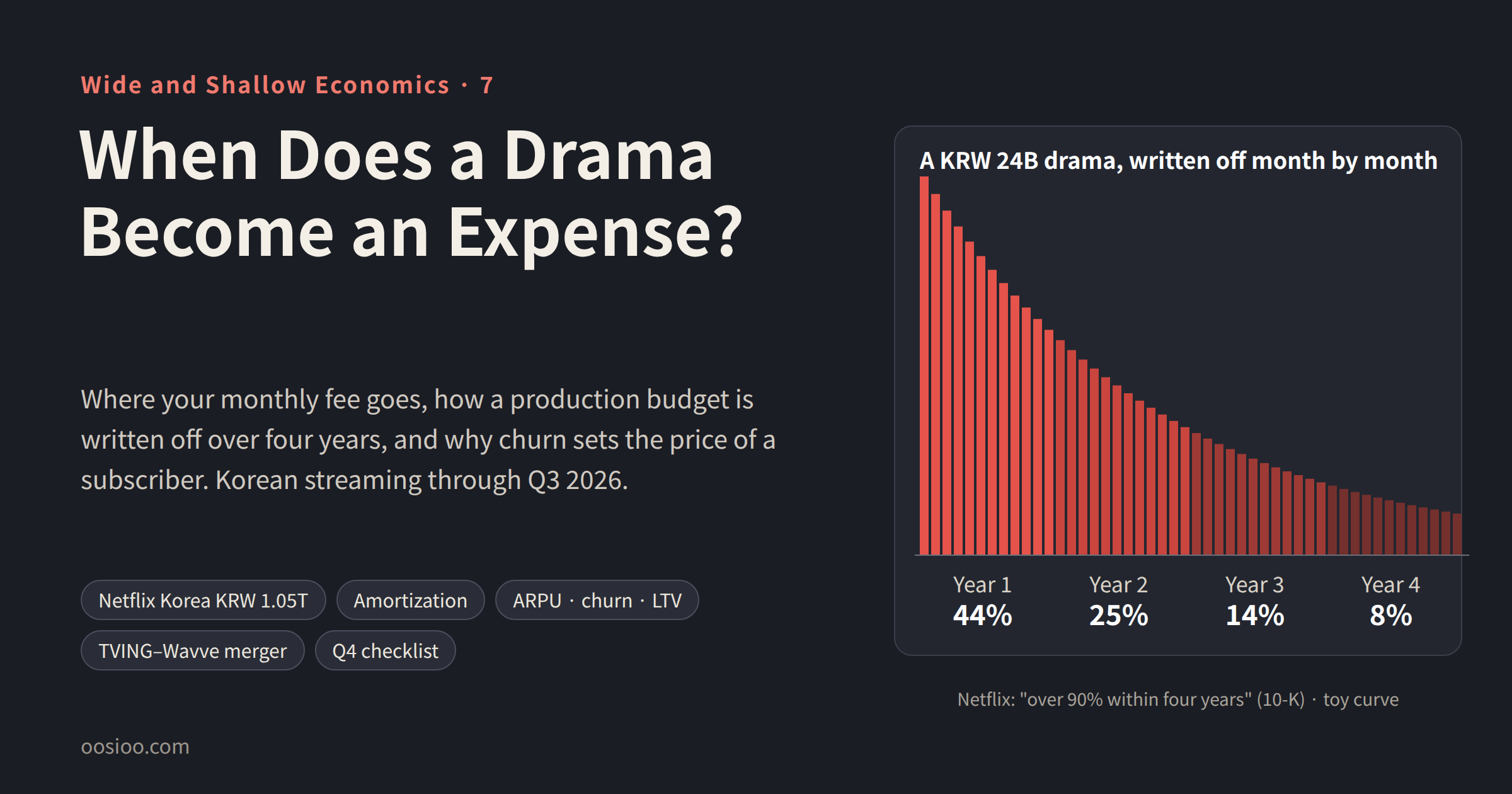
The amortization curve in panel (2) approximates Netflix's disclosure, "on average over 90% within four years," with an exponential curve. Every real show has its own curve, and Netflix does not publish the shape. With the defaults, 43% of the budget is expensed in year one, 25% in year two, 14% in year three and 8% in year four. Slide the four-year share down to 40% and it becomes ten-year straight-line amortization.
The default churn in panel (3) is Antenna's 4.6% US average; the 2% and 8% buttons are assumptions for comparison. A few things to try:
- In panel (1), lower Netflix viewing from 20 hours to 2. The cost per hour goes from 675 won to 6,750 won, ten times as much. A subscription is a fixed cost that leaves whether you watch or not.
- In panel (2), press the Squid Game S1 button: nine episodes at about KRW 2.7 billion each (converted at the 2021 average exchange rate). Just to cover the first year of amortization, about 200,000 Standard subscribers would each have to put 36% of a year's fees into this one show.
- In panel (3), lower churn from 4.6% to 2%. Average tenure goes from 22 months to 50, and the number of new subscribers needed to pay for the same drama falls from about 250,000 to about 110,000. That number is why account-sharing crackdowns and bundles matter.
The calculator simplifies by assuming one subscriber puts their entire content share into a single show. In reality each person watches many shows, and companies measure separately how much each title contributed to sign-ups and to preventing cancellations. Those methods are not public.
Companies with interesting strategies
Netflix: list prices move slowly, structure moves fast
As the Korean price list shows, Netflix does not raise list prices often. Instead it rearranges the ladder of plans. It closed the cheapest ad-free plan, opened an ad tier and turned account sharing into a paid feature. In March 2026 it raised US and Canadian prices for the first time in 14 months (Standard to $19.99), and the Q3 letter says "member response to our 2026 price increases is consistent with prior price changes and our expectations." Korean list prices have not changed since May 2025.
It is also widening the ways it brings content in. In Q3 it signed a new licensing deal with Disney and started carrying channels from the French broadcaster TF1 inside Netflix. That is a matter of balancing originals it makes itself (capitalized and amortized) against titles it licenses (amortized over the license period). Korean titles keep showing up: the Q3 letter named two Korean shows among its Asia-Pacific hits. At its "Next on Netflix 2026 Korea" event in January 2026, Netflix said its commitment to Korea had not changed, but it gave no new figure beyond the four-year, $2.5 billion pledge from 2023.
Coupang Play: video started as a perk of a shopping membership
Coupang Play's accounting is different from the start. It began as a perk of the Coupang WOW membership (7,890 won a month), and its revenue and costs sit inside Coupang, Inc.'s results without separate disclosure. What it is worth depends less on whether video makes money on its own than on how much it helps win and keep WOW members. It is the churn arithmetic above, applied to an entire shopping membership.
Its weapon is sports. Coupang Play began exclusive Korean coverage of England's Premier League (EPL) from the 2025-26 season. The deal is "reported" to run six years at a total of KRW 420 billion (Korea Economic Daily, March 24, 2025; the company has not disclosed it). On June 15, 2025 it began selling a separate "Sports Pass" covering overseas football, the NBA, F1 and more for 9,900 won a month to WOW members, and from June 1, 2026 it raised the price for new subscribers to 12,400 won (Digital Times).
Live sports have a different life span from dramas. People come back to a drama for years after release, but most of a live game's value is gone the moment it ends. In exchange, a season gives people a reason to come back every week. Coupang Play's MAU rose 16% in a single month in August 2026, when the new European football season starts, and passed ten million for the first time. Instead of building up assets to amortize, the strategy buys a fresh reason not to cancel every week.
TVING: a platform built on baseball, waiting on a merger
TVING grew its audience after taking over online broadcasting of KBO professional baseball in 2024 (CEO Score Daily, November 20, 2024). It was the first Korean streamer with an ad tier, and its ad revenue grew 42.1% year over year in Q3 2026 (coverage of CJ ENM's results). It turned a KRW 6.0 billion operating profit in Q2, then fell back to a KRW 7.2 billion loss in Q3. According to press reports, the company said overseas content sales had been concentrated in Q2, and that part of the cost of compensating users after a personal-data leak was booked in Q3, with the rest to come in Q4. It is renegotiating its KBO rights and said it expects to sign within the year.
TVING's problem is all in the chart above. When 78% of revenue goes to content, getting to profit means either growing revenue or cutting content costs. In 2025 it chose to cut (an additions-to-amortization ratio of 0.78). The Wavve merger was the answer on the revenue side: with combined users, the same drama's cost could be spread over more subscription fees. That merger has been stuck at the shareholder-consent stage for more than a year.
Marketing worth a look
Netflix inside the Naver Plus membership
Since November 2024, members of Naver Plus (4,900 won a month), the membership program of Korea's biggest web portal, have been able to watch Netflix's ad-supported Standard plan at no extra cost (Naver press release, September 30, 2024). It was the first time a Korean internet platform's membership included Netflix. Naver said daily new sign-ups rose 1.5 times after the partnership. When Netflix raised its ad plan to 7,000 won in May 2025, Naver left its membership price alone, and from July 1, 2026 it cut the add-on for moving up to an ad-free plan from 8,000 to 6,500 won for Standard and from 11,500 to 10,000 won for Premium (MTN, June 25).
The deal is interesting in accounting terms too. Netflix Services Korea's audit report says that in bundles where the partner sets the price, payments to the partner are deducted from revenue. Bundles lower ARPU. In return they turn people who come to Naver to shop into Netflix subscribers and put them inside a membership they are unlikely to cancel, lowering churn. For Naver, Netflix becomes a reason not to cancel the membership. Each side lowers the other's churn.
The "Double" pass that came before the merger
On June 16, 2025, six days after the Fair Trade Commission's approval, TVING and Wavve launched four "Double" passes that let one subscription cover both services. They were up to 39% cheaper than the two subscriptions combined, and the cheapest, "Double Slim," had a launch price of 7,900 won a month until September 30. The companies pitched it as a preview of the combined service. It was also an early trial of the "combined plan at a similar price" the regulator required. While the merger stalls, this product has become the only real bridge between the two services.
Raise the price, but not for the people already here
When Coupang Play raised the Sports Pass price in June 2026, existing subscribers kept the old price (9,900 won) for as long as they stayed subscribed. When Netflix raised prices in May 2025, the new prices applied first to new members, with existing members asked to consent in line with their billing cycle. When TVING raised prices in 2023, it softened the increase for existing web subscribers and let them keep the old price for up to three months.
This kind of grandfathering is less marketing than churn management. A price increase is the surest trigger for someone to think about cancelling. Charge new prices only to new customers, and ARPU rises slowly, but the people already paying are never given that trigger. Raise churn by a single percentage point in panel (3) and you can see why this is a sensible choice.
What to watch next quarter
I will score these five in coming episodes, and note what went wrong whether they hit or miss.
- Netflix's Q4 2026 revenue will land between $13.3 billion and $13.6 billion. Guidance is $13.442 billion, and the company said Q3 revenue was in line with its forecast. Scored with: Netflix's Q4 shareholder letter, January 2027.
- Netflix's full-year 2026 content amortization will land between $17.5 billion and $18.5 billion. It was $12.765 billion through Q3, up 9.5% year over year; the same pace in Q4 gives about $18 billion. Scored with: the cash flow statement in the Q4 letter (January 2027) or the fiscal 2026 10-K.
- TVING and Wavve will not complete their legal merger (reach the merger effective date) by March 31, 2027. As of November 12 there is no news of KT's consent, and even with it, a merger agreement, shareholder meetings and creditor-protection procedures take time. Scored with: DART filings and press reports.
- TVING's standalone list prices (with ads 5,500 won, Basic 9,500 won, Standard 13,500 won, Premium 17,000 won) will not rise by March 31, 2027. The regulator's price freeze ends at the end of 2026, but with the merger unfinished and Coupang Play pulling ahead in users, I think raising prices will be hard. Scored with: TVING's official price page on March 31, 2027 and any reports of an increase.
- Coupang Play's January 2027 MAU will exceed TVING's by at least one million. January is mid-season for the EPL and off-season for the KBO. In January 2026 the figures were 7.81 million for Coupang Play and 7.14 million for TVING, a gap of 670,000. Scored with: press coverage of Mobile Index's January 2027 MAU (February).
A few things I will watch without scoring. Netflix guided to a 26.0% operating margin for Q4, including about 1.2 percentage points from headcount reductions, and the year ends with a heavy run of live events, including NFL games and a major boxing match. TVING's Q4 will show the terms of its KBO renewal and the remaining cost of the data-leak compensation. Netflix Services Korea's 2026 revenue will come out in its audit report in April 2027; with Korean prices unchanged since May 2025, the question is whether growth slows from 2025's 17%.
Closing
A drama's budget leaves as cash while it is being made, then becomes expense over several years from the month it launches. In between, the company writes down its expectation that the show will bring in and keep subscribers, under the name of an asset. Netflix spreads that expectation across more than 300 million subscribers and keeps a third of its revenue; TVING and Wavve spread the same kind of expectation across far fewer and ran into losses and impairments. The 2% profit in the Korean unit's books means that, in this structure, Korea stands where the memberships are sold.
Back on my own card statement, the arithmetic runs the other way. To the company, my subscription is one month of lifetime value. To me, it is a fixed cost to divide by the hours I watched this month. The next time I hesitate in front of the cancel button, I might also think about why companies tuck that button somewhere so hard to find.
This piece is a summary of public information and does not recommend buying or selling any security.
Sources
- Netflix IR: Q3 2026 shareholder letter (Oct 20, 2026) · Q4 2025 shareholder letter (Jan 20, 2026) · Q4 2024 shareholder letter · Fiscal 2025 10-K
- DART audit reports: Netflix Services Korea 2025 (Apr 10, 2026) · 2024 · 2023 · 2022 · 2021 · 2020 · TVING 2025 (Apr 7, 2026) · Content Wavve 2025 consolidated (Apr 1, 2026)
- Exchange rates: Bank of Korea Economic Statistics System (ECOS) 731Y004, KRW/USD monthly average
- Netflix in Korea: iNews24 (Oct 14, 2026) · CEO Score Daily on the tax case (Apr 28, 2026) · CBS News on the $2.5B pledge (Apr 25, 2023) · Segye Ilbo (Jan 21, 2026) · Al Jazeera on Squid Game's impact value (Oct 18, 2021)
- Prices: Korea Economic Daily (Nov 18, 2021) · Seoul Shinmun (Nov 4, 2022) · Newsis on paid sharing (Nov 2, 2023) · Newsis on Basic closing (Dec 13, 2023) · Byline Network (May 9, 2025) · Herald Economy (Mar 30, 2026) · Financial News on TVING prices (Oct 31, 2023) · Newsis on TVING's ad plan (Mar 3, 2024)
- Naver: Naver press release (Sep 30, 2024) · SBS Biz · MTN (Jun 25, 2026) · News Tomato
- TVING and Wavve: MTN on CJ ENM's Q3 call (Nov 5, 2026) · Digital Daily (Aug 6, 2026) · Money Today (Aug 6, 2026) · MTN on KT's CEO (Jul 23, 2026) · Byline Network on the FTC approval (Jun 10, 2025) · Byline Network on the Double pass (Jun 16, 2025) · News Tomato (Apr 2026)
- Coupang Play and usage: iNews24 (Sep 6, 2026) · Digital Times (May 21, 2026) · Dailian (Jul 6, 2026) · Korea Economic Daily on the EPL (Mar 24, 2025) · Newneek on the Sports Pass (Jun 15, 2025)
- Ad tiers and churn: CEO Score Daily (Mar 30, 2026) · Antenna Q1'26 State of Subscriptions
- TVING and the KBO: CEO Score Daily (Nov 20, 2024)
- Production costs: Weekly Kyunghyang (Jul 21, 2026) · Star News (Sep 1, 2026)