Do Fines Migrate?
The idea that water pushes fines down to clog the bottom filter rests on simulation and 1993 flow data, while CT of capsule pucks found the outlet more porous instead. Following 400 fines at a time through 3D lattice Boltzmann flow fields, fines that stick to walls barely moved, and only small sliding fines passed between coarse particles to the bottom. In a puck with fines even the widest pore is 49 µm across, leaving fines over 40 µm almost no room to move. With a fines tracker.
A common explanation in espresso talk goes like this: as water flows, it pushes fines downward, and the fines pile up near the bottom filter and block the water's paths. Flow slowing late in a shot, or a hard layer at the bottom of the puck, is often explained this way. But I could not find a study that directly measured fines moving inside a coffee puck.
So I released fines into the 3D flow fields calculated in "Running Water Through Lattice Boltzmann" and followed them. The result depends on whether fines stick when they touch a wall or slide along it. If they stick, fines barely move: in the puck with fines, all of them were caught within a few tens of µm of the top. If they slide, small fines can pass between coarse particles all the way to the bottom. But the puck with fines has such narrow pores that fines larger than 40 µm had almost no room to move in the first place.
The idea of fines migration
Water flowing through porous media detaching small particles, carrying them along and lodging them in narrow throats, lowering permeability, has long been studied in oil reservoirs and groundwater (Khilar and Fogler 1998). In coffee, Ellero and Navarini (2019) put this idea into a simulation. They fixed coarse particles of about 450–500 µm as stationary solids and added fines of about 30 µm as particles carried by the water. Fines reaching the bottom filter were stopped there. With fines at 0.6% of the volume, steady-state flow fell by "nearly one order", and reversing the flow released the trapped fines so the same decline repeated. The forward and reverse flow data they fitted came from Illy researchers in 1993 (Petracco and Suggi Liverani).
Looking directly showed the opposite. Mo and colleagues (2023) imaged coffee capsules with micro-CT before and after brewing; after brewing, porosity was always higher at the outlet (bottom) than at the inlet (top). The authors wrote that "fine migration will tend to lead to lower porosity near the bottom as the filter on the bottom prevents the fines from leaving the capsule", and explained their result by pressure-dependent erosion instead.
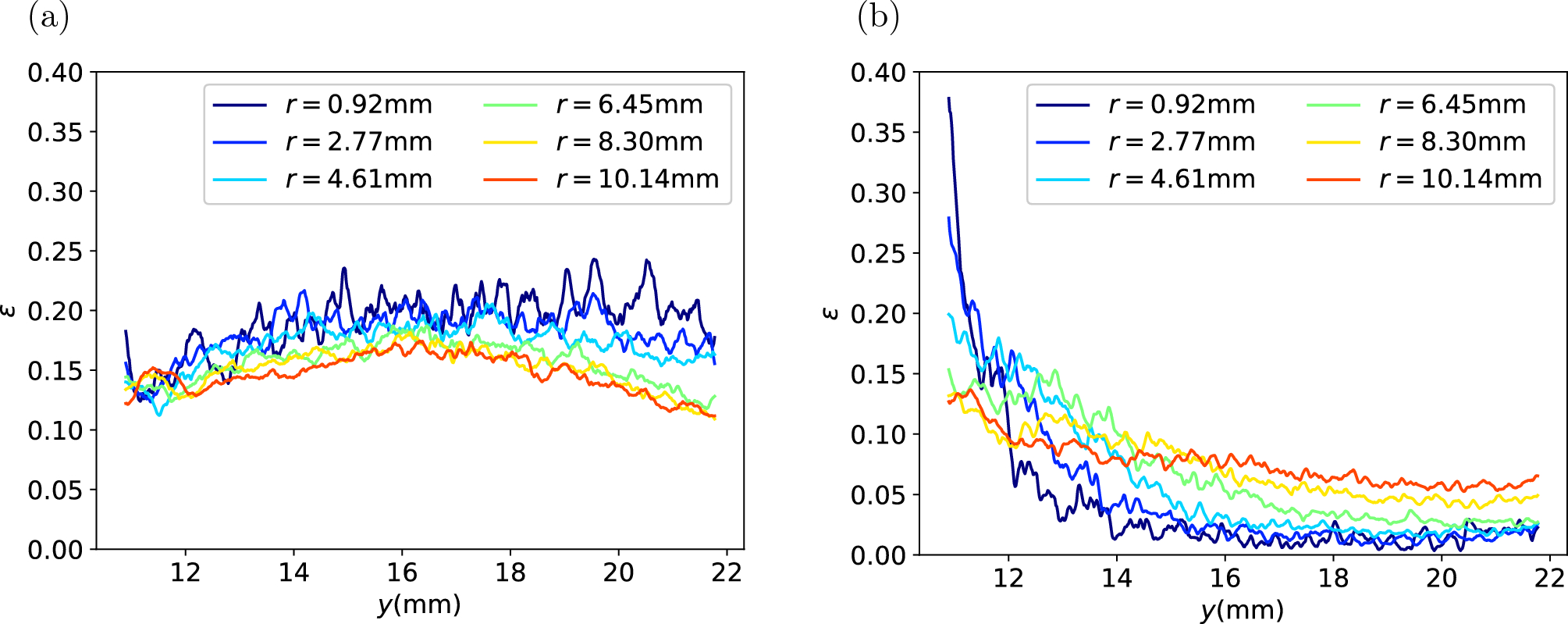
Porosity by height measured by Mo and colleagues (2023). (a) before brewing, (b) right after brewing. Colours are radial positions r. If fines had gathered at the bottom, porosity near the outlet should be low · Figure: Mo et al. (2023), Scientific Reports, CC BY 4.0
Cameron and colleagues (2020) also reported "partially clogged" flow at fine grinds, but they did not measure fines moving. For now, the case for fines migration rests on simulation and old flow data, while direct images of the puck point the other way.
Following fines through the flow field
I used two virtual pucks from "Running Water Through Lattice Boltzmann". One is a "coarse skeleton", 250 µm-gap grounds with the fines removed (porosity 0.38); the other is the same grind with its fines left in (porosity 0.23). The 3D flow field of each 1.12 mm cube was scaled to a superficial velocity of 0.5 mm/s (about 36 g in 28 s at 9 bar), and the cube was stacked on itself to make a 13.6 mm-thick puck.
I placed 400 fines of each diameter from 10 to 100 µm at random in the pores and moved them with the water. Particles this size follow the water almost exactly (their inertia is negligible). When the distance from a particle's centre to the nearest solid became smaller than its radius, it counted as touching a wall, and I separated two cases:
- Sticks on contact: caught the moment it touches a wall, as when fines and coarse-particle surfaces adhere well
- Slides: pushed off the wall and carries on; caught only when wedged in a gap too narrow to pass
Sticking or sliding
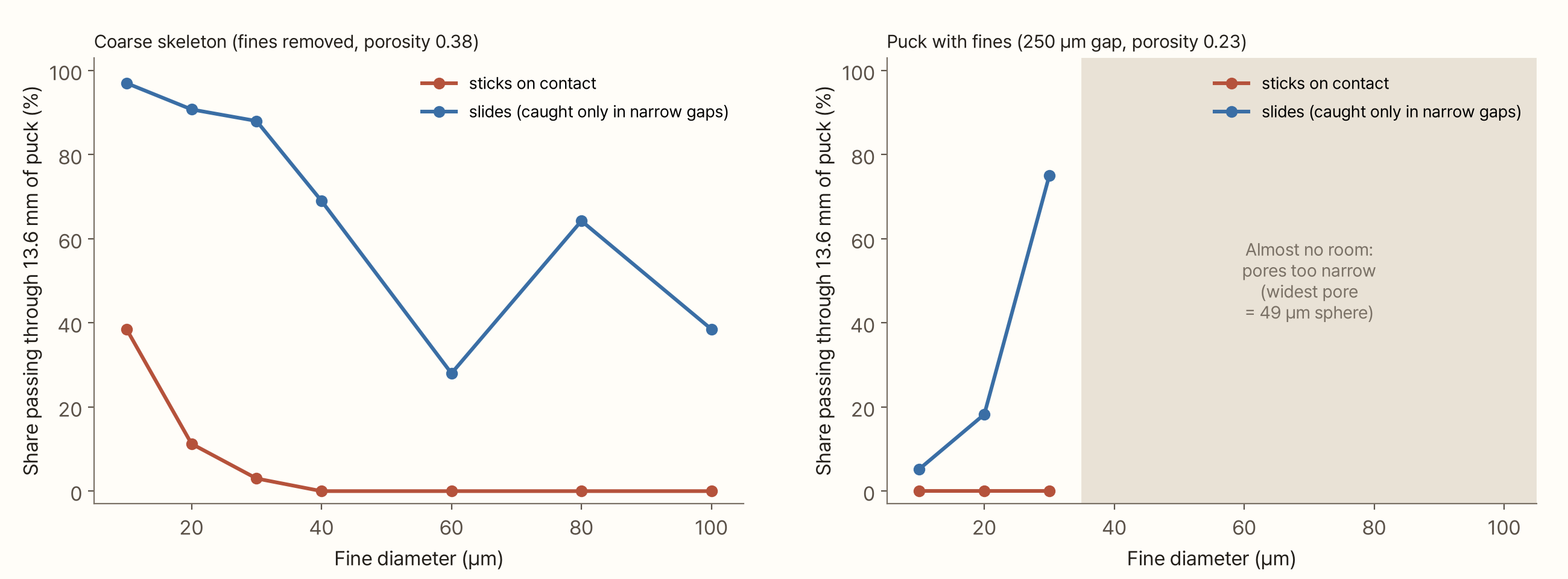
In the coarse skeleton, 88–97% of sliding fines of 10–30 µm passed all 13.6 mm to the bottom. The paths between coarse particles are wide, so small fines find few places to get stuck. Above 40 µm, the share passing fell to 30–70%. The ups and downs between sizes arise because the puck is one cube repeated, so the outcome depends heavily on which path a fine enters.
Fines that stick behaved differently. Even in the coarse skeleton, 97% of 30 µm fines were caught, and none of 40 µm or larger got through. Larger fines touch walls more easily, so they were caught sooner.
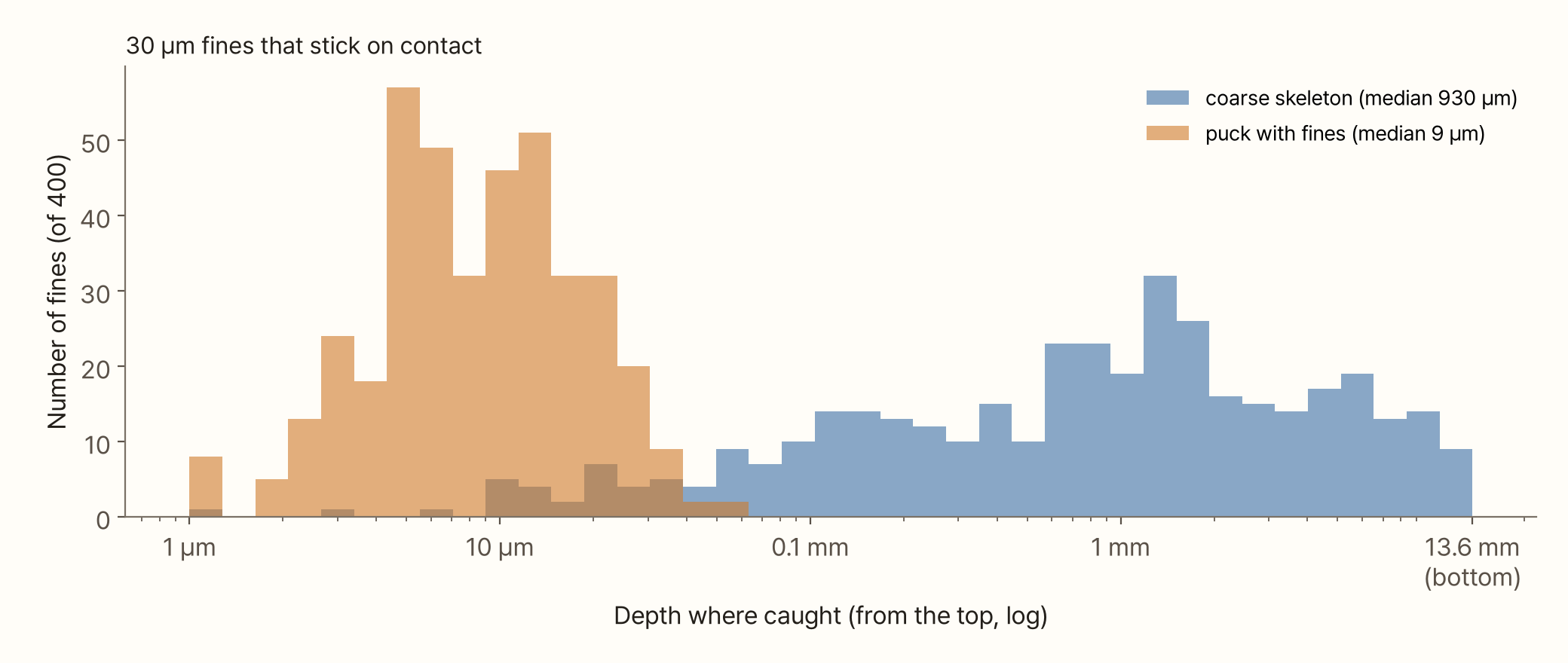
The depth at which they were caught makes the difference clearer. In the coarse skeleton, 30 µm fines were caught at a median depth of 0.93 mm, and some got close to the bottom. In the puck with fines, the median was 9 µm and 90% were caught within 23 µm: they hardly moved from where they started. Even 10 µm fines had a median of 58 µm.
A puck with fines is too narrow
Even the widest pore in the puck with fines barely holds a sphere 49 µm across. Places to put a 40 µm fine made up only 0.003% of the cube's volume, and for 60 µm or more there were none. Fines like these are part of the solid that makes up the puck, not particles drifting in its pores. Only smaller fines can move.
Even those, if they stick, stop within a few tens of µm. If they slide, 75% of 30 µm fines got through, but 10–20 µm fines are about the size of the grid (10 µm), so their results may reflect snagging on the walls' stair-stepped outline and are hard to trust.
In short, for fines to travel several millimetres or more through a puck, three things must hold together: the fines must be smaller than about 30 µm, they must slide rather than stick, and the paths must be wide like those of the coarse skeleton. Ellero and Navarini's simulation dealt with fines drifting between coarse particles. If in a real puck most fines are packed between coarse particles, those conditions would hold in only part of the puck.
How readily fines stick is not something this calculation can decide. Surface charge, oils and dissolved compounds would determine it, and I found no data measuring it.
Follow them yourself
In the tool below, choose the puck (coarse skeleton or puck with fines), what fines do on touching a wall (stick or slide) and the fine diameter, and you see what share of 400 fines got through and where the others were caught.
What this conclusion leaves out
- The flow field is fixed. When caught fines narrow a path, flow changes and other fines get caught in turn. This feedback is not included, and it is what produces the decline in flow Ellero and Navarini saw
- The same cube is stacked on itself. A path that is open is open for all 13.6 mm, which may overstate the share of sliding fines that get through
- Fines are spheres that follow the water exactly. Real fines are flat, angular fragments such as pieces of cell wall. Brownian motion and settling under gravity are left out
- Only fines already drifting in the pores are considered. Whether fines attached to coarse-particle surfaces are torn off by the flow is a separate question
- The grid is 10 µm. Fines of 10–20 µm may snag on the walls' stair-stepped outline
- Ellero and Navarini's 2019 journal paper was checked from the abstract only. Figures come from the same authors' PARTICLES 2019 conference paper
Summary
- The explanation that water pushes fines down to block the bottom rests on simulation (Ellero and Navarini 2019) and flow data from 1993. Mo and colleagues (2023), imaging capsule pucks with CT, found porosity after brewing was higher at the outlet instead
- Following fines through 3D lattice Boltzmann flow fields, fines that stick to walls barely moved. In the puck with fines, 30 µm fines were caught at a median depth of 9 µm
- Fines that slide went further: in the coarse skeleton, about 90% of 10–30 µm fines reached the bottom
- In the puck with fines even the widest pore is 49 µm across, so fines larger than 40 µm have almost no room to move. If fines migrate, it is likely limited to small fines and wide paths
References
- Ellero M, Navarini L (2019). Mesoscopic modelling and simulation of espresso coffee extraction. Journal of Food Engineering 263, 181–194. doi:10.1016/j.jfoodeng.2019.05.038 — abstract only
- Ellero M, Navarini L (2019). Simulation of espresso coffee extraction using smoothed particle hydrodynamics. PARTICLES 2019, VI International Conference on Particle-based Methods
- Mo C, Johnston R, Navarini L, Liverani F, Ellero M (2023). Exploring the link between coffee matrix microstructure and flow properties using combined X-ray microtomography and smoothed particle hydrodynamics simulations. Scientific Reports 13, 16374. doi:10.1038/s41598-023-42380-y
- Khilar KC, Fogler HS (1998). Migrations of Fines in Porous Media. Kluwer Academic Publishers. doi:10.1007/978-94-015-9074-7 — bibliographic details only
- Cameron MI, Morisco D, Hofstetter D, Uman E, Wilkinson J, Kennedy ZC, Fontenot SA, Lee WT, Hendon CH, Foster JM (2020). Systematically improving espresso: insights from mathematical modeling and experiment. Matter 2, 631–648. doi:10.1016/j.matt.2019.12.019
Image credits
- Porosity by height (Figure 16): Mo et al. (2023), Scientific Reports, CC BY 4.0
- All other charts, the cover and the tracker: made by me