Where Does a Tent Give Way First in a Windy Campsite? — Eight Tents Set Up in a Wind Simulator
I went camping and the wind was far too strong. Using published structures and material figures, I set up eight tents in a simulator: dome, geodesic, tunnel, A-frame, pyramid, family cabin, and two rooftop tents that sit on a car, one fold-out and one wedge. Changing wind direction, pole and fabric material, stake length and ground, guylines and vehicle mass, I worked out what gives way first. In most cases it was the stakes, not the poles, and quartering winds were the weakest direction.
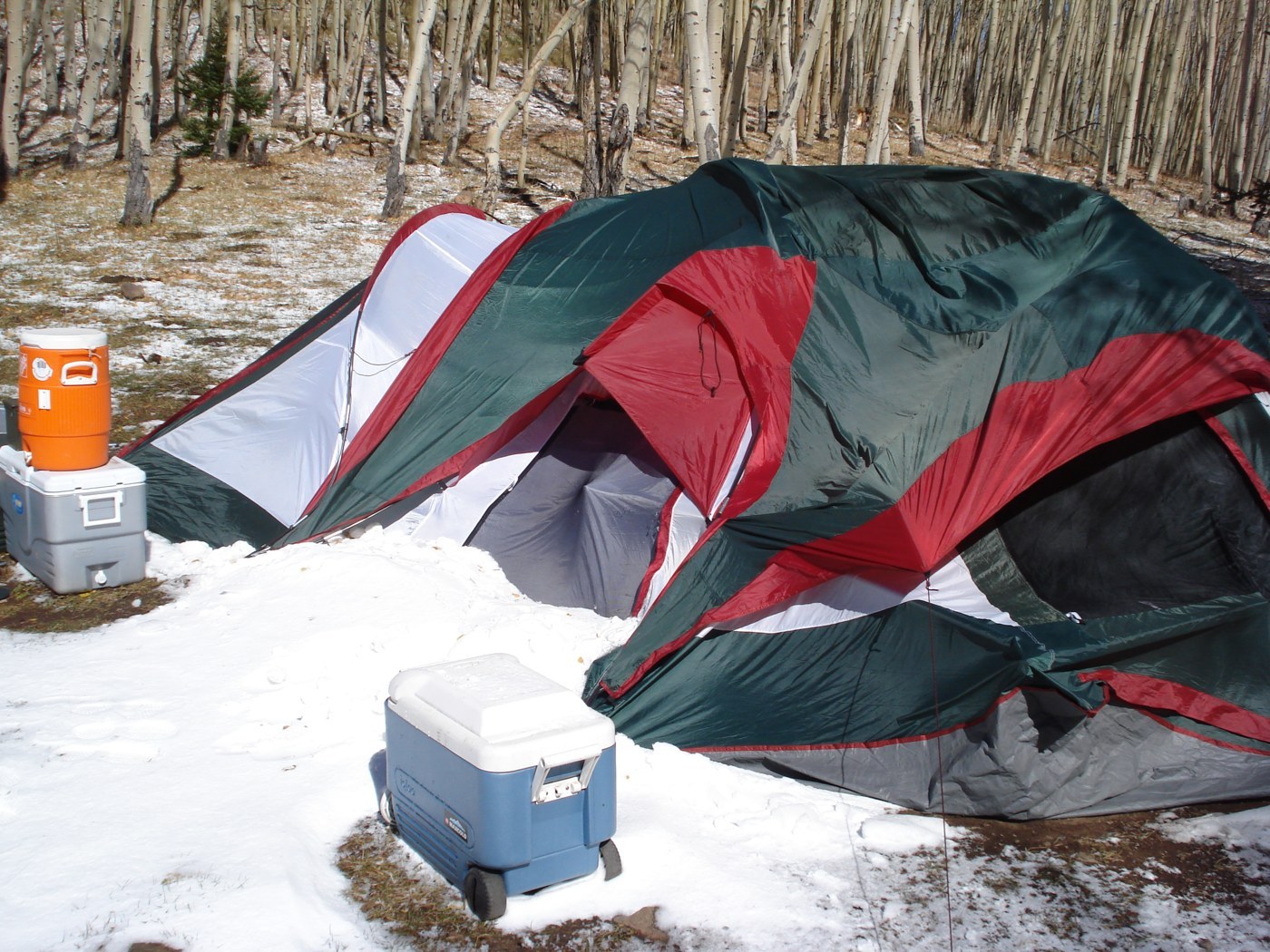
A family dome tent after a night of gusts around 100 km/h. Photo: brian gautreau / Wikimedia Commons (CC BY-SA 2.0)
I went camping today and the wind was blowing far too hard. Sitting inside the tent, listening to it flap, I started to wonder. How much stronger would the wind have to get before this tent gave way? And when it did, would a pole snap first, would a stake pull out first, or would the fabric tear first? Would a differently shaped tent have done better, or one pitched on the roof of a car?
What I set out to do
There were three things.
- Gather published structural and material figures for each tent type: pole diameter and material, fabric strength, how hard a stake holds in the ground, and how hard the wind pushes on each shape, from the literature and from manufacturers.
- Use those figures to build a simulator that pitches eight tents. Change wind speed and direction, poles and fabric, stake length and ground, guylines and vehicle mass, and see which part reaches its limit first.
- Compare the results with published test results and write down where the model goes wrong.
Three helper tasks spun up by the AI split the research: one took tent structures and materials, one took wind-tunnel studies and standards, and one took rooftop tents and vehicles. Meanwhile the main task wrote the pole solver and the simulator.
The forecast wind is not the wind the tent feels
One number needed correcting first. The wind speed in a weather forecast is a 10-minute average measured 10 m above the ground. The Korea Meteorological Administration issues a gale advisory when that average reaches 14 m/s or a gust reaches 20 m/s (KMA).
A tent is not 10 m up. Wind slows down near the ground. On grass, the mean wind at half the tent's height (about 0.5 m) is roughly 0.59 times the 10 m wind. Near the ground, though, there are gusts. Over open land, a 3-second gust can reach 1.66 times the 10-minute mean (Harper et al., WMO project). Wind force scales with the square of speed, so a single gust pushes 2.8 times harder than the mean.
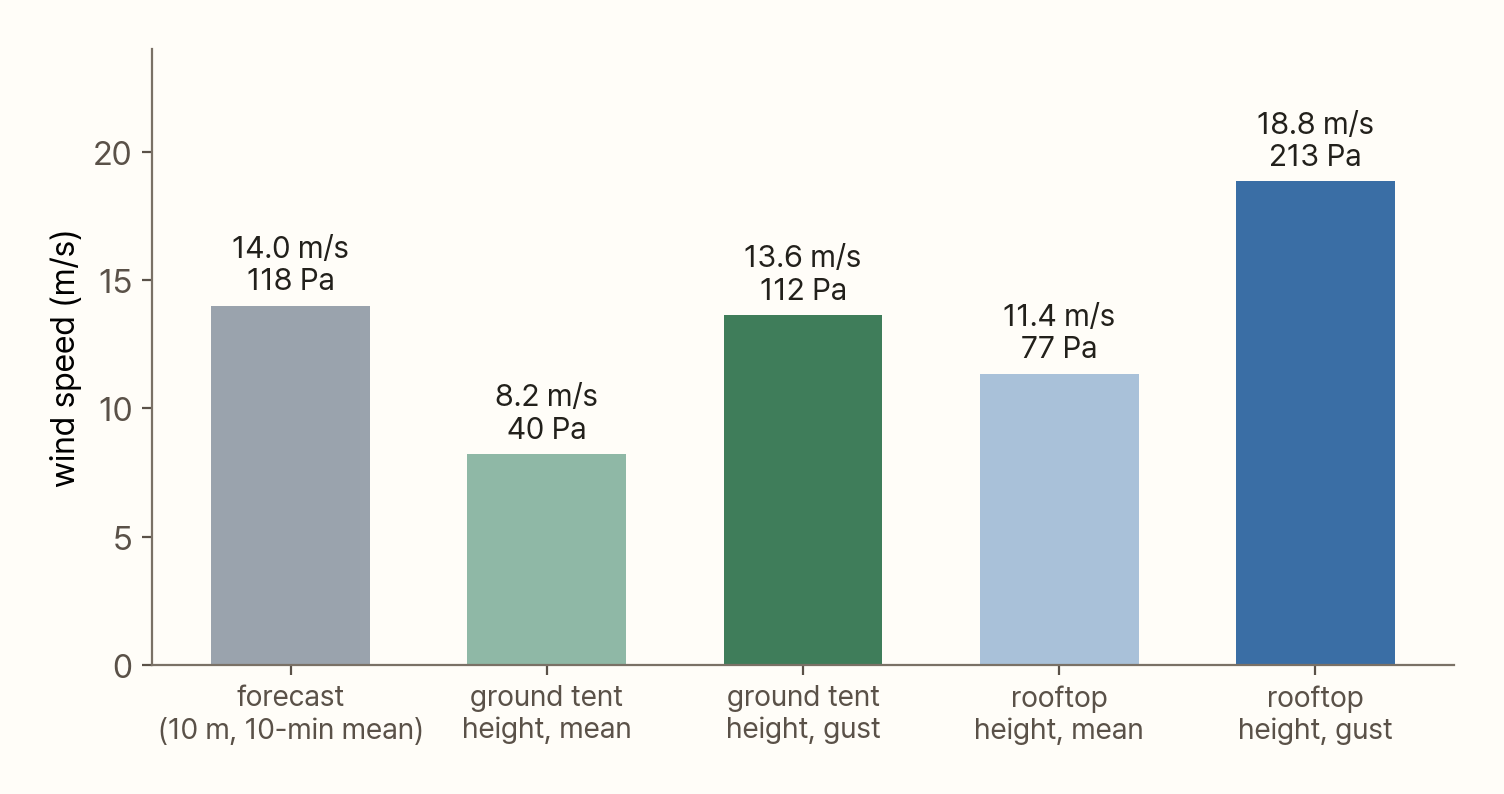
Put in the gale-advisory forecast of 14 m/s, and a tent on the ground feels gusts of 13.6 m/s while a tent on a car roof feels 18.8 m/s. A rooftop tent takes the same day's wind 1.9 times harder. That is what 2.6 m of height does. Every calculation in this post takes the forecast wind, converts it to a gust at tent height, and works out the forces from there.
The numbers that make a tent
The structure of each tent type comes from a representative published model.
| Type | Representative model | Structure | Size used here |
|---|---|---|---|
| A-frame | Vango F10 family | A-shaped poles at each end, wide flat walls | 2.1×1.5 m, 1.1 m high |
| Cross-pole dome | Decathlon MT900 | two poles crossing in an X, 9 mm aluminium | 2.1×1.3 m, 1.05 m high |
| Geodesic | Hilleberg Saivo | 4–5 poles crossing at several points | 2.2×1.6 m, 1.1 m high |
| Tunnel | Hilleberg Nammatj, Keron | 2–3 parallel hoops, tensioned by front and rear stakes | 3.0×1.8 m, 1.0 m high |
| Pyramid (mid) | Hyperlite UltaMid 2 | one centre pole, tension from perimeter stakes | 2.4×2.4 m, 1.5 m high |
| Cabin (family) | Decathlon Arpenaz 4.2 family | near-vertical walls, fiberglass poles | 3.0×2.4 m, 2.0 m high |
| Rooftop fold-out | Thule Tepui Kukenam 3 | unfolds sideways off the car, a ladder holds up half | 2.44×1.42 m, 1.32 m high |
| Rooftop wedge | iKamper BDV Duo | hard shell hinged at one end, opens to about 30° | 2.28×1.42 m, 1.5 m high |
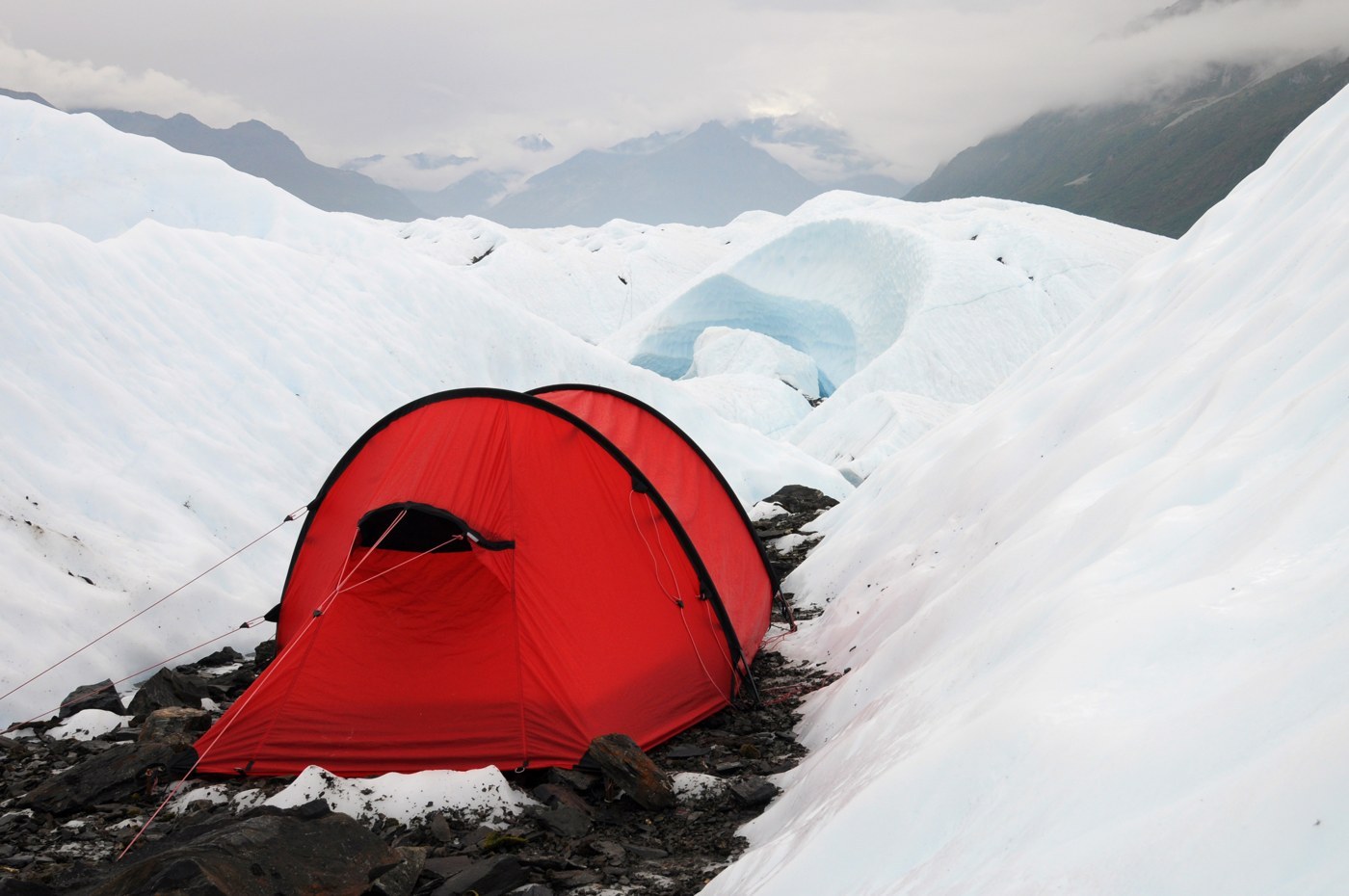
A tunnel tent (Hilleberg Nammatj 2) on the Matanuska Glacier, Alaska. Photo: Paxson Woelber / Wikimedia Commons (CC BY 2.0)
These are the figures for poles, fabric and stakes.
| Item | Value | Source |
|---|---|---|
| 9 mm aluminium pole | second moment of area 131 mm⁴, bending stiffness about 9 N·m² | DAC NSL spec |
| 7075-T6 aluminium | modulus 70 GPa, yield 480 MPa | MakeItFrom |
| Fiberglass rod | modulus 38 GPa, flexural strength 830 MPa | Goodwinds spec |
| Carbon tube | modulus 127 GPa, flexural strength 1,370 MPa | same source |
| Silnylon 20D / 40D | tensile strength 270 / 392 N per 5 cm | Extremtextil 20D · 40D |
| Wet nylon | stretches 2–4%, loses about 10% strength | Durston |
| 15 cm stake, soil | 24 N pulled up, 83 N pulled sideways, 38 N at 45° | Backpacking Light (2024) |
| 23 cm stake, soil | 54 N up, 243 N sideways, 73 N at 45° | same source |
| 15 cm stake, sand | 13 N up, 32 N sideways, 18 N at 45° | same source |
Wind-tunnel data for camping tents themselves is almost never published, so I borrowed from similar shapes. For the tunnel tent I used a drag coefficient of 0.3 and a lift coefficient of 0.2 from wind-tunnel tests on half-cylinder greenhouses (Moriyama et al., 2015). For the dome I used a hemisphere's 0.4, and for the vertical-walled cabin a flat plate's 1.2 (Çengel, Table 11-2 solutions). The same greenhouse study found that opening a windward door raised the net load on the wall to as much as 1.35. The simulator's "door open" button adds that effect.
How the calculation works
When wind hits a tent, the force reaches the ground along three paths: through the fabric hem to the perimeter stakes, along the pole arches to the stakes at the pole ends, and along the guylines to the guyline stakes. The simulator splits it like this.
- Wind force: wind pressure from the gust at tent height, times each shape's drag coefficient and the area facing the wind. The force lifting the roof is calculated separately.
- Poles: one arched pole is divided into 32 frame elements and solved by the finite element method. It finds how far the top moves and where it bends most under a 1 N side load. I checked this first against a case with an exact solution, a sideways point load at the top of a semicircular arch. The maximum bending moment matched exactly at 0.2071PR, and the deflection converged to the exact 0.0708PR³/EI as the elements were refined.
- Sharing: half the wind force goes straight through the fabric hem to the windward perimeter stakes. The other half is shared at the top of the tent by the pole arches, the guylines and the fabric, each in proportion to its stiffness. An arch resists only in its own plane, and a guyline resists only in tension. So which poles and guylines do the work depends on the wind direction.
- Judging failure: four checks. Does the top move more than 25% of the tent's height so the roof caves in (shape collapse)? Does pole stress exceed yield or fracture? Does a stake exceed its holding force? Does fabric membrane tension exceed its strength? For stakes, the horizontal and upward pulls are each compared with the matching holding force and added. If a guyline stake pulls out first, that guyline is removed and the tent is recalculated, because losing a guyline does not bring a tent straight down.
The calculation showed that the poles carry a lot of stress before any wind blows. It comes simply from bending a straight pole into an arch. A 9 mm aluminium pole bent to the size of a cross-pole dome (radius 1.25 m) is already using 52% of its yield stress. The wind gets only the remaining half.
Running it
In most cases, the stakes go before the poles
With 23 cm stakes in soil and guylines on, I turned the wind 5° at a time and found the forecast wind each of the eight tents survives.
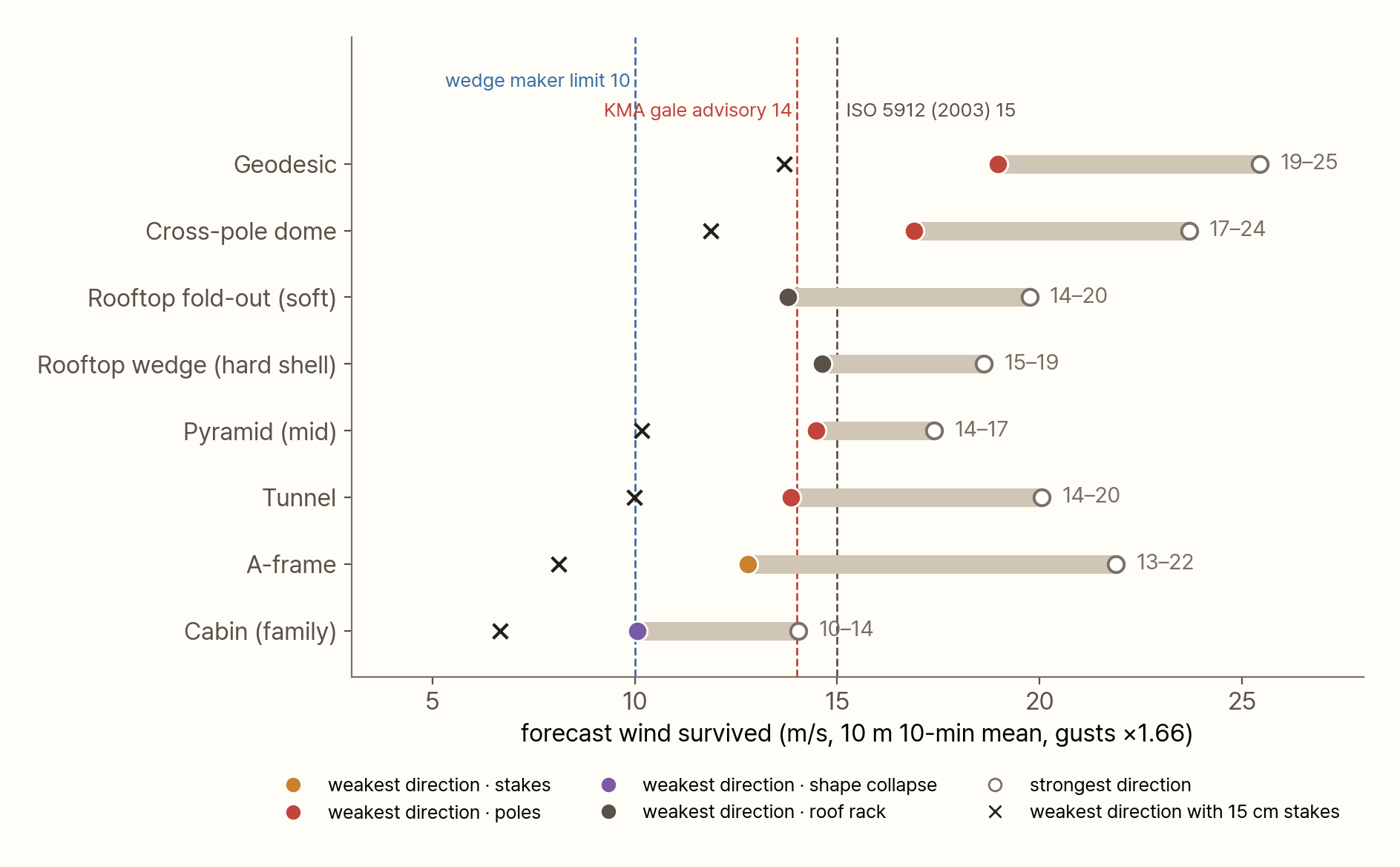
| Type | Weakest direction | Strongest direction | With 15 cm stakes |
|---|---|---|---|
| Geodesic | 19.0 m/s (45°, poles) | 25.4 m/s | 13.7 m/s |
| Cross-pole dome | 16.9 m/s (55°, poles) | 23.7 m/s | 11.9 m/s |
| Rooftop fold-out | 13.8 m/s (50°, roof rack) | 19.8 m/s | no stakes |
| Rooftop wedge | 14.6 m/s (40°, roof rack) | 18.6 m/s | no stakes |
| Pyramid | 14.5 m/s (45°, centre pole) | 17.4 m/s | 10.2 m/s |
| Tunnel | 13.9 m/s (60°, poles) | 20.1 m/s | 10.0 m/s |
| A-frame | 12.8 m/s (65°, stakes) | 21.9 m/s | 8.1 m/s |
| Cabin (family) | 10.1 m/s (45°, shape collapse) | 14.0 m/s | 6.7 m/s |
With 23 cm stakes, the geodesic and the dome clear the gale-advisory level (14 m/s) comfortably. Switch to the common 15 cm stakes and the picture changes. All six of the eight tents that use stakes lose a stake below the gale-advisory level in their weakest direction. Even the strongest, the geodesic, gets only 13.7 m/s. Changing the stakes did more than changing the tent.
Changing only the stakes on a cross-pole dome in a side wind:
| Ground · stake | No guylines | With guylines |
|---|---|---|
| Soil · 15 cm | 12.6 m/s | 14.5 m/s |
| Soil · 23 cm | 19.9 m/s | 21.2 m/s (shape collapse first) |
| Sand · 15 cm | 8.6 m/s | 10.1 m/s |
| Sand · 23 cm | 15.1 m/s | 17.5 m/s |
In sand with 15 cm stakes, the tent lets go at a forecast of a little over 9 m/s. That is why tents blow away so easily at beach campsites. A stake holds 2.5–4.5 times more when pulled sideways than when pulled straight up. That is the reason behind the advice to keep guylines low and drive stakes leaning away from the tent. In large event-tent tests by the American Rental Association, raising the guyline angle from 45° to 60° cut holding power by 10–50%, and by as much as 81% (ARA).
Quartering winds are the weakest
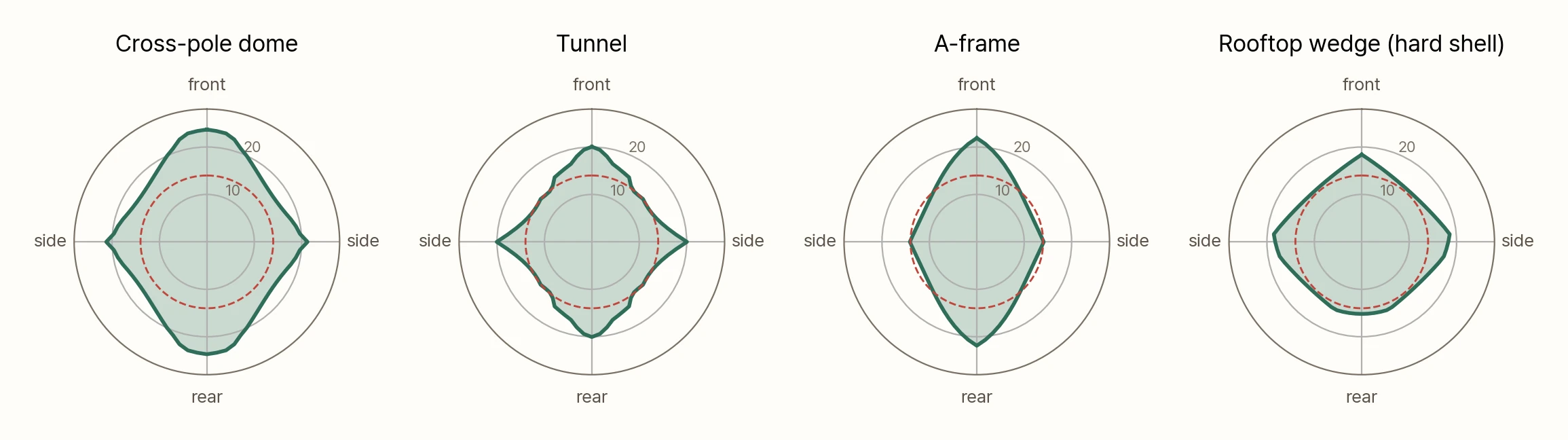
For all eight tents, the weakest direction was neither head-on nor side-on but quartering (40–65°). There are two reasons. A quartering wind pushes both arches at an angle, so neither pole resists fully in its own plane. And the force piles onto a single guyline. A wind-tunnel study of four large tent halls also found the strongest roof suction with the wind at 45° (Flaga et al., 2018).
Each shape had its own character. The A-frame holds out to 22 m/s with the wind on its end, but only 13–14 m/s from the side, because its wide flat walls take the wind head-on. The tunnel is tensioned lengthwise, so it is stiff with its end to the wind. This calculation does not separately include the suction that concentrates on the first arch in an end-on wind (a pressure coefficient of −1.8 in wind-tunnel tests), though.
Pole material: thicker is not simply better
On a cross-pole dome without guylines, with a 14 m/s forecast side wind, I changed only the pole material.
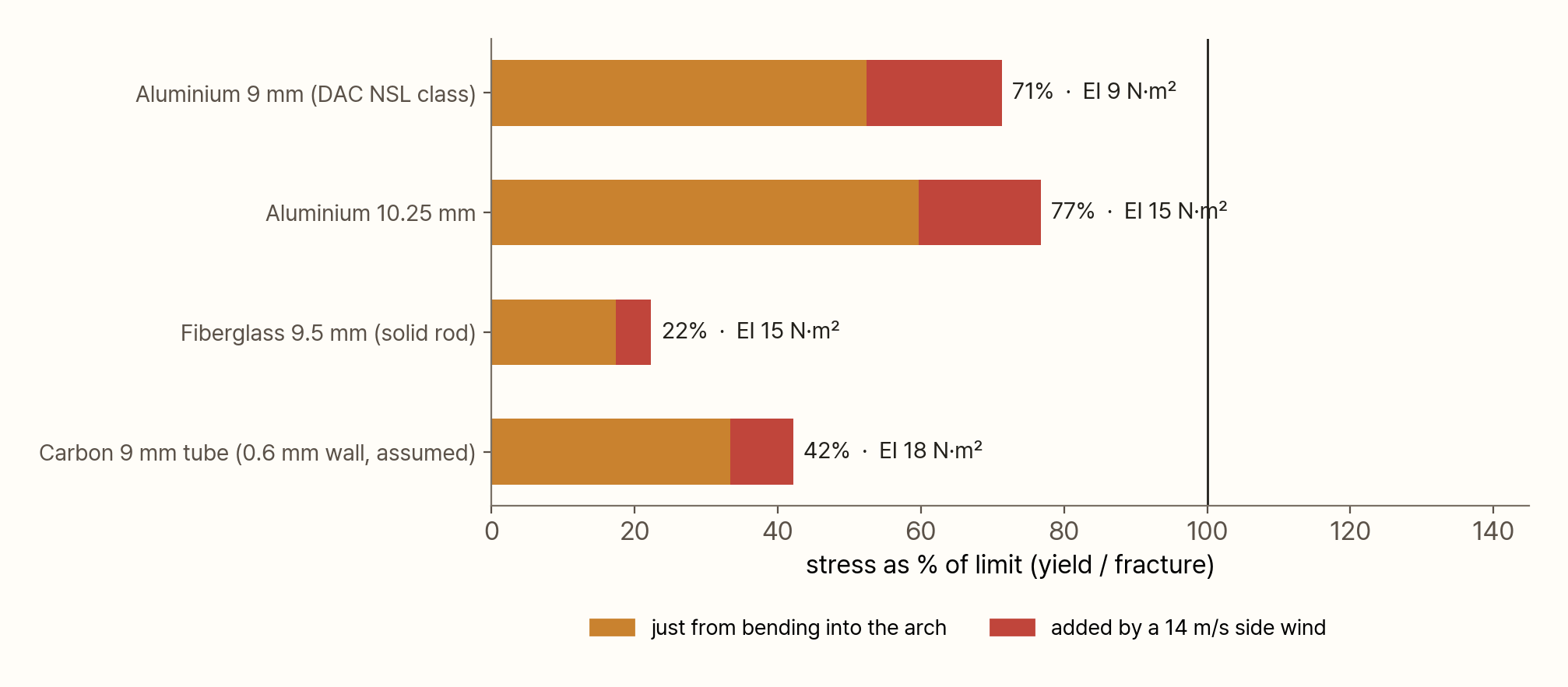
The surprise was that 10.25 mm aluminium sits closer to its limit than 9 mm. A thicker tube is stiffer, but bent to the same radius its outer fibres stretch more, so the stress from bending it into the arch is larger. That is why expedition tents with thick poles build bigger arches (longer radius) or use pre-bent poles. The advantage of a thick pole is deflection, not stress: in the same wind the top moves 9 cm instead of 12 cm.
Fiberglass had the most stress margin. Its modulus is half that of aluminium, so bending it into an arch costs less, and its flexural strength is higher. But to match the stiffness you need a solid rod, about 57 g per 400 mm, three times the weight of 9 mm aluminium (19 g). The real reasons fiberglass poles break in wind lie outside this calculation: ferrules, fatigue under repeated loading, and the way it splits. More on that below in "Where it goes wrong".
Rooftop tents: what holds instead of stakes
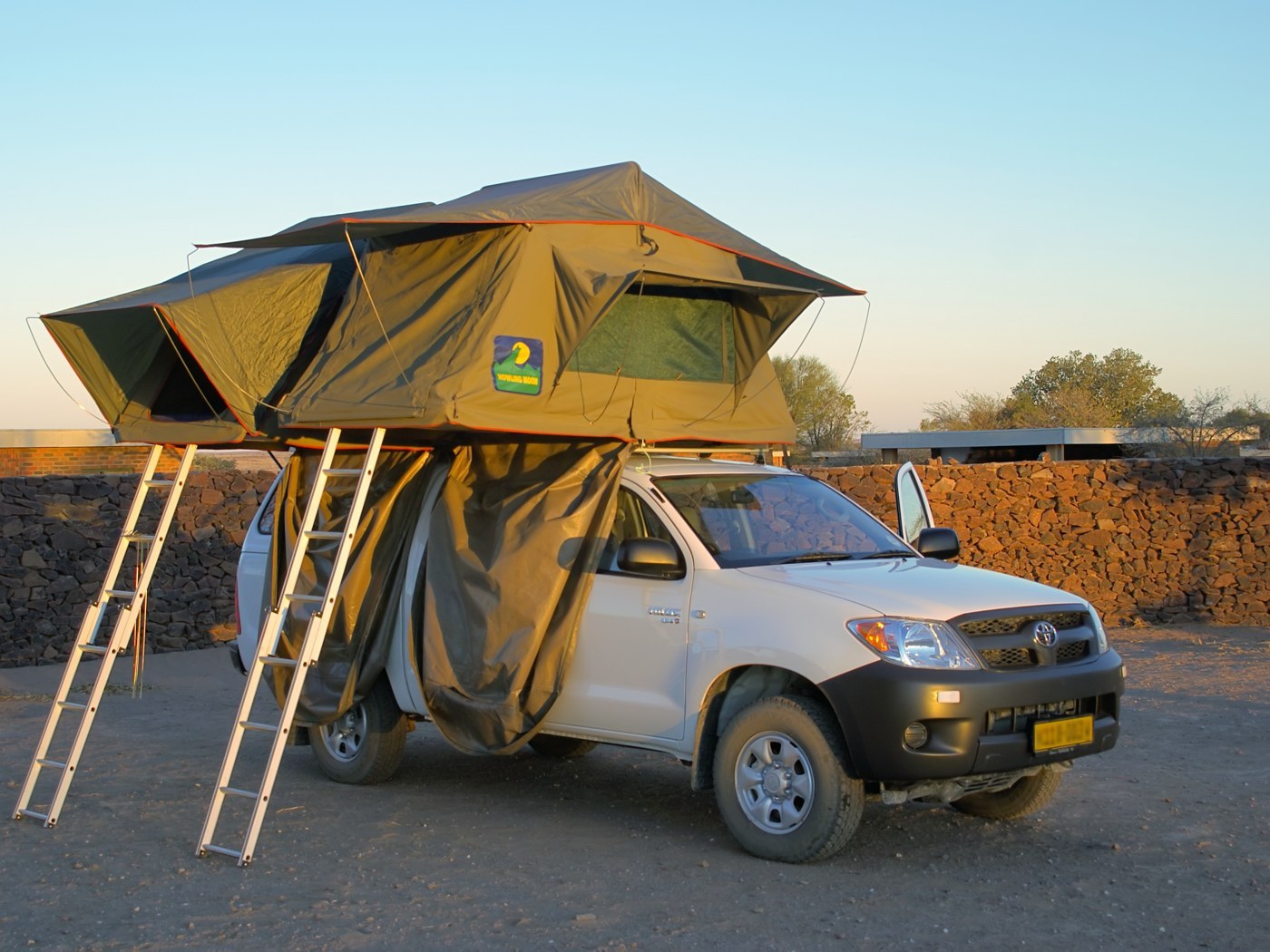
Soft-shell fold-out rooftop tents. A ladder holds up the half that folds out over the side. Photo: Hans Hillewaert / Wikimedia Commons (CC BY-SA 3.0)
A rooftop tent has no stakes. It is bolted to a roof rack, and the rack is clamped to the car roof. So instead of stakes, the simulator looks at four other things: the force lifting the tent, the load on the roof rack, the frame and fabric, and whether the car tips over sideways.
Fold-out (soft shell). On a fold-out such as the Thule Tepui, the opened half hangs out over the side of the car and its end rests on a ladder. The ladder supports the tent but is not tied to the ground. If the force lifting the roof exceeds the weight of that half (about 27 kg), it lifts off the ladder. That works out to a forecast of around 17 m/s. Thule's manuals give no wind-speed limit. They do say to use a roof rack with at least a 75 kg dynamic rating, and warn that when driving, the tent must be mounted parallel to the road to avoid extra lift (Thule safety manual).
In the calculation, the first limit the fold-out reached was the roof rack. When the tent takes a side wind, it twists between the front and rear crossbars, and the windward crossbar is pulled upward. That pull reaches the rack's 75 kg rating at a forecast of 14–17 m/s. The rack rating really refers to the weight of a load while driving (pressing down), so applying it to an upward pull is a conservative comparison. Still, Thule's general roof-rack safety document states that "maximum load applies to driving as well as parked vehicle" (Thule).
Wedge (hard shell). A wedge such as the iKamper BDV is hinged at one end and lifts to 1.5 m at the other, opening the lid to about 30°. Here the key is the force with which the wind opens the lid. Wind from the hinge end flows over the lid and pulls it up slightly. Wind from the open end inflates the inside and pushes the lid up from below. In pressure coefficients I used 0.5 for the hinge end, 0.9 for the side and 1.3 for the open end.
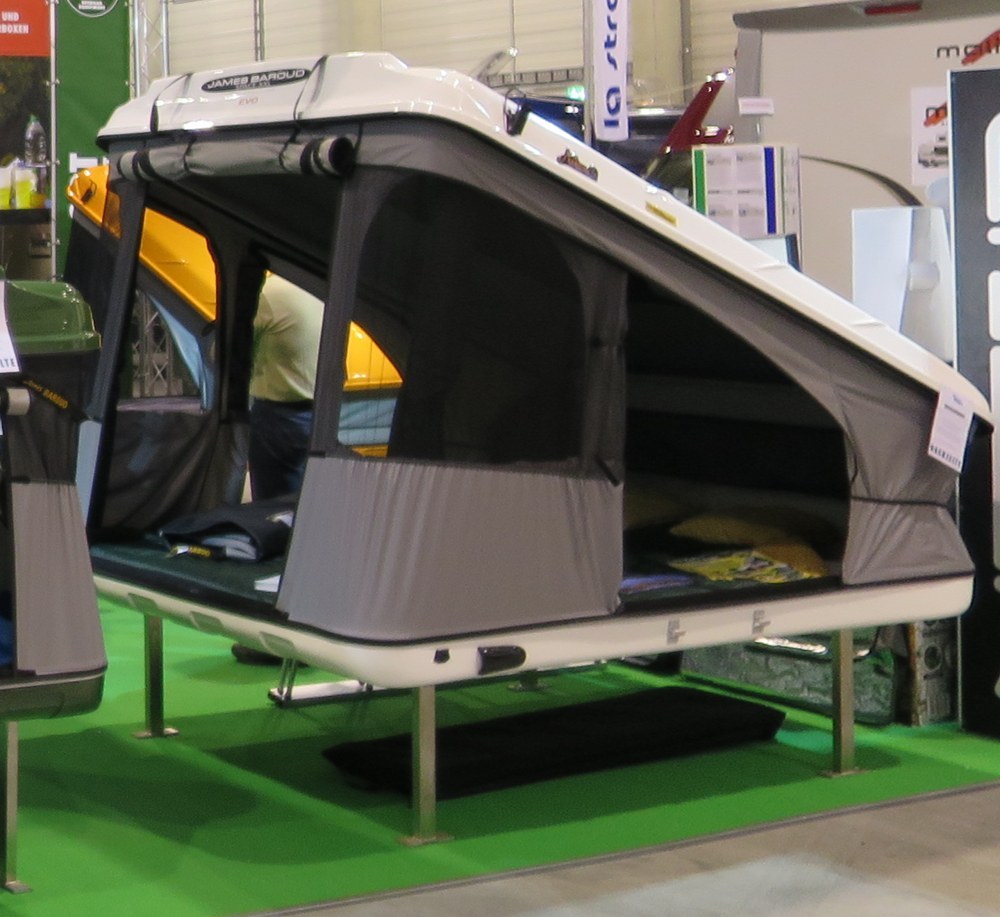
A hard-shell wedge rooftop tent (James Baroud). Photo: Travelarz / Wikimedia Commons (CC BY-SA 3.0 pl, cropped)
iKamper's BDV manual gives a usage limit of 10 m/s (BDV manual). I took that as the limit in the worst direction (wind into the open end) and set the lid's holding strength from it. Then the direction alone splits the results. Without guylines, the hinge end into the wind gives 16.2 m/s, a side wind 12.0 m/s, and the open end into the wind 10.0 m/s. This points the same way as iKamper's advice to keep the hard shell facing the wind (iKamper blog). Leave the windward door open as well, and the side-wind limit drops from 12.0 to 8.5 m/s.
How much does vehicle mass matter?
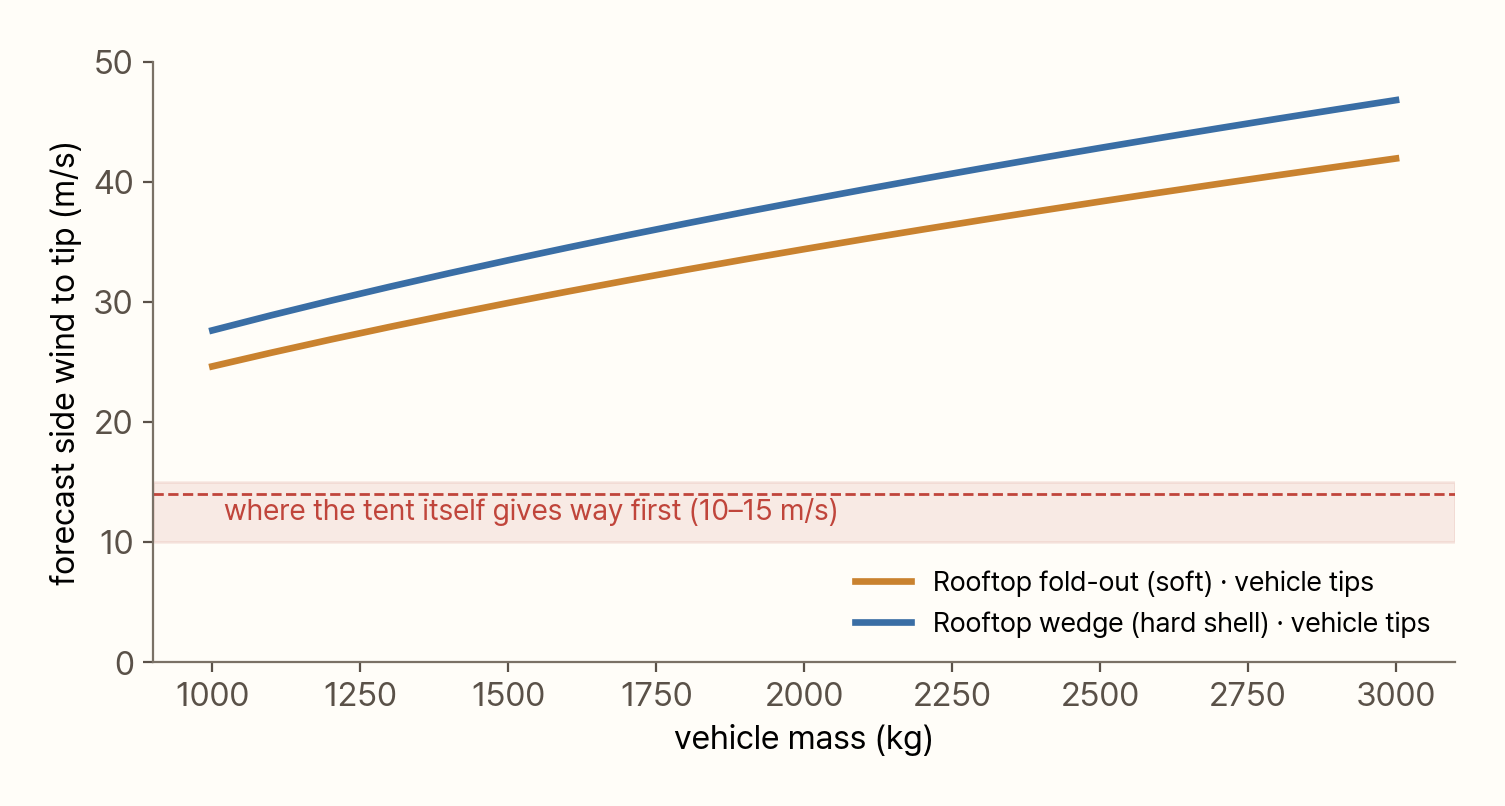
Whether a car tips in a side wind depends on its mass, the distance between its wheels (track), and the height of its centre of gravity. When the moment of the wind pushing on the car and tent exceeds the moment of the weight holding it down, the car rotates about its leeward wheels. I used an SUV of RAV4 size (track 1.61 m, centre of gravity 0.67 m) (NHTSA stability report). The car body's wind coefficient was matched to scale-model wind-tunnel tests in which parked cars tipped at 52–58 m/s (Schmidlin et al.). With no tent, a 1,529 kg car tips at 54 m/s of wind at body height.
Opening a rooftop tent adds wind-catching area high up and lowers the tipping speed considerably. On an 1,800 kg car, the fold-out tips at a forecast of about 33 m/s and the wedge at about 37 m/s. As the car's mass rises from 1,000 kg to 3,000 kg, this climbs from 25 m/s to 42 m/s. Mass does make a difference.
At any mass, though, the tent's own limits (10–17 m/s) come first. Long before the car tips, the lid flips or the roof rack twists. What vehicle mass really changes is how much the car rocks through the night. In the same wind, the ratio of the rocking moment to the restoring moment is inversely proportional to mass. Compare a 1,200 kg small car with a 2,400 kg large SUV, and the rocking in the same wind roughly halves.
What I built: a tent wind simulator
Below, you can pick any of the eight tents and change the forecast wind, wind direction (0–360°), gusts, stake length and ground, guylines, the windward door, and the pole and fabric. Pick a rooftop tent and vehicle mass replaces the stake settings. The bars at upper right show how much of its limit each part is using; the radial chart below shows the forecast wind the tent survives from each direction.
Where it goes wrong
Against published test results, some things match and some don't.
| Compared with | Published result | This simulator |
|---|---|---|
| Decathlon MT900 dome | habitable up to 70 km/h (19.4 m/s) in a wind tunnel | with 23 cm stakes and guylines, survives gusts of about 17–23 m/s at tent height depending on direction. No conflict |
| TheTentLab domes (no guylines) | solid at 30–35 mph (13–16 m/s), collapsing at 40–50 mph (18–22 m/s) | fabric stiffness was set to match this. Calibration, not validation |
| Decathlon Arpenaz family tent | 50 km/h (13.9 m/s) in a wind tunnel | at first it collapsed at 6 m/s at tent height, far off. I raised the fabric stiffness and stake count for large tents to bring it to about 16 m/s. Also calibration |
| iKamper BDV wedge | usage limit 10 m/s, tested to 35 mph (15.6 m/s) with guylines | lid strength and the guyline effect were set to these two numbers. Only the difference between directions is a computed result |
| ISO 5912:2003 | a fully guyed tent must withstand 15 m/s from any direction | the standard does not say whether that is wind at tent height, so I did not compare directly |
| Parked cars | tip at 52–58 m/s (1 m height) | the car-body coefficient was set to this |
Four values are calibrated. To be honest about it, this simulator is more trustworthy for comparisons, what fails first under the same conditions and how much a change helps, than for absolute numbers.
Here is what the model leaves out.
- The real weakness of fiberglass poles is missing. In the calculation fiberglass had the most stress margin, but in reality the ferrules break first and the rods split under repeated loading. This calculation only looks at a single large bend.
- Pole crossings are not modelled. In a geodesic, the poles hold each other at several points, so it is stronger in reality. The geodesic results here are conservative.
- There is no flapping. Under static membrane tension the fabric barely approached its limit (about 12% of its strength on the dome at a 14 m/s forecast). What actually tears fabric is flapping, abrasion and the force concentrated at guyline loops.
- Wind coefficients are borrowed. I found no published wind-tunnel coefficients for camping tents and used values for greenhouses, hemispheres and flat plates.
- Stake data comes from one place. Stake holding force is from a single experiment (standard error 15–25%). Wet ground or stones change it several-fold.
- Part of the quartering-wind weakness comes from guyline layout. Adding guylines on the diagonals reduces it. The simulator assumes guylines evenly spaced around the tent.
- Air-beam tents are not included. A 7 psi air tube that bends and springs back does not behave like this frame model.
Can you trust a simulator built by AI?
This time the AI did the research, wrote the simulator code and drew the figures. So why not just ask an AI, "How much wind can a dome tent take?" and stop there?
Recent research has an answer. In a study published in April 2026, general-purpose AI models were given 20 frame structural-analysis problems (Geng et al., arXiv 2604.09866). Asked to write analysis scripts for an open-source program (OpenSees) directly, GPT-5.2 got 18% right and Gemini-3-Pro 79%. For commercial programs (SAP2000, ETABS), both scored 0%. Many models ran but were wrong, with beams connected incorrectly or nodes missing. When several agents translated the same problems into code through an intermediate representation, accuracy rose to 98–100%. Another study from 2025 reported that having the AI write analysis code instead of answering with a number pushed accuracy above 99% (Liu et al., arXiv 2507.02938).
The same thing happened here. The first model made the tent weaker when guylines were added, collapsed the family tent at 6 m/s at tent height, and made the tunnel weakest with its end to the wind. All three went against common sense. The causes were a calculation that piled force onto guyline stakes, the fabric stiffness of large tents, and leaving out the lengthwise tensioning of a tunnel. Doubting strange results and checking them against exact solutions and published tests was still the human part of the job. What the AI did was make it quick to run that checking again and again.
Pitching a tent on a windy day
Boiled down to what came out of the calculation:
- Read the forecast in tent terms. A 14 m/s forecast means gusts of 13–14 m/s on a ground tent and 19 m/s on a rooftop tent.
- Change the stakes first. Going from 15 cm to 23 cm stakes raises the survivable wind by 1.4–1.6 times. That helps more than changing the tent. Short stakes do almost nothing in sand.
- Keep guylines low and drive stakes leaning away from the tent. A stake holds 2.5–4.5 times more pulled sideways than pulled straight up.
- Face the wind head-on or side-on. Quartering winds are the weakest. Put the end of an A-frame or tunnel into the wind, and on days when the wind shifts, add guylines on the diagonals.
- Close the windward door. An open door inflates the tent and increases lift. The dome's limit fell from 21 to 17 m/s, and the wedge's from 12 to 8.5 m/s.
- Point a rooftop wedge's hinge into the wind. With the open end to the wind, the survivable wind fell by about a third.
- A heavier car rocks less, but does not hold out longer. A rooftop tent's limits come from the tent and the roof rack before the car.
Sources
- Korea Meteorological Administration, warning criteria — gale advisory 14 m/s (gust 20 m/s), warning 21 m/s (gust 26 m/s)
- Harper, Kepert, Ginger, Wind speed time averaging conversions for tropical cyclone conditions — 10-minute mean to 3-second gust 1.66 (inland)
- Moriyama et al. (2015), JARQ 49(1) — half-cylinder greenhouse wind tunnel, CD 0.3, CL 0.2, net load 1.35 with door open
- Pool-Blanco et al. (2022), Ingeniería Investigación y Tecnología 23(2) — inflatable half-cylinder, end-on wind, first arch Cp −1.81
- Flaga, Kłaput, Kocoń (2018), Wind tunnel tests of wind pressure distributions for four different tent halls — maximum roof suction at 45°
- ISO 5912:2003, sample — fully guyed tent, 15 m/s
- DAC, NSL pole spec · MakeItFrom, 7075-T6 · Goodwinds, rod and tube spec
- Extremtextil, silnylon 20D · 40D · Durston, materials
- Backpacking Light (2024), How do tent stakes interact with soils · ARA, Tent Stake Study
- Decathlon, MT900 · Arpenaz 4.2 · TheTentLab, MoonLight strength
- Hilleberg, Nammatj · Saivo
- Thule, rooftop tent safety manual · roof rack safety document · evo, Tepui Autana 3 specs
- iKamper, BDV manual · preparing for wind
- NHTSA, DOT HS 812 444 · Schmidlin et al., Wind speeds required to upset vehicles
- Geng et al. (2026), arXiv 2604.09866 · Liu et al. (2025), arXiv 2507.02938
Image credits
- Collapsed family dome tent: brian gautreau, Wikimedia Commons.jpg), CC BY-SA 2.0
- Tunnel tent on a glacier: Paxson Woelber, Wikimedia Commons.jpg), CC BY 2.0
- Fold-out rooftop tents on a Hilux: Hans Hillewaert, Wikimedia Commons, CC BY-SA 3.0
- Hard-shell wedge rooftop tent: Travelarz, Wikimedia Commons_ACC_Berlin_2017.JPG), CC BY-SA 3.0 pl (cropped, same licence)
- Charts and simulator: made by me
