Fewer Children, Record Spending on Cram Schools
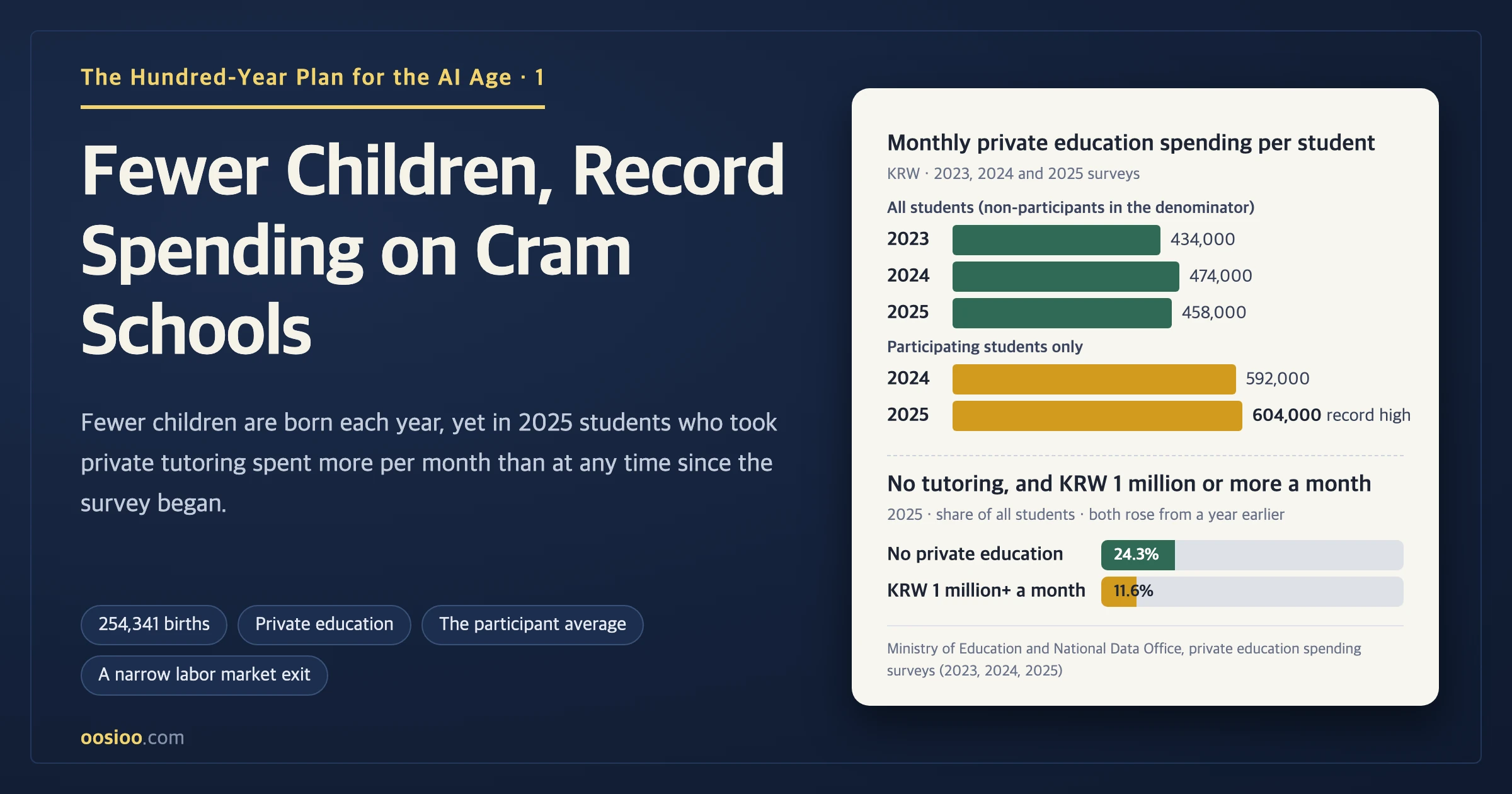
Korea recorded 254,341 births in 2025 (final figure), and the total fertility rate was 0.80. The population aged 0 to 5 fell 37.9% in the ten years from 2013, and by the Ministry of Education's projection, first graders in the 2026 school year fell below 300,000 for the first time. Yet in 2025, elementary, middle and high school students who took private tutoring spent an average of KRW 604,000 a month (about USD 430 at KRW 1,400 per dollar), the most since the survey began. In the same year, total private education spending fell for the first time in five years, to KRW 27.5 trillion, and both the share of students taking no private education at all (24.3%) and the share spending more than KRW 1 million a month (11.6%) rose. This piece starts by unpacking what the "participating student average" hides, then looks at who dropped out and who held on by income, grades and region. It goes on to connect the reasoning of families who stake more on each child when they have fewer, a competition fought by rank rather than headcount, and the narrow exit of the labor market: 41.2% of young people whose first job is simple, routine work, and a 19.0% chance of moving from a small or medium-sized company to a large one. It sets out an American Economic Review paper that ties private education competition and low fertility into one model, along with its limits, the strength of the evidence behind remedies such as care vouchers and regional proportional admission, and the indicators to watch next. The first piece in a new series on education, The Hundred-Year Plan for the AI Age.
After 9 p.m. on a weekday, yellow vans line up outside the cram-school buildings. Children with backpacks come down the stairs and walk between the vans, hazard lights blinking. At the same hour, a few bus stops away, the playground of a neighborhood elementary school is dark. That school very likely has fewer first-grade classrooms this year than it did a few years ago. Both are common sights in Korea in 2026.
In numbers, it looks like this. 254,341 children were born in Korea in 2025. National Data Office, the government statistics agency, published that as a final figure in August 2026. The total fertility rate was 0.80, up two years running from a low of 0.72 in 2023. It is a welcome rebound, but the population aged 0 to 5 fell from 2,791,000 in 2013 to 1,734,000 in 2023, a drop of 37.9% in ten years. And yet in 2025, elementary, middle and high school students who took private tutoring spent an average of KRW 604,000 a month on it (about USD 430 at KRW 1,400 per dollar). That is the highest amount since the Ministry of Education and the statistics agency began the survey.
Common sense says it should go the other way. Fewer children means fewer people competing for the same places, and looser competition means less needs to be spent on cram schools. That did not happen. So the question for this piece is this. With so few children being born, competition should be easing, so why has the money spent on each child gone up?
That question is also the first scene of a larger one. Between 2023 and 2026, three things shook Korea at once. The number of children hit bottom, generative AI moved into classrooms and homework, and the path for young people into their first job narrowed. Over those years, how did education change, from daycare to university, where does it stand now, and what should be done? This series follows that question one scene per episode. The first scene is money. I start with what families' spending on their children's education tells us.
Where things stand, in numbers
Start with a table. Private education spending is surveyed every year by the Ministry of Education and National Data Office (renamed from Statistics Korea in the second half of 2025), using a sample of elementary, middle and high school students, and published the following March. "The 2025 survey" means money spent in 2025, published in March 2026. In Korea, private education mostly means hagwon, the private cram schools and academies that most children attend after school, plus private tutors and paid study materials.
| Item | Figure | Basis |
|---|---|---|
| Births | 254,341 (up 16,024, or 6.7%, from a year earlier) | 2025, final figure (published August 2026) |
| Total fertility rate | 0.72 → 0.75 → 0.80 | 2023, 2024, 2025 |
| Population aged 0 to 5 | 2,791,000 → 1,734,000 (down 37.9%) | 2013→2023, analysis by the National Assembly Futures Institute (press reports) |
| First graders in elementary school | just over 298,000 (below 300,000 for the first time) | 2026 school year, Ministry of Education projection |
| Total private education spending, grades 1 to 12 | KRW 27.1 trillion → 29.2 trillion → 27.5 trillion | 2023, 2024, 2025 surveys |
| Share of students in private education | 78.5% → 80.0% → 75.7% | Same |
| Monthly spending per student, all students | KRW 434,000 → 474,000 → 458,000 | Same. Students with no private education are included in the denominator |
| Monthly spending per participating student | KRW 592,000 → KRW 604,000 (record high) | 2024, 2025. Only students who take private education |
| No private education / KRW 1 million or more a month | 24.3% (up 4.3 percentage points) / 11.6% (up about 0.4 percentage points) | 2025, share of all students |
I pick three lines from this table.
First, the total fell. Total spending in 2025, KRW 27.5 trillion, was KRW 1.7 trillion (5.7%) less than a year earlier. It was the first decline in five years. The participation rate also dropped 4.3 percentage points, from 80.0% to 75.7%. The rate had crossed 80% for the first time in 2024, and within a year it was back in the mid-70s. From these two lines alone, you could write that the private education fever has cooled.
Second, the amount per participating student rose. Counting only students who take private education, the 2025 monthly average was KRW 604,000, 2.0% more than a year earlier. By school level it was KRW 512,000 for elementary students, KRW 632,000 for middle school and KRW 793,000 for high school. The ministry said education prices rose 2.3% that year, so after inflation the real increase was not large (press reports). In nominal terms it is still the highest since the survey began.
Third, the middle thinned and both ends grew. Students with no private education at all rose 4.3 percentage points to 24.3%, and students spending KRW 1 million or more a month also rose slightly, to 11.6%. Households that spend nothing and households that spend a lot both increased.
What the "participating student average" hides
One number here has to be read carefully. The KRW 604,000 per participating student is an average over students who take private education and no one else. It is not a number that goes up only when everyone spends more.
Take a simple example. There are 10 students. Five spend KRW 200,000 a month and five spend KRW 1 million. The average for participating students is KRW 600,000. The next year, two of the students who spent KRW 200,000 quit, and everyone else keeps spending the same. Now there are eight participating students and their average rises to KRW 700,000. Nobody spent a won more, and yet "spending per student" hits a record. Divided over all 10 students, the average goes the other way, from KRW 600,000 to KRW 560,000.
The 2025 statistics have exactly this shape. Spending per student across all students fell 3.5%, from KRW 474,000 to KRW 458,000, while spending per participating student rose 2.0%. That makes you want to know who dropped out and who held on. The figures by income and by grades give a clue.
| Group (2025) | Monthly spending per student, all students | Change from a year earlier | Participation rate |
|---|---|---|---|
| Household income KRW 8 million or more a month | KRW 662,000 | -2.1% | 84.9% |
| Household income under KRW 3 million a month | KRW 192,000 | -6.6% | 52.8% (-5.3 percentage points) |
| High school, top 10% by grades | KRW 661,000 | -0.7% | 63.0% |
| High school, bottom 20% by grades | KRW 326,000 | -11.9% | 50.1% |
The income figures come from several outlets and the grade figures from the Korea Economic Daily, all reporting the ministry's release. Every amount is on an all-students basis, so the denominator differs from the KRW 604,000 above.
The gap in spending between the top and bottom income groups is 3.4 times. What stands out more is how much each cut. Households earning under KRW 3 million a month cut 6.6%, and their participation rate fell 5.3 percentage points. Households earning KRW 8 million or more cut 2.1%. High school students in the bottom 20% by grades cut 11.9%; the top 10% cut only 0.7%. By region, spending per student was KRW 663,000 in Seoul and KRW 309,000 in South Jeolla Province, a 2.1-fold gap (all-students basis).
So the first answer to this episode's question is a bit of a letdown. The 2025 "per-student record" is hard to read as every family spending more. It is closer to the lower spenders leaving first while the heavy spenders held almost steady. Rather than private education shrinking, the group that takes it narrowed toward the top. The ministry said the cause of the 2025 decline was "hard to pin down to one thing" (press reports). The number of students itself fell, after-school care for early elementary grades expanded, and some households were under financial strain. This survey alone cannot tell how much each of those mattered.
That does not end the explanation, though. 2025 is one year's number. In the years before it, the total rose even as student numbers fell. It went from KRW 27.1 trillion in 2023 to KRW 29.2 trillion in 2024, up 7.7% in a single year, and the participation rate passed 80% for the first time. To see why families spent so much while the number of children was shrinking, let me go through it year by year from 2023.
What happened
2023. The total fertility rate hit a record low of 0.72. In June the government said it would remove so-called "killer questions," items beyond the public school curriculum, from the Suneung, Korea's national college entrance exam, and announced measures to reduce private education. Its view was that cram schools made their money preparing students for those very hard items. The Suneung held that November was judged difficult despite the announcement that "there were no killer questions." On December 27, a reform of university admissions for the 2028 school year was finalized. It drops elective subjects from the Suneung in favor of common integrated social studies and integrated science, and changes high school internal grading from nine bands to five. It applies to students who entered high school in 2025, meaning second-year high school students as of 2026. Private education spending in 2023 was KRW 27.1 trillion, up 4.5% from a year earlier.
2024. In February the government announced an increase in medical school places, and admissions for the 2025 school year rose by about 1,500. Private education spending that year rose 7.7% to KRW 29.2 trillion and participation reached 80.0%. The medical school announcement and the jump in spending overlap in time. But the spending survey does not ask why families spent, so this data cannot establish whether one caused the other. In August the Bank of Korea published a report titled "Social Problems Caused by Overheated Competition for University Entrance and Policy Responses." Its analysis was that entry to top universities depends more on parents' wealth and where a family lives than on a student's potential. I come back to this report later.
2025. In April the government returned medical school admissions for the 2026 school year to the pre-increase level of 3,058. A major variable in admissions changed again within a year. On the school side, participation in after-school care for first and second graders (the Neulbom School program) grew to about 552,000 children, a participation rate of 81.3%. And that year private education spending fell to KRW 27.5 trillion, its first decline in five years. Births rose for a second straight year, to 254,341.
2026. In January, the Ministry of Education projected just over 298,000 first graders for the 2026 school year, below 300,000 for the first time. 210 elementary schools had no new first graders at all. In February, medical school capacity for the 2027 school year was set at 3,548, up 490, with all the added places to be filled through a regional doctor track. In March, a program called "Ondongne Elementary Care and Education" began, giving third graders a voucher worth KRW 500,000 a year for after-school programs. The same month, the results of the 2025 private education survey came out. The total and the participation rate went down, and spending per participating student hit a record.
To sum up: the number of children bottomed out in 2023 and has risen very slightly since. Private education spending rose through 2024 and turned down in 2025. Over the same period, the admissions system and medical school capacity changed almost every year. And what turned down in 2025 was the total and the participation rate, not the money spent by families who kept going.
Why it turned out this way
Several reasons overlap to explain why spending per child does not fall when the number of children does. I list them from the most solidly supported to the closest to inference.
The fewer the children, the more is staked on each
Economics has an old explanation for this, the trade-off between the quantity and quality of children, as Gary Becker set it out. The fewer children a family has, the more time and money it puts into each one. If the money for raising two goes to raising one, that one's share gets bigger; that is close to arithmetic. Korea's low birth rate has pushed this to the extreme. As more families have only one child, more parents feel that if that one child falls behind, there is no other child to make up for it.
This explanation fits the trend through 2024, when the total rose even as student numbers fell. But it is hard to say flatly that low fertility "increases" private education. There are years like 2025 when the total fell. The explanation only tells us why spending on one child does not easily come down.
Competition is by rank, not by headcount
The expectation that fewer children will mean less competition has a hidden premise: that the number of good places stays the same. If students drop by 30% and top universities keep the same intake, getting in becomes easier, arithmetically. In fact, most universities that fail to fill their freshman places are outside the Seoul area.
But what parents look at is not how many universities their child could get into. It is their child's rank. Many Suneung subjects are graded on a curve, and internal school grades are assigned by percentage bands. Even when high school grading moves to five bands from the 2028 school year, the top band will still be the top 10%. However many students there are, the top 10% is 10%. Places where competition concentrates, like medical school, move regardless of student numbers. Medical school admissions went back to 3,058 for the 2026 school year and then capacity rose to 3,548 for 2027. School-age population kept falling over that time, but it is hard to find any sign that competition for medical school eased accordingly. What sets the intensity of competition is less the number of children than the gap between the good places and everything else.
When the exit is narrow, the fight at the entrance gets harder
That gap comes from outside school, from the labor market. According to a Bank of Korea issue note published in January 2026, the share of young people whose first job was in an elementary occupation, meaning simple, routine work, rose from 29.7% in 2004 to 41.2% in 2025 (confirmed through press reports). The same material put the probability of moving from a small or medium-sized company to a large company at 19.0% as of 2023. Only about one in five people working at a smaller company moves to a large one. Where you start shapes much of what follows, and a wrong first step is hard to recover from.
Put those numbers into a parent's calculation and one more reason appears for why private education spending does not easily fall. University is the door to the first job, and the first job shapes the next 30 years. The fewer second chances there are at the exit, the harder people fight at the entrance. This is inference. In researching this piece I did not find Korean studies that directly link labor market mobility to private education spending. Still, the way competition crowds toward "sure tickets" such as medical school, professional licenses and top universities points in the same direction.
Where you live and what you earn set the starting line
The Bank of Korea's 2024 report shows that this competition is not just a fair contest of rank. In 2018, students from Seoul's three Gangnam districts, the city's wealthiest area, were 4% of general high school graduates nationwide but 12% of those entering Seoul National University. Widen it to all of Seoul and the figures are 16% of graduates and 32% of Seoul National University entrants. The report estimated that 92% of the gap in Seoul National University entry rates between Seoul and the rest of the country comes not from students' potential but from a "region-of-residence effect." Here the region-of-residence effect covers parents' wealth and the private education environment together.
The 2.1-fold gap between Seoul and South Jeolla and the 3.4-fold gap between top and bottom incomes in the table above are that environment. For parents, private education is an investment to put their child further ahead, but it is also a defense against falling behind. As long as other families spend, it is hard for one family to stop. That last sentence is exactly what research abroad has focused on.
Other countries
When others spend, you have to spend too
A 2024 paper in the American Economic Review by Seongeun Kim, Michèle Tertilt and Minchul Yum, "Status Externalities in Education and Low Birth Rates in Korea," ties two features of Korea into one structure: intense concern with children's education and the world's lowest fertility rate. The authors start from the fact that a child's educational success is judged in comparison with other people's children. If the neighbors spend more on private education, your child's relative position drops, so your family spends more too. Economists call this kind of effect, where someone else's choice raises your burden, an externality. The authors present new empirical evidence that private education spending spreads to those nearby, and build a model calibrated to Korean data on that basis.
By the model's calculation, without this externality the fertility rate would have been about 28% higher. The "competition cost" of raising one child becomes a reason not to have another. The authors calculate that a tax on private education or a birth subsidy could raise fertility and lower education spending, and that the combination that maximizes the welfare of the current generation is a 22% tax on education spending plus a modest birth subsidy.
The study gives a fairly direct answer to this episode's question. Competition does not ease when children become fewer because competition is relative, and the cost of that competition in turn leads people to have fewer children. Fertility and private education spending moving in opposite directions may not be a coincidence; they may be feeding each other.
The limits are clear too. The 28% and the 22% are not values observed after actually implementing a policy; they are values a model calculated. A model is tied to the period and assumptions of the data it was fitted to. In an earlier version of the paper (a working paper), the same calculations came out differently. No country has tried taxing private education spending and checked the effect, and actually doing it would raise hard problems, starting with what counts as private education. The paper is better read as a map of the structure than as a prescription.
The bigger the inequality, the busier the parents
Another study makes a similar argument by comparing countries. In their 2019 book Love, Money, and Parenting, the economists Matthias Doepke and Fabrizio Zilibotti argue that the larger the income gap between the more and less educated in a country, the more common "intensive parenting" becomes, with parents deeply involved in their children's studies and schedules. In countries where that gap is small, like Sweden, parents are relatively relaxed; where it is large, like the United States or China, they are busier. Korea's cram-school streets and the narrow labor market exit described above sit at one end of this explanation.
The book's argument rests on comparisons built from country-level surveys and statistics, so it is hard to say it establishes causation rigorously. Still, the two studies point the same way. What moves private education spending is less the number of children than "the difference between winning and losing the competition."
So what should be done
Prescriptions fall into two broad groups: easing the cost of competition with public resources, and lowering the stakes of the competition itself. The strength of the evidence differs between them, so I note it with each.
On the policy side
Grow care and after-school programs inside schools as an alternative to private education (policy in effect, not yet evaluated). Participation in after-school care for first and second graders was 81.3% in 2025. From 2026, third graders get a voucher worth KRW 500,000 a year to use on after-school programs inside the school, with a budget of KRW 106 billion. The government set a target of raising third graders' after-school participation from 42.4% in 2025 to 60%. A large part of private education in the early grades is less about learning than about "somewhere to leave the child." If schools take over that time, some of the spending may be replaced. But there is no official evaluation yet of how much this has cut private education spending. The third-grade figures in the 2026 survey results are worth looking at separately.
Change how top places are allocated (a policy proposal based on simulation). In its 2024 report, the Bank of Korea proposed "regional proportional admission," under which top universities would select most of their freshmen in line with each region's share of high school seniors. Its simulation found that keeping each region's share of admits within 0.7 to 1.3 times its share of seniors would shrink the average gap between actual Seoul National University entry rates and the rates predicted by potential from 0.14 percentage points to 0.05 percentage points, a reduction of about 64%. The logic is that weakening the power of where you live to decide rank could also reduce some of the competition and private education aimed at moving to certain neighborhoods. Whether universities would go along voluntarily, and whether families would get around it by moving between regions, cannot be known without trying. Filling all of the added medical school places from the 2027 school year through a regional doctor track is a real case heading in a similar direction, and worth watching.
Widen the exit to lower the stakes at the entrance (inference). If there are ways to move on after the first job, there is less reason to bet everything on one round of admissions. If the 19.0% probability of moving from a smaller company to a large one goes up, the weight of a university's name may get a little lighter. Education policy cannot do this alone; it has to go together with labor market policy. It is also the part most easily missed under the current government structure, which treats education and labor separately.
Change how the statistics are read (proposal). Each March, when private education spending is announced, the headline is usually either "per-student spending at a record" or "total spending down." Both are true and both are half the picture. As shown above, the participating-student average rises just from low spenders dropping out. Unless the changes by income and grades and the distribution across spending bands are shown together, the same argument over whether private education "fell" or "rose" will repeat every year. Simply having the government lead its release with distribution measures would make the targets of policy clearer.
Taxing private education (model calculation, no empirical evidence). The American Economic Review paper above calculated that a tax on education spending could raise both fertility and welfare. It is an interesting conclusion, but no country has actually tried it. Questions such as how to define what is taxed, whether tutoring would go underground, and whether it would fall regressively on low-income households need to be answered first. At this stage it is more honest to leave it as a question than to treat it as a policy.
For families, schools and individuals
Telling parents to spend less is easy but not fair. Given the structure described above, a family that stops on its own may lose out. Instead, I lay out some information to judge by.
Don't measure your own spending against "an average of KRW 600,000." That number is the average for students who take private education only, and heavy spenders pull it up. As of 2025, a quarter of all students took no private education. By school level, the average for participating elementary students was KRW 512,000, well below high school students (KRW 793,000). The sense that everyone else spends that much may be larger than what the statistics actually show.
Check first what time the school covers. First and second graders can use two hours of free care every day, and from 2026 third graders can use a KRW 500,000-a-year after-school voucher. The voucher can only be used for programs inside the school, so check the school's notices. In families where much of the cram-school spending in the early grades is really for childcare, there may be room to cut.
Know exactly which grades an admissions change applies to. The admissions reform for the 2028 school year (an integrated Suneung, five-band school grading) applies from students who are in their second year of high school as of 2026. If you hear at a cram-school information session that "it's changing this time," first check whether your child's grade is affected. Changes in the system feed anxiety, and anxiety easily turns into spending.
Schools can show "where the school's part ends." If schools spell out what they can offer in career counseling and in support for students who have fallen behind, the areas parents hand over to cram schools shrink. This is not about piling everything onto teachers. The point is to make clear at least the areas schools have agreed to take on, like care in the early grades.
What we don't know yet
Is the 2025 decline a trend? One year of decline is not enough to say the direction has changed. If the usual schedule holds, the 2026 survey results will come out in March 2027. What to look at then is less the total than the participation rate, whether the declines in the lower income and grade groups continued, and whether third-grade spending moved together with the care voucher.
The actual number of first graders in the 2026 school year. The figure of just over 298,000 used here is a Ministry of Education projection. The actual count as of April 1, 2026 is in the Basic Education Statistics, but the summary published in August 2026 did not list first graders separately.
Will the birth rebound last? Births rose for a second year in 2025, but it will take a few more years to tell whether that is a trend. If the usual schedule holds, provisional 2026 birth statistics will come out around February 2027. Even if the rebound continues, those children will not start school until the 2030s. It will not change the shape of competition in today's schools.
The link between medical school capacity and private education spending. The jump in private education spending in 2024 overlaps in time with the announcement of more medical school places, but in researching this piece I did not find a study that analyzes this directly. How regional private education spending moves as medical school capacity grows, mainly through the regional doctor track, from the 2027 school year could serve as one experiment.
Will AI change the private education market? The number of students studying with generative AI has grown quickly. Whether this will replace cram-school spending, or split the market further into expensive in-person academies and cheap AI tools, has not yet shown up in the numbers. In researching this piece I also did not find official statistics that count spending on AI learning tools separately.
Closing
The expectation that fewer children would mean less competition was half right. Total private education spending fell in 2025, and more students took no private education. But the decline came mostly from the lower end of income and grades, while the upper end held almost steady. The record KRW 604,000 per participating student records how much the families still in the competition are spending. Reading it as everyone spending more gets it wrong.
Competition is fought by rank, not by headcount. The weight of rank is set by the gap between the good places and everything else, and that gap comes from the labor market outside school. That is why this problem cannot be solved by regulating cram schools alone, or by birth incentives alone. Leave in place a structure where you must spend because others do, tell each family to spend less, and only the families that stop lose out.
This series follows the same question, moving it one stage earlier at a time: how far down the competition now reaches, what schools are doing in the meantime, and how AI is shaking all of it. When the next private education survey comes out in March 2027, it will be the first chance to judge whether the 2025 turn was a beginning or a one-year wobble.
Sources
- Births and population: National Data Office, "2025 Birth Statistics" (2026-08-26, posted by the KDI Economic Information and Education Center) (in Korean) · e-Narajipyo indicators, births and total fertility rate (in Korean) · Daum News, "40% of infants and toddlers gone in 10 years" (National Assembly Futures Institute analysis, 2026-01-26) (in Korean) · Korea Education Newspaper, population of young children (National Assembly Futures Institute) (in Korean)
- School-age population: Herald Economy, first graders fall below 300,000 (Ministry of Education student projection, 2026-01-12) (in Korean) · Korea Times, first-grade enrollment falls below 300,000 (2026-01-13) · Korea Education Newspaper, 210 elementary schools with no new students (2026-03) (in Korean)
- Private education spending: e-Narajipyo indicators, private education spending for grades 1 to 12 (in Korean) · Korea Policy Briefing, results of the 2023 private education survey (2024-03-14) (in Korean) · Ministry of Education press release, results of the 2024 private education survey (morning papers, 2025-03-14) (in Korean)+%EC%A1%B0%EA%B0%84%EB%B3%B4%EB%8F%84%EC%9E%90%EB%A3%8C]+2024%EB%85%84+%EC%B4%88%EC%A4%91%EA%B3%A0+%EC%82%AC%EA%B5%90%EC%9C%A1%EB%B9%84+%EC%A1%B0%EC%82%AC+%EA%B2%B0%EA%B3%BC.pdf) · Korea Economic Daily, the 2025 private education survey (2026-03-12) (in Korean) · Newsis, the 2025 private education survey (2026-03-12) (in Korean)
- Admissions and medical schools: Korea Policy Briefing, 2028 university admissions reform finalized (2023-12-27) (in Korean) · Kyunghyang Shinmun, examples of killer questions released (2023-09-06) (in Korean) · Aju Business Daily, medical school admissions for the 2025 school year (2024-05-24) (in Korean) · Korea Economic Daily, 3,058 medical school places for the 2026 school year (2025-04-17) (in Korean) · Newsis, medical school capacity for the 2027 school year (2026-02-10) (in Korean)
- Bank of Korea: BOK Issue Note No. 2024-26, "Social Problems Caused by Overheated Competition for University Entrance and Policy Responses" (2024-08-27) (in Korean) · Financial News, Bank of Korea issue note on young people's delayed entry into the labor market (2026-01-19) (in Korean) · Economist Korea, the same issue note (2026-01-19) (in Korean)
- Care: Financial News, Neulbom participation and Ondongne elementary care (2026-02-03) (in Korean) · Korea Policy Briefing, Ondongne Elementary Care and Education (in Korean)
- Research abroad: Kim, Tertilt, Yum, "Status Externalities in Education and Low Birth Rates in Korea," American Economic Review 114(6), 2024 · Abstract of the same paper (RePEc) · Doepke & Zilibotti, Love, Money, and Parenting (Princeton University Press, 2019)