Ideas Come When You’re Not Looking, and Leave Just as Fast
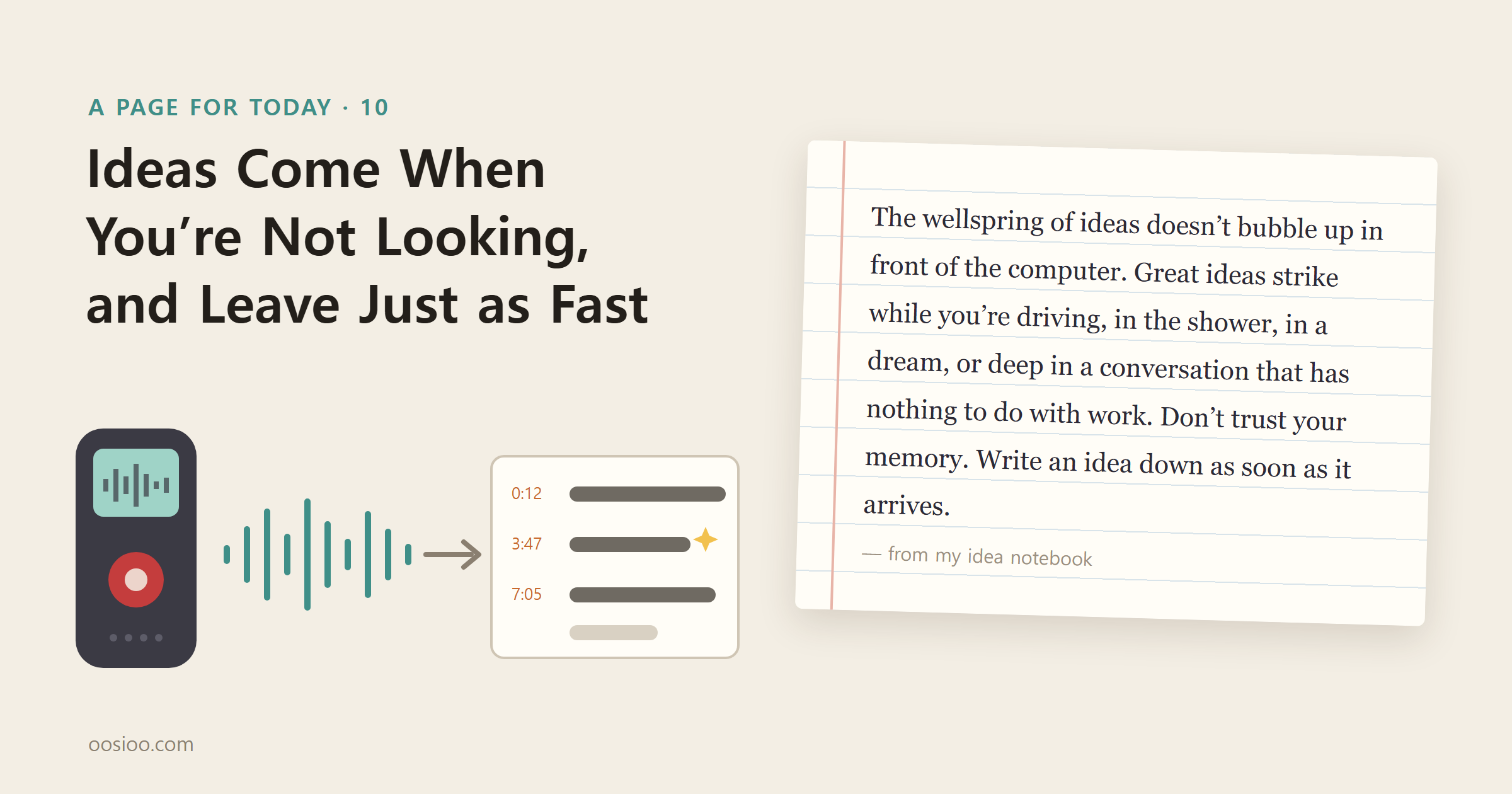
The sentence in my notebook read: “The wellspring of ideas doesn’t bubble up in front of the computer … Don’t trust your memory. Write an idea down as soon as it arrives.” Through physicists’ and writers’ idea diaries, experiments on showers, driving and the 15 seconds before sleep, and a 200-year-old essay on how thoughts take shape as we speak, this post looks at when ideas arrive and why they vanish so fast. Then it turns to the transcription engines that changed my all-day-recorder routine: how they turn sound into text, what happened when I installed one and transcribed a Korean reading, why they hallucinate, and the apps and devices built on top of them. The tenth post in A Page for Today.
When I opened my idea notebook today, this is what I found.
Where should you start? The wellspring of ideas doesn't bubble up in front of the computer. Great ideas strike suddenly while you're driving, in the shower, in a dream, or when you're absorbed in a conversation that has nothing to do with work. Don't trust your memory. Write an idea down as soon as it arrives.
It's a little longer than usual. I nodded as soon as I read it. Good ideas come to me far more easily when I'm doing something else than when I'm at my desk. Especially in conversation: something I blurt out turns out, later, to have been a usable idea. The problem is that my short-term memory is on the weak side. The better the idea I said out loud, the faster it fades unless I catch it. So for a while, I wore a voice recorder all day long.
Today I'll follow the notebook sentence in two halves. The first half: do ideas really come while we're doing something else, and why? People have actually measured this. The second half: why do they vanish so fast, and how do we catch them? On the catching side, the biggest change between my recorder days and now is the transcription engine, which turns recordings into text.
Not at the desk, even 135 years ago
Someone said almost exactly what the notebook says. At the celebration of his seventieth birthday in 1891, the German physicist Hermann von Helmholtz looked back on how he had made his discoveries. Good ideas arrived suddenly, without effort, like an inspiration, and "as far as my experience goes, they never came to a tired brain, and never at the desk." They were often already there when he woke in the morning, and they came especially readily while he was slowly climbing wooded hills on a sunny day. Even the smallest amount of alcohol, he added, seemed to scare them off.
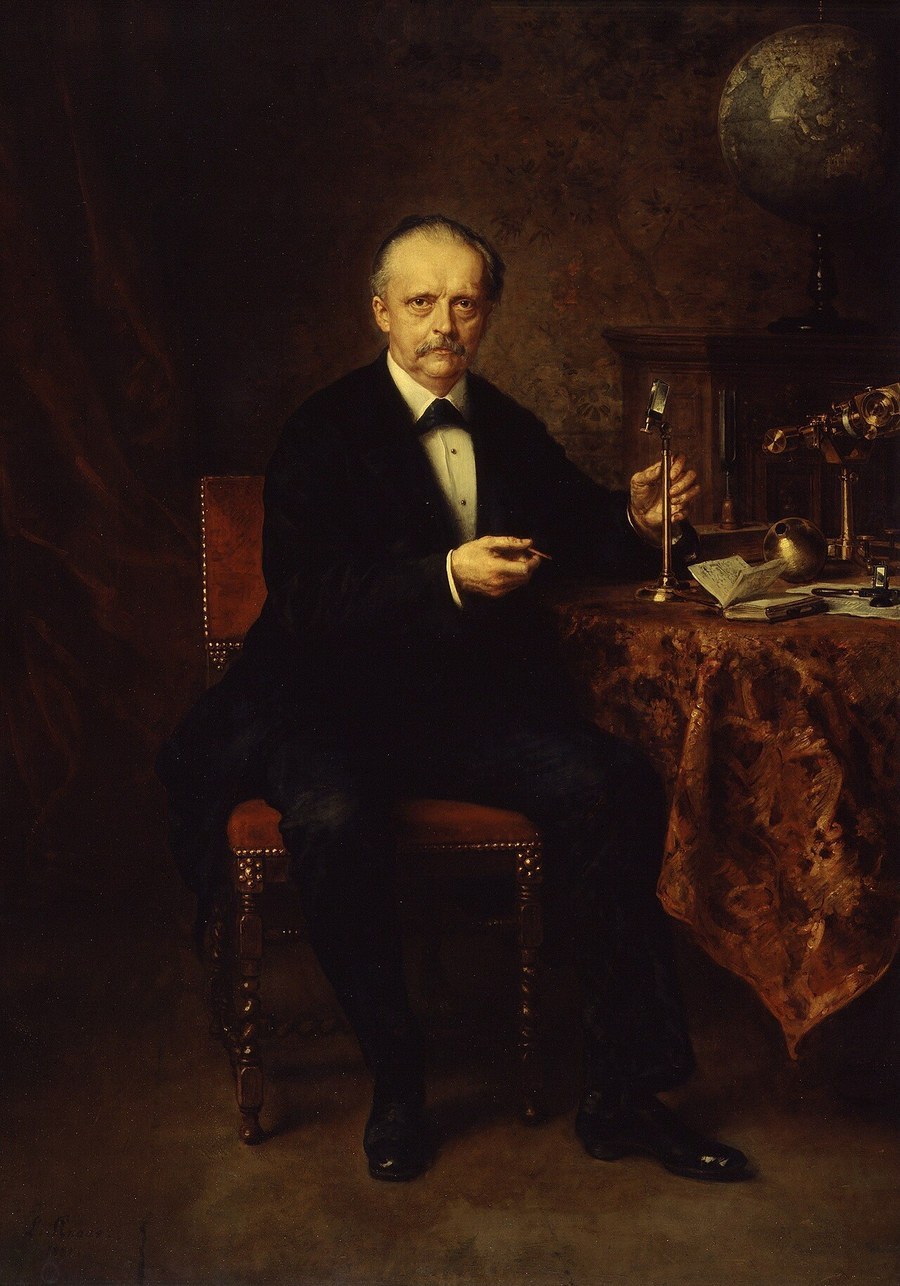
*Image: Ludwig Knaus, "Der Physiker Hermann von Helmholtz" (1881), public domain, Wikimedia Commons.jpg)*
But the recollection has a first half. Before that, he said, he always had to turn the problem over on every side until he could see all its twists and tangles in his head. Only after that fatigue had passed, and an hour of bodily freshness and calm had come, did the good ideas arrive. They come once you leave the desk, but only to someone who has wrestled with the problem at the desk long enough.
The four stages of Graham Wallas that I introduced last time (preparation, incubation, illumination, verification) were built on exactly this passage. Pooled experimental research points the same way. In 2009, Ut Na Sio and Thomas Ormerod gathered incubation studies into a meta-analysis and found that stepping away really does help. The effect was larger the longer people had worked on the problem beforehand, and smaller when the break was filled with mentally demanding work. Doing something else doesn't hand you ideas for free. You have to fill your head with the problem first; then the other activity keeps it turning.
Asking physicists and writers to keep a diary
So how many ideas actually come away from the desk? A diary study measured it. In 2019, Shelly Gable, Elizabeth Hopper and Jonathan Schooler at the University of California, Santa Barbara asked 98 professional writers and 87 physicists to record, every day, the most creative idea they'd had that day. They also noted what they were doing at that moment, what they were thinking about, and whether they felt an "aha."
About one in five of the day's most important ideas came while they were doing something other than work and thinking about something unrelated to the idea. Those ideas were no different from ideas had while working in creativity or importance. But they were more often accompanied by an "aha" feeling, and more often broke through a problem that had been stuck.
This number cuts both ways. One in five is not small: it means one of your five best ideas of the day comes in the shower or on a walk. Turned around, though, the other four in five came while working. So the notebook's "ideas don't bubble up in front of the computer" overstates it. More precisely: ideas do come at the desk. And problems that get stuck at the desk are often solved away from it.
There's a bonus in this study. Its method was itself a diary, written as soon as the idea came. Without writing things down, it couldn't have been measured at all.
The shower, the driver's seat, and the edge of sleep
Let's take the notebook's places one at a time.
The shower. You often hear that "72% of people get ideas in the shower." Follow the source and you reach a 2014 consumer survey commissioned by a German bathroom-fixture company to promote a new product. It isn't peer-reviewed research. The experiments come with a condition. In 2022, Zac Irving's team at the University of Virginia had participants think up new uses for objects, and in between showed them a three-minute video. One group saw a dull clip of two men folding laundry; the other saw a scene from When Harry Met Sally. Only with the film did more mind wandering mean more ideas. A wandering mind led to ideas more easily during a mildly engaging activity than during a merely boring one. The researchers gave showering, walking and gardening as examples of such activities. Last time I wrote that a 2012 experiment, which found mind wandering during an easy task boosted creativity, failed in a large replication. This study revives that result, with conditions attached.
Driving. I couldn't find any study that directly measured whether ideas increase while driving. There is research on mind wandering at the wheel. In a 2016 New Zealand study, all 502 drivers surveyed said their minds wandered while driving, more so on familiar roads and when tired. But in driving-simulator experiments, drivers lost in thought reacted later to sudden events and followed the car ahead more closely. An idea that comes to you in the driver's seat must not be written down by hand. Say it out loud, or write it after you've pulled over.
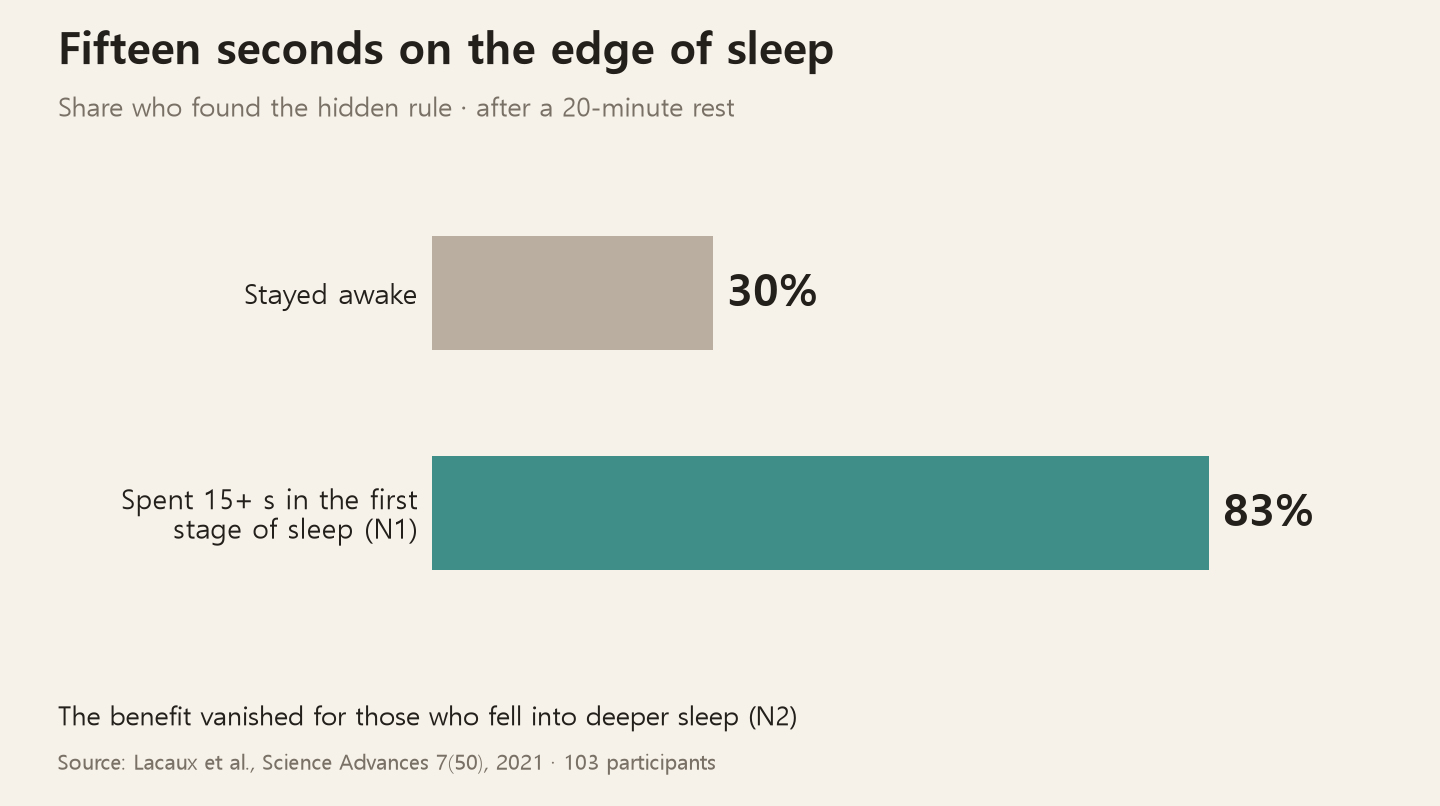
The edge of sleep. Here there is a fairly solid experiment. In 2021, Célia Lacaux's team at the Paris Brain Institute gave 103 people number problems with a hidden rule. Find the rule and the answer pops out at once, but participants weren't told it existed. Midway through, they rested in a reclining chair for 20 minutes, holding a water bottle loosely in one hand. Fall asleep and the hand relaxes and the bottle drops. Of those who spent at least 15 seconds in the first, half-asleep stage of sleep (N1), 83% found the hidden rule. Of those who stayed awake, 30% did. For those who slipped into deeper sleep, the effect disappeared.
The bottle had a reason. A widely told story says Edison would doze holding steel balls and wake at the sound of them falling, then write down whatever had come to him. But the story isn't confirmed by any record. What is certain is that the painter Salvador Dalí described the same method in a 1948 book: hold a heavy key between thumb and forefinger over an upturned plate, doze in a chair, and the clatter of the key on the plate wakes you.
Dreams. Adam Haar Horowitz's team at the MIT Media Lab built "Dormio," a glove-like device that detects the moment of falling asleep. It reads signals such as muscle tone in the hand and heart rate, and at that moment plays a prompt like "Think of a tree" to seed the dream's topic. In a 2023 experiment with 49 people, those who napped this way wrote more creative stories about trees after waking. With only about a dozen people per condition, it's a small experiment that shows a possibility so far. For a full night's sleep, there's the 2004 Nature experiment by Ullrich Wagner's team at the University of Lübeck. After practicing problems with a hidden rule, more than twice as many people in the group that slept a night found the rule as in the group that stayed awake. That held only when they'd wrestled with the problems enough the day before.
Kekulé, who saw the benzene ring in a dream, always comes up too. At a celebration in 1890, 25 years after the discovery, Kekulé said he'd dozed by the fire and seen atoms twisting like snakes, one biting its own tail. Whether this story is true still divides historians of chemistry.
Thoughts take shape as you speak
The notebook's last place is "a conversation that has nothing to do with work." That's the part that hits home for me.
About 200 years ago, the German writer Heinrich von Kleist wrote a short essay on this experience, titled "On the Gradual Completion of Thoughts While Speaking." Twisting the French proverb "appetite comes with eating," he wrote that "the idea comes with speaking." Even if you have only a vague notion in your head, once you start talking, the pressure to finish the sentence you've begun pushes the thought through to the end, he wrote. His example is a problem he couldn't solve until he talked it through with his sister, who knew no mathematics at all. It didn't matter that the listener didn't understand. It's the same story as "rubber duck debugging," where programmers find a bug by explaining their code line by line to a rubber duck on the desk.
Experiments have confirmed this effect too. Since the 1990s, learning research has repeatedly found that explaining what you've learned to yourself deepens understanding. Pooled across studies, the effect isn't large, but it was larger when explaining out loud than in writing. In Kevin Dunbar's study, which recorded and analyzed the regular lab meetings of molecular biology labs, new concepts and analogies were formed and revised less in one person's head than in the back-and-forth among colleagues.
But conversation has a trap. In 1987, Michael Diehl and Wolfgang Stroebe in Germany showed that group brainstorming produces fewer ideas than the same number of people thinking separately. The biggest cause was "production blocking": while waiting your turn as someone else talks, you forget or set aside the idea that came to you. Conversation gives birth to ideas, and the flow of conversation overwrites them.
Why they vanish so fast
In 1959, Lloyd and Margaret Peterson at Indiana University ran a simple experiment. They showed three consonants, then had people count backward by threes so they couldn't rehearse them silently. After 3 seconds, about 80% was remembered; after 18 seconds, only a little over 10% remained. Later researchers showed that much of this forgetting came less from time itself than from interference by letters seen earlier. Memories fade less because time passes than because something else overwrites them.
That's why the idea from the shower is gone by the time you've toweled your hair and picked up your phone to check messages. The idea from a conversation buried under the next person's words follows the same principle. So do dreams. One study found that people who remember their dreams well stay awake a little longer during the night. The interpretation is that dreams get written into memory during those few waking minutes. When Paul McCartney woke with a melody he'd heard in a dream and went straight to the piano, he was catching it before it slipped away.
If ideas come "without effort, like an inspiration," as Helmholtz said, then they also don't sink deeply into memory. You didn't work to memorize them. The notebook's "don't trust your memory" sounds like modesty, but it matches the experiments exactly.
The people who wrote it down
So there were people who wrote things down. The lab notebooks left by Edison's laboratory number more than 3,000. Leonardo da Vinci's notebooks survive in about 7,000 pages. In 1837, when Darwin first sketched the tree of life in his notebook, he wrote "I think" above it. Beethoven kept pocket sketchbooks to carry on walks, apart from his desk sketchbooks; more than thirty survive.
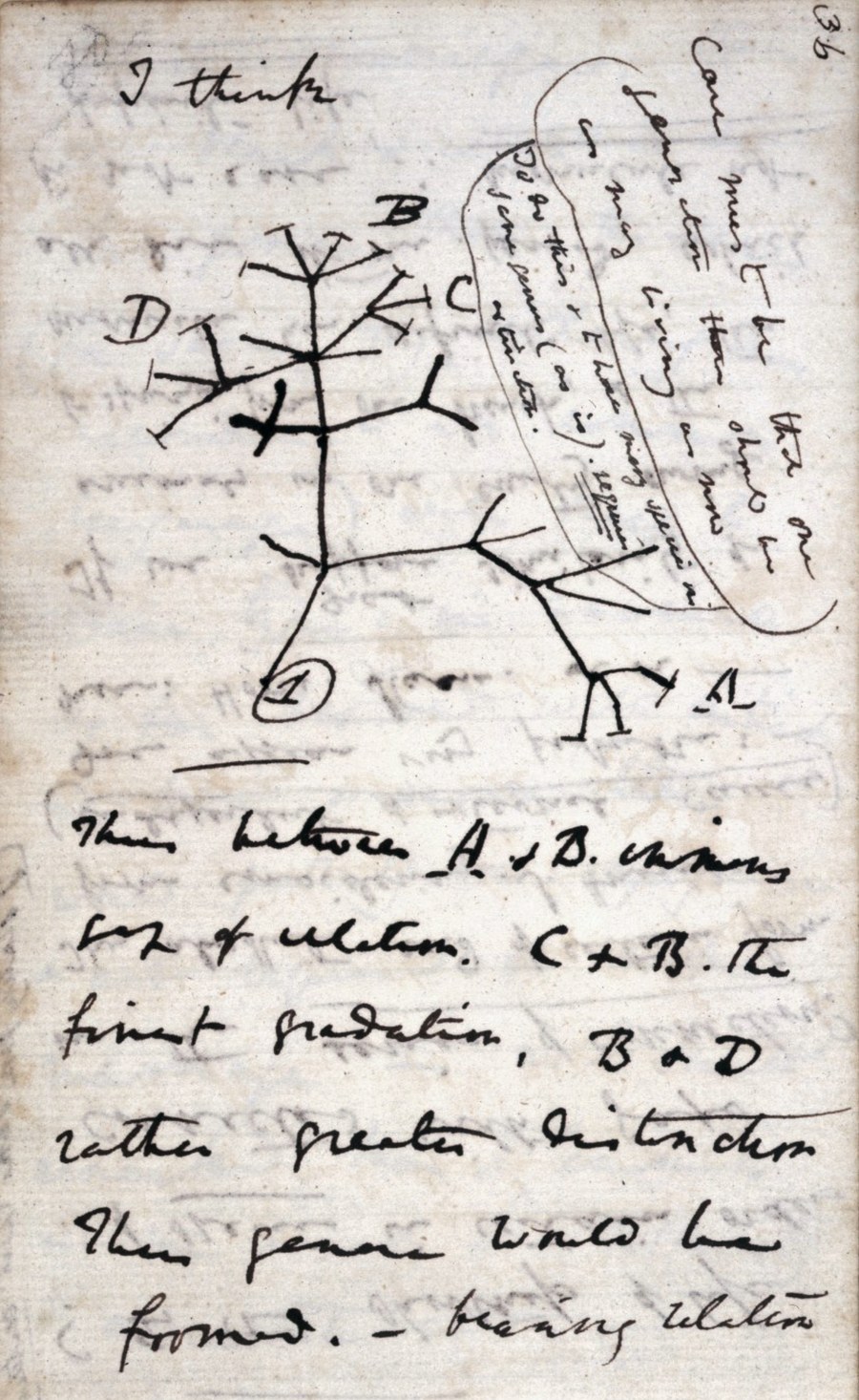
*Image: Charles Darwin, Notebook B, p. 36 (1837), public domain, Wikimedia Commons*

There's a famous case of recording by voice, too. One night in 1965, Keith Richards of the Rolling Stones recorded a guitar riff that came to him half asleep onto the cassette recorder by his bed. When he played the tape in the morning, he wrote in his autobiography, there were about two minutes of guitar followed by forty-odd minutes of snoring. Those two minutes became the riff of "(I Can't Get No) Satisfaction."
There's a counterexample as well. In a 1908 lecture, the mathematician Henri Poincaré said that during a geological excursion, at the very moment he set foot on the step of an omnibus, the answer to a function problem he'd long been working on came to him. He didn't check it on the spot, because as soon as he sat down he went back to the conversation he'd been having. Yet he felt complete certainty, and verified it calmly when he got home. When the answer to a problem you've held for years arrives as certainty, it seems it doesn't get forgotten. But most of us aren't Poincaré, and most of the ideas that come to us aren't that weighty.
The cheapest way to keep them
Recording has one law: if it's a hassle, people don't do it. In 2024, Sam Gilbert's team at UCL ran an experiment in which people decided whether to set reminders for things they'd need to do later. The more effort it took to set a reminder, the fewer reminders people set. So the notebook's "as soon as possible" means the same thing as "as easily as possible."
Speaking is the easiest. In 2016, Stanford researchers compared how fast people entered short messages on phones. For English, speech was three times faster than typing on the keyboard, with fewer errors. Your hands can be wet, gripping the steering wheel, or busy in a conversation, and you can still talk.
Saying things out loud has a bonus. The same word is remembered better when read aloud than when read silently. Psychologists call this the "production effect." In 2018, researchers at the University of Waterloo in Canada went a step further, showing that hearing a recording of your own voice is remembered better than hearing someone else's. Speak an idea into a voice memo and it's stored twice: once in the recorder, once in your head.
Writing things down has another effect. Experiments show that saving one thing helps you remember the next. The reassurance that you're allowed to forget clears room in your head for the next thought.
That's why I wore a recorder all day. The problem was what came next.
The days of the all-day recorder
The recorder never missed an idea. But getting the ideas back out took as long as the recording. Record a day, and you have to listen to a day. Most of it is footsteps, keyboard clatter, and stretches where nobody says anything. To find the useful words mixed in between, I had to listen to the recordings one by one, check them, and copy them out. The recorder stood in for my memory, but it didn't do the work of getting things back out.
It's different now. Feed a recording into a transcription engine and in a few minutes it becomes timestamped text. Once it's text, you can search it, skim it, and ask an AI to "pick out only the parts that sound like ideas." The recording itself hasn't changed. What changed is the step after.
I ran it on this laptop
Words alone don't convey it, so I ran it on the laptop I'm writing this on: an Intel i7-10700 with an RTX 3070 graphics card (8 GB of memory), a desktop-class laptop a few years old. I couldn't use recordings that contain other people's conversations, so I used a 6-minute-43-second public reading (LibriVox) of Hyun Jin-geon's short story "Piano," whose copyright has expired, read by a volunteer. I compared the output with the original text on Wikisource character by character to get the share of errors (character error rate).
| Setup | Time | Speed vs. real time | Character error rate |
|---|---|---|---|
| large-v3-turbo · GPU · silence removal | 30.5 s | 13.2× faster | 7.0% |
| large-v3-turbo · CPU only | 3 min 44 s | 1.8× faster | 6.8% |
| large-v3 · GPU (8-bit compressed) | 2 min 24 s | 2.8× faster | 16.1% |
| small · CPU only | 2 min 21 s | 2.8× faster | about 15% |
The best setup transcribed 6 minutes 43 seconds in 30 seconds. At that speed an hour-long recording takes under 5 minutes. Even on the CPU alone, without a graphics card, it finishes in about half the recording's length. The output looks like this.
[  26.26->  32.56]  궐은 가정의 단란에 흠신 심신을 잠기게 되었다.
[  33.64->  36.62]  보기만 해도 지긋지긋한 형식상의 아내가
[  36.62->  41.10]  궐이 일본 어느 대학을 졸업하자마자 불의에 죽고 말았다.
The original says "흠씬," which came out as "흠신." For unfamiliar vocabulary from a 1920s story, it heard well. The small model transcribed the same passage as "걸은 가정의 단단해 심신 심신을," and turned the author's name into "현진권." This is where model size shows.
Two strange things happened, too. The large model (large-v3) got stuck around 379 seconds like this.
[ 379.38-> 379.92]  그럼 남편은...
[ 379.92-> 379.98]  남편은...
[ 379.98-> 380.08]  남편은...
   (the same line repeats more than fifteen times)
[ 381.18-> 382.30]  웃음을 웃고는
The reader said "남편은" ("the husband...") once. And although the recording ends at 402.7 seconds, the turbo model wrote its last line as [401.94->431.92] 자세히 ("in detail"). It heard words nobody said during 30 seconds that don't exist. This is called "hallucination." Why it happens becomes clear from the engine's structure.
How a transcription engine listens
Most of today's open transcription engines either started from, or are measured against, Whisper, which OpenAI released in September 2022. The paper is titled "Robust Speech Recognition via Large-Scale Weak Supervision." It was trained on 680,000 hours of audio collected from the internet, along with the transcripts that came with it. "Weak supervision" means it used transcripts already on the internet as they were, rather than answers polished one by one by people. Of that, 7,993 hours were Korean transcription data.
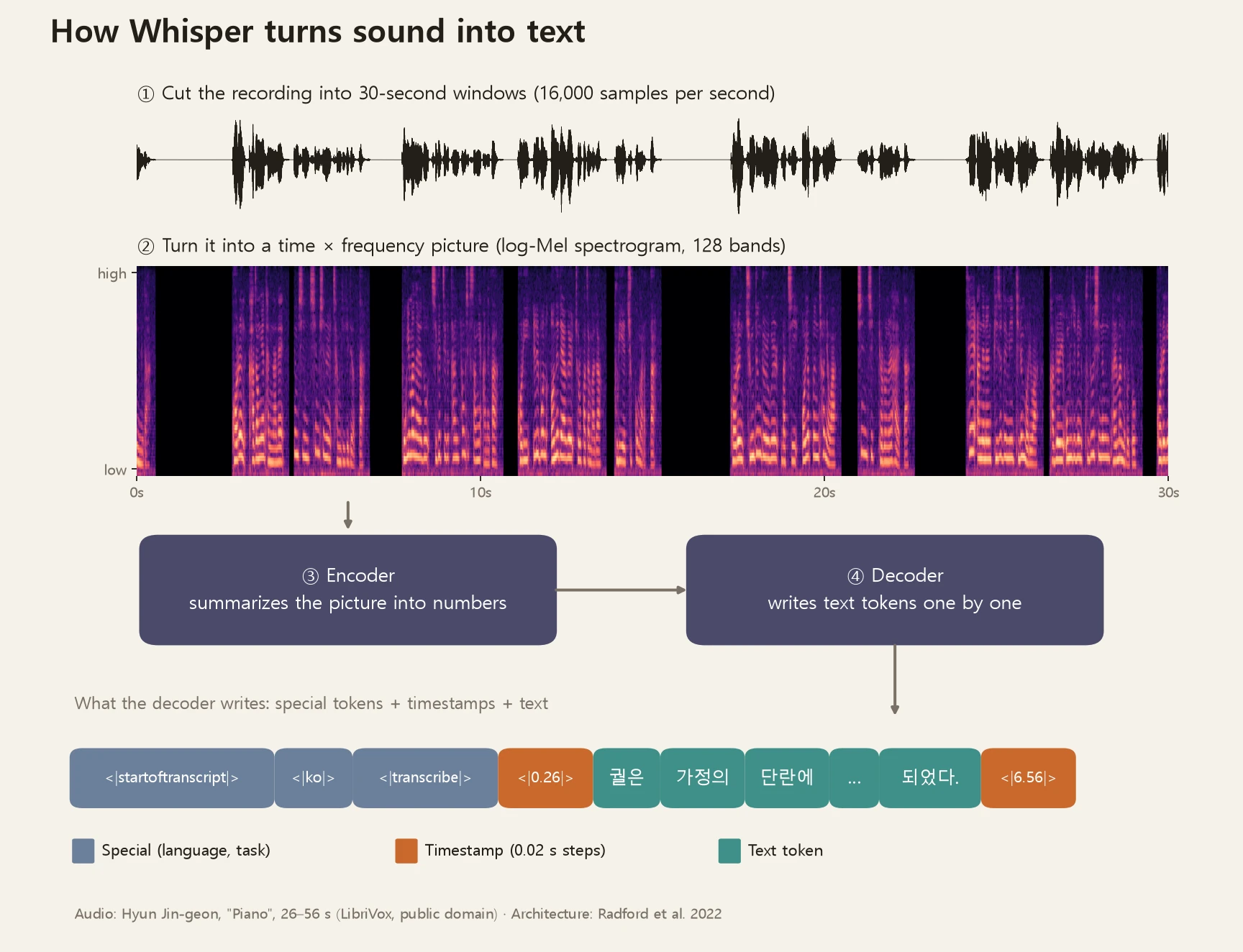
Here's the process.
- Turn sound into a picture. The recording is resampled to 16,000 values per second and cut into 30-second windows. For each window, it draws a picture of how strong each pitch of sound is over time (a log-Mel spectrogram). Mimicking the human ear, which is more sensitive to differences among low sounds, it divides low frequencies finely and high frequencies coarsely.
- The encoder reads the picture. A Transformer neural network, the same family as ChatGPT, summarizes the picture into a block of numbers.
- The decoder writes the text. Another Transformer looks at that summary and writes text pieces (tokens) one at a time. At the start come special markers like "start of transcript, Korean, transcribe (not translate)," and between sentences come timestamp markers in steps of 0.02 seconds. The
[26.26->32.56]above comes from those markers. When the language is unknown, it guesses by which language marker is most likely to come first. - Choose among candidates. Instead of picking only the single most likely piece each time, it carries about five candidate sentences forward together and picks the one that's most likely overall (beam search). If it sees signs of the same words repeating, it tries again a little more randomly.
Hallucination happens at step 3. The decoder is, in the end, a language model that predicts the next piece of text. Even in stretches of silence or pure noise, it writes "what would plausibly come next." Pulled along by what it just wrote, it can also repeat the same words. In 2024, a Cornell team reported that about 1% of recordings transcribed through the Whisper service around 2023 contained words that were never actually said. It happened more often with speakers who pause for long stretches between words. OpenAI itself warns about this problem in the model card.
The fix is simple. Before transcribing, cut out the stretches with no human voice. A small model that does this is called VAD (voice activity detection); the open Silero VAD judges a 30-millisecond chunk of sound in under a millisecond on a single CPU thread. An all-day recording is mostly silence, so running VAD first cuts both the time and the hallucinations. Even so, as in the experiment above, they occasionally leak through at places like the very end. So the transcript should stay linked to the original recording by timestamp. For any suspicious line, go to that time and listen for yourself.
What engines are out there
Whisper comes in several sizes. In October 2024 came large-v3-turbo, which cut the large model's decoder from 32 layers to 4. Accuracy is close to the large model, and it's much faster. It was the best in the experiment above, too. Here is the table from the original Whisper repository (English, relative speed on a high-end GPU).
| Model | Size (parameters) | GPU memory needed | Relative speed |
|---|---|---|---|
| tiny | 39 million | ~1 GB | ~10× |
| small | 244 million | ~2 GB | ~4× |
| medium | 769 million | ~5 GB | ~2× |
| large | 1.55 billion | ~10 GB | 1× |
| turbo | 809 million | ~6 GB | ~8× |
There are many open models besides Whisper. If you want to use Korean, though, check support first. Many of the open models that drew attention in 2025 don't support Korean: NVIDIA's Parakeet and Canary, the French lab Kyutai's real-time model, IBM Granite Speech, Microsoft's Phi-4 multimodal, and Mistral's first Voxtral. As of early October 2026, these are the open models that support Korean.
| Model | Made by | Released | Notes |
|---|---|---|---|
| Whisper large-v3 / turbo | OpenAI | 2023, 2024 | The most widely used baseline, with the most derived tools |
| Qwen3-ASR | Alibaba | January 2026 | 30 languages; top open model on the English open leaderboard |
| SenseVoice / Fun-ASR | Alibaba | 2024–2025 | Also outputs tags for emotion and sounds like laughter or applause |
| Voxtral Realtime | Mistral | February 2026 | Real-time transcription in 13 languages |
| Moonshine tiny-ko | Moonshine AI | September 2025 | A tiny Korean-only model with 27 million parameters |
| Omnilingual ASR | Meta | November 2025 | More than 1,600 languages |
Hugging Face's public transcription leaderboard (Open ASR Leaderboard) is often cited, but it's based on English. Even its multilingual track has no Korean. Korean performance has to be judged from the numbers in each model's card or by running it yourself. On the Korean side, companies such as NAVER CLOVA Speech and Return Zero have strong Korean engines, but they offer them only as services and APIs and don't release the models themselves.
Installing and trying it
There are roughly four ways to run it on your own computer. Whichever you choose, you'll first need a conversion tool called ffmpeg to read recording files (brew install ffmpeg on a Mac, sudo apt install ffmpeg on Ubuntu).
The simplest route: the original Whisper. If you have Python, it's one line to install and one line to run. The model file downloads on first run.
pip install -U openai-whisper
whisper memo.m4a --model turbo --language Korean
The fast route: faster-whisper. This reimplements the same Whisper models on an inference engine called CTranslate2. Accuracy is the same, it's up to four times faster, and it uses less memory. It's what I used in the experiment above.
from faster_whisper import WhisperModel

model = WhisperModel("large-v3-turbo", device="cuda", compute_type="float16")
# Without a GPU: device="cpu", compute_type="int8"
segments, info = model.transcribe("memo.wav", language="ko", vad_filter=True)
for s in segments:
    print(f"[{s.start:.2f}->{s.end:.2f}] {s.text}")
vad_filter=True is the silence removal mentioned above. To use an NVIDIA graphics card, you need the CUDA 12 libraries (cuBLAS, cuDNN 9). One caveat: as of October 2026, a plain install pulls in an audio library (PyAV 19) that causes an error the moment a file is opened. I got around it by first converting to a 16 kHz mono wav with ffmpeg and passing the audio data directly.
On a Mac: whisper.cpp or mlx-whisper. whisper.cpp is Whisper rewritten in C/C++. It uses Apple Silicon's graphics (Metal) directly and has silence removal built in.
git clone https://github.com/ggml-org/whisper.cpp && cd whisper.cpp
sh ./models/download-ggml-model.sh large-v3-turbo
cmake -B build && cmake --build build -j --config Release
./build/bin/whisper-cli -m models/ggml-large-v3-turbo.bin -l ko -f memo.wav
mlx-whisper, which runs on Apple's machine-learning framework MLX, is just pip install mlx-whisper. I didn't get to measure these two on a Mac this time, so I'm not giving speed numbers.
If you need a timestamp for every word: WhisperX. It layers word-level time alignment and speaker separation (who spoke when) on top of faster-whisper. Speaker separation uses a separate model called pyannote, and the repository itself notes that it is "far from perfect."
If you'd rather not run it on your own computer, you can hand it to an API. OpenAI's transcription API costs $0.003–0.006 per minute at October 2026 list prices, or at most about $0.36 an hour. You just have to accept that your recordings go to someone else's server.
Turning a day of recordings into a list of ideas
If I were redoing my all-day-recorder routine today, I'd do it like this.
- In the evening, move the recording to the computer.
- Convert it to a 16 kHz mono wav with ffmpeg:
ffmpeg -i day.m4a -ar 16000 -ac 1 day.wav - Transcribe with VAD on, using faster-whisper (whisper.cpp on a Mac). At the speed from the experiment above, eight hours of recording takes under 40 minutes, and with the silence cut out, far less in practice.
- Hand the timestamped text to an AI to pick out "ideas, to-dos, things to look up later" and turn them into dated notes. Attach the timestamp to each item, and any doubtful line can be found and played back from the original right away.
A job that used to take eight hours is done over dinner. This is what I really wanted back when I wore the recorder.
What branched off from transcription
As transcription engines got cheaper and better, many apps and devices grew on top of them.
- It's already in your phone. From the Galaxy S24 on, Samsung's recorder app transcribes many languages, Korean included, separates speakers and even summarizes. Google Pixel's Recorder also supports Korean, though by re-transcribing in the cloud rather than on the device.
- Meeting-notes apps. NAVER CLOVA Note is a Korean meeting-notes app that began in beta in 2020. Otter.ai is widely used in the English-speaking world but doesn't support Korean. There are also apps like Granola that transcribe your computer's own audio instead of bringing a recording bot into the video call.
- Apps that run only on your computer. MacWhisper and Aiko on the Mac, and the open-source Buzz for Mac, Windows and Linux, run Whisper inside the app. The recording never leaves the machine.
- Typing by voice. Apps like Superwhisper and Wispr Flow transcribe whatever you say into any text field and even tidy up the phrasing. They turn the "speech is three times faster than typing" finding from earlier straight into a product.
- Recorders you wear. This branch turns what I used to do into a device. Plaud's NotePin is a recorder you wear as a necklace or pin, and the app handles transcription and summaries. There were also companies selling AI pendants that listen all day. Limitless stopped selling its device after Meta acquired it in December 2025, and shut its service down in some countries, including Korea. Amazon agreed in July 2025 to acquire Bee, a wristband device. The Friend pendant, pitched as a companion to talk to, became a symbol of backlash against "machines that are always listening" when its New York subway ads were covered in graffiti.
The last branch leaves a question. A machine that listens all day doesn't hear only you. Korea's Protection of Communications Secrets Act prohibits recording private conversations between other people, with a penalty of one to ten years in prison together with suspension of qualifications. According to Supreme Court precedent, a participant recording a conversation they're part of doesn't count as "a conversation between other people" under the law. The problem is a recorder left on all day. If it captures what others say among themselves after you've left, that is a conversation between other people. If you plan to record all day, you need the habit of stopping the recording when you step away, and once you've copied out your ideas, it's better not to hold on to originals containing other people's voices.
Don't trust your memory, and don't trust the recorder either
Back to the notebook sentence. Ideas come while you're doing something else. More precisely, after wrestling enough at the desk, they come in the shower, on walks, at the edge of sleep, and in conversation. And they vanish the moment the next thought comes in. So don't trust your memory: capture them as quickly and as easily as you can.
That speaking is the easiest way to capture was known before, too. Keith Richards's cassette tape is proof. What changed is the cost of getting back what you said. You used to have to listen for as long as you'd recorded. Now it becomes text in minutes, the text can be searched, and an AI can sort it. But that text occasionally includes words nobody said. So keep the original recording with timestamps, and listen to the important lines yourself. "Don't trust your memory" now applies just as much to the transcription machine.
That's how A Page for Today starts from one line in a notebook and arrives at one page of today's thinking.
Sources
Where ideas come from
- Helmholtz, H. v. (1891). Seventieth-birthday speech "Erinnerungen," in Vorträge und Reden (1903). archive.org
- Sio, U. N., & Ormerod, T. C. (2009). Does incubation enhance problem solving? A meta-analytic review. Psychological Bulletin, 135(1), 94–120. doi:10.1037/a0014212
- Gable, S. L., Hopper, E. A., & Schooler, J. W. (2019). When the muses strike: Creative ideas of physicists and writers routinely occur during mind wandering. Psychological Science, 30(3), 396–404. doi:10.1177/0956797618820626
- Irving, Z. C., et al. (2024, online 2022). The shower effect: Mind wandering facilitates creative incubation during moderately engaging activities. Psychology of Aesthetics, Creativity, and the Arts, 18(6), 1096–1107. doi:10.1037/aca0000516
- Burdett, B. R. D., Charlton, S. G., & Starkey, N. J. (2016). Not all minds wander equally. Accident Analysis & Prevention, 95, 1–7. doi:10.1016/j.aap.2016.06.012
- Yanko, M. R., & Spalek, T. M. (2014). Driving with the wandering mind. Human Factors, 56(2), 260–269. doi:10.1177/0018720813495280
- Lacaux, C., et al. (2021). Sleep onset is a creative sweet spot. Science Advances, 7(50), eabj5866. doi:10.1126/sciadv.abj5866
- Haar Horowitz, A., et al. (2023). Targeted dream incubation at sleep onset increases post-sleep creative performance. Scientific Reports, 13, 7319. doi:10.1038/s41598-023-31361-w
- Wagner, U., Gais, S., Haider, H., Verleger, R., & Born, J. (2004). Sleep inspires insight. Nature, 427, 352–355. doi:10.1038/nature02223
- Dalí, S. (1948). 50 Secrets of Magic Craftsmanship. ("Slumber with a key")
- On the Kekulé dream debate: Rocke, A. J. (2010). Image and Reality: Kekulé, Kopp, and the Scientific Imagination. University of Chicago Press.
Thinking by speaking
- Kleist, H. v. "Über die allmähliche Verfertigung der Gedanken beim Reden" (written c. 1805). Projekt Gutenberg
- Chi, M. T. H., et al. (1994). Eliciting self-explanations improves understanding. Cognitive Science, 18(3), 439–477.
- Lachner, A., Jacob, L., & Hoogerheide, V. (2021). Learning by writing explanations: Is explaining to a fictitious student more effective than self-explaining? Learning and Instruction, 74, 101438. doi:10.1016/j.learninstruc.2020.101438
- Dunbar, K. (1997). How scientists think: On-line creativity and conceptual change in science. In Creative Thought. APA.
- Diehl, M., & Stroebe, W. (1987). Productivity loss in brainstorming groups. Journal of Personality and Social Psychology, 53(3), 497–509. doi:10.1037/0022-3514.53.3.497
Forgetting and keeping
- Peterson, L. R., & Peterson, M. J. (1959). Short-term retention of individual verbal items. Journal of Experimental Psychology, 58(3), 193–198. doi:10.1037/h0049234
- Keppel, G., & Underwood, B. J. (1962). Proactive inhibition in short-term retention of single items. Journal of Verbal Learning and Verbal Behavior, 1, 153–161.
- Vallat, R., et al. (2017). Increased evoked potentials to arousing auditory stimuli during sleep: Implication for the understanding of dream recall. Frontiers in Human Neuroscience, 11, 132. doi:10.3389/fnhum.2017.00132
- Chiu, G., & Gilbert, S. J. (2024). Influence of the physical effort of reminder-setting on strategic offloading of delayed intentions. Quarterly Journal of Experimental Psychology, 77(6), 1295–1311. doi:10.1177/17470218231199977
- Ruan, S., et al. (2018). Comparing speech and keyboard text entry for short messages in two languages on touchscreen phones. Proc. ACM IMWUT, 1(4). doi:10.1145/3161187
- MacLeod, C. M., et al. (2010). The production effect: Delineation of a phenomenon. JEP: Learning, Memory, and Cognition, 36(3), 671–685. doi:10.1037/a0018785
- Forrin, N. D., & MacLeod, C. M. (2018). This time it's personal: The memory benefit of hearing oneself. Memory, 26(4), 574–579. doi:10.1080/09658211.2017.1383434
- Storm, B. C., & Stone, S. M. (2015). Saving-enhanced memory. Psychological Science, 26(2), 182–188. doi:10.1177/0956797614559285
- Edison notebooks: Thomas A. Edison Papers, Rutgers · Leonardo notebooks: University of Rochester · Darwin notebooks: Darwin Online
- Richards, K. (2010). Life. Little, Brown. · Poincaré, H. (1908). "L'invention mathématique." Wikisource
Transcription engines
- Radford, A., et al. (2022). Robust Speech Recognition via Large-Scale Weak Supervision. arXiv:2212.04356 · openai/whisper
- SYSTRAN/faster-whisper · ggml-org/whisper.cpp · m-bain/whisperX · snakers4/silero-vad
- Koenecke, A., et al. (2024). Careless Whisper: Speech-to-Text Hallucination Harms. FAccT 2024. arXiv:2402.08021
- Open ASR Leaderboard · individual model cards (Hugging Face)
- OpenAI API pricing: developers.openai.com (checked 2026-10-09)
- Korea's Protection of Communications Secrets Act, Articles 3, 14 and 16 (National Law Information Center); Supreme Court Decision 2006Do4981, October 12, 2006
- Test audio: Hyun Jin-geon, "Piano," read by Jessie Yun (LibriVox), public domain, Wikimedia Commons · Reference text: Korean Wikisource