I Erased the Name and Gave It Only Eight Characters — AI Reads the Fortunes of Einstein and Jobs
Saju (the Korean four-pillars fortune system) is good raw material for AI. Everyone is curious about it, and a fair amount of money and time goes into studying it or getting a reading done. Maybe it's because our lives are that uncertain and anxious. The reason Saju works so well for AI is that it's a system that has been codified in books for over a thousand years. Which character means what, where the seasons are cut off, at what age each ten-year cycle begins — it's all written down in the literature, and that literature is scattered across the web. In other words, this isn't a matter of taste; it's a calculation with a fixed answer. Of course, digging into it, I found there are different schools of interpretation, each with its own know-how. Still, there was clearly a mainstream line that tends to get it right.
Fields with well-established rules like this are ones AI can generally grasp and reconstruct well. Building this Saju program actually took half a day. It was a field I didn't know well, and along the way there turned out to be a fair amount I had to study up on.
The problem was that, even after building it, I still had to verify just how accurate this AI-generated Saju reading actually was. We can click-and-build all sorts of things with AI easily enough, but verification is a different story.
What I Asked
Read out a Western celebrity's Saju with the same depth as an actual product, highlighting the parts that match their documented life and blurring out the rest. Make it screenshot-ready as is.
How Do You Know If It's Right?
Build a Saju program and you inevitably run into this question. A hundred reviews saying "it's spot on" don't count as evidence. People only remember the hits.
So I decided to do the opposite. Read the Saju of someone whose life is already fully documented, but never tell the one doing the reading who the person is.
The reason is simple. A reading looks accurate for one of two reasons — it's genuinely accurate, or the one reading it already knew the answer. Say "born March 14, 1879, in Ulm" and it's obviously Einstein. Read it that way and the AI isn't reading a Saju, it's summarizing a biography.
What it was given — the eight characters and the values calculated from them. For the ten-year cycles, the years were stripped out, leaving only ages.
What it was not given — name, birth year, birth date, birthplace, time zone, occupation, nationality. Nothing.
And every piece of text fed to the AI was scanned for any word that could identify the person; a single hit would count as failure. Not one hit came up.
So the reading contains only sentences like this — "In the 38-to-47 age range…" No mention of 1992. The year was attached by a person afterward.
What Came Out
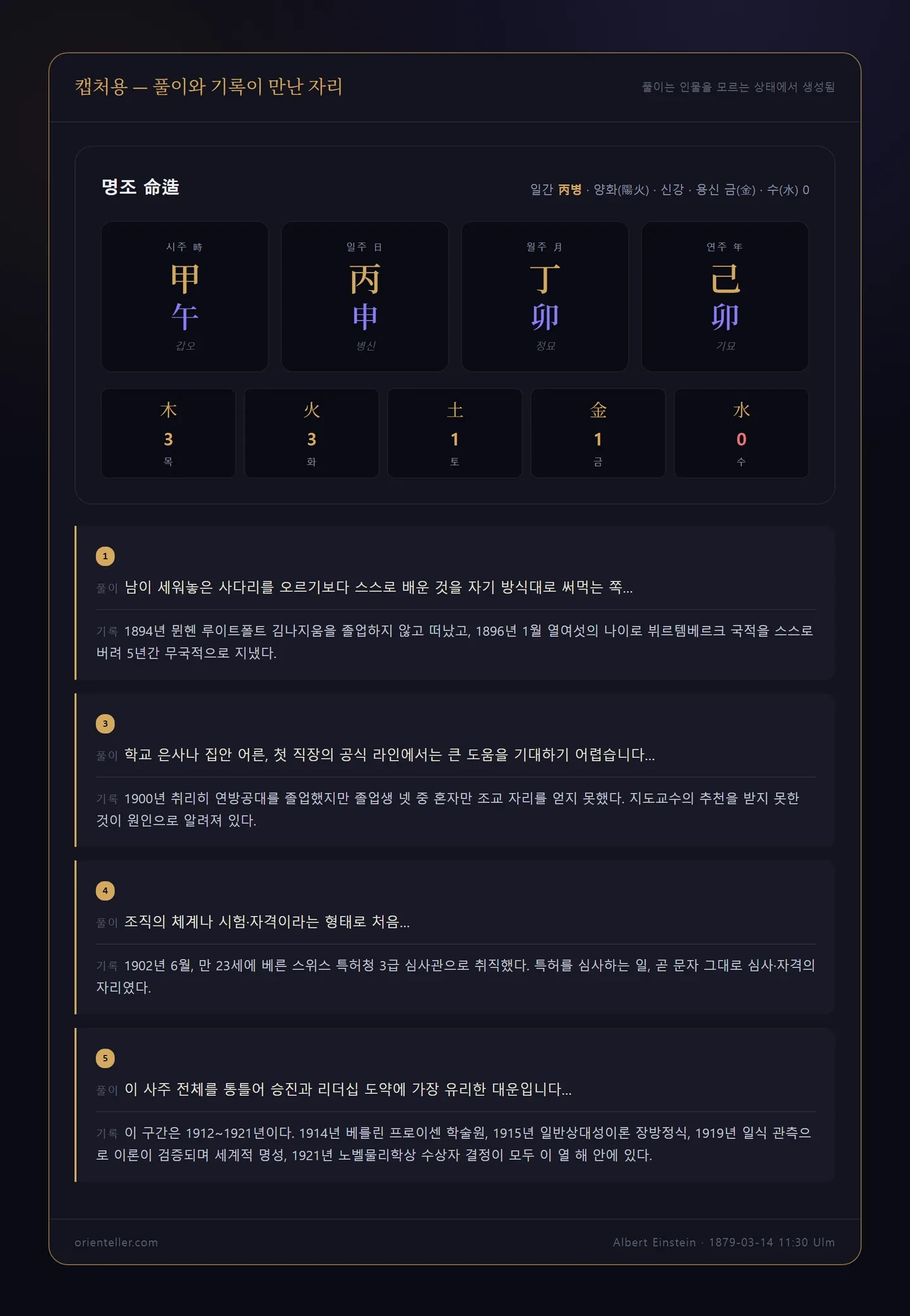
Below is the card that appears at the top of the report once the Saju is confirmed. I wanted it to spark curiosity while also underscoring that this is material with a theoretical foundation.

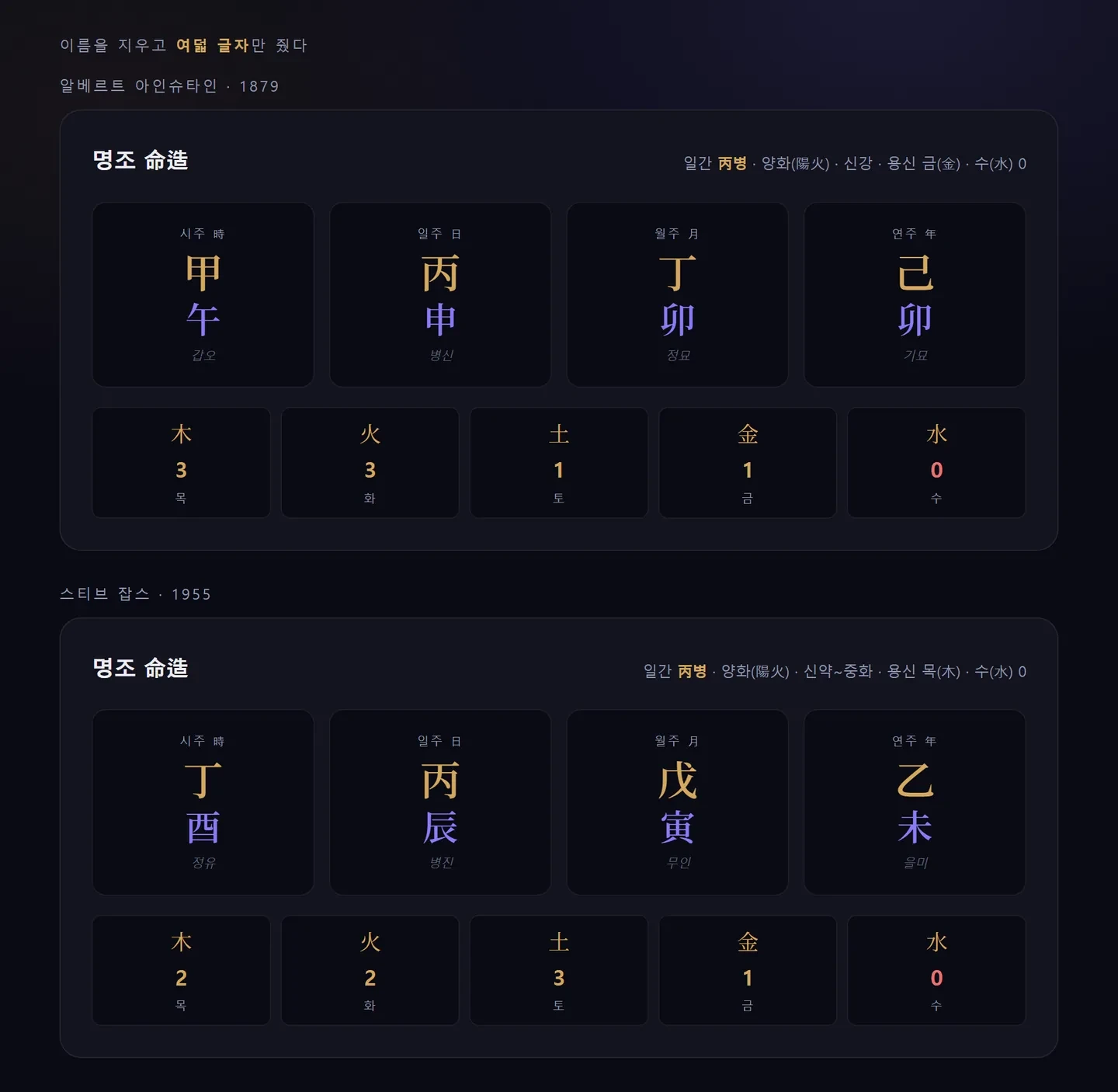
The Myeongjo (命造) in the top left is the Saju itself — the year, month, day, and hour of birth, each written as two characters, eight characters in total. Below it, the five boxes for 木火土金水 (Wood, Fire, Earth, Metal, Water) count how many of each energy appear among those eight characters.
The four boxes below that are the substance. The gray text on top is the AI's reading; the text below is the fact confirmed by the historical record.
Einstein got the same treatment.
In numbers, it looks like this.
| Einstein | Steve Jobs | |
|---|---|---|
| Chart | 己卯 丁卯 丙申 甲午 | 乙未 戊寅 丙辰 丁酉 |
| Reading length | 41,000 characters | 47,000 characters |
| Matching points | 22 | 31 |
| Missed points | 3 | 6 |
There's one reason for listing the misses too. Counting only the hits turns this from evidence into advertising. The misses are left in the report body as well, unblurred.
Where It Matched
The full reading runs past 40,000 characters per person. Here I'll quote just a few passages. The grayed-out parts are the original text; the sharp gold parts are where it lines up with the record.

The middle sentence. The AI wrote that this person has "the power to read documents and extract what matters, and the power to organize complex things and explain them to others."
Einstein was a patent examiner for seven years starting in 1902 — a job spent all day reading patent specifications and judging whether they were genuinely new. He himself said more than once, in retrospect, that the training had sharpened his thinking.
The sentence at the top — "time that looked like drifting may actually have been a process of honing skill." He graduated from university in 1900 and went two years without a permanent position — he was the only one of four graduates not kept on as an assistant. At the end of that stretch, in 1905, he published four papers in a single year, one of them the special theory of relativity.
The reading broken down by ten-year cycles is even sharper.

The stretch the AI called "the most favorable ten-year cycle in this entire chart for promotion and a leap into leadership" maps to 1912–1921 once you attach the years. The Prussian Academy of Sciences in 1914, general relativity in 1915, worldwide fame in 1919 once the eclipse observations confirmed the theory, and the Nobel Prize decision in 1921 — all within that one decade.
Again: the AI didn't know the years. It only knew the age.
Same story for Jobs.

"This person likely built their skill through mentors or methods they discovered on their own, rather than a fixed curriculum" — he dropped out of Reed College after one semester and, unconcerned with credit, sat in only on the calligraphy class. That the class became the Macintosh's typography ten years later is a story he told himself, in his 2005 Stanford commencement address.
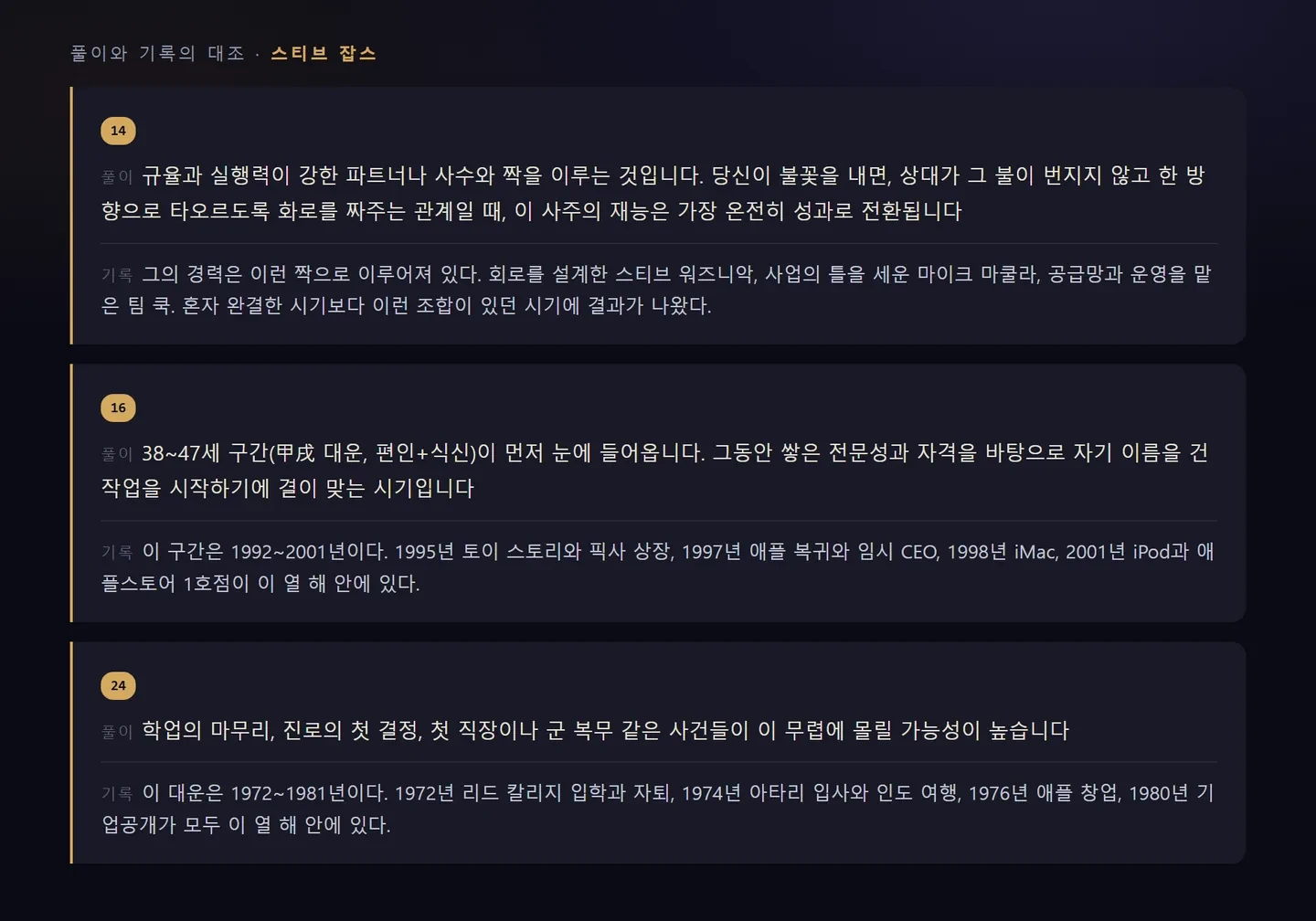
The middle one was, personally, the most striking. "This chart's talent converts most fully into results when paired with a partner strong in discipline and execution." Wozniak designed the circuits, Markkula built the business framework, Tim Cook ran the supply chain. What the output looked like in periods without that combination is also on the record.
It Looked Easy, But There Were Spots That Needed Care
Up to here, it sounds like one click. Point AI at a field overflowing with material and a finished product comes out in half a day.
But something kept tripping me up while building it: spots where the smallest shift in input flips the entire result.
In Saju, the hour is a two-hour block. But what divides that block isn't the clock — it's the sun. Depending on where someone was born and how that region kept time back then, clock time and solar time drift apart. Add daylight saving and a whole hour can shift.
Jobs was exactly that case. The gap between his recorded time and the actual solar time crossed a boundary. Once one pillar changed, everything else flipped in a chain reaction — a relationship read as clashing became a harmonious one, and an auspicious combination appeared where there hadn't been one. The signal came out the exact opposite.
Get one of the eight characters wrong and the reading of the other seven goes wrong with it. I saw that claim proven in the flesh.
And this wasn't the only such spot. Values that shift by era and region, values that slide a year depending on where you set the starting point of the calculation, names that differ from one source to the next. Each one had to be checked and reconciled by hand. Lots of material on the web also meant lots of material that contradicted each other.
So Does It Click Together?
It does. With a condition attached.
Fields with fixed rules are easy to build. The material has piled up and the answers are set, so AI locks onto it well. The speed this series calls "the click" really does show up.
But the more that's true of a field, the more the spots that decide accuracy hide out of sight. Rules being dense means exceptions and boundaries are dense too. On the surface it looks like a single calculation, and the result comes out looking plausible. The problem is that being wrong doesn't show.
So what I actually produced this time wasn't the tool itself — it was a method for checking whether it's right, built alongside it. Pick a case where the answer is already known, read it with the answer hidden, and count the hits and misses together. Without that procedure, the two report cards would have just been plausible-sounding text.
Even if it starts as one line, folding "how do you know it's right" into the request itself — that, for now, is the part a person has to do.
Verifying it with what felt like a fairly solid method left me quite pleased with myself.
What It Can't Do
This isn't prediction. The matching passages were picked out with the life already known. It doesn't mean that, handed these eight characters in 1955, it could have said "this person will found a company, get pushed out, and come back." The report says so directly.
Charts with the same structure are common. A chart heavy on expressive energy and light on disciplinary energy isn't rare, and most people with that chart never founded a company.
Birth records themselves are shaky. Jobs's solar time sits less than ten minutes from the boundary. The slightest inaccuracy in the record shifts the pillar. That's why only records confirmed by birth certificate were used for both people — rated AA (birth certificate / birth registry), the top sourcing grade from Astro-Databank, which archives astrological data. Jobs's time once circulated as 6:00 a.m., back-calculated from a biography, until a birth certificate obtained in 2006 fixed it at 7:15 p.m.
Health, death, and family were left untouched. Even where the calculated result pointed that way, no comparison marker was added. Discussing illness or death through a real person's chart is neither well-founded nor decent.
This material was generated with the same engine actually running at Orienteller. Not everything is shown above, but it can produce fairly detailed results tailored to a wide range of fields and life stages — worth a visit if it sounds interesting.