Those Who Have Not Yet Raised Their Own Banner
The word in my notebook was "Bachelor." I had only known it as the bachelor of a bachelor's degree, but it first meant a young knight who could not yet raise his own banner and fought under someone else's. I traced how it came to mean both an unmarried man and a college graduate, then followed the numbers on how many more people in Korea and the United States are not marrying and how many more hold degrees. Finally I sorted out who is saying what about where to focus as entry-level jobs for graduates shrink after AI, and how solid each claim is. The sixteenth piece in A Page for Today.
I opened my idea notebook today and found a single word written there.
Bachelor (독신남)
At first I tilted my head. To me, a bachelor was the bachelor of a bachelor's degree and nothing else. When I looked it up, though, the first sense in English is a man who has not married. An unmarried woman is a bachelorette. I found it odd that one word could mean both a university diploma and the state of being single, so I decided to trace back what connects the two.
A knight who fought under someone else's banner
The English word bachelor comes from the Old French bacheler. The French records go back to the 11th or 12th century, and the word first appears in English around 1300, when it meant "a young man," and in particular "a knight who is still a novice" (Etymonline). What lies before that is uncertain. Medieval Latin baccalarius is often cited, a word for a farmer who held no land of his own. Some say it comes from vacca (cow), others from baculum (stick), but the first edition of the Oxford English Dictionary marked it "of doubtful origin," and the etymologist Anatoly Liberman still considers it unexplained (OUP Blog).
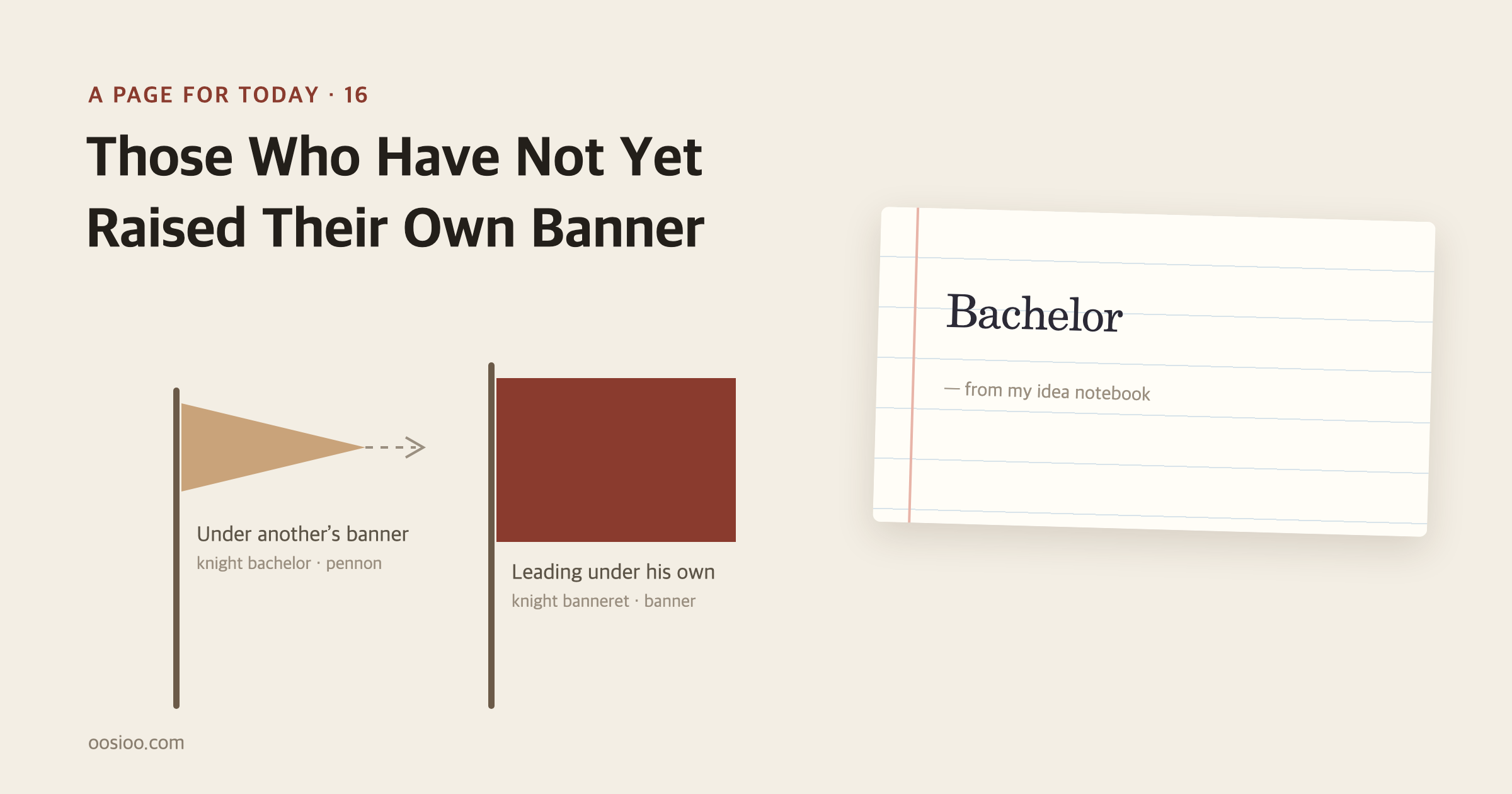
Medieval knights had ranks. A knight with enough wealth and standing to lead his own company carried a square flag, a banner, and was called a knight banneret. A knight below him carried a small pointed triangular flag, a pennon. A knight too young or too poor to lead men of his own, who fought under another knight's banner, was a knight bachelor (Wikipedia: Knight banneret). There is also a story that a knight who distinguished himself in battle had the tail of his pennon cut off to make it square, raising him to banneret. The chronicles disagree on the details of each famous instance, though, so the specifics are not to be trusted.
In the 14th century this sense of "a young man not yet fully his own man" spread in two directions. One was the university. A person who had taken the lowest degree, who had finished study but had not yet become a master, was called a bachelor. I had once heard that baccalaureate, the word for the bachelor's degree, comes from bacca lauri, "laurel berry," but that is a folk etymology attached later because the words look alike (Etymonline: baccalaureate). The other direction was marriage. A young man who had not yet set up a household was called a bachelor. The young Squire in Chaucer's Canterbury Tales is introduced as "a lovyere and a lusty bacheler," and in that line the two senses, apprentice knight and unmarried man, overlap.
So the two meanings that confused me grew from one root. Both described someone still learning under another person's banner. The knighthood survives, too. Britain's Knight Bachelor is the most basic form of knighthood, belonging to no order, and it has been conferred since the 13th century and still is today (Wikipedia: Knight Bachelor).
The word for women came much later. Bachelorette, for an unmarried woman, is first recorded in 1896, and around then people also said bachelor girl (Etymonline: bachelorette). Before that the word was spinster. A 14th-century word for "a woman who spins thread" became the legal term for an unmarried woman in English documents, and in the 18th century it picked up the disparaging sense of a woman past marrying age (Etymonline: spinster). Men were "knights still learning," women were "the ones spinning at home." The same situation was seen through very different eyes. In 2005, England and Wales dropped bachelor and spinster from marriage registers and began writing single.
Korean has a similar grain. In the Standard Korean Language Dictionary, mihon (미혼, 未婚) means "not yet married." That "yet" carries an expectation that it will happen someday. Bihon (비혼, 非婚), "not married," is not in that dictionary; it appears only in the open dictionary Urimalsaem (Urimalsaem). It began to be used in women's groups in the late 1990s, and mentions on blogs and Twitter jumped from a little over 3,000 a year in 2014 to 13,000 in 2015 (Seoul Shinmun). In 2018 the Seoul Foundation of Women and Family took suggestions from citizens and recommended using bihon instead of mihon (Seoul Media Hub). While the word moved from "not yet" to simply "not," people's lives moved the same way.
More people are not marrying
Start with Koreans in their early thirties. In the census, 13.9% of men aged 30 to 34 were unmarried in 1990, about one in seven. By 2020 it was 65.9%, two in three. For women of the same age it rose from 5.3% to 45.9% (Seoul Shinmun 1992, 1conomy News). Households of one grew too. One-person households were 15.5% of all households in 2000 and 36.6%, or 8.24 million, in 2025 (e-Narajipyo). The most common household in Korea now is a person living alone.
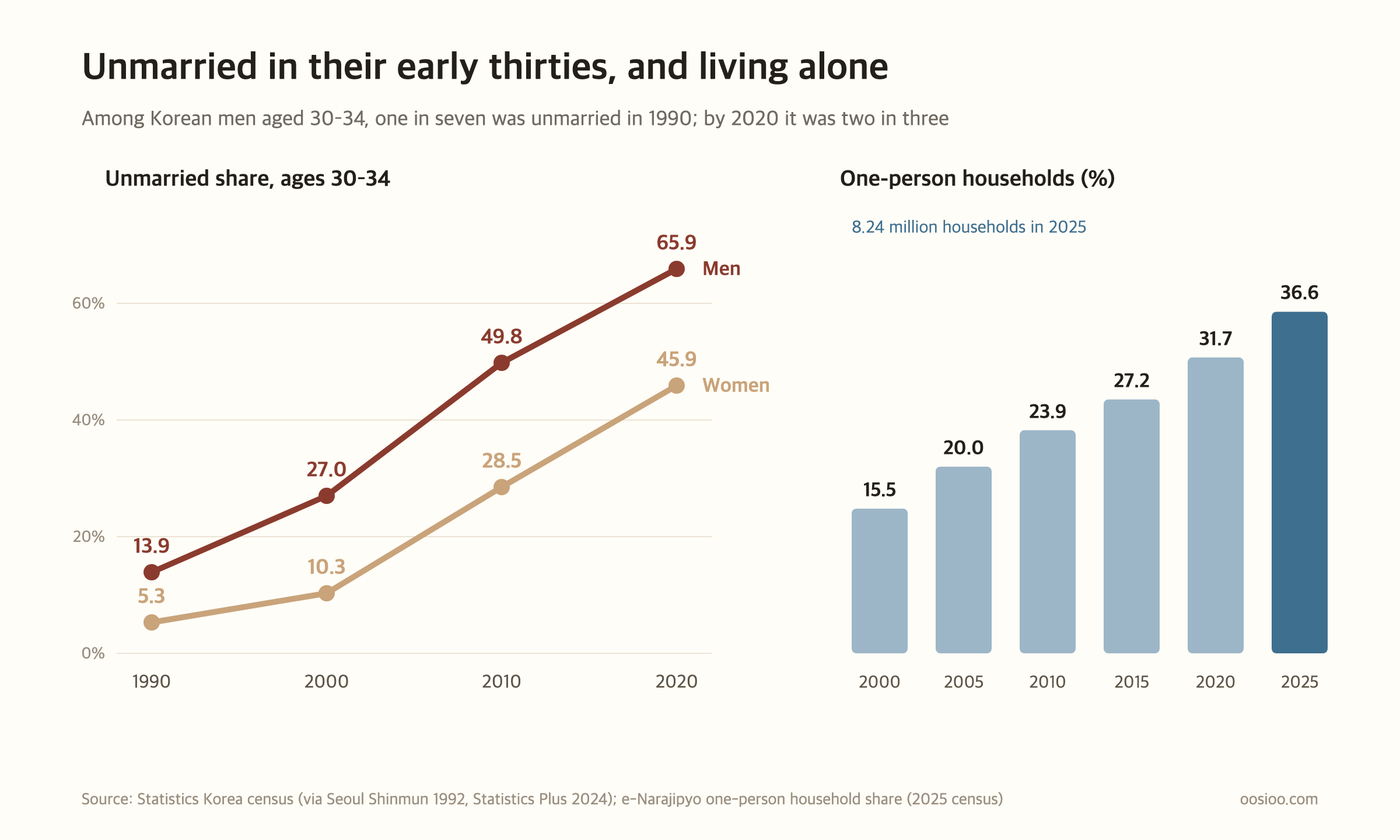
Marriages peaked at 435,000 in 1996 and fell to 192,000 in 2022. Recently they have turned up a little: 222,000 in 2024 and 240,000 in 2025, two years of increase in a row (e-Narajipyo). Attitudes followed a similar curve. In Statistics Korea's Social Survey, 68.0% said in 2008 that one should marry; in 2018 it fell below half for the first time, to 48.1%, and in 2024 it came back up slightly to 52.5%. Among people in their twenties, though, only 39.7% agreed (Financial News).
Other countries are heading the same way. According to the Pew Research Center, in 2021 a record 25% of 40-year-olds in the United States had never married, up from 6% in 1980 (Pew Research Center). In Japan, the share of people who have never married by age 50 was 28.3% for men and 17.8% for women in 2020.
Pew's survey also breaks the numbers down by education. The share of never-married 40-year-olds was 33% among those with a high school diploma or less and 18% among those with a bachelor's degree or more. An analysis by the Korea Institute for Health and Social Affairs likewise found that men with less education and lower income were less likely to marry. Marriage has increasingly become a choice, but the conditions for making that choice are not evenly shared. Here the two meanings of bachelor meet again: degrees and jobs are tied to the threshold of marriage.
More people hold degrees, too
Now to the other bachelor, the degree. In Korea, the share of high school graduates going on to college was 27.2% in 1980 and 33.2% in 1990. It climbed steeply in the 2000s and peaked at 83.8% in 2008. From 2011 it was counted by actual enrollment rather than acceptance, which lowered the figure; in 2024 it was 73.6% (e-Narajipyo). Even under the new definition, more than seven in ten go on to college.
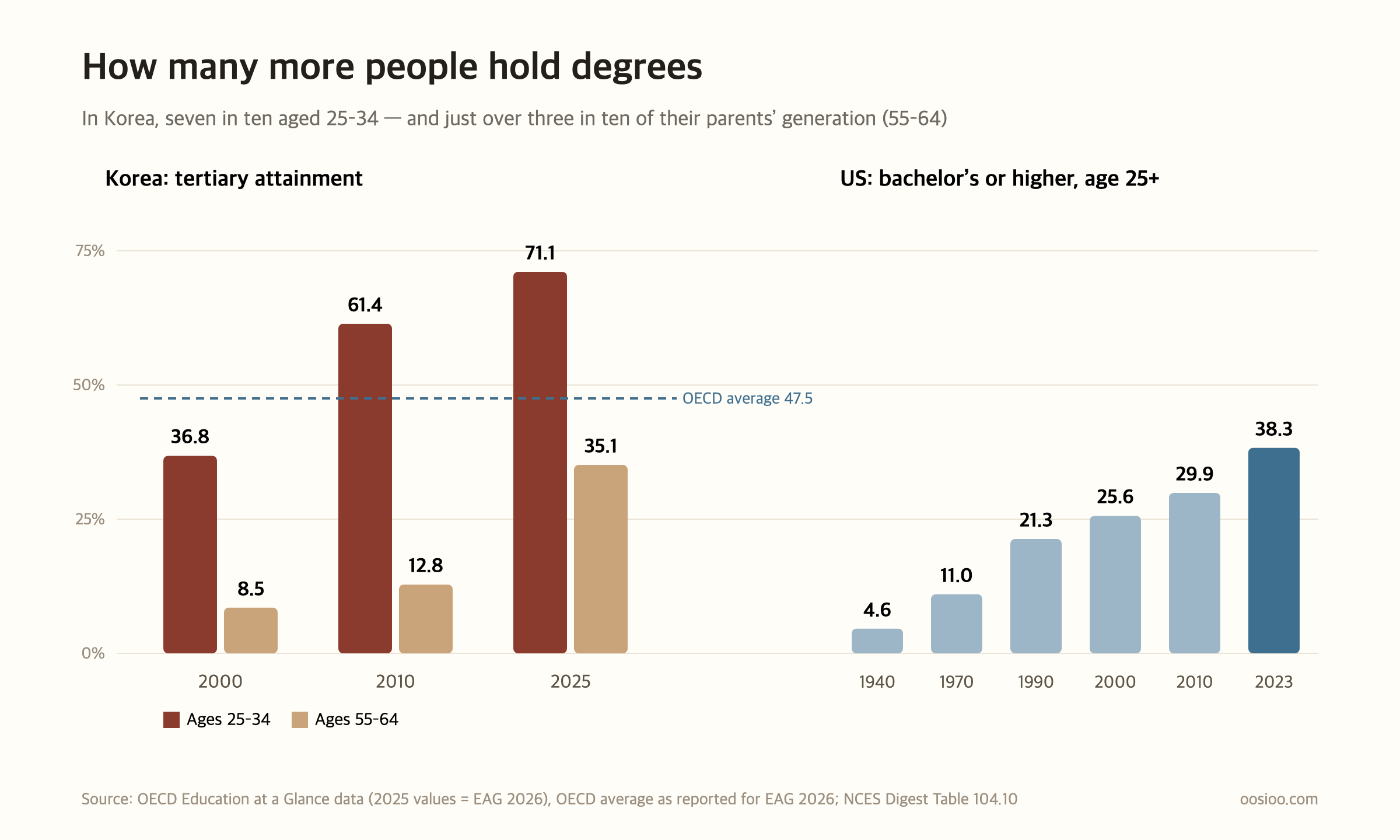
In the OECD's Education at a Glance 2026, 71.1% of Koreans aged 25 to 34 have completed tertiary education, far above the OECD average of 47.5% (Korea Herald). For their parents' generation, aged 55 to 64, it is 35.1%. As recently as 2010 the same comparison was 61.4% to 12.8%, so an education one in eight of the parents received is now held by six or seven in ten of their children. Among 25- to 34-year-olds, women are at 79.7% and men at 63.4%; women pulled ahead around 2010.
The United States grew a great deal too. The share of people 25 and over holding a bachelor's degree or higher was 4.6% in 1940 and 38.3% in 2023 (NCES). Worldwide, tertiary enrollment rose from about 100 million in 2000 to 269 million in 2024 (The PIE News).
When degrees become common, each one is worth less. According to reports citing the OECD's 2026 Economic Survey of Korea, 31% of Korean workers are overqualified, doing work below their level of education, compared with an OECD average of 23% (Hankyung). If the medieval bachelor was a knight not yet able to raise his own banner, today's bachelor is a knight whose banner no longer stands out because so many others are carrying one.
The bottom rung of the ladder is giving way
Then AI arrived. The Federal Reserve Bank of New York regularly reports on college graduates aged 22 to 27. In June 2026 their unemployment rate was 5.7%, above the 4.1% for all workers. The share working in jobs that don't require a degree, the underemployment rate, was 42% (New York Fed). The breakdown by major is more striking. In the 2024 data, unemployment for computer engineering majors was 7.8% and for computer science 7.0%, higher not only than the 4.2% average but than art history (6.7%) or nutrition (4.5%). Fields long called the safest choice have moved toward the top of the unemployment table.
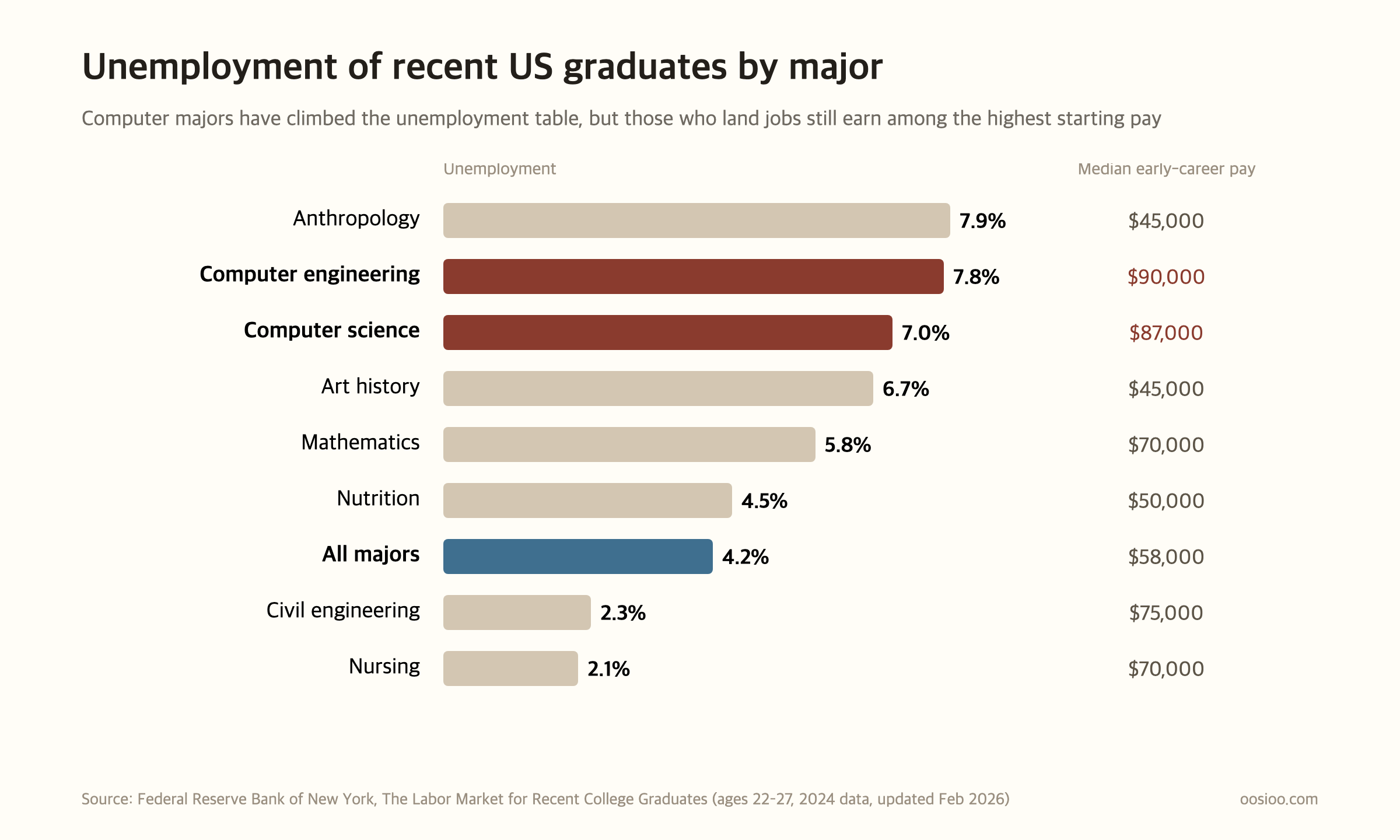
The other columns of the same table matter, though. Computer majors who do land a job still earn among the highest median early-career salaries, $87,000 to $90,000, and their underemployment is low, under 20%. People of the same age without a degree have an unemployment rate of 7.2%, higher than graduates, and median pay is $60,000 for a bachelor's versus $40,000 for high school. It is still a good place to be once you get in. The entrance has narrowed.
The reason most often given for the narrowing is AI. Erik Brynjolfsson's team at Stanford's Digital Economy Lab examined it with data from ADP, the largest US payroll processor. In the August 2026 revision of their paper, employment of 22- to 25-year-olds in occupations highly exposed to AI is 19% below where it would be had it kept pace with less-exposed occupations. No comparable gap shows up among experienced workers (Stanford Digital Economy Lab). The team titled the paper "Canaries in the Coal Mine": like the bird that senses poison gas first, the youngest workers feel the change first.
Korea shows the same picture. According to a Bank of Korea report from August 2026, the number of employed people aged 15 to 29 fell by 285,000 between June 2022 and June 2026, and 94.0% of that decline came in industries highly exposed to AI. Over the same period, employment of people in their fifties rose by 230,000. Youth employment in computer programming and systems integration fell 16.6%. The unemployment rate of young people with a four-year degree or more averaged 7.0%, higher than the 5.4% for those with a two-year degree or less (Etoday). A reversal has set in where those who stayed in school longer have a harder time finding work. In an analysis by the Korea Labor Institute, the share of software developer job postings seeking new graduates fell from 53.5% in 2022 to 37.4% in 2024. According to the JoongAng Ilbo, the employment rate of graduates of Seoul National University's computer science department fell from 83.8% in 2023 to 72.6% in 2025, and Hanyang University's from 81.4% to 70.3% (JoongAng Ilbo).
Students are already changing course. In the Computing Research Association's survey, new enrollment in computing bachelor's programs fell 12.9% in 2025 (CRA Taulbee). The National Student Clearinghouse counted 8.4% fewer undergraduate computer science majors in spring 2026, about 53,000 (NSC). In Korea, mock applications for the 2026 regular admission round to computer and software programs at five universities fell 20.6%, while applications to semiconductor contract departments rose 50.8% (Segye Ilbo).
What is everyone telling us to watch?
People offer all kinds of prescriptions for this. When I gathered up what they say, it fell into five broad strands. I noted who said it and what it rests on.
| Strand | Main voices | What they say | Kind of evidence |
|---|---|---|---|
| The broken ladder | Aneesh Raman of LinkedIn, the Bank of Korea | AI is taking the work new hires used to do, so the first rung of a career is disappearing | Job postings and employment data. The trend is solid; the part about AI being the cause is middling |
| Hands-on trades | Geoffrey Hinton, Jensen Huang | Work done with the hands, plumbers and electricians, will hold up longer | Expert forecasts, not data |
| AI plus a domain | Andrew Ng, Tobi Lütke of Shopify | Don't give up coding; pair the ability to use AI with knowledge of another field | Field experience and company policy |
| Degrees are useless | Palantir's hiring of high school graduates, and others | College is no longer a reliable training ground | A few company cases |
| Caution | Yale Budget Lab, EIG | AI's effect is not yet clear across the economy; rate hikes are a bigger cause | Macroeconomic statistical analysis |
The first strand is the one heard most. In a 2025 New York Times essay, LinkedIn's Aneesh Raman wrote that the bottom rung of the career ladder is breaking: AI is taking the simple coding and debugging junior developers used to do, and entry-level work in law and retail. The Bank of Korea report likewise found that AI has sped up a shift already under way toward year-round hiring of experienced workers, and proposed redesigning the career ladder. A Harvard study of 65 million résumés found that junior employment at firms adopting generative AI fell about 9% six quarters later. It happened through hiring fewer people, not through layoffs.
The second strand comes from the people who built AI. Geoffrey Hinton, often called a godfather of deep learning, said on a 2025 podcast, in effect, that AI will take over ordinary intellectual labor and that, since physical manipulation will take longer, becoming a plumber might be a good bet. Nvidia's Jensen Huang said building data centers will require hundreds of thousands of electricians, plumbers and carpenters (Fortune). Both are worth hearing, but they are forecasts, not data. It is also worth remembering that Huang stands to gain the more data centers get built.
The third strand comes from the opposite direction. Andrew Ng has called "don't learn to code" some of the worst career advice ever given. As coding gets easier, more people should code, and people who know another field deeply get better results out of AI. In a 2025 internal memo, Shopify's Tobi Lütke told teams that before asking for more headcount they must show why they cannot get the work done with AI (TechCrunch). Read from the side of someone trying to get in, it says: show us what a person using AI does that AI alone does not.
The fourth strand is loud but has the thinnest evidence. Palantir's fellowship hiring high school graduates instead of college graduates drew attention, but it took 22 people (Fortune). As we saw, in the United States graduates still have lower unemployment and higher pay than non-graduates. Korea is different: young graduates already have higher unemployment. It is hard to cover both countries with the single sentence "college is useless."
The fifth strand pours cold water. In two analyses, in October 2025 and May 2026, the Yale Budget Lab found no clear change in the US labor market as a whole that could be attributed to AI, with the caveat that "this could change quickly" (Yale Budget Lab). A paper published by the Economic Innovation Group named the sharpest interest-rate tightening in four decades as the most plausible reason entry-level jobs shrank (EIG). Oxford Economics pointed to "AI washing," companies dressing up ordinary layoffs as the work of AI (Fortune). Indeed, the New York Fed data show that graduate unemployment rose above the overall rate in early 2021, before ChatGPT came out.
Laid side by side, the five strands seem to argue with one another but they overlap. Even the cautious camp says only that the effect is still small across the economy as a whole; most agree that a gap is opening in the first jobs of the youngest workers. The sentence most people would accept right now is something like this: AI has not yet shaken employment as a whole, but it is already shaking the bottom rung of the ladder.
They overlap in one more way. None of the prescriptions include the ability to carry out instructions precisely, because that is what AI does best. Instead, the same things keep coming up in almost all of them: an eye for what the real problem is, a willingness to answer for the result, the ability to work things out among people, a feel for handling a physical site with hands and body, and the judgment that comes from knowing one field deeply. The Bank of Korea report, too, said senior workers hold up in the AI era because of tacit knowledge such as understanding the context of the work, interpersonal skills and managing an organization.
The years of learning under a banner
Let me go back to the medieval knight bachelor. The young knight fought under someone else's banner not only because he lacked skill. That position was where he learned. Beside senior knights he learned to handle horses, to keep his weapons in order, and to feel in his body when to advance and when to pull back on the field. If he distinguished himself, the tail of his pennon was cut and it became square.
That position is exactly what is giving way now. The simple tasks new employees used to handle were in fact a channel for learning the job. You learned how a company runs by writing up meeting notes, and you learned the structure of a large codebase by fixing small bugs. When AI takes that work, companies save money now, but the places that would grow the experts of ten years from now disappear too. That is why AWS's Matt Garman called the idea of replacing junior staff with AI "the dumbest thing I've ever heard" (TechRadar).
Even so, I am not pessimistic. Even as the times change, I believe that if the abilities only people have are good enough, a way through can be found, however hard it is. If places under a banner are shrinking, one option is to raise a small banner of your own first. Pick up a problem you chose rather than an assignment someone gave you, put AI to work as much as you like, and see it through to the end. Along the way you grow an eye for what the real problem is and the habit of answering for the result under your own name, the very abilities the prescriptions above all pointed to. Work that used to be handed out only after several years on the job can now be tried alone. AI has narrowed one door, but it has left another open.
Back at the notebook
When I first saw the word in my notebook, I read bachelor as nothing more than a diploma. Tracing it back, I found it had pointed from the start to "someone who has not yet raised a banner of their own but will one day." Within that word, people who have not married and people who have just received a degree are both still on their way.
News that the employment rate of computer science graduates dropped more than 10 percentage points in a few years must land heavily on the young people who chose that major. They took the path everyone called safest, and it suddenly narrowed. But following the numbers this time, what narrowed was the entrance to the path. The value of the work at the end of it was still high. When an entrance narrows, people look for a way around, and on the way around some find another door that suits them.
So I hope the young people standing without a banner right now don't wander for too long. I hope they look first at what makes them lose track of time, rather than at a map others drew for them, find that direction quickly, and build their own happiness on top of it. The day the tail of the pennon is cut square may be closer than they think.
A Page for Today starts that way, from a single line in my notebook, and arrives at one page of today's thoughts.