Afternoons Are Sleepy Even Without Lunch
The line in my notebook read, "how to get through the afternoon when sleep comes crashing down after lunch." I trace experiments showing that the afternoon slump arrives even when lunch is skipped and that eating only piles on top of it, check the truth behind folk theories like turkey and blood flow, weigh ten-minute naps against coffee naps, and note the warnings around long or frequent napping. I also look at how a car's eyes catch drowsiness and build my own drowsiness mirror that reads eyelids through a webcam and sounds a warning. The eighth piece in A Page for Today.
I opened my notebook of ideas today and found this sentence written down.
How to get through the afternoon when sleep comes crashing down after lunch
Everyone has felt it. In a two o'clock meeting room, the speaker's voice grows distant and your head drops, just once. People call this post-meal drowsiness and blame it on eating too much, on carbohydrates, or on blood pooling in the stomach. But is lunch really the cause? Why doesn't breakfast or dinner leave us this drowsy?
Today I'll trace this question through the research literature, study by study. Then I'll look at studies that tested ways to fight off drowsiness, and weigh whether it's better to give in and sleep or to push through. Finally, I'll look at how cars try to notice drowsiness before the driver does, and borrow that same principle to build a small tool that reads eyelids through a webcam.
The Afternoon Comes Even If You Skip Lunch
In 1992, sleep researchers Mary Carskadon and William Dement brought sixteen people into the lab — three groups: children around ten, teenagers around sixteen, and adults over sixty. Every two hours they were put to bed and timed on how many minutes it took to fall asleep. The key was the meals: to erase "lunch" as an event during the study, participants ate the same small amount every hour instead.
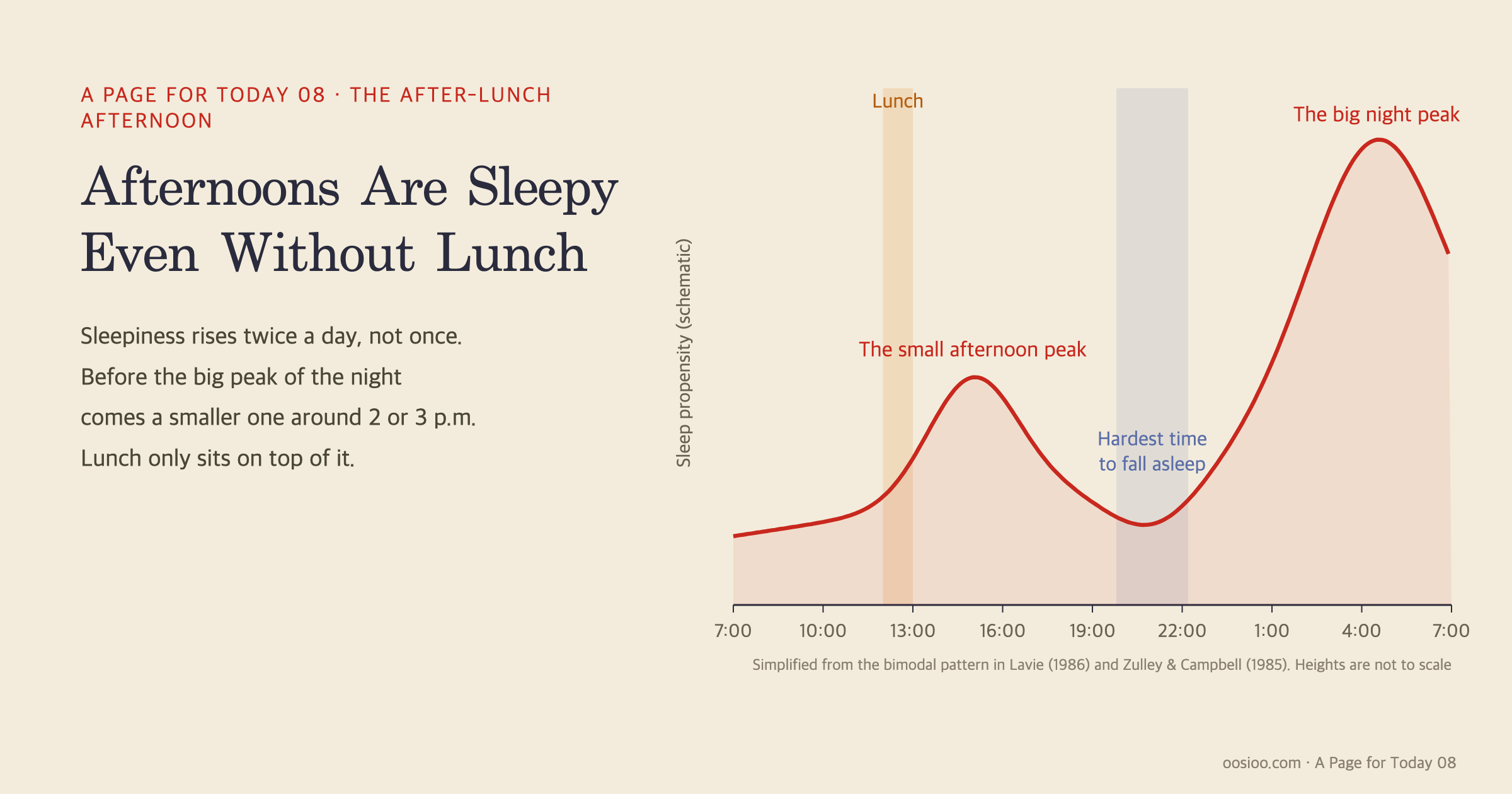
Even so, the teenagers and older adults fell asleep faster in the middle of the day. The authors' opening line noted that the name "post-lunch dip" might be "perhaps a misnomer." The dip comes even without lunch.
Israel's Peretz Lavie ran an even more relentless experiment in 1986. Subjects stayed awake for thirteen minutes, then were given seven minutes to try to fall asleep, repeated around the clock for up to thirty-six hours. Plotting how easily they fell asleep every twenty minutes revealed not one daily peak but two: a large one before dawn and a smaller one in the middle of the afternoon. Between them, around eight to ten at night, came a valley where falling asleep was hardest of all. Lavie called this window the sleep "forbidden zone." In a study that let people nap freely in an isolation chamber with no clock and no outside light (Zulley & Campbell, 1985), naps clustered around roughly the midpoint of the waking day as well.
Why is eight at night — the point furthest from when we woke up — less drowsy than the afternoon? Sleep research's long-standing "two-process model" answers this.
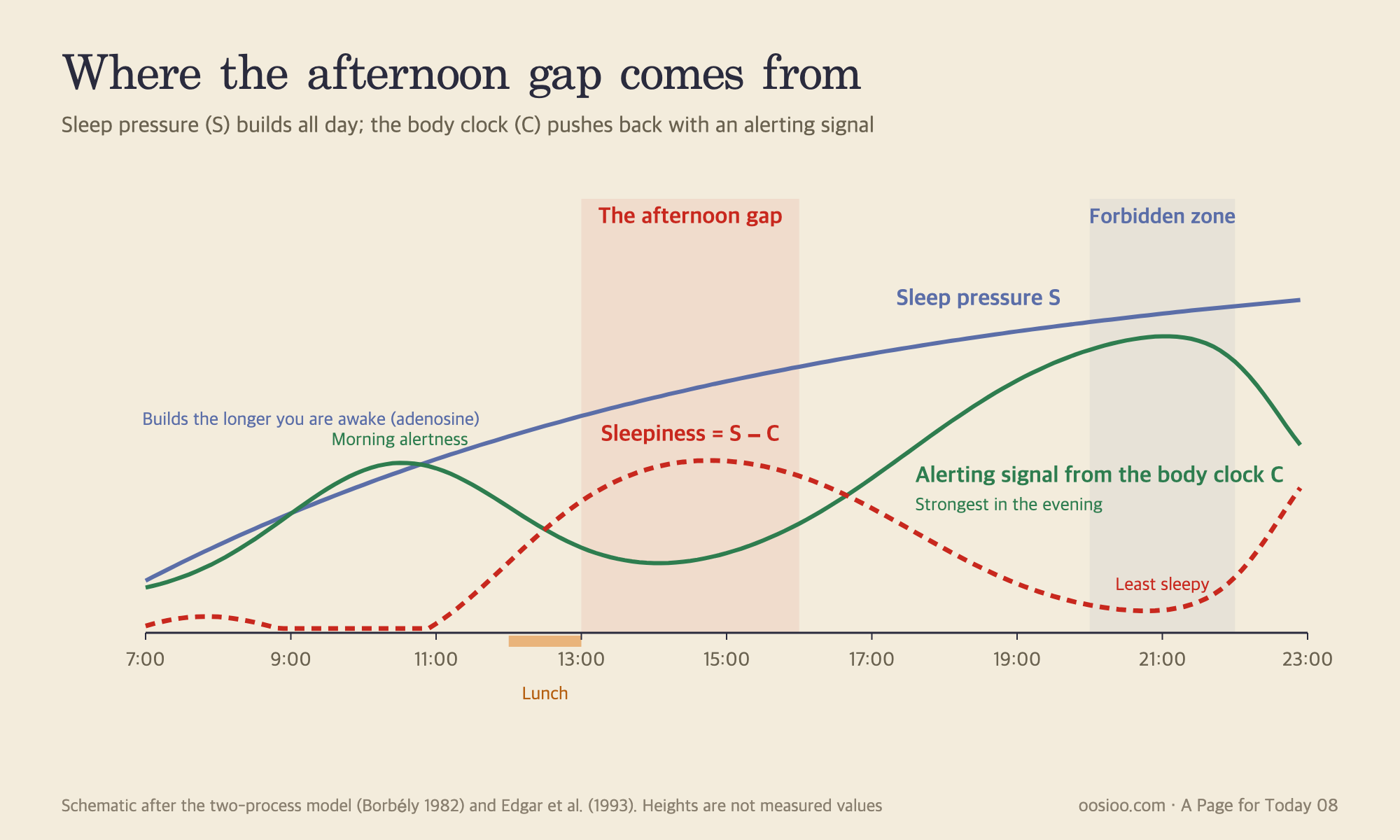
While we're awake, sleep pressure accumulates in the brain. Catheters placed in cats' brains showed that adenosine rose the longer they stayed awake, and fell slowly once they slept (Porkka-Heiskanen et al., 1997). Coffee keeps sleep at bay because caffeine blocks these adenosine receptors. On the other side, the brain's internal clock, the suprachiasmatic nucleus, sends out a wake signal on a daily cycle. When the suprachiasmatic nucleus was removed in squirrel monkeys, their longest single stretch of daytime wakefulness dropped from an average of 223 minutes to just 15 (Edgar et al., 1993). The body clock isn't so much a device that summons sleep as one that keeps us awake against the rising tide of sleep pressure.
Overlay these two forces and the afternoon gap appears. After waking in the morning, sleep pressure climbs steadily, while the clock's wake signal doesn't peak until late afternoon into evening. In between, in the early afternoon, pressure has built up considerably but the wake signal hasn't yet caught up, so the balance briefly tips toward drowsiness. No single experiment proves this sentence outright — it's an interpretation woven from many studies — but for now it's the most plausible explanation we have.
The same pattern shows up on the road. When Britain's Jim Horne and Louise Reyner gathered 679 drowsy-driving crashes from police records and field interviews, peaks appeared around 2 a.m., 6 a.m., and 4 p.m. (1995). Among 4,333 drowsy-driving crashes in North Carolina, accidents clustered in the same two windows — the middle of the night and around 3 p.m. (Pack et al., 1995). In South Korea, the Korea Road Traffic Authority analyzed 1,833 spring drowsy-driving crashes from 2019–2021 and found that drivers fifty and older crashed most often between 2 and 6 p.m. (28.8%). Drivers in their twenties crashed most at dawn, and those in their thirties and forties late at night — so the afternoon peak isn't identical across every age group. In this analysis, drowsy-driving crashes caused 2.6 deaths per hundred incidents, nearly double the rate for crashes overall (1.4).
Even So, Eating Does Make the Drowsiness Worse
If lunch isn't the cause, does eating matter at all? Not quite. In 1997, William Orr's team in Oklahoma compared a day when people ate solid food at a set time against a day when they drank only an equivalent amount of water. On the day they ate, people fell asleep faster. The following year, the same team compared a "sham meal" — chewing and spitting food out — against actually swallowing it, and the group that swallowed fell asleep faster for a while afterward. Tasting and chewing alone weren't enough; something had to actually reach the stomach for the drowsiness to follow.
Portion size clearly matters. In 2012, a team led by Reyner at Loughborough University in the UK cut twelve young male drivers' prior night's sleep to five hours, then fed them either a light 305 kcal lunch or a heavy 922 kcal lunch before two hours on a monotonous driving simulator. On the heavy-lunch day, they drifted out of their lane more often, and drowsiness signals in their brainwaves were more pronounced. The two lunches made no difference for the first thirty-some minutes, though; the gap opened up only afterward. The paper's introduction itself notes that the afternoon dip is a twice-daily phenomenon "largely independent of lunch," worsened by a short night's sleep beforehand.
Putting it together: the afternoon dip comes from the body clock. Eating sits on top of it and makes it worse, and the more you eat, the worse it gets. Both effects grow if you slept too little the night before. Lunch feels uniquely drowsy mainly because it happens to land right in the time of day we're most prone to sleepiness anyway. The same studies found that a meal eaten at five in the evening also increased drowsiness, so post-meal sleepiness isn't unique to lunch. It's just that dinner falls near the "forbidden zone" where the wake signal is strongest, masking the effect, while lunch overlaps with the afternoon valley, amplifying it. There's also a lot of individual variation — in one 1983 experiment, only five of fifteen people actually fell asleep faster after eating.
Turkey, Blood Flow, and Carbohydrates
Several famous explanations trail behind post-meal drowsiness. Here's what the research says about each.
| Common explanation | What the research says |
|---|---|
| Tryptophan in turkey makes you sleepy | USDA food composition data show turkey breast's tryptophan content (0.29–0.36g per 100g) is similar to chicken breast (0.36g) or cheddar cheese (0.32g). A protein-heavy meal, moreover, actually reduces the share of tryptophan that reaches the brain |
| Blood pools in the stomach, starving the brain | Brain blood flow is preferentially preserved even when blood rushes to the muscles, as during exercise. There's little evidence that brain blood flow drops after eating and causes drowsiness |
| A carb-heavy (high-GI) lunch is the culprit | The evidence is mixed. Some studies find no difference based on fat versus carbohydrate composition (Orr et al. 1997, Wells et al. 1998), while others found more of a slump after a high-fat lunch (Wells et al. 1995). What's clear is that quantity matters more than composition |
| Eating lunch itself causes the drowsiness | Only half true. The dip comes even without lunch (Carskadon & Dement, 1992), and eating simply amplifies it (Reyner et al., 2012) |
The tryptophan story isn't entirely wrong. Eating 120g of carbohydrates raises blood tryptophan's share relative to other large amino acids competing with it by 20–34%, while a fat- and protein-heavy meal lowers it by 45% (Lyons & Truswell, 1988). A higher ratio is thought to let the brain produce more serotonin. But that's a blood-marker story, and how much it actually explains afternoon drowsiness remains unknown. Eating a protein-rich food like turkey, in fact, lowers this ratio.
A more plausible link on the brain side is orexin. Orexin-producing neurons are the cells that keep us awake; when they die off, narcolepsy results. In 2006, Denis Burdakov's team showed that these cells are suppressed by glucose — sensitively enough to respond even to the small blood-sugar swings between meals. When hungry, orexin keeps us awake; after eating, that signal eases. But a 2011 follow-up from the same team found that amino acids actually woke these orexin cells back up, and weakened glucose's suppressive effect when present. This is where the idea comes from that a meal paired with protein might leave you less drowsy — though this was in mice, not confirmed in humans.
Fruit flies sleep after eating too. In a 2016 study published in eLife, flies slept a bit more right after a meal, and that extra sleep scaled with how much they ate, and with protein and salt content — but had nothing to do with sugar. The species gap means this can't be mapped directly onto humans, but it suggests post-meal drowsiness is a deeply conserved response across animals.
How to Push Through, How to Nap
Back to the sentence in my notebook: how do you get through the afternoon?
The most reliable remedy is a short nap. In 2006, Amy Brooks and Leon Lack at Flinders University in Australia gave twenty-four young adults who'd slept only five hours the night before a chance to nap at 3 p.m. for 0, 5, 10, 20, or 30 minutes, then tracked them for three hours after waking.
| Nap length | After waking |
|---|---|
| 5 minutes | Nearly identical to not napping |
| 10 minutes | Sleepiness, fatigue, vigor, and cognitive performance improve immediately, lasting up to 155 minutes for some |
| 20 minutes | Benefits appear about 35 minutes later |
| 30 minutes | A groggy spell right after waking, followed by improvement later |
The grogginess right after a thirty-minute nap is called sleep inertia. After dropping into deep sleep, the brain takes time to restart. It usually clears within thirty minutes, but that's a problem if you have to give a presentation the moment you wake. Naps of thirty or ninety seconds showed no effect at all (Tietzel & Lack, 2002). Still, "under twenty minutes" isn't an ironclad rule — some reviews note that even a short nap can tip into deep sleep depending on how little you slept the night before and what time it is.
NASA tested this in the cockpit. In a 1994 report, twelve of twenty-one long-haul international pilots were each given a chance to rest for forty minutes during cruise, one at a time. They actually fell asleep in 93% of those chances, nodding off in an average of 5.6 minutes and sleeping for 26 minutes. In the final ninety minutes before landing, brief sleep signals caught in brainwaves and eye movements averaged 2.90 per pilot among those who'd rested, versus 6.37 among those who hadn't. Among the group that hadn't rested, four pilots nodded off a combined five times even though they'd been told to work as usual. Yet the pilots' own sense of how alert they felt was about the same between the two groups — the effect of napping is something people often can't judge for themselves. The often-cited figures of "34% better performance, 54% better alertness" could not actually be found in the original report.
There's also the trick of combining caffeine with a nap. Drink coffee and immediately take a short nap, and by the time you wake, the caffeine has had time to kick in. In 1997, Horne and Reyner put twelve drowsy drivers through two hours on a simulator. Compared with a placebo, dangerous incidents like lane departures dropped to 34% with caffeine alone, and to 9% with caffeine plus a nap combined. Japan's Mitsuo Hayashi and colleagues compared a twenty-minute nap combined with caffeine, bright light, and face-washing in 2003; the caffeine-plus-nap combination worked best, while face-washing was weak and short-lived.
There are also ways to push through without sleeping at all. Thirty minutes of natural light by a window right after lunch reduced afternoon drowsiness (Kaida et al., 2006). A similar result came from shining 1,000-lux bright light on sleep-deprived people. Walking for five minutes every hour improved fatigue and mood by the end of the day (Bergouignan et al., 2016). Chewing gum eased pupil-based drowsiness markers, though people's own sense of alertness stayed unchanged.
Behind the wheel, the story changes. In 1998, Horne and Reyner had sleep-restricted drivers try cold air or the radio, and neither meaningfully reduced dangerous incidents. The authors concluded these were, at best, stopgaps to get a driver to the next rest stop. Drowsiness is often compared to alcohol: after seventeen to nineteen hours awake, some measures of performance were as bad as or worse than a 0.05% blood alcohol level (Williamson & Feyer, 2000). The AAA Foundation for Traffic Safety analyzed roughly 700 real driving videos and estimated that drowsiness was a factor in 9.5% of crashes (2018) — about eight times higher than official statistics suggest.
Is It Better to Sleep, or to Push Through?
So far, napping looks like a clear good. But long-term epidemiological studies show another side.
Start with the good news. In a study following 23,681 Greek adults for an average of over six years, people who napped regularly had a 37% lower risk of dying from coronary heart disease (Naska et al., 2007). A study of 3,462 residents of Lausanne, Switzerland, followed for over five years found that people who napped once or twice a week had roughly half the risk of cardiovascular events (Häusler et al., 2019). A UK Biobank study using genetic variants to analyze nap tendency linked it to slightly larger brain volume (Paz et al., 2023).
There's a darker side too. A meta-analysis pooling eleven cohorts with over 150,000 people found that napping sixty minutes or more a day was associated with a 1.82 times higher risk of cardiovascular disease and a 1.27 times higher risk of death compared with not napping (Yamada et al., 2015). Under sixty minutes showed no difference, and the risk curve was J-shaped: dipping slightly below thirty minutes, then climbing sharply from around forty-five minutes on. A study of 3,275 adults in Murcia, Spain, found that siestas longer than thirty minutes co-occurred with obesity and metabolic syndrome, while naps of thirty minutes or less were actually linked to a lower risk of high blood pressure (Vizmanos et al., 2023). An analysis of over 350,000 people in the UK Biobank reported that habitual nappers had 1.12 times more hypertension and 1.24 times more stroke (Yang et al., 2022).
When looking at these numbers, the direction of the arrow needs care. People who are already unwell may nap more often, and for longer. In a study tracking 1,401 older adults with wrist actigraphy for up to fourteen years, the pace at which napping increased more than doubled as Alzheimer's disease progressed (Li et al., 2023). Whether long naps bring on illness, or illness brings on long naps, is hard to untangle through observation alone. It's telling that two studies using the same UK Biobank data and the same method reached opposite conclusions — one favorable to the brain, one unfavorable to blood pressure.
The right prescription can also flip depending on the goal. In 2003, a Harvard team led by Sara Mednick reported that a 60–90 minute nap passing through both deep and dream sleep improved visual learning about as much as a full eight hours of nighttime sleep. For chasing off drowsiness, 10–20 minutes is best; but for cementing what you've just learned, a longer nap may actually be the better call.
Grouped by situation, the research roughly says this.
| Situation | What to do |
|---|---|
| Drowsy while driving | Pull over, no exceptions. If possible, drink coffee and nap for 15–20 minutes. Cold air and the radio barely help |
| Short on sleep the night before, drowsy in the afternoon | Nap for 10–20 minutes in the early afternoon. The US CDC's own educational materials recommend under 20 minutes |
| A presentation right after waking | Skip the nap, or keep it under 10 minutes. Instead, get light by a window and walk for 5 minutes |
| Late afternoon or evening | Avoid napping if you can — it disrupts nighttime sleep |
| Habitually napping over 45 minutes | Try cutting back — though this may be a symptom more than a cause |
| Naps growing longer with age | Treat it as a signal from the body worth checking with a doctor, rather than blaming the nap itself |
| Living with insomnia | Don't nap. Cognitive behavioral therapy for insomnia works by cutting naps to build up nighttime sleep pressure |
South Korea tried this too. In August 2014, the Seoul Metropolitan Government let employees who requested it nap for thirty minutes to an hour between 1 and 6 p.m. — the first such policy among any central or local government body — on condition that the nap time be made up by working longer in the morning or evening. How widely it was actually used couldn't be confirmed.
The Car That Notices Drowsiness First
In an office, nodding off and lifting your head again is harmless enough, but in the driver's seat, two seconds is a long time. So cars have long worked to notice drowsiness before the driver does. The methods fall into roughly three categories.
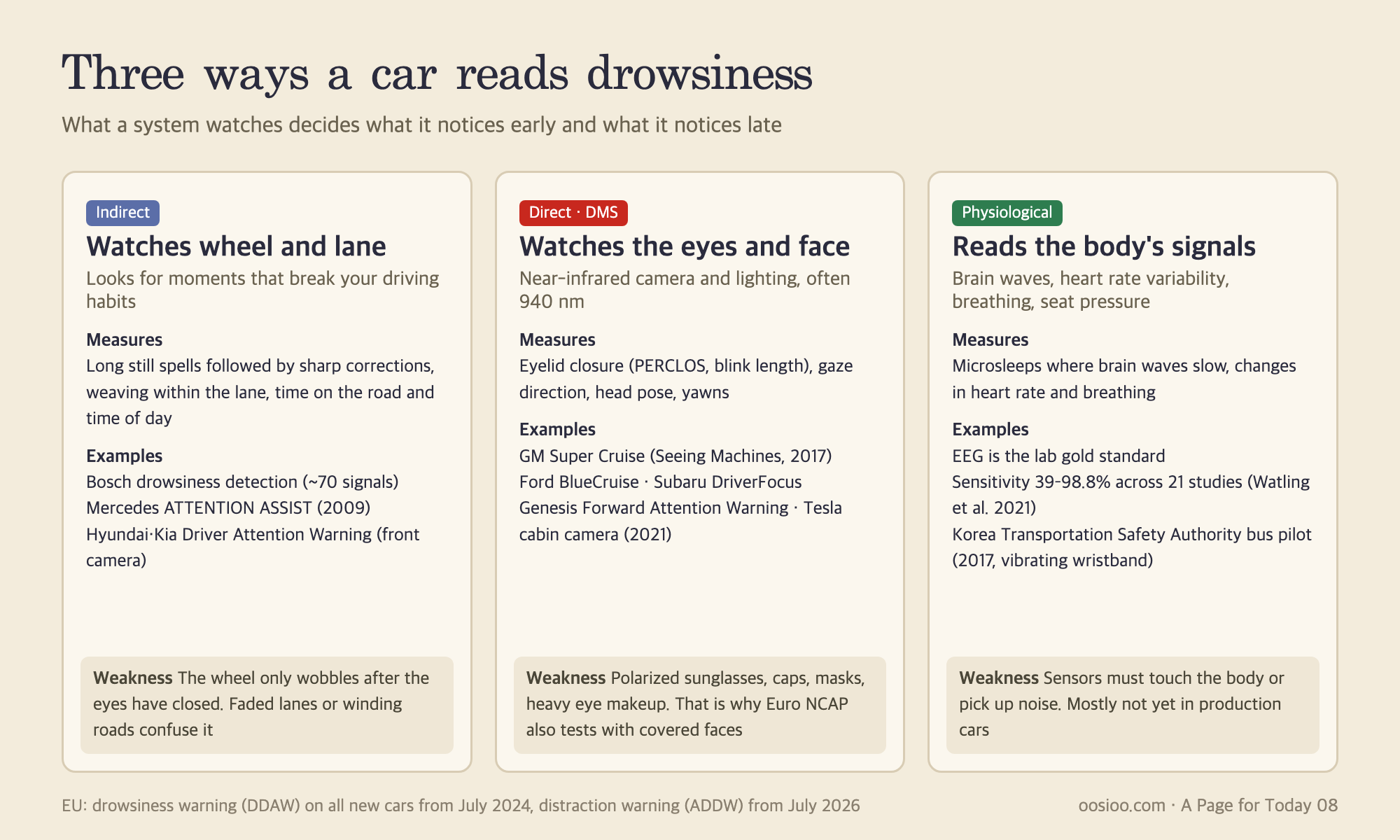
Inferring from the steering wheel. A drowsy driver tends to leave the wheel almost motionless for a stretch, then jerk it with a small, quick correction. Bosch's drowsiness detection uses the steering-angle sensor to spot this pattern. Once a drive begins, it learns that driver's usual steering habits, weighs around seventy signals together, and flashes a coffee-cup icon on the dashboard when behavior strays from the baseline. Mercedes-Benz introduced Attention Assist in 2009, measuring more than seventy variables between 60 and 200 km/h and re-establishing the driver's baseline anew in the first few minutes of every drive. Hyundai/Kia's Driver Attention Warning (DAW), despite its name, doesn't film the driver at all — it watches how the car wanders within its lane via a forward camera on the windshield and infers alertness from that. Its manual accordingly warns that it may not work properly on roads where lane markings are faded or missing.
Watching the eyes directly. Driver monitoring systems (DMS) place a small camera on the steering column or above the dashboard to film the face, usually paired with near-infrared lighting invisible to the human eye. The 940nm wavelength is popular, since atmospheric moisture absorbs sunlight at that wavelength, reducing daytime interference, and it appears less red to the eye than 850nm. Ordinary sunglasses often block visible light but let near-infrared through, so the eyes remain visible. GM's Super Cruise (announced in 2017, launched in the 2018 Cadillac CT6) uses Seeing Machines' technology to track head direction and eyelids; if the driver's gaze leaves the road for more than a few seconds, it escalates — lights on the wheel, dashboard alerts, seat vibration, and an alarm — and stops the car if there's still no response. Genesis's Forward Attention Warning (FAW) also watches the eyes via an interior camera, while noting that polarized sunglasses, hats, or heavy eye makeup can interfere, and stating that it does not store the footage.
Tesla, for a long time, judged whether a driver was alert by the faint force applied to the steering wheel over time. In 2017, the US National Transportation Safety Board (NTSB) noted this told almost nothing about where the driver was actually looking, and recommended better monitoring. Tesla began detecting distraction via an interior camera above the rearview mirror in a May 2021 software update, and in December 2023, following a National Highway Traffic Safety Administration investigation that found Autosteer's safeguards against misuse might be insufficient, recalled 2,031,220 vehicles via an over-the-air update. The steering wheel side evolved too — Mercedes added a wheel to the 2020 E-Class that detects hands through the change in capacitance when touched.
Reading the body's signals. Brainwaves are the lab's gold standard for judging drowsiness, but impractical to use behind the wheel. Methods using heart-rate variability, seat sensors, or radar-based breath measurement remain mostly at the research stage. A review pooling twenty-one studies on biosignal-based drowsiness detection found sensitivity ranging wildly from 39% to 98.8% (Watling et al., 2021). In South Korea, the Korea Transportation Safety Authority piloted a device combining a facial-monitoring camera, route-trajectory analysis, and a vibrating band on metro-area express buses in 2017.
These systems are no longer optional. Under the EU's General Safety Regulation, Driver Drowsiness and Attention Warning (DDAW) became mandatory for newly type-approved vehicles from July 2022, and for all newly registered vehicles from July 2024. Advanced Driver Distraction Warning (ADDW), which also catches prolonged glances away from the road, applies to new vehicle types from July 2024 and to all new cars from July 2026. Every car newly registered in Europe now has to watch the driver's gaze. The fine print shows real care: DDAW must warn drivers who self-rate at 8 or higher on the nine-point Karolinska Sleepiness Scale, and switches on automatically above 70 km/h. Both systems must avoid relying on biometric data, and must process any necessary data inside the car and delete it immediately.
Europe's new-car safety rating body, Euro NCAP, has scored driver monitoring since 2023. A perfect score is reserved for systems that watch the driver directly. Looking away from the road for more than three seconds counts as long distraction; accumulating ten seconds of glances away within thirty seconds counts as short distraction. Eye closures over 0.5 seconds are linked to microsleep, and those over 3 seconds to actual sleep.
Turning Eyelids into Numbers
The principle behind how a camera reads drowsiness is simpler than it sounds. In 1994, Walter Wierwille at Virginia Tech, working from driving-simulator studies, formalized a metric called PERCLOS: the percentage of a given time window (usually one minute) during which the eyelid covers at least 80% of the pupil. In 1998, David Dinges's team at the University of Pennsylvania compared sleep-deprived subjects' performance errors against various eye metrics and reported PERCLOS as the most reliable. Drowsiness showed up in slow-closing eyes more than in blink frequency.
But how does a camera measure "80% closed"? The Eye Aspect Ratio (EAR), introduced in 2016 by Tereza Soukupová and Jan Čech at the Czech Technical University, became the starting point for webcam-based drowsiness detection. Six points are marked around the eye, and the eye's vertical length is divided by its horizontal length.
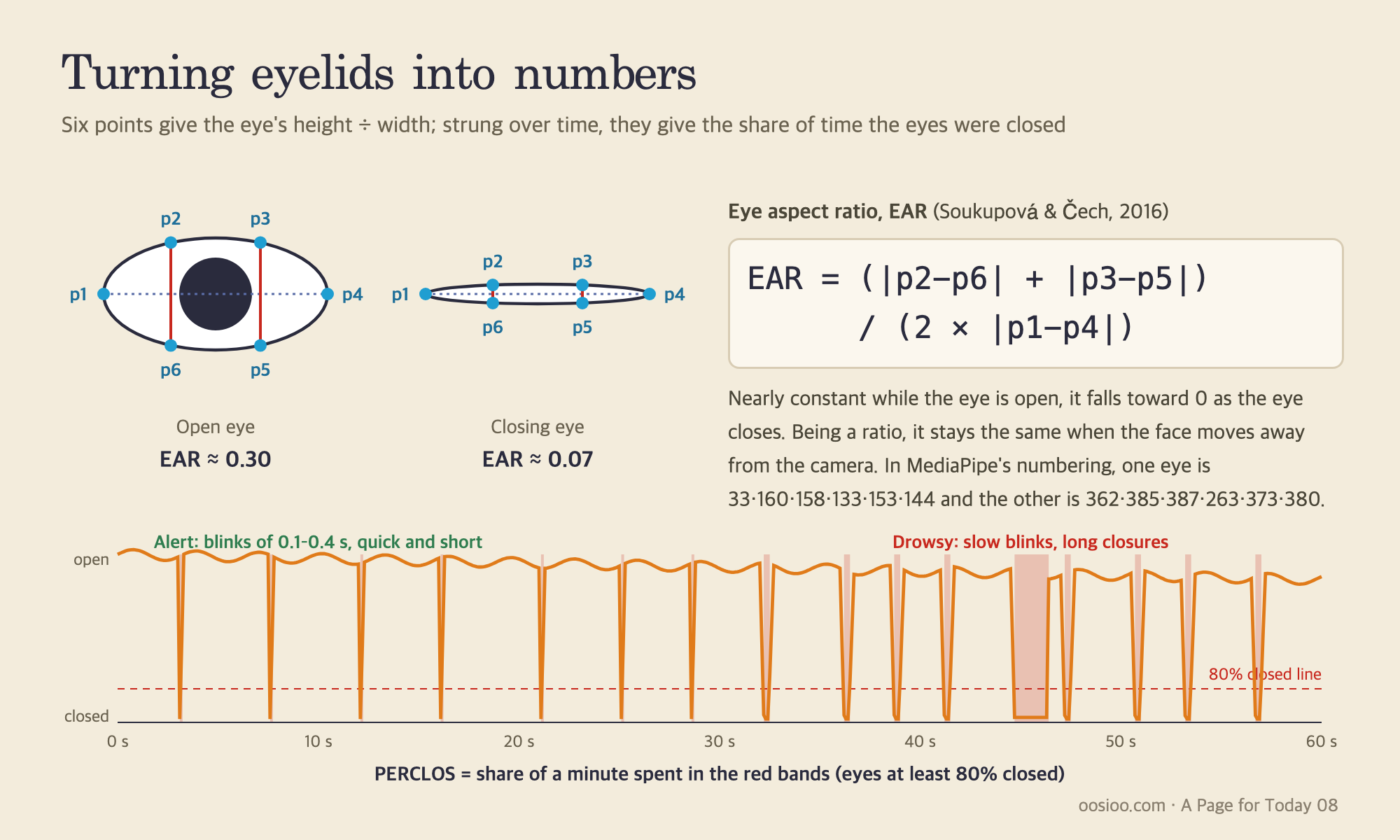
EAR = (|p2−p6| + |p3−p5|) / (2 × |p1−p4|)
With the eye open, this value stays roughly constant; it drops toward zero as the eye closes. Because it's a ratio, the value doesn't shift even if the face appears smaller, farther from the camera. A blink usually finishes within 0.1–0.4 seconds. The original paper used an EAR of 0.2 as a simple comparison threshold, but in practice built a classifier using thirteen EAR values — six frames before and after — to decide whether a given dip was a blink. The authors warned that yawning or frowning can also lower the EAR.
Euro NCAP's 2023 paper tells the other side of the story too. Indirect signals like lane position or steering wheel movement did not reliably catch drowsy drivers, and PERCLOS alone didn't produce the best results either. It noted that it's better to combine blink duration, eyelid-closing speed, and blink frequency together, since drowsiness shows up differently from person to person. That's why real devices overlay several metrics and set an individual baseline for each driver.
The Webcam Drowsiness Mirror
I borrowed this same principle to build a "drowsiness mirror" that runs in the browser. The frame below is a simulation of an illustrated face that, following a script, grows drowsy, jolts awake, and looks away. The detector runs the exact same code as the camera mode.
To try it with your own face, click Try it yourself with your camera. The in-article frame blocks camera access for security reasons, so camera mode opens as a separate page. The video never leaves your browser; the only things downloaded are Google's MediaPipe library and a 3.8MB face model file. Needless to say, never use this while actually driving — it's a toy meant to illustrate the principle.
Building it took five steps.
- Capture the frame. The webcam feed is captured in the browser via
getUserMedia. - Mark 478 points on the face. MediaPipe's Face Landmarker returns 468 face points plus 10 iris points in 3D coordinates for every frame. The same model also outputs 52 expression scores, like "eye closure" and "jaw open," along with a head rotation matrix. The library's latest release, 1.1.0, came out on October 6, 2026, but since it was only a day old, I pinned it to the prior version, 1.0.1.
- Extract features. Points 33, 160, 158, 133, 153, and 144 give the EAR for one eye; points 362, 385, 387, 263, 373, and 380 give it for the other. Inner-lip points give the mouth's vertical-to-horizontal ratio (MAR), and the rotation matrix yields the head's left-right and up-down angles.
- Accumulate over a time window. During the first three seconds, looking straight ahead, the EAR of a normally open eye is measured and set as the baseline. From then on, every frame's "eye-openness" is expressed relative to that baseline, and anything below 20% counts as 80%-or-more closed. PERCLOS is the share of the trailing 30 seconds spent closed this way. Real studies use windows of a minute or longer, but this was shortened so the demo wouldn't drag. Each closing-to-opening cycle is timed to also produce blink duration and count.
- Judge and warn. The scoring rules are as follows:
- A single closure lasting over 0.5 seconds jumps straight to drowsy; over 1.5 seconds jumps to danger. The 0.5-second threshold is what Euro NCAP ties to microsleep; the 1.5-second one is a value set for this demo.
- PERCLOS crossing 6%, 12%, or 25% escalates the status to caution, drowsy, or danger respectively.
- An average blink longer than 0.35 seconds, or two yawns within two minutes, escalates to caution.
- Turning the head more than 28 degrees, or tilting it down or back more than 22 degrees, for over 3 seconds triggers an "eyes on the road" prompt.
These thresholds vary from study to study, and from person to person, which is why they're all gathered in one place at the top of the code.
Trying it yourself exposes the limits right away. A webcam is a visible-light camera, so it can't see the eyes behind sunglasses, and the points jitter in a dark room. Turn your head, and the far eye flattens out, dragging the EAR down on its own. Smile, and narrowed eyes get mistaken for drowsiness. Conversely, there are days you feel exhausted but the numbers look fine. This is exactly why in-vehicle systems add their own infrared lighting, re-calibrate an individual baseline every time, and overlay multiple metrics — you feel the reasons firsthand. Next to the display, I also show the "eye closure" score MediaPipe's model produces on its own, so you can compare when the geometric number from six points and the trained model's judgment diverge.
How to Face Two O'Clock
The sentence in my notebook asked how to "get through" the afternoon. Having traced it this far, afternoon drowsiness looks less like an enemy to defeat and more like something written into the body's schedule. It comes even without lunch, grows with a heavy meal, and deepens when sleep runs short. So rather than forcing yourself through it, it's better to know the window and work with it: eat a lighter lunch, step by a window for light, walk for five minutes, and if nothing else works, have a coffee and close your eyes for fifteen minutes. If you're driving, pull over, no exceptions.
Cars are counting eyelids to do this work on our behalf. Even so, all a device can do is tell us. Hearing the alarm and actually pulling over is still up to the person. The same goes for the drowsiness mirror I built today — when the screen starts flashing red, the best way to turn it off is to close your eyes for a while.
A Page for Today starts, each time, from a single line in a notebook, and arrives at a page's worth of thought for the day.