
The Spark at the Doorknob
The notebook said: in winter my hand hesitates in front of the doorknob; where does that zap come from? With every step, shoe sole and floor touch and part and leave a little charge on the body, and when a fingertip comes within a few millimetres of the knob the air gives way and a spark jumps. I follow the industry table in which a body walking on carpet on a dry day reaches tens of thousands of volts, a Japanese occupational safety institute's table of what you feel at each kilovolt, and the arithmetic by which simply heating winter air drops its humidity into the teens. Why the triboelectric series used for centuries comes out differently from lab to lab, as a 2025 study explained; why the story of Thales and amber is a report written centuries later; and why petrol stations and chip factories fear static. A playground lets you pick humidity, shoes and floor, walk, then grab the doorknob. The forty-third piece in A Page for Today.
The page I opened today held this line.
In winter my hand hesitates in front of the doorknob. Where does that zap come from?
Once the heating goes on, the moment comes several times a day. Opening the office door, pressing the lift button, shutting the car door as you get out. The pain lasts no longer than a blink, and yet that brief prickle stays with you. So people invent small rituals. Tapping the knob with the back of the hand first, pulling a sleeve down over the fingers, touching the knob with the tip of a key before taking hold.
These rituals mostly work. But ask why they work and the words run out. Static electricity is something everyone experiences and few can properly explain. So today I decided to take the zap apart, piece by piece: how much charge builds up on a body, how many volts it takes to hurt, why it only seems to happen in winter, and the fact that scientists still don't fully understand this ancient phenomenon.
What the zap is
Static electricity is, as the name says, electricity that stays put. Electricity from a socket flows along wires; static electricity piles up somewhere and stays there. The zap we feel is the moment that piled-up charge leaves all at once.
Start with how charge piles up. When two different materials touch and then separate, one surface takes a few more electrons and the other loses as many. This is called triboelectric or contact charging. The word "friction" makes it sound as if you have to rub hard, but what really matters is touching and parting. Rubbing just increases the area and the number of contacts.
Walking does this with every step. The sole of a shoe touches the floor and lifts off, trousers brush the legs, sleeves sweep along the torso. Each time a little charge is left on the body. Soles made of rubber or synthetic resin conduct poorly, so the charge on the body can't escape to the floor and simply stays. In this way the human body becomes a capacitor, a vessel that holds electricity.
Now the doorknob. A metal doorknob conducts well, and it is connected through the door frame and the building to the ground, or at the very least it can take in far more charge than a human body can. As a charged fingertip approaches the knob, the electric field across the narrowing gap of air grows stronger. Air is normally an insulator that barely conducts, but it has a limit. The textbook value is that dry air breaks down at around 3,000 volts per millimetre. Past that limit, air molecules split into ions, a path opens, and the charge stored in the body rushes through it all at once. The tiny blue spark between fingertip and knob, the snapping sound and the prickle are all this one discharge.
Strictly speaking, then, the zap comes not when you grab the knob but just before. The spark jumps a few millimetres ahead of the fingertip, before you touch. That is why no matter how fast you reach out, you can't avoid it.
Voltage that builds with every step
How much does a body charge up? The electronics industry has an old table that answers this. It is the "Typical Electrostatic Voltages" table that the US ESD Association (Electrostatic Discharge Association) puts in its introductory material.
| Situation | 10–25% relative humidity | 65–90% relative humidity |
|---|---|---|
| Walking across carpet | 35,000 V | 1,500 V |
| Walking across vinyl tile | 12,000 V | 250 V |
| Worker at a bench | 6,000 V | 100 V |
| Picking up a poly bag from a bench | 20,000 V | 1,200 V |
| Chair with urethane foam | 18,000 V | 1,500 V |
So a person walking on carpet on a dry day can reach 35,000 volts. If the number seems too large to believe, remember that voltage is the "push" of electricity, while the amount of charge that actually flows is tiny. It is the same reason a 1.5-volt battery feels like nothing when you touch it, yet static at thousands of volts doesn't injure people. The quantity of charge in static is so small that the discharge is over in a millionth of a second.
There is a caveat in reading this table, though. It doesn't say what shoes were worn, what carpet was walked on, or for how many steps. These are representative values the industry uses for training. On the same carpet, results can differ several-fold depending on soles, clothing and gait. So rather than memorising "the human body reaches 35,000 volts," I think the right way to read the table is to look at the gap between the left and right columns. The same activity produces voltages tens of times apart depending on humidity: 23 times for carpet, 48 times for vinyl tile, 60 times at the bench.
What about the number of steps? If each step only added charge, the voltage would seem to climb without end the longer you walked. It doesn't. The more charge a body holds, the more leaks away through soles, air and clothing, so after a while it stops at a point where what comes in matches what leaks out. It climbs quickly over the first few steps, then creeps towards a ceiling. Shoes, floor and humidity set that ceiling.
How many volts before it hurts
If we carry thousands of volts around every day, why do we usually not notice? Because it takes a higher voltage than you might expect before a person feels static.
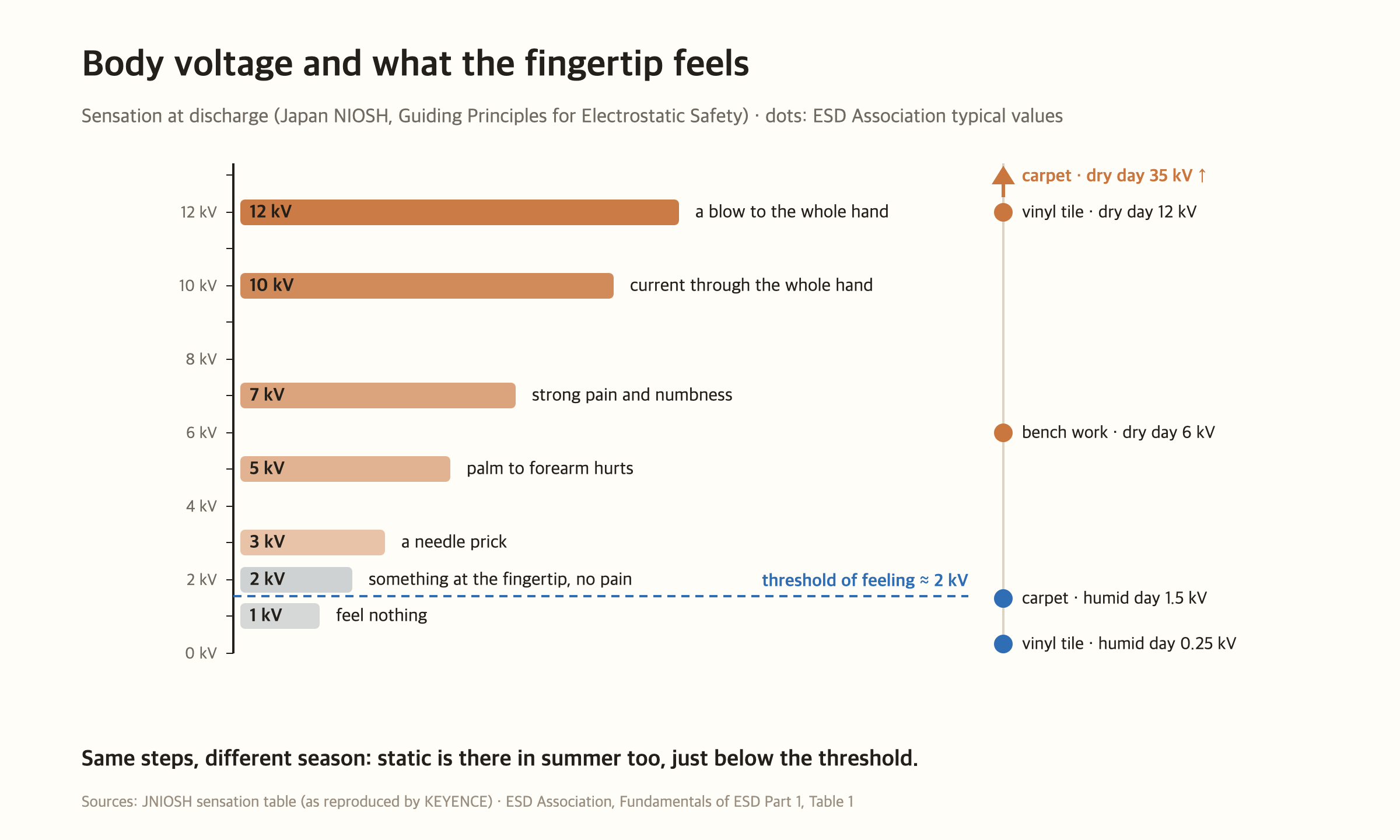
The ESD Association's handbook says most people cannot feel a discharge below 2,000 volts. Japan's National Institute of Occupational Safety and Health, in its Guiding Principles for Electrostatic Safety, gives a more detailed table of what you feel when a body charged to a given voltage discharges.
- 1 kV: you feel nothing.
- 2 kV: something at the fingertip, but no pain.
- 3 kV: a prick like a needle.
- 5 kV: pain from the palm to the forearm.
- 7 kV: strong pain and numbness in the fingers and palm.
- 10 kV: pain through the whole hand and a sense of current flowing.
- 12 kV: like a hard blow to the whole hand.
Set this beside the earlier table and the winter scene explains itself. A body charged to 1,500 volts by walking on carpet on a humid summer day still discharges at the doorknob, but you don't feel it. Static was there in summer too; it was just below the threshold. In dry winter, the same steps produce voltages well over it. It isn't that static only "happens" in winter. It is only "felt" in winter.
I should add that people differ in how much they feel. The same discharge feels different depending on how dry the skin is and which part of the finger makes contact. The table is best read as a rough scale.
You can also work out the energy in a discharge. Electronic component testing treats the human body as a 100-picofarad capacitor (a real body may be larger or smaller depending on posture and footwear). The energy stored in a capacitor is half the capacitance times the square of the voltage, so 3 kilovolts gives 0.45 millijoules and 10 kilovolts gives 5 millijoules. Five millijoules is about the energy needed to lift a one-gram object half a metre. Pour that small amount into a single point on a fingertip within a millionth of a second, and the nerves are bound to jump. Spread the same energy over the whole palm and it hurts much less. That is why the trick of holding a key or coin and touching the knob with its tip works. The spark jumps between the key's tip and the knob, and the current enters through the wide area of the palm holding the key. Tapping with the back of the hand first works the same way: it avoids the fingertip, where nerves are densest.
Humidity as a switch
Why does humidity make such a large difference?
The surface of any object holds a very thin film of water drawn from the vapour in the air. The higher the humidity, the thicker the film. Water carries dissolved ions and conducts a little, so charge on a surface slowly leaks away along the film. Charge on the body, clothing and floor bleeds off almost as soon as it forms, so the voltage can't climb very high. In dry air that escape route is closed and charge simply accumulates. Note that the humid column in the table isn't zero volts either. Humidity doesn't stop charging; it just drains what builds up faster.
This is a good point to ask why indoor air in winter is so dry. It isn't because outdoor air has low relative humidity. Winter outdoor air is often quite damp in relative terms. The problem arises when you heat it.
Relative humidity means "how much of the water vapour this air could hold is it actually holding." But the amount of vapour air can hold rises steeply with temperature. Air at 22 degrees can hold more than four times as much vapour as air at 0 degrees. So if you bring in outdoor air at 0 degrees and 70 percent relative humidity and heat it to 22 degrees, the amount of vapour stays the same but the relative humidity drops to around 16 percent. If it is minus 5 degrees and 60 percent outside, the indoor figure falls below 10 percent. Breath, cooking and laundry add vapour, so a real home will be a little higher, but the drying power of heating is plain to see. In terms of the earlier table, the winter indoors lives in the left column, the world of 10–25 percent relative humidity.
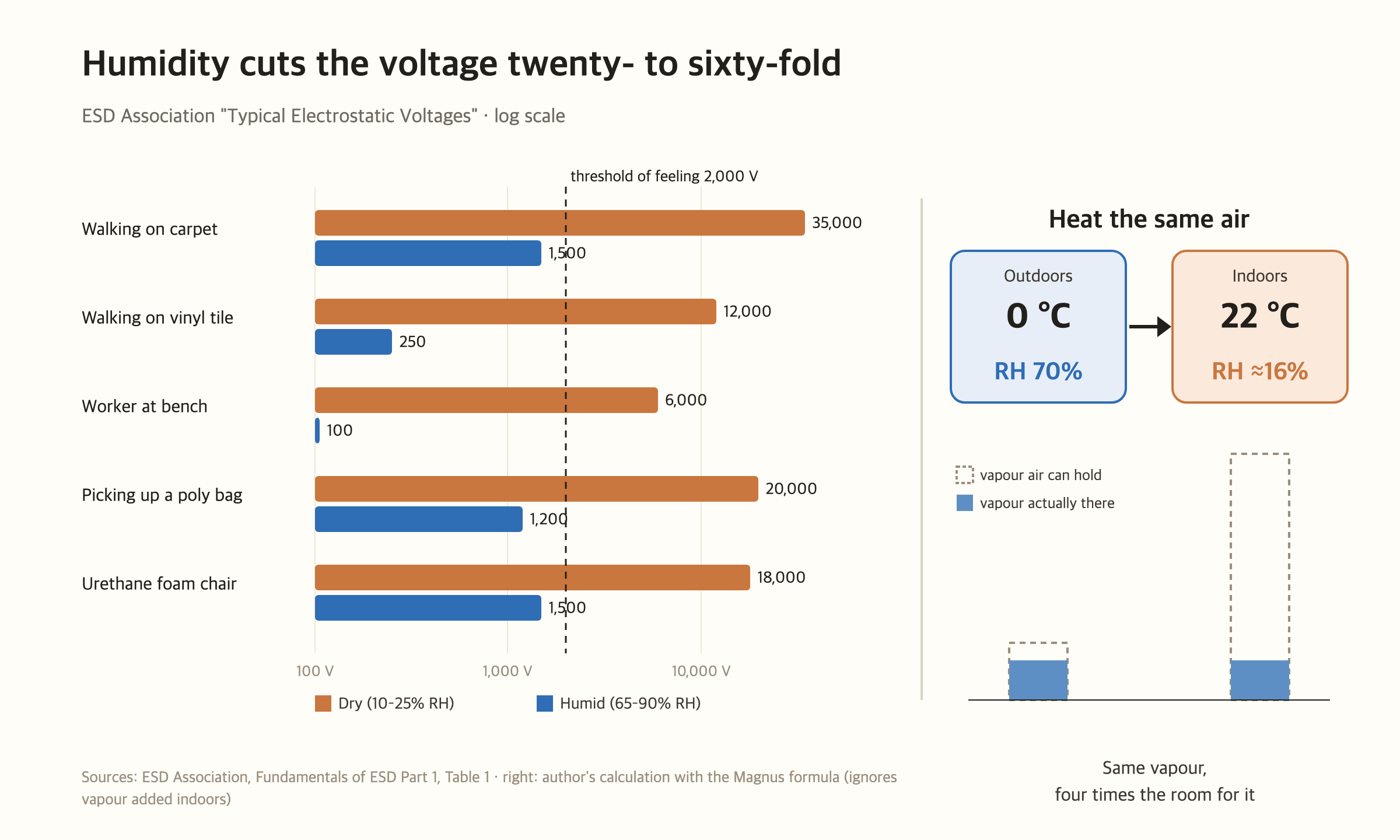
So the surest way to cut winter static is to raise the humidity. Places like semiconductor plants manage indoor humidity, and at home a humidifier does the job. As the table shows, raising humidity cuts the voltage from the same steps by a factor of twenty to sixty. That is enough to drop below the threshold of the sensation table.
Why the series wobbles
Now a more fundamental question. What decides which material takes electrons and which loses them?
Science textbooks print a table called the triboelectric series. It lines materials up in a row and tells you that if you rub one higher on the list against one lower down, the higher one becomes positive and the lower one negative. Human skin, hair and wool usually sit at the positive end; plastics such as Teflon and PVC at the negative end. The experiment where hair sticks to a balloon rubbed on your head is explained with this table.
Put several of these tables side by side, though, and something odd appears. The order differs from table to table. The two ends mostly agree, but towards the middle the order shuffles, and A may be above B in one table and below it in another. For researchers in the field this has long been a headache. Different labs got different series, and it wasn't unusual for the same person repeating the same experiment to get a different order.
In 2019 a team of researchers from China and the United States tried to reduce the confusion by standardising the measurement (Zou et al., Nature Communications). Because the contact area between two solids differs every time, they used liquid mercury as the partner material. Mercury flows into the shape of the surface and touches it the same way every time. To remove the effect of humidity, they ran the experiments inside a nitrogen box at 0.43 percent relative humidity. In this way they put numbers on the charging of some fifty polymers. Even so, the authors noted that the series is relative and depends on the partner material. That it took this much control just to build a standard says a lot about how slippery the phenomenon is.
A more surprising result came in 2025. Scott Waitukaitis's lab at the Institute of Science and Technology Austria (ISTA) tested what happens when completely identical materials touch (Sobarzo et al., Nature). They made identical pieces of PDMS, a kind of silicone rubber, and pressed them together and pulled them apart. Being the same material, in principle there was no reason for charge to move. But it did, and at first the direction was random. There were even results that couldn't be put in a line: A above B, B above C, yet C above A. In the researchers' words, "The experiments are wildly unpredictable and can sometimes seem completely random."
The clue lay somewhere unexpected. The team began recording how many times each piece had been in contact with another. Then the chaos sorted itself out. The more contacts a piece had had, the more it charged negatively against a piece with fewer. After about 200 contacts the outcome became predictable, and by controlling the number and order of contacts they could even design a series in advance. Looking at the surfaces, they found that contact had smoothed out tiny bumps on the nanometre scale. Why that smoothing decides the direction of charging is still unknown.
What this result says about the series is this: not just the kind of material but its history, what it has been through, enters into charging. Different labs may have got different series not because someone made a mistake but because each lab's samples had a different past. So the textbook series is best read as a map of rough tendencies. Pairs at opposite ends, like a wool jumper and a plastic, are reliable; but which of two materials near the middle ends up positive can change with that day's humidity and the object's history.
It is a little surprising that a phenomenon known for over 2,500 years still isn't fully understood. Static is that common, and that hard to pin down.
From amber to electron
Since the figure of 2,500 years has come up, let's go back to the beginning. The history of static electricity usually starts with the ancient Greek philosopher Thales. The story goes that Thales rubbed amber with fur and dust and feathers clung to it. Even the electronics industry's introductory material opens with this story.
But there is something to note about it. Thales lived in the sixth century BC, and not a single line of his writing survives. The record of the amber story is Lives of the Eminent Philosophers, written centuries later by Diogenes Laërtius. He wrote: "Aristotle and Hippias affirm that, arguing from the magnet and from amber, he attributed a soul or life even to inanimate objects." What can be confirmed in Aristotle's surviving writings is the story that Thales said the magnet has a soul because it moves iron.
In this tradition, then, Thales is less an experimenter than a philosopher. Rather than "discovering" static electricity, he is said to have looked at an already familiar fact, that rubbed amber attracts light things, and interpreted it as a sign of a soul. Anyone who polished amber into jewellery would long have known that rubbing it picks up dust. The scene we know as "Thales's experiment" is closer to a picture painted by later commentators.
Even so, amber left its name on the phenomenon. The Greek for amber is ēlektron. In 1600 the English physician William Gilbert, in his book on magnets, De Magnete, grouped the substances that attract light things when rubbed, as amber does, under a Latin word meaning "amber-like." The words electricity and electron both come from there. Every electronic device carries in its name a piece of ancient jewellery.
Petrol stations and chip factories
A zap at the doorknob hurts and is over. The same discharge somewhere else is another story.
Petrol stations are the classic case. Petrol evaporates easily, and there is always vapour hanging around the filler neck. According to industrial safety summaries, hydrocarbon vapours can ignite with very small energies, from around 0.2 millijoules. The human discharge energy worked out earlier was 0.45 millijoules at 3 kilovolts and 5 millijoules at 10 kilovolts. A discharge strong enough to prick the fingertip is already over that threshold. If it happens where vapour is mixed in the right concentration, a fire can start.
So petrol station safety notices commonly recommend a few things. Touch a metal part, or the static discharge pad on a self-service pump, before handling the nozzle. Don't get back into the car while fuelling. The second rule follows the same principle as walking. When you sit in the driver's seat and get up again, clothing and seat touch and part, and charge builds up on the body again. Grab the nozzle at the filler with that body and the discharge happens right at the filler neck, where the vapour is thickest. I couldn't find reliable statistics this time on how many such fires happen each year, so I won't give a number. But the mechanism is clear, and preventing it is simple.
Chip factories, by contrast, worry about discharges people can't even feel. According to the ESD Association's introductory material, many electronic components can be damaged by discharges below 100 volts, and many disk drive components can't withstand even 10 volts. With the human threshold of feeling at a bit over 2,000 volts, a part can be ruined while the worker notices nothing. Worse, the damage doesn't always show at once. Some parts work fine at first and fail later.
So the scenery wherever electronic parts are handled is shaped by the fight against static. Workers wear wrist straps with grounding cords, floors and benches are covered with slightly conductive materials, and parts travel in silver or pink antistatic bags. The table's figure of 20,000 volts from merely picking up a poly bag isn't there for nothing. It's also why people building computers tell each other to touch the metal of the case before handling components.
At the doorknob
I turned the story so far into a toy model. In the first tab, choose indoor humidity, shoe soles, floor and clothing, then take steps and watch the curve of your body voltage build. When you've walked enough, grab the doorknob. Depending on the voltage, the sensation table from Japan's occupational safety institute tells you what you would feel, and the discharge energy is calculated for a 100-picofarad body. The second tab takes outdoor temperature and humidity and indoor temperature, works out how far the relative humidity of heated air falls, and compares how high walking on carpet would climb at that humidity.
The model's numbers come from the tables and calculations, but how much shoes and clothes matter are values I set as estimates. Real bodies will be far more erratic. Even so, the direction is clear. On a vinyl tile floor with leather soles and cotton clothes, raising the humidity from 20 to 40 percent is enough to bring the ceiling for the same steps down from around 3 kilovolts to under 1 kilovolt. That is the difference between a needle prick and feeling nothing at all.
Fewer zaps
To sum up, there are three things you can do at the winter doorknob: let less build up, drain what has built up beforehand, or take the hit in a way that hurts less.
For letting less build up, humidity is the surest. Raising indoor humidity reduces charge not only on your body but also on clothes, floors and furniture. Clothes and shoes matter too. Rubber or synthetic soles that conduct poorly trap the body's charge, while leather soles let it drain relatively well. But how much difference each material makes is hard to state with certainty, given the uncertainty of the series we saw earlier. The same garment can behave differently with the day's humidity and the washing and wear it has been through.
Draining beforehand is the set of tricks you use at the doorknob. Before grabbing the knob, you can rest your palm on a wall or a wooden door first. Such surfaces don't conduct as well as metal, and for that very reason they let charge leak away bit by bit without a spark. Results vary with the material. Holding the metal frame of the car door while you lift yourself off the seat works on the same principle. The charge produced as your body leaves the seat drains through your hand into the car body before it can build up.
Taking the hit more gently works as we saw. Touch metal first with the tip of a key or coin and the spark jumps from that tip, while the current enters through the broad palm. Making first contact with the back of the hand or the palm rather than the fingertip also means taking the discharge where nerves are less dense. You can't abolish the prickle entirely, but you can turn a needle prick into a tap.
In closing
Back to the question in the notebook. Where does the zap at the doorknob come from?
From what I followed today, it is the moment when charge gathered bit by bit with every step leaves all at once a few millimetres ahead of the fingertip. Charge builds up and drains away in every season. What is different in winter is that heated air dries out the water film on surfaces, closing the path by which charge escapes, so the same steps push the body above the threshold you can feel. Winter doesn't create the zap. Winter reveals it.
And beneath this common phenomenon lies a question still unanswered. Even identical materials exchange charge, and the direction is set by what each has been through. Scientists still can't fully explain what people saw in rubbed amber 2,500 years ago. A hand hesitating at the doorknob is confirming that old riddle with the body, several times a day.
That habit of tapping with the back of the hand first was, it turns out, a fairly scientific ritual. It avoids the nerve-dense fingertip and takes the discharge over a broader surface. This winter you might add one more step to it: a glance at the number on the humidifier.
A Page for Today opens an idea notebook at random and sets the day's thoughts on a single line written there. Today's line was "In winter my hand hesitates in front of the doorknob. Where does that zap come from?"
- Static voltage and humidity: ESD Association, Fundamentals of Electrostatic Discharge Part 1: An Introduction to ESD (Table 1, Typical Electrostatic Voltages) · ESD Association, ESD TR20.20 Handbook (as quoted on the Desco technical blog, 2012)
- Sensation and energy: Japan National Institute of Occupational Safety and Health, Guiding Principles for Electrostatic Safety, sensation table for body discharges (as reproduced in KEYENCE's static electricity basics) · JEDEC JESD22-A114 human body model (HBM, 100 pF, 1,500 Ω) · minimum ignition energy of hydrocarbon vapours (G. Hearn, Static Electricity: Guidance for Plant Engineers, Wolfson Electrostatics, 2002, secondary citation)
- Humidity calculation: Magnus formula (approximation of saturation vapour pressure, author's calculation)
- Triboelectric series: H. Zou et al., Quantifying the triboelectric series, Nature Communications 10:1427, 2019 · J. C. Sobarzo et al., Spontaneous ordering of identical materials into a triboelectric series, Nature 638, 2025 · ISTA press release, An electrifying turn in an age-old quest (19 Feb. 2025)
- History: Diogenes Laërtius, Lives of the Eminent Philosophers I.24 (trans. R. D. Hicks) · Aristotle, On the Soul I.2 · W. Gilbert, De Magnete (1600)
- Electronic components: ESD Association, Fundamentals of Electrostatic Discharge Part 1 (components damaged below 100 V, disk drive components below 10 V)