I Put Stories on the Bottles Piling Up at Home — A Drink Log Where One Label Photo Lets AI Fill In the Details
When COVID made it hard to drink out, bottles started piling up at home. I built an app over one weekend where a single label photo gets the drink's description filled in by AI, and all I write is where it's stored and who I drank it with and how it went. Alongside domestic and international precedents like Vivino, CellarTracker, and WineGraph, a look at how low the bar has dropped for building a tiny service meant for just yourself.
When COVID was at its peak, having a drink out became difficult. Restaurants closed early, and gatherings kept getting postponed. So the drinking moved home. A wine that caught my eye at the supermarket, a whisky I got as a gift, a sake I'd bought meaning to drink it someday — one bottle at a time, the shelf filled up.
I wasn't the only one. When Korea's Ministry of Food and Drug Safety surveyed 2,000 drinkers in late 2020, 92.9% of those who said their drinking location had changed since COVID said it was now "home." The numbers are even more blunt. According to Korea Customs Service statistics, wine import value jumped nearly 70% in a single year, from $330 million in 2020 to $560 million in 2021, then hit an all-time high of $580 million in 2022. Whisky followed a bit later, with 2023 import volume the highest since record-keeping began. The US saw something similar — Nielsen figures show retail alcohol sales up roughly 55% year-over-year for one week in March 2020, when lockdowns began.
As the bottles piled up, a problem emerged. I couldn't remember whether this was the same wine I'd had before, or who I'd been with and how it went. Drinks had at home carry more stories than drinks had at a bar, but those stories weren't being kept anywhere. So I decided to start logging them.
One Photo, and AI Handles the Rest
I tried keeping a spreadsheet but gave up within days. To log a single bottle, I had to search for its name and look up its type and origin, and once that became a chore, the logging stopped quickly. So there was really just one thing I wanted: snap a photo of the label, have the drink's description fill itself in, and let me write only my own story.
I want to build a web app that logs the drinks I have at home. When I upload a photo of a bottle's label, figure out what the drink is and fill in its type, origin, characteristics, food pairings, and how to drink it. I just want to write where it's stored, who I drank it with, and how it went.
With that request, I spent one weekend on it, and out came a working app. Upload a photo, and a few seconds later a description like this appears.
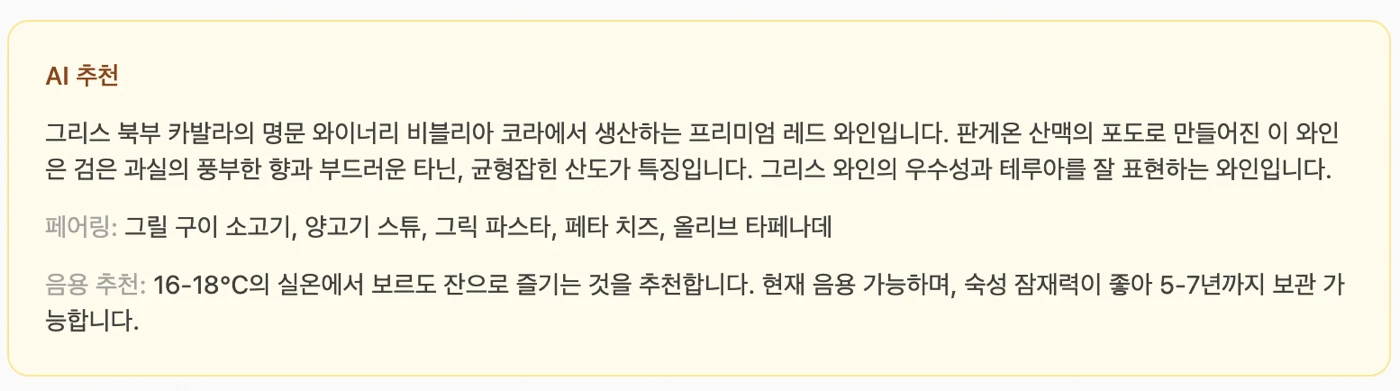
It's a red wine made at a winery in northern Greece, noted for dark fruit aromas and soft tannins, pairs well with lamb stew or feta cheese, and is best enjoyed at 16-18°C in a Bordeaux glass. For someone who doesn't know much about wine, these few lines make me look at the bottle differently. If I'd had to look all this up and write it myself, I never would have written this much.
AI Handles the Information, I Handle the Story
What the app does ultimately splits into two columns. The left column is what AI fills in: type of drink, origin, flavor characteristics, food pairings, ideal serving temperature. The right column is what I fill in: where this bottle is kept, who I drank it with, how that day went, what score I'd give it.
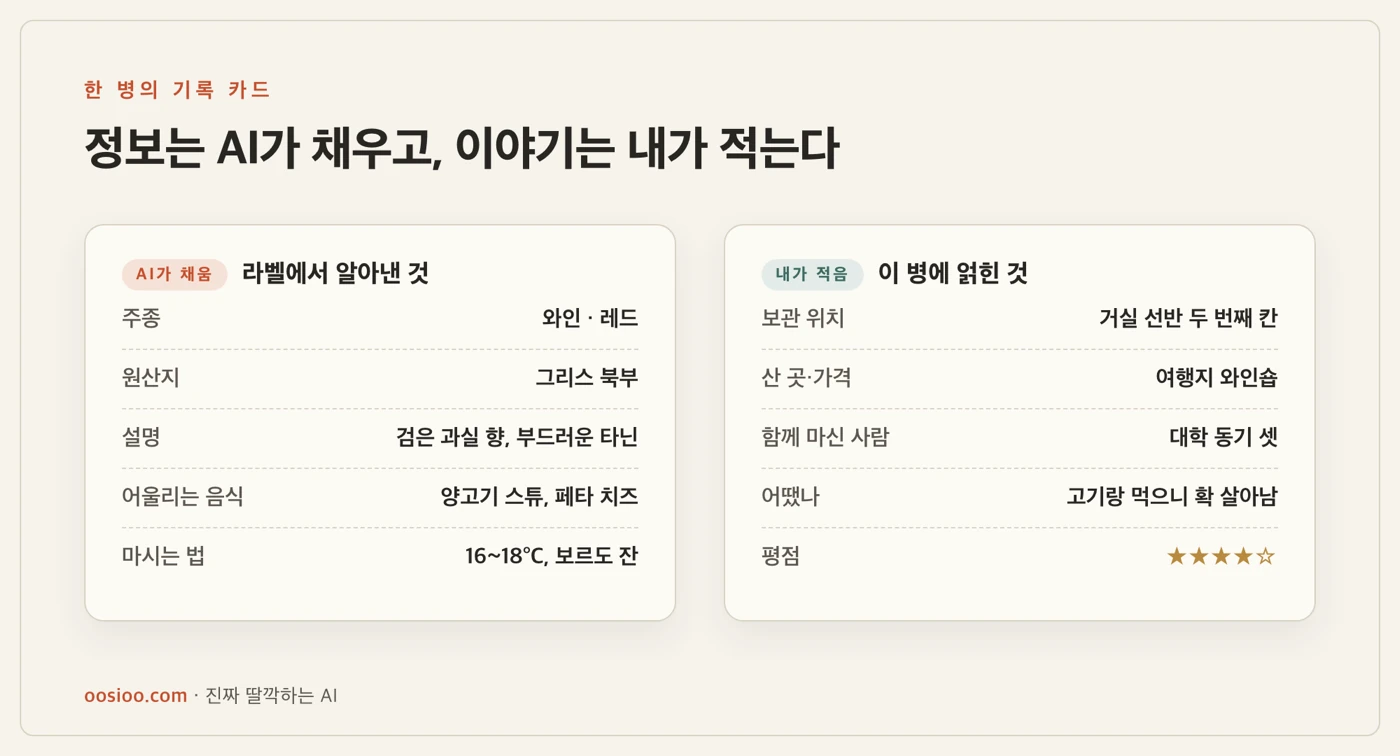
Using it, I found the right column was the real point. Writing down "second shelf in the living room" means I don't go hunting when guests show up. A wine logged with "three college friends, really came alive with meat" is one I reach for again the next time I see those same people. Right now my shelf holds over twenty bottles of wine and ten each of whisky and beer. It's less a drink inventory than a record of several years' worth of evenings.
Of course, AI isn't always right. If the label is blurry or lighting reflects off it, it sometimes reads the wrong drink entirely, and it doesn't know much about small, obscure producers either. When a label lacks an ABV figure, it sometimes invents a plausible-looking number, so I set it up to leave unverified values blank. So I treat what AI writes as a draft, and fix it myself when something looks off. Most of the time, there's nothing to fix.
Plenty of Apps Like This Already Exist
After building it, I looked around and found quite a few similar services.
The most famous is Vivino, which started in Denmark. Scan a label and it tells you what the wine is and shows other users' ratings. By the company's own figures, it has over 77 million users and has logged more than 3.5 billion label scans cumulatively. There's an interesting study too. A 2024 paper analyzing 200,000 Bordeaux wine reviews found that Vivino's crowd ratings generally move in the same direction as expert scores, but with a different texture. Experts look at how well a wine will age going forward, while the crowd gave higher scores to older vintages that tasted good right now.
CellarTracker, from the US, began in 2003 as a program one person built to manage their own wine cellar. Because users register wines themselves when they're missing from the database, individual records piled up into a massive shared database. By 2014 it was already tracking 30 million bottles. On the beer side there's Untappd, where you "check in" beers you've drunk and collect badges, and an app called InVintory that recreates your actual wine fridge in 3D and lets you assign each bottle its own slot. It's essentially turning my "second shelf in the living room" note into something three-dimensional.
Korea has its own examples too. Naver's app let users photograph wine labels to look up information as far back as 2011, with the wine outlet Wine21 supplying the data. The domestic startup WineGraph built its pitch around label recognition and taste-based recommendations, and in 2021 added label search to the CU convenience store app. The app that really caught the home-drinking wind was Dailyshot, a smart-order liquor app. It's not a logging app, but by letting people order drinks through the app and pick them up at a nearby store, it passed one million monthly users by late 2024. There are also small apps built by individual developers, such as one that manages multiple cellars and shelves and logs aromas as icons.
| Service | Origin | Strength |
|---|---|---|
| Vivino | Denmark | Label scanning, ratings from tens of millions of users |
| CellarTracker | US | Cellar inventory and tasting notes, a user-built shared database |
| Untappd | US | Beer check-ins and badges |
| InVintory | US | 3D wine fridge layout, per-bottle placement |
| Wine21 / Naver | Korea | Scan a label to look up wine information |
| WineGraph | Korea | Label recognition, taste recommendations, convenience store integration |
| Dailyshot | Korea | Liquor ordering and in-store pickup |
So, Why Does This Count as a Click
Most of these services are good at "information." A database of ratings from tens of millions of people, covering millions of products, isn't something you can build alone. What I wanted, though, was something a bit different. Who I drank this bottle with, where I kept it, how that day went. More than other people's ratings, I wanted to preserve stories about me and my people.
In the past, something like this would have ended with "eh, I'll just use an existing app." Building screens, storing data, and attaching drink information just for my own use would have taken far too much effort. Now, since AI fills in the descriptions of the drinks, all I need to do is decide which fields I actually need. Two weekend days, and I have an app that fits my shelf exactly, with no feature I don't use and no subscription fee.
It doesn't have to be a grand service. The bar for building an app around one small habit in my own life has dropped this low. That's what I took away from this click.