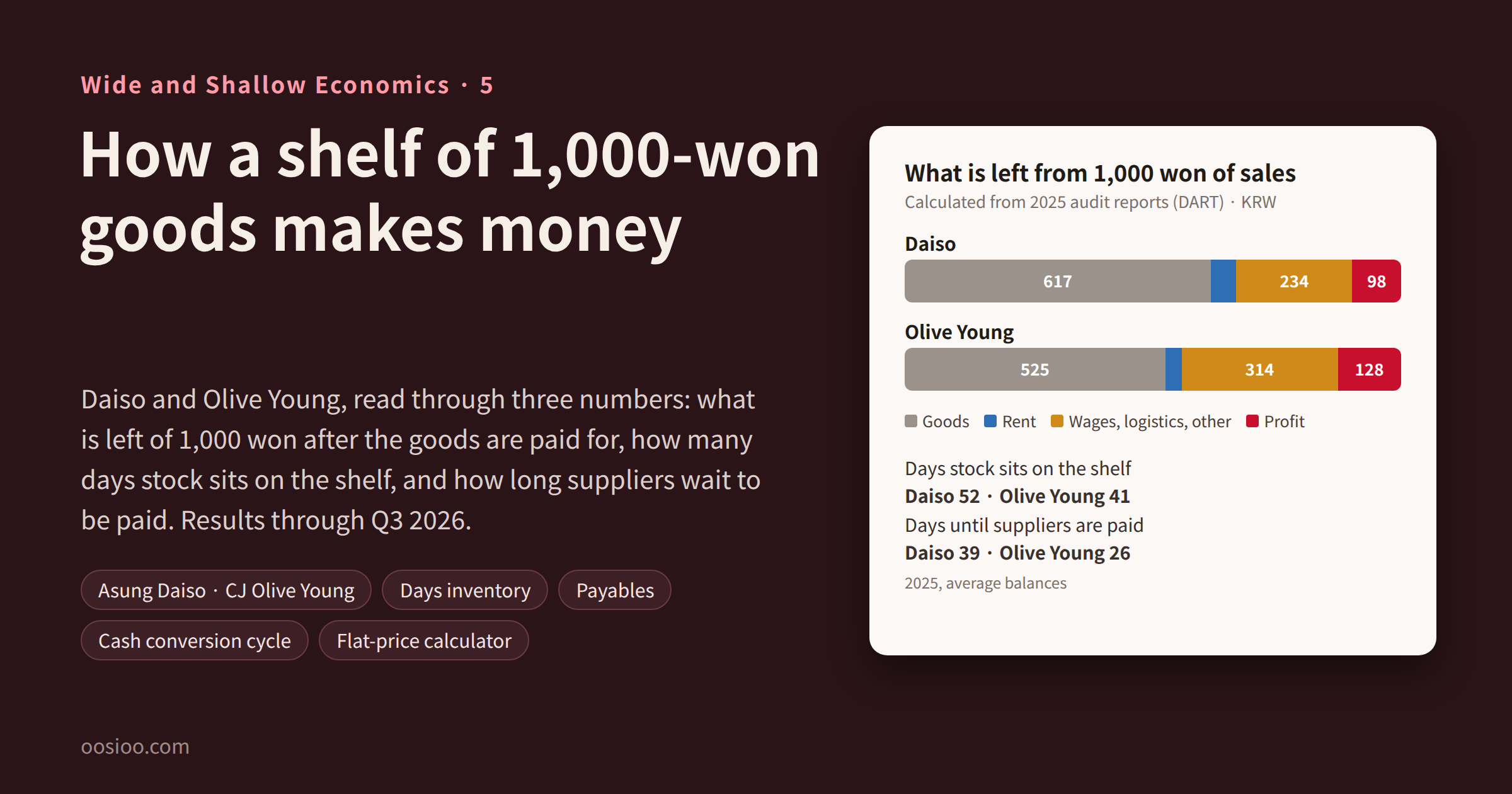
How a shelf of 1,000-won goods makes money
In 2025 Asung Daiso earned an operating profit of KRW 442.4 billion on revenue of KRW 4.5364 trillion, and CJ Olive Young earned KRW 744.7 billion on KRW 5.8335 trillion, both confirmed in their audit reports. Even though almost everything at Daiso costs 5,000 won or less, 383 won of every 1,000 won in sales is left after paying for the goods. It is not quite the thin-margin business people imagine. This episode of Wide and Shallow Economics pulls inventory and trade payables out of both companies' audit reports to count how many days goods sit on the shelf (52 at Daiso, 41 at Olive Young) and how many days suppliers wait to be paid. Daiso's cash conversion cycle went from minus 2.3 days in 2024 to plus 18.8 days in 2025. In the playground you change floor area, sales per square meter, cost ratio, rent and turnover days to work out one flat-price store's annual profit and the cash it ties up. Along the way: Olive Young, where foreign visitors now account for a third of in-store sales, and its first US stores; Daiso, which grew from 7 beauty brands to 150; Musinsa Beauty's move into physical stores; and Lalavla, Lohb's and Sephora, which closed first. It ends with five predictions to be scored between Q3 2026 and April 2027.
At a Daiso checkout the baskets tend to look alike. A couple of storage boxes, detergent, batteries, and these days a cosmetic or two. Each item costs 1,000 or 2,000 won, yet the total on the register screen easily passes 20,000 won. A few stops away, an Olive Young feels different. In a tourist district, half the people in the checkout line seem to be speaking another language, arms full of sunscreen and sheet masks.
The two shops sell different things at different prices, but they have something in common. Both are retailers built on physical stores, and in the 2020s, while online shopping kept growing, both sold more in their stores, not less. Over the same years, companies chasing similar shoppers closed one by one: GS Retail's Lalavla, Lotte's Lohb's, and Sephora, the world's biggest beauty chain.
This episode looks at those two shops. Is there really anything left over from selling a 1,000-won item, and if so, where does it come from? I follow the answer through the companies' audit reports. The accounting idea this time is inventory and supplier credit: how many days goods sit on the shelf, and how many days later the store pays for them. Those two numbers hold the purse strings in this business. Today is November 12, 2026. Daiso is unlisted and publishes no quarterly results, and CJ Corp., Olive Young's parent, has not yet released Olive Young's third-quarter 2026 numbers.
Three numbers for where things stand
Neither company is listed. The most reliable numbers are therefore the audit reports each files every spring on DART, the Financial Supervisory Service's disclosure system. Daiso filed its fiscal 2025 report on April 14, 2026, and Olive Young on March 27. CJ Corp., which owns 51% of Olive Young, breaks out its sales in quarterly investor presentations, so the quarterly trend is visible through the first half of 2026.
| Company (brand) | 2024 revenue | 2025 revenue | 2025 operating profit | Latest in 2026 | Stores |
|---|---|---|---|---|---|
| Asung Daiso (Daiso) | KRW 3.9689 trillion | KRW 4.5364 trillion (+14.3%) | KRW 442.4 billion (9.8%) | No quarterly results disclosed | About 1,600 (end-2025, press) |
| CJ Olive Young (Olive Young) | KRW 4.7900 trillion | KRW 5.8335 trillion (+21.8%) | KRW 744.7 billion (12.8%) | H1 revenue KRW 3.3349 trillion (+23.7%) | 1,367 in Korea (end of June 2026) |
Revenue and operating profit are from the audit reports (separate, parent-only statements). Percentages in parentheses are year-on-year growth and operating margin. Olive Young's first-half 2026 revenue and store count come from CJ Corp.'s investor materials. Daiso does not disclose a store count, so that figure comes from press reports citing company data.
Three numbers stand out.
First, 9.8%. That is Daiso's operating margin: 98 won of operating profit on every 1,000 won of sales. In episode 4, the leading convenience store franchisor, BGF Retail (CU), posted a 4.0% operating margin in Q3 2026. A shop selling 1,000-won items earns more than twice the margin of a convenience store head office. Olive Young is higher still at 12.8%. Both have edged up every year: Daiso from 7.6% in 2023 to 9.4% in 2024 and 9.8% in 2025, Olive Young from 12.1% to 12.7% to 12.8%.
Second, 33%. That is the share of Olive Young's in-store sales paid by foreign visitors. The company says it was around 2% in 2022; it passed 25% in 2025 and reached 33% in August 2026 (press reports citing the company). In 2026, sales to foreigners passed 1 trillion won by August, three months earlier than in 2025, the company announced. While foreign sales climbed, the number of stores in Korea actually slipped, from 1,394 at the end of Q3 2025 to 1,367 at the end of June 2026. Olive Young grew by making each store sell more rather than by adding stores. It is the same pattern episode 4 found in convenience stores.
Third, −2.3 days and +18.8 days. These are Daiso's cash conversion cycle in 2024 and 2025. The cycle counts how many days the company's own money is tied up in one round of buying goods, selling them and collecting the cash. A negative number means customers' money arrives before the store has paid for the goods. The figure moved by 21 days in a single year. What that means is this episode's accounting story.
Where the money comes from
Thin margins, high volume?
Daiso is often described as a thin-margin, high-volume business. The high volume is real. The company says it carries about 30,000 products and adds more than 600 new ones every month. The "thin margin" part deserves a check against the audit report.
Revenue minus what the goods cost to buy (cost of goods sold) is gross profit. Daiso's 2025 cost of goods sold was KRW 2.7972 trillion. Subtracted from revenue of KRW 4.5364 trillion, that leaves gross profit of KRW 1.7392 trillion, or 38.3% of sales. Sell 1,000 won of goods and 617 won goes to pay for them, leaving 383 won. The ratio has been steady: 37.8% in 2022, 37.0% in 2023, 37.9% in 2024. CU's gross margin in Q3 2026 was 19.2%. A convenience store head office is closer to a wholesaler supplying its franchisees, so the comparison is not exact, but it is hard to call Daiso's margin thin.
Olive Young keeps more. Its 2025 cost of goods sold was KRW 3.0621 trillion, for a gross margin of 47.5%. Sell 1,000 won of cosmetics and the goods cost 525 won, leaving 475.
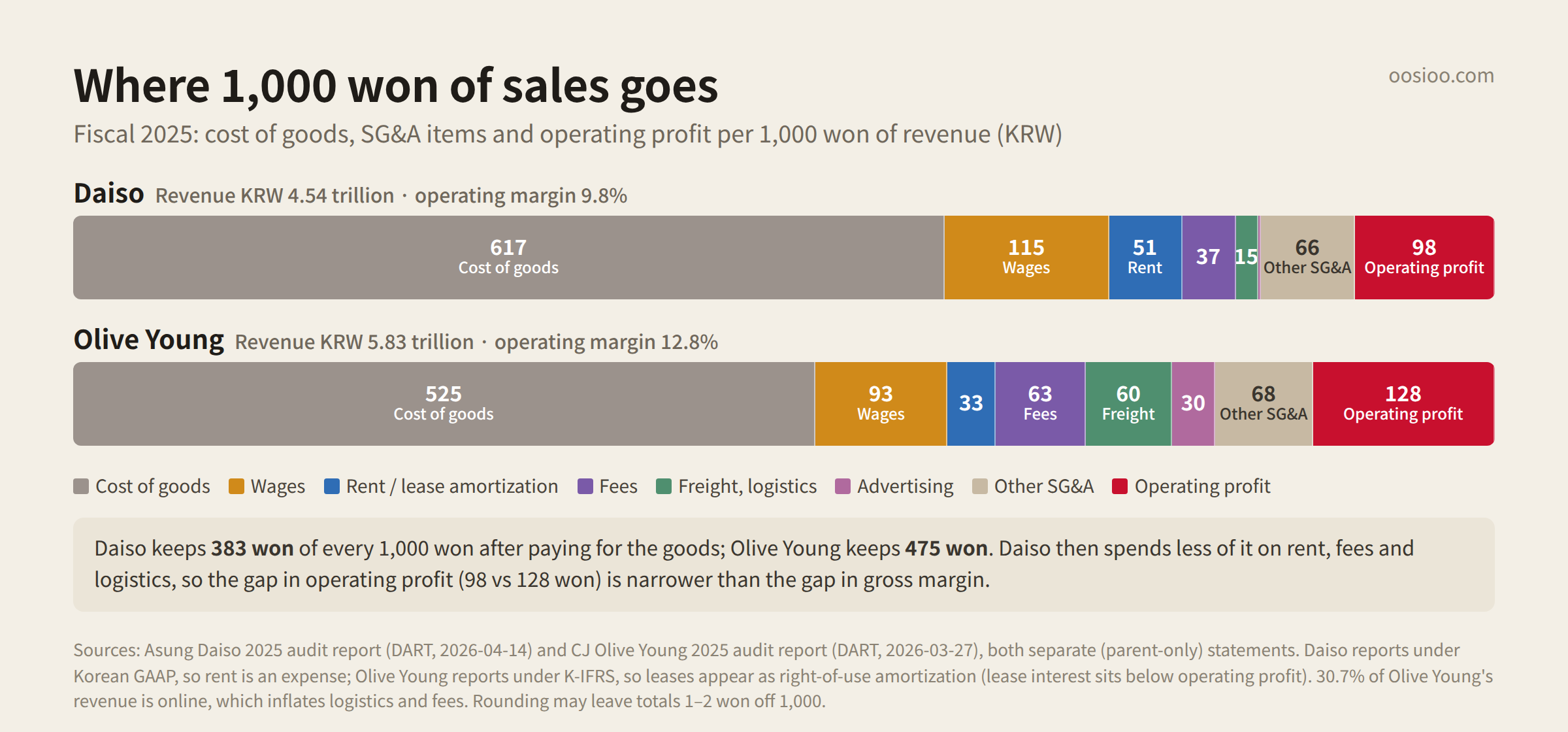
What happens next is the interesting part. From its 383 won, Daiso spends 115 won on staff wages, 51 on store rent, 37 on fees and 15 on freight. Advertising takes about 1 won: KRW 5.6 billion in 2025, or 0.12% of sales. The passers-by in front of each store are the billboard. Olive Young has 92 won more to work with but spends far more on fees (63 won), logistics (60) and advertising (30). With 30.7% of its sales online, it pays for parcels and payment fees, and it runs big promotions such as the quarterly Olive Young Sale. So the gap in operating profit narrows to 98 won against 128.
One detail in Daiso's rent is worth a look. Of the KRW 231.9 billion in lease payments it expensed in 2025, KRW 71.3 billion was "contingent rent" that varies with sales. Some of its leases, such as stores inside hypermarkets or malls, charge a percentage of sales. When sales rise, rent follows, which helps explain why rent came to exactly 5.1% of sales in both 2024 and 2025. In a bad year, the rent bill shrinks a little too.
Inventory turnover: days on the shelf
The first accounting idea is inventory turnover: a year's cost of goods sold divided by average inventory. It counts how many times the stock turns over in a year. Divide 365 by that and you get days inventory, the average number of days an item sits in the store or warehouse before it sells.
Daiso's inventory was KRW 424.2 billion at the end of 2025 and KRW 374.2 billion a year earlier, an average of KRW 399.2 billion. Divide cost of goods sold of KRW 2.7972 trillion by that and you get 7.0: the stock turns about seven times a year. In days, 52. Clearing everything on the shelves and in the warehouses takes a little under two months. The figure has barely moved: 53 days in 2022, 51 in 2023, 51 in 2024. Between 2022 and 2025, revenue grew 1.54-fold and inventory 1.45-fold. Daiso added stock at almost exactly the pace of sales. Keeping that speed while spreading 30,000 products across 1,600 stores is no small feat.
Olive Young is faster, at 41 days in 2025 (38 in 2024). Cosmetics have expiry dates and trends change quickly, so holding stock for long is costly. At the end of 2025 the company carried a KRW 23.8 billion inventory valuation allowance, the amount it had already written off in expectation that some stock would not sell at full price.
There is also a number that combines speed and margin: gross profit divided by average inventory, known in retail as GMROI (gross margin return on inventory investment). It counts how many won of gross profit each won of stock on the shelf earns in a year. For Daiso in 2025 it was about 4.4; for Olive Young about 8.0. Higher margin and faster turnover give Olive Young nearly double. Daiso instead uses the same stock to fill bigger stores with more products. A wide range is what makes customers pick up "one more thing while I'm here," and that is how the 20,000-won basket gets built.
Trade payables: stock the suppliers are carrying
The second idea is trade payables: what the store owes for goods it has received but not yet paid for. Divide payables by cost of goods sold and multiply by 365, and you get days payable, the average number of days suppliers wait for their money.
Now the three numbers join up. The company buys goods, holds them for the days-inventory period, and sells them. Card payments arrive after the days-receivable period (six to seven days for Daiso). Meanwhile, it pays suppliers after the days-payable period. So
Cash conversion cycle = days inventory + days receivable − days payable
It measures the gap between the day the company pays for the goods and the day the customer's money lands in its account. The longer the gap, the more of its own money the company has to put up. A shorter gap means less, and a negative one means the business is effectively running on its suppliers' money.
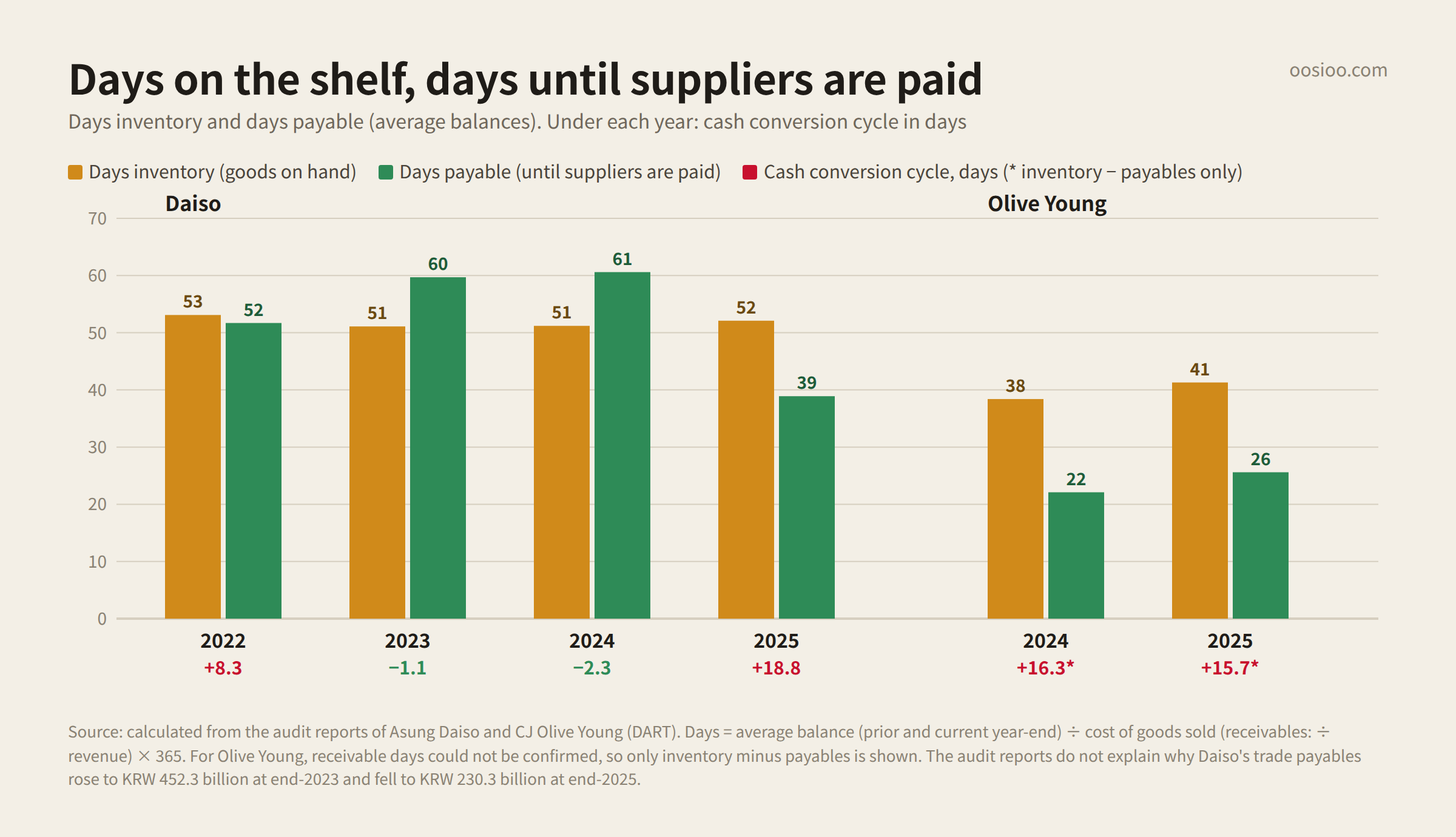
Daiso's chart is the intriguing one. Days inventory stays flat at 51 to 53 for four years, but days payable climbs from 52 to 60 and 61, then drops to 39 in 2025. In won, trade payables fell from KRW 366.5 billion at the end of 2024 to KRW 230.3 billion at the end of 2025, down KRW 136.2 billion. Sales rose 14% while the amount owed to suppliers fell 37%. At the end of 2023 it had gone the other way, jumping by more than KRW 190 billion in one year to KRW 452.3 billion.
The audit report does not say why. So I will not claim a reason here. It is worth remembering, though, that these are balances on a single day at year-end. For a company that pays suppliers on a fixed date each month, whether that date falls before or after December 31 can swing the year-end balance a lot, and an average of two year-ends is still just two snapshots. Reading one year's cycle as "Daiso has started paying suppliers faster" would be premature. Once the end-2026 figures come out, we can tell whether 2025 was an exception or a new pattern. It is on the checklist below.
Whatever the reason, the cash flow shows the trace. Daiso's 2025 operating profit was KRW 442.4 billion, but cash from operations was KRW 300.2 billion. Much of the difference is the drop in payables: money spent clearing supplier bills is money that did not stay in the bank. The same year Daiso spent KRW 326.5 billion on capital investment, including a distribution center in Sejong (press figure), and paid KRW 100 billion in dividends. Its cash and cash equivalents fell to KRW 78.8 billion at the end of 2025 from KRW 301.3 billion a year earlier. Short-term financial deposits rose from KRW 200 billion to KRW 300 billion, so the money did not run out. Still, it is plain that a few days of turnover are tied to hundreds of billions of won in cash.
Daiso's payables have a twist of their own. Of the KRW 2.8492 trillion in goods Daiso bought in 2025, KRW 728.9 billion (about 26%) came from its largest shareholder, Asung HMP, and KRW 305.7 billion from the affiliate Asung. Asung HMP owns 76% of Daiso and is also one of its biggest suppliers. When the bills get paid also decides where the money sits inside the group.
The KRW 535.2 billion of 2023
One more scene in Daiso's financial statements stands out. In 2023 total equity fell from KRW 1.0866 trillion to KRW 806.6 billion. On September 25 that year, Asung Daiso bought back 220,200 of its own shares from Japan's Daiso Industries (Daiso Sangyo) for KRW 535.2 billion, and on December 5 it cancelled them. Daiso Industries had been the second-largest shareholder, with 34.21% at the end of 2022. Once the deal closed, Asung HMP's stake rose from 50.02% to 76%.
The deal is often described as "Asung HMP buying the Japanese stake for about 500 billion won," but according to the audit report, it was Asung Daiso itself that paid. The company bought and retired its own shares, so the remaining shareholders' stakes rose automatically. It paid without borrowing, using cash on hand and that year's operating cash flow, which is why cash fell from KRW 503.0 billion to KRW 381.4 billion in 2023. After the deal, Daiso began paying dividends: four payments from an interim KRW 20 billion in May 2024 through March 2026, KRW 150 billion in total.
Playground
Now try it yourself. The calculator below looks at one year of a single flat-price store from two sides: how much is left, and how fast the money turns. You can start from Daiso 2025, Daiso 2024 or Olive Young 2025. Cost ratios, SG&A ratios and turnover days are calculated from the audit reports, and sales per store is company revenue divided by the store count. Rent is the Korea Real Estate Board's national average for mid-to-large retail space in Q3 2026 (KRW 26,700 per m² per month). Neither company discloses average store size, so I assumed 200 pyeong (660 m²) for Daiso and 50 pyeong (165 m²) for Olive Young. One pyeong is about 3.3 m².
Leave Daiso 2025 as it is and one store sells KRW 2.84 billion a year and keeps KRW 209 million (7.3%). That is below the company-wide margin of 9.8% because of rent. Multiply the average rent by 660 m² and rent takes 75 won of every 1,000, whereas the audit report shows 51. The average is for ground-floor space. Daiso stores are often upstairs, underground or inside hypermarkets, so their rent per m² is likely below average. Slide rent down to around KRW 18,000 and the result approaches the company-wide margin. Fill a big floor with many products but avoid expensive ground floors: that is the location formula of a flat-price store.
Now look at the bottom half. With 52 days of inventory, 6 days of receivables and 39 days of payables, the cash conversion cycle is 19 days. Each store holds an average of KRW 249 million in stock at cost and owes suppliers KRW 187 million, so KRW 109 million of the company's own money is tied up. Switch the preset to Daiso (2024): payables stretch to 61 days and the tied-up cash nearly disappears, down to KRW 5 million. Some 200 million won of goods sit on the shelves, but most of it has not yet been paid for. Same company, same inventory speed; only the credit period differs, by 22 days.
Move the days-inventory slider and the chart on the right shows the slope. Under Daiso 2025 settings, keeping stock 10 days longer ties up another KRW 48 million per store, or about KRW 76.8 billion across 1,600 stores. Daiso paid KRW 100 billion in dividends in 2025. Ten extra days on the shelf come close to a year of dividends.
Pick Olive Young and a store's sales (KRW 2.92 billion) are almost the same as Daiso's, but on an assumed quarter of the floor area, so sales per m² are about four times higher. Higher gross margin and faster turnover mean each won of stock earns 8.1 won. But Olive Young's costs include online logistics and fees, and rents in foreigner-heavy districts like Myeongdong and Seongsu are nowhere near the national average. Push rent up to KRW 100,000 and you get a feel for how different the math is in a tourist district.
This calculator spreads company-wide figures evenly across stores, so it is a rough sketch. Head office and distribution center costs, Daiso's sales to franchisees and Olive Young's online sales are all mixed in. A real store's profit varies widely with location, floor and lease terms.
Companies with interesting strategies
Daiso: keep the price, change the product
Daiso's price list has six slots: 500, 1,000, 1,500, 2,000, 3,000 and 5,000 won. The first note of its audit report says the same. One report says the 5,000-won ceiling has held for 20 years, and another says 1,000-won items account for more than half of products and more than half of sales (Money Today, June 2026, a single outlet).
When prices are fixed, the only thing left to adjust when costs rise is the product: a smaller size, a different material, or a different item altogether. The 600-plus new products a month are partly the result. Even so, Daiso's cost ratio in 2025 was 61.7%, almost the same as three years earlier (62.2%). It has been quite good at matching costs to fixed price slots.
Where this approach has worked best is cosmetics. According to News1, Daiso's cosmetics sales grew 85% in 2023, 144% in 2024 and more than 70% in 2025. Beauty brands went from 7 at the end of 2022 to about 150 at the end of 2025, and products from about 120 to 1,420. In September 2024, Amorepacific (Mimo by Mamonde) and LG H&H (Bio D-TD) launched brands made only for Daiso: products with different names from the ones they sell in department stores and at Olive Young, in smaller sizes, priced to fit the 3,000 and 5,000-won slots. At the end of August 2026, Daiso opened its first beauty-focused store near Konkuk University in Seoul, with more than 1,800 beauty products (Dealsite). Its fashion sales reportedly rose 140% in the first half of the year.
Elsewhere, it is spending heavily on logistics. A KRW 400 billion hub in Sejong is due for completion in January 2027 and an online-only center in February 2027, with another hub planned in Yangju, Gyeonggi Province (Bizwatch and Economist reports). Capital spending rose from KRW 37.3 billion in 2023 to KRW 326.5 billion in 2025. The online store, Daiso Mall, was only 1.6% of sales in 2024, but card-payment estimates from data firms such as WiseApp and Hankyung Aicel suggest Daiso Mall spending rose about 80% in 2025. Given that the knack for keeping stock at 52 days comes from the distribution centers, I am curious how the turnover days move once this investment is finished.
Olive Young: the same stores at home, customers from everywhere
Olive Young's quarterly revenue growth in 2025 was 14.4%, 21.0%, 26.2% and 24.6%, and in the first two quarters of 2026 it was 24.5% and 23.0%. A company with more than 5 trillion won in sales growing over 20% a year is rare. Meanwhile, its store count in Korea has stalled at around 1,380; at the end of June 2026 there were 1,153 company-run stores and 214 franchised ones. Growth has come from foreign visitors and from online.
The online share rose from 28.9% in Q1 2025 to 33.1% in Q1 2026, then eased to 30.5% in Q2. According to CJ Corp.'s Q2 2026 materials, store sales rose 22% and online 25%. The stores have kept pace with online rather than losing ground to it. But net profit in the same quarter was KRW 135.2 billion, down 6.1% from a year earlier: sales up 23%, profit down. CJ Corp. said advertising costs rose with the opening of Olive Better and overseas events such as Olive Young Festa. Quarterly operating profit is not disclosed, so we will only know whether the margin held at 12% once full-year results come out.
The company publishes plenty of numbers on foreign shoppers. In 2024, customers of 189 nationalities made 9.42 million purchases, and foreign sales grew 140%. In January to August 2026 foreign sales rose 47%, passing 1 trillion won in August, and 151 stores are classed as "global tourist district" stores. One report says 88% of cosmetics purchases processed by the tax-refund operator GTF were made at Olive Young (January to November 2025). If a tourist in Korea buys cosmetics, they almost always buy them at Olive Young.
The next step is abroad. Olive Young set up a US subsidiary in February 2025, and on May 29, 2026 it opened its first US store (803 m²) in Pasadena near Los Angeles, launching a US-only online store the same day. A second store opened at Westfield Century City in LA on June 13, and five more are planned by the first half of 2027 (Electronic Times). The start has not been entirely smooth. The same article reported that the US app was rated 2.8 out of 5 and carried about 380 brands, against about 1,300 on the existing global mall, with US shoppers asking for the global mall back. In January 2026 Olive Young partnered with Sephora, and from August 20 about 580 Sephora stores in the US began carrying the "Olive Young K-Beauty Edit," some 150 products from 19 brands. Sephora, which left Korea in 2024, is now selling Olive Young's selection.
In calculator terms, Olive Young raises sales per m² at home through foreign shoppers, and abroad it chose first to turn stock on someone else's shelves rather than build its own stores. Overseas results are still small. Its Japanese subsidiary had 2025 sales of KRW 20.0 billion and a net loss of KRW 7.9 billion (CEO Score Daily). Overseas sales in the audit report were KRW 273.4 billion in 2025, under 5% of the total.
There is a regulatory shadow too. On December 7, 2023, the Korea Fair Trade Commission ruled that Olive Young had violated the Large-Scale Retail Business Act, including by telling suppliers not to join promotions at rivals such as Lalavla and Lohb's, and fined it KRW 1.896 billion. The bigger question, whether it abused a dominant market position, was closed without a ruling. The power to hold suppliers to one chain grows from the same root as the power to turn stock quickly: a shelf that sells well is leverage over the people who supply it.
Musinsa Beauty and the shops that closed
The H&B (health and beauty) store market once had several contenders. GS Retail's Lalavla grew to 186 stores in 2017, announced its exit in August 2022 and closed its stores by the end of November that year. Lotte's Lohb's shut all its street stores in 2022 and moved into Lotte Mart locations. Sephora Korea, which opened its first store in Seoul in 2019, posted 2023 sales of KRW 13.7 billion with an operating loss of KRW 17.6 billion and announced its exit in 2024. Boots, brought in by E-Mart, closed most of its stores in 2020.
Drag the sales-per-m² slider to the left and you can guess what happened to them. Below a certain level of sales, rent and wages stay put and profit quickly turns negative. When the best-selling brands crowd into one chain, the remaining shelves turn even more slowly. The "no promotions at rivals" practice the Fair Trade Commission targeted dates from this period.
The newcomers in the gap are unexpected. One is Daiso. Another is Musinsa, which started online. Musinsa opened its first permanent beauty store (about 146 pyeong) inside its Musinsa Megastore Seongsu on April 24, 2026, and its first standalone beauty store in Hongdae on September 11 (Byline Network, My Daily). The company said Musinsa Beauty's transaction value grew more than 50% in 2025. Coupang launched R.LUX, a luxury beauty section, on October 2, 2024, and the discount cosmetics chain Off Beauty, which opened its first store at Gwangjang Market in May 2025, reportedly grew to 40 stores in a year. Olive Young still takes a large share of beauty app downloads and web visits (as reported from Sensor Tower data), but this is the first time it faces challengers in stores and online at once.
Marketing worth a look
Olive Young N Seongsu: a 1,400-pyeong cosmetics playground
On November 22, 2024, Olive Young opened "Olive Young N Seongsu" in Seoul's Seongsu district, five floors and 4,628 m² (about 1,400 pyeong). Where an ordinary store packs shelves tight, this one gives much of its space to trial zones and event areas. The company says foreign customers made up 70% of its sales within four months of opening, and 2.5 million people visited in its first year (The Fact). On sales per m² it may be less efficient than a regular store. But if it becomes the place foreign tourists "drop by in Seongsu," it works as an advertisement for the global mall and the US stores they use after flying home. That effect does not show up in the calculator. On January 30, 2026, Olive Young also opened the first "Olive Better" (about 430 m²) in Gwanghwamun, a new format built around health and wellness products.
Daiso supplements: the 3,000-won vitamins pulled in four days
On February 24, 2025, Daiso began selling health supplements in about 200 stores, with a month's supply of vitamins for 3,000 to 5,000 won. The comparison with pharmacy products costing tens of thousands of won made headlines, but pharmacists' groups pushed back, and four days later, on February 28, Ilyang Pharmaceutical withdrew its products. The Fair Trade Commission later conducted an on-site inspection of the Korean Pharmaceutical Association over the episode (Dailymedi, Financial News). It was a head-on collision between the flat-price slots and an existing channel's price structure, and it showed that a formula that worked for cosmetics does not carry over to every category.
Daiso's beauty-focused store: deep instead of wide
The beauty-focused store Daiso opened near Konkuk University at the end of August 2026 fills most of its floor with cosmetics, more than 1,800 products. If Daiso's usual formula is "30,000 products in a big store," this one goes deep in a single category instead. It competes for the same customers as the Olive Young in the neighboring streets. In calculator terms, it is an experiment in lifting gross margin by raising the share of lower-cost-ratio cosmetics and cutting days inventory by keeping only fast-moving products. The results are not yet in the numbers.
What to watch next quarter
I will score these five, in order, starting next episode. Right or wrong, the results will be published as they are.
- [ ] CJ Olive Young's Q3 2026 revenue (per CJ Corp. IR) will be at least KRW 1.8373 trillion (+18% or more on Q3 2025's KRW 1.5570 trillion). Growth was 24.5% and 23.0% in the first two quarters of 2026, and foreign sales kept rising. Q3 2025 was a high base (+26.2%), so growth may slow somewhat; I set the bar at 18%. Scored with CJ Corp.'s Q3 results, due this month.
- [ ] CJ Olive Young's Q4 2026 revenue will be at least KRW 1.8175 trillion (+15% or more on Q4 2025's KRW 1.5804 trillion). Scored with CJ Corp.'s Q4 results in February 2027.
- [ ] CJ Olive Young's store count in Korea at the end of 2026 will be lower than at the end of 2025 (1,381). The pattern of growing sales per store without adding stores continues. Scored with the store count in CJ Corp.'s Q4 materials in February 2027.
- [ ] Asung Daiso's 2026 revenue will be at least KRW 5 trillion (+10.2% or more on 2025). Growth in 2025 was 14.3%, and estimated card spending hit a monthly record in March 2026, according to press reports. Scored with the 2026 audit report, due in April 2027.
- [ ] Asung Daiso's 2026 days inventory (average balances) will be 55 days or fewer. It has been 51 to 53 for four years. The prediction could fail if Daiso stocks up at year-end ahead of the Sejong distribution center (targeted for January 2027). Scored by calculation from the same audit report, noting also whether days payable return to their 2024 level (61 days).
Closing
How a 1,000-won shop makes money turned out to be less simple than it looks. Daiso is not a thin-margin shop. It keeps 383 won of every 1,000 and spends it on big stores and 30,000 products. Olive Young keeps more and turns it faster. The real difference between them is not the price tag but how many days goods sit on the shelf and how many days later the bill gets paid.
The cash conversion cycle is this industry's hidden number. When it is negative, as at Daiso in 2024, the suppliers are effectively carrying the stock; when it turns positive, as in 2025, the company has to put up hundreds of billions of won of its own. Shoppers at the register feel none of it. Move the days-inventory slider in the playground by just ten days and you will see that the goods on those shelves add up to serious money.
Next episode I will score the five predictions above. The first answer arrives this month.
This piece summarizes public information and is not a recommendation to buy or sell any security.
Sources
- Audit reports (DART): Asung Daiso 2025 · Asung Daiso 2024 · Asung Daiso 2023 · Asung Daiso 2022 · CJ Olive Young 2025 · CJ Olive Young 2024
- CJ Corp. IR materials: Q1 2025 · Q2 2025 · Q4 2025 · Q2 2026 · Money Today, Olive Young first-half revenue (2026-08-14)
- Daiso stores, logistics, pricing: Financial News (News1), Daiso store count (2026-06-15) · Hankyung, 1,600th store (2025-08-05) · Bizwatch, Daiso logistics investment (2026-04-24) · Economist Korea, Daiso (2026-10-26) · Money Today, 1,000-won items (2026-06-06) · Digital Daily, Daiso card-spending estimate (2026-04-14) · Hankyung, Daiso Mall (2026-01-26) · CEO Score Daily, Daiso dividends (2026-04-24)
- Daiso beauty, supplements, fashion: Financial News (News1), Daiso cosmetics (2026-02-19) · Dealsite, Daiso beauty store (2026-09-23) · Dailymedi, Daiso supplements · Financial News, Ilyang withdrawal (2025-02-28) · New Daily, Daiso fashion (2026-07-24)
- Olive Young foreign shoppers and global: CJ Newsroom, 9.42 million foreign purchases in 2024 (2025-02-26) · CJ Newsroom, foreign sales pass 1 trillion won (2026-08-31) · Herald Business, foreign purchases and GTF 88% (2025-12-03) · Daily Pharm, foreign share · CosInKorea, Pasadena store · Electronic Times, second US store (2026-06-14) · CJ Newsroom, Sephora partnership · Insight, K-Beauty Edit at Sephora (2026-08-05) · CEO Score Daily, Olive Young overseas subsidiaries (2026-05-07)
- Olive Young stores, marketing, regulation: New Daily, Olive Young N Seongsu (2024-11-21) · The Fact, Olive Young N Seongsu after one year · Byline Network, Olive Better (2026-01-30) · Newsis, Fair Trade Commission fine (2023-12-07) · Herald Business, H&B competition and Off Beauty (2026-06-30)
- Competition and exits: Byline Network, Lalavla exit (2022-08-12) · Bizwatch, Lalavla (2022-08-18) · Economist Korea, Lohb's (2021-11-05) · Vogue Korea, Sephora exit (2024-03-20) · Dealsite, Boots · Byline Network, Musinsa Beauty Seongsu (2026-04-22) · My Daily, Musinsa Beauty Hongdae · Byline Network, Musinsa Beauty growth (2026-01-27) · Byline Network, Coupang R.LUX (2024-10-02)
- Calculator defaults: SBS Biz, Korea Real Estate Board Q3 2026 commercial rent survey (2026-10-29)