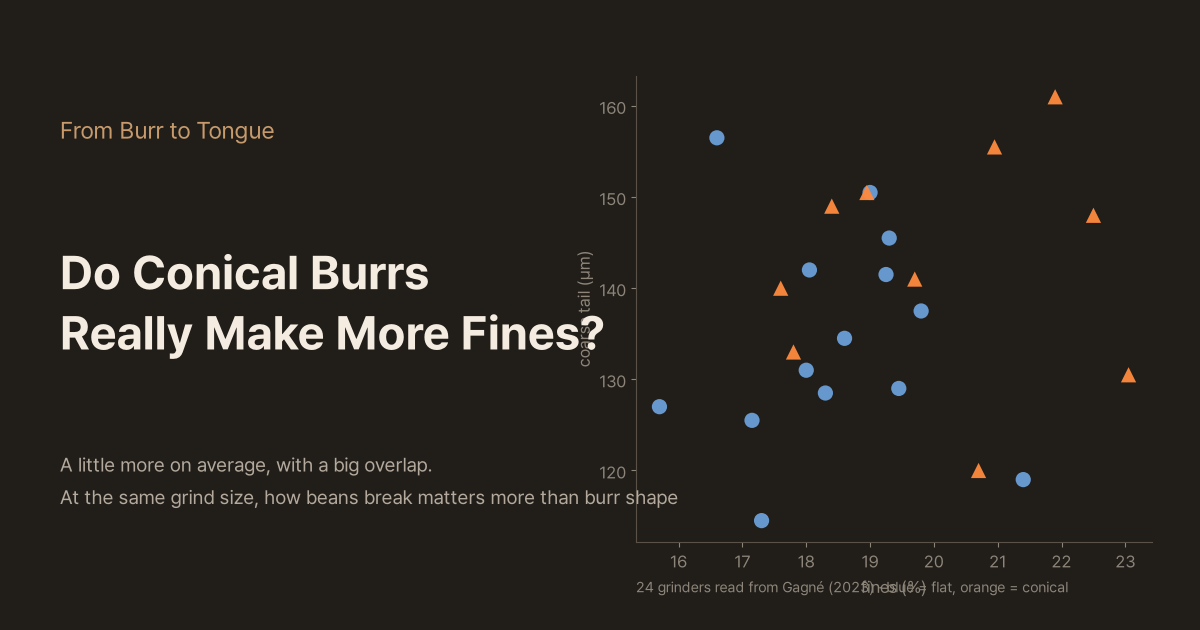
Do Conical Burrs Really Make More Fines?
How true is it that conical burrs make more fines and two peaks while flat burrs grind evenly? In data from 24 espresso grinders (Gagné 2023), conicals averaged 1.8 points more fines, but the grinders overlapped heavily and all 24 had two peaks. Matching twelve virtual flat and conical burrs to the same grind size, the difference in fines was only about 0.4 points; the real difference was a long coarse tail in slowly turning conicals. With a tool for comparing them yourself.
There is something you hear a lot when choosing a grinder. Conical burrs make more fines, so their distribution has two peaks; flat burrs grind evenly, so theirs has one. That is supposedly why coffee from a conical grinder has a heavy body and coffee from a flat grinder tastes clearer. Retailer pages and coffee blogs say it in almost the same words. How far is it true?
Start with the measurements, and the average holds up. In a dataset that measured 24 espresso grinders with the same coffee and the same instrument, the conicals had 1.8 percentage points more fines on average. But the grinders overlapped a great deal, and a few conicals had fewer fines than most of the flats. I put the same question to the virtual flat and conical burrs from the last two episodes. Matched to the same grind size, the difference in fines was only a little over 0.4 percentage points. The bigger difference showed up in the coarse tail, and only in conicals that turned slowly.
Where the belief comes from
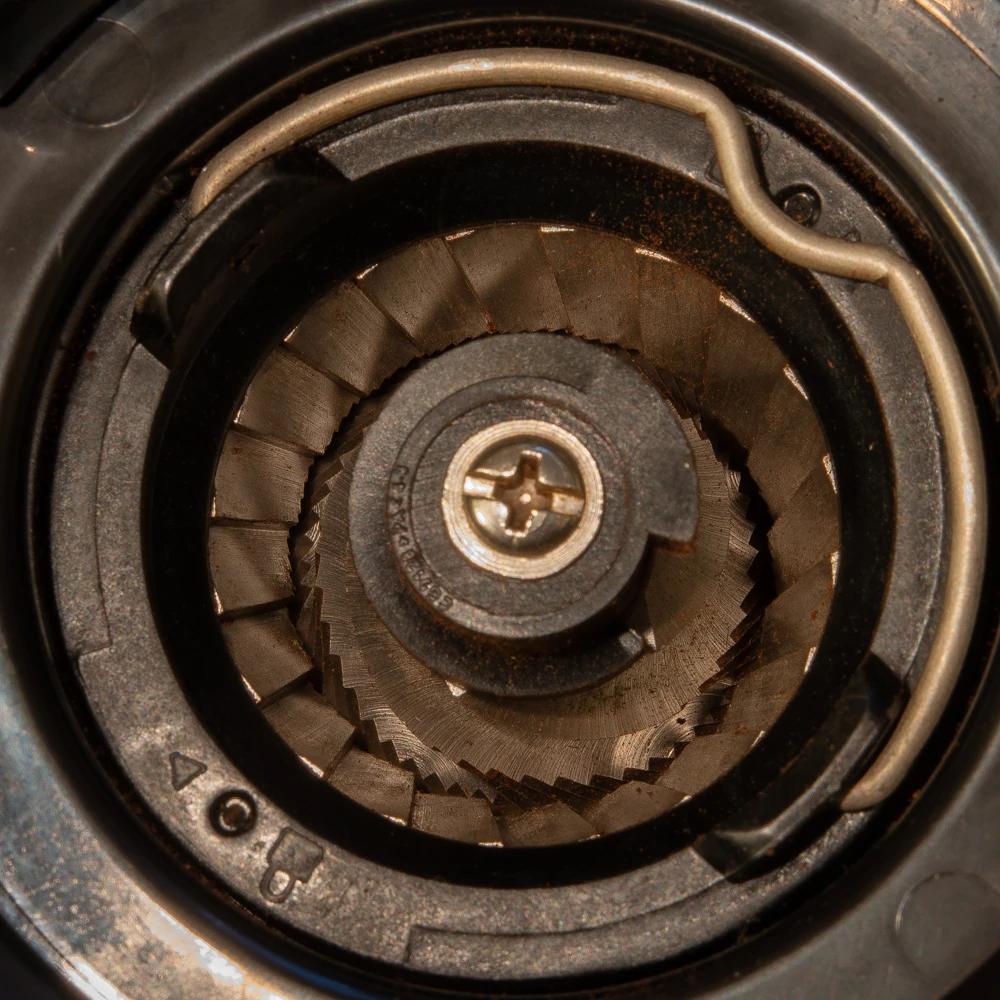
A conical burr in an electric grinder: the coarse teeth of the outer ring and the fine teeth of the inner cone · Photo: Matthew Hill (Fletcher), Wikimedia Commons, CC BY 4.0
"Conicals have two peaks, flats have one" is easy to find on retailer pages and coffee blogs. One retailer's blog says conical burrs grind to two sizes, while with flat burrs "all the grinds produced are relatively the exact same size". It gives speed, heat and the direction the grounds come out as reasons. Another coffee guide says the same thing but adds that "this rule doesn't always fit". An influential coffee author wrote on his blog that "conical burrs generally produce more fines than flat burrs do". None of the three gives any measurements.
The explanations offered are usually similar: conicals turn slowly; the large teeth at the top and the long grinding path break beans many times; the inner cone, supported on only one side, wobbles. They sound plausible, but none of them has been tested on its own.
And "flats have one peak" is not true at espresso fineness to begin with. The coffee research group at the Zurich University of Applied Sciences writes that espresso grounds have a "characteristically bimodal" distribution (Smrke and colleagues 2024). The same paper starts from the fact that, for the same median size, the share of fines (below 100 µm) depends on the grinder. As we saw in "A Distribution with Two Peaks", the fines peak is tied to the size of the bean's cells, so it appears whatever the burr. What really needs examining is not how many peaks there are but how big the fines peak is.
Twenty-four grinders
The largest comparison is Gagné's (2023) reanalysis. The Swiss coffee school Kaffeemacher ground the same Brazilian natural coffee at several settings on 24 espresso grinders (14 flat, 10 conical). The Zurich University of Applied Sciences measured the grounds with an image-analysis instrument (Camsizer X2), producing about 300 distributions. For each grinder, Gagné fitted a curve through the points measured at different settings and read off two values at a median size of 340 µm: the volume share below 100 µm (fines), and the right-hand half-width of the coarse peak (the coarse tail). In effect, he compared the grinders at the same grind size.
The raw data are not public and the figures carry no licence, so I redrew them from values read by eye from the figures. They may be off by about 0.2 percentage points and 2 µm.
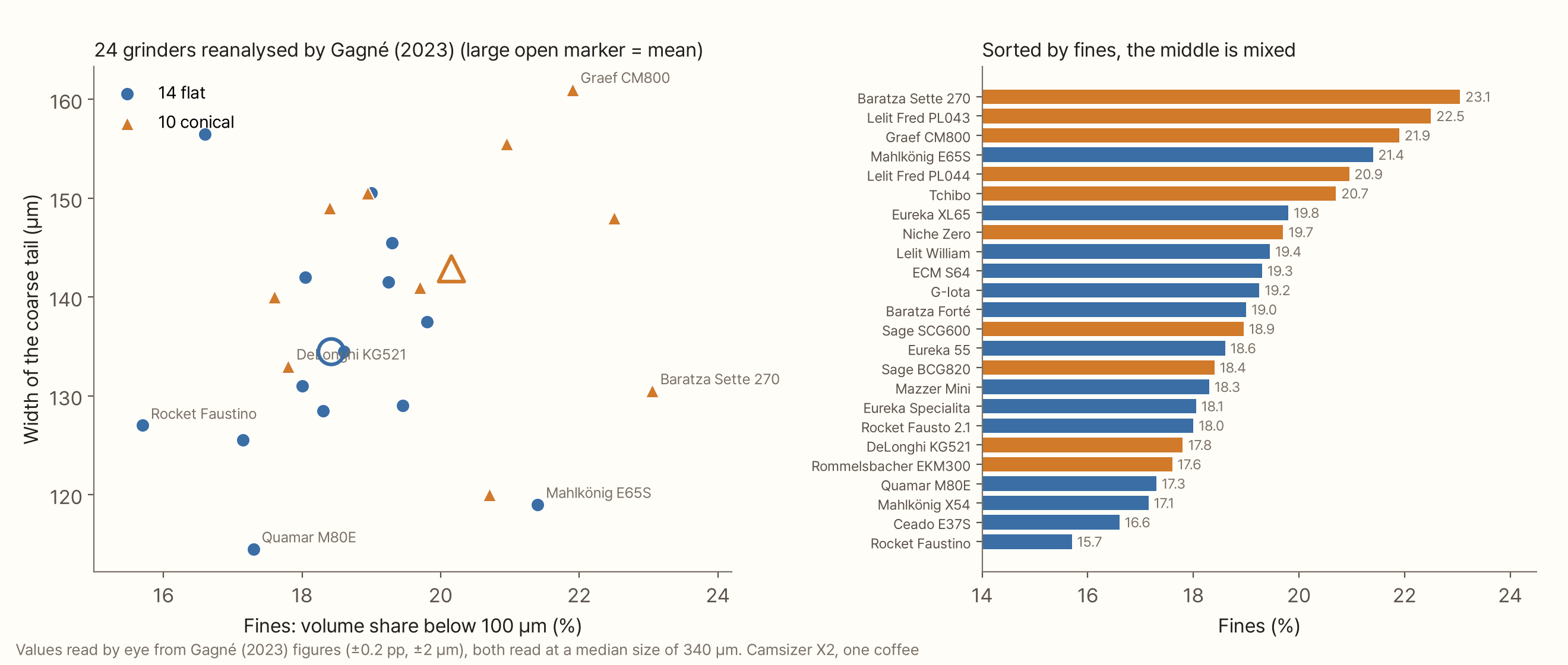
On average, the belief wins. The 14 flats had 15.7–21.4% fines, averaging 18.4%. The 10 conicals had 17.6–23.1%, averaging 20.2%. The conicals' coarse tail was also 9 µm wider on average. Gagné concluded that conicals are "on average" less unimodal and less uniform. Here "unimodal" does not mean having one peak; it means having fewer fines. All 24 grinders had two peaks at espresso fineness.
Line them up, though, and they are mixed. The four with the fewest fines are all flat and the three with the most are all conical, but everything in between is jumbled. Two conicals, the Rommelsbacher and the DeLonghi, had fewer fines than ten of the flats. The Mahlkönig E65S, a flat, had more fines than seven of the conicals. Even among flats, fines vary by 5.7 percentage points, three times the 1.8-point difference between the two averages. Gagné found no clear trend with speed or burr diameter either; instead, he wrote, "burr teeth geometry and coating appear much more important". He also noted that there was no way of knowing how well each grinder was aligned.
Twelve virtual grinders
I used virtual burrs to ask whether the type itself sets the fines, or whether the design within a type does. Taking the two models from "The Path of a Bean Through a Flat Burr" and "The Path of a Bean Through a Conical Burr" as they were, I varied the design to make six virtual grinders of each type.
- Flat: default (1,000 rpm, teeth +15°), 600 rpm, 1,500 rpm, teeth 0°, teeth +30°, longer narrowing zone
- Conical: default (400 rpm, helix 20°), 100 rpm, 1,000 rpm, helix 10°, helix 30°, longer narrowing zone
Each ground 16 beans twice, at gaps of 0.8 mm and 1.1 mm. There were originally seven of each type, but in one flat and one conical, pieces jammed at the tip of the wedge, so I left them out.
In this model, fines are the crumbs shed every time a bean breaks. At each break, 8% of the piece's volume is set aside as powder smaller than the model's resolution (400 µm). As we saw in "Fines Are the Size of a Cell", real fines also come from cells crushed where a bean breaks. So the crumb share tells you how many times the beans were broken. The absolute level (in the 40s, in percent) comes from my choices of 8% and 400 µm and cannot be set against Gagné's 18–20%. What can be compared is the difference between grinders.
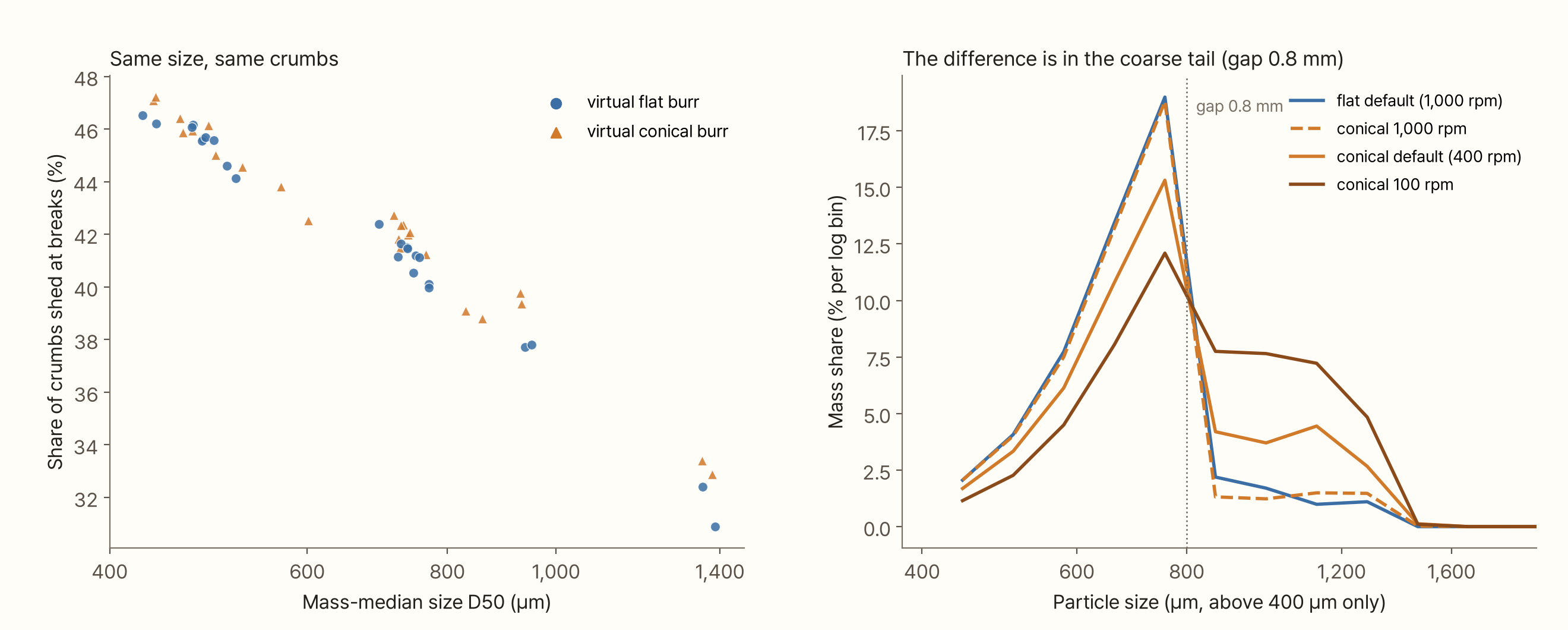
Plot the 48 runs by D50 and crumb share, and they fall on a single curve. Flat or conical, a D50 of about 480 µm came with about 46% crumbs, and a D50 of about 730 µm with 41–42%. To reach the same size you have to split the beans the same number of times, and every split sheds the same share. Measuring how far each run sits from the common curve, conicals were 0.26 points above on average and flats 0.26 points below. The direction matches the belief, but the size is small, smaller even than the scatter between runs (standard deviation 0.6 points).
The difference shows up on the coarse side, on the right. At the same 0.8 mm gap, the flat and the 1,000 rpm conical peak just below the gap with almost nothing above it. The 400 rpm conical grows a shoulder at 0.9–1.4 mm, and at 100 rpm that shoulder becomes a broad hill. The mass share of pieces larger than the gap was 4–9% for the flats, 6% for the 1,000 rpm conical, 15% at 400 rpm and 28% at 100 rpm.
Matched to the same grind size
Just as Gagné read every grinder at a median size of 340 µm, I joined the results at the two gaps for each virtual grinder and read them at D50 = 600 µm. The two with teeth or helix laid down to 30° were coarser than 600 µm at both gaps, so I left them out. That leaves ten.
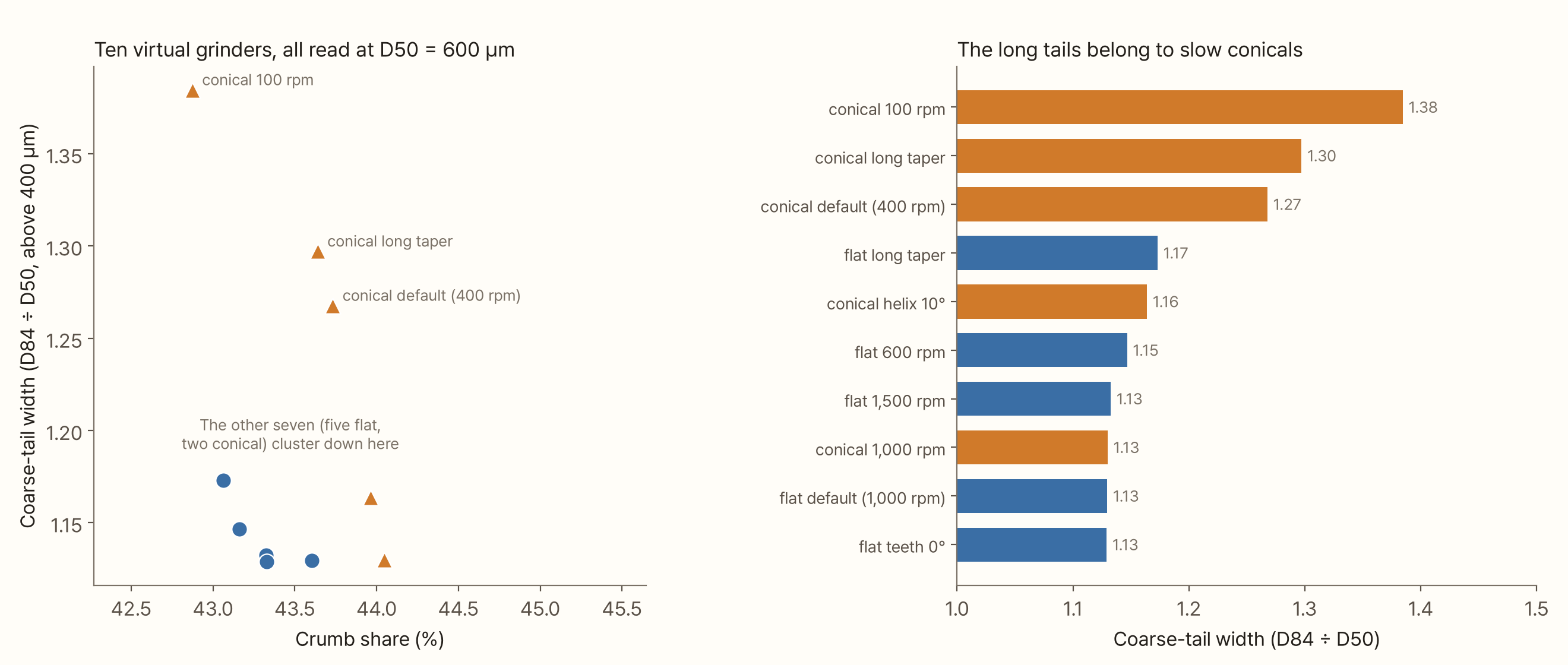
The five flats had crumb shares of 43.1–43.6%, averaging 43.3%. The five conicals had 42.9–44.1%, averaging 43.7%. The conicals have 0.4 points more, but the two ranges overlap. The lowest is a conical (100 rpm) and so is the highest (1,000 rpm). The pattern is the same as in Gagné's data: the averages differ a little and the ranges overlap a lot. The size, though, is about a quarter of Gagné's 1.8 points.
The coarse tail was different. The tail width, D84 divided by D50, was almost the same for the five flats, at 1.13–1.17. The conical was 1.13 at 1,000 rpm, the same as the flats, and 1.16 with a 10° helix. The default (400 rpm) was 1.27, the longer narrowing zone 1.30, and 100 rpm 1.38. In this model, "conicals are less uniform" happens not because they are conical but because they turn slowly.
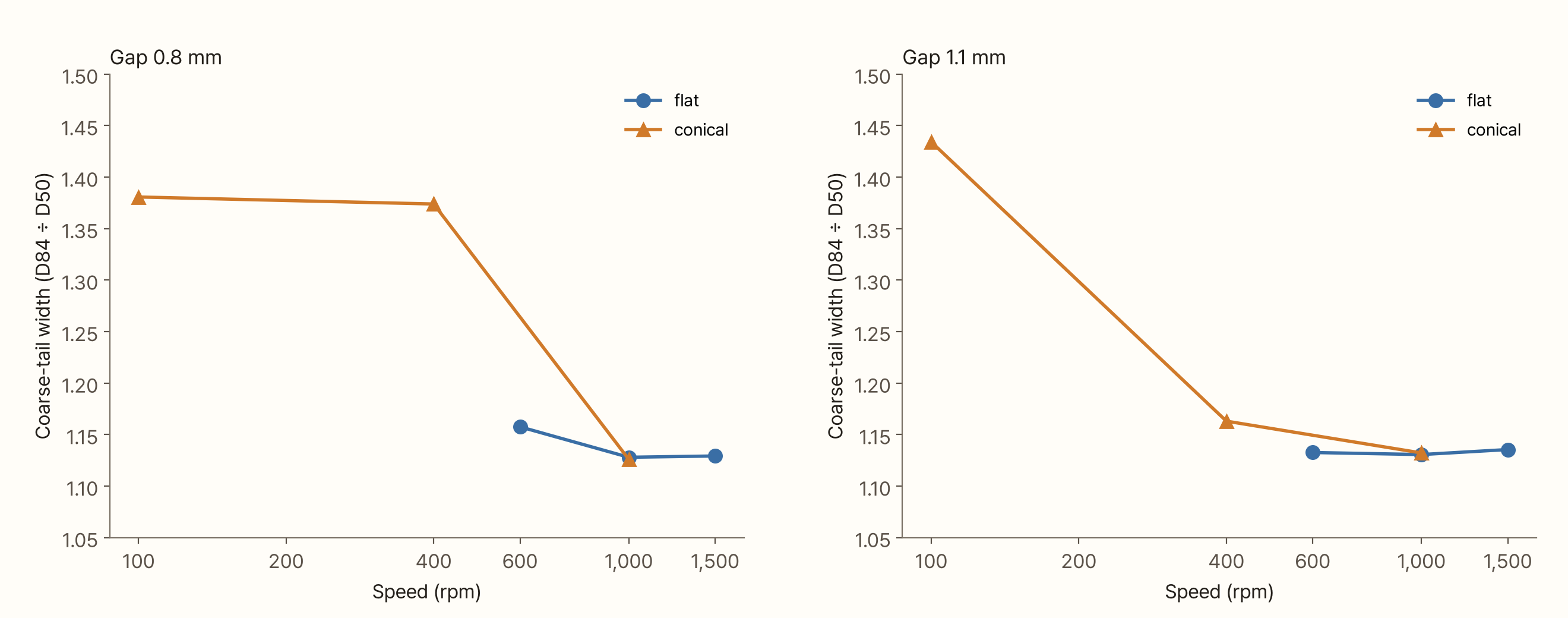
Changing only the speed makes it clearer. The flats' tail width barely moved between 600 and 1,500 rpm. The conicals' tail grew longer the slower they turned, and matched the flats at 1,000 rpm. As we saw in "The Path of a Bean Through a Conical Burr", a conical burr has two clocks. Turn it slowly, and pieces larger than the gap but small enough to slip through the finishing band (gap ÷ flatness) get out before the next tooth arrives. But switching gravity off at 400 rpm left the coarse tail almost unchanged (last episode's experiment), so gravity alone does not explain it. There must be another reason why pieces meet fewer teeth at low speed, and this round of calculations could not separate it out.
Most real conical grinders are slow. Gagné also noted that the conicals in this sample "use slower rpms on average". If so, part of the average tendency for conicals to be less uniform may be down to speed. Gagné found no trend with speed when all 24 grinders were put together, but what this model describes is a different comparison: the same conical burr, turned more slowly. Measurements that change only the speed of one conical grinder would settle it. Electric grinders with adjustable speed exist, so the experiment can be done.
Where does the rest of the difference come from?
The virtual burrs in this model follow the same breakage rule whatever their type. A piece breaks when a force crosses a threshold, and the same share becomes crumbs at every break. Under those conditions, the difference in fines produced by burr shape and rotation was a little over 0.4 points at the same grind size. If the 1.8 points in Gagné's data are a real difference, the rest must come from things this model lacks. The candidates:
- How the teeth break the bean. Sharp teeth that cut and blunt teeth that crush may shed different amounts of crumbs. This model does not tell them apart
- Impact speed. There is no rule that faster impacts break pieces finer
- Alignment and wobble. If a cone supported on one side wobbles, the gap changes even within one turn. Gagné, too, said alignment was not controlled
- Heat, static electricity and grounds retained in the burrs
And the bigger differences in Gagné's data were within each type: 5.7 points among the flats and 5.5 among the conicals. In this model, too, speed alone changed the coarse tail of a single type from 1.13 to 1.38. When choosing a grinder, it is better to ask "what does this grinder's distribution look like?" than "is it conical or flat?".
Compare for yourself
The first tab of the tool below redraws the 24 grinders read from Gagné's (2023) figures. Tap a point to see the grinder's name and values, and how many grinders of the other type have more (or fewer) fines than it. You can switch each type on and off. In the second tab, pick two virtual grinders and overlay the distributions of grounds they produced at the same gap. It also shows D50, crumb share, coarse-tail width, the share larger than the gap and the number of times a bean broke.
Pick the flat default and conical 100 rpm, and the hill on the coarse side is right there. Pick the flat default and conical 1,000 rpm, and the two lines almost overlap.
What this conclusion leaves out
- Gagné's values were read from figures. The raw data are not public, so I read them by eye; they may be off by about 0.2 points and 2 µm. Each grinder was a single unit, and there was one coffee
- The virtual grinders are 2D and the burrs are virtual. They carry all the limitations of the last two episodes. In particular, I chose the dimensions and tooth layout of both burr types, so they cannot be called "a flat and a conical under the same conditions"
- Fines are below the model's resolution. I did not compute anything below 100 µm directly; I counted the 8% shed at every break instead. So the absolute level cannot be compared with measurements, and differences in fines caused by how beans break are absent from the start
- A D50 of 600 µm is coarser than espresso. The 340 µm Gagné compared at is below this model's resolution, and I could not check whether the finer end looks the same
- I could not pin the long coarse tail on a single cause. Slow rotation is the cause, but gravity alone did not explain it
- Beans were fed one every 4 ms. In a real grinder, the feed rate changes with speed, and the beans piled in the hopper press down
Summary
- "Conicals have two peaks, flats have one" is not true at espresso fineness. All 24 grinders Gagné reanalysed had two peaks. What matters is the size of the fines peak
- On average, the belief holds. The 10 conicals averaged 20.2% fines, 1.8 points more than the 14 flats (18.4%), and their coarse tail was 9 µm wider. But two conicals had fewer fines than ten of the flats, and the spread within each type (5.5–5.7 points) was three times the difference between the averages
- In twelve virtual flat and conical grinders, the crumb (fines) share was set almost entirely by D50, whatever the burr type. At a D50 of 600 µm, the conicals had 0.4 points more on average, but the ranges overlapped
- The difference was in the coarse tail. The flats' tail width stayed at 1.13–1.17, while the conical was 1.13 at 1,000 rpm, 1.27 at 400 rpm and 1.38 at 100 rpm. In this model, conicals are less uniform because they turn slowly
- If Gagné's 1.8 points are real, most of it must come from things this model lacks: how teeth break beans, impact speed, alignment, heat. When choosing a grinder, look at that grinder's measured distribution rather than its type
References
- Gagné J (2023). What I learned from analyzing 300 particle size distributions for 24 espresso grinders. Coffee ad Astra. link — measured by Kaffeemacher and the Zurich University of Applied Sciences (Camsizer X2); per-grinder values are approximations read from figures
- Smrke S, Eiermann A, Yeretzian C (2024). The role of fines in espresso extraction dynamics. Scientific Reports 14. doi:10.1038/s41598-024-55831-x
- LaTour R (2021). Conical vs. flat burrs. Prima Coffee blog. link — an example of the belief
- Honest Coffee Guide (2019, revised 2024). Flat vs conical burr grinders. link — an example of the belief (with a caveat)
- Rao S (2023). The happy medium amount of fines. link — an example of the belief
- Cundall PA, Strack ODL (1979). A discrete numerical model for granular assemblies. Géotechnique 29(1), 47–65. doi:10.1680/geot.1979.29.1.47
Image credits
- Conical burr in an electric grinder: Matthew Hill (Fletcher), Wikimedia Commons, CC BY 4.0
- 24-grinder chart: redrawn from values read from Gagné's (2023) figures
- All other charts, the cover and the comparison tool: made by me
