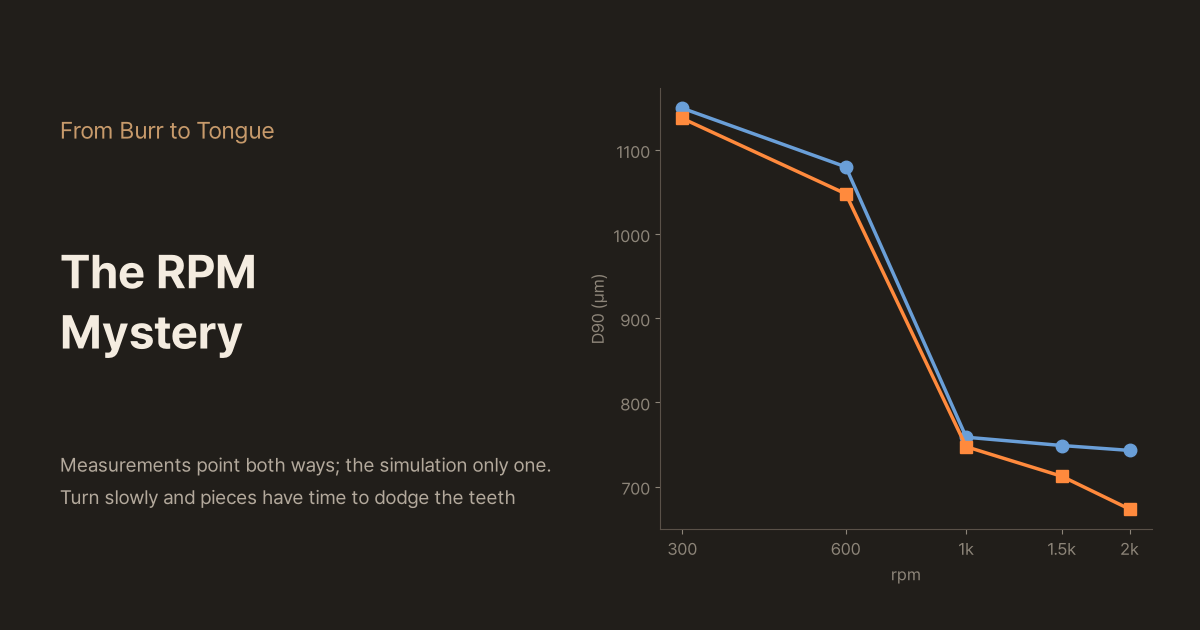
The RPM Mystery
Raise the speed at the same setting: do the grounds get finer or coarser? Measurements and patents split into "faster is finer", "faster is coarser" and "no difference". Changing only the speed of a 3D virtual flat burr, faster always meant finer (D50 697 µm at 300 rpm, 430 µm at 1,000 rpm): at low speed, gap-sized pieces dodged the teeth and slipped out. "Faster is coarser" never appeared in the model; I list candidate reasons. With a comparison tool.
With variable-speed grinders now common, choosing a speed has become a new thing to worry about. Retailers mostly say that grinding slower means fewer fines and a cleaner cup. But gather the measurements and patents together and they split two ways. Some measurements found that raising the speed at the same setting made the grounds finer; others found it made them coarser. Some found almost no difference.
I took the 3D flat burr from the last episode and ground beans at different speeds, changing nothing else. In this model, faster always meant finer. The difference between 300 and 1,000 rpm was large; above 1,000 rpm it was small. The opposite result, coarser when faster, did not appear under any setting of this model. Why the measurements disagree is still unknown.
Claims that point both ways
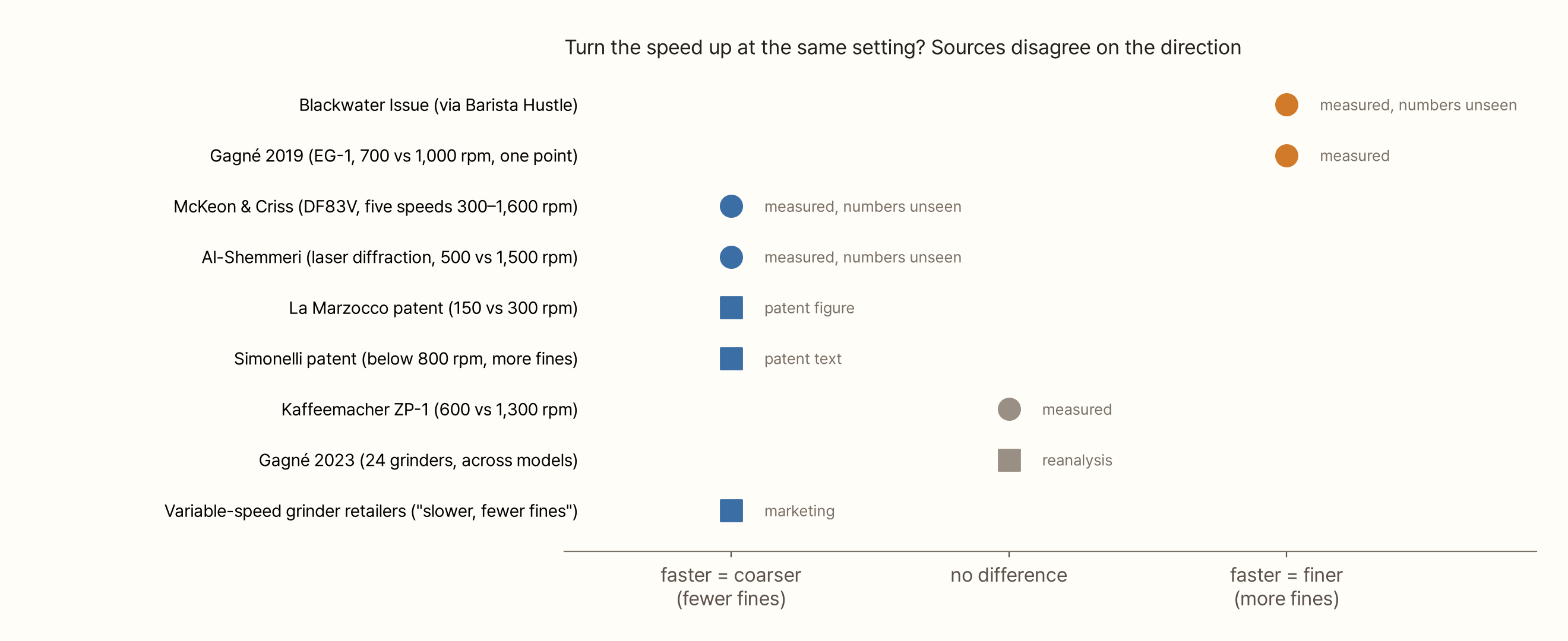
Start with "faster is finer". Barista Hustle reproduced a graph from an article in the Korean magazine Blackwater Issue showing that higher speed gave a smaller median size and more fines. Gagné (2019), while breaking in burrs, recorded that a sample accidentally taken at 1,000 rpm came out finer than one at 700 rpm; it is a single point.
There is also "faster is coarser". Robert McKeon Aloe and Aaron Criss ground on a DF83V at five speeds from 300 to 1,600 rpm with the same gap, and wrote that the distribution moved coarser and fines fell as speed rose. Mark Al-Shemmeri reported from laser diffraction that, in the fine range, 500 rpm gave more than 7 points more fines than 1,500 rpm. I could not open either original and confirmed them only through search summaries. A La Marzocco patent states that the first peak of the distribution sat at about 425 µm at 150 rpm and about 475 µm at 300 rpm. A Simonelli patent likewise says to grind below 800 rpm to increase fines. The retailers' line that "slower means fewer fines" points the same way, without numbers.
Some measurements found no difference. Kaffeemacher ground on a WPM ZP-1 at 600 and 1,300 rpm and measured with a Camsizer; the width of the main peak was almost the same, 233.6 µm and 231.0 µm. When Gagné (2023) reanalysed 300 distributions from 24 grinders, he found no clear trend between speed and distribution shape either, though that compares different grinders with one another.
The comparisons themselves are mixed. Some measurements changed only the speed at the same setting; others re-dialled so that the shot ran in the same time before comparing. If raising the speed at the same setting makes grounds coarser, then tightening the setting to get the same taste may bring the fines back. Burr design, how beans are fed (a full hopper or a slow trickle) and how much the motor slows under load also differ from grinder to grinder.
Grinding in the model
I ran the 3D flat burr from last time (64 mm, gap 1.2 mm) at 300, 600, 1,000, 1,500 and 2,000 rpm, feeding 12 beans one every 4 ms, and ground twice with different seeds. I tried three breakage rules.
- Force threshold only: as in earlier episodes. A particle breaks when the force on it exceeds its breaking force
- Same beans per turn: the same rule, but the feeding interval is inversely proportional to speed, so that, like a real grinder, more beans go in when it turns faster
- Impact breakage too (hypothesis): on top of the force threshold, a particle breaks with some probability if it is hit fast enough. I borrowed a Vogel–Peukert-type formula from impact comminution research (breakage probability = 1 − exp(−f·x·(v²/2 − threshold))). There are no values fitted to coffee, so I set the threshold speed for a whole bean to 1.5 m/s and made it higher for smaller pieces. This is an assumption without support
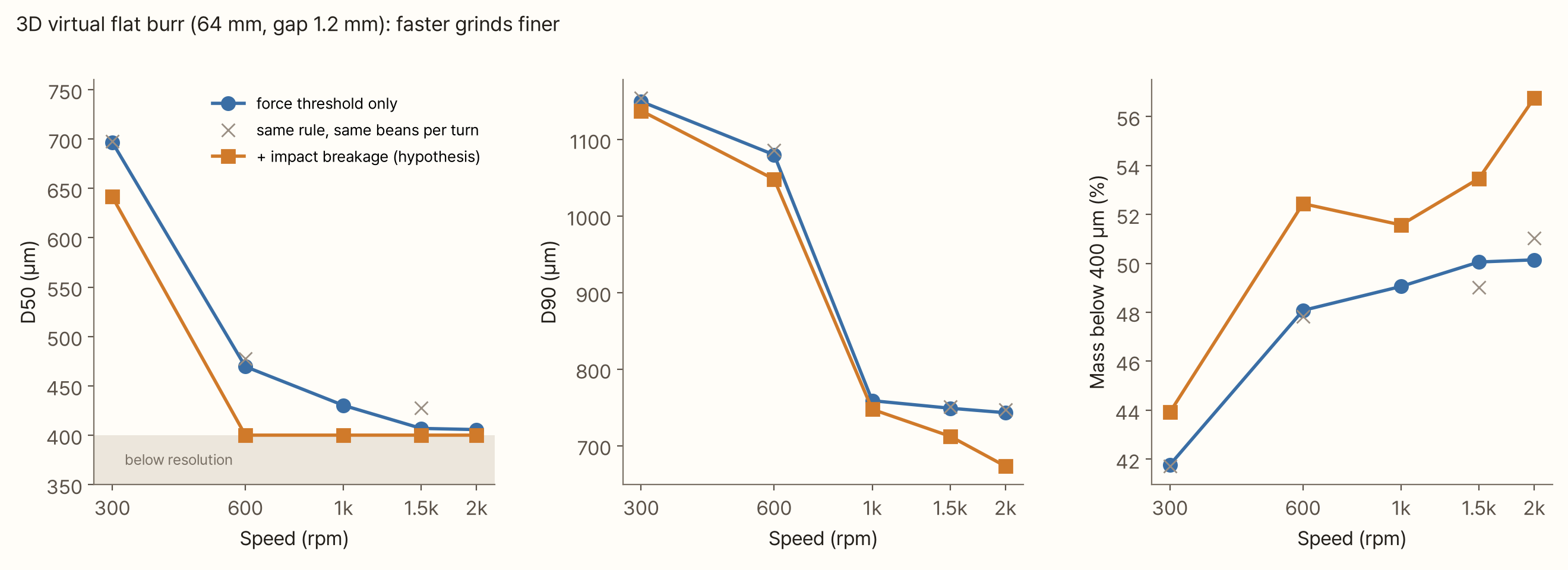
With only the force threshold, the faster the burr turned, the finer the grounds. D50 was 697 µm at 300 rpm, 469 µm at 600, 430 µm at 1,000 and 406 µm at 2,000. D90 stayed close to the gap (1.2 mm), at 1.08–1.15 mm, up to 600 rpm, then dropped sharply to 759 µm at 1,000 rpm. The mass below 400 µm rose from 42% to 50%. Feeding the same number of beans per turn gave almost the same result; the feed rate did not change the grind size in this range.
This differs from the 2D result in "The Path of a Bean Through a Flat Burr", where changing speed left D50 almost unchanged at 480–510 µm. In 2D, height was a number and the condition for catching on a tooth was a rule; in 3D, pieces really move above and below the teeth. That difference brought the speed effect to light.
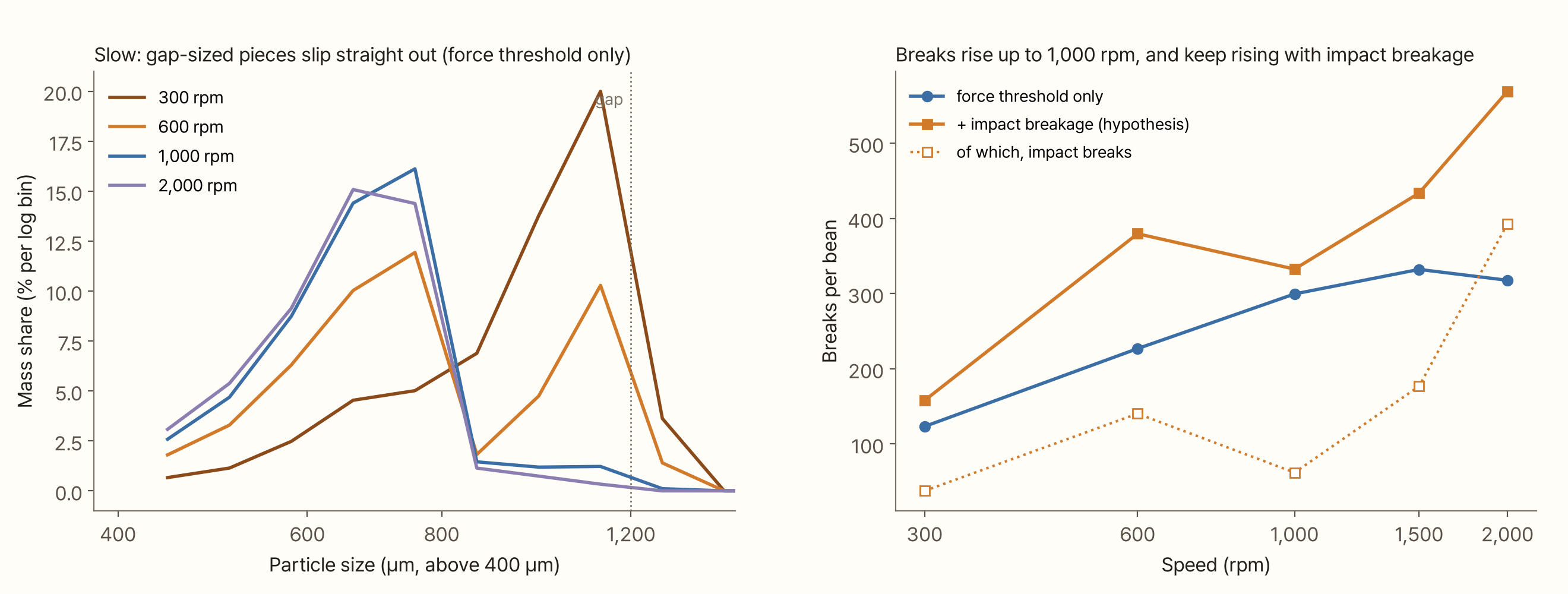
The distributions show what happens. At 300 rpm, pieces just under the gap (1.15 mm) made up a large share of the mass. Such pieces do not touch both faces, but they do catch on the stationary burr's teeth. At low speed, these pieces left the finishing band unbroken. Above 1,000 rpm, pieces of that size hardly remained, and the number of breaks per bean rose from 123 to 299.
In this model, the force a piece receives from a tooth grows with the speed at which the tooth approaches. A piece caught between two teeth crossing quickly receives a force above its threshold before it can move aside; when they cross slowly, it has time to roll over the tooth. If this interpretation holds, the speed at which the effect appears depends on how stiff the particles are. To keep the calculation affordable, the model's particles are much softer than real beans. So the 600–1,000 rpm boundary cannot be carried over to real grinders; only the direction can.
Adding the impact hypothesis kept the effect going above 1,000 rpm. At 2,000 rpm, a bean broke 569 times, 393 of them from impacts. D90 went down to 673 µm and the mass below 400 µm up to 56.7%. But the edge speeds of burr grinders are far lower than those of the impact mills such formulas are used for.
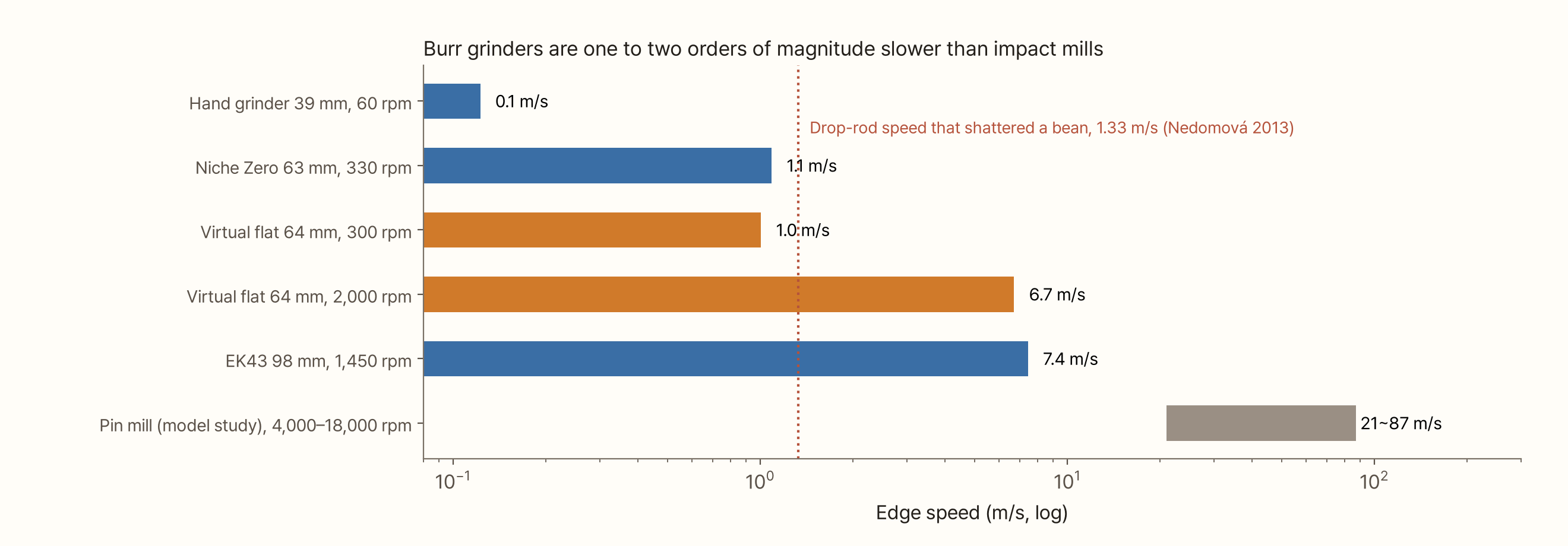
Mills that pulverise by impact, such as pin mills, spin their tips at 21–87 m/s. Burr grinders run at 0.1–7 m/s, one to two orders of magnitude slower. Burr grinders break beans more by squeezing and rubbing than by striking. Still, beans are fragile under impact. In tests by Nedomová and colleagues (2013), a rod dropped from 90 mm (about 1.33 m/s) shattered a bean, and the breaking force under fast loading was 20–25% higher than under slow loading. There are still no values describing how coffee beans break on impact.
Why the measurements disagree
Whether it had only the force threshold or impact breakage as well, this model only ever produced "faster is finer". Half of the measurements point the other way, so they must contain something this model lacks. The candidates:
- Gap changes under load. When grinding, the burrs push each other apart. Depending on motor torque and the stiffness of the shaft and burr carrier, the real gap opens wider than the setting, and by how much may depend on speed and feed rate. In this model the burrs do not move
- Popcorning. If beans bounce on top of the burrs, some escape through the large gap. Gagné (2019) wrote that feeding beans one at a time gave a mean particle cross-section about 0.08 mm² coarser than with a full hopper. If speed changes how much beans bounce, it changes the grind size too
- Air and heat. Fast burrs move air that carries fines away, and heat and static change clumping. The model has no air
- Burr design. Gagné also pointed out that the same change in speed acts differently on different burrs. This model has only one burr
Compare for yourself
The tool below holds the results of the experiments above. Choose a breakage rule and change the speed, and the distribution at that speed is drawn over the one at 1,000 rpm, with D50, D90, the mass below 400 µm, breaks and residence time.
What this conclusion leaves out
- Particles are softer than real beans. To save computing time, I lowered the particle stiffness. The boundary where the speed effect appears (600–1,000 rpm) depends on this stiffness and cannot be transferred to real grinders
- The impact-breakage values are made up. I found no data on how coffee beans break depending on impact speed
- The burrs do not move. There is no gap opening under load and no motor slowing down
- No air, heat or static electricity
- Gap 1.2 mm, spherical particles, 12 beans ground twice. The same limits as last time
- Many measurements were confirmed only through search summaries. I could not open the McKeon & Criss, Al-Shemmeri or Barista Hustle originals
Summary
- Measurements and claims about the effect of speed split into "faster is finer", "faster is coarser" and "no difference". Same-setting and same-taste comparisons are mixed, and every grinder is different
- In the 3D virtual flat burr, faster meant finer. With only the force threshold, D50 fell from 697 µm at 300 rpm to 430 µm at 1,000 rpm, and the mass below 400 µm rose from 42% to 49%. Matching the feed rate to speed gave the same result
- At low speed, gap-sized pieces dodged the teeth and slipped straight out. Where this boundary lies depends on particle stiffness, so the model can only tell the direction
- Adding the impact hypothesis made grounds keep getting finer up to 2,000 rpm. Even so, burr edge speeds (0.1–7 m/s) are one to two orders of magnitude below those of impact mills (21–87 m/s)
- "Faster is coarser" never appeared in this model. Burrs being pushed apart under load, popcorning and airflow are the candidates
References
- Gagné J (2019). Seasoning grinder burrs and grind quality. Coffee ad Astra. link
- Gagné J (2019). Grind quality and the popcorning effect. Coffee ad Astra. link
- Gagné J (2023). What I learned from analyzing 300 particle size distributions for 24 espresso grinders. Coffee ad Astra. link
- Barista Hustle (2020). Coffee grinder RPM. link — paywalled, confirmed only via search summary
- McKeon Aloe R, Criss A. DF83v coffee grinder RPM analysis. Medium. link — confirmed only via search summary
- Kaffeemacher (2026). WPM ZP-1 review. link
- La Marzocco, US Patent 12,329,319 B2. link
- Simonelli Group, US Patent 10,722,075 B2. link
- Nedomová Š, Trnka J, Stoklasová P, Buchar J (2013). Strength of coffee beans under static and dynamic loading. Acta Universitatis Agriculturae et Silviculturae Mendelianae Brunensis 61(3), 743–749. doi:10.11118/actaun201361030743
- Vogel L, Peukert W (2003). Breakage behaviour of different materials — construction of a mastercurve for the breakage probability. Powder Technology 129, 101–110. doi:10.1016/S0032-5910(02)00217-600217-6) — abstract only
Image credits
- All charts, the cover and the comparison tool: made by me