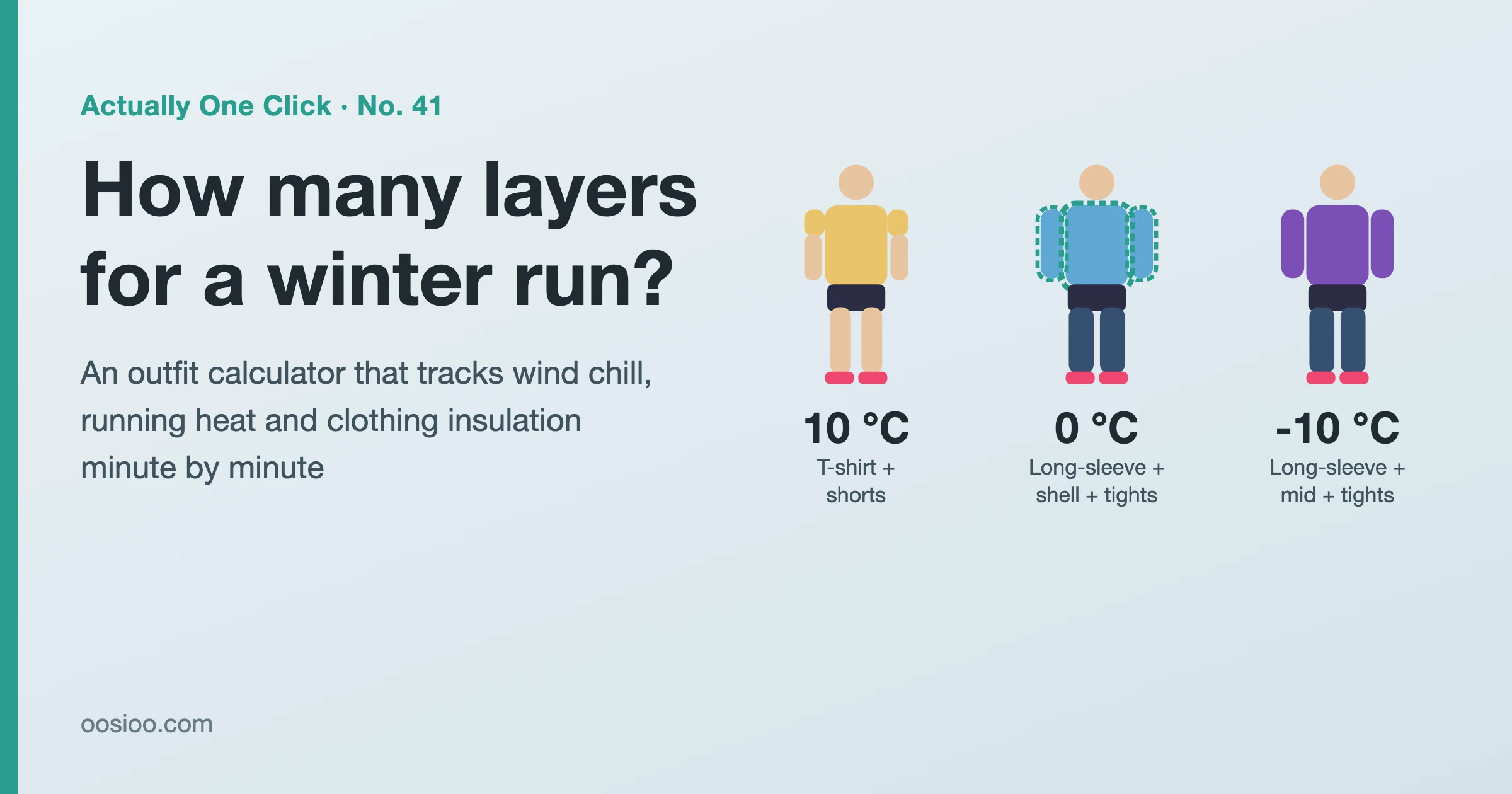
How Many Layers for a Winter Run? — An Outfit Calculator That Tracks Wind Chill, Running Heat and Clothing Insulation Minute by Minute
Every winter morning I face the same question at the front door: one more layer or not? Runners pass around two rules of thumb: "dress as if it were 10 ℃ warmer" and "start out cold". To check them with numbers, I built a body-temperature model. It links the heat running produces (the ACSM equation), the heat clothing holds in (the ASHRAE clothing table with the ISO 9920 correction) and how body temperature moves over time (the Gagge two-node model), then checks the result against an experiment of 40-minute runs at 5 ℃. With the model's defaults, skin temperature came out 6 ℃ warmer than the experiment. Changing one coefficient brought the skin within 1 ℃, but then core temperature came out 1.5 ℃ high. By this model, "start out cold" is right: one more layer raises skin temperature at the coldest moment by 1.3 ℃, but adds 11% more sweat and runs hot later on. "Add 10 ℃", on the other hand, turned out far too small: the outfit the model picked for 0 ℃ is what suits a 25 ℃ day when standing still.
Come November, I always stop once at the front door before a morning run. Do I throw on the windbreaker or just go? If I wear it, twenty minutes later it's tied around my waist. If I don't, the first ten minutes are miserable.
Runners have two rules of thumb for this moment.
- Dress as if it were 10 ℃ (18 ℉) warmer than it is. At 0 ℃ (32 ℉), wear what you'd wear on a 10 ℃ day.
- Start out cold. If you're warm at the start, you'll be hot later.
Both sound right. But where does the number 10 come from? And how cold is "cold"? This time I put numbers on it. I built an outfit calculator that tracks, minute by minute, the heat your body makes, the heat your clothes hold in and the heat the wind takes away.
What I set out to do
- Lay out how wind chill is calculated and where it becomes dangerous, using public weather agencies' standards.
- Calculate the heat a runner's body produces from pace and body weight.
- Set the insulation of each running outfit from standard tables, and correct it for how much it drops while running.
- Use a standard body-temperature model to follow skin and core temperature minute by minute through "five minutes at the front door + N minutes of running".
- Check the model against an experiment where people actually ran in the cold.
- Build a calculator on that model that picks an outfit, and test the two rules of thumb.
AI agents did the research, the calculations, the web calculator and the charts. I had them check each equation against the original paper or a public implementation, and mark any number they couldn't source as an "assumption".
Wind chill is measured on the face
The wind chill that the Korea Meteorological Administration (KMA) publishes in winter is calculated from air temperature and wind.
Wind chill = 13.12 + 0.6215 × T − 11.37 × V^0.16 + 0.3965 × V^0.16 × T (T in ℃, wind speed V in km/h)
It is the same formula the US and Canadian weather services have used together since 2001. KMA reports it only when the temperature is 10 ℃ or below and the wind is at least 1.3 m/s. The formula is built around how fast bare skin on a face in the wind cools. So it tells you nothing about how cold a clothed torso will feel. What it does tell you well is when hands, ears and face are at risk.
Environment Canada breaks the risk down in detail.
| Wind chill | Risk | Environment Canada's description |
|---|---|---|
| 0 to -9 ℃ | Low | Slight discomfort |
| -10 to -27 ℃ | Moderate | Risk of hypothermia and frostbite with long exposure without proper protection |
| -28 to -39 ℃ | High | Exposed skin can freeze in 10–30 minutes |
| -40 to -47 ℃ | Very high | Exposed skin can freeze in 5–10 minutes |
When the calculator advises gloves, ear covers and a neck warmer, it takes them straight from this table, because the model doesn't calculate hands or ears.
How much running warms you up
I counted the heat the body produces with the American College of Sports Medicine (ACSM) running equation. On flat ground, the oxygen used per kilogram of body weight per minute is 0.2 × speed (m/min) + 3.5 ml. At 10 km/h (a 6:00 per km pace) that's 36.8 ml, 10.5 times what you use sitting still. A 70 kg person uses about 2.6 L of oxygen a minute. At roughly 20 kJ per litre of oxygen, that's around 860 W — like running a small electric heater inside your body.
The equation was built for speeds of 8 km/h and up, and some studies find it overestimates actual oxygen use. The calculator shows a warning when the pace is slower than 8 km/h.
How much clothes hold in
Clothing insulation is measured in clo. One clo is about the insulation of a business suit. From the clothing table in the ASHRAE Handbook I picked the items closest to running clothes.
| Running item | Table item used instead | clo |
|---|---|---|
| T-shirt | T-shirt | 0.08 |
| Thin long-sleeve (base) | Long underwear top | 0.20 |
| Fleece long-sleeve (mid) | Long-sleeve sweatshirt | 0.34 |
| Windbreaker (shell) | Not in table → assumption | 0.10 |
| Shorts | Short shorts | 0.06 |
| Running tights | Long underwear bottoms | 0.15 |
| Fleece tights | Sweatpants | 0.28 |
| Socks + running shoes | Ankle socks + Shoes | 0.04 |
These values were measured on a mannequin standing still. When you run, your arms and legs pump the air out of your clothes, and the headwind pushes through them too. ISO 9920 gives an equation that corrects for this using walking speed and wind speed. Run at 10 km/h in a thin long-sleeve and tights (0.39 clo), and the effective insulation drops to around 0.20 clo — about half.
Stacking these eight items, I made eight outfits, from the lightest, L1 T-shirt + shorts (0.18 clo), to the heaviest, L8 thin long-sleeve + mid + shell + fleece tights (0.96 clo).
Body temperature moves minute by minute
What links the heat the body makes to the heat the clothes hold in is the Gagge two-node model. It splits the body into two compartments, "core" and "skin", and calculates how much heat builds up or drains away every minute. When it senses cold, skin blood vessels narrow; when it senses heat, they widen and you sweat. ASHRAE uses this model in its comfort standard. I ran it four times under the same conditions as a public implementation (pythermalcomfort), and skin and core temperatures matched to two decimal places.
I added three things.
- Five minutes at the front door. This is the time spent outside setting your watch and warming up before the run. During it you produce only the heat of someone standing (1.2 met).
- A turnaround. I assumed half the run is into a headwind and half with a tailwind. As the wind-chill formula does, I multiplied the forecast wind (measured 10 m up) by 2/3 to bring it down to body height.
- Weight and height. The public implementation fixes weight at 70 kg, so I made it an input.
Checking against an experiment
To see whether the model was right, I needed records of people actually running in the cold. An experiment by Fournet and colleagues in 2015 fit well. Twelve men ran for 40 minutes at 70% of their maximum oxygen uptake, at 5 ℃ and 70% humidity. They switched between three garment designs, and mean skin temperature was 25.3–25.9 ℃ in all three. After 40 minutes, rectal temperature was 37.9 ℃, and comfort votes right after the run showed no difference between the three garments.
I ran the model under the same conditions.
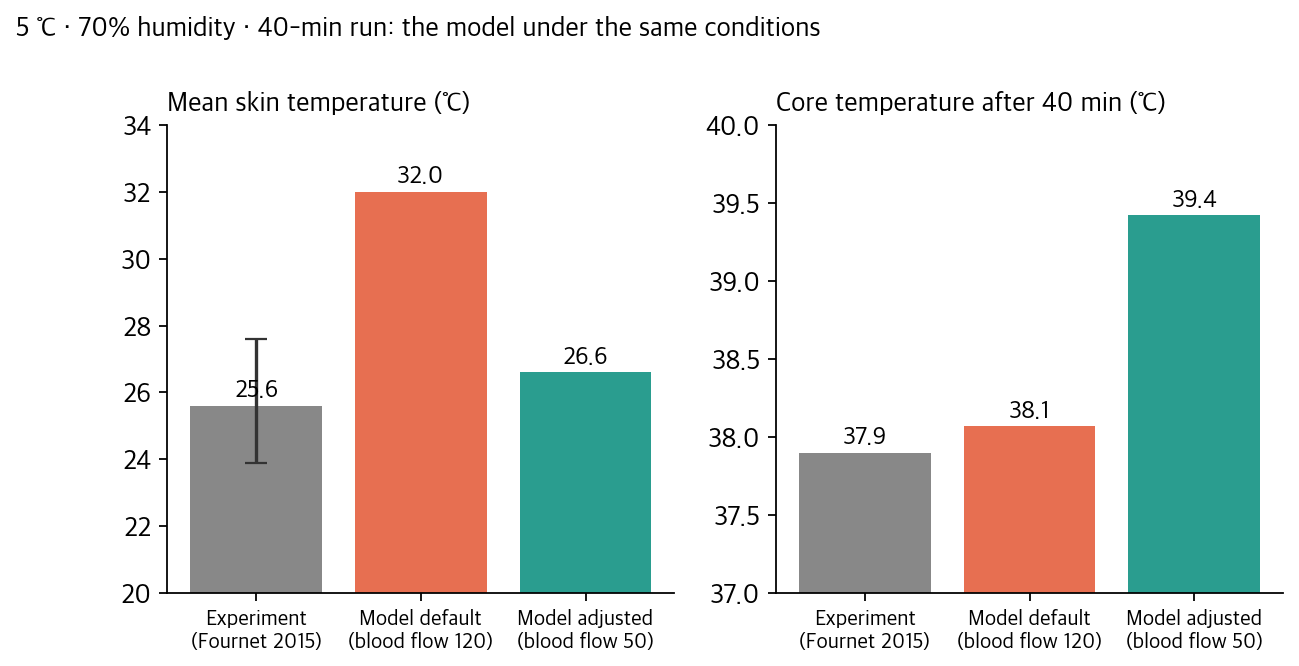
With the public implementation's default values, skin came out at 32.0 ℃ — more than 6 ℃ warmer than the experiment. The cause was the coefficient for blood flow to the skin. The default is 120, but a comment in the code says the ASHRAE Handbook uses 50. With 50, skin came out at 26.6 ℃, inside the experiment's range. In exchange, core temperature rose to 39.4 ℃, 1.5 ℃ higher than the experiment.
One coefficient couldn't match both values at once. What matters for choosing an outfit is "am I cold?", and feeling cold comes from the skin. So I picked 50, which matches the skin. The price is that this model overstates sweat and core temperature. In this post, sweat is given only as "how many percent more", never "how many grams".
How the outfit is chosen
What counts as "just right" also comes from the experiment. The calculator picks the outfit whose mean skin temperature, from 10 minutes after the start to the finish, falls within 23.9–27.6 ℃ — the range in that experiment when runners said they were comfortable. If several fit, it picks the one closest to the experiment's mean of 25.6 ℃.
At first I tried to choose using the "thermal sensation" value the model produces itself. That value couldn't be used as it was (see "Where it went wrong" below).
Results: outfit by temperature and wind
These are for 40 minutes at 10 km/h and a body weight of 70 kg.
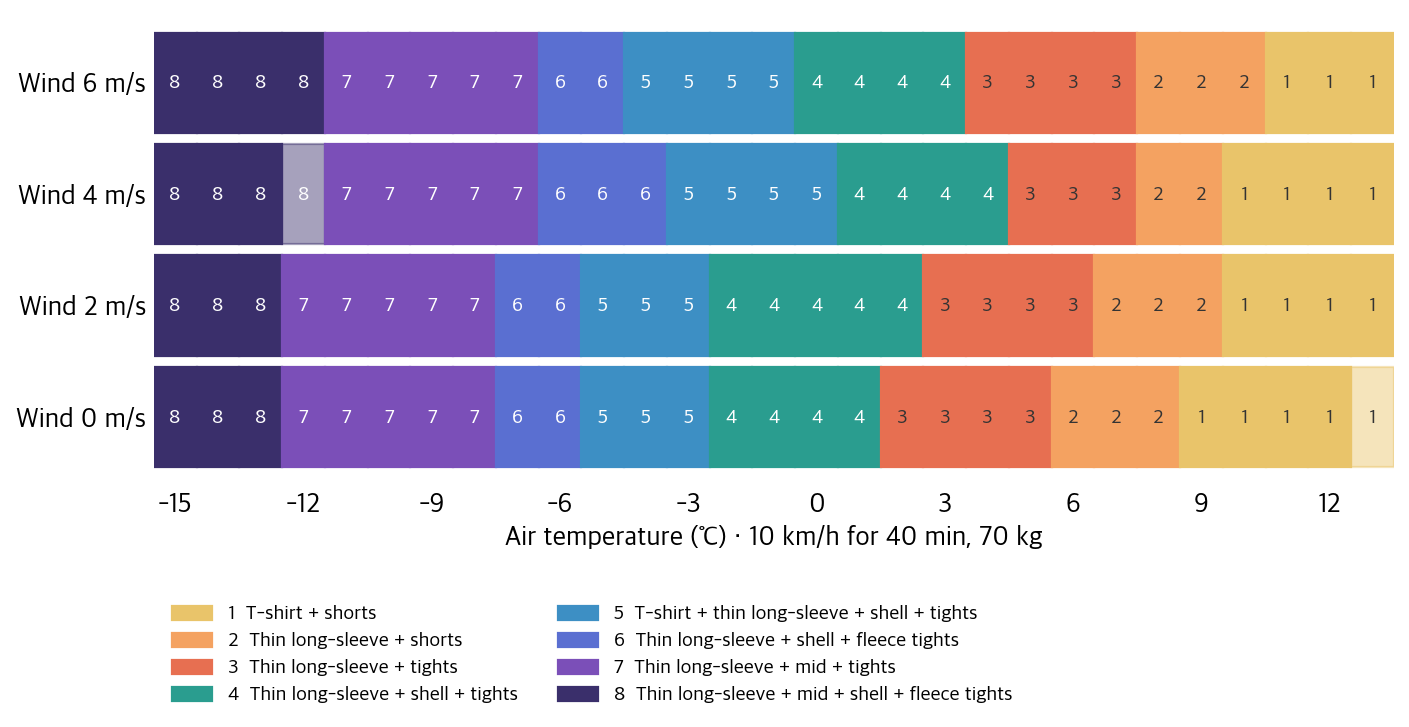
Here is the 2 m/s row in words.
| Temperature | Outfit |
|---|---|
| 10 ℃ and above | L1 T-shirt + shorts |
| 7 to 9 ℃ | L2 thin long-sleeve + shorts |
| 3 to 6 ℃ | L3 thin long-sleeve + tights |
| -2 to 2 ℃ | L4 thin long-sleeve + shell + tights |
| -5 to -3 ℃ | L5 T-shirt + thin long-sleeve + shell + tights |
| -7 to -6 ℃ | L6 thin long-sleeve + shell + fleece tights |
| -12 to -8 ℃ | L7 thin long-sleeve + mid + tights |
| -13 ℃ and below | L8 thin long-sleeve + mid + shell + fleece tights |
Changing the inputs shows what changes the outfit. These were calculated at 0 ℃ with a 2 m/s wind.
- Pace matters most. At 8 km/h it's L5, at 10 km/h L4, at 12 km/h L3. The faster you run, the fewer layers you need, one at a time.
- Body weight barely matters. 55 kg, 70 kg and 85 kg all came out L4. A heavier body makes more heat, but the skin area that sheds heat grows with it.
- Short runs need more. 20 minutes gives L5; 40 and 80 minutes give L4. On a short run you finish before you're fully warmed up, so the average comes out colder.
- Wind matters less than you'd think. A 6 m/s wind moves the boundaries by only 1–2 ℃. This is very likely because the model doesn't know that a windbreaker blocks wind (see "What it can't do" below).
"Start out cold" is right
At 0 ℃, 2 m/s wind and 40 minutes at 10 km/h, I followed the skin temperature of three outfits minute by minute.
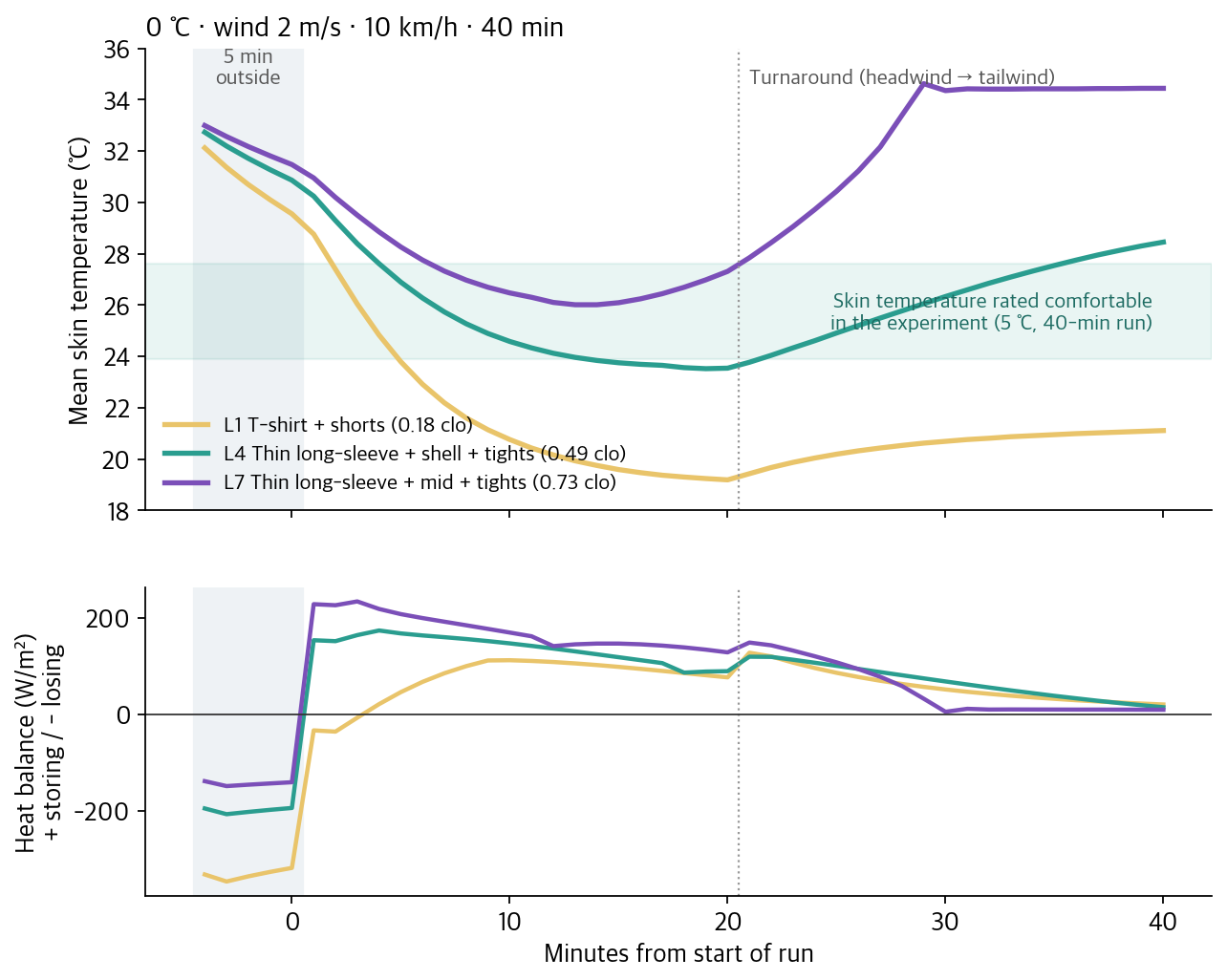
The chart shows three things.
The five minutes at the front door cost the most. Standing still in running clothes, an L4 runner loses 200 W of heat per square metre of body. The moment you start running, it flips to +150 W. The body starts warming right after you set off. The skin, though, follows later.
The coldest moment is just before the turnaround. Running into the headwind, skin temperature keeps falling, and with L4 it bottoms out at 23.5 ℃ at 19 minutes. Turn around into a tailwind and it rises. It's less "just get through the first ten minutes" and more "just get through the headwind leg". On a course where the headwind comes later, the picture changes.
One more layer only helps early on. Wearing L5 instead of L4 — one extra T-shirt underneath — raises skin temperature at the coldest moment by 1.3 ℃, from 23.5 to 24.8 ℃. But sweat goes up 11%, and by the finish skin temperature is 33.8 ℃, well past the comfortable range. L7, with a mid layer, sweats 25% more, and around 29 minutes its skin temperature suddenly jumps past 34 ℃. That's the moment the core warms up and the skin vessels open wide.
An experiment points the same way. Carriker and colleagues (2014) had nine men exercise for 45 minutes at 2 ℃ with a 1.5 m/s wind, alternating a thin and a thick windbreaker over the same base layer. They felt less cold in the thicker one only for the first 15 minutes. After that there was no difference.
"Add 10 ℃" is far too little
I rephrased the rule of thumb as a question: "If you stood still in the running outfit the model picked, what temperature would feel just right?" I judged standing comfort with the PMV from ISO 7730. A PMV of 0 means neither cold nor hot.
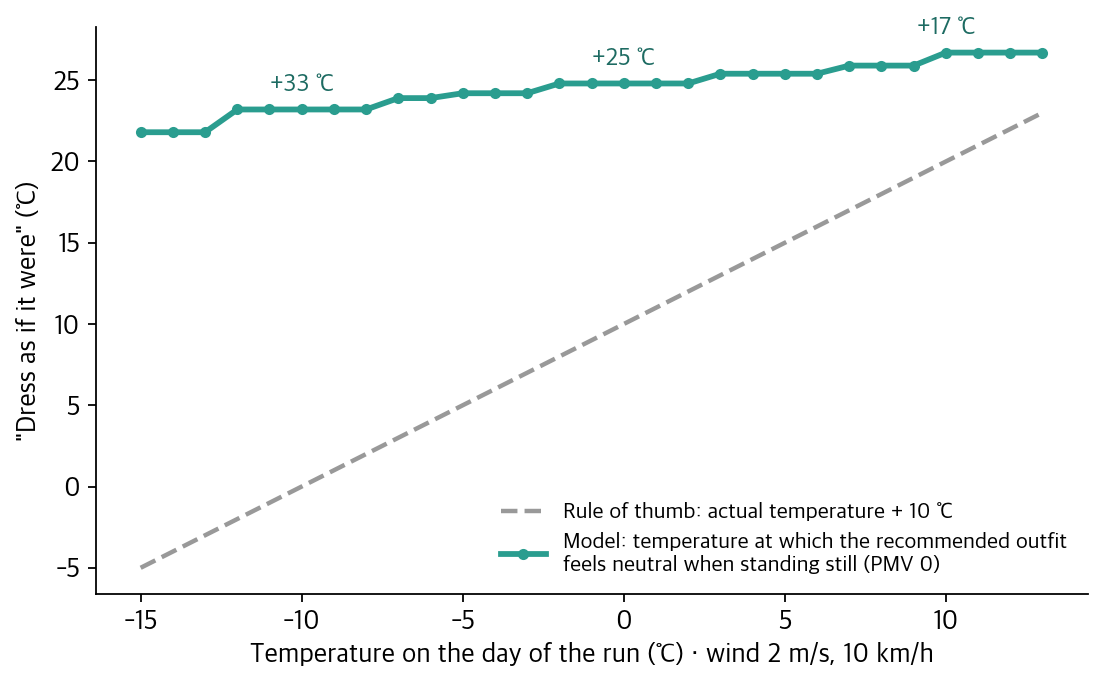
L4, the model's choice at 0 ℃, suits 24.8 ℃ when standing still. The gap isn't 10 ℃ but 25 ℃. It widens as it gets colder, reaching 33 ℃ at -10 ℃. The green line is nearly flat for this reason: whatever the temperature, a running outfit ends up as thin as indoor clothes. As the temperature changes, only one or two layers come and go.
That doesn't make the rule useless. What people actually wear on a 10 ℃ day is much thinner than "clothes that are just right standing still". Measured against that habit, the number 10 might well come out. But if you picture the knit and jacket you'd wear for a 10 ℃ walk, you'll be too hot. The model says to dress much lighter than that.
On Seoul winter mornings
I fed 7 a.m. weather in Seoul for two winters (2016–17 and 2019–20), 180 days, into the calculator. These are for 40 minutes at 10 km/h.
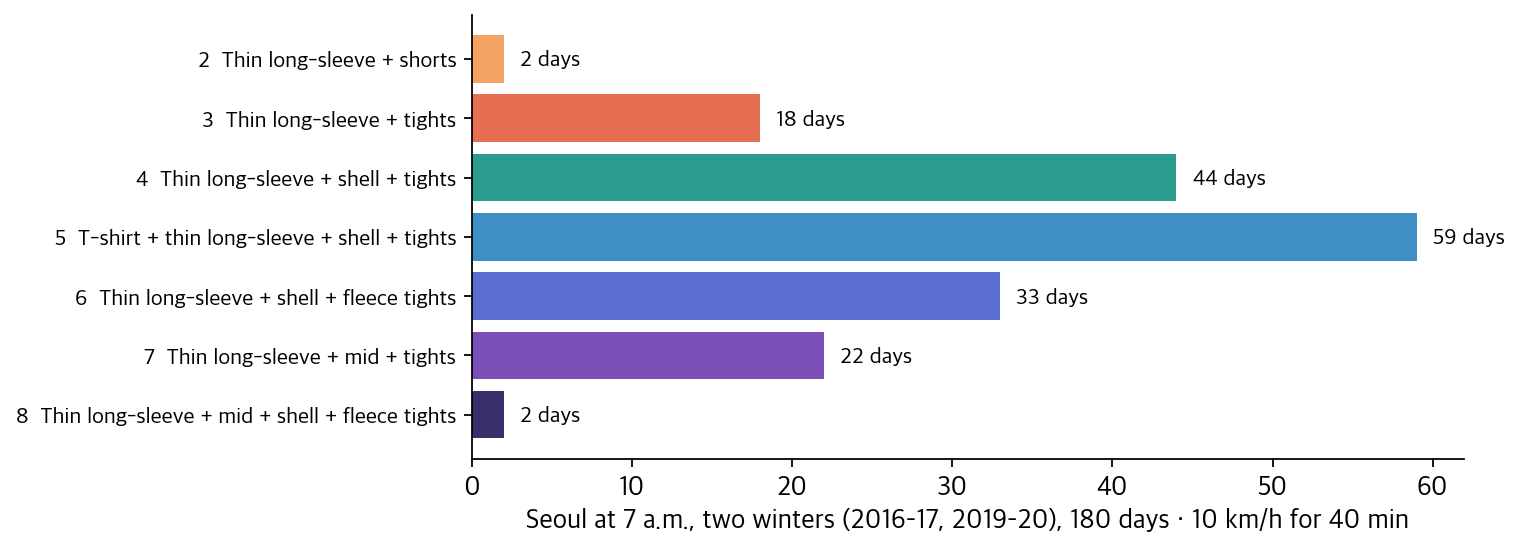
- Across these two winters, the mean temperature at 7 a.m. was -3.4 ℃, the coldest day -11.9 ℃ and the mean wind 2.3 m/s.
- The most common outfits were L5 (59 days) and L4 (44 days). A thin long-sleeve, a windbreaker and tights are the default for a Seoul winter morning. Whether to add a T-shirt underneath is the daily question.
- Days that needed a mid layer (L7 and L8) numbered 24, about one in seven.
- There were 29 "moderate risk" mornings with wind chill of -10 ℃ or below — days for gloves, ear covers and a neck warmer. There were no days at -28 ℃ or below.
On this week's forecast (an Open-Meteo forecast fetched on the morning of November 3), the mornings of November 4–5 are 8–10 ℃, so L1 T-shirt + shorts is enough. The morning of November 7 is -1.4 ℃ with a wind chill of -4.2 ℃ — the first L4 day of the winter.
Try it
Change temperature, wind, humidity, pace, run duration and body weight, and the outfit and the skin-temperature curve change right away. The chart draws the recommended outfit along with one layer lighter and one layer heavier. The three numbers below it are when your skin is coldest, when you start sweating (model), and how much more you sweat with one more layer (model).
Where it went wrong
- I trusted the model's own "thermal sensation". The Gagge model also outputs a thermal sensation value from -3 (cold) to +3 (hot). At first I tried to pick the outfit with a value closest to 0. But running at -10 ℃ in a T-shirt and shorts came out at -0.76, "slightly cool". The model's skin temperature at that point was 20.7 ℃. This sensation formula is based on how close body temperature is to "the body temperature at which sweating starts for that level of exercise". At 10 km/h that threshold rises to 37.9 ℃. So almost every case clustered around "slightly cool", whether the skin was freezing or not. I threw this value out and used the skin temperature people in a real experiment rated as comfortable instead.
- The first run used the defaults. My first results came from the public implementation's default values (blood-flow coefficient 120). Set beside the 5 ℃ running experiment, skin temperature was 32.0 ℃, more than 6 ℃ above the experiment's 25.3–25.9 ℃. Had I chosen outfits in that state, they would have leaned hard towards "a T-shirt is plenty".
- I tried to match two values with one coefficient. I swept the blood-flow coefficient from 0 to 120. At 50 the skin matches, but core is 39.4 ℃, 1.5 ℃ above the experiment. Below 20, core goes over 41 ℃. Checking against an experiment of uphill walking and stair climbing at 2 ℃ (Carriker 2014) gave the same story: matching the skin produced a core rise of 1.73 ℃, more than the experiment's 1.1–1.2 ℃. In the end I chose the skin, and decided not to use sweat or core temperature as absolute values.
- The wardrobe had a gap. I started with six outfits. After thin long-sleeve + shell + tights (0.49 clo) came the outfit with a mid layer (0.73 clo). With that, no outfit fit at -5 to -3 ℃ with no wind: 0.49 left the skin too cold, in the 23s, and 0.73 too hot, in the 34s. The first version of the code was written to return "the lightest outfit" in that case, so at -5 ℃ it recommended a T-shirt and shorts. I added 0.57 (an extra T-shirt underneath) and 0.62 (fleece tights) in between, and changed it so that if nothing fits, it picks the outfit closest to the range.
- Skin temperature jumps like a staircase. Add just a little more clothing and skin temperature leaps from the 23s to the 34s. That's because the model is built so the skin vessels fling open the moment the core warms up. I couldn't confirm whether a real body changes this abruptly. So the calculator also draws the neighbouring outfits as dotted lines, to show that near a boundary it could go either way. In one cell, -12 ℃ with a 4 m/s wind, L7 with a mid layer was too cold, and L8 with a shell and fleece tights added went over the range by 0.02 ℃. Cells like that are drawn in a paler colour.
- I went past the correction's range. The ISO 9920 correction is defined only up to a walking speed of 1.2 m/s and a wind of 3.5 m/s. 10 km/h is 2.8 m/s. Feeding in values outside the range produced something odd: because of a squared term in the correction, once speed exceeds the range the correction turns back the other way. A thin long-sleeve and tights (0.39 clo) came out warmer running at 2.8 m/s than walking at 1.2 m/s (0.20 → 0.25 clo). So I capped it at the limit. In reality clothing insulation probably keeps falling as you run faster, so this model likely overstates clothing insulation while running. If so, the recommendations may be one layer lighter than they should be.
- I tried to put rain in as a number. At first I included "rain halves clothing insulation". I couldn't find a source for that value, so I took it out. The calculator doesn't handle rain.
- I couldn't get all the past weather. I tried to fetch nine winters, but another job was calling the same weather service at the same time, and I hit the per-minute and per-hour request limits. I got only two winters. Read the Seoul results only as "an example from two winters". These values also come from a reanalysis grid rather than a weather station, so they may be colder than actual Seoul observations.
Why this works in one click
Because every equation is public. The wind-chill formula, the ACSM equation, the ASHRAE clothing table, the ISO 9920 correction and the Gagge model have all been in textbooks for decades. A Python implementation is public too, so I could check the ported code against it straight away. The calculation itself is light: running eight outfits for 45 minutes each finishes in the blink of an eye in a browser.
Where it doesn't work in one click is the definition of "comfortable". The equations count heat accurately, but what skin temperature feels comfortable you can only learn by asking people. This time I leaned on a single experiment of 12 people running at 5 ℃. That standard will only broaden as records pile up from people running below freezing, and from women and older runners.
If you want to try this
- Check the model against a public implementation first. Only once you know your ported code is right can you tell whether a later discrepancy is the model's limit or your own mistake.
- Match measured values from experiments, not the model's "feeling" values. Values like thermal sensation or comfort come out strange outside the range their makers designed for.
- Doubt the defaults. This time one default changed skin temperature by 6 ℃.
- Keep the wardrobe steps tight. Leave a 0.1 clo gap and the right answer for the weather in between disappears.
- Treat hands and ears separately. The torso calculation and frostbite risk are different problems. It's safer to use a public agency's wind-chill risk table as it is.
What it can't do
- Everyone is different. Body fat, heavy sweating and cold acclimatisation are not included. The reference experiment is 12 men who exercise.
- It doesn't know a windbreaker blocks wind. The windbreaker is counted only as a garment with 0.10 clo of insulation. In reality its bigger effect is blocking wind and protecting the insulation of the layers underneath. On windy days, reach for the windbreaker before the calculator.
- It doesn't calculate hands, feet, ears or face. It only carries over the wind-chill risk table.
- It doesn't calculate rain, snow, sunshine or hills. Wet clothing loses a lot of its insulation.
- It overstates sweat. Checked against the experiment, the model's core temperature comes out 1.5 ℃ high. Sweat is used only to compare outfits.
- It isn't medical advice. On days when hypothermia or frostbite is a concern, follow the weather and health authorities' guidance, and stop if you start to shiver.
Still, it cuts down the time spent dithering at the front door. Make a thin long-sleeve, a windbreaker and tights the default. From -3 ℃, add a T-shirt underneath; from -6 ℃, switch to fleece tights; from -8 ℃, bring out the mid layer. If you're cold until the turnaround, you've dressed right.
I'm writing about getting back into running in a separate series on becoming a healthy forty-five-year-old. I built this calculator for those mornings.
If you enjoyed this, please leave a comment.
Sources
- Wind chill: KMA Open MET Data Portal, wind chill (Korean); risk bands from Environment Canada, Wind chill index
- Running heat: ACSM running equation (ACSM's Guidelines for Exercise Testing and Prescription); the equation's range and overestimation, PMC3743617
- Clothing insulation: ASHRAE Handbook Fundamentals clothing table (values checked against the table reproduced in Wikipedia, Clothing insulation); ISO 9920:2007 movement and wind correction
- Body-temperature model: Gagge, Fobelets & Berglund (1986) two-node model; public implementation pythermalcomfort two_nodes_gagge; standing comfort judged with ISO 7730 PMV (same library)
- Experiments: Fournet et al. (2015), Can body-mapped garments improve thermal comfort for sport in the cold?, Extreme Physiology & Medicine; Carriker et al. (2014), Windproof outer-garment density impacts thermal sensation and mean body temperature during exercise in the cold, IJES Conference Proceedings
- Weather: Open-Meteo (Historical Weather API and Forecast API, CC BY 4.0)
- The model port, the comparison with experiments, the outfit table, the rule-of-thumb tests, the calculator and the charts were all produced by the experiments in this post
Image credits
- All charts and screens were made by the experiments in this post