Placement Tests at Four, and Half an Integration
Korea's daycare centers fell 40%, from 43,770 in 2013 to 26,064 at the end of 2025, and from 2014 to August 2024, 283 of the daycare centers and kindergartens that closed were converted into long-term care facilities for older people. Over the same period, English academies for young children grew. In a 2024 government pilot survey (not an approved national statistic), 47.6% of children under 6 took some form of private education, and an English academy attended for more than three hours a day cost KRW 1,545,000 a month (about USD 1,100 at KRW 1,400 per dollar). From October 1, 2026, the government banned placement tests at academies for young children by law, and in April it announced plans for further rules, such as a ban on cognitive instruction for children under 36 months. But the target for completing the integration of daycare and kindergarten, which would bring the two under one system, slipped from 2026 to 2030. What money can do, such as wider free education and better teacher-to-child ratios, is moving ahead, while merging teacher qualifications and institutions has stalled. Drawing on analysis by the National Assembly Budget Office and on the laws themselves, this piece follows whether the state is turning early childhood education into a right or only regulating private education, and looks at Heckman's research on early childhood investment and Japan's anyone-can-attend system together with the limits of their evidence.
The daycare center sign comes down from the ground floor of a neighborhood shopping building, and a few months later a "day care center for seniors" sign goes up in the same spot. In the mornings, a van with a wheelchair lift pulls up where the yellow daycare bus used to stop. Across the street, a van from a preschool academy with an English name picks up children. How much of this you see depends on the city, but in Korea in the 2020s it is not an unfamiliar sight.
When there are fewer children, there are fewer places that look after them. That much is natural. The odd part is that over the same years, English academies for young children grew. In a government pilot survey, an English academy that children attend for more than three hours a day, the kind commonly called an "English kindergarten," cost KRW 1,545,000 a month (about USD 1,100 at KRW 1,400 per dollar). Many of them held entrance tests. Four-year-olds sitting placement tests became common enough to earn a phrase of its own: the "age-four exam."
The state moved in two directions. On one side, it banned placement tests at academies for young children by law and put forward rules to cap their teaching hours. On the other, it pushed ahead with yubo tonghap, the integration of daycare and kindergarten, and widened free education and care for children aged 3 to 5. Yubo tonghap means bringing daycare centers (care), which had been run under the Ministry of Health and Welfare, and kindergartens (education), run under the Ministry of Education, under one ministry, one set of standards and one teacher system. But the target date for completing that integration has slipped from 2026 to 2030.
So the question for this piece is this. Is the state turning early childhood education into a right for every child, or is it stopping at regulating private education?
Where things stand, in numbers
| Item | Figure | Basis |
|---|---|---|
| Number of daycare centers | 43,770 → 26,064 (down 40%) | 2013 (peak) → end of 2025, Ministry of Education childcare statistics (press reports) |
| Number of daycare centers (latest) | 25,082 | End of June 2026 |
| Daycare centers and kindergartens converted into long-term care facilities for older people | 283 (56 in 2023 alone) | 2014 to August 2024, compiled by a lawmaker's office (press reports) |
| Share of children under 6 in private education | 47.6% (81.2% at age 5) | Government pilot survey, July to September 2024 (not an approved national statistic) |
| Monthly private education spending per participating child | KRW 332,000 | Same |
| Monthly cost of a half-day English academy | KRW 1,545,000 | Same. For young children attending three hours or more a day |
| Children covered by free education and care | About 503,000 children aged 4 to 5, budget KRW 470.3 billion | 2026 |
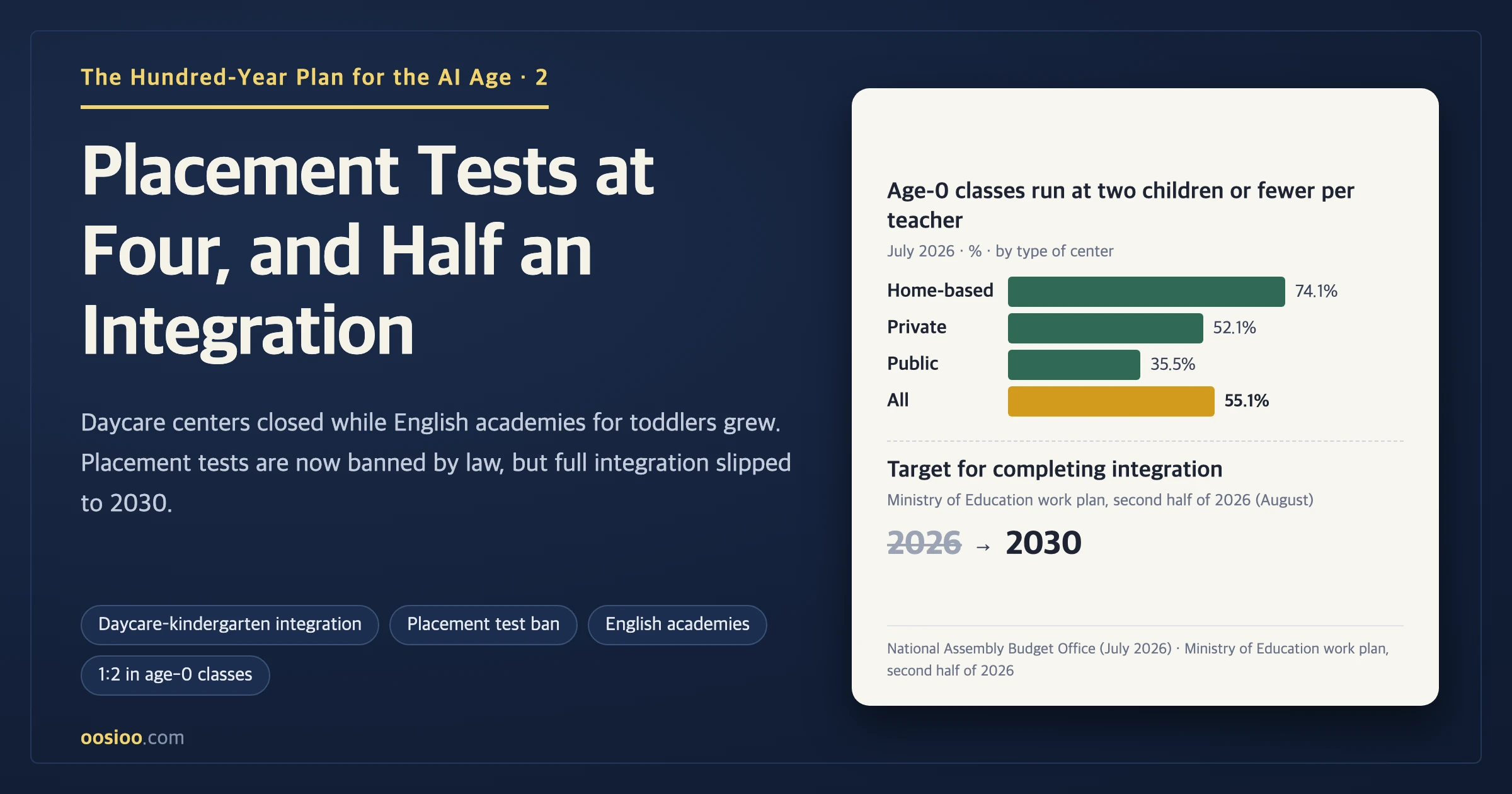
| Share of age-0 classes run at two children or fewer per teacher | 55.1% (home-based 74.1%, private 52.1%, public 35.5%) | July 2026, National Assembly Budget Office |
| Ministry of Education budget for early childhood education and care | KRW 9.9 trillion (up 7.2%), of which KRW 1.2 trillion for integration | 2027 government budget proposal |
| Target date for completing integration | 2026 → 2030 | Ministry of Education work plan for the second half of 2026, August |
Before reading this table, the nature of the private education figures needs pointing out. The 47.6%, KRW 332,000 and KRW 1,545,000 come from a "pilot survey" in which the Ministry of Education surveyed 13,241 children under 6 in July to September 2024 and published the results in March 2025. A pilot survey tests the method ahead of a main survey, and it is not an approved national statistic. For now it is the only nationwide set of numbers on private education for young children. The government said in April 2026 that "the main survey of private education spending for young children will be carried out for the first time this year," and its results are not out yet. So these numbers are best used only to get a sense of scale.
Some things are clear even so. By age 5, four in five children take some kind of private education. The KRW 1,545,000 a month for an English academy is more than four times the average for participating children (KRW 332,000). Even within private education for young children, English academies are a market apart. And the number of those academies grew. According to a Newsis report, there were 814 English academies for young children as of 2025, up 32% over the past five years. The figure was not confirmed by other outlets, and I could not confirm whether the original source was a full survey by the Ministry of Education. It is best read as "around 800, up more than 30% in five years."
The institutions went the other way. Four in ten daycare centers disappeared in 12 years. From 2014 to August 2024 there were 283 cases of closed daycare centers and kindergartens being converted into long-term care facilities for older people (figures the office of lawmaker Jeon Jin-suk obtained from 17 provinces and major cities). Year by year, that was 56 in 2023 and 38 in January to August 2024. There is another count from a different lawmaker's office covering a different period (194 cases from 2014 to September 2023), and no updated count continuing past 2024. At a few dozen conversions a year, this is small next to the overall fall in institutions. But it is symbolic, in that a single building shows a population with fewer children and more older people.
What happened
December 2023 to June 2024: the administration was merged. The Government Organization Act was amended to move responsibility for daycare centers from the Ministry of Health and Welfare to the Ministry of Education. The transfer actually took place in June 2024, and the same month the government released its "Implementation Plan for Early Childhood Education and Care Integration." The goals it set out then were fairly concrete. By 2026 it would create standards for integrated institutions (provisionally called yeongyua hakgyo, "early childhood schools") and a single qualification for integrated teachers, widen free education and care for ages 3 to 5 in stages, and reduce the number of children each teacher looks after.
December 2024: the public hearing collapsed. A public hearing on the integrated teacher qualification and the integrated institution model was planned, but it broke down amid conflict among stakeholders. The National Assembly Budget Office wrote that this task has since remained in a state of being "to be reviewed after social deliberation."
March 2025: private education for young children was measured for the first time. The Ministry of Education published the results of the 2024 pilot survey. That is where the 47.6% and the KRW 1,545,000 above came from. From that spring, the phrases "age-four exam" and "age-seven exam" showed up often in news reports.
July 2025: free education and care for 5-year-olds began. It was the first year of phased free provision, with the state covering more of the basic cost for 5-year-olds whether they attended a kindergarten or a daycare center.
December 2025: a channel for the money was created. On December 23, the Early Childhood Special Account Act was enacted, taking effect on January 1, 2026. It sets up a separate account that spends 60% of education tax revenue entering the general account on early childhood education and care. It is a temporary account, valid until December 31, 2030.
March 2026: coverage widened to ages 4 to 5, and the placement test ban passed. Free education and care expanded to about 503,000 children aged 4 to 5, with a budget of KRW 470.3 billion. The added state support is KRW 20,000 a month for public kindergartens, KRW 110,000 for private kindergartens and KRW 70,000 for daycare centers. On March 12, an amendment to the Hagwon Act, the law governing private academies, banning entrance tests at academies for young children passed a plenary session of the National Assembly, and it was promulgated on March 31 as Act No. 21501.
April 1, 2026: the government announced further measures. These were the "Measures to Respond to Private Education for Infants and Young Children." They would ban outright, for children under 36 months, cognitive instruction, meaning instructor-led teaching of Korean, English or math knowledge, and limit it to three hours a day and 15 hours a week for children 36 months and older. Violations would bring a penalty surcharge of up to 50% of revenue and a fine of KRW 10 million, and rewards for reporting violations were set at up to KRW 2 million. But these measures are not law yet. Putting them into effect requires another amendment to the Hagwon Act, and implementation was reported as coming "as early as the second half of 2027." Criticism that the measures would have little effect, since most English academies already run under three hours a day, came out the same day (Newsis).
August 2026: the completion date was pushed back. In its work plan for the second half of the year, the Ministry of Education said it would complete the unification of early childhood education and care in 2030. The original target of 2026 slipped by four years.
October 1, 2026: the placement test ban took effect. The enforcement decree passed the Cabinet on September 22. From that day, academies may not hold tests or assessments to recruit young children or sort them into classes. This covers not only written tests but also oral questioning and interviews. Fines are KRW 1 million for a first violation, KRW 2 million for a second and KRW 3 million for a third. A legal basis for rewards for reporting violations was also created. Diagnosis by observation or interview after enrollment, with the guardian's prior consent, is still allowed. The Ministry of Education said it would publicize the rules in October and November and then run intensive inspections from December to January 2027.
October 27, 2026: the National Assembly Budget Office laid out the remaining tasks. The report is "What Tasks Remain to Complete Early Childhood Education and Care Integration?" (NABO Focus No. 178). Most of the integration figures in this piece come from it. The report said the Ministry of Education was due to publish a new roadmap in November 2026, but as of November 18, when I am writing this, I could not confirm that it has been published.
Why it turned out this way
Only what money could do moved forward
Put the National Assembly Budget Office report side by side with the 2024 implementation plan, and the progress of integration splits in two.
| Task | Plan, June 2024 | Status, October 2026 |
|---|---|---|
| Free education and care for ages 3 to 5 | Age 5 in 2025 → ages 4 to 5 in 2026 → ages 3 to 5 in 2027 | On schedule. Government proposal of KRW 642.9 billion for ages 3 to 5 in 2027 |
| Teacher-to-child ratio | Age-0 classes 1:3→1:2 (2026), age-1 classes 1:5→1:4 (2027), age-2 classes 1:7→1:6 (2028) | Age-0 improvement under way, participation 55.1% |
| Teacher pay and conditions | Improve pay and conditions | Pay supplement raised by KRW 20,000 a month in both 2026 and 2027 |
| Integrated teacher qualification | Introduce in 2026, start training new teachers in 2027 | Stalled after the public hearing collapsed in December 2024 |
| Standards for integrated institutions (early childhood schools) | Finalize by end of 2024, enact integration law in 2025 | Not finalized |
| Legal status of daycare teachers | Employee → certified teacher | Not pursued, as there is no integration law |
| Local administration | Transfer childcare administration to provincial superintendents of education | Three related bills introduced in October 2024, pending in the National Assembly |
| Curriculum for ages 0 to 5 | Integrated curriculum in 2026 | At the level of linking the standard childcare curriculum, the Nuri Curriculum for ages 3 to 5, and the elementary curriculum |
The first three rows are things that can be done by raising the budget. In the 2027 government proposal, the Ministry of Education's budget for early childhood education and care is KRW 9.9 trillion, up 7.2%, and within it the integration budget is KRW 1.2 trillion, up 46.9%. Free provision has also actually lowered what parents pay. Based on April 2026 consumer prices, kindergarten fees were 41.4% lower than a year earlier, and fees for daycare centers and similar services 18.4% lower.
The five rows below them are about merging people and institutions. Kindergarten teachers are certified teachers under the Early Childhood Education Act and hold a teaching certificate. Daycare teachers get their qualification under the Infant Care Act through several routes, and legally they are employees. Merging the two into one qualification means deciding who is recognized and by what standard, and in that process one side or the other feels it is losing out. The National Assembly Budget Office described the cause of the failed hearing only as "conflict among stakeholders." In researching this piece I could not confirm who argued for what.
Money problems remain too. As of 2025, local governments support daycare centers with KRW 3.2 trillion as their matching share of national funding and KRW 2 trillion through their own programs. Local governments take the position that since the work has moved to the Ministry of Education, the education offices should pay this money too, and the three bills pending in the National Assembly do not set the scope of the transfer. And the early childhood special account is temporary, ending at the end of 2030. 2030 is the year when both funding and the system reach a fork in the road.
This is why it gets called "half an integration." What parents pay has gone down, and the number of children each teacher looks after is going down. But integration's original promise, that whichever institution a child attends, they learn the same curriculum from teachers with the same qualification, is still on paper.
Why age-0 improvement is slowest in public centers
One number in the table stands out. The share of age-0 classes run at two children or fewer per teacher is lowest in public daycare centers, at 35.5%. In home-based daycare centers it is 74.1%. The institutions the state runs directly or is responsible for are the ones following state policy the least.
The National Assembly Budget Office pointed to the scope of support as one reason. Support is limited to staff costs and does not cover investment in facilities to add childcare rooms. To turn a room where two teachers look after six infants into a 1:2 room, you need one more teacher, and possibly one more room. Public centers with long waiting lists find it hard to cut the number of children. In fact, even as the number of institutions falls, there have been reports of public daycare centers in some areas with hundreds of children on their waiting lists. Children are fewer, but places at the institutions parents want are still short.
Regulation targets tests and hours
Now to the academies. The amended Hagwon Act that took effect in October 2026 bans tests used to select young children or sort them into classes. The April 2026 measures try to cap teaching hours. Both aim at the "form" of private education. Spending the whole day in English, or a cost of more than KRW 1.5 million a month, is not something the rules cover.
It is too early to call this a regulatory failure. Making four-year-olds take tests is a question of children's rights before it is a question of parents' choices, and stopping it means something. But regulation does not remove demand. The same sorting can happen under the name of "observation and interview" instead of a test, and many academies already run within the three-hour daily limit. How well the rules are followed will only be known once the results of the intensive inspections in December 2026 to January 2027 are out.
Why parents start earlier
The reasons on the demand side share roots with private education in grades 1 to 12. The fewer the children, the more is staked on each one. Competition is by rank, not by headcount. At the early childhood stage, one more thing is added: anxiety about not knowing which abilities will turn out to be useful later.
Signals from the youth labor market feed that anxiety. In an August 2026 issue note (No. 2026-19), the Bank of Korea found that of the 285,000 jobs for young people (aged 15 to 29) lost between June 2022 and June 2026, 268,000, or 94%, were in industries highly exposed to AI. That does not mean jobs for young people fell by 94%. It shows where the lost jobs were concentrated. The Bank of Korea also saw AI not as the sole cause but as something that sped up changes already under way.
News that routine entry-level work is the first to be shaken reads to parents as a signal that their child "needs to acquire something that sets them apart, and early." English is the most visible and most easily measured of those abilities. This is inference. I did not find direct evidence that the labor market outlook has increased demand for private education among young children. That said, the effects of early childhood investment described in research abroad point somewhere a little different from what parents are trying to buy.
Other countries
Heckman: the returns on early childhood investment, and their conditions
The research of Nobel economics laureate James Heckman on investment in early childhood is often cited in Korea as well. The best-known example is his analysis of the ABC/CARE programs in North Carolina. Begun in 1972 (ABC) and 1978 (CARE), these programs gave disadvantaged children full-day, high-quality care, education and health care from shortly after birth until age 5. Following participants into adulthood, Heckman's team calculated an internal rate of return of 13.7% a year and a benefit-cost ratio of 7.3 (García, Heckman, Ermini Leaf and Prados, Journal of Political Economy, 2020). For the Perry Preschool Program, begun in the 1960s, the social rate of return was estimated at roughly 7% to 10% a year (Heckman et al., 2010). The two figures are calculated differently, so I do not set them side by side for comparison.
These numbers are used as grounds for spending money on early childhood education. But the evidence comes with conditions. First, both were small, intensive programs with around 100 participating children, and they served disadvantaged children. The same returns cannot be expected from universal childcare for all children. Second, what produced the effect matters. In the Perry program, the gain in IQ faded within a few years, yet participants' adult earnings, education and criminal records were still better than the comparison group's. Heckman's team traced this to changes in non-cognitive skills such as persistence and self-control.
It would be wrong to jump straight from here to a conclusion about Korea's English academies. ABC/CARE and Perry were not English or advance-learning programs, and these studies did not evaluate academy education for middle-class or wealthier children. What this research can say goes as far as this: "providing high-quality, in-person care and education early to children in disadvantaged environments brings large gains to society as a whole." That evidence leads us to ask less about private education than about the quality of public care, and whether it reaches the children who need it most.
Japan: a daycare center children can attend even if their parents don't work
From April 2026, Japan put its Kodomo Daredemo Tsuen Seido, a system under which any child can attend, into effect in municipalities nationwide. Japan's Children and Families Agency describes it as "a new attendance benefit that can be used flexibly by the hour regardless of the guardian's employment status." It was institutionalized in 2025 as a program based on the Child and Child-Rearing Support Act, and from fiscal 2026 it became a formal benefit under the same law. According to municipal guides, it covers children from 6 months to under 3 years old who do not attend a daycare center, kindergarten or similar facility, for up to 10 hours a month. Hamamatsu City runs it as two hours per visit, five visits a month.
The system's starting point is not whether the parents work. It is to give every child a chance to spend time with peers outside the home and to meet childcare professionals. It reads as an attempt to shift early childhood institutions away from supporting parents' employment and toward children's rights. Compared with Korea's integration, which concentrates on lowering costs for ages 3 to 5, it heads in a different direction.
Its limits are clear too. Ten hours a month is two or three hours a week. That is still small to call a right. Local Japanese reporting and analysis by research institutes list problems: workloads rising amid a chronic shortage of childcare workers, cases where facilities give priority to their enrolled children and so find it hard to take others even when they have room, and booking convenience varying by area. I have not yet found any material evaluating its use or its effects.
So what should be done
On the policy side
Put dates on the remaining half of integration (policy proposal). Free provision and better teacher ratios have budget timetables. The integrated teacher qualification, standards for integrated institutions, the legal status of daycare teachers and the transfer of administration do not. Since the early childhood special account ends at the end of 2030, if the 2030 completion target is serious, the legislative schedule for the remaining tasks should be made public first. Whether the new roadmap promised for November 2026 contains that schedule is the first test.
Extend support for age-0 improvements to facilities (inference based on the National Assembly Budget Office's findings). If the lack of support for facilities is why public centers have the lowest 1:2 rate, at 35.5%, then including additional childcare rooms and remodeling in the scope of support is the most direct remedy. A situation where state standards are followed least in the institutions the state is responsible for cannot be left for long.
Spend the next stage after free provision on "quality" (inference based on Heckman's research). The high returns on early childhood investment came from high-quality, in-person care. Once free provision for ages 3 to 5 is complete in 2027, the evidence suggests spending the next budget on teachers' pay and conditions, teacher-to-child ratios, and whether disadvantaged children actually get into good institutions. The KRW 20,000-a-month increase in the pay supplement is a start in that direction, but it is small.
Make statistics on private education for young children regular and break them down (proposal). The main survey being carried out for the first time in 2026 should not be a one-off. Only if it is published every year, by income, region and age, like the survey for grades 1 to 12, will it be possible to judge whether the regulations worked. Right now even basic numbers, like the count of English academies, depend on a single outlet's report.
Publish enforcement results, and decide whether to legislate the April measures (policy in effect, plan stage). Whether the placement test ban is being followed will first become visible in the results of the intensive inspections from December 2026 to January 2027. How many academies were inspected and how many were caught should be made public. The ban on cognitive instruction for children under 36 months and the hour limits are still an announced plan. The government needs to decide whether to put them into law, and if so, whether to set the hour limit at a level that actually means something.
Consider ways to use institutions that do not depend on parents' employment (implication from an overseas example). Japan's anyone-can-attend system is small and has staffing problems, but the idea of designing early childhood institutions around children's rights is worth learning from. Now, when falling numbers of institutions are leaving space empty, may actually be a time with room to try something like it. This is a proposal about direction, not the result of an experiment.
For families, institutions and individuals
Know exactly what the placement test ban covers. From October 1, 2026, academies for young children may not hold tests or assessments for admission or class placement. This covers not only written tests but also oral questioning and interviews. Diagnosis by observation or interview after enrollment requires the guardian's prior consent. An academy that has a child solve problems, or sorts children by level through questions, before enrollment may be breaking the law, and there is a reward system for reporting it.
Tell the rules in effect apart from the ones that are not. As of November 2026, the ban on cognitive instruction for children under 36 months and the three-hour daily limit are not law. If you hear from an academy or from people around you that "they can't do that anymore" or "it's about to be banned," it is better to check whether it has taken effect through the Ministry of Education or the local education office.
See what free support covers and what it does not. For ages 4 to 5, support for basic costs increased from 2026. Private kindergartens get an extra KRW 110,000 a month, which has sharply reduced their fees. But additional charges, such as fees for after-hours programs and other necessary expenses, remain. When choosing an institution, comparing these extra items rather than the basic fee is how to know the real cost.
Separate what the evidence says from what it does not. The claim that "investment in early childhood has the highest returns" is true, but the evidence for it came from high-quality care programs provided to disadvantaged children. It is not research showing the effect of any particular academy or of early English education. If this research is cited at an academy information session, it is good to listen knowing that difference.
Institutions and teachers should keep records. What in the integration process puts a burden on the front line, and where the age-0 1:2 improvement gets stuck, are best captured by records from the field. The National Assembly Budget Office report is, in the end, a collection of field data too.
What we don't know yet
Results of the 2026 main survey of private education spending for young children. It is the first approved national statistic the government has produced on this. I could not confirm when it will be published. These results are needed to see whether the 47.6% and KRW 1,545,000 from the 2024 pilot survey were close to reality, and what changed after the placement test ban. But because the survey period overlaps with when the law took effect, it may be hard to read the effect of the regulation right away.
The new integration roadmap. The National Assembly Budget Office said it was due in November 2026. As of this writing I could not confirm it. The thing to watch is whether the integrated teacher qualification and standards for integrated institutions get dates.
Results of the intensive inspections. Intensive inspections on the placement test ban are scheduled from December 2026 to January 2027. If the number and types of violations caught are made public, we will learn how much circumvention there is under the banner of "observation and interview."
Legislation of the April measures. I could not confirm whether the further Hagwon Act amendment containing the ban on cognitive instruction for children under 36 months and the hour limits has passed the National Assembly. If reports are right, implementation would come as early as the second half of 2027.
Where the decline in institutions bottoms out. The population aged 0 to 5 is projected to be at its lowest around 2028. Since births rose in 2025, demand for age-0 and age-1 classes may hold up for a while. There is no updated count of when the fall in daycare centers will stop, or of what has happened to conversions into long-term care facilities since 2024.
Results of the Japanese system. Evaluations of first-year use of the anyone-can-attend system and of the burden it puts on childcare workers will only come out in 2027 or later.
Closing
Is the state turning early childhood education into a right? So far the answer is close to "with money, yes; with the system, not yet." Free education and care for ages 3 to 5 have expanded on schedule, and what parents pay has actually gone down. Teacher ratios for age-0 classes are improving. Making four-year-olds take tests has been stopped by law. These are not small changes.
But integration's promise, that whichever institution a child attends, they receive education and care of the same quality from teachers with the same qualification, has been pushed back to 2030. In the meantime English academies have grown, and state standards are being met most slowly in the institutions the state is responsible for. Regulation of private education targets tests and hours, but it does not reach the question of why parents want to start earlier.
What Heckman's research pointed to was not expensive early education but high-quality, in-person care. The senior day care center that moved into the space of a closed daycare center is the result of a changed population. Within that change, what the remaining daycare centers and kindergartens will become has not been decided yet. The four years left until 2030 are the time to decide it.
Sources
- Integration: National Assembly Budget Office, NABO Focus No. 178, "What Tasks Remain to Complete Early Childhood Education and Care Integration?" (2026-10-27) (in Korean) · Newsis, integration implementation plan announced (2024-06-27) (in Korean)
- Free education and care: Korea Policy Briefing, expansion of free early childhood education and care (Ministry of Education, 2026-09-22) (in Korean) · Bokjiro, guide to free education and care for ages 4 to 5 (in Korean) · Seoul Shinmun, "Free care for 4-year-olds too" (2026-01-01) (in Korean)
- Decline and conversion of institutions: Newsis, 2025 childcare statistics (2026-07-31) (in Korean) · Segye Ilbo, decline in daycare centers (2026-08-05) (in Korean) · Segye Ilbo, daycare centers and kindergartens converted into long-term care facilities (2024-10-08) (in Korean) · Financial News, another lawmaker's office's count on the same topic (2024-05-26) (in Korean)
- Pilot survey of private education spending for young children: Seoul Shinmun, 2024 pilot survey of private education spending for young children (2025-03-13) (in Korean) · Etoday, the same survey (in Korean)
- Hagwon Act and measures: Korea Law Information Center, Act on the Establishment and Operation of Private Teaching Institutes and Extracurricular Lessons (in Korean) · Ministry of Education press release on the Cabinet's approval of the Hagwon Act enforcement decree (2026-09-22, posted by the KDI Economic Information and Education Center) (in Korean) · Newsis, measures to respond to private education for young children (2026-04-01) (in Korean) · Segye Ilbo, the same measures (2026-04-01) (in Korean) · Newsis, criticism of the measures' effectiveness (2026-04-01) (in Korean)
- Youth employment: Bank of Korea, BOK Issue Note No. 2026-19, "Is AI to Blame for Shrinking Youth Employment?" (2026-08-18) (in Korean)
- Heckman: García, Heckman, Ermini Leaf, Prados, "Quantifying the Life-cycle Benefits of an Influential Early Childhood Program," NBER WP 23479 · Heckman, Moon, Pinto, Savelyev, Yavitz, "The Rate of Return to the HighScope Perry Preschool Program," NBER WP 15471 · Heckman, Pinto, Savelyev, "Understanding the Mechanisms through Which an Influential Early Childhood Program Boosted Adult Outcomes," American Economic Review 103(6), 2013
- Japan: Children and Families Agency, Kodomo Daredemo Tsuen Seido (anyone-can-attend system) (in Japanese) · Hamamatsu City guide (2026-05) (in Japanese) · Dai-ichi Life Research Institute report (in Japanese) · Japan Research Institute column (2026-10-27) (in Japanese) · Kumamoto Nichinichi Shimbun (in Japanese)