Do Dark Roasts Grind More Evenly?
"Dark roasts grind evenly" or "dark roasts make more fines"? Measurements say that at the same setting dark roasts grind finer with more fines (over 10% more fines on sieves, a mean size about 100 µm smaller by laser); the case for "more even" is weak. In the virtual grinder, more fines required beans that crumble more as they break, and depending on how clumps are handled, different methods can read the difference differently. With a comparison tool.
Two sayings go around together: "dark roasts shatter easily, so they grind evenly" and "dark roasts make lots of fines". Can both be true? Gathering the measurements, they point one way: at the same setting, darker roasts grind finer and produce more fines. But "finer" and "more even" are different things, and the evidence that the distribution gets narrower and more even was weak.
I also tried it in the virtual grinder. Making beans weaker and break into more pieces did not increase fines. To get more fines, as in the measurements, the beans had to crumble more each time they broke. And for the same grounds, depending on how a measurement method treats clumps, the difference in fines can grow or disappear.
What has been measured
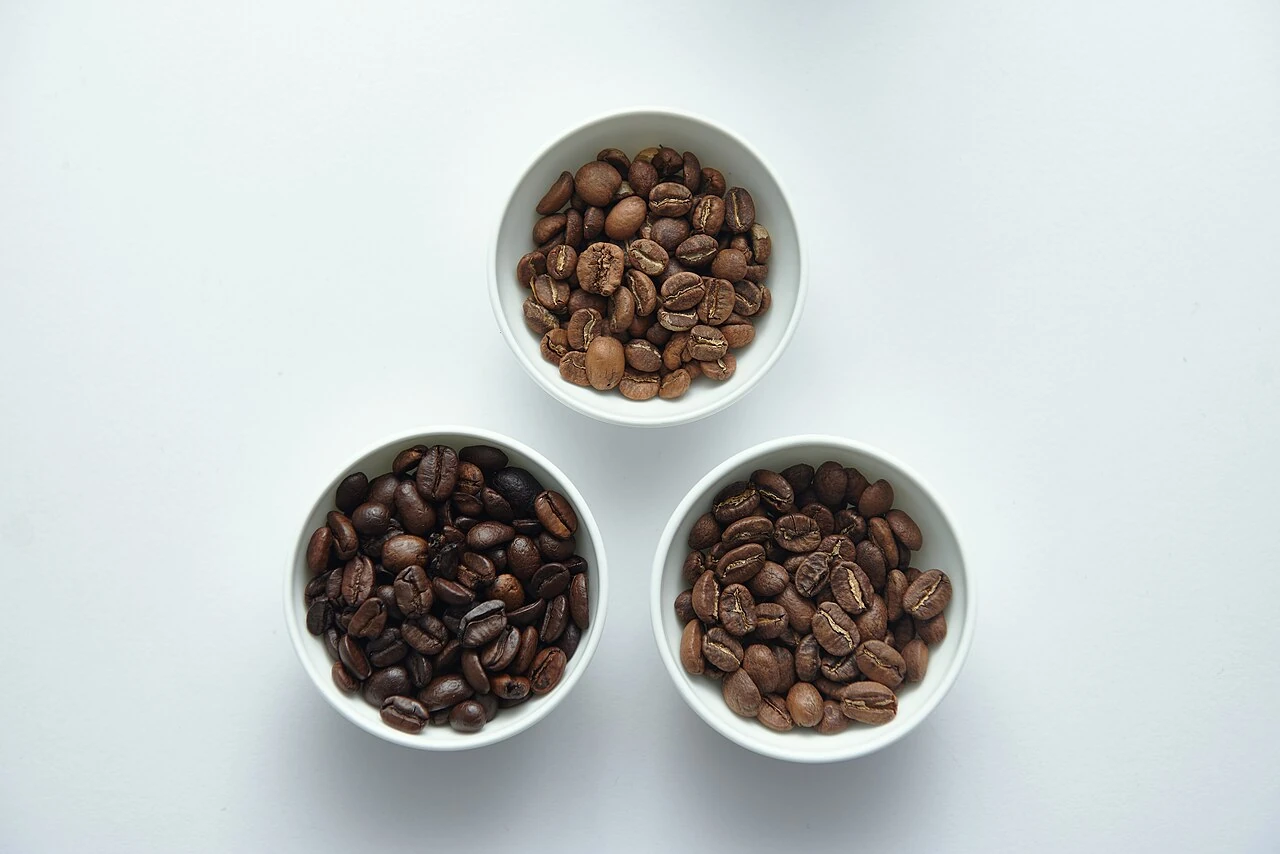
15 g of beans roasted to different degrees · Photo: Alorin, Wikimedia Commons, CC BY 4.0
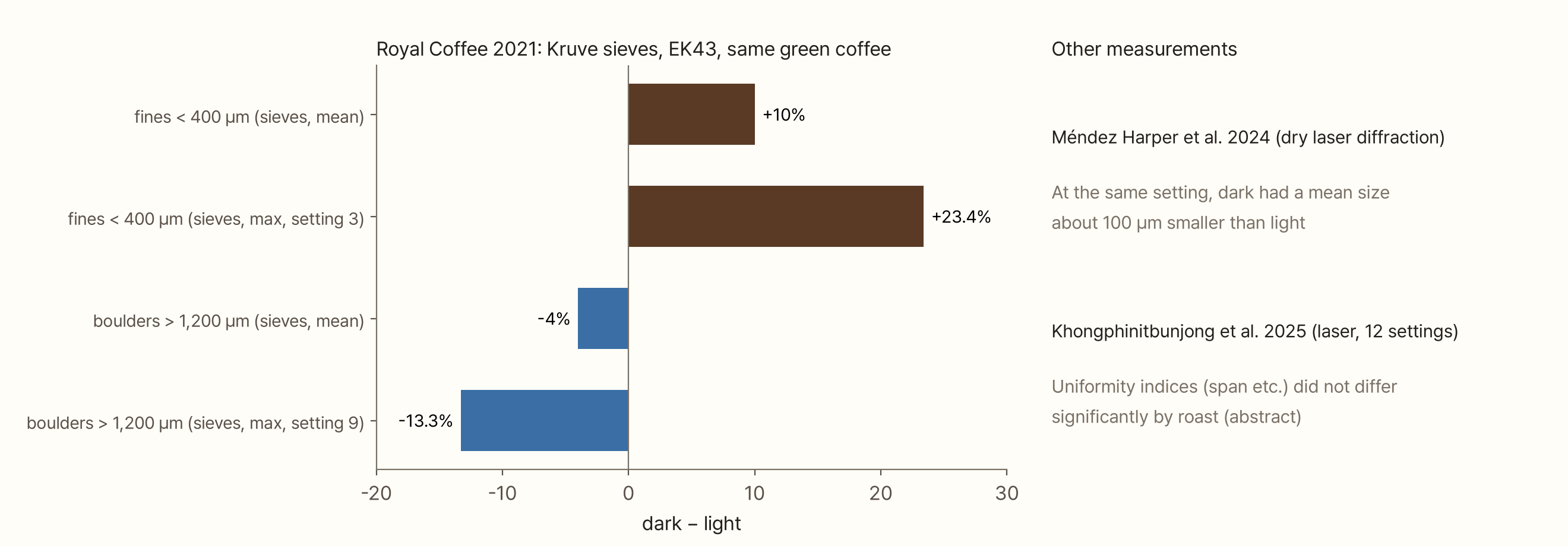
Kornman and Becker at Royal Coffee (2021) roasted the same green coffee to three levels, ground it on two EK43s and measured with Kruve sieves. The dark roast had on average more than 10% more fines below 400 µm than the light roast, and more than 4% fewer boulders above 1,200 µm. At the setting where they differed most, fines differed by 23.4% and boulders by 13.3%. Their "light" (Agtron around 50) is medium by specialty standards.
Laser diffraction pointed the same way. Méndez Harper and colleagues (2024), met in the static episode, wrote that at the same setting the dark roast's mean particle size was about 100 µm smaller than the light roast's, and attributed it to beans being more brittle. According to their companion preprint, their dark beans held 1.0–1.3% moisture and their light beans 2.8–3.0%.
Width is a different matter. Khongphinitbunjong and colleagues (2025) ground light, medium and dark roasts at twelve settings, measured them by laser diffraction and compared uniformity indices (span, uniformity coefficient and so on); according to the abstract, the differences by roast were not statistically significant. I could not open the full text, so I have not checked the numbers. I found no credible measurement supporting "dark roasts grind more evenly"; industry advice says the opposite, that dark roasts make more fines and should be ground a setting or two coarser.
Why grind finer?
Roasting drives out moisture, opens up pores and makes beans more brittle (Pittia and colleagues 2001, Schenker 2000). Even at the same roast degree, beans roasted fast and hot had a density of 622 g per litre against 747 g for beans roasted slowly, a different structure. I found no data on the breaking force of the same beans at different roast levels.
So I put "dark beans" into the 3D virtual grinder (gap 1.6 mm, 1,000 rpm) in three ways: beans with only their breaking force cut to 0.85 times; beans with breaking force at 0.7 times that split into 2–5 pieces when they break (instead of 2–4); and the same again, with the crumbs shed at each break raised from 8% to 12%.
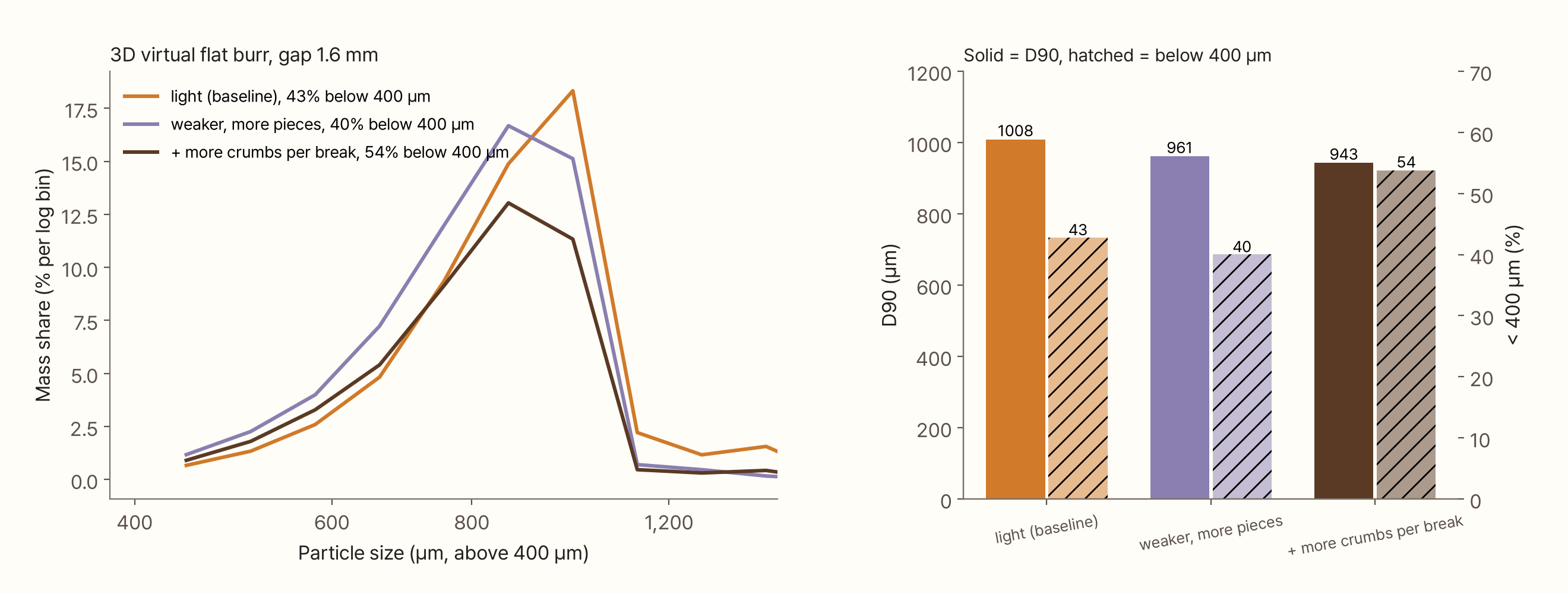
Making beans weaker and break into more pieces did not increase fines; the mass below 400 µm actually fell from 43% to 40%. With more pieces per break, fewer breaks are needed to reach the same size. D90 shrank slightly, from 1,008 µm to 961 µm. Only raising the crumbs shed at each break increased fines as the measurements did: below 400 µm rose 11 points to 54%, and D50 dropped below the model's resolution (400 µm). In this model, "dark roasts make more fines" requires not that the whole bean be weaker but that the cell walls at the broken faces crumble more easily ("Fines Are the Size of a Cell").
Measurement methods change the answer
Dark beans have one more trap. They charge more strongly (negative charge up to 120 nC/g, as seen in the static episode) and oil comes to their surface, so fines readily stick to larger particles and form clumps. Each method handles these clumps differently. Sieves leave clumps intact, so the fines stuck to them are counted as large. Dry laser diffraction blasts particles apart with air, breaking some clumps, and at too high a pressure it creates new fines. Image analysis sees a clump as one big particle. Méndez Harper and colleagues also noted that fines stuck inside the grinder are left out of the measured sample.
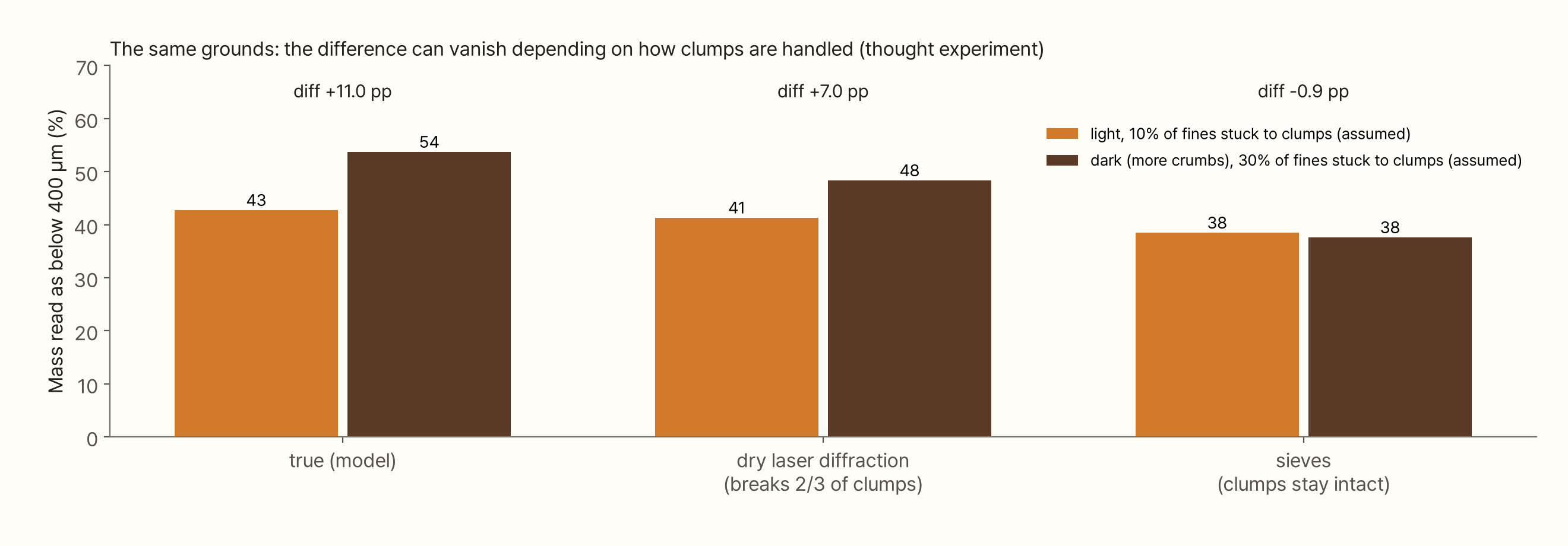
I ran a thought experiment. Taking the model grounds above (a true difference of 11 points), I set the share of fines that stay stuck to large particles on the sieves at 10% for the light beans and 30% for the dark, and assumed dry laser diffraction breaks two-thirds of the clumps. The laser then read the difference as 7 points, and the sieves as −0.9 points. The same grounds, measured by sieves, show no difference. The stuck shares are made up, so the numbers themselves mean nothing; they only show that the answer to the same question can depend on the method. Royal Coffee found more fines in the dark roast even with sieves, so the real difference was larger than this assumption, or fewer clumps formed.
I found no study measuring the same samples with all three methods. Much of the apparent conflict between "dark roasts grind evenly" and "dark roasts make more fines" comes from using "finer" and "more even" interchangeably, from each study's different definitions of "light" and "dark", and from each method's different handling of clumps.
Compare for yourself
The tool below holds the grounds from the experiments above. Choose an assumption for dark beans (weaker only, weaker with more pieces, more crumbs) and a gap, and its distribution is drawn over the light beans'. Change the share of fines stuck to clumps on the sieves, and the values read by laser and sieves change.
What this conclusion leaves out
- The properties of dark beans are assumptions. I found no data measuring breaking force and crumbling for the same beans at different roasts
- The stuck shares are made up. The method comparison is a thought experiment
- The model cannot see below 400 µm, so "fines" here means mass below 400 µm. That matches Royal Coffee's fines cutoff (below 400 µm) but not the 100 µm cutoff used in laser studies
- I could not check the full texts of Khongphinitbunjong and colleagues (2025) or Pittia and colleagues (2001)
- Oil and static are not in the model. Clumps were assumed only at the measurement stage
Summary
- Measurements say dark roasts grind finer. At the same setting, sieves found more than 10% more fines below 400 µm on average, and laser diffraction a mean size about 100 µm smaller
- "More even" has weak support. A laser study across twelve settings found no significant difference in uniformity indices, and industry advice says dark roasts make more fines
- In the virtual grinder, making beans weaker and break into more pieces did not increase fines (43 → 40%). Only more crumbs per break increased them as measured (54%)
- Dark beans charge more and sweat oil, so clumps form easily. Sieves, lasers and images handle clumps differently, so they can read the difference in the same grounds differently
References
- Kornman C, Becker E, Loofbourow SE (2021). Grinder alignment: an evaluation of consistency, cupping settings, and the impact of roast degree. Royal Coffee. link
- Méndez Harper J et al. (2024). Moisture-controlled triboelectrification during coffee grinding. Matter 7(1), 1–18. doi:10.1016/j.matt.2023.11.005
- Méndez Harper J, Hendon CH (2023). Chemical strategies to mitigate electrostatic charging during coffee grinding. arXiv 2312.03103. doi:10.48550/arXiv.2312.03103
- Khongphinitbunjong K, Wongsakul S, Mookum T (2025). Particle size distribution model for optimizing coffee grind consistency. Journal of Food Process Engineering. doi:10.1111/jfpe.70129 — abstract only
- Pittia P, Dalla Rosa M, Lerici CR (2001). Textural changes of roasted coffee beans with roasting conditions. LWT 34. doi:10.1006/fstl.2000.0749 — bibliographic details only; title not checked against the original
- Schenker S et al. (2000). Pore structure of coffee beans affected by roasting conditions. Journal of Food Science 65. doi:10.1111/j.1365-2621.2000.tb16026.x — abstract only; title not checked against the original
Image credits
- Beans roasted to different degrees: Alorin, Wikimedia Commons, CC BY 4.0
- All other charts, the cover and the tool: made by me
