A Warm Meal
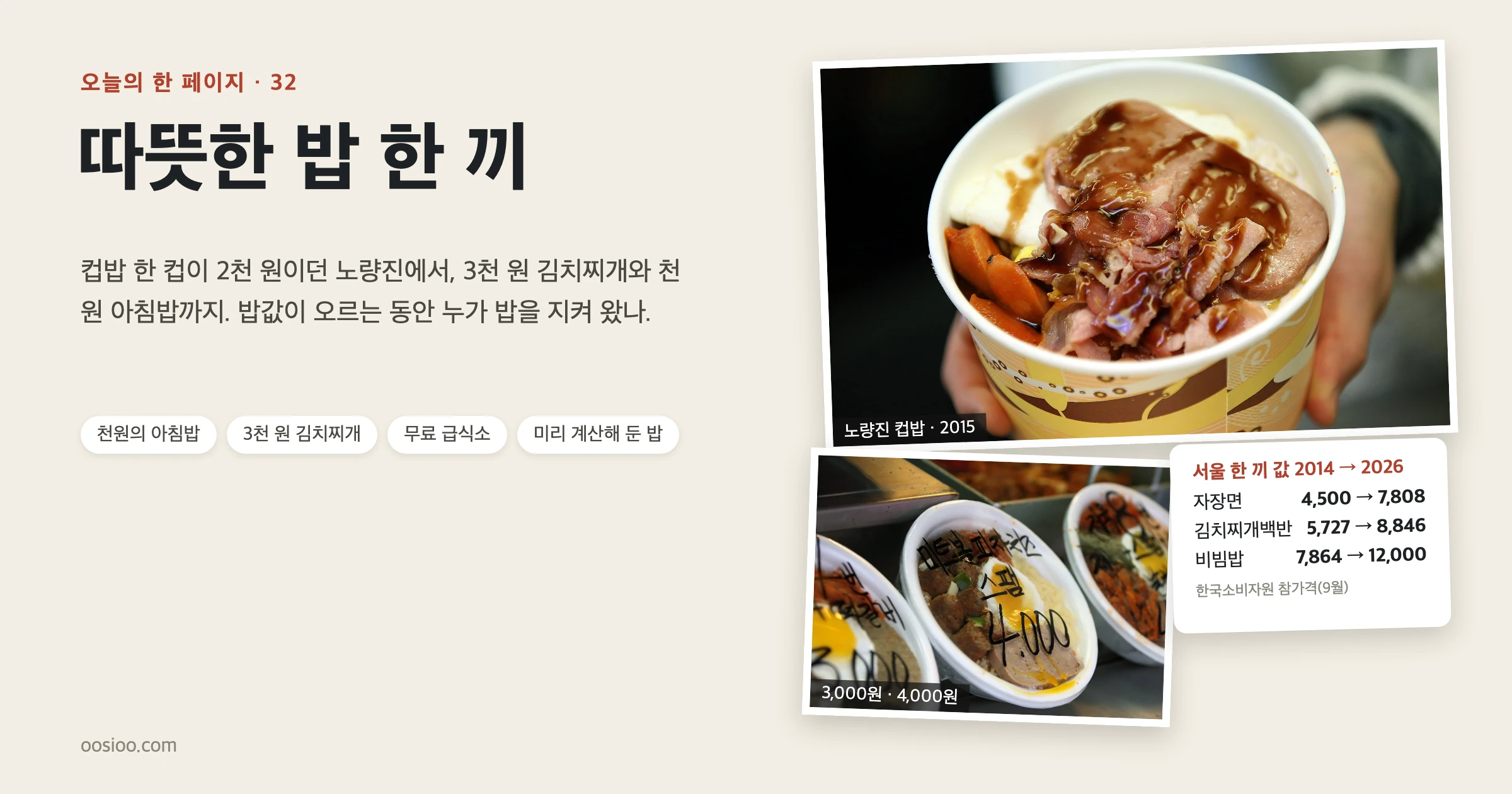
The notebook said only “A warm meal.” This piece follows the 15 years in which Noryangjin's cupbap went from around 2,000 won to 4,500 won and the cupbap street dwindled to just four open stalls, then sets Seoul dining-out prices against the minimum wage to work out how many minutes of work it takes to buy a meal. The burden comes less from how fast prices are rising now than from how high they've piled up over the years. After looking at the numbers on young people waiting for their first jobs, it revisits the ways communities have paid the difference in meal costs: the 1,000-Won Breakfast and 3,000-won kimchi stew, free meal centers where hundreds line up every day, meal cards for children at risk of going hungry, and Japan's children's cafeterias and the langar at India's Golden Temple. It also includes an interactive that converts the price of a meal into working time, and another that counts how many meals' worth of the difference your contribution would cover at each table. The thirty-second installment of A Page for Today.
The notebook I opened today said this:
A warm meal.
A meal comes around three times a day. That's why, when meal prices rise, you feel it in your body before any other price. Look at a lunch menu these days and the options a single 10,000-won bill can cover have noticeably shrunk. Office workers grumble and move on, but for someone who has yet to receive a first paycheck, that number carries a different weight.
There used to be food made for people like that: cupbap in the Noryangjin cram-school district, the gosi cafeterias of the exam village in Sillim-dong, the 1,000-won gimbap at snack shops near universities. People ate it for the price and the speed rather than the taste, but those who staked years on a single exam got by on it. Today I want to follow, in numbers, how that cheap food dwindled, and look at who has filled the gap, and how.
As Noryangjin's Cupbap Dwindled
There's no clear record of when cupbap first appeared. The earliest article I could find is from the Segye Ilbo in November 2011, which reported that kimchi fried rice served in cup-noodle-sized containers was selling for around 2,000 won in the Noryangjin area and had caught on. In an OhmyNews article the following year, the owner of a snack shop in business since 2004 says, “Cupbap stalls started moving into the alley two or three years ago.” So by around 2010 it was already a Noryangjin fixture.
Cheap food was contentious from the start. In April 2012, the Dongjak District Office sent the street vendors an official notice telling them to stop selling cupbap. The trigger was complaints from gosi cafeteria owners who were losing customers. A 2,000-won cupbap and a 4,000-won gosi buffet were going head-to-head over the same exam-takers' wallets. In the end, in 2015, the district moved the stalls scattered along the Noryangjin-ro cram-school strip to a 270-meter stretch across from Sayuksin Park, consolidating them into 28 standardized street stalls. In a government promotional photo from March that year, prices of 3,000 and 4,000 won are written in marker on each cup.
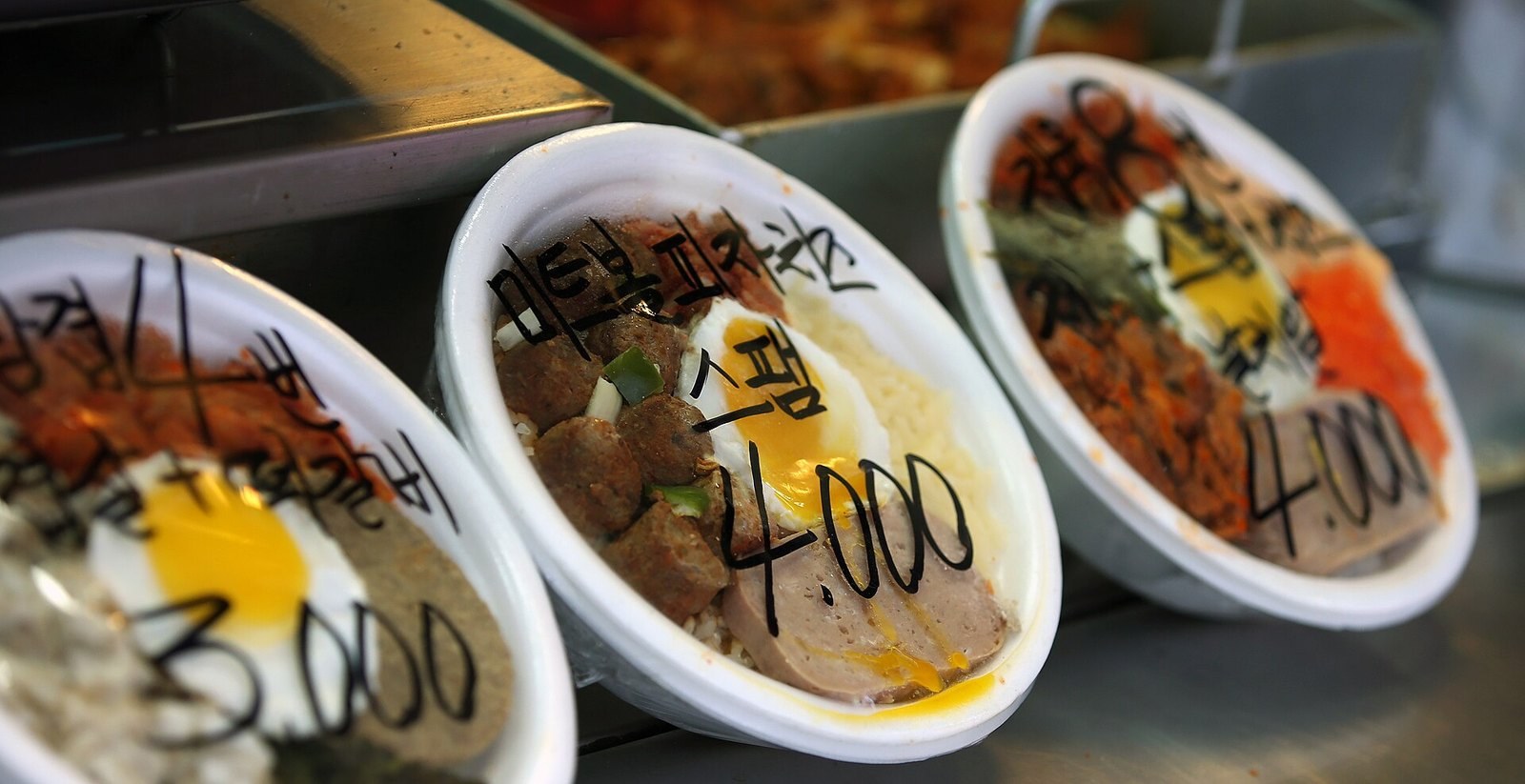
After that, the street went quiet. When a Bizhankook reporter counted around midday in June 2019, only three or four of the 28 stalls on the cupbap street were open. In a field report from the same outlet in April 2026, just four were in business. Prices went the other way. Cupbap that cost 3,000 won in 2021 went for 3,500–4,500 won in 2022, and vendors said an 18-liter can of cooking oil had gone from 28,000 to 58,000 won. In a Seoul Shinmun article from June 2026, cupbap costs 4,500 won.
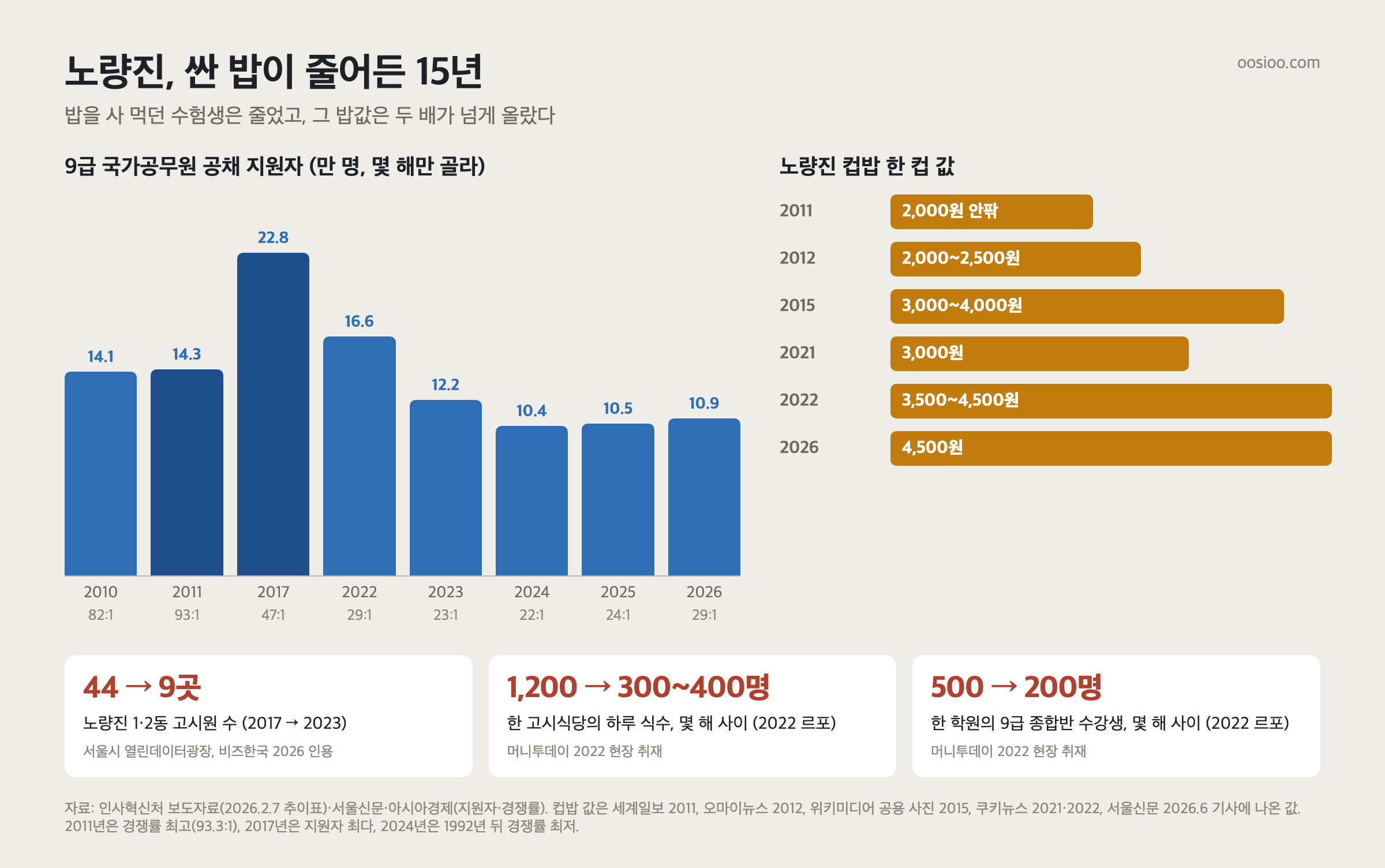
The reason customers dwindled is clear. Applicants for the grade 9 national civil service open recruitment peaked at about 228,000 in 2017, then fell to less than half that, 103,597, in 2024. That year's competition ratio of 21.8 to 1 was the lowest since 1992. People often say “another record low this year,” but that isn't true. The ratio rose two years running, to 24.3 to 1 in 2025 and 28.6 to 1 in 2026, and applicants edged up to 108,718. Even so, Noryangjin hasn't come back. Bizhankook points out that as exam-takers study at home through online lectures, the people who used to stay in the cram-school district and buy their meals there haven't returned. Gosiwon in Noryangjin 1-dong and 2-dong dropped from 44 in 2017 to 9 in 2023.
The exam village in Sillim-dong followed a similar path. The bar exam disappeared after its final second-round test in 2017. According to a 2007 article, a gosi cafeteria meal had a list price of 3,000 won, and with a 100-meal monthly ticket, each meal came to about 1,600–1,700 won. Once the exam-takers left, Daehak-dong filled with middle-aged and older people living alone, looking for cheap rooms. According to a Segye Ilbo feature in August 2026, 79% of households in Daehak-dong are single-person households, and recipients of basic livelihood security tripled from 682 in 2020 to 1,956. One of the places keeping meals going in the neighborhood today is the civic group Happy In. Every Monday, Wednesday, and Friday it serves a free lunch to around 150 people, covering its monthly food costs of 3–4 million won mostly with donations. Where cheap food used to be, free food is now filling in.
How Much Has a Meal Gone Up?
It isn't only that cheap food vanished as the exam-takers left. The price of a meal itself went up. According to the Seoul dining-out prices the Korea Consumer Agency publishes every month, between September 2014 and September 2026 jajangmyeon rose 74%, from 4,500 to 7,808 won; kimchi stew set meals rose 54%, from 5,727 to 8,846 won; and bibimbap rose 53%, from 7,864 to 12,000 won. Kalguksu topped 10,000 won for the first time this year.
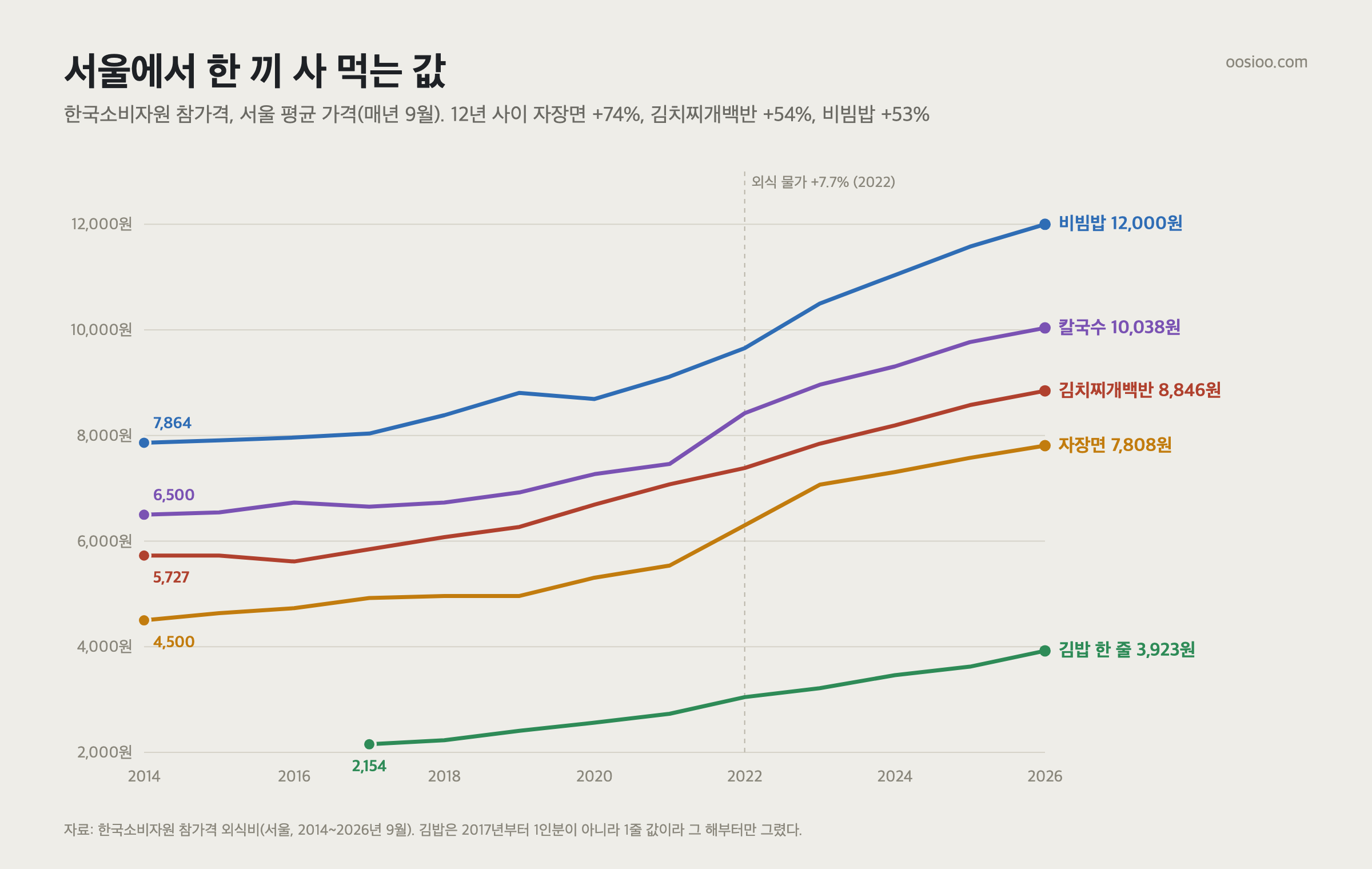
The steepest climb came in 2022. Statistics Korea's dining-out prices rose 7.7% that year and 6.0% the next. With 2020 set at 100, the dining-out price index stood at 129.15 in October 2026, well above overall consumer prices (120.73). The rate of increase has come down to the 2% range lately, but the cheaper the meal, the faster its price still rises. This October, gimbap was up 5.0% from a year earlier and boxed lunches 4.6%, outpacing the dining-out average of 2.9%. Rice prices played a part too. The retail price of a 20 kg bag of rice topped 60,000 won for the first time in July 2025, and in October that year rice prices jumped 21.3% year on year. In an analysis of 11 million company meal-voucher payments, the average office worker's lunch cost 10,000 won in 2026. In 2017 it was 6,000 won.
How Many Minutes of Work Does a Meal Cost?
If earnings had risen as much as prices, it would be a different story. So I divided the price of a meal by that year's minimum wage. It's a way of working out how many minutes you'd have to work at minimum wage to buy one meal.
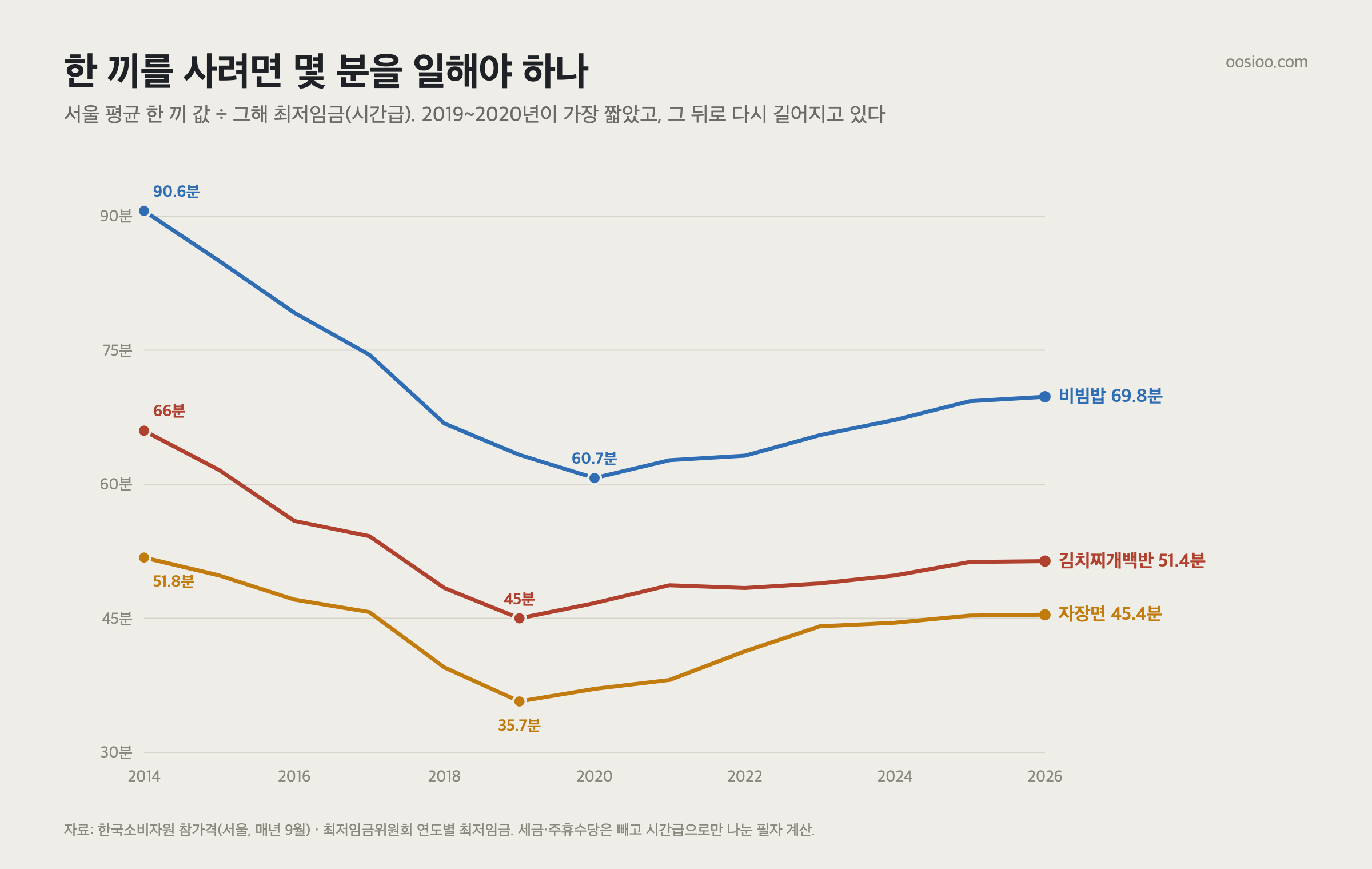
The result is a little different from what you might expect. In 2014, a kimchi stew set meal in Seoul cost 66 minutes of work; now it costs 51. That's because the minimum wage rose 98% over that period, from 5,210 to 10,320 won, outpacing the rise in meal prices. Over the long run, the saying that “meal prices rise faster than paychecks” turns out to be wrong. But the lines bottomed out in 2019–2020 and are climbing again. After 2020, minimum wage increases slowed to the 1–5% range while dining-out prices jumped sharply. Bibimbap went from 60.7 to 69.8 minutes, and jajangmyeon from 35.7 to 45.4 minutes. Today's burden comes less from how fast prices are rising now than from how high they've piled up over the years.
And this calculation only applies to people who have a job at all. Eating two kimchi stew set meals a day for 30 days on the minimum wage costs over 530,000 won a month, about 25% of a full 209-hour minimum-wage monthly salary.
At the Table While Waiting for a First Job
In September 2026, the employment rate for 15- to 29-year-olds was 44.0%, down 1.1 percentage points from a year earlier. The number of employed young people fell by 147,000, the 47th straight month of decline. The official unemployment rate is 5.4%, but the expanded unemployment rate, which also counts people who want more work and people who have put off looking, is 15.6%. Those preparing for employment number 602,000. That said, the claim that the number of young people who are “just resting” keeps growing isn't correct. In September it was 364,000, down 44,000 from a year earlier.
Few statistics show these numbers directly at the table. In the 2024 Korea National Health and Nutrition Examination Survey, the breakfast-skipping rate among people in their 20s was 62.1%, nearly double the overall rate (35.3%). But the survey doesn't ask why people skipped breakfast. There's no telling whether it was oversleeping or money. In the Household Income and Expenditure Survey, households in the bottom 20% by income spend 21.1% of their consumption on food, while the top 20% spend 12.0%. This figure, too, is hard to map onto young people's circumstances: the average age of heads of bottom-20% households is 62.2. I have yet to find an official statistic that separately measures the food-cost burden on young people living alone.
Still, the lines on the ground don't lie. At a youth restaurant in Jeongneung that sells 3,000-won kimchi stew, a daily crowd of just over 100 grew to more than 200 after fall 2022. Articles about universities' 1,000-Won Breakfast selling out the moment it opens, so-called “open runs,” turn up regularly.
The People Who Set the Table
While cheap food was disappearing, more and more people elsewhere began serving cheap meals on purpose. These meals have something in common. There's a gap between what the diner pays and what the meal actually costs, and someone else pays the difference.
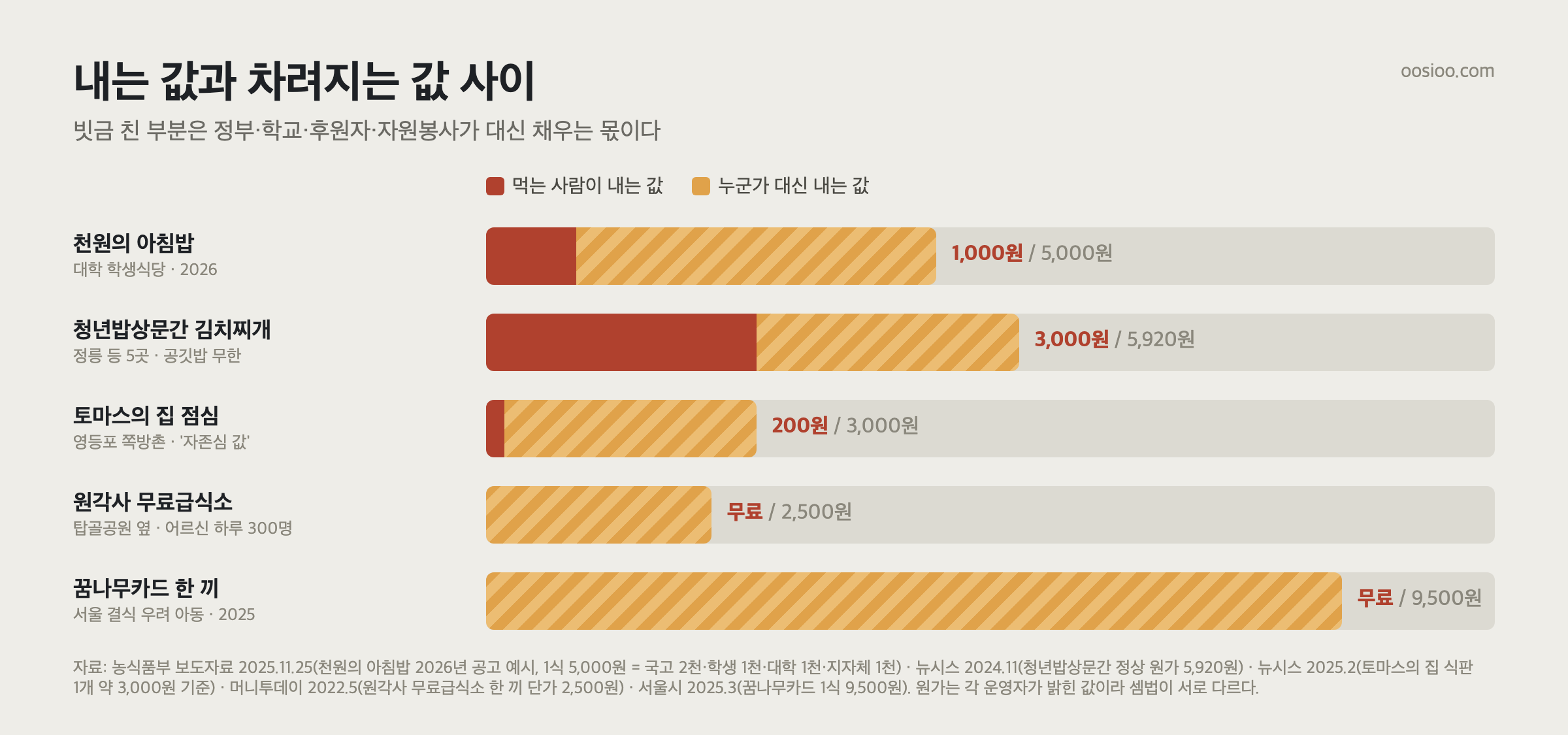
The largest is the government-funded 1,000-Won Breakfast. Launched at 10 universities in 2017 to boost rice consumption, it jumped to 144 in 2023, and 220 universities are taking part in 2026. Students pay 1,000 won, the government 2,000 won (since 2024; 1,000 won before that), and universities and local governments cover the rest. The 2026 allocation for university students is 5.4 million meals, and starting this year another 900,000 meals go to industrial-complex workers. There are reports that the 2027 budget proposal raises the government subsidy to 3,000 won. But the numbers hide something too. Among students at participating universities, only 2.1% actually eat this breakfast on a given day. The quantity is fixed, so only those who show up early get to eat.
Cheongnyeon Bapsang Mungan in Jeongneung, Seoul, is a restaurant Father Lee Mun-su opened in December 2017. It was prompted by the story of a young man who died in 2015 after going hungry in a gosiwon. Kimchi stew costs 3,000 won, and rice refills are unlimited. At full cost, a bowl reportedly comes to 5,920 won. The difference is made up by donations from individuals and organizations and by volunteers. As of 2024, it had grown to five locations: Jeongneung, Ewha Womans University, Nakseongdae, Daehangno, and Jeju. Seoul National University has offered a “1,000-Won Meal” since 2015 using school funds and donations, and when total visits rose from 150,000 in 2021 to 390,000 in 2023, it held a fundraising event in 2024 that brought in 730 million won. The Jogye Order Social Welfare Foundation serves lunch to young people once a week during the semester at three temples near universities.
Tables for older people and neighbors go back further. The Dail Community's Bappeo in Cheongnyangni started on November 11, 1988, in the plaza in front of Cheongnyangni Station and had served 15 million bowls by the end of June 2026. Around 500 people still come each day, but in March 2025 it was reported that donations had fallen nearly 30% from two years earlier. The Wongaksa Free Meal Center next to Tapgol Park serves 270–300 older people a day. When the cost per meal rose from 1,800–2,000 won to 2,500 won in 2022, it cut the number of side dishes for the first time in 30 years, and in 2024 its monthly operating costs went from 20 million won to as much as 28 million won. Thomas's House, in Yeongdeungpo's jjokbang village of tiny rented rooms, charges 200 won for a meal. It's a “dignity fee,” so that no one feels they're being handed a free meal. In January 2025, an average of 362 people came each day, and on the eve of Chuseok that year, the line stretched more than 500 meters down the alley before serving began.
Children's meals fall to local governments. Seoul gives children at risk of skipping meals the Kkumnamu Card, a meal card they can use at local shops. The per-meal allowance rose from 8,000 won to 9,000 won in 2024 and 9,500 won in 2025. As meal prices go up, the card's allowance has to keep pace, or children run out of places they can choose to eat. Haetteuneun Sikdang in Gwangju's Daein Market has served 1,000-won set meals since 2010, and in 2024 Gwangsan-gu in Gwangju brought together the district office, Nonghyup, and a senior employment program to launch “Cheonwon Hanggi,” serving bean sprout soup with rice for 1,000 won. This year, the Ministry of Health and Welfare made “Meokgeori Geunyang Deurim,” which lets people take food on the spot without proof of income, a permanent program. It began as a pilot at 57 sites in December 2025, drew 97,926 people in five months, and now runs at more than 280 sites.
Not every effort lasted. Mirinae shops, a movement that began in Sancheong, South Gyeongsang Province, in 2013, had customers prepay the next person's meal. At one point they spread to 400–500 locations, but when Bizhankook checked 20 of them in Seoul and Gyeonggi in 2019, only one was still keeping it up. Goodwill alone can't keep a table set for long. There has to be a structure that pays the difference, steadily.
Tables in Other Countries
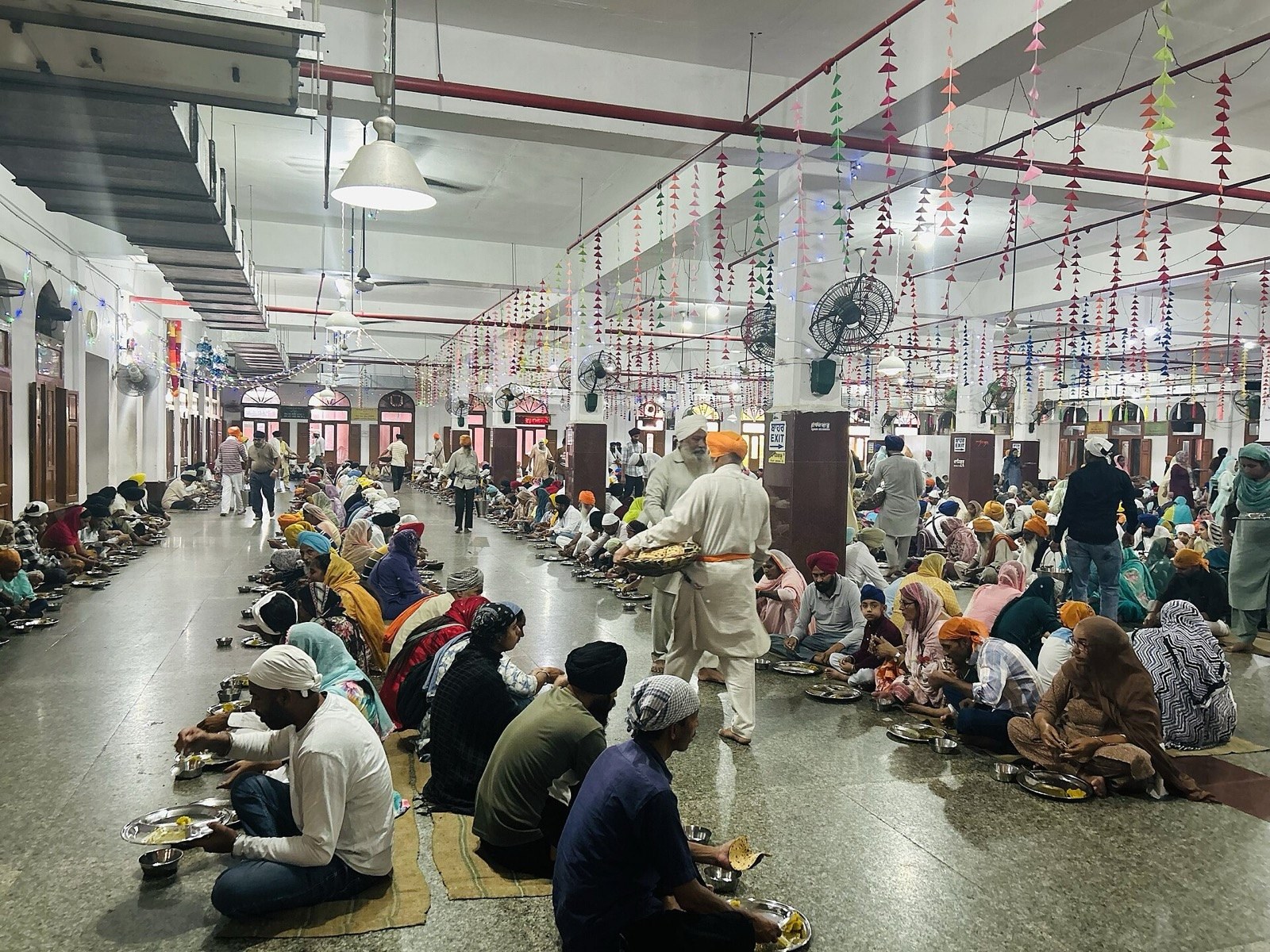
Other countries have their own ways for a community to share the difference in a meal's cost. The largest is the langar at the Golden Temple in Amritsar, India. It's the Sikh temple's communal kitchen, where anyone, regardless of religion or caste, sits side by side on the floor and eats the same food. Reports put the number of diners at 50,000 to 100,000 a day, but I couldn't find official figures. Ingredients come from donations, and volunteers do the cooking and dishwashing.
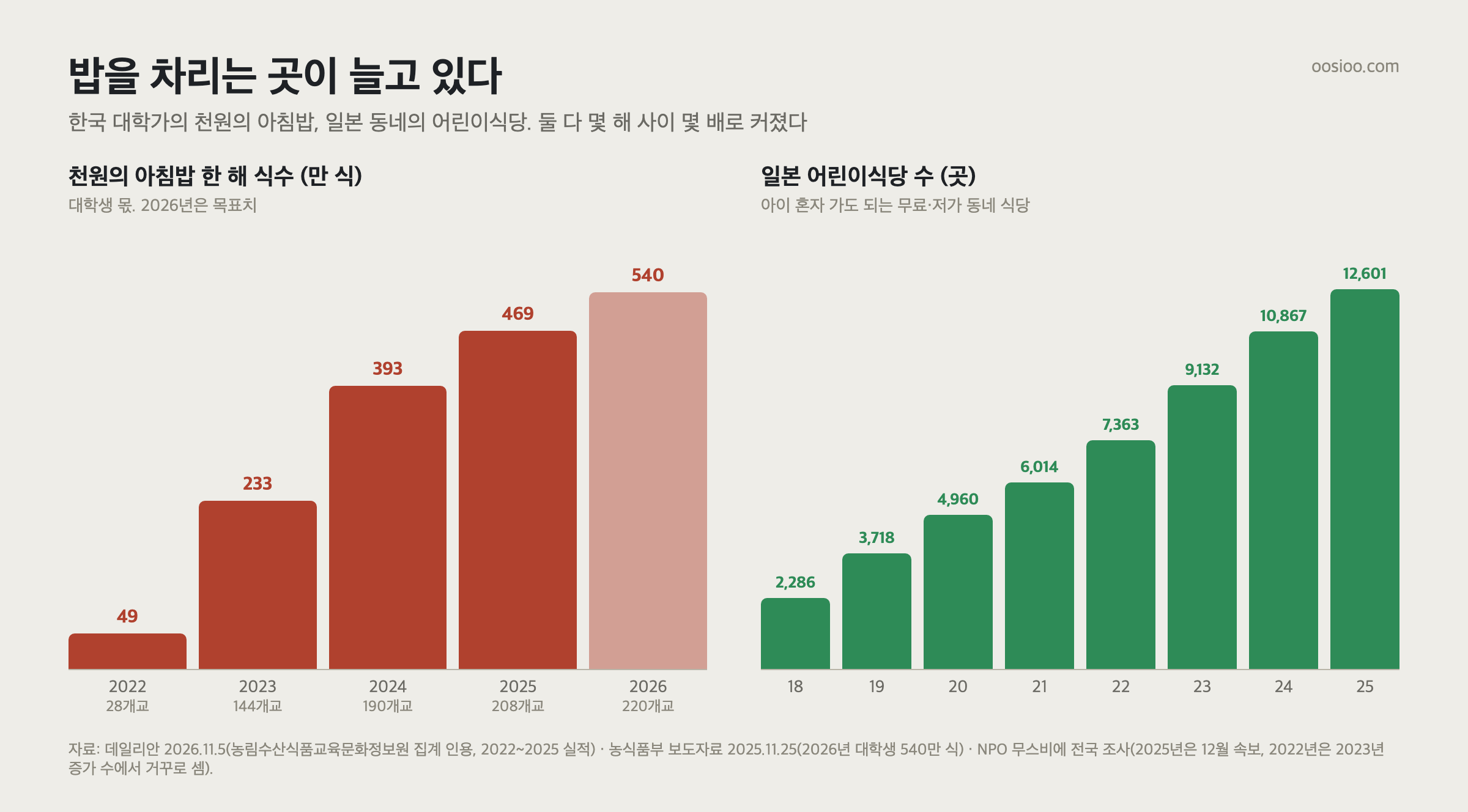
Japan has children's cafeterias (kodomo shokudo): free or low-cost neighborhood eateries where even a child on their own can sit down and eat at ease. They are said to have started in Ota Ward, Tokyo, in 2012. According to surveys by the NPO Musubie, there were 2,286 in 2018, and the preliminary count for December 2025 put the number at 12,601. That's close to 70% of the number of public elementary schools. Annual visits are estimated at 25.33 million, and the biggest worries are a lack of people to take over and rising prices. Many are run as places where anyone in the neighborhood eats together, so they don't look like somewhere only poor children go.
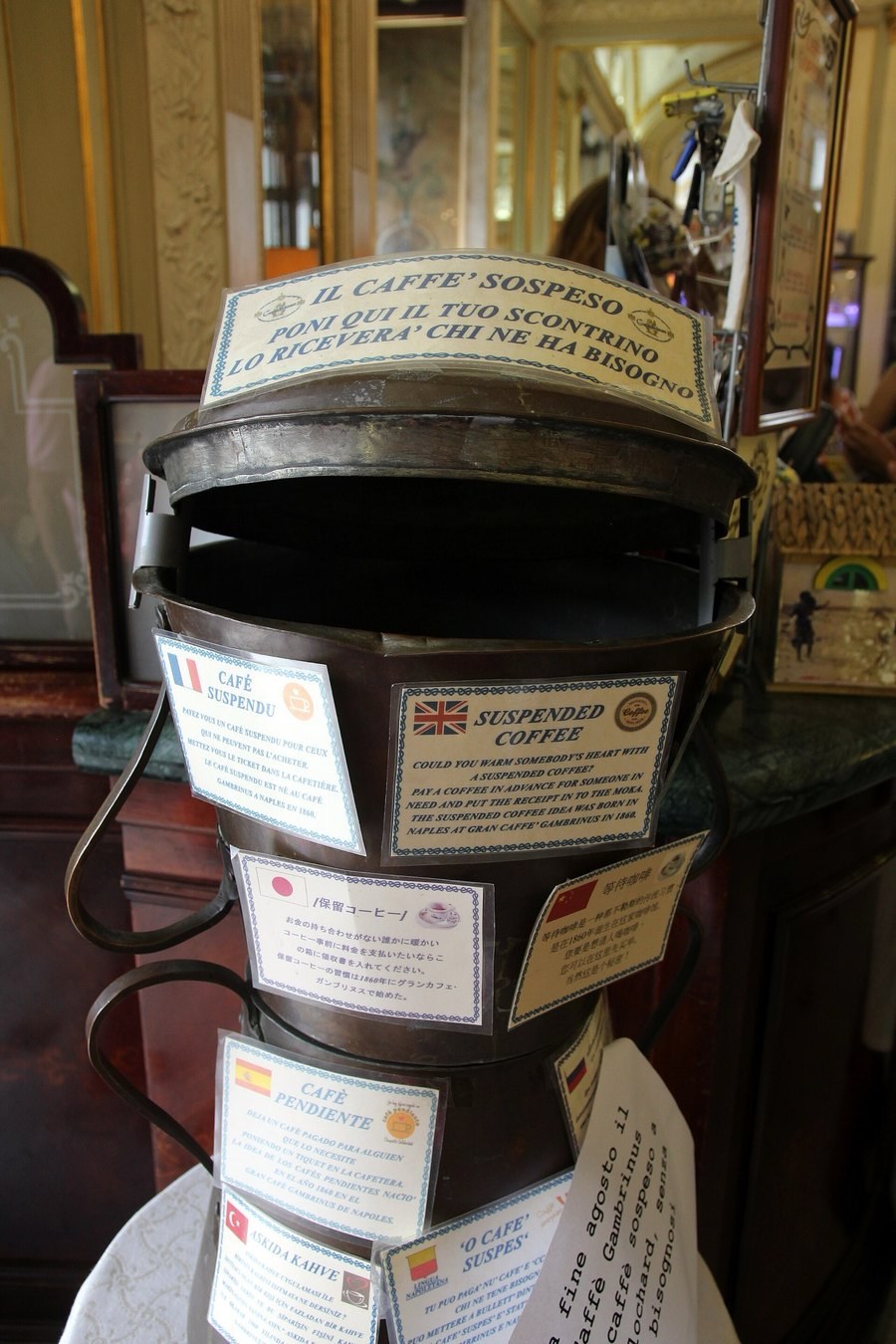
Naples, Italy, has a custom called caffè sospeso (suspended coffee). You pay for two coffees and drink one, leaving the other for whoever comes in next. It's unclear when it began, but it spread again after the 2008 economic crisis. Korea's Mirinae shops were also introduced as a movement modeled on this “suspended coffee.” In England, starting in September 2026, free school meals were extended to students in every household receiving Universal Credit, making more than 500,000 additional children eligible.
Do the Meal Math Yourself
In the first tab of the interactive below, you can pick a dish and a year to see how many minutes of work that meal costs. Enter your own hourly wage and it recalculates for your situation. The second tab gathers the tables that appear in this piece. Choose an amount you'd contribute, and it counts how many meals' worth of the difference that money covers at each one. Each operator calculates its costs differently, so it doesn't work well as a chart for comparing where your donation would do the most good. Rather, I built it to show that behind every cheap bowl of rice, someone is covering the difference.
Where Does the Warmth Come From?
The number I lingered on longest while gathering material was the 200 won at Thomas's House. Two hundred won is one-fifteenth of what a single tray of food costs. They charge it anyway so that the person eating can sit down as a customer. At the langar, everyone sits side by side on the floor, and Japan's children's cafeterias work hard not to look like places only poor children go. The warmth in a warm meal isn't just the temperature of the food. It depends on whether you can sit in the same place as everyone else and eat without worrying how anyone sees you.
Noryangjin's cupbap may have been cheap for the same reason. It was food you ate standing in the street, but no one thought of it as a handout. Now food like that struggles to survive in the market. Prices are higher, and the people who used to buy those meals have scattered. Filling the gap are government budgets and university funds; priests, pastors, and monks; and anonymous donors who send 10,000 won at a time. But these tables face the same prices too. Wongaksa cut its side dishes, Bappeo's donations shrank, and Thomas's House may have to move because of a redevelopment project.
So perhaps today's line in the notebook can be reread this way: to feed someone a warm meal is to keep sharing the cost of the difference. Just as the 1,000-Won Breakfast carries on only if it gets a budget every year, the 3,000-won kimchi stew carries on through small donations that arrive every month. If there's a place like that near you, one thing you can do is go once, eat, and pay a little more than the menu price.
A Page for Today is a series in which I open my idea notebook to any page and lay that day's thoughts on the line written there. Today, the line “a warm meal” became the thirty-second piece. If you spot an error in any of the numbers or examples, please let me know and I'll correct it.
References
- Korea Consumer Agency Price Portal, “Dining-Out Price Information” (Seoul, September of each year, 2014–2026)
- National Data Office, Consumer Price Index (dining out, rice, gimbap, boxed lunches), retrieved via Bank of Korea ECOS (October 2026 data)
- Minimum Wage Commission, “Minimum Wage Decisions by Year”
- National Data Office, “Employment Trends, September 2026” · Korea Policy Briefing summary
- National Data Office, “Household Income and Expenditure Survey Results, Q2 2026” (2026.8.27)
- Seoul Shinmun, “Twentysomethings Who Skip Breakfast,” report on the Korea National Health and Nutrition Examination Survey (link, 2025.10)
- SBS Biz, report on office workers' average lunch reaching 10,000 won (link, 2026.9) · Financial News, report on rice prices (link, 2025.7)
- Ministry of Personnel Management, “2026 Grade 9 National Civil Service Open Recruitment: Application Figures” press release (link, 2026.2.7)
- Segye Ilbo, “From Exam-Takers' Meals to Picnic and Party Food… The Evolution of ‘Cupbap’” (link, 2011.11) · OhmyNews, “Have You Heard of the ‘Noryangjin War’ over 2,000-Won Cupbap?” (link, 2012.4)
- Seoul Shinmun, “The ‘Rice Bowl Fight’ on Cupbap Street Is Over” (link, 2015.11) · Kukinews, report on Noryangjin prices (link, 2022.5)
- Bizhankook, on-site report from Noryangjin's cupbap street (2019.6) · “Civil Service Exam-Takers Are Back, but Noryangjin's Shops Aren't” (2026.4)
- Money Today, “Noryangjin's Exam Village in an ‘Ice Age’” (link, 2022.6)
- Segye Ilbo, “Beyond Closed Doors ④: ‘The Power of a Meal’ That Drew Isolated Households Out” (link, 2026.8)
- Ministry of Agriculture, Food and Rural Affairs, “Apply Now for the 2026 ‘1,000-Won Breakfast’ Program for University Students and Industrial-Complex Workers” press release (link, 2025.11.25) · Dailian, report on the state of the 1,000-Won Breakfast (link, 2026.11)
- Newsis, “Father Lee Mun-su: ‘Eat and Take Heart. Good Times Will Surely Come’” (link, 2024.11) · Seoul in My Hand, “A Hearty Meal for 3,000 Won!” (link, 2023.2)
- Money Today, report on SNU's “1,000-Won Meal” fundraising (link, 2024.9) · Newsis, report on the Jogye Order's “Cheongnyeon Bapsim” (link, 2026.5)
- Nocut News, report on Bappeo (link, 2026.9) · Money Today, report on falling donations to free meal centers (2025.3) · reports on the Wongaksa Free Meal Center (2022.5, 2024.8)
- Newsis, reports on Thomas's House (2025.2, 2025.10) · Herald Economy, report on the expropriation ruling against Thomas's House (link, 2026.1)
- Seoul Metropolitan Government, Kkumnamu Card allowance increase (link, 2025.3) · Newsis, “Meokgeori Geunyang Deurim” becomes a permanent program (link, 2026.5)
- Bizhankook, report on Mirinae shops five years on (link, 2019.1) · Segye Ilbo, report on Haetteuneun Sikdang (link, 2021.10)
- NPO Musubie, “こども食堂全国箇所数調査 2025(速報値)” (PDF, 2025.12)
- Gulf News, “Concept of equality pervades world's biggest community kitchen” (link) · NPR/WAMC, “Suspended Coffee: Old Italian Custom Spreads” (link, 2013.4)
- UK Department for Education, “Free school meals expansion grant 2026 to 2027”
- Photos: Noryangjin cupbap (2015, Republic of Korea/Korea.net, CC BY-SA 2.0.jpg)) · Golden Temple langar (2024, Harvinder Chandigarh, CC BY 4.0) · Caffè sospeso at the Gambrinus café in Naples (2016, Bex Walton, CC BY 2.0_at_Gran_Caff%C3%A8_Gambrinus,_Naples,_Italy.jpg)) · The two cupbap photos on the cover are also 2015 Korea.net photos (CC BY-SA 2.0). All from Wikimedia Commons
