
My Own Magazine, Every Morning — Personalized Briefings That Pick Only What You Need and Fit It on One Page
Newsletters keep piling up and inboxes keep getting messier. This piece traces how personalized briefings that curate only the information you need have evolved at home and abroad — from Newneek, Naver, and SK Telecom's A. (A-dot) to Artifact, ChatGPT Pulse, and NotebookLM — and, alongside the current trends, suggests how to build, in one click with AI, your own morning briefing for work and the commute.
A hundred years ago, this is how the morning news arrived. A newspaper printed at three in the morning was sold by children at the foot of a bridge, and people bought a copy on their way to work and folded it under an arm. Inside that single copy was a world an editor had spent the night choosing. What mattered was decided by the newspaper company, and readers simply took what they were given.
Now it's the opposite. There's too much to choose from. The newsletters you've subscribed to have somehow grown past ten, and news pours in from portals, YouTube, and group chats. Some newsletters are half advertising, some have a stiff tone, and the news you actually need for your work gets buried somewhere in between. The inbox fills up with unread counts.
What I want is simple. Every morning, only what I need, picked out and organized onto a page that's easy to read. This installment is about the people who first turned this wish into a business, and about how to build it yourself these days with AI.
Who Does the Choosing Has Changed
Choosing information on someone else's behalf is an old job. Newspaper editors did it, as did the clipping digests a corporate PR office used to circulate every morning. What's changed is who does the choosing.
The last heyday of humans doing the choosing was the newsletter. The place that opened this trend in Korea was Newneek, launched in 2018. With a tone that explains current events the way a friend would, it grew to around 1.5 million subscribers, and in 2024 it acquired Publy's paid membership business. Uppity, which sends daily money news for people in their twenties and thirties, states on its own that it had 1.15 million subscribers as of September 2026. Longblack, which launched in 2021, went the opposite direction. It publishes only one note a day, and even that has to be read within 24 hours. It's a way of telling people worn out by an overload of information, "Today, just this one thing."

Next, algorithms did the choosing. Naver attached an AI recommendation system called AiRS (AI Recommender System) to its news starting in February 2017. It composes a different front page for each person based on articles read by people similar to you. In November of that year came Summary Bot, which pulls out three key sentences from an article and displays them. Koreans are already used to this approach. According to the Reuters Institute for the Study of Journalism's Digital News Report 2025, 63% of Korean respondents access news through search or portals — the second-highest among surveyed countries. Only 6% go directly to a media outlet's site, ranking 47th. Seeing news through a list someone else curated is already the default in Korea.
Now AI picks the news and rewrites it too. Naver's Summary Bot shifted in 2025 from cutting and pasting original sentences to writing summaries in new sentences. In December 2024, the Seoul Economic Daily launched "AI Prism," which divides readers into 16 types and summarizes the same article differently for each, and the JoongAng Ilbo also now attaches an AI summary to every article. Machines have begun not just choosing but rewriting to fit the reader.
Across the Ocean
Abroad, this experimentation has been far louder. Here are a few highlights.
| Service | Who | What it did | Status now |
|---|---|---|---|
| Artifact | Two Instagram co-founders | Learned from articles you'd read to build a personalized news feed for each user, with AI summaries and rewritten clickbait headlines | Shutdown announced January 2024; the technology was bought by Yahoo and attached to Yahoo News |
| Particle | Former Twitter employees | Bundled articles from multiple outlets covering the same event into a single combined summary | Still operating (raised $10.9 million in 2024) |
| Copilot Daily | Microsoft | Voice summary of morning news and weather. Uses only articles from outlets it has paid and contracted with | Launched October 2024 |
| NotebookLM Audio Overview | Turns material you provide into a podcast conversation between two AI hosts | Still operating | |
| ChatGPT Pulse | OpenAI | Reviews overnight conversation history and your schedule and surfaces a few cards each morning | Launched September 2025, discontinued June 2026 → replaced by "Scheduled Tasks" |
| Huxe | Developers who had built NotebookLM | Personalized audio briefing drawn from email, calendar, and interests | Raised funding September 2025, shut down May 2026 |
| Gemini Daily Brief | Morning summary bundling email, calendar, and to-dos by priority | Announced May 2026 (starting with paid US subscribers) |
The same thing has happened in Korea. SK Telecom attached a beta feature called "Briefing" to its AI assistant A. (A-dot) in June 2025. It's what the company calls an "ambient agent": it remembers how you reacted to the previous briefing and reflects that in the next one. Kakao will shut down its AI app Kanana, launched in May 2025, on October 15, 2026, and move its functions inside KakaoTalk.
Four Current Trends
Laying the cases out chronologically reveals a few threads.
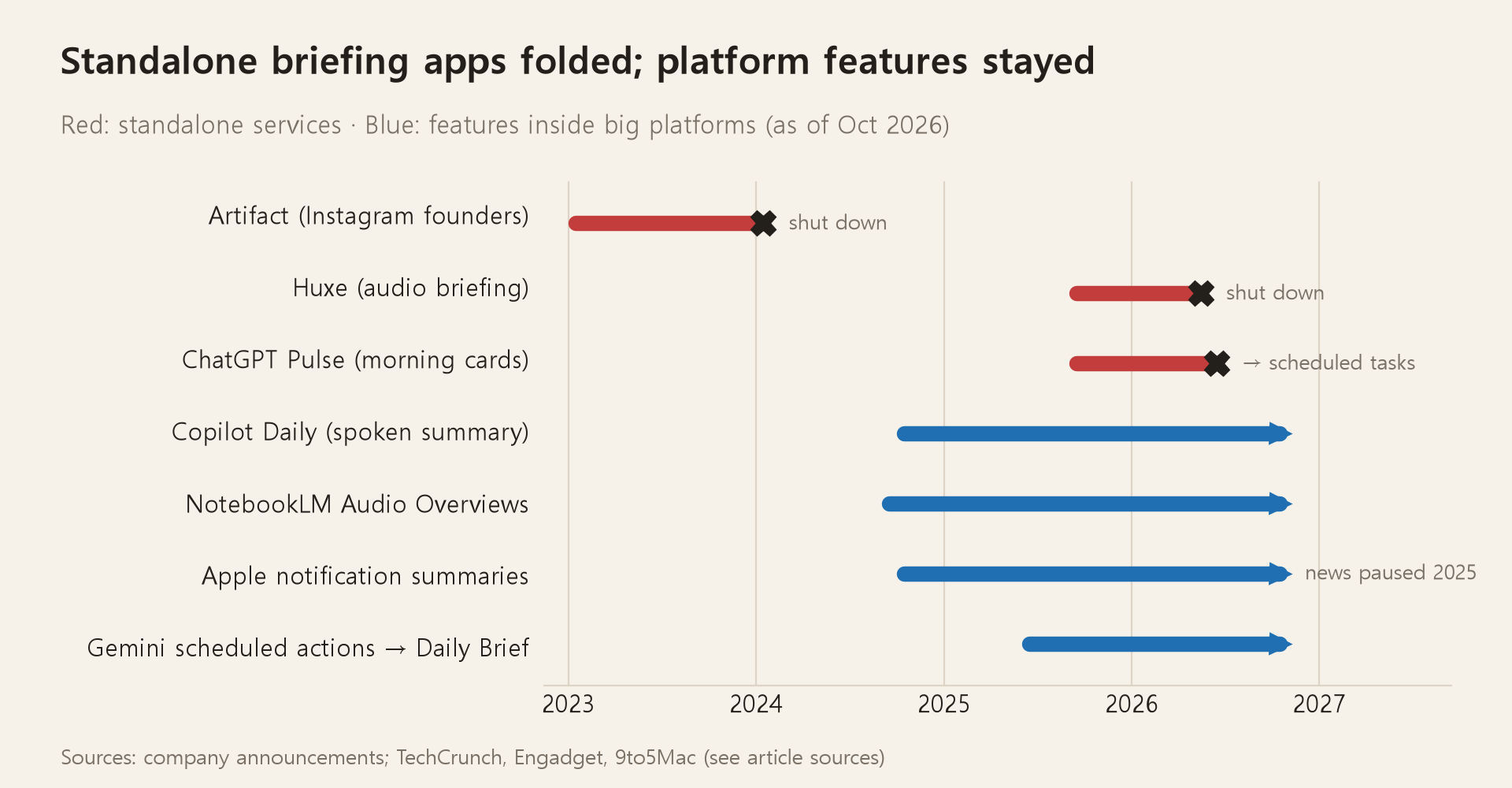
First, standalone apps are fading, and only the features built into large platforms remain. Artifact, Huxe, ChatGPT Pulse, the Kanana app — most services that tried to stand on the morning briefing alone didn't last two years. Instead, the same functions have moved into ChatGPT's Scheduled Tasks, Gemini, iPhone notifications, and KakaoTalk. A personalized briefing is no longer a separate app you install, but a feature attached to a tool you already use.
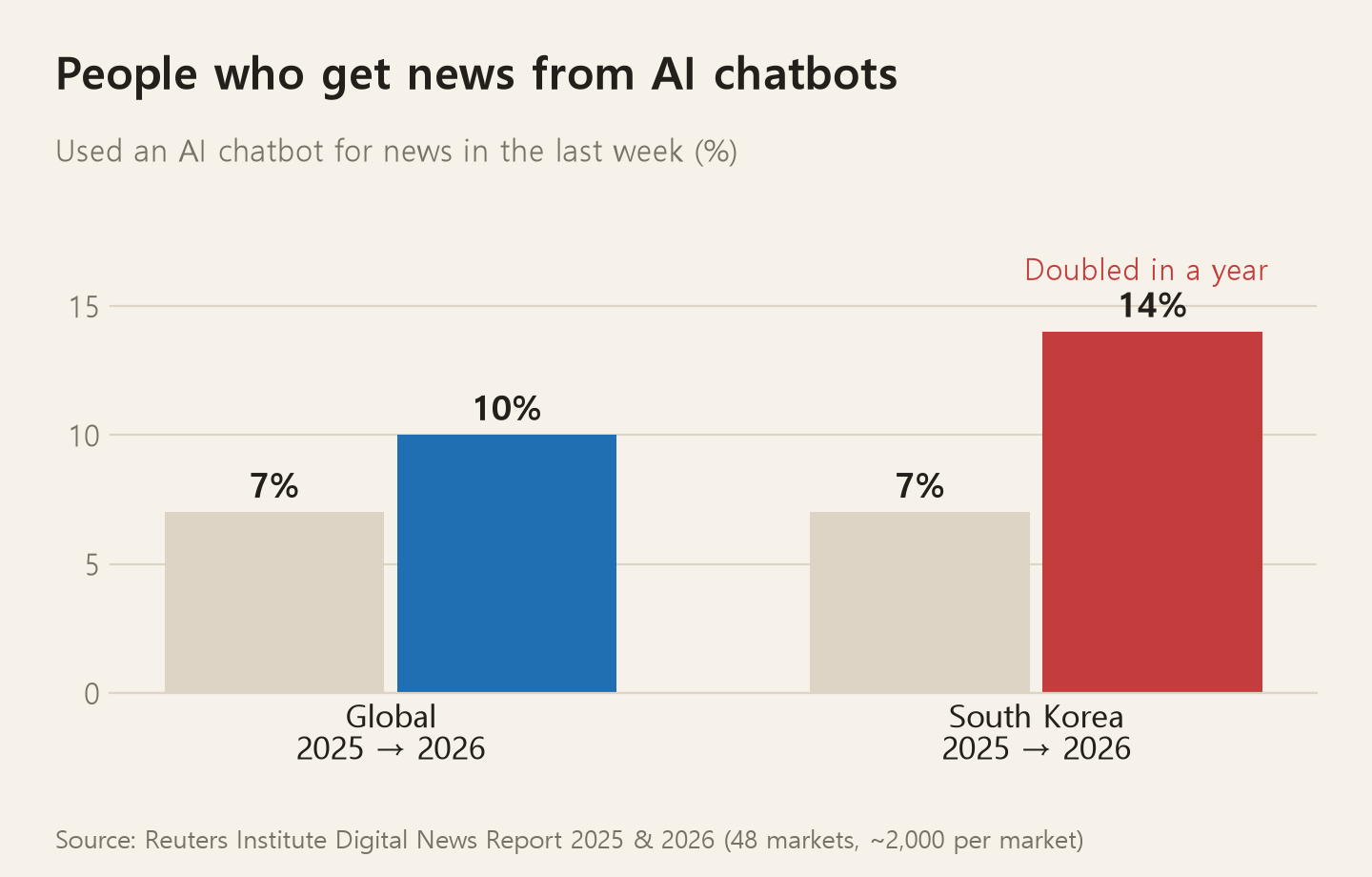
Second, the number of people using AI to see news is rising fast, and Korea especially so. In the Digital News Report 2026, 10% of people worldwide said they'd used an AI chatbot to see news in the past week, up from 7% a year earlier. Among those under 35, it's 16%. Korea went from 7% to 14%, doubling in a single year, tying with Turkey for the highest among surveyed countries.
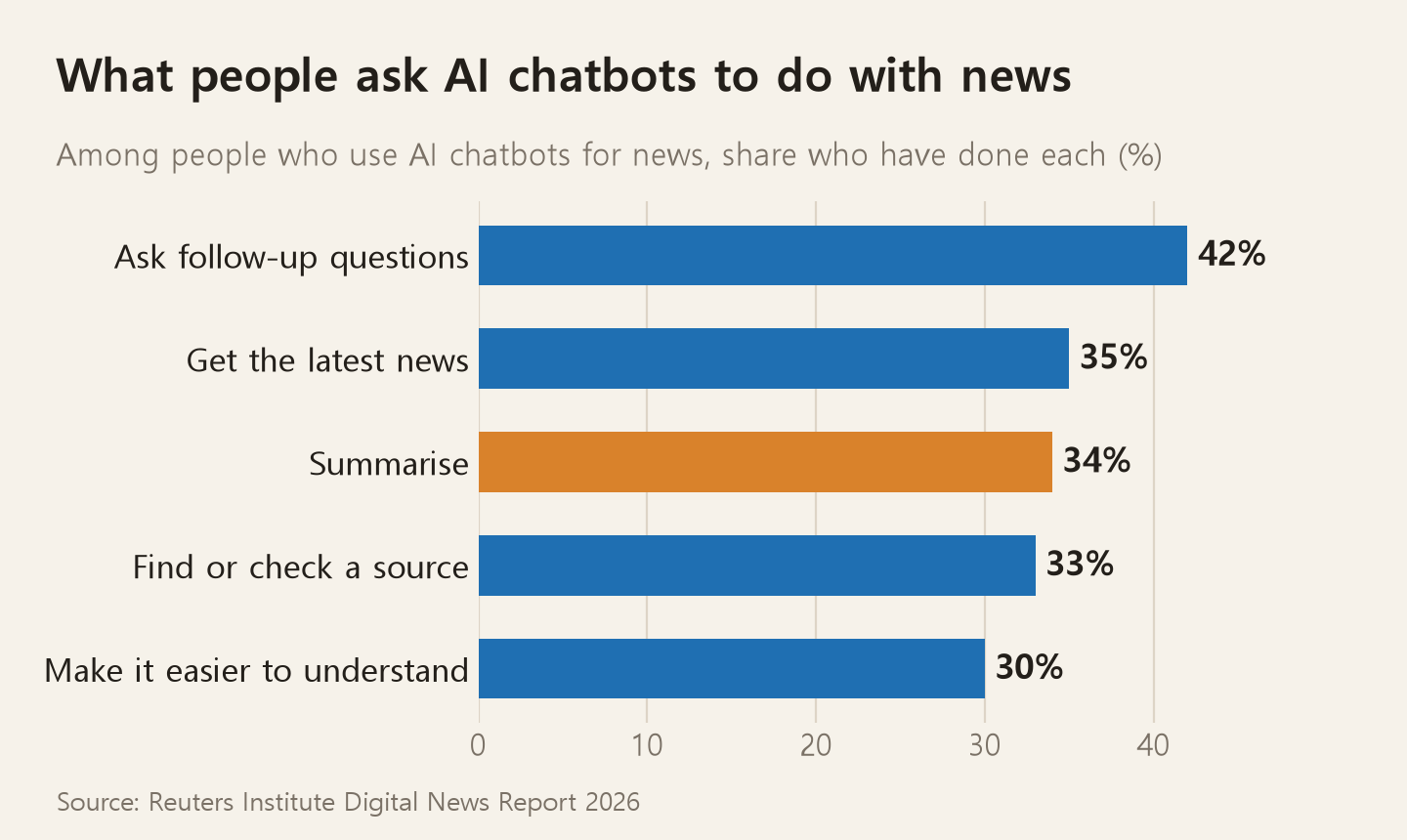
What people ask AI to do is interesting too. The most common is "ask follow-up questions about something I'm curious about" (42%), followed by getting the latest news (35%) and summarizing (34%). Rather than stopping at a summary, more people go back and ask further questions about the summary they received. A newspaper never took questions.
Third, from reading to listening. NotebookLM's Audio Overview, Copilot Daily, Google's "Daily Listen" (a five-minute AI podcast made from articles you're interested in, tested in January 2025), and Huxe — a good number of the briefings launched in the past two years come out as audio. That's because on a commute spent driving or standing in a packed subway car, your ears are free even when your eyes aren't.

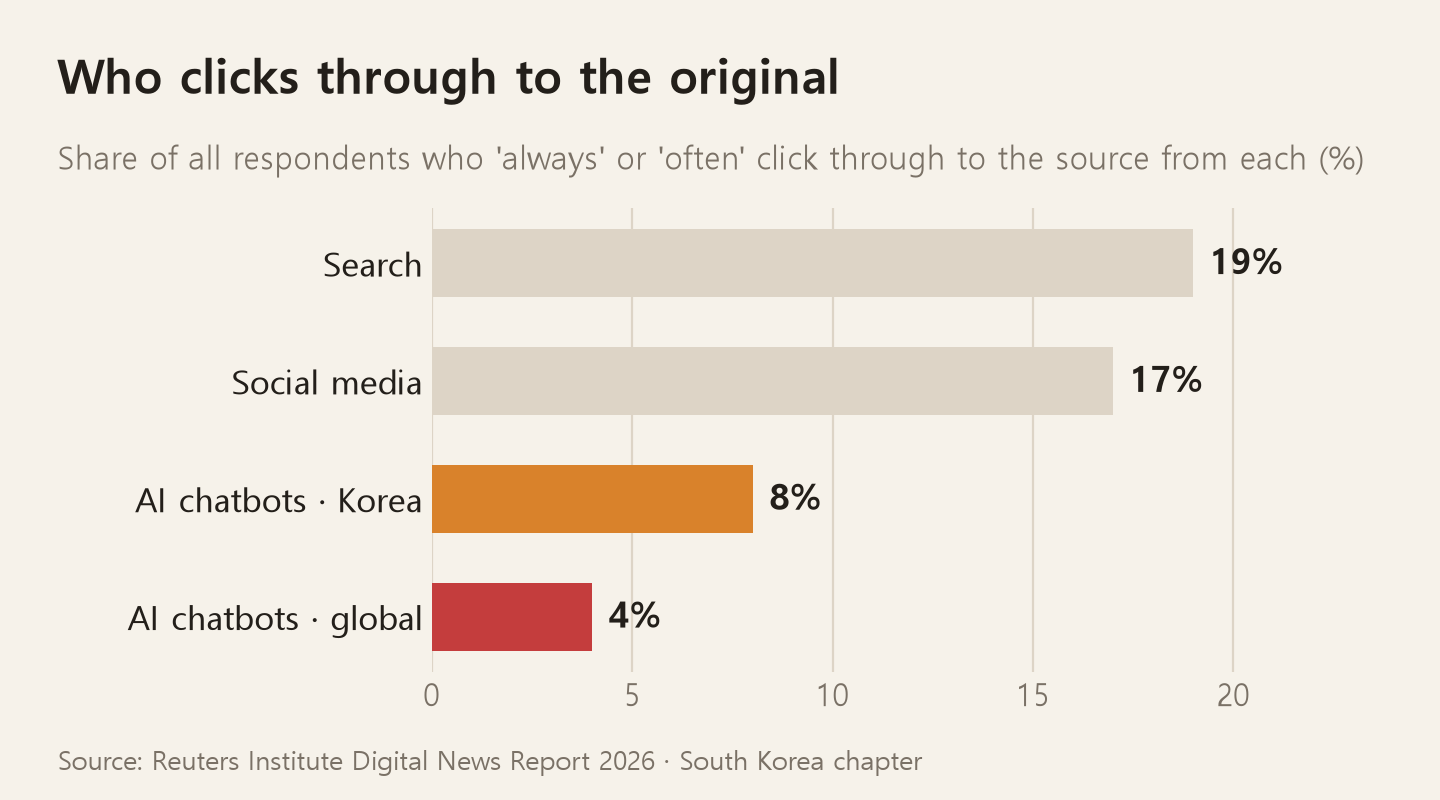
Fourth, tension with the original source material has grown. The more convenient a summary is, the fewer people go on to the original article. In the same report, only 4% of all respondents said they "always" or "often" click through to the original link from an AI chatbot, far lower than from search (19%) or social media (17%). Korea does a bit better at 8%. Looking only at people who use AI to see news, 56% of Koreans say they move on to the original article, higher than the global figure of 42%.
So the people who write the articles have grown wary. The New York Times filed suit against OpenAI in late 2023, and in Korea in January 2025, KBS, MBC, and SBS sued Naver for using their news to train AI. Starting in July 2025, Cloudflare began blocking AI crawlers by default on sites using its network and testing a "pay per crawl" option that charges for scraping. On the other hand, the path to using content legitimately, with payment, has also widened. OpenAI signed deals with AP and Axel Springer, and Copilot Daily uses only articles from outlets it has contracted with from the start. When Naver rolled out its new summary feature, it went out of its way to state that it does not store or use original articles for training.
There's also the problem of summaries getting things wrong. In late 2024, Apple faced complaints when an iPhone notification summary misrepresented a BBC article, attributing an inaccurate sentence to the BBC's name, and in January 2025 it paused news app summaries. When it turned them back on in July, it italicized the summary text and added the label "Summarized by Apple Intelligence."
So, What If You Built Your Own?
Putting all this together leads to one conclusion. Running a personalized briefing as a business has gotten steadily harder. You have to compete with large platforms, and using original content costs money and requires permission. But building one as a tool just for yourself has actually gotten easier. Explain a few things to an AI, and the skeleton of it runs in a single evening. This is exactly the spot where the "one click" this series, Actually One Click, is about fits.
A briefing made by someone else and one you make yourself use different criteria for choosing. Gemini or A. (A-dot) have to satisfy countless people, but yours only has to satisfy you. You can receive, every morning, news that no portal would ever put on its front page — a regulatory notice specific to your industry, a competitor's press release, a new paper in your field.
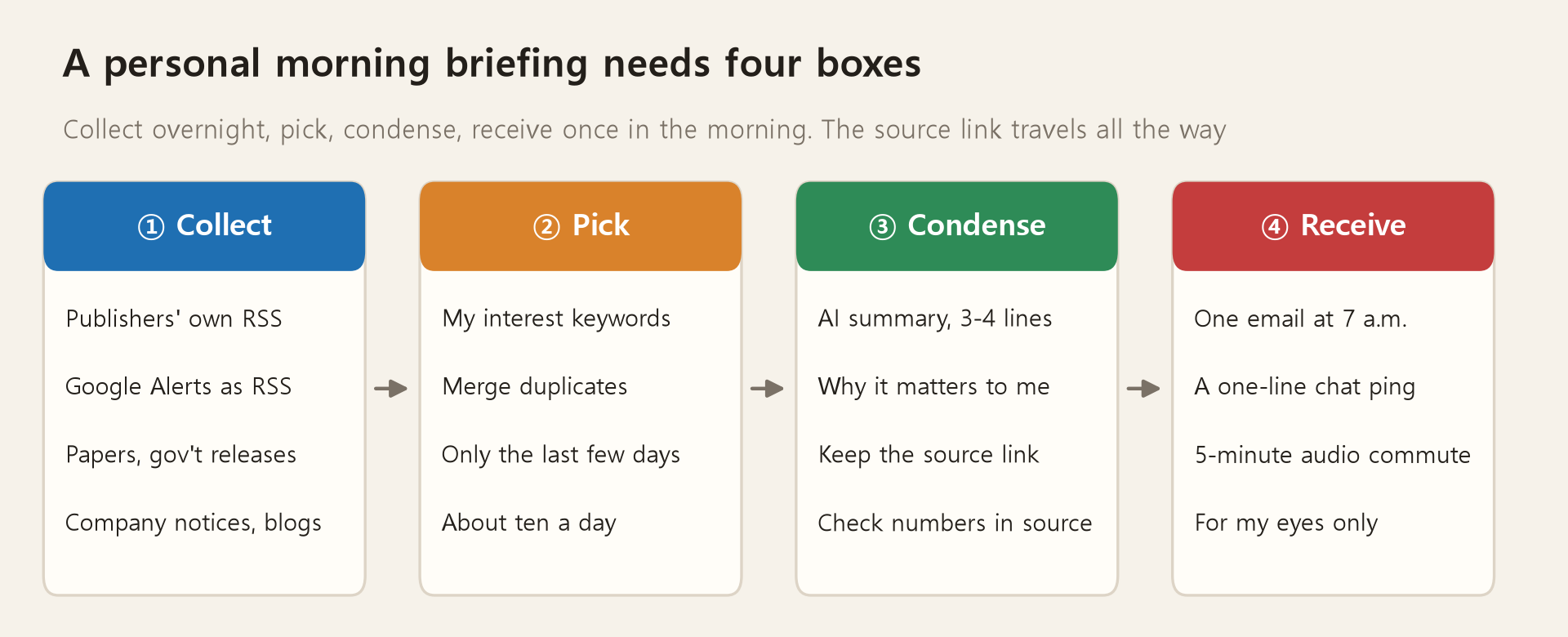
The skeleton has four parts.
- Gather. More places than you'd think still offer RSS. Foreign outlets like the New York Times, the BBC, and the Guardian, and domestic outlets like Yonhap News and the Hankyoreh, all still have live feed addresses. For topics without a feed, you can set a keyword in Google Alerts and switch the delivery method to "RSS feed." Government ministry press releases, preprint sites, and company blogs usually have feeds too.
- Select. Filter by your interest keywords, and merge articles from different outlets covering the same event into one. About ten items a day is plenty. Any more and it becomes an inbox again.
- Condense. Have AI summarize each item in three or four lines, and add one more line: "Why does this matter to me?" That one line is what sets it apart most from a briefing someone else made.
- Receive. Whether it's a single 7 a.m. email, a messenger notification, or a five-minute audio clip to listen to on the commute, send it to wherever you actually look.
There's no shortage of places to use it.
- For work: if you make medical devices, notices from the Ministry of Food and Drug Safety and foreign regulators; if you're in sales, press releases from clients and competitors; if you do research, new papers containing your keywords. A morning skim that used to take 30 minutes shrinks to a single email.
- For the commute: turn news in your field of interest into a five-minute audio clip, and you can catch an entire day's worth of developments in the span of one subway stop. It's a way of making the "listening briefing" discussed earlier your own, built around your own topics.
- For a team: send the same thing to a team messenger channel, and everyone walks into the morning meeting having seen the same news. In this case, don't just send the summary — always include the original links too.
I've also been getting news from my own field of interest in a single message every morning for a few months now. In practice, getting it running the first time really did take just one evening. What took time came after that. There comes a day when a feed address quietly changes and an outlet silently drops out, or when no new posts have come in for days while the program keeps running fine and logging as if nothing's wrong. One click gets the skeleton up quickly, but keeping it running quietly and well every day takes the occasional check-in. Even that check-in, though, is done in half a day if you just ask the AI to "show me evidence of why no new posts are coming in."
Lines to Keep When Building One
The fourth trend above isn't someone else's problem. Even a tool just for yourself has lines to keep.
- Use only feeds and public material that outlets offer themselves. RSS is something an outlet has put out saying "take this and read it." Don't forcibly scrape sites that block bots, and don't get around paywalls.
- Keep it for yourself. If you post the summaries on a blog or sell them to others, that's no longer your briefing — it's republishing someone else's article. Even when sharing with a team, keep the summary short and send the reading material as an original link.
- Carry the original link all the way through. A summary is a signpost to the original. If a number or a quotation matters, check it again against the source. As with Apple's BBC incident, summaries can be wrong.
Closing
What the newsboy was selling a hundred years ago wasn't paper — it was a world someone had spent all night choosing. Now, the big platforms are racing to hand that choosing over to machines. But the world they choose is tuned to the average of millions of people.
What I need is a world tuned to my own work and my own interests. The machine that does that choosing can now be built by your own hand in a single evening. Why not try building, this evening, the one page you'll look at on tomorrow morning's commute?
Sources and Further Reading
Surveys and Reports
- Reuters Institute for the Study of Journalism, Digital News Report 2026 summary (2026-06-16) — reutersinstitute.politics.ox.ac.uk · AI chatbot usage chapter — reutersinstitute.politics.ox.ac.uk · South Korea chapter — reutersinstitute.politics.ox.ac.uk
- Reuters Institute for the Study of Journalism, Digital News Report 2025 summary (2025-06-17) — reutersinstitute.politics.ox.ac.uk
- Korea Press Foundation, Media Issue, Digital News Report 2025 Korea (2025-06-17) — kpf.or.kr
- Digital Daily, Korean AI chatbot news usage at 14% (2026-06-18) — ddaily.co.kr · Kukinews, 56% of Korean AI news users move to the original article (2026-06-25) — kukinews.com
Domestic Cases
- Flex Blog, Newneek interview (2025-04-16) — flex.team
- Uppity — uppity.co.kr (subscriber count per the company's own figures)
- StartupN, Longblack (2022-03-30) — startupn.kr
- Segye Ilbo, Naver AiRS (2019-04-08) — segye.com · Digital Times, Naver Summary Bot (2017) — dt.co.kr · iNews24, Naver generative summaries (2025-11-19) — daum.net
- Media Today, Seoul Economic Daily's "AI Prism" and JoongAng Ilbo's AI summaries (2025-02-04) — mediatoday.co.kr
- Asia Economy, A. (A-dot) Briefing beta (2025-06-30) — asiae.co.kr
- Nate News, Kanana app shutdown (2026-09-15) — nate.com
Cases Abroad
- Engadget, Yahoo's acquisition of Artifact (2024-04-02) — engadget.com
- TechCrunch, Particle funding round (2024-06-11) — techcrunch.com
- TechCrunch, Copilot Daily and payments to publishers (2024-10-01) — techcrunch.com
- Google, NotebookLM Audio Overviews (2024-09-11) — blog.google · 9to5Google, Daily Listen (2025-01-08) — 9to5google.com
- OpenAI, introducing ChatGPT Pulse (2025-09-25) — openai.com · discontinuation announcement (2026-06-17) — digit.in
- TechCrunch, Huxe launch (2025-09-23) — techcrunch.com · shutdown (2026-05-22) — techcrunch.com
- Google, Gemini Scheduled Actions (2025-06) — blog.google · TechCrunch, Gemini Daily Brief (2026-05-19) — techcrunch.com
- 9to5Mac, Apple pauses notification summaries (2025-01-16) — 9to5mac.com · MacRumors, resumption (2025-07-22) — macrumors.com
Copyright and Crawling
- Nieman Lab, Cloudflare blocks AI crawlers by default (2025-07) — niemanlab.org
- Electronic Times, the three terrestrial broadcasters sue Naver (2025-01-13) — etnews.com
- Fortune, OpenAI–AP deal (2023-07-13) — fortune.com · TechCrunch, OpenAI–Axel Springer deal (2023-12-13) — techcrunch.com
- How-To Geek, turning a Google Alert into an RSS feed — howtogeek.com
Photos (all via Wikimedia Commons)
- Newsboys: "February 23rd 1908 Boys Selling Newspapers on Brooklyn Bridge," Lewis Wickes Hine, public domain — commons.wikimedia.org
- Morning newspaper: "Man Reads Morning Paper in Park - Cetinje - Montenegro," Adam Jones, CC BY-SA 3.0 — commons.wikimedia.org (cropped; available under the same license)
- Seoul subway: "People engaging with their phones on the Seoul Metro," Marc Smith, CC BY 2.0 — commons.wikimedia.org (cropped)


