
The One Who Gives First (5) — Reciprocity Spreads
Reciprocity spreads from individuals to teams, and from teams to society. But what is never returned is sacrifice. Let's talk about why what looks like a loss is actually the wisest investment.
Reciprocal relationships start between two people, but they don't stop there.
Sacrifice Is Not the Same as Reciprocity
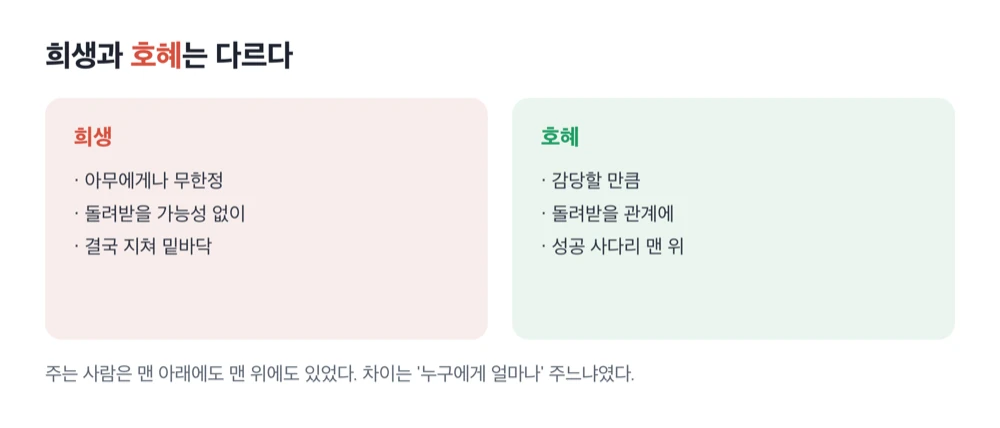
First, a line needs to be drawn. Not every relationship becomes reciprocal. Some relationships involve only giving, never receiving anything back. In that case, the right move is to keep your distance. Giving without limit isn't reciprocity — it's sacrifice. According to one psychologist's research, "givers" clustered at both the very top and the very bottom of the success ladder. The ones at the bottom were people who had given to anyone and everyone until they burned out; the ones at the top were people who gave within what they could afford, to people likely to give back. Giving within your own means, to someone with a chance of reciprocating — that's healthy reciprocity.
Reciprocity Spreads
Healthy reciprocity spreads. When our team helped another team, that team started helping yet another team. People who have experienced reciprocity know its value. So it naturally propagates outward.
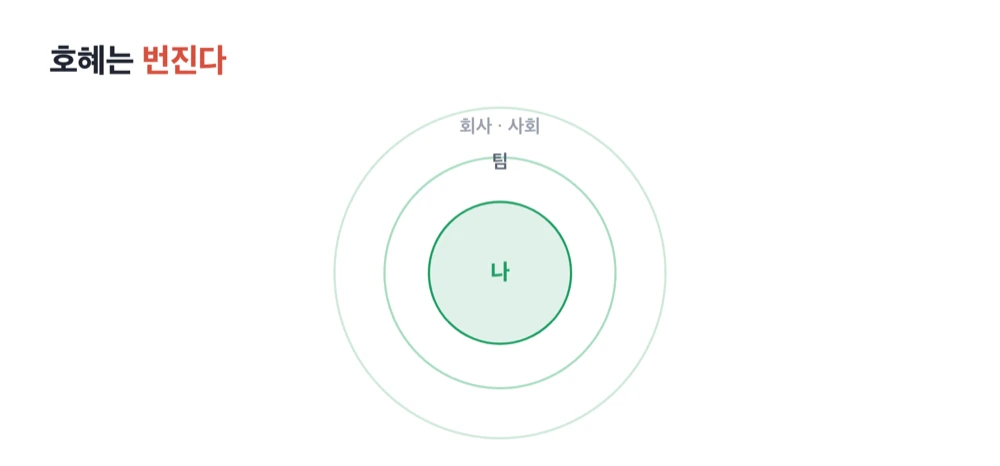
Reciprocity also extends into society. One community store runs on the principle of "receive first, restore, and give again." It refurbishes donated goods and sells them cheaply, then channels the proceeds back into the public good. Goods, people, and money circulate in a single direction. After a major flood in 1972, one region's relief program didn't simply hand out funds — it offered support on the condition that residents organize their own cooperative. That seed grew into credit unions, consumer co-ops, and medical cooperatives, and today a tenth of that city's population are co-op members. Anthropologists have long said that a gift is not merely the transfer of an object but the opening of a relationship. The cycle of giving, receiving, and repaying is what sustains a society.
There are also neighborhoods that issued trust first. In one region of our country, residents have been exchanging labor and goods for over twenty years using their own currency called "Duru." What's interesting is that even with no balance on hand, anyone with the intention to repay later can start trading from a negative balance. A whole village put into practice the principle that relationships open up when trust is extended first. The labor-exchange system that began with this currency is said to have later grown into the village's medical cooperative.
An organizational psychologist has shown that this kind of "giving culture" lifts the performance of an entire team. When one person's generosity becomes the team's norm, members come to see helping each other as a given, and the team produces better results. Reciprocity begins as a personal virtue, hardens into an organizational culture, and then into a way a society operates.
Starting Today
Reciprocity doesn't have to be grand. It starts with giving first whatever you can easily give — knowledge, an idea, even thirty minutes. To the person receiving it, that value feels far bigger than it seems to you. Once those small favors accumulate, at some point you find that everyone around you has become part of a web of reciprocity.
Tomorrow, it would be good to look around you. There's bound to be at least one thing that someone finds hard, which you could easily help with. Doing that first is where it begins. Even in an age when machines handle so much of the work, reaching out first to build trust remains something only people can do. You don't need to expect anything in return. It has never failed to come back. It simply takes a different shape.