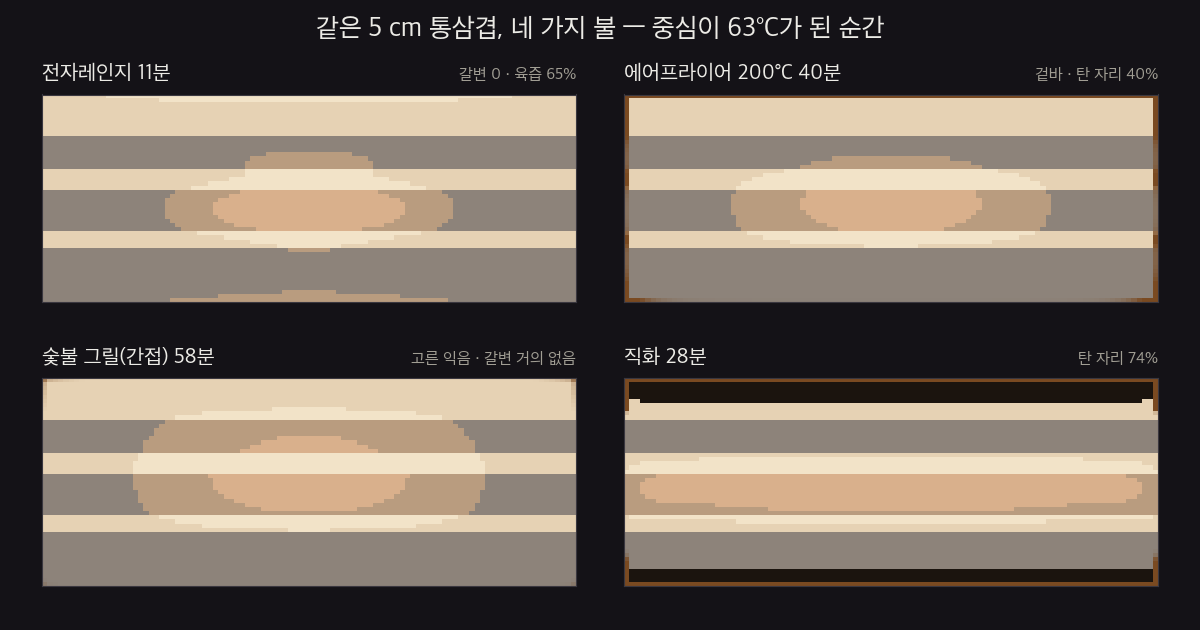
Does Barbecue Add Up? — I Ran a 5 cm Pork Belly Through a Microwave, Air Fryer, Charcoal Grill, and Open Flame in a Simulator
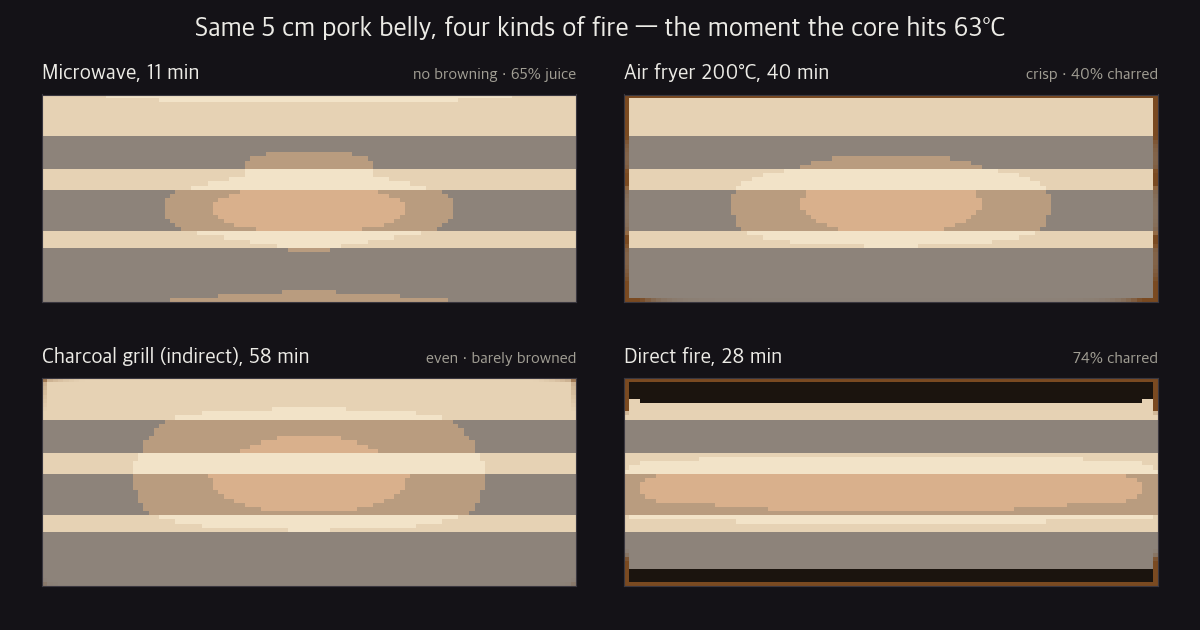
The same meat becomes a completely different food depending on where you cook it. I sliced the cross-section of a 5 cm pork belly roast into a 1 mm grid and built a simulator that jointly computes heat conduction, surface evaporation, juice loss, Maillard browning, and collagen softening. Cooking to a 63°C core took 11 minutes in the microwave, 28 over direct fire, 40 in the air fryer, and 58 in a lidded charcoal grill. The microwave kept 65% of the juice but produced zero browning; direct fire charred 74% of the surface — the calculation itself explains why Koreans slice pork belly thin for grilling. A search over 32 two-phase recipes that switch appliances mid-cook crowned 'microwave to 50°C, finish in a 200°C air fryer' (19.5 minutes), with the barbecue community's reverse sear re-emerging near the top. Also covered: the people who compute cooking for real — baking simulation in graphics (UCLA), meat-as-polymer food engineering (Wageningen), computational gastronomy (IIIT-Delhi), and AI recipe exploration at Sony AI, IBM, and NotCo.
Choosing a meat-cooking appliance is a surprisingly religious affair. Some insist it isn't barbecue unless it's charcoal; some say the air fryer is plenty; some just microwave it on a busy day. But everyone agrees on one thing: put the same meat in different machines and completely different foods come out. Burnt outside and raw inside, or evenly cooked but bland, or fast but bone-dry.
This difference is not mystery — it is physics. How heat enters the meat (convection, radiation, microwaves), how fast it spreads inside (conduction), and what temperature does to proteins, water, and surface chemistry: that's the whole story. So, as with the fire pits (episode 46), why not compute it before buying — or before cooking? I decided to carve a virtual 5 cm pork belly roast and put it into four kinds of fire.
What I set out to do
- Draw the cross-section of a 5 cm pork belly (seven layers of skin, fat, and lean) onto a 1 mm grid.
- Build a cross-section cooking simulator: heat conduction plus surface evaporation, boiling, juice loss, Maillard browning, and collagen softening.
- Put the same meat into four appliances — microwave (700 W), air fryer (200°C), charcoal grill with the lid on (indirect, 160°C), and direct fire (charcoal radiation) — and cook until the core reaches 63°C. Compare time, juice, browning, and char.
- Turn the knobs: change temperatures, move the coals away, change the flip interval, and see what each knob actually does.
- Run 32 two-phase combinations that switch appliances mid-cook, letting the machine search for recipes automatically. Then find the people who do this for real, and summarize their work.
The research, the simulator, the experiments, the figures, and the interactive playground below were all written and run by an AI agent on a laptop. What it got wrong is listed separately under "Where it went wrong."
Meat does something different at every notch of the thermometer
To compute meat cookery you first need to know what temperature does to meat. Meat is a protein network holding water. Each notch brings a different event.
- Around 50°C: muscle proteins begin to denature. The raw translucency disappears.
- 55–80°C: the protein network tightens and squeezes water out. That's the juice pooling in your pan. In the model, up to 35% of the lean meat's water can leave in this range.
- Above 60°C, held long: tough collagen slowly melts into gelatin. Hotter is faster, but it always takes time. This is why boiled pork and pulled pork are tender.
- 100°C: water boils. As long as water remains, that spot is pinned at 100°C — evaporation steals all the heat.
- 110–150°C, on a dry surface: amino acids and sugars run the Maillard reaction, making brown color and "roasted" flavor. It cannot happen on a wet surface — the temperature is pinned at 100°C.
- Well past 200°C: not browning but carbonization. Bitter black char.
So "crisp outside, juicy inside" is a temperature-placement problem: you must create a 150°C spot and a 63°C spot in the same piece of meat at the same time. Each appliance places those temperatures differently.
Building the simulator
The cross-section is 10 cm wide × 5 cm thick, 5,000 cells on a 1 mm grid. True to pork belly, I stacked seven layers from the top: 2 mm skin, 8 fat, 8 lean, 5 fat, 10 lean, 4 fat, 13 mm lean. Fat conducts heat at less than half the rate of lean (0.18 vs 0.48 W/m·K) and holds almost no water. The meat starts at 5°C, straight from the fridge.
Each cell solves the heat conduction equation, with five extras on top.
- Surface evaporation: hot air dries the surface water and steals heat (evaporative cooling).
- Boiling cap: a cell with water left stops at 100°C; excess heat goes into evaporating the water.
- Juice loss: based on the highest temperature a cell has seen, lean cells lose water across the 55–80°C range.
- Maillard browning: surface cells that are dry and above 105°C accumulate a browning index that speeds up exponentially with temperature. Far past the index limit, or above 240°C, counts as char.
- Collagen softening: accumulates over time above 60°C.
The four appliances differ only in boundary conditions. The air fryer is hot wind on all sides (convection); the grill is weak convection at 160°C under the lid plus wall radiation; direct fire is 800°C charcoal radiating at the bottom face (with flipping); and the microwave makes heat inside the body, not at the surface. Microwaves lose 1/e of their power about 1 cm into lean meat, but go deeper into the low-water fat layers, and the waves entering from all four faces overlap at the corners.
Four fires, four different meats
I stopped each cook the moment the core touched 63°C (the safe mark for whole-muscle pork, resting included) and compared.
| Appliance | Time to 63°C core | Juice left (lean) | Avg browning | Charred surface |
|---|---|---|---|---|
| Microwave 700 W | 11 min | 65% | 0.00 | 0% |
| Air fryer 200°C | 40 min | 51% | 5.4 | 40% |
| Charcoal grill (indirect) 160°C | 58 min | 63% | 0.2 | 0% |
| Direct fire (flip every 1 min) | 28 min | 43% | 7.6 | 74% |
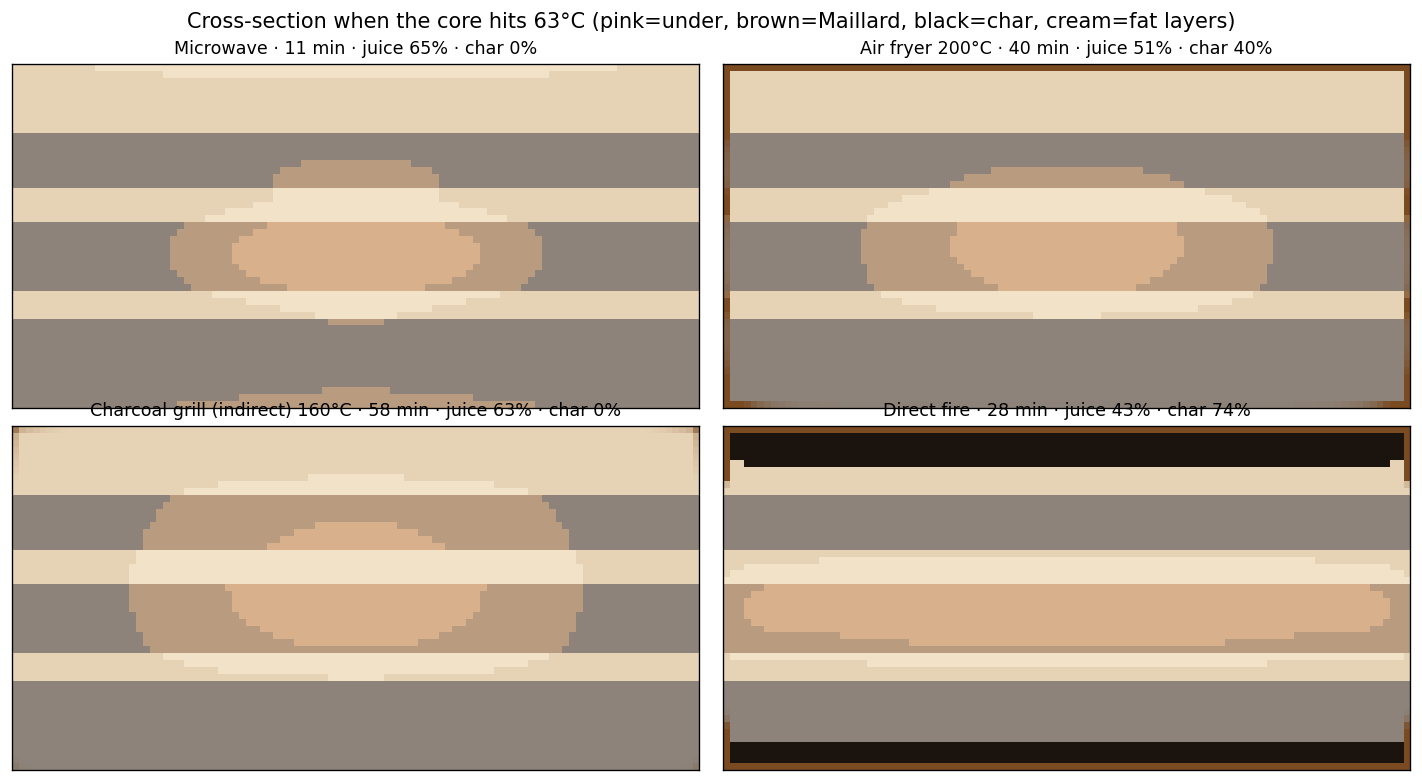
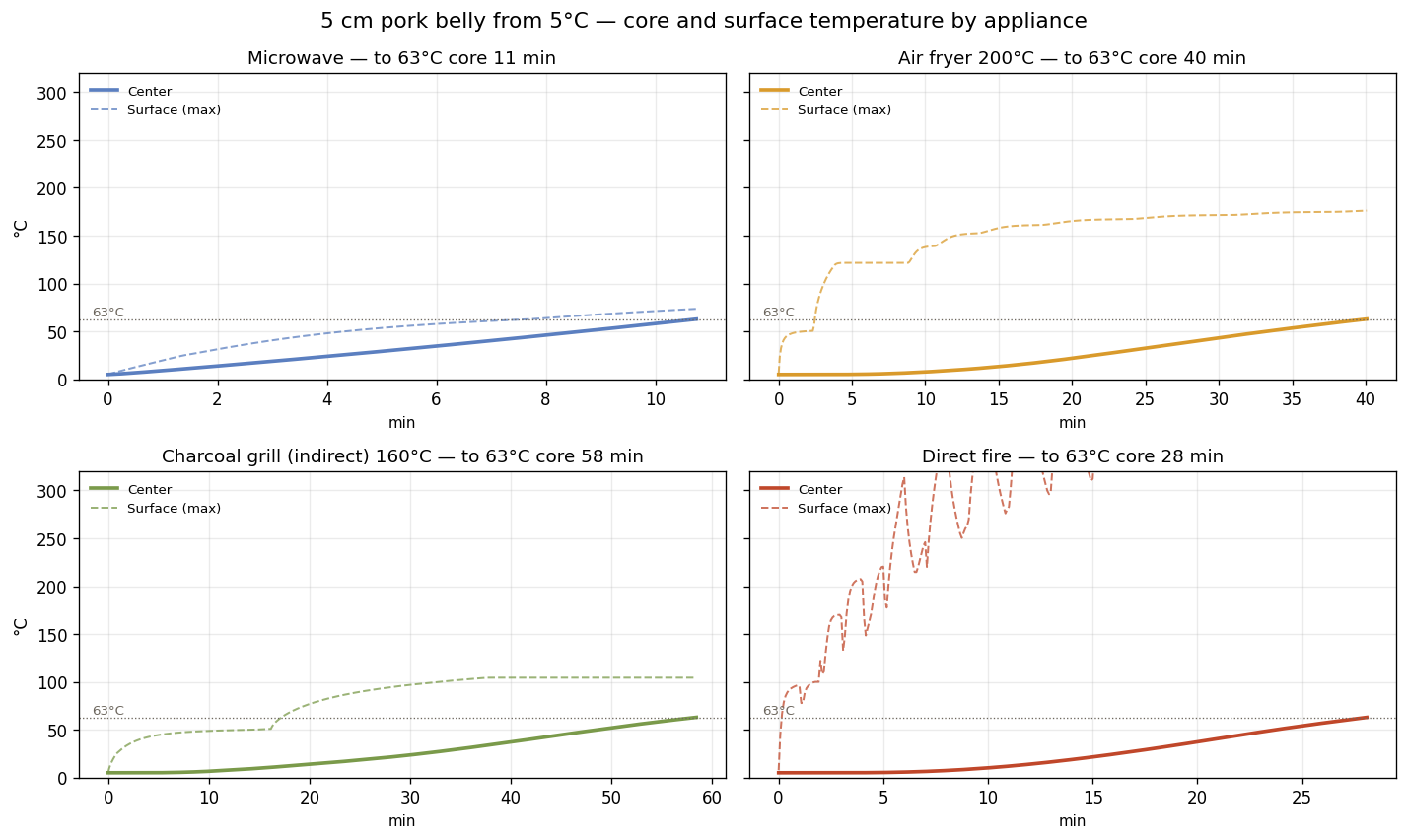
- The microwave won on speed and juice. It makes heat inside the body, so 5 cm of thickness is no wall. But the surface can never pass 100°C, so Maillard is exactly zero. You get fast boiled pork, not roast pork. The numbers say microwaved meat tastes flat not because it's slow, but because there is no browning.
- The air fryer produced the textbook crisp shell. But surviving 40 minutes at 200°C cost it: 40% of the rim went past browning into char. As the knob experiment below shows, lowering the temperature fixes this.
- The indirect charcoal grill was the slowest and the most even. For a full hour the surface sat pinned near 100°C by evaporative cooling, so there is almost no browning either. This is why barbecue people finish over the fire — the sear — at the end.
- Direct fire charred 74% of the surface. Flipping every 15 seconds: still 74%. Every 5 minutes: 76% — the interval barely matters. During the 28 minutes a 5 cm slab needs to cook through, the total radiation the surface absorbs from the coals is simply too much. Moving the coals away didn't save it either (below). The calculation explains why the Korean habit of slicing pork belly 5 mm thin for direct grilling is rational — a thin slice cooks through in a minute or two, leaving the surface no time to burn.
All four share one shadow. The moment the core reaches 63°C, 66–78% of the volume has already passed 80°C. As long as thick meat is cooked from the outside (even a microwave cooks corners first), overcooking the outer zone is unavoidable. This is exactly the problem sous-vide solves.
What the microwave is really doing
The cross-section at the 6-minute mark of microwaving is a treat.
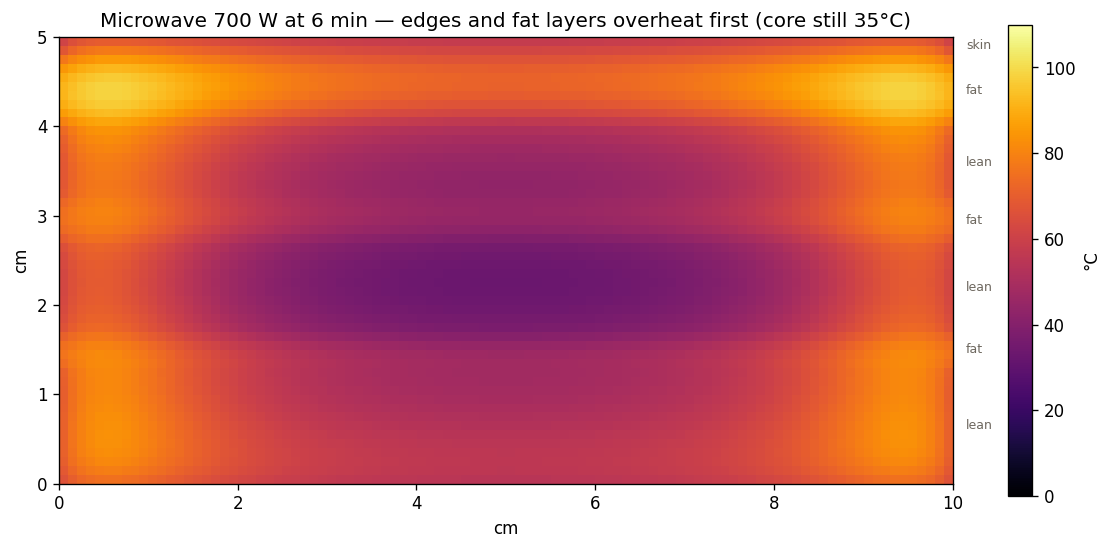
- Corners cook first. Waves entering through all four faces overlap at the corners — the same phenomenon that overheats the rim of a plate of dumplings.
- The fat layers run hot in stripes (fat averages 67°C vs lean 57°C). Fat has low heat capacity, lets microwaves in deep, and has no water to cool itself by evaporation. That's why pork belly starts sizzling from the fat when microwaved.
- Even so, the surface stops around 100°C. It can dry out and turn rubbery, but it will never, ever brown.
Turning the knobs
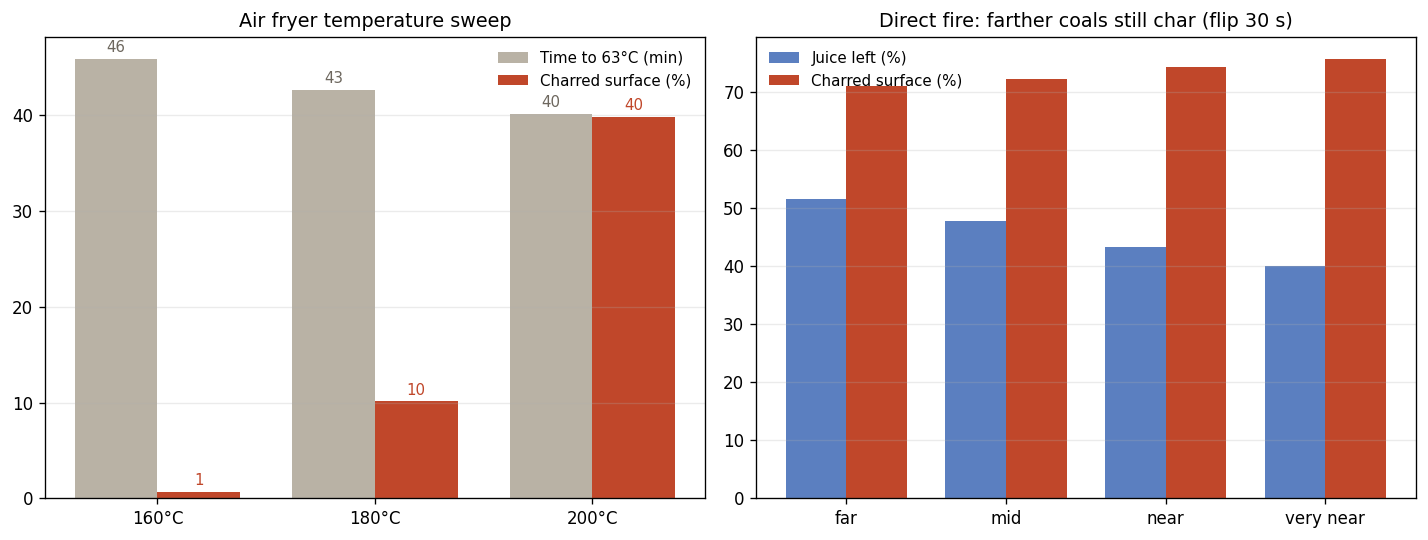
- The air fryer is saved by just 20°C. From 200 to 180°C, time grows 40→43 minutes but char drops 40→10%. At 160°C it's 1%. The old advice for thick cuts — lower and longer — falls straight out of the model.
- Direct fire cannot be saved by coal distance. Farther coals are weaker but take longer, so char stayed between 71 and 76%. The only thing distance really changes is juice: the closer the coals, the more you lose — 52% left with the coals far, 40% with them close.
- Grill chamber temperature trades juice for time. At 120°C: 78 minutes and 67% juice. At 160°C: 58 minutes and 63%.
And I left one slab on the grill for three whole hours.
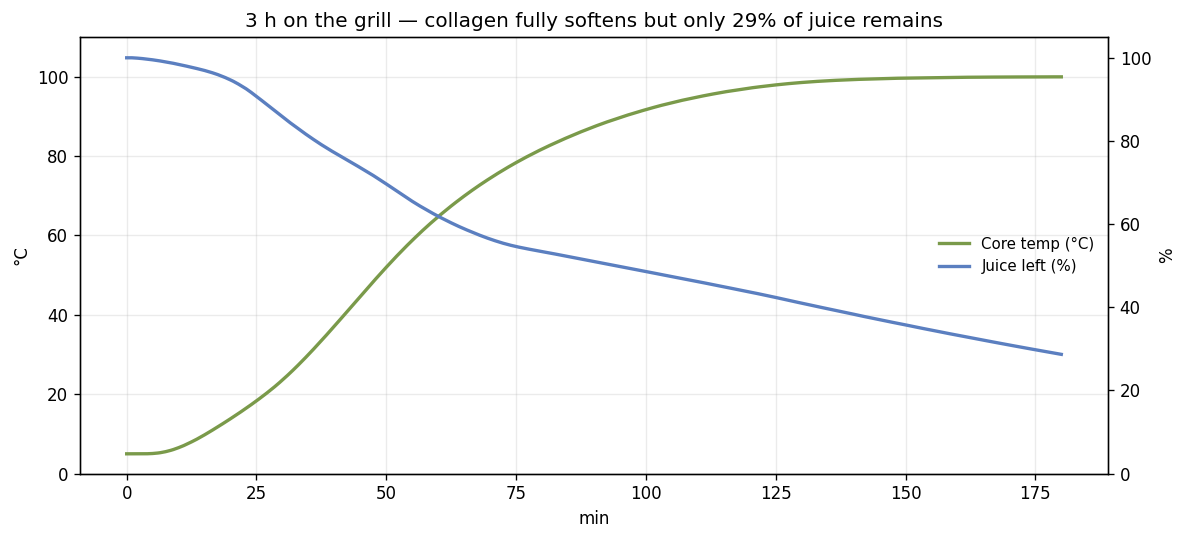
The collagen melts completely — softening 100% — the physics of pulled pork that shreds with chopsticks. The price is juice: only 29% remains. Real barbecue papers over this loss with sauce, fat, and lower chamber temperatures (usually 107–135°C). "Moist boiled pork" and "shreddable barbecue" are different destinations for the same meat.
Playground: cook it yourself
Drive the four appliances yourself below. You can switch machines mid-cook (warm it in the microwave, then sear it over the fire), and the sliders change air-fryer temperature, coal distance, and flip interval. When you're done, press "Serve" and it simulates a 10-minute rest and scores your cook.
Letting the machine search for recipes
Automate what you just did by hand in the playground, and that is recipe search. I ran all 32 two-phase combinations of the form "appliance A until the core hits 50°C (or 57°C), then appliance B to finish," followed by a simulated 10-minute rest (carryover heat pushes the core a few degrees higher), and ranked them with a single score: juice 40 points + browning 20 + collagen 10 − char 40 − elapsed time − an undercooked penalty. The weights are taste. That changing the scoring table crowns a different recipe — that, too, is part of the experiment.
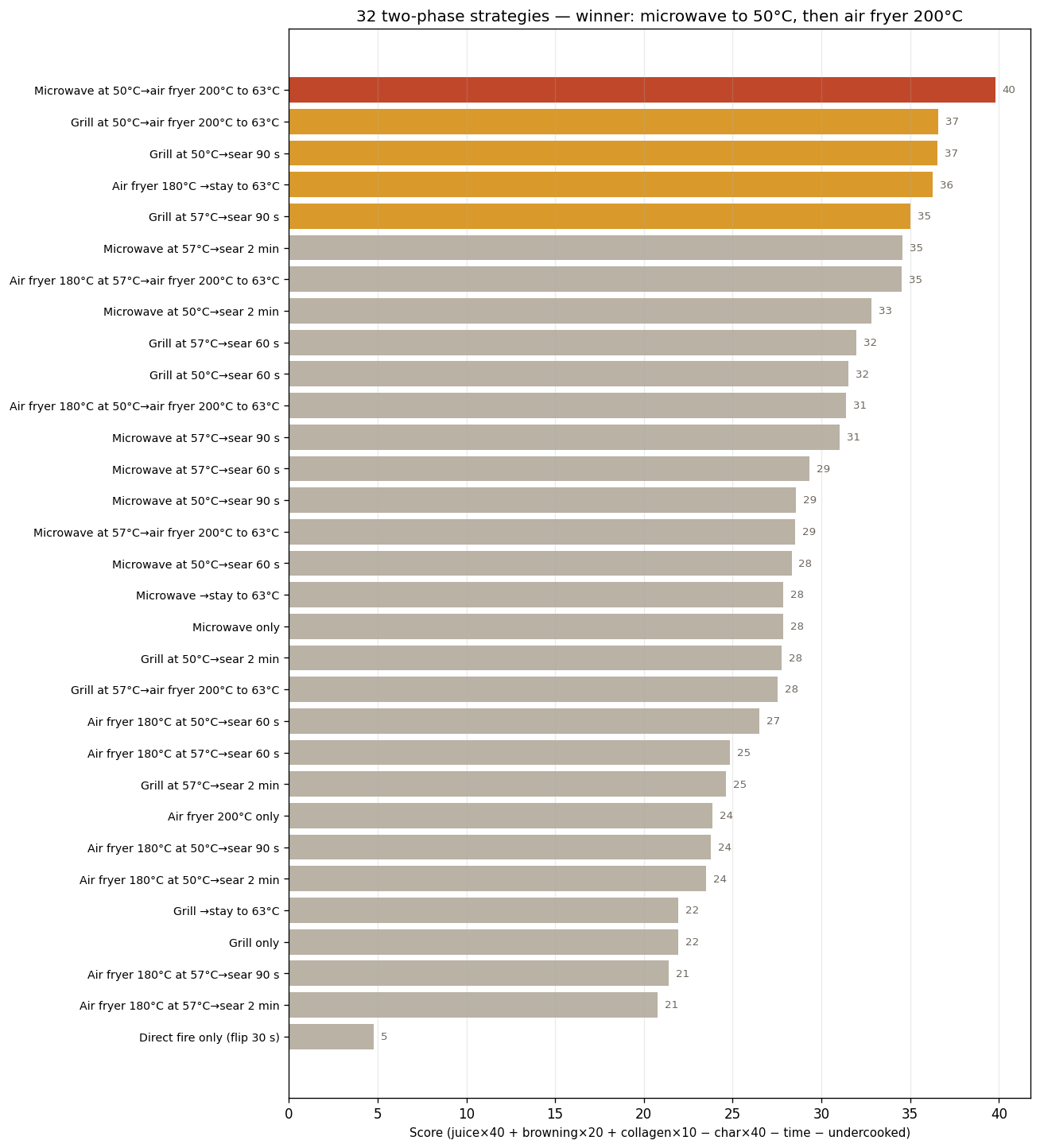
- First place: microwave to 50°C (about 9 minutes) → air fryer 200°C to a 63°C core. 19.5 minutes total. Juice 57%, browning 1.5, char under 1%. Microwaves handle the inside fast; hot air handles the outside briefly — each erases the other's weakness. The search re-derived why combi ovens, a microwave and a convection oven in one box, became a household fixture.
- The reverse sear, rediscovered. "Indirect grill to 50°C → 90 seconds over direct fire" ties for second (score 37). The indirect phase pre-dries the surface, so browning 1.9 attaches in just 90 seconds while char stays at 10%. The thick-cut orthodoxy of the barbecue community fell out of a grid search on its own.
- Reversing the order fails — that came out too. Run the same two machines as "2 minutes of direct fire first → then grill" and only 0.1 of browning attaches. Cold meat has a wet surface, and a sear won't take. Direct fire right after the microwave browned poorly for the same reason — microwaves push internal water to the surface, leaving the meat drenched in its own sweat.
- Direct fire alone scored 5, dead last. Counting the rest makes it worse: the blazing shell pushes the core to 84°C with carryover heat and juice falls to 31%. Carryover is a classic trap of thick-cut cookery, and the model reproduces it.
Thirty-two combinations barely deserve the word "search," but the structure is the real thing. With a simulator accurate enough and fast enough, you could screen millions of cooking strategies without burning a single piece of meat. How far "accurate enough" has come is the subject of "The people who compute cooking" below.
Where it went wrong
This model is a cartoon of real cooking. Never trust its numbers as absolutes; read them only as comparisons between appliances.
- Water transport is not properly solved. In real meat, internal water moves by pressure and capillarity, and steam pushes from inside out. The model makes do with surface evaporation plus "squeezed water vanishes instantly." The surface drying rate — and therefore the moment browning begins — is the most suspect number here.
- The microwave is heavily simplified. A real oven cavity has standing-wave hot spots stirred by a turntable. The model only uses exponential decay from four faces. Properties like "corners and fat layers overheat" are right; which exact spot gets hot is beyond it.
- Convection coefficients and radiation settings are assumptions picked from literature ranges. Air-fryer wind speed, coal temperature (800°C), and view factors vary severalfold by machine and by charcoal. No measurement calibration was done.
- Half of flavor is missing from the model. Smoke aroma, the flare-up taste of fat dripping onto coals, marinade sugars accelerating browning, salt's water retention — none of it is here. Much of why charcoal wins lives outside this calculation.
- No physical validation. As with the fire pits, I only checked that directions and magnitudes agree with common sense and literature. Numbers like 40 minutes to a 63°C core (air fryer, 200°C, 5 cm) sit in the right ballpark of published recipes, but no thermometer-in-meat experiment was run.
- It is a 2-D cross-section. With no end faces in the depth direction, everything cooks slightly slower than a real roast would, in every appliance.
The people who compute cooking
Unlike this toy, there are research programs that compute cooking seriously, along several lines.
- Graphics bakes bread. Joseph Teran's group at UCLA presented "A Thermomechanical Material Point Method for Baking and Cooking" at SIGGRAPH Asia 2019. Dough is treated as a mixture of solid, water, and gas, and the method simulates rising, cracking, drying, and browning in one framework — the paper's demos show cookies spreading in the oven and bread crust splitting. The goal is film CG, but the physics shares its roots with food engineering.
- Food engineering treats meat as a polymer. The van der Sman group at Wageningen University in the Netherlands models meat as a water-swollen protein polymer network and predicts moisture transport and juice loss during heating with Flory–Rehner theory, borrowed from gel physics. Industrial processes like chicken tunnel ovens are designed with these calculations. Where we hand-waved "35% squeezed out between 55 and 80°C," they solve from first principles.
- Recipes as data. Ganesh Bagler's group at IIIT-Delhi flies the flag of "computational gastronomy," releasing RecipeDB, a structured recipe database, and FlavorDB, a flavor-molecule database, and running experiments like Ratatouille, which generates novel recipes with language models trained on them. There is even a doctoral thesis that judged machine-generated recipes with a Turing test for chefs.
- The companies. IBM's Chef Watson (2014–15) mined flavor chemistry to propose unexpected ingredient pairings and even published a cookbook — a now-retired classic of the field. Sony AI has been running its Gastronomy Flagship since 2020, developing an AI recipe-creation app and a chef-assisting robot with three-Michelin-star chef Hajime Yoneda. And NotCo, the plant-based food company, became a unicorn on a loop where its AI "Giuseppe" proposes plant combinations, chefs cook and taste them, and the feedback goes back into the model.
One gap stands out: the physics-simulation side (heat, moisture, texture) and the recipe-search side (combinations, flavor, generative models) still work separately. As today's grid search hints, joining them gives you an AlphaGo of cooking — simulate millions of cooks, then physically verify only the promising ones. Given how fast ingredient-property data and validated cooking models are accumulating, it would surprise no one if a lab or an appliance maker shipped that combination within a few years.
So — was it one click?
It was a day's work. The model is crude, but one computational frame produced the reason pork belly is sliced thin, the reason 180°C is the safe air-fryer setting, the reason the reverse sear works, and the reason microwaved meat is sad (not slowness — zero browning). Next time I buy a whole pork belly, I intend to verify the winner in the flesh: microwave 9 minutes, air fryer to finish. With a thermometer in it.