
People Who Add Value (3) — What Came of Work Nobody Asked For
Added value is born from work nobody asked for. Stories of a failed adhesive that became a sticky note, and idle-time tinkering that changed a career.
After doing your assigned share well comes what lies outside that share. This is the added value that comes from work nobody asked you to do.
Let's start by correcting the most famous story out there. Google's Gmail is often cited as the classic product born from an employee's free time. That isn't true. The developer himself has said it was an official project from the very start. The real product of free time is something else: Google News. Right after 9/11, a researcher built a tool to compare the perspectives of multiple outlets at a glance, purely out of personal need, and it went on to become the standard for news aggregation services worldwide. Nobody asked him to do it — he simply turned his own frustration into a tool.
A Failed Adhesive Sticks the World Together
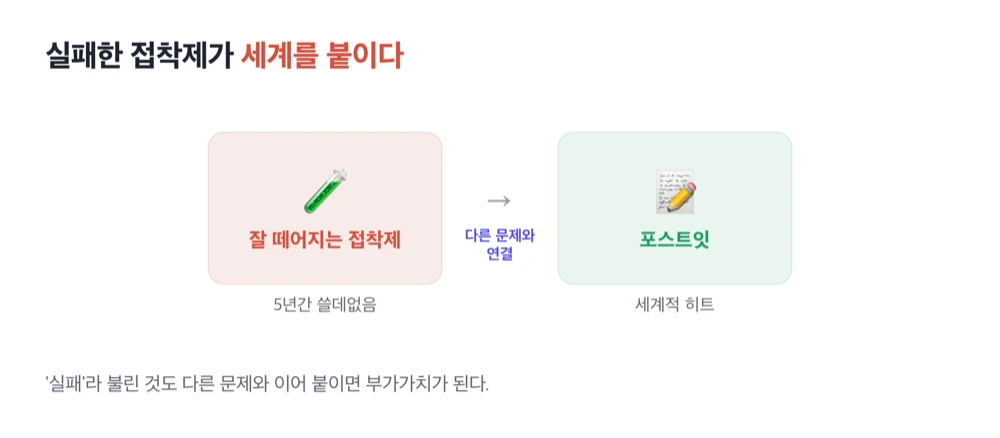
A researcher at 3M was trying to make a strong adhesive and ended up with the opposite: one that stuck well but peeled off easily. For five years, it had no use. Then another researcher, struggling with hymnal bookmarks that kept falling out, remembered this adhesive and used the company's free-time program to make a note that could be stuck on and peeled off. The Post-it. What had been called a "failed adhesive" became a worldwide hit once it was connected to a different problem.
A mechanic at Nintendo was responsible for repairing the machines that made hanafuda cards. In his spare time, he built a toy just for fun, and when the company president visited the factory and saw it, he ordered it turned into a product. It sold over a million units, and the mechanic moved from the repair department into product development, later going on to create the Game Boy. Adding "spare-time tinkering" on top of his assigned job of repair work ended up changing his entire career.
Outside the Test Range
The same principle applies to studying. One high school student, separately from exam prep, was curious about when the bus he rode every day would arrive, so he turned public data into a real-time bus app. It was nowhere in any curriculum. The app was downloaded hundreds of thousands of times, was later acquired by a major company, and became a stronger credential for him than any exam score. If the exam range was his assigned share, what he added was a solution built for his own frustration.
Another middle school student built a rhythm game he loved and released it as an app. Watching reactions in an open chat room, he learned what people wanted, and taught himself low-latency audio technology that wasn't in any textbook to implement it. The app was downloaded more than ten million times cumulatively, and as a high schooler he earned ad revenue comparable to a decent starting salary at a major company. It was the result of pushing something purely fun, outside the test range, all the way through.
Our companies also try to create such channels — in-house hackathons, free-project programs. One employee at a major corporation pushed a health-measurement device he was personally interested in through the company's internal venture program, and eventually spun it off into his own independent company. Even when a system lays the groundwork, only the person who actually jumps in produces a result.
There's something curious about unasked-for work. Because nobody asked for it, nobody holds you accountable for it — but by the same token, nobody else takes credit for it either. It becomes entirely your own. Do well at something you were told to do, and the credit goes to whoever told you to do it; but a result born from something nobody asked for carries your name from beginning to end. That's why the strongest line on a career is usually "nobody asked me to, but I made this."
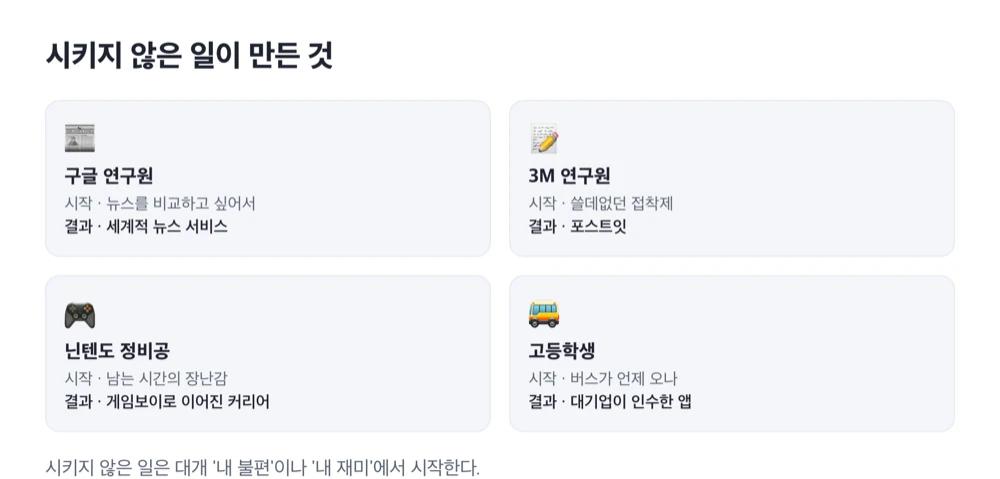
Unasked-for work tends to share something in common: it usually starts from "a frustration I personally experience" or "something I personally find fun." That is the easiest door out of your assigned share.
In the next piece, I'd like to talk about a somewhat different kind of added value — the story of people who connect two different worlds.