
People Who Add Value (5) — What Protects You as the Times Change
What AI replaces is "the assigned share"; what survives is the added value you build on top of it. A look at the mindset of people who keep raising their own worth no matter how the times change.
Why tell this whole story at all? Because the times are changing.
Forecasts from various institutions all point in the same direction. The World Economic Forum projects that by 2030, 92 million jobs will disappear while 170 million new ones are created, for a net gain of 78 million. But that is only the net figure; for individuals, it presupposes changing jobs and retraining. The same forecast says that about 39% of the core skills workers use today will change within the next few years. The OECD puts the share of jobs at high risk of automation at roughly 27%, and what's different this time is that the exposure isn't limited to simple, repetitive labor — it extends to highly skilled cognitive work like programming and translation. One consulting firm projects that by 2030, up to 30% of today's work hours could be automated.
The numbers aren't meant to scare anyone. They simply point out a direction. What gets replaced is the "assigned share" — the more a task consists of repeating something fixed and predetermined, the sooner it gets automated. Conversely, what survives and rises in value is whatever you build on top of that.
| Replaced first (the assigned share) | Survives and rises in value (added value) |
|---|---|
| Repeating a fixed procedure | Redefining the problem |
| Standardized work with clear rules | Working with and persuading people |
| Simple tasks that stand alone | Connecting things that differ |
The skill the World Economic Forum ranked as most needed was "analytical thinking" — not the ability to produce a predetermined answer quickly, but the ability to work out for yourself what the problem even is.
Let's picture this a bit more concretely. Take translation. The part that renders a sentence literally is already something machines do faster and cheaper than people. A translator who only did that much is now in a precarious position. But the part that preserves the texture of a culture, catches potential misunderstandings not present in the original, and designs how this piece of writing will land with a particular reader — that part still belongs to a person. The more the machine takes over the "assigned share," the higher the value of what's built on top of it actually climbs. The work isn't disappearing; the center of gravity of the work is shifting upward.
So This Is the Lens
Everything this series has been saying from the start converges here. A person who only fills the assigned share is the person automation can replace first. A person who builds something on top of that keeps raising their own worth no matter how the times change. Doing the same work differently, taking on work nobody asked for, and connecting two different worlds — all of these fall on the side that's hard for a machine to replace.
That makes clear what to do now. Why not break your own work down into pieces and ask yourself: how much of this is a share that just repeats according to a fixed pattern, and what am I building on top of it? Be prepared to eventually hand the repeating share over to a machine, and instead grow the part you build on top of it. That is how you can prepare for the wave of change instead of fearing it.
Added value also comes back to you in how you are rewarded. Salary or position, in the end it follows "how much it has to be this particular person." And the more unsettled the times, the stronger a safeguard that becomes.
The Reward Called Flow
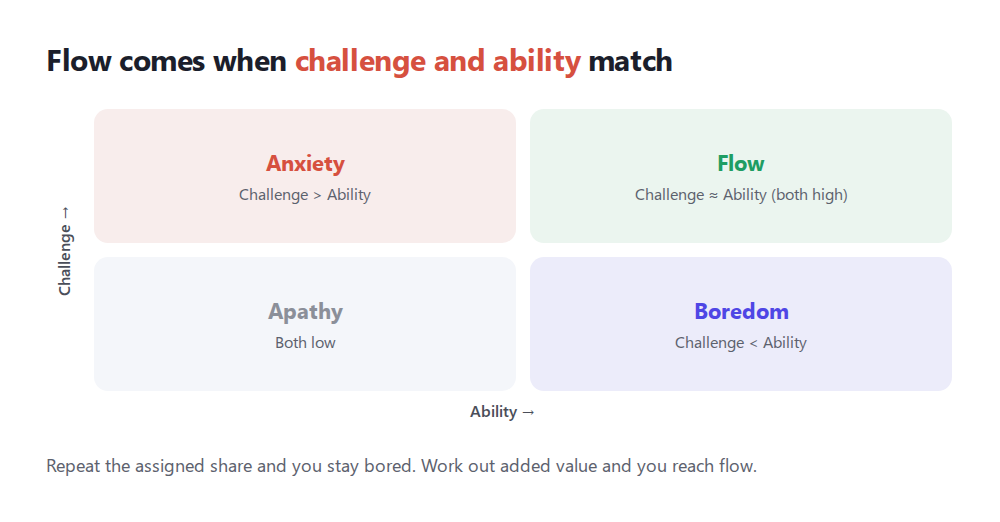
There's also a reward here that numbers can't capture. The psychologist Mihaly Csikszentmihalyi called the moment a person feels the deepest satisfaction "flow." When a challenge is far beyond your ability, you feel anxious; when it's far below, you feel bored. When the two are evenly matched, you lose track of time and get absorbed. If you only repeat the assigned share, you tend to stay on the bored side. Working out how to add value always hands you a challenge half a step above your current ability. That's exactly why it becomes meaningful flow in its own right.
Lastly, One Attitude
While writing this piece, I considered including a well-known anecdote. The story goes that a president visiting some institution asked a janitor what he did, and the janitor answered, "I'm helping put a man on the moon." It's a good story, but I left it out because I couldn't find a solid source for it. In fact, this attitude is the last piece of added value: how big you take your own work to be. And with it, not passing off an unsourced story as a sourced one. Seeing your work as something big, yet seeing it accurately — that, too, is added value that is hard to replace.
In the end, these five installments come down to a single question: "Am I just filling the assigned share right now, or am I building something on top of it?" Whoever carries that question with them keeps making their own place, no matter how the times change.