
Swelling Particles
Measurements of how much coffee grounds swell when wet range from 0% to 15%. Swelling a virtual puck's particles by 2–8% inside the basket and running water through with 3D lattice Boltzmann, every 2% cut permeability by about 30%, to a quarter at 8%. Even 15% would mean about a tenth; combined with compaction, it falls far short of the thousandfold gap between dry grounds and a real shot. Includes a calculator for that gap.
Coffee grounds are said to swell when wet. If grounds trapped in a basket swell, the gaps between particles shrink and the water's paths narrow. In "Porous Media 101" and "Running Water Through Lattice Boltzmann", permeability calculated from dry grounds was a thousand times higher than a real shot's. Could swelling fill part of that gap?
To begin with, measurements disagree on how much grounds swell: one study finds about 15% in diameter, others find no difference. Swelling the particles of a virtual puck by 2–8% and running water through with 3D lattice Boltzmann, permeability fell to a quarter at 8% swelling. If swelling reached 15%, it would be about a tenth: some ten of the thousandfold.
How much do they swell?
Measurements disagree sharply:
- Hargarten and colleagues (2020) measured with laser diffraction and microscopy. According to the abstract, particle size grew by "approximately 15%", regardless of initial size or roast. "60–80% of the final steady-state diameter" was reached within 30 s and swelling was complete after 4 min. Wetting also eroded particles into more fines, more so at higher temperature
- Maille and colleagues (2021) measured over 0.5–5 min with laser diffraction and microscopy; after correcting for particles being drawn into the instrument's recirculating loop over time, they found "no statistically significant increase in particle size", and the microscopy saw no increase in diameter either
- Schmieder and colleagues (2023) found dry and wet size distributions of the same grounds showed "high similarity"
- Corrochano (2017, thesis) found mean size after 1, 10 and 30 min of extraction either unchanged or about 1.04 times larger, and set the swelling factor to 1. He summarised earlier studies reporting a 20–23% increase in particle volume and 17% in diameter
Modelling studies used small values. Mo and colleagues (2022) assumed swelling under 8% and found it mainly changes flow between grains, slightly slowing extraction but considerably raising strength. Mo and colleagues (2024) used 3.6%. Where swelling lies between 0 and 15% is not yet settled.
Swelling in a fixed space
I took the virtual puck from "Running Water Through Lattice Boltzmann" (250 µm-gap grounds, 1.12 mm cube, 10 µm cells) and enlarged the particle diameters by 2, 4, 6 and 8% while keeping their centres fixed. The box stays the same size, as for grounds trapped in a basket. Overlaps count once (particles pressing into each other).
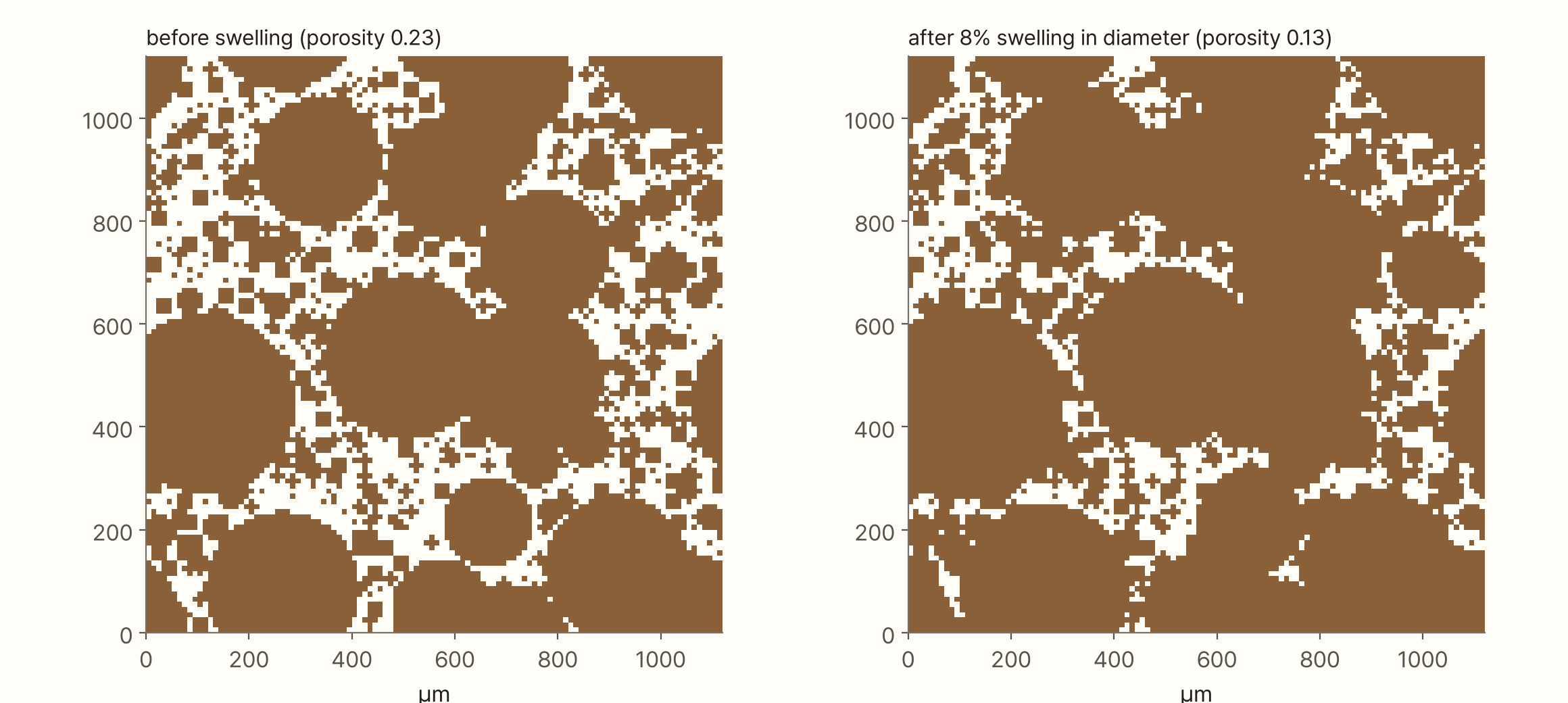
An 8% larger diameter means 26% more particle volume. With only 23% of the space empty to begin with, most of the extra volume fills the gaps. Porosity fell from 0.23 to 0.13.
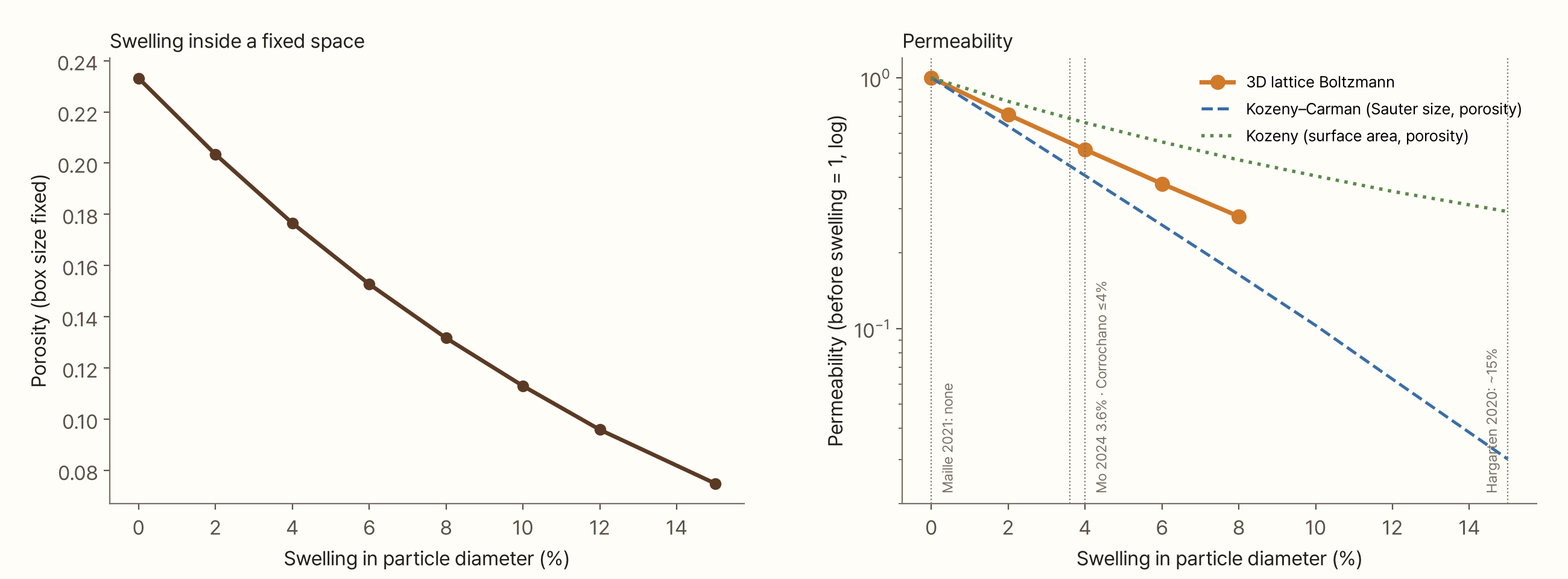
Permeability from lattice Boltzmann was 0.71 times at 2% swelling, 0.52 at 4%, 0.38 at 6% and 0.28 at 8%: about 30% less for every 2% of swelling. The two formulas bracket this result: Kozeny–Carman from Sauter size and porosity falls more steeply (0.16 times at 8%), Kozeny from surface area and porosity less steeply (0.47 times).
If the trend continued to 15%, permeability would be about a tenth. At the 3.6% Mo used, or the 4% or so Corrochano measured, it would be about half. With no swelling, as Maille found, nothing happens.
How much of a thousandfold?
In "Porous Media 101", permeability from dry grounds was about a thousand times that of a typical shot. Compaction by pressure explained about a factor of three ("Why More Pressure Doesn't Mean More Flow"). Swelling of 15% would explain another factor of ten, 4% another factor of two. Multiplied together that is 6–30 times, far short of a thousand.
Where does the rest come from? In "Running Water Through Lattice Boltzmann", coarsening the grid raised permeability, so the 10 µm cells may not capture all the fines and may overstate the dry puck's permeability. New fines eroded on wetting, as Hargarten saw, may fill gaps. And the movement of fines, the next question, remains.
Fit it yourself
The calculator below starts from the dry virtual puck's permeability and multiplies in compaction by pressure, particle swelling and a grid-resolution correction, then compares with a real shot. You can see whether any gap remains even with 15% swelling and strong compaction.
What this conclusion leaves out
- The amount of swelling is unknown. With measurements ranging from 0% to 15%, the calculation only shows how much swelling would matter if it happens
- Swelling enlarges diameters with centres fixed. In reality particles may push apart and the whole puck may rise, so gaps would shrink less than here
- Pores inside particles and swelling are not treated separately. Water soaking into particles (1.3–1.7 mL per gram, Corrochano) is a different thing from particles growing
- The box is small and iterations were not run to the end. Permeability ratios were compared at equal iteration counts; the remaining change is within a few percent
- Hargarten et al. (2020) and Maille et al. (2021) were checked from abstracts only
Summary
- Measurements of how much coffee grounds swell when wet range from 0% to 15% (Hargarten et al. 2020 about 15%, Maille et al. 2021 none, Corrochano 2017 about 4%)
- Swelling a virtual puck's particles inside a fixed basket and running water through with 3D lattice Boltzmann, every 2% of diameter cut permeability by about 30%; at 8% it was 0.28 times
- With 15% swelling permeability would be about a tenth, with 4% about half. Even combined with compaction by pressure (threefold), it falls far short of the thousandfold gap between dry grounds and a real shot
References
- Hargarten VB, Kuhn M, Briesen H (2020). Swelling properties of roasted coffee particles. Journal of the Science of Food and Agriculture 100, 3960–3970. doi:10.1002/jsfa.10440 — abstract only
- Maille MJ, Sala K, Scott DM, Zukswert H (2021). Critical examination of particle swelling during wetting of ground coffee. Journal of Food Engineering 295, 110420. doi:10.1016/j.jfoodeng.2020.110420 — abstract only
- Schmieder BKL, Pannusch VB, Vannieuwenhuyse L, Briesen H, Minceva M (2023). Influence of flow rate, particle size, and temperature on espresso extraction kinetics. Foods 12(15), 2871. doi:10.3390/foods12152871
- Corrochano BR (2017). Advancing the engineering understanding of coffee extraction. EngD thesis, University of Birmingham
- Mo C, Navarini L, Liverani F, Ellero M (2022). Modeling swelling effects during coffee extraction with smoothed particle hydrodynamics. Physics of Fluids 34(4), 043104. doi:10.1063/5.0086897 — abstract only
- Mo C, Navarini L, Liverani F, Ellero M (2024). Modelling swelling effects in real espresso extraction using a 1-dimensional coarse-grained model. Journal of Food Engineering 365, 111843. doi:10.1016/j.jfoodeng.2023.111843 — abstract only
Image credits
- All charts, the cover and the calculator: made by me