The Person Who Changed Their Mind at the Altar
Starting from grooms and brides who changed their minds mid-ceremony, this piece looks through statistics at the wavering institution of marriage and the belief in compatibility, and writes about the one value that still doesn't change.
I opened the two notebooks on my desk again. They're not books you read but books you flip open — filled with inspiring words and sentences in no particular order. Today, where my finger landed, it read:
Write about a groom, or a bride, whose mind changed in the middle of the wedding.
It felt like a scene from a novel — a hall full of guests, someone halfway down the aisle suddenly stopping in place. But after looking into it a little, this turned out to be less far-fetched than it seemed.
Common, But Not Harmless
A team of psychologists led by Justin Lavner at UCLA followed 232 newlywed couples in Los Angeles for four years, asking them one question: had they ever hesitated, before the wedding, over whether this marriage was the right one?
Nearly half said yes. 47% of grooms, 38% of brides — meaning most people wavered at least once before standing at the altar. What stood out more was what came next. Among brides who had hesitated, 19% divorced within four years, versus 8% of those who hadn't. Grooms split similarly, 14% versus 9%. The team's conclusion was measured: everyone says a little premarital doubt is fine, but that doubt, while common, isn't harmless.
The image of a bride turning away at the altar is an old storytelling trope. Hollywood has always loved it, and further back there are even old folk songs about runaway brides. And yet nowhere is there a tally of how many people actually change their minds mid-ceremony — because stopping in the aisle is, in practice, rare. Most changes of heart happen long before the ceremony, in some quiet moment, not at the altar. And in most cases, people don't stop. They keep walking.
Why? Because they've already come this far. The invitations are sent, the date is set, both families have gathered. Psychology calls this the sunk cost — reluctant to waste what's already been invested, and seeing more loss in turning back than in pressing on, a person takes one more step in the direction they were already walking. The more public the commitment, the stronger that inertia becomes. Which is why, even after the heart changes, the feet so rarely do.
The Institution Is Changing Its Mind Too, Little by Little
Look up from one person's hesitation to society as a whole, and you can see the institution of marriage itself slowly changing its mind.
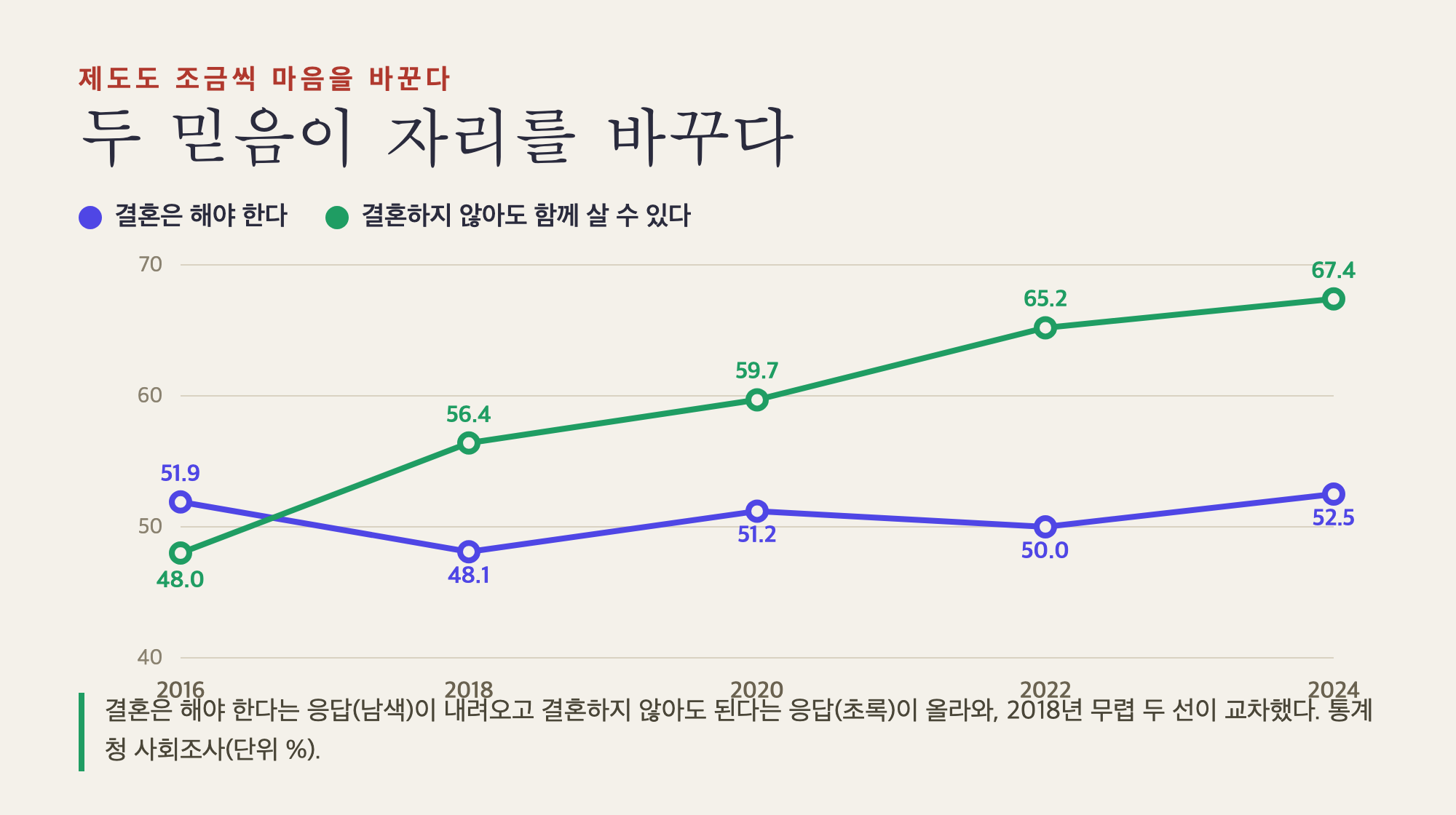
Statistics Korea's Social Survey asks, every two years, what share of people believe marriage is something one should do. In 2008, seven in ten — 68% — said yes. That share fell steadily, bottoming out at 48.1% in 2018. A society that once took marriage for granted had, in a single generation, become one that asks whether it's really necessary. Over the same period, the opposite line climbed. The share who agreed that people can live together without marrying rose from 48% in 2016 to 67.4% in 2024. The two lines cross around 2018.
The marriage count has fallen even more steeply. In 1996, 435,000 couples married that year; by 2022 that number had nearly halved to 192,000. The average age at first marriage has also climbed, to 33.9 for men and 31.6 for women — five or six years later than three decades ago. In their place, other shapes of life have taken up more room. One household in three — 36.1% — is now a single-person household.
What's interesting is that this graph doesn't run in only one direction. After bottoming out, the share who view marriage favorably climbed back to 52.5% in 2024, and that year the number of marriages rose 14.8%, the sharpest rebound since records began. The biggest reason the younger generation delays or gives up on marriage is less romantic than it sounds. Lack of money for marriage tops the list at 31.3%, followed by the burden of child-rearing and job insecurity. It's circumstance, more than sentiment, that holds people back.
The Misconception That Divorce Keeps Rising
Whenever the institution is said to be wavering, one line always follows: isn't divorce just going up and up? The data, though, says otherwise.
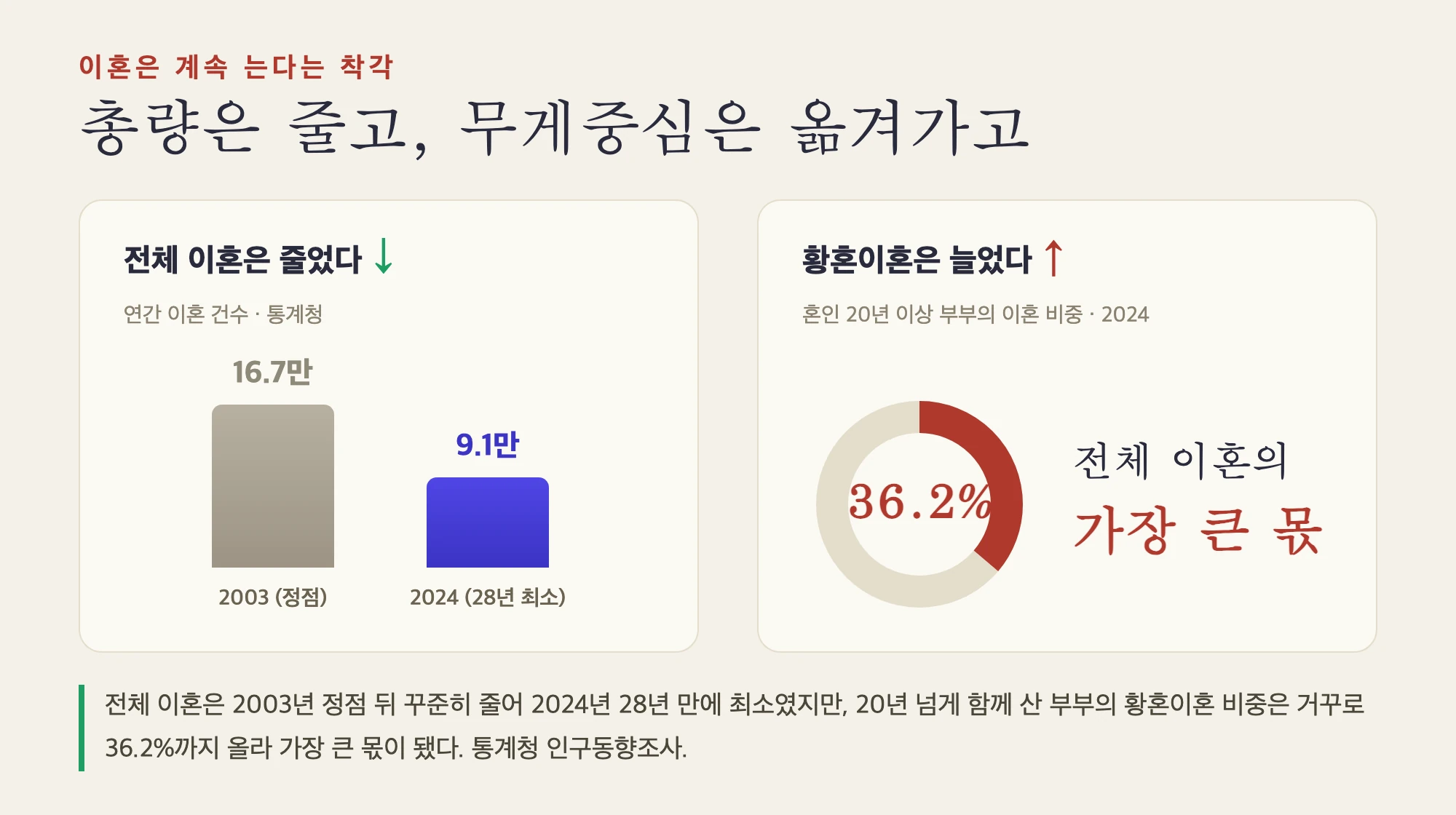
Divorce in Korea peaked in 2003 at 167,000 cases and has been declining ever since. In 2024, it fell to 91,000 — the lowest in 28 years. The sense that everyone's divorcing these days isn't true, at least not by the raw numbers. What's shifted isn't the total but the center of gravity. So-called "twilight divorces," among couples who split after more than twenty years of marriage, now make up 36.2% of all divorces in 2024 — the largest single share. More people, it seems, endure as long as they can, raise their children, and only then choose separate paths. Marriage hasn't declined so much as the way people end it has changed.
Why We Ask About Compatibility
The more uncertain marriage becomes, the more people want to read the other person in advance. Are this person and I compatible? Tools that promise an answer to that question are always popular.
Blood type is one example. This belief, put forward by a Japanese professor in 1927, was shown long ago to have no scientific basis, yet it still survives in lines like "that's just how type A people are." MBTI runs even hotter. At blind dates people ask for your type before your name, and some job postings even say they screen out certain types. Yet the test is unstable enough that, retaken five weeks later, only about half — 47% — get the same type. Western astrology fares little better.
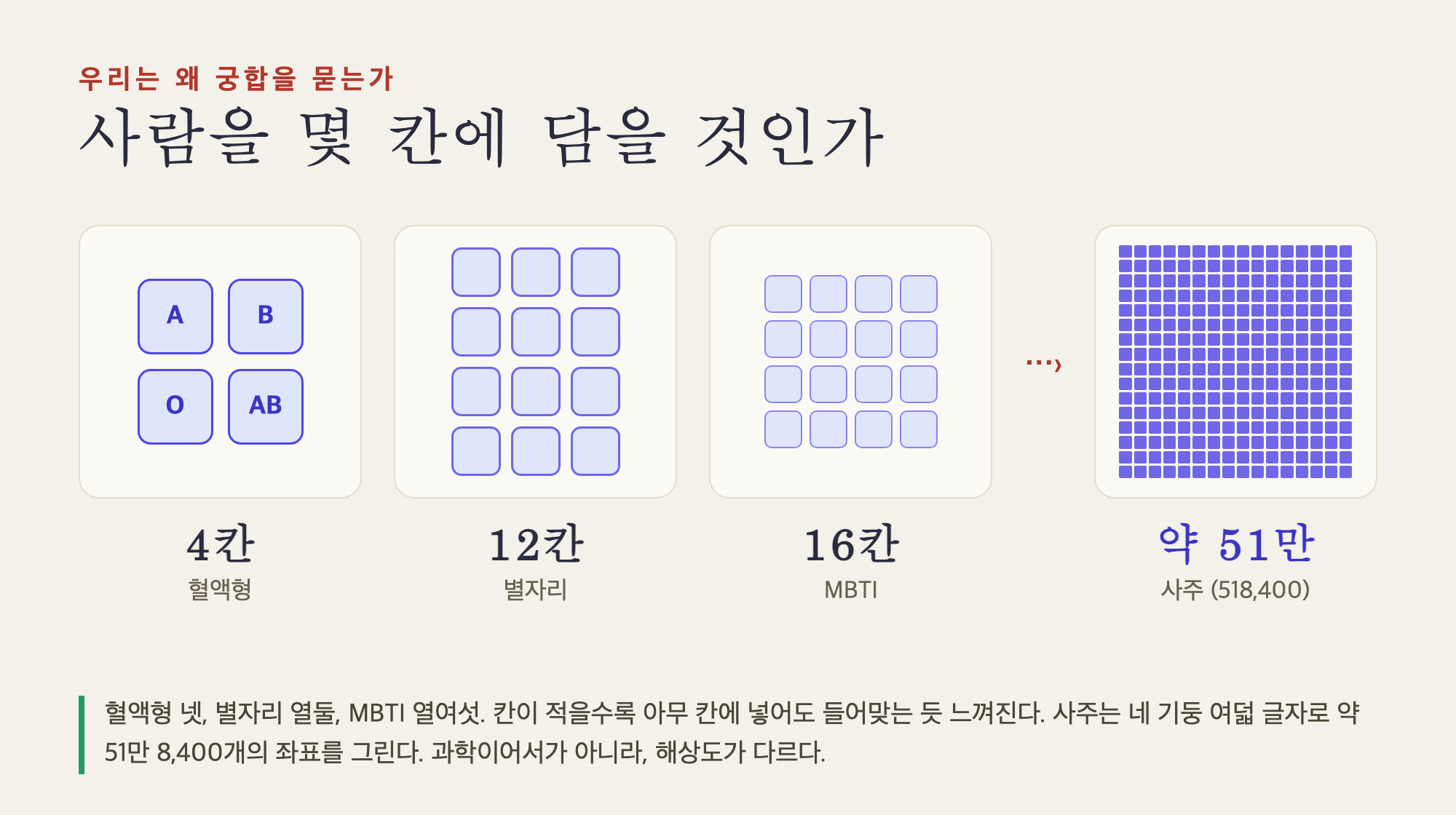
What these three have in common is that they sort people into a very small number of boxes. Four for blood type, twelve for astrology, sixteen for MBTI. Cram billions of people into four, twelve, or sixteen slots, and whichever slot you land in, some statement is bound to feel like a match. The fewer the boxes, the more accurate the reading feels. We often mistake low resolution for a good fit.
There's also a way of answering the same question with a far finer grid — saju, which East Asia has used for a long time. It takes the four pillars of birth year, month, day, and hour, attaches two characters to each, and builds eight characters in all, which together yield roughly 518,400 possible combinations. That's an order of magnitude beyond four or sixteen. This isn't to say saju is science. But in reading a person through hundreds of thousands of coordinates rather than a handful of boxes, it's a different thing entirely from the flat labeling of "you're type A, so."
Orienteller (orienteller.com) is a service that reads those eight characters for English-speaking users. Instead of a horoscope that ends with twelve zodiac signs, it overlays two people's saju and unpacks their compatibility — in romance, marriage, business partnership, family — in two voices, traditional interpretation and modern language. It's less a device for pronouncing right or wrong than a somewhat finer mirror for looking into each other. It asks what kind of person someone is, rather than which box to put them in.
What Doesn't Change
We've walked a fair distance from one line in a notebook — starting with a groom and bride whose minds changed at the altar, and arriving at a society that keeps changing its mind, and the numbers behind it.
What finally comes into view is this: everything is made of change. The belief that marriage is necessary, the numbers of marriages and divorces, the ways people choose to live together, the fashionable tools for reading one another — all of it shifts shape, little by little, over the time people spend living together. That's simply what institutions and rules are for. They exist to waver and be revised as the times demand, not to last forever. Even changing your mind at the altar isn't really a mistake — it's honest information. Because to waver is to still be alive.
So I find myself asking: in the middle of all that change, is there perhaps one thing that doesn't need to change? I want to write that it's love. An institution is the vessel that holds love, not love itself. The vessel's shape may change from era to era, but what it was meant to hold can remain a constant value. The will to keep looking all the way into another person, no matter which box they fall into. Perhaps the reason I looked this closely at all the things that change was to see that one unchanging thing more clearly.
That is how A Page for Today starts from a single line in a notebook and arrives at a page of today's thinking.