
We Are All the Same (1) — The Invisible War Across Three Layers
Juniors, leaders and executives each pile up grievances, sure the others are the problem. Yet none of the three layers was saying anything untrue. A look at where the conflict really comes from.
After the stories about leadership, this time I want to talk about understanding the people you work with. However good your leadership, it was no use if you couldn't understand the people beside you. And what most often got in the way of that understanding was differences in generation and background.
A War Across Three Layers
This happened at one company. The middle was empty. It had hired a lot of juniors, and above them there were only the founding members, now executives. There were almost no senior people to connect the two. As a result, three layers, the juniors, the team leaders and the executives, piled up their own grievances without understanding one another.
At lunch the juniors said things like, "They changed direction again. The people upstairs never do anything themselves, they just order us around." In leaders' meetings you heard, "Why are new hires so passive these days? All they ask is 'Why are we doing this?'" In the executive offices it was different again: "The company won't run the way I want. Neither the leaders nor the staff live up to expectations." All three layers had complaints, and all three thought the other side was the problem.
| Layer | What they said out loud | What was really going on |
|---|---|---|
| Juniors | "The people upstairs just give orders" | Direction changed without explanation, and it was confusing |
| Leaders | "Kids these days are passive" | They didn't fully understand the orders from above either |
| Executives | "Why do they only complain?" | They worried every day about whether the company would survive |
Nobody Was Wrong
What's interesting is that none of the three layers was saying anything untrue. From where the juniors sat, direction really did change often, and nobody explained why. From where the leaders sat, they were busy digesting orders from above and had to pass them on without knowing all the reasons. From where the executives sat, the company worried about survival every day; it had to change direction fast to survive, and there was no time to persuade everyone each time. Seen from each seat, everyone had their reasons. The problem was that each of them saw only their own side.
Their truths didn't collide with each other. They simply never reached each other. The three layers were worrying about the same thing in different languages. The juniors worried about "why I am doing this," the leaders about "how to get this done," the executives about "whether this keeps the company alive." All three were worried about the same ship, yet each could see only the other side's deck.
Their Fault, My Circumstances
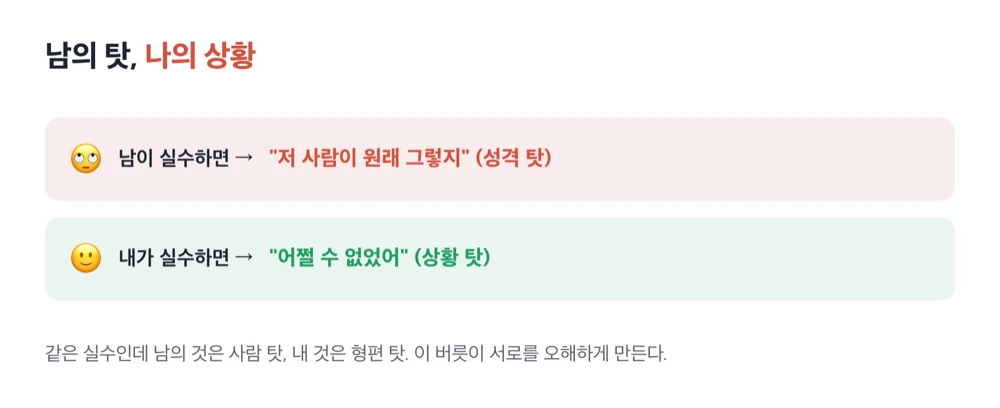
There is an old human habit at work here. Psychologists call it the fundamental attribution error. When someone else slips up, we blame their character: "That's just how they are." When we slip up, we blame the situation: "I had no choice." The same behavior is the person's fault when it's theirs and the circumstances' fault when it's ours. That habit is why each of the three layers saw "the other side" as the problem. You can't see the other person's situation; you can only see their character.
Experiments have confirmed this habit. In one study long ago, people read an essay and were asked to guess what the writer really thought. They were told plainly that the writer had been assigned to argue that position regardless of their own views. Even so, readers still believed the essay reflected the writer's true opinion. They knew the situation full well and still blamed the person. That is how thoroughly our minds erase other people's circumstances.
Why the other person acts the way they do, and what position they are in. Without trying to see that, misunderstandings pile up, and misunderstandings turn into conflict. In the next piece, let's look together at the name we like to give those misunderstandings: "the generation gap."