What Is a Diameter?
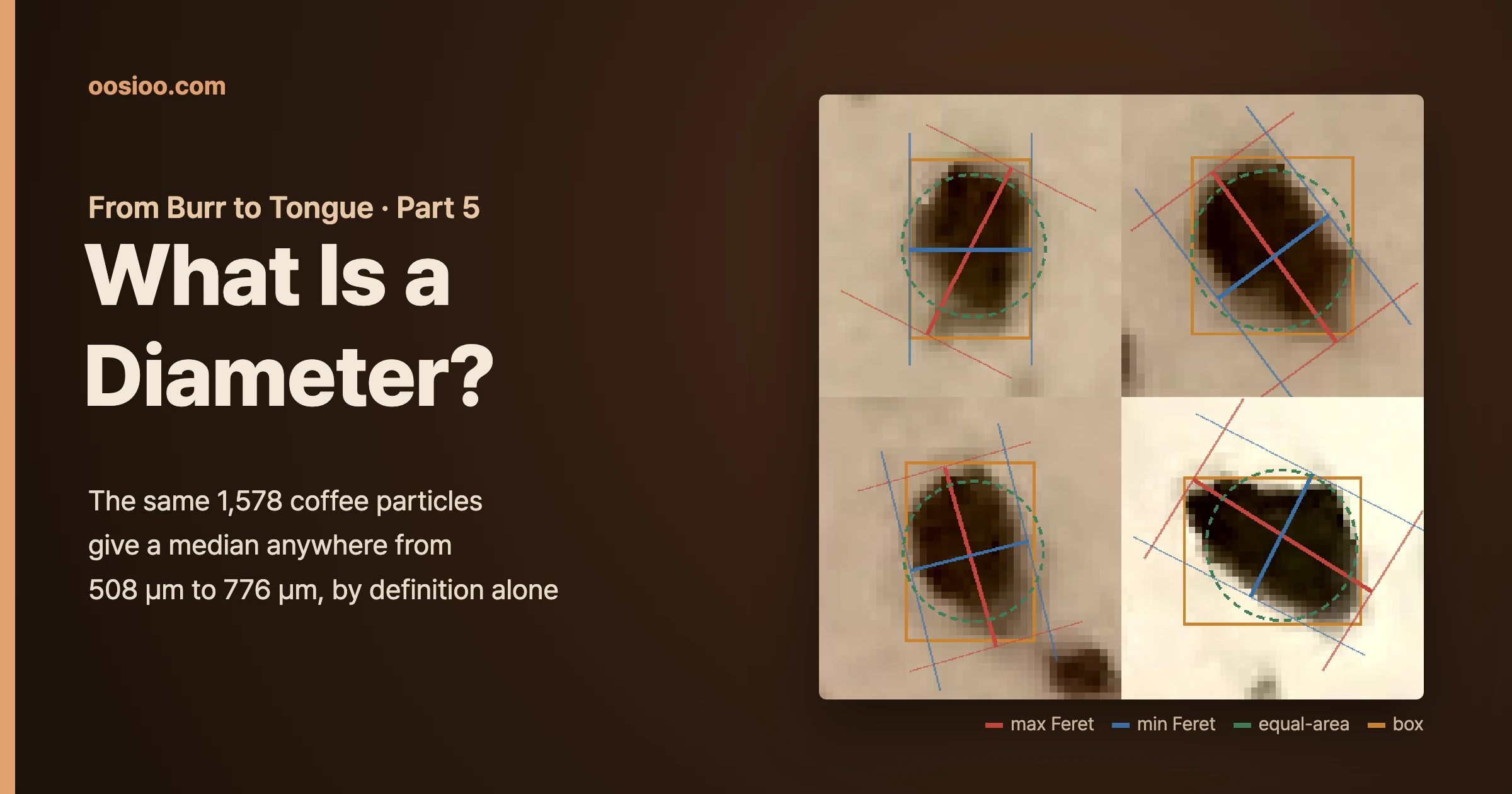
Once particles have been picked out of a photo, their size has to be written down as a single number. But flat, elongated coffee particles don't have just one diameter. Measuring the same 1,578 real particles from a public example photo under five different definitions, the median ranged from 508 µm to 776 µm. The piece also calculates how the thickness axis — invisible in the photo — changes both the sieve-measured size and the volume.
In the previous piece, we split the photo's pixels into particle and background. Now it's time to write down a single number for the size of each particle — the number that sits on the horizontal axis of a grind-distribution chart, commonly called the "diameter."
For a sphere, there's nothing to think about. It measures the same no matter which direction you measure it from. But coffee particles aren't spheres. When a bean breaks, it splits into angular, flat fragments. Photograph such a fragment from above and it has a long side and a short side; look at it from the side and there's a separate thickness. Which of these three should we call the diameter? This piece measures the same particle under several definitions and looks at how much the answer changes with the definition alone.
What does a sieve measure?
The oldest tool for measuring grind distribution is the sieve. Sieves with different hole sizes are stacked largest-hole-first from the top, powder is poured in and shaken, and then the weight of powder remaining on each sieve is weighed.
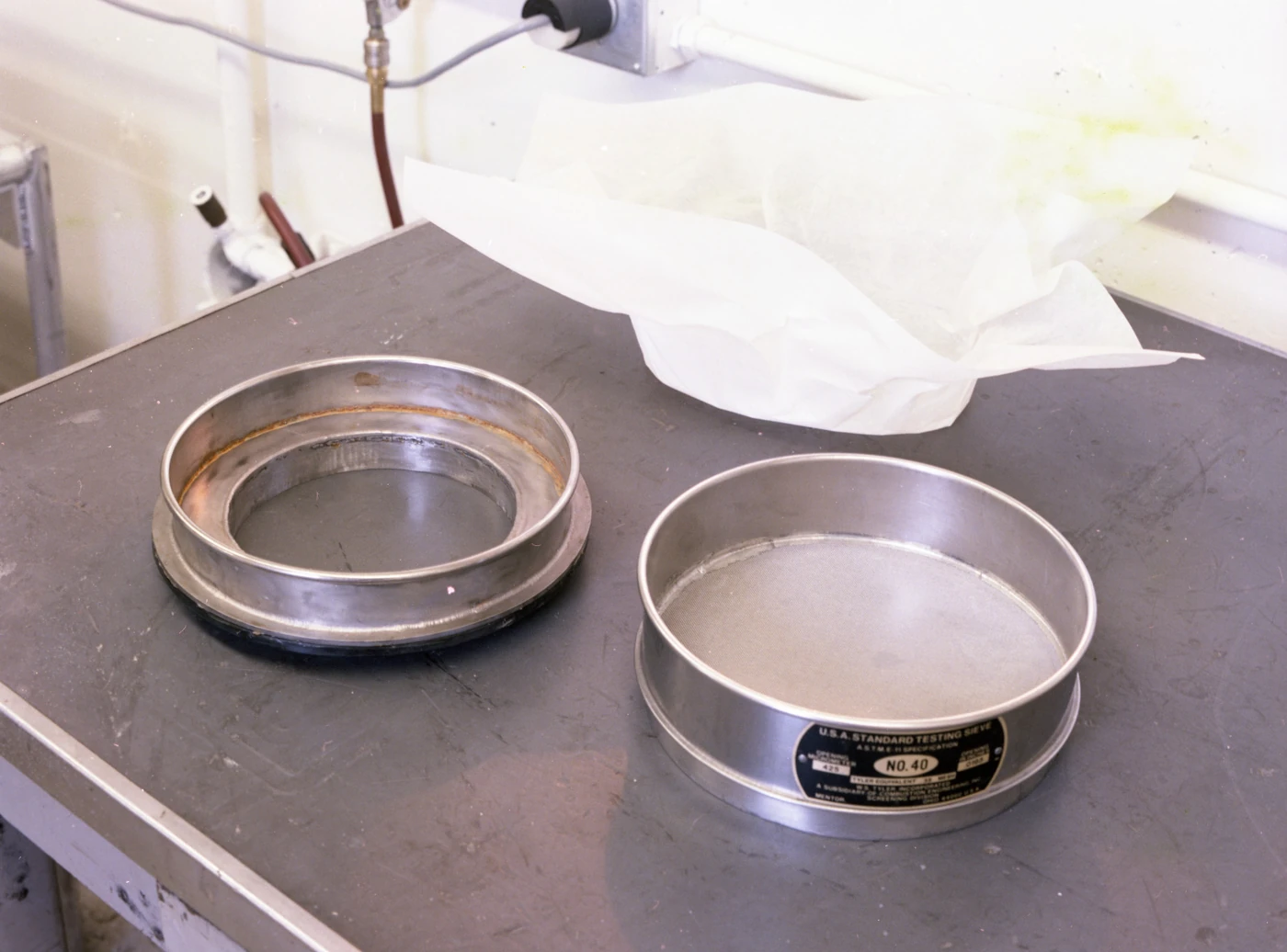
U.S. Standard Testing Sieve No. 40. Each hole side is 425 µm. Photo: San Diego Air & Space Museum Archives / Wikimedia Commons (public domain)
Which length of a particle does a sieve actually measure? A particle shakes around on the sieve and falls through the instant its smallest cross-section faces a hole. An elongated particle passes through standing on its long side. So what the sieve separates by is not the long length but the width of the short side. Microtrac, a particle-measurement equipment maker, makes the same point in an application note that measured coffee grounds with both sieving and image analysis together. The sieve results matched best with width, one of the three sizes (width, length, and the diameter of a circle of equal area) that image analysis produces separately (Microtrac). The same note states that for spherical particles the three distributions would be identical, but for coffee they differed widely from each other.
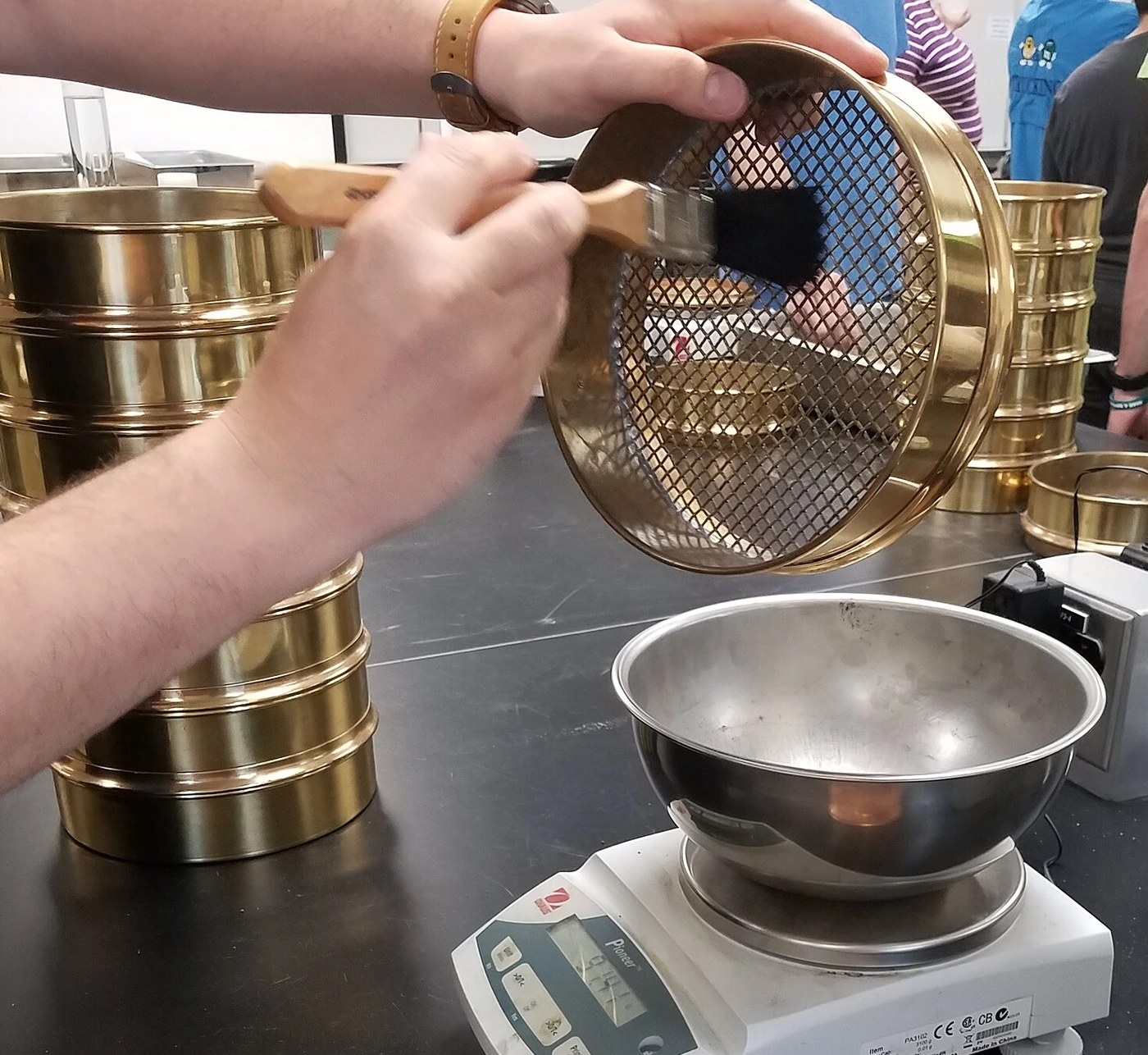
The powder remaining on each sieve is brushed off into a bowl and weighed. Photo: Soccer jim2002 / Wikimedia Commons (CC BY-SA 4.0, cropped)
What does a photo see?
A camera looks down at the particles from above. A flat fragment scattered on paper tends to lie with its widest face down. So the photo captures the long side and the short side, but not the thickness. The short width that a sieve sees is also present in the photo, but the thickness, which acts together with width as the particle passes through a sieve, is not.
There are several ways to extract a size from the outline of a particle captured in a photo. The representative ones found in the international standard for image analysis (ISO 13322-1) and the standard for particle shape notation (ISO 9276-6) were overlaid on an actual coffee particle. The particle was chosen from Gagné's example photo used in the previous piece. The Canadian 25-cent coin in the photo (23.88 mm in diameter) measured 523 pixels, so one pixel equals 45.7 µm.
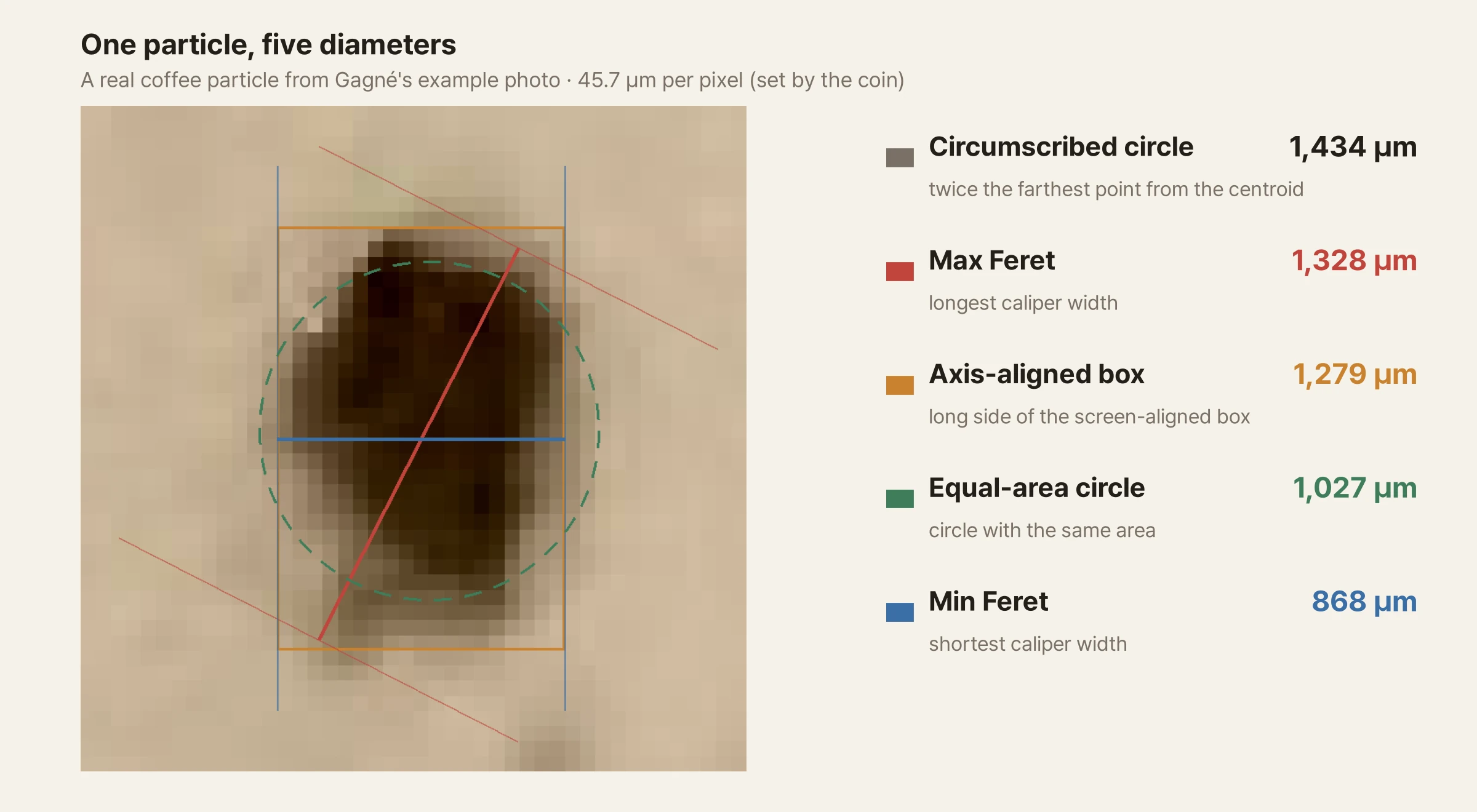
- Feret diameter. The width of a particle when gripped between two caliper jaws. Rotating the particle and measuring repeatedly yields the longest width (Feret max) and the shortest width (Feret min). The name comes from the statistical diameter used by France's L. R. Feret in the 1930s (Walton 1948).
- Equivalent circle diameter. The diameter of a circle with the same area as the particle. Since it only requires counting pixels, it is the easiest to compute.
- Axis-aligned box. A rectangle enclosing the particle, aligned to the photo's horizontal and vertical axes. Because computer vision libraries return this value by default for every blob, it tends to get used without much thought.
- Circumscribed circle. The circle that fully contains the particle. Here it was taken as twice the distance from the centroid to the farthest point.
Even for this single particle, the largest value (circumscribed circle, 1,434 µm) is 1.65 times the smallest value (Feret min, 868 µm). Neither is a wrong measurement — they're simply measuring different things.
Gagné's diameter, Unspecialty's diameter
So which diameter do the tools in current use rely on? Tracing through Gagné's coffeegrindsize code reveals the following. For each blob, the distance from the centroid to the farthest pixel is taken as the long radius, a. The area is then divided by πa to produce the short radius, b. In other words, the particle is treated as an ellipse of equal area. The diameter used in the chart is 2√(ab). But since b equals area ÷ πa, 2√(ab) reduces to 2√(area/π) — exactly the equivalent circle diameter. However the long radius is chosen, it has no effect on the diameter.
The difference shows up in volume. coffeegrindsize assumes the third axis invisible in the photo (thickness) equals the short radius, and treats the particle as an oblate spheroid to compute volume. This is stated in the code's comments. How valid this assumption is will be examined later.
Unspecialty's "Developing a Grind Size Guide" (2023), the starting point for this series, used the circumscribed circle diameter of the outline for particles above a certain size, and the circumscribed rectangle for smaller particles. For the particle above, the circumscribed circle is 1,434 µm while the equivalent circle is 1,027 µm. The two tools assign different numbers to the same particle. This is why their charts should not be placed side by side for comparison.
One particle, five distributions
What about the whole photo rather than a single particle? As in the previous piece, the background was flattened using the brightness of blank paper and then thresholded, yielding 2,140 particle blobs on the paper. Of these, blobs with convexity (area ÷ convex hull area) below 0.85 were excluded, since they might be several particles stuck together. Particles smaller than roughly 330 µm in diameter (40 pixels in area) were also excluded, since, as shown in the previous piece, shape cannot be read reliably at this size. The remaining 1,578 particles were measured under five definitions.
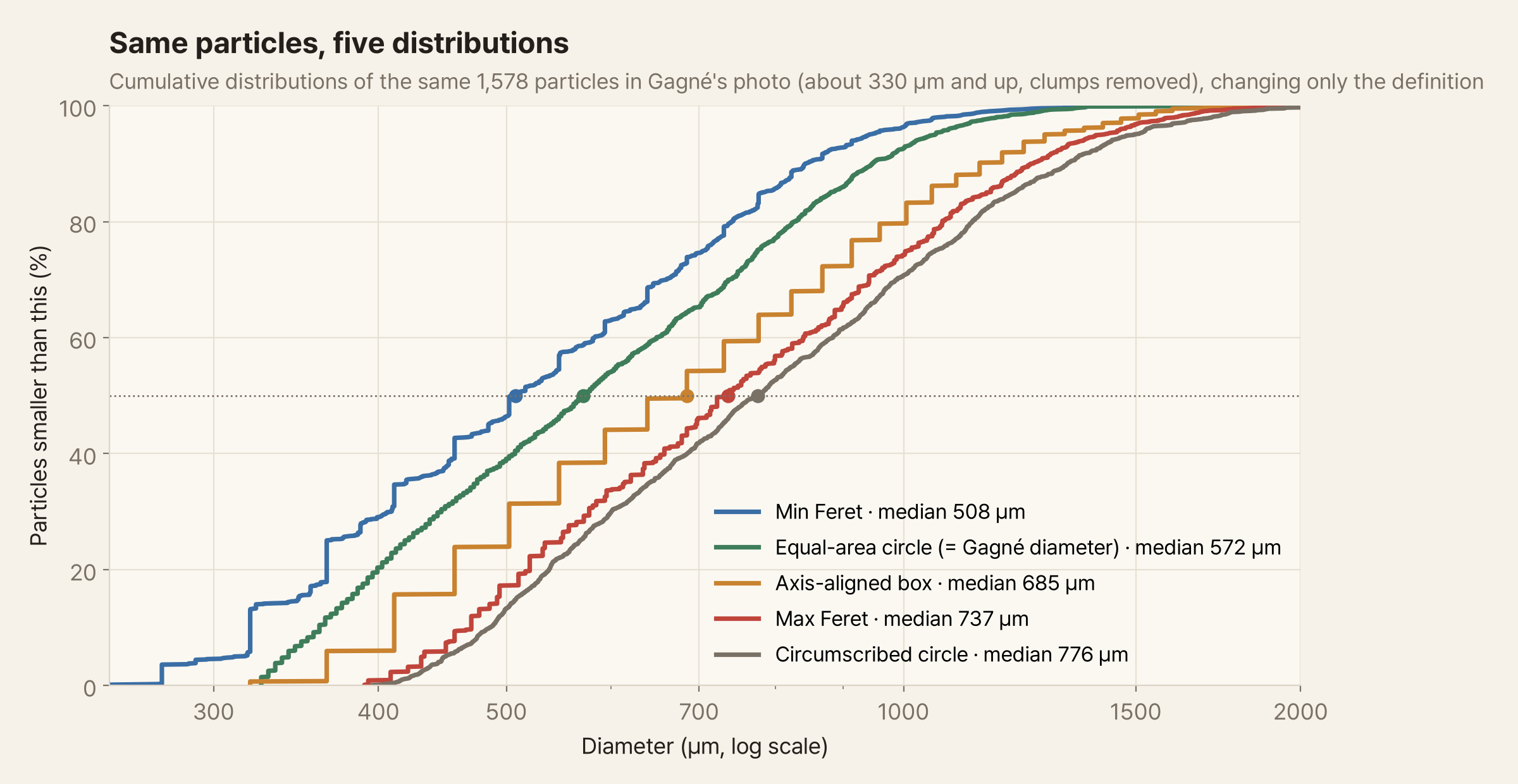
| Definition | Median |
|---|---|
| Feret min | 508 µm |
| Equivalent circle (= coffeegrindsize's diameter) | 572 µm |
| Axis-aligned box | 685 µm |
| Feret max | 737 µm |
| Circumscribed circle | 776 µm |
Same photo, same particles, same threshold. Yet the medians spread from 508 µm to 776 µm — a 1.53-fold difference. On a grind-distribution chart, a gap this large corresponds to several notches on a grinder's dial. That's why, before looking at the number itself, you first have to ask which definition is being used.
Coffee particles aren't round
What drives the gap between definitions is particle shape. For each particle, Feret min divided by Feret max was taken as a measure of elongation. A value of 1 means round; smaller values mean more elongated.
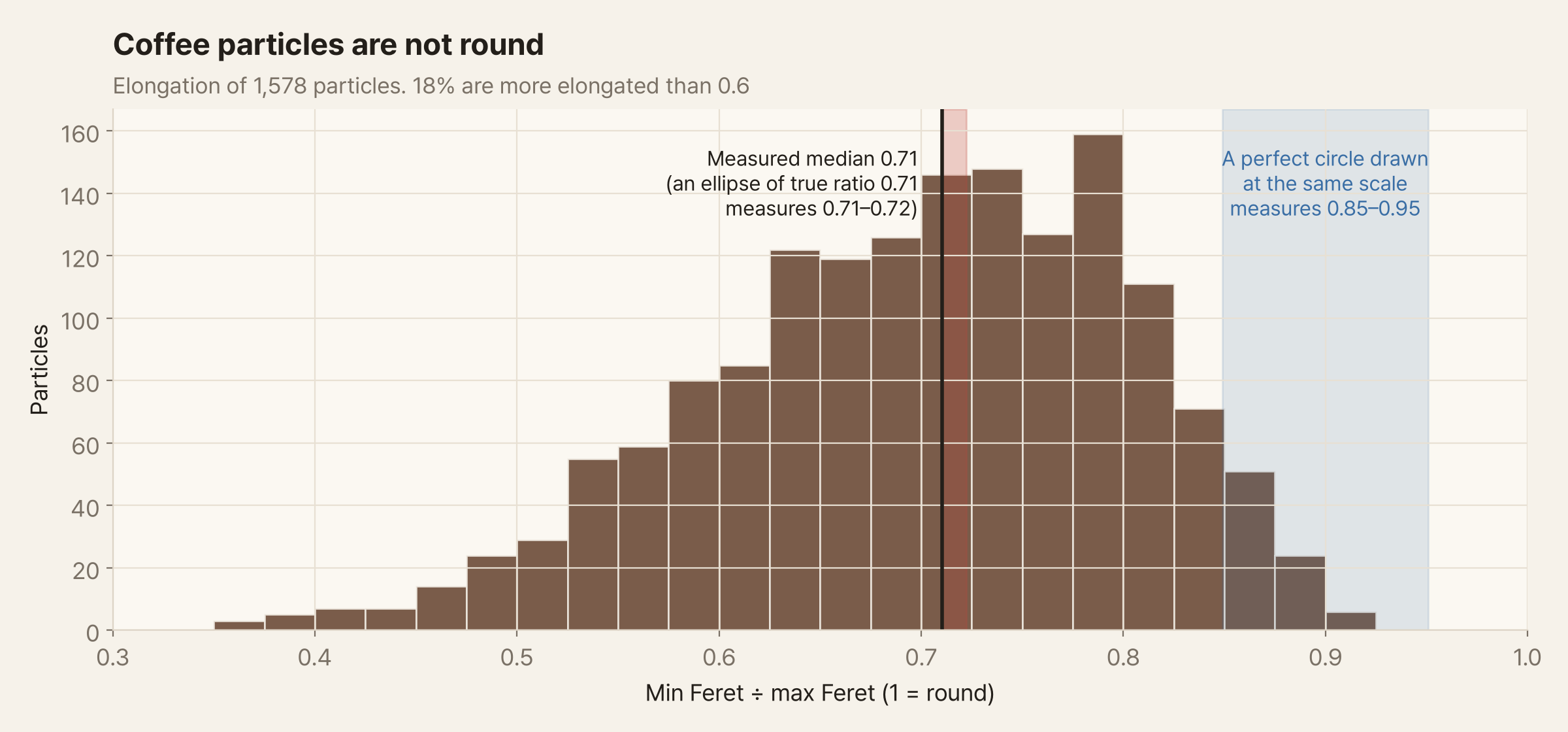
The median was 0.71. The middle half fell between 0.63 and 0.78, and 18% of particles were more elongated than 0.6. Breaking the data down by size, the median stayed close to 0.71 across the range from 330–500 µm up to 1,200 µm and above.
Before trusting this number, it had to be checked how much the pixel grid itself distorts shape. Virtual particles of known shape were drawn at the same scale (45.7 µm/pixel) and measured the same way. The result was unexpected: even a perfect circle came out as 0.85–0.95. A circle only a few pixels across has a stair-stepped outline, which makes its diagonal width come out slightly longer. An ellipse with an aspect ratio of 0.71, on the other hand, came out correctly as 0.71–0.72. So the measured median of 0.71 can be trusted. However, particles near 0.9 may actually be rounder than measured. The absence of any particle close to 1 in this photo is likely a limitation of pixels rather than evidence that coffee is never round.
Boxes depend on orientation
The axis-aligned box carries one more wrinkle: its value changes depending on how many degrees the particle is rotated relative to the photo's axes.
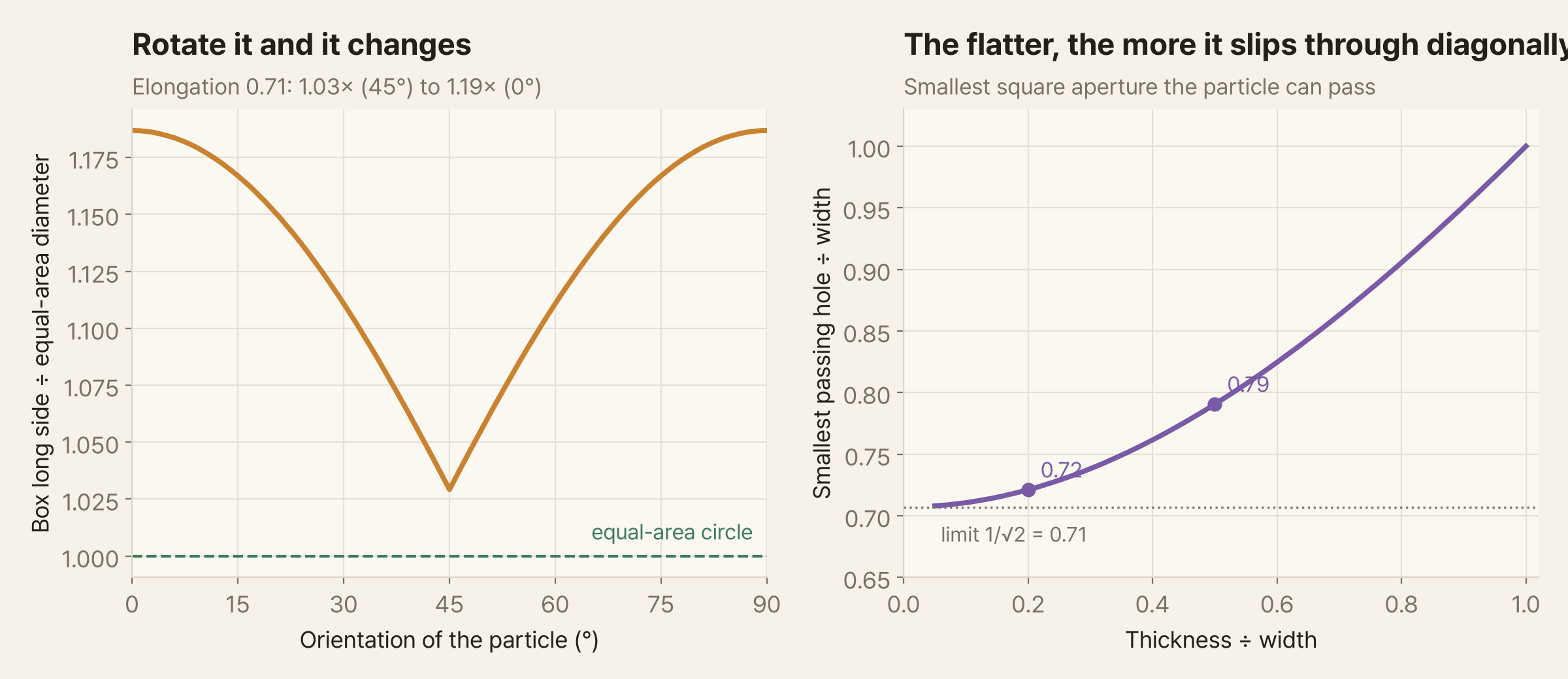
For a particle with elongation 0.71 placed parallel to the photo's axes, the box's long side is 1.19 times the equivalent circle diameter. Rotated 45°, that becomes 1.03 times. Without changing the particle at all, simply rotating it on the paper produces a 15% swing. Since scattered powder lands at random orientations, box diameters end up mixed with scatter that has nothing to do with particle size. This is also why, in the distribution above, the box's median falls between the equivalent circle's and Feret max's.
Sieves are fooled by the diagonal
Back to sieves. Sieve holes are square. The diagonal of a square is √2, about 1.41, times its side. A very thin flake, tilted and pushed through diagonally, can pass even if its width is larger than the hole's side.
The calculation was done treating a particle as an ellipsoid with three axes L ≥ W ≥ T. To pass through a hole, the particle's smallest cross-section (width W × thickness T) must fit inside the hole. Fed in straight, the hole's side must be at least W. Fed in rotated 45°, a side of at least √((W² + T²) / 2) suffices. A sieve picks whichever is smaller. When thickness equals width, the sieve measures width as-is. When thickness is half the width, a hole 0.79 times the width lets the particle through; when thickness is a fifth of the width, a hole 0.72 times the width does. As thickness shrinks further, this falls as low as 0.71 times (1/√2). The claim that sieves measure width only holds for particles close to spherical. For flat particles, a sieve can report a value up to 29% smaller than the width.
This calculation assumes the sieve is shaken long enough that every particle eventually finds its most favorable orientation for falling through. In reality, some particles never find that orientation within the allotted shaking time, so actual sieve results likely fall somewhere between this calculation and the width.
The axis the photo can't see
Here's the catch. Sieve size depends on thickness, but thickness isn't captured in the photo. The same goes for volume. Since volume is proportional to length × width × thickness, not knowing thickness means not knowing volume either. And when grind distribution is expressed by mass, volume is effectively weight.
Even without knowing thickness, it's possible to calculate how much things change as thickness changes. A virtual sample of 20,000 particles was generated from the size and elongation distributions measured in the actual photo. It was then re-measured while varying thickness ÷ width from 0.2 to 1.
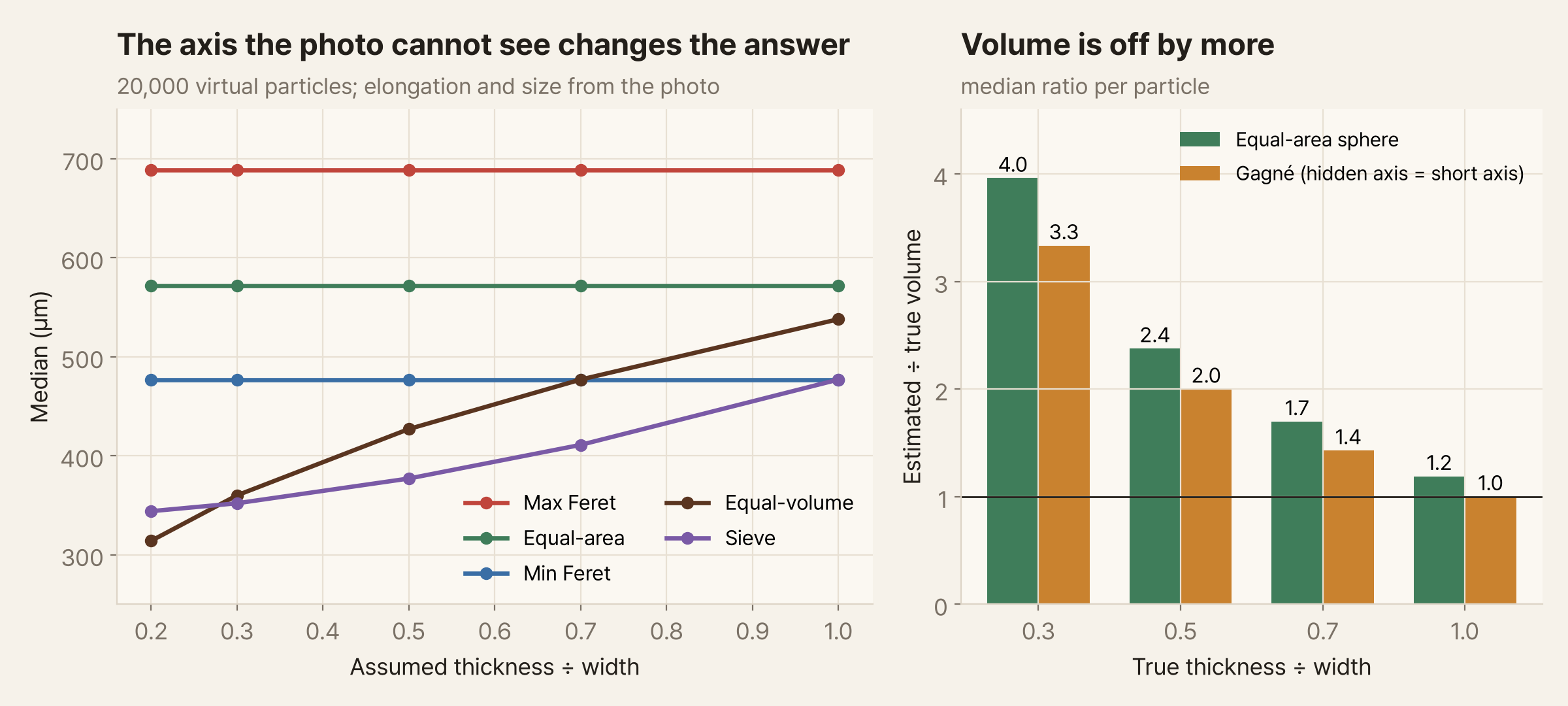
The three definitions the photo can see (Feret max, equivalent circle, Feret min) stay flat regardless of thickness — unsurprising, since the photo has no thickness information. By contrast, sieve size and the diameter of a sphere of equal volume move substantially depending on the thickness assumption. Assuming thickness is half the width, the median sieve size is 377 µm — 34% smaller than the photo's equivalent circle value of 572 µm. If thickness is a fifth of the width, sieve size drops to 344 µm and the equal-volume sphere to 314 µm. At that point, the gap between the largest definition (Feret max) and the smallest reaches 2.19-fold.
Volume estimates go wrong even more severely. Building a sphere from the equivalent circle diameter overstates the volume of a particle with thickness half its width by 2.4 times. Treating the hidden axis as equal to the short axis, as coffeegrindsize does, overstates it by 2.0 times. This method is only correct when the particle's thickness truly equals its width. The photo alone cannot verify this assumption — thickness has to be measured separately.
Try it yourself
In the simulation below, you can change a particle's elongation, thickness, and orientation. On the left is a single particle viewed from above with its five diameters, its thickness viewed from the side, and the smallest sieve hole it can pass through. On the right are the medians of a 20,000-particle virtual sample — built from sizes and elongations measured in the actual photo — under six different definitions. Lowering thickness to 0.2 pulls the sieve-passing size and the equal-volume sphere diameter down together, away from the three bars the photo can see.
What this model leaves out
- Thickness was not measured. All sieve sizes and volumes in this piece are based on an assumed thickness ÷ width. Measuring the actual thickness of coffee particles requires shooting from the side or varying focus distance
- Particles were treated as ellipsoids. Real particles have corners and concave regions. The sieve-passing and volume calculations are based on smooth ellipsoids
- The photo was not corrected for perspective. The coin measured 524 pixels wide and 546 pixels tall in the photo, about 4% distorted. This could shift elongation values by up to about 4%. This limitation arises because the photo was not shot with the marker sheet described in Part 2
- Particles smaller than 330 µm were excluded. Fine particles are only a few pixels, too small to measure shape. The distributions in this piece describe only the coarser particles
- This is a single photo, a single grind. Whether elongation is the same for other beans or other grinders is unknown
- No sieve experiment was run. How much the diagonal-passing effect actually shifts real sieve results can only be known by measuring the same powder with both a sieve and a photo
Summary
- A particle's "diameter" is not a single thing. There are at least five representative definitions that can be extracted from a photo. For a sphere they would all agree; for coffee particles, they diverge sharply
- Measuring 1,578 real particles from a public example photo gave medians of 508 µm (Feret min), 572 µm (equivalent circle), 685 µm (axis-aligned box), 737 µm (Feret max), and 776 µm (circumscribed circle). For the same particles, changing only the definition produces a 1.53-fold spread
- coffeegrindsize's diameter is exactly the equivalent circle diameter. Unspecialty's method used the circumscribed circle and the box. The two tools' charts are not on the same scale
- The median elongation of coffee particles (Feret min ÷ Feret max) was 0.71. The pixel grid distorts round particles up to 0.85–0.95, but reads values near 0.71 correctly
- The axis-aligned box swings by 15% from orientation alone
- Sieves measure width, but flat particles slip through diagonally, reading as low as 0.71 times the width. Thickness, invisible in the photo, determines sieve size and volume. If thickness is half the width, the volume computed from the equivalent circle is 2.4 times the actual value
Sieves and cameras give different answers not because one of them is wrong, but because they look at different axes. Before taking a grind-distribution number at face value, ask first what was called the "diameter."
References
- Gagné J. coffeegrindsize. GitHub. Link — confirmed in code: long radius (farthest pixel from centroid), short radius (area ÷ π·long radius), diameter 2√(ab), volume π·b²·a (hidden axis = short axis)
- Unspecialty, "Developing a Grind Size Guide" (2023). Link — circumscribed circle of the outline for large particles, circumscribed rectangle for small ones
- Microtrac. Coffee powder (application note, equipment manufacturer material). Link — explanation that image analysis's width, length, and equivalent circle distributions differ widely from each other, and that sieve results match width best
- ISO 13322-1:2014. Particle size analysis — Image analysis methods — Part 1: Static image analysis methods — bibliographic reference
- ISO 9276-6:2008. Representation of results of particle size analysis — Part 6: Descriptive and quantitative representation of particle shape and morphology — bibliographic reference
- Walton WH (1948). Feret's statistical diameter as a measure of particle size. Nature 162, 329–330. doi:10.1038/162329b0 — bibliographic reference
- Royal Canadian Mint. 25-cent coin diameter 23.88 mm
Image credits
- U.S. Standard Testing Sieve No. 40: San Diego Air & Space Museum Archives, Wikimedia Commons.jpg), public domain (resized)
- Brushing off the sieve mesh: Soccer jim2002, Wikimedia Commons, CC BY-SA 4.0 (cropped)
- Coffee particle photo: Jonathan Gagné, coffeegrindsize Help/Decent_Example_Picture.png, MIT license. The particle close-up, diameter annotations, and distribution/elongation graphs were produced by analyzing this photo directly
- All other figures and the simulation: produced directly
