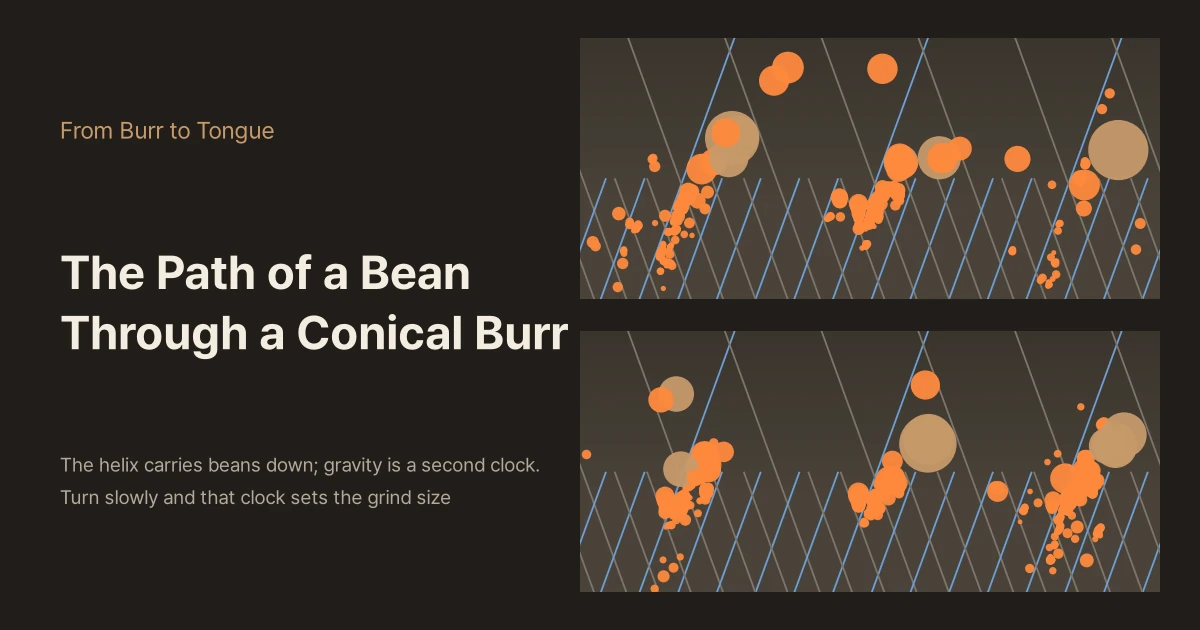
The Path of a Bean Through a Conical Burr
A hand grinder turns a little more than once a second, and electric conical grinders run at only 330–500 rpm. What sends the beans down: gravity or the helix? I built a virtual conical burr in a 2D DEM on the unrolled gap between cone and ring and ground beans in it. With gravity off, pieces passed in 0.7 turns at any speed, just as the screw-conveyor formula says. Gravity is a second, independent clock, so below 200 rpm the grounds came out coarser at the same gap (D50 450 → 820 µm). With a simulation you can run yourself.
The handle of a hand grinder goes round a little more than once a second. Electric conical grinders are slower than you might think, too. The Niche Zero turns at 330 rpm and the Mazzer Robur at 420 rpm (50 Hz). The flat burr in the last episode turned at over 1,000 rpm, so these are three to more than ten times slower. Yet the beans still make it through the burrs. What sends them down? Is it gravity, since they fall in from above, or the helix cut into the cone, pushing them in like a screw?
I could not find a study that answers this either. There is no experiment that measured how beans move inside a conical burr, how long they stay or where they break, and no peer-reviewed paper that computed it. So I moved the 2D simulation from "The Path of a Bean Through a Flat Burr" into a conical burr. The short version: what carries the beans down is the helix. With gravity switched off, a bean always passes while the burr turns the same number of turns, whatever the speed. Gravity is a second clock that runs independently of the rotation. The slower the burr turns, the more this clock gets ahead, and then the grounds come out coarser even at the same gap.
A cone and a ring
A conical burr has two parts. The inner one is a rotating cone; the outer one is a stationary ring. The photo below looks down into an electric grinder with the hopper removed. The star-shaped blade in the middle pushes the beans down, and the cone underneath it turns. Coarse teeth stand close together around the inside of the outer ring.
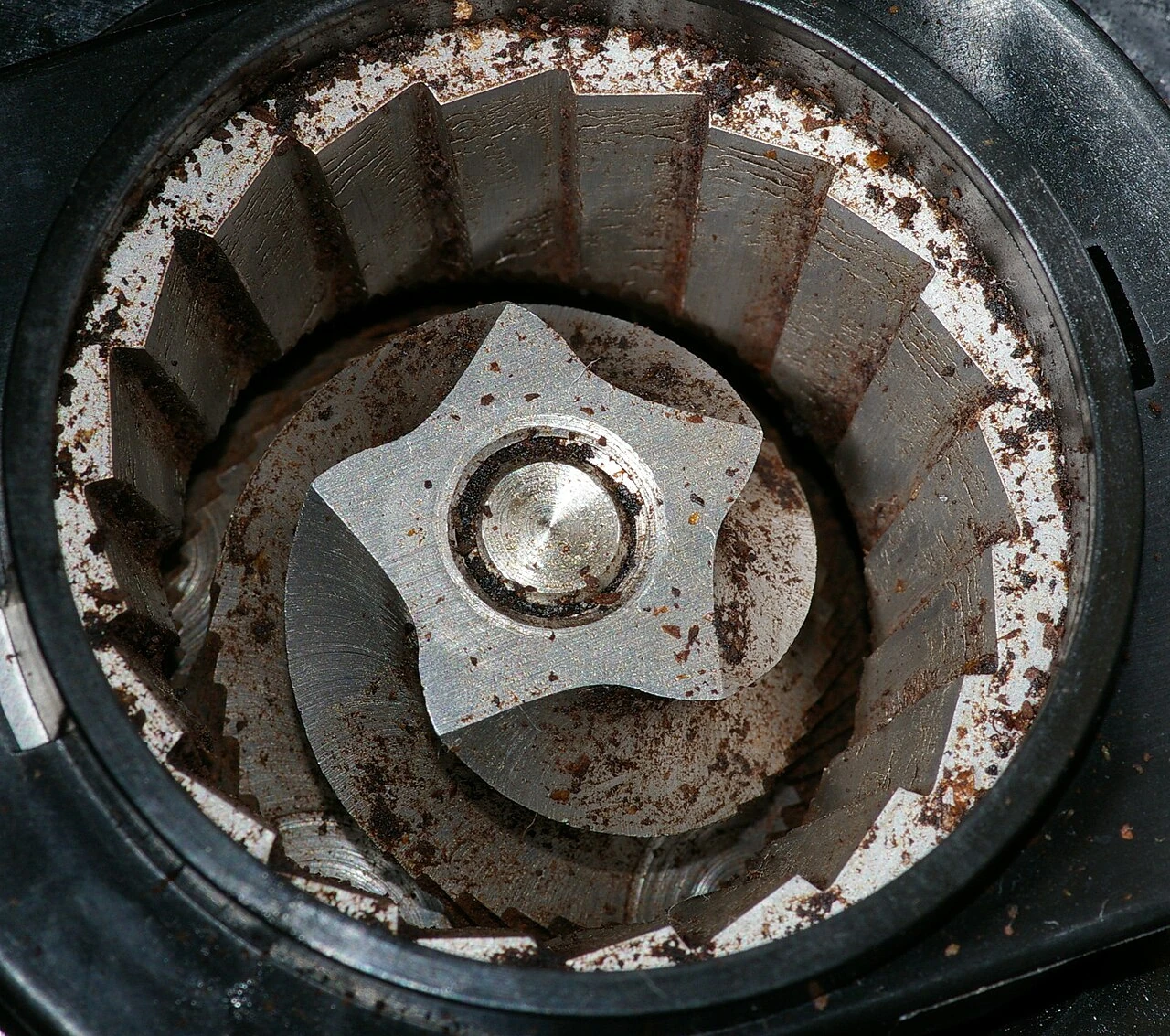
A conical burr seen from above: the star-shaped blade and cone in the middle, the teeth of the outer ring around it · Photo: Hustvedt, Wikimedia Commons, CC BY-SA 3.0
The design is old. A coffee-mill section in an 1875 US patent shows a rotor at the end of the crank shaft sitting inside a bowl-shaped shell. The gap between them narrows downward, and the ground coffee falls into a drawer below. A patent drawing thirty years older, from 1843, shows a toothed cone (the "Wheel") next to a shell whose inner teeth are twisted at a slant (the "Shell").
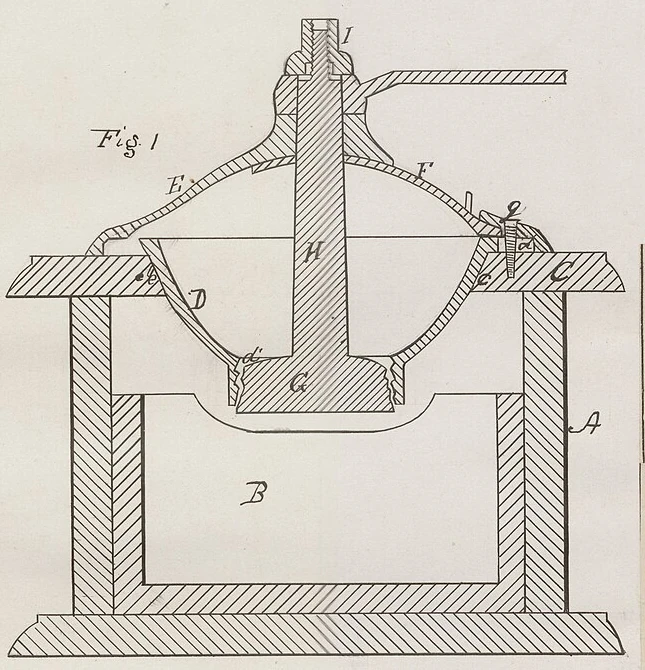
T. Strobridge's coffee mill in section (1875) · US Patent 159,467, Wikimedia Commons, public domain
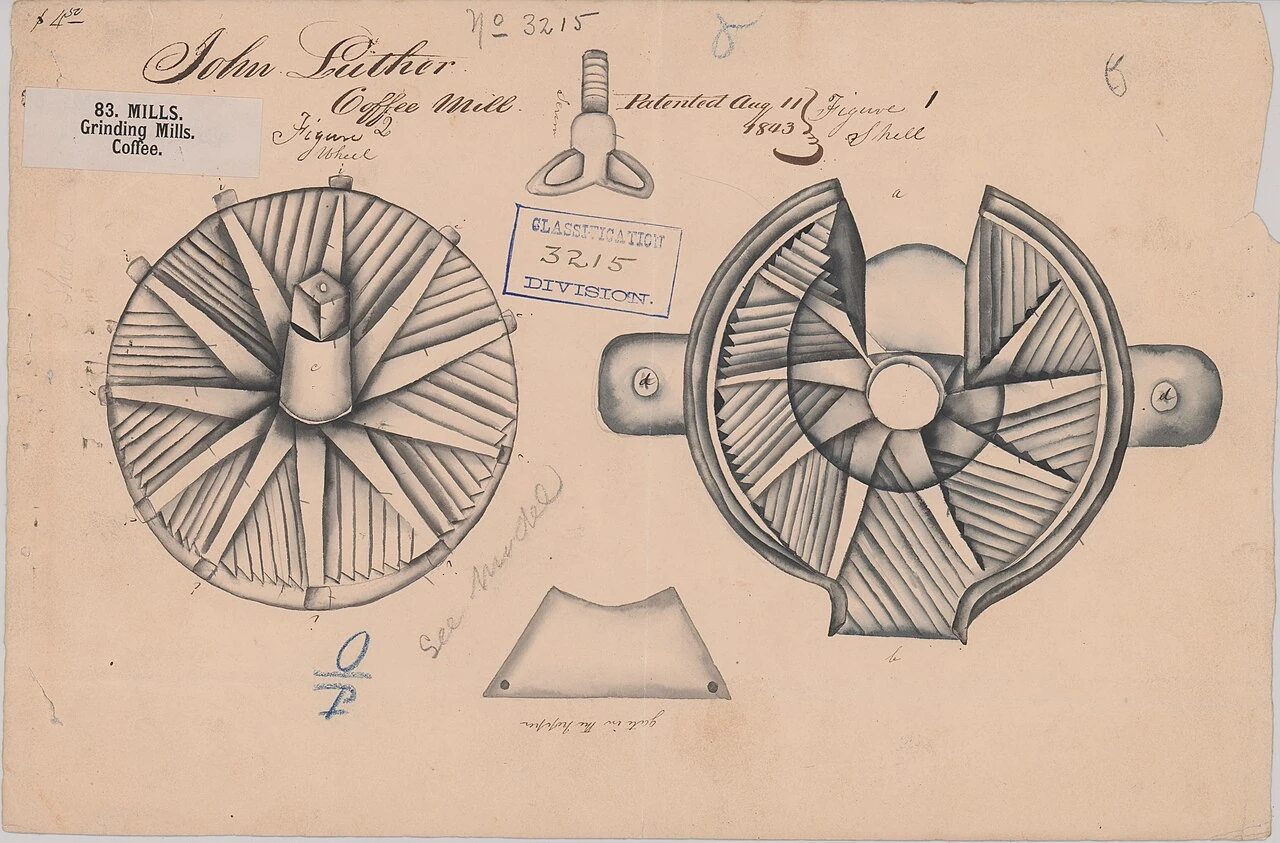
John Luther's coffee mill patent drawing (1843) · US Patent 3,215, Wikimedia Commons, public domain
The model in this piece is a virtual burr modelled on a conical burr about 40 mm across. I chose the dimensions; they are not measured from a real product.
- Narrowing zone (depth 0–16 mm): the gap between cone and ring narrows linearly from 8 mm
- Finishing band (depth 16–24 mm): the gap is constant at g. This is the value you change with the grinder dial
- Teeth: the cone has six large helical teeth running from top to bottom and the ring has twelve. Near the finishing band, fine teeth are added, bringing the totals to 30 on the cone and 36 on the ring. The cone's teeth lean 20° so that their lower ends trail behind the direction of rotation; the ring's teeth lean the other way, so the two cross like scissors
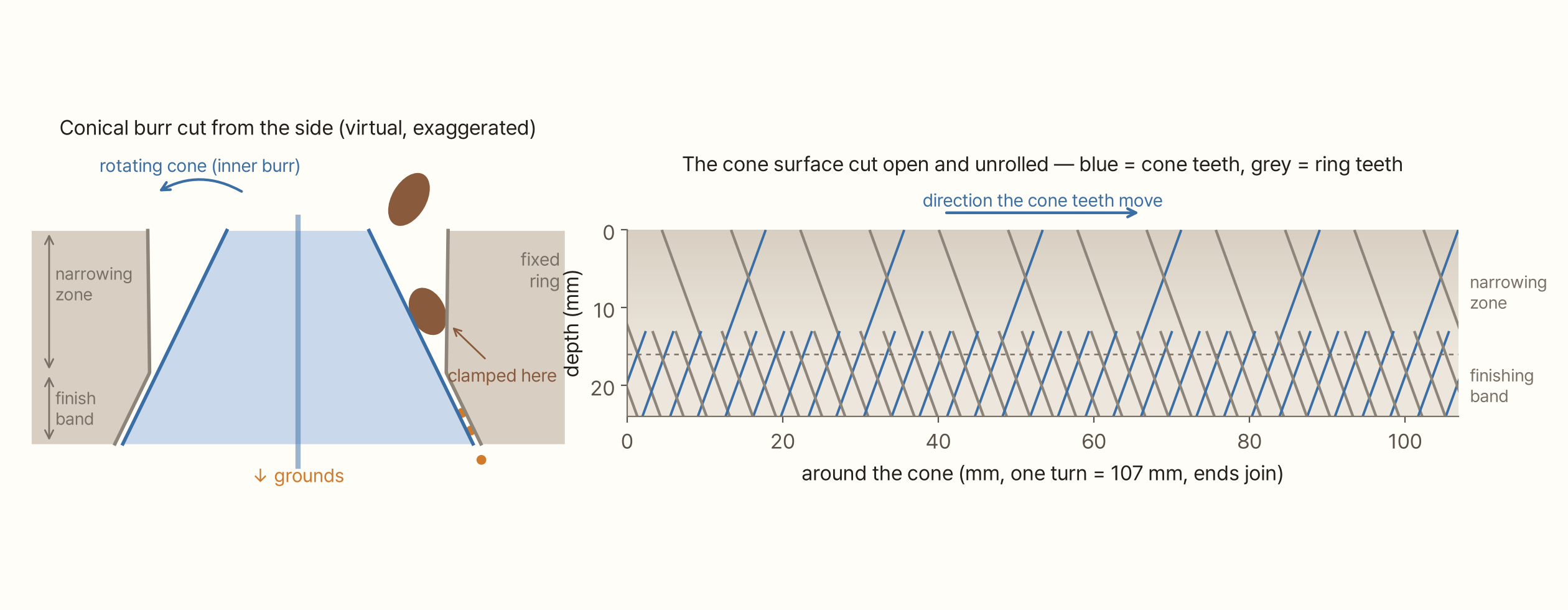
Last time I sliced horizontally between the two discs of a flat burr to get a plane. For a conical burr, I take the surface halfway across the gap between cone and ring, cut it along the cone and unroll it like paper. That gives a strip whose width is one turn of circumference (107 mm) and whose height is depth. The left and right ends of the strip join. A helix wrapped on a cylinder becomes a straight line when unrolled, so the helical teeth are slanted line segments on the strip. The rotating cone's teeth slide to the right across it. The cone widens downward, but in this model I unrolled it as a cylinder of radius 17 mm, so the circumference is the same at every depth.
The rules are almost the same as last time.
- Particles are discs on the strip, and I separately remember a height across the gap equal to 0.6 of the diameter (flatness 0.6, an assumption). If the height is greater than the gap at that spot, the particle is "clamped". Both faces press on it (this force also counts towards breakage), the cone face drags it and the ring face holds it back. Because the gap narrows downward, the wedge also pushes it upward
- Every particle catches on the cone's teeth. A particle catches on the ring's teeth only if its height is more than 60% of the gap
- Two forces are new. Gravity pulls down along the strip. With a cone half-angle of 15°, 97% of gravity acts along the strip. Centrifugal force arises as v²/R from the speed v at which a particle travels round. Most of it presses the particle against the outer ring, where friction holds it back. The component along the strip (sin 15°) pushes downward. In the flat burr, centrifugal force pushed particles outward within the plane; in a conical burr it mostly points straight out of the plane, so it acts as a brake
- Breakage works as in "How to Simulate Breakage". If the force a particle receives exceeds its breaking force, it is replaced by 2–4 fragments, conserving volume
The defaults are 400 rpm and a 0.8 mm gap, close to the speed of a Niche Zero or Baratza Encore.
Do they fall, or are they pushed down?
Start by comparing the forces a bean feels inside the burrs. Conical burrs are slow and small, so centrifugal force is weak. Turn a 39 mm hand grinder at 60 rpm and the centrifugal acceleration at the edge is 0.08 g. Electric conical grinders reach only 4–7 g. The 64 mm flat burr in the last episode reached 36 g at 1,000 rpm. Inside a hand grinder, gravity is more than ten times stronger than centrifugal force.
The other way to send beans down is the helix. A screw conveyor, which turns a helical flight inside a tube to carry grain or powder, works on the same principle. The theory of these machines has one important observation. If the outer tube is so slippery that it cannot hold the material at all, the material simply turns with the flight and never moves forward. Friction from the stationary outer wall is what turns "going round" into "going forward" (Gupta and Nott 2021; Roberts 1999). If the flight is slippery and the material is pushed off perpendicular to its face, the axial speed is the surface speed × sin α × cos α, where α is the angle the teeth lean from the axis. For this burr, that means the burr turns 0.70 turns while a bean travels to the bottom, whatever the speed.
To check whether the simulation follows this formula, I opened the gap as wide as the inlet so that nothing would be clamped, and let 1 mm pieces flow through. I compared gravity on and off at each speed.
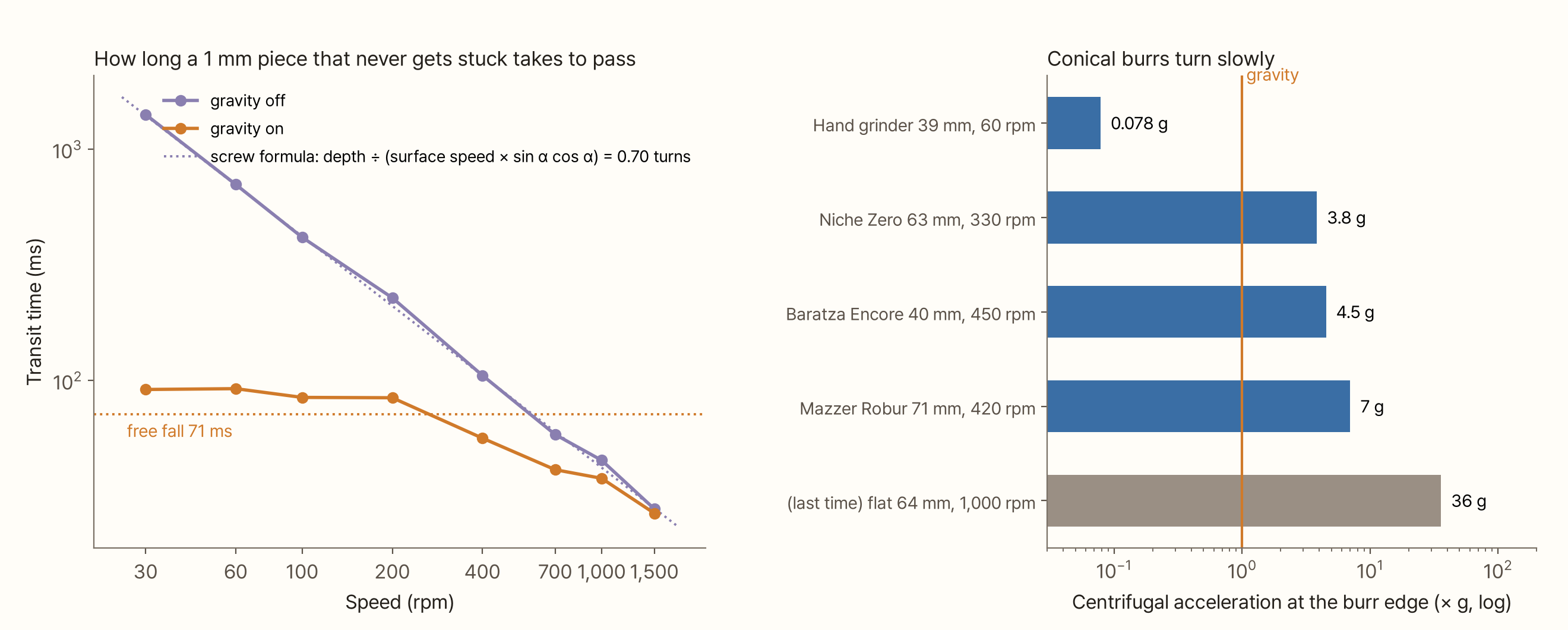
With gravity off, the pieces took 1,410 ms to pass at 30 rpm and 28 ms at 1,500 rpm. In turns, all of them came to 0.68–0.76 turns, matching the screw formula's 0.70. If the helix is the only thing sending beans down, a conical burr keeps to "always the same number of turns", just like a flat burr.
Switch gravity on and the story changes. Below 200 rpm the pieces were out in 84–92 ms, close to the 71 ms it takes to fall 24 mm without touching anything. They fall before the helix can carry them. Above 700 rpm the helix is faster and the two lines meet. In this burr, the two clocks cross at around 300 rpm. Hand grinders sit well on the slow side of that.
Where does a bean break?
A bean enters from the top and is first clamped at a depth of about 9 mm, where the gap has narrowed to its own height (3.9 mm). From there it breaks on the way down.
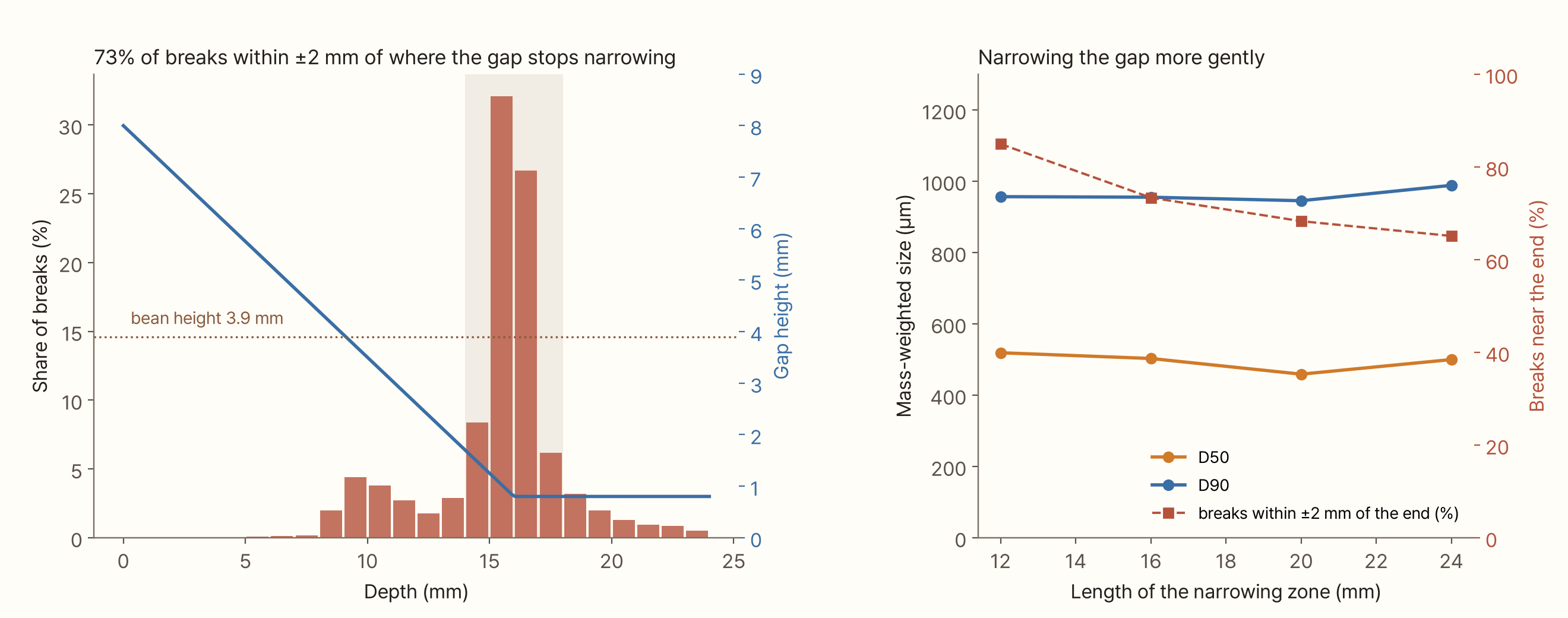
Grinding 16 beans three times, 73% of breaks happened within 2 mm either side of where the gap stops narrowing (depth 14–18 mm). The beans split coarsely a few times at 9–12 mm, where they are first clamped, and most breaks come from those pieces being pushed to the tip of the wedge and crushed fine. It is the same picture as in the flat burr (82%).
People often say that a conical burr narrows the gap long and gently. So I varied the length of the narrowing zone from 12 to 24 mm, keeping the 8 mm finishing band. A longer zone spread the breaks a little: the share bunched within ±2 mm of the end fell from 85% to 65%. Yet the grounds came out almost the same size. D50 stayed between 460 and 520 µm and D90 between 950 and 990 µm. Whether the bean is squeezed slowly or quickly, it is the gap of the finishing band that sets the final size. Cut the zone the other way, down to 8 mm, and the wedge became so steep that pieces piled up at its tip and jammed. Even after 6 seconds, 30–40 particles could not get out, so I left that case out of the chart.
Paths
Joining up the positions of two beans and their fragments every 0.25 ms gives this.
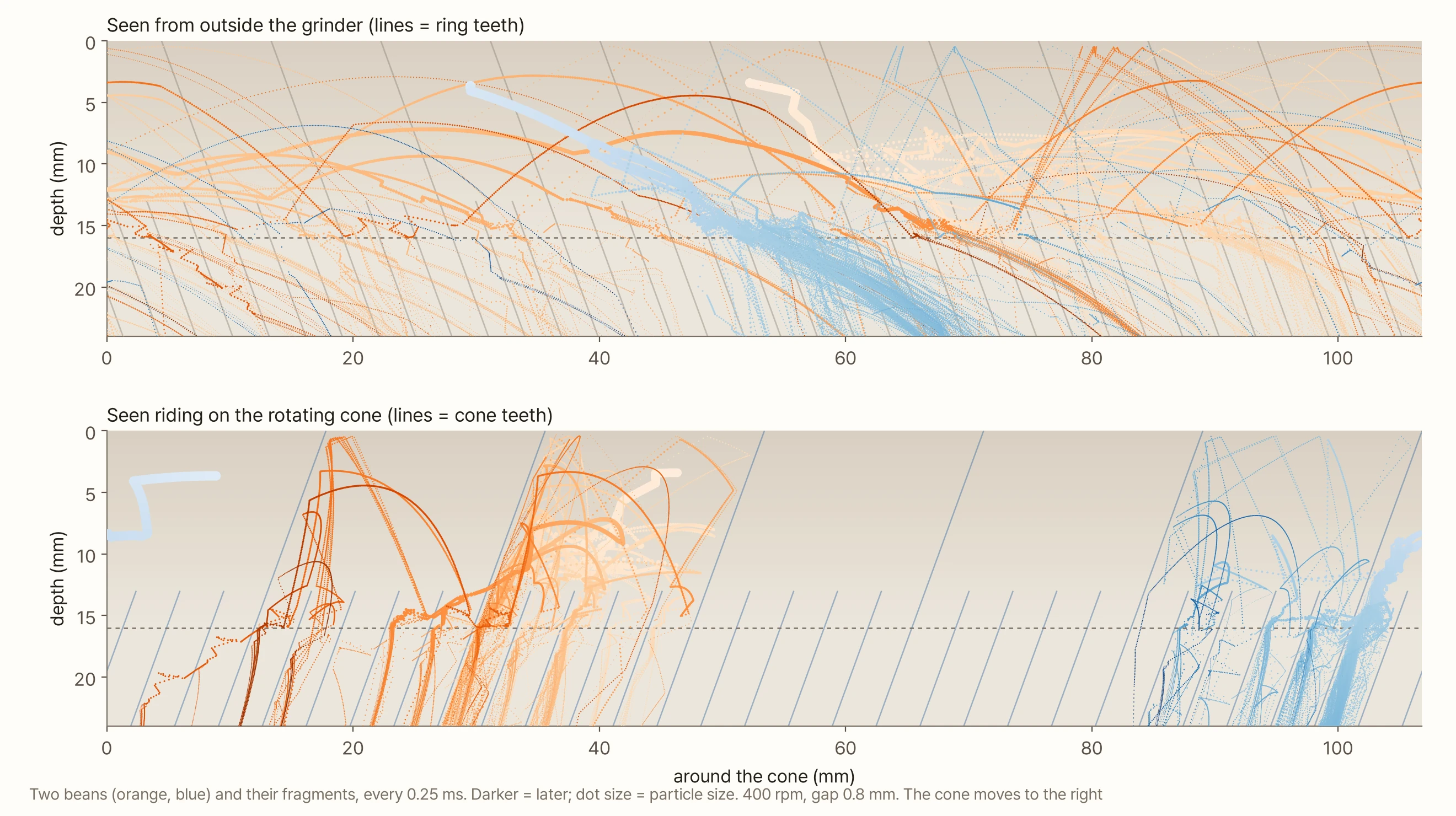
From outside, particles travel round with the cone as they go down. Riding on the cone, they slide down at a slant, almost along the cone's teeth. It is the same motion as in the flat burr, where particles leaned on one tooth of the rotating burr and slid outward along it. The difference is that many pieces jump upward. When a bean is squeezed in the narrowing zone, the wedge pushes it back up, and the broken pieces take that push and fly up in parabolas. Once they fall back, the helix carries them down again. Inside a conical burr, particles do not pass straight through in one go; they rise and fall and go in and out of the tip of the wedge several times.
How long they stay
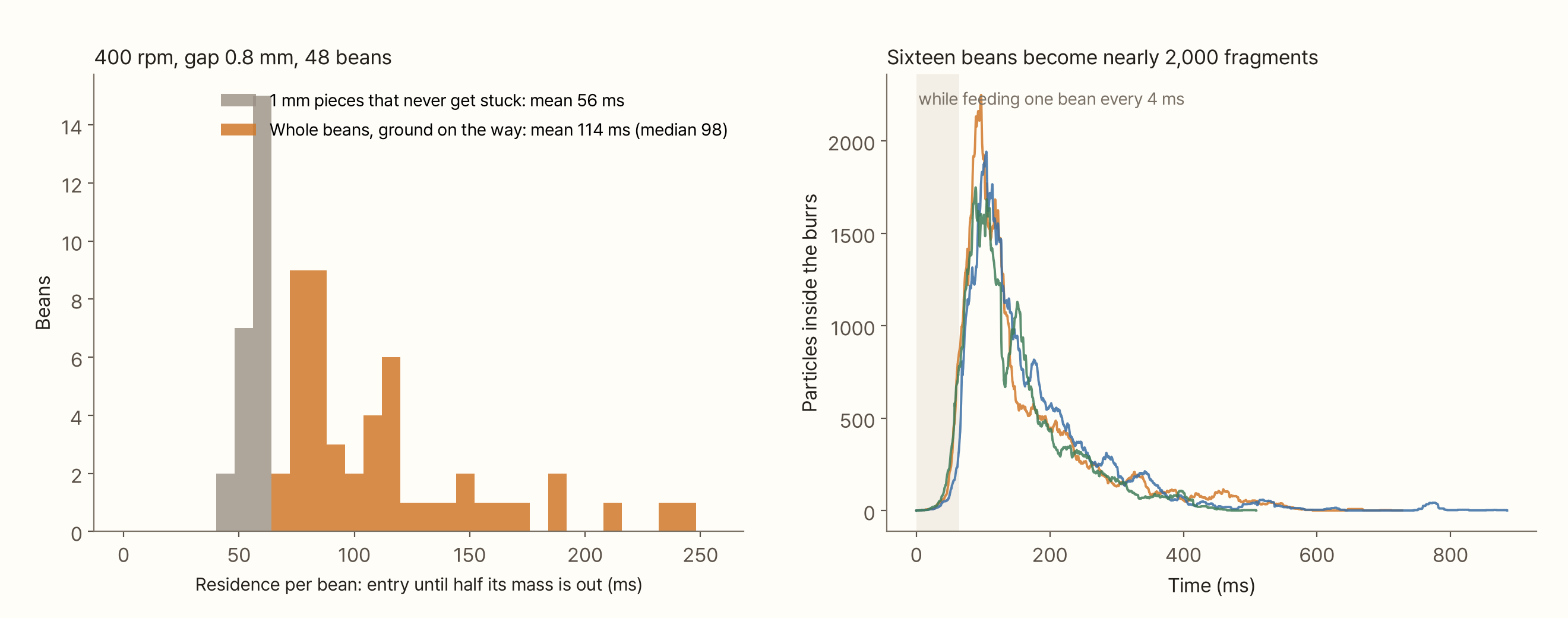
At 400 rpm, the residence time of 48 beans averaged 114 ms with a median of 98 ms. That is the time the burr takes to make 0.76 turns, twice as long as a piece that never gets stuck (56 ms). In the flat burr, beans that were ground on the way took only 14% longer than pieces just passing through. The difference comes from gravity. Unclamped pieces fall quickly thanks to gravity, but a clamped bean has to wait for a tooth to come and break it, however hard gravity pulls. With gravity off, beans stayed for 1.03 turns and unclamped pieces for 0.70 turns, and the gap between them shrinks to 47%.
There were only sixteen beans, but at one point the burrs held nearly 2,000 particles. Putting the Niche Zero's grinding rate (1.5–2.1 g per second) and this residence time into Little's law (amount inside = rate in × time spent) gives 0.2–0.3 g of beans inside the burrs at 330 rpm, a little over two beans. Only the order of magnitude means anything here.
Two clocks
Change the speed and grind whole beans, and the biggest difference from the flat burr shows up.
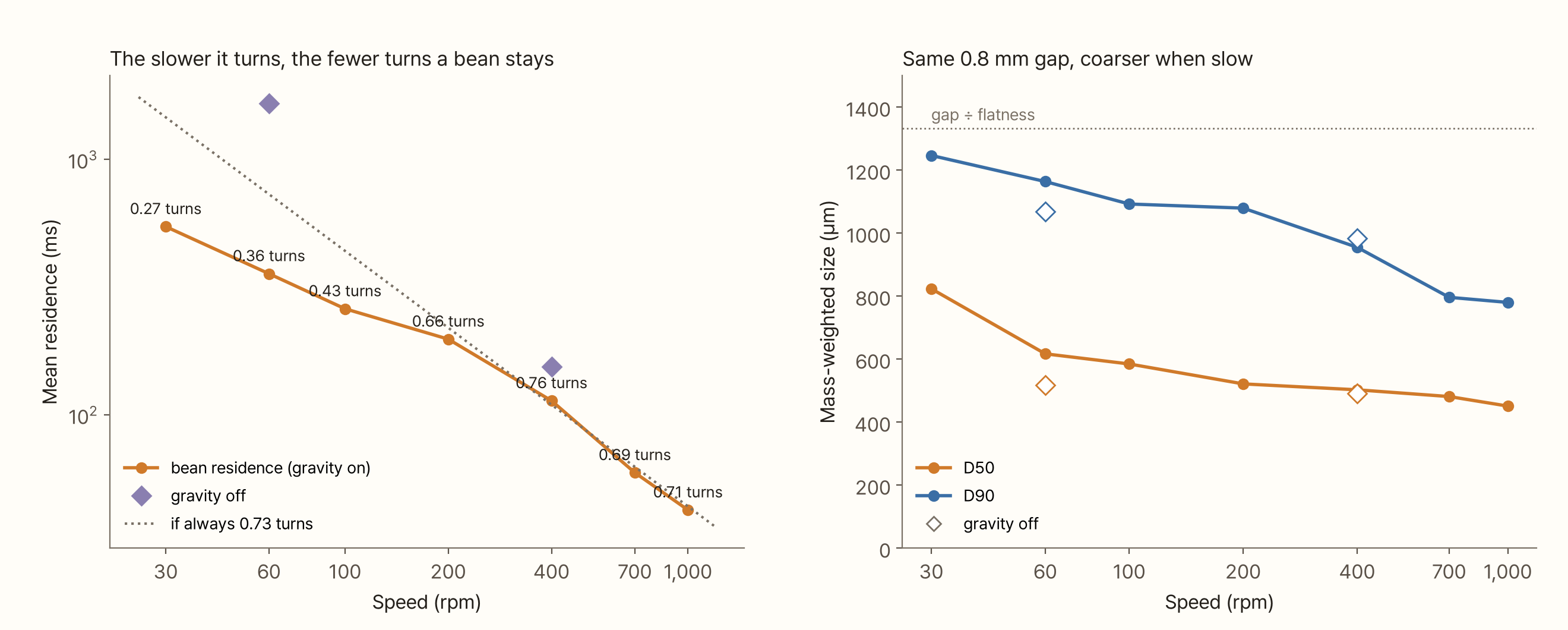
Above 200 rpm, beans stayed for 0.66–0.76 turns, roughly in inverse proportion to speed, like the flat burr last time. Below that, the number of turns fell: 0.43 turns at 100 rpm, 0.36 at 60 rpm and 0.27 at 30 rpm. At 30 rpm that is 545 ms, a third of the time the helix alone would have needed (0.73 turns, 1.5 seconds). Gravity did the rest. Indeed, with gravity switched off at 60 rpm, beans stayed an average of 1.7 turns, or 1.7 seconds, 4.6 times as long as with gravity on.
The flat burr had only one clock. Centrifugal force and the push of the teeth both grow with the square of the speed, so everything was set by "how many turns has the burr made". A conical burr has two clocks: the helix clock (turns) and the gravity clock (milliseconds). Turn fast and the helix clock gets ahead; turn slowly and the gravity clock does.
That difference changed the size of the grounds. At the same 0.8 mm gap, D50 was 450 µm at 1,000 rpm, 500 µm at 400 rpm, 580 µm at 100 rpm and 820 µm at 30 rpm. D90 grew from 780 µm to 1,250 µm. At 30 rpm, D90 sits right up against the size that can slip through the finishing band unbroken (gap ÷ flatness = 1.33 mm). The number of times a bean and its fragments broke also fell, from about 370 at 1,000 rpm to about 100 at 30 rpm. Turn slowly and a piece that has become small enough to pass falls out before the next tooth arrives. Turn fast and the same piece meets a few more teeth before it gets out, and breaks once more. With gravity off at 60 rpm, D50 went from 620 µm back to 520 µm, close to the 400 rpm value. Gravity is what made it coarser.
That is this model's answer. Breakage here is decided only by whether a force crosses a threshold; there is no rule that makes particles break differently depending on how fast they hit. So effects like "faster impacts break things finer" are left out from the start. If such effects exist, speed would change the grind size even more. On the other hand, in a real hand grinder the beans pile up in the hopper and press down from above, so the gravity clock may matter less than in this model, where pieces fall on their own. When Gagné (2023) reanalysed 300 distributions from 24 grinders, comparing grinders with each other showed no clear trend between speed and the shape of the distribution. I could not find any measurement that changed only the speed of one grinder and compared at the same gap.
The gap and the helix angle
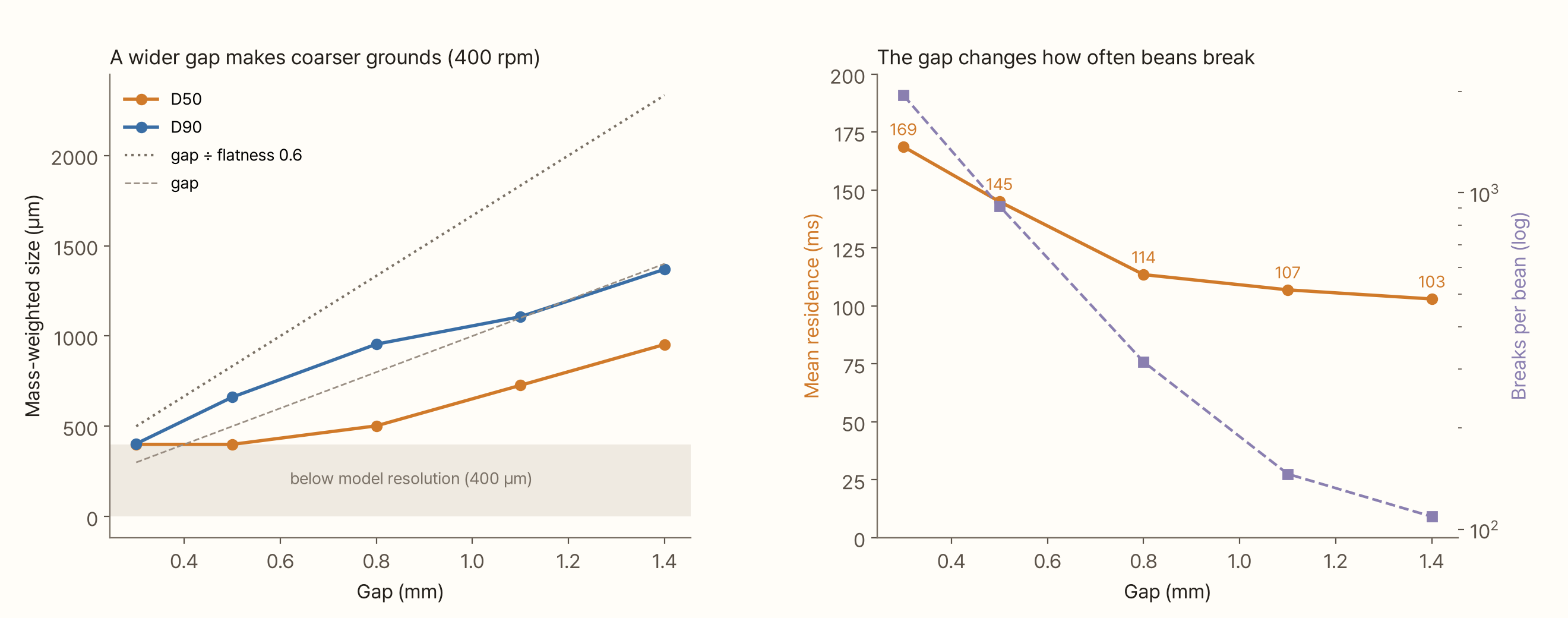
A wider gap made coarser grounds, and D90 ended up close to the gap, just as in the flat burr (D90 1.11 mm at a 1.1 mm gap, 1.37 mm at 1.4 mm). A bean and its fragments broke about 110 times at a 1.4 mm gap, about 310 times at 0.8 mm and about 1,950 times at 0.3 mm. The difference is residence time. In the flat burr, the residence time stayed the same whatever the gap; in the conical burr, closing the gap to 0.3 mm stretched it from 103 ms to 169 ms. In the flat burr, centrifugal force kept pushing beans outward. In the conical burr the force sending beans down is weak, so the time spent waiting to be broken fine adds straight onto the residence time.
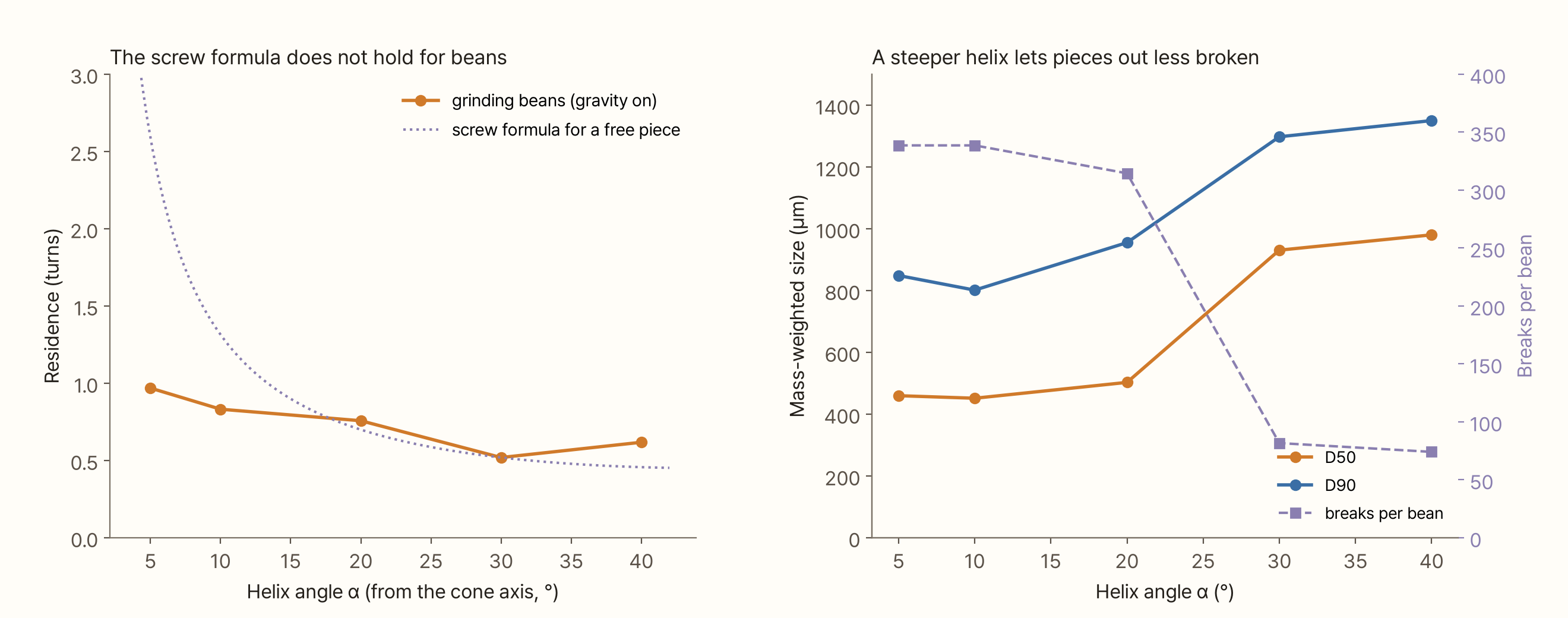
The helix angle did not change the residence time as much as the screw formula predicts. By the formula, a 5° helix should hold a bean for 2.6 turns, but the beans got through in one. When the helix is nearly upright, the cone's teeth and the ring's teeth cross at a small angle, and the point where they meet slides down fast. A piece caught between them is squeezed out downward like a watermelon seed. At 5°, pieces left at an average of 2.8 m/s, nearly three times the speed at 20° (1.0 m/s).
Lay the helix down past 30° and the grounds suddenly got much coarser. D50 jumped from 500 µm to 930 µm, and the number of breaks per bean fell from about 310 to around 80. The beans pass the finishing band less broken. It points the same way as last time, when laying the flat burr's teeth down to +30° doubled D50. It also fits Gagné's (2023) guess that, at the same gap, the shape of the teeth changes the grind. Of course, this is a story about a virtual burr.
Grind it yourself
The simulation below runs the virtual burr above in your browser. The unrolled strip is drawn in two rows of half a turn each, with the same gap cut from the side underneath. You can change the speed, gap, particle flatness, helix angle, number of beans and smallest fragment size, and switch gravity on and off. Let go of a slider and it starts again from the beginning. The red particle is the first bean, and its path is left behind as dots. Press "Riding the cone" to switch to coordinates in which the cone's teeth stand still.
The calculation runs far slower than real time. The time step is around 0.3 µs, so a second on screen is only tens of milliseconds inside the simulation.
Turn the speed down to 60 rpm and switch gravity on and off, and the number of turns a bean stays changes a lot. Stand the helix up at 5° and pieces squirt out; lay it down at 40° and beans leave less broken.
What this conclusion leaves out
- It is an unrolled 2D strip. I unrolled the surface halfway across the gap between cone and ring, and kept the height across the gap only as a number. I ignored the cone widening downward and unrolled it as a cylinder. In reality the circumference grows and the surface moves faster further down
- The burr shape is virtual. I could not find data on the number, shape or helix angle of real conical burr teeth, or on how steeply the gap narrows. The large feed blade at the top (the star-shaped blade in the photo) is also missing
- No beans press down from above. There is no weight of beans piled in the hopper and no uneven speed from turning by hand. I dropped in one bean every 4 ms. In a real grinder, more beans come in as the speed goes up
- Breakage is force-based and damage does not accumulate. There is no rule that makes particles break differently depending on impact speed, so the effect of speed on grind size here contains only the "gravity clock". At every break, 8% was set aside as fines below the resolution, and anything smaller than 400 µm is outside the calculation
- The pieces that jump upward come from the wedge rule. I gave an upward push in proportion to how steeply the gap narrows, and I have not been able to check the size of that force against measurements
- No air, static electricity, heat or bean moisture
- I could not check residence times against measurements. There are none to compare with. With a short narrowing zone (8 mm), particles jammed at the tip of the wedge, so I left that case out of the results
- Bean size and mass are simple. Each bean is a single disc of about 6.5 mm with a height of 0.6 times its diameter
Summary
- In a conical burr, the helix is what carries beans down. With gravity off, pieces that never get stuck always passed in 0.68–0.76 turns at 30–1,500 rpm, matching the screw-conveyor formula (0.70 turns)
- Gravity is a second clock that runs independently of the rotation. Below 200 rpm, pieces fell ahead of the helix and were out in 84–92 ms. Centrifugal acceleration at the burr edge is 0.08 g in a hand grinder and 4–7 g in electric conical grinders, far weaker than in a flat burr (36 g)
- As in the flat burr, breaks bunched where the gap stops narrowing (73%). Lengthening the narrowing zone from 12 to 24 mm spread the breaks a little but left the grind size unchanged
- At 400 rpm, a bean's residence time averaged 114 ms (0.76 turns), twice that of pieces that never get stuck. A clamped bean gets no help from gravity
- Below 200 rpm, beans stayed for fewer turns (0.27 turns at 30 rpm) and the grounds came out coarser at the same 0.8 mm gap (D50 450 → 820 µm). With gravity off at 60 rpm, the size came back close to the 400 rpm value
- Laying the helix down past 30° let beans out less broken and nearly doubled D50. No study has yet measured how beans move inside a conical burr. The numbers above are model estimates from a virtual burr
References
- Gupta R, Nott PR (2021). Analysis of the flow of granular materials through a screw conveyor. arXiv 2111.13396. arXiv — axial speed in a screw conveyor and the role of friction at the outer tube
- Roberts AW (1999). The influence of granular vortex motion on the volumetric performance of enclosed screw conveyors. Powder Technology 104(1), 56–67. doi:10.1016/S0032-5910(99)00039-X00039-X) — bibliographic details only
- Deng X, Scicolone J, Han X, Davé RN (2015). Discrete element method simulation of a conical screen mill: A continuous dry coating device. Chemical Engineering Science 125, 58–74. doi:10.1016/j.ces.2014.08.051 — abstract only; DEM residence time in a conical screen mill
- Gagné J (2023). What I learned from analyzing 300 particle size distributions for 24 espresso grinders. Coffee ad Astra. link
- Nedomová Š, Trnka J, Stoklasová P, Buchar J (2013). Strength of coffee beans under static and dynamic loading. Acta Universitatis Agriculturae et Silviculturae Mendelianae Brunensis 61(3), 743–749. doi:10.11118/actaun201361030743
- Cundall PA, Strack ODL (1979). A discrete numerical model for granular assemblies. Géotechnique 29(1), 47–65. doi:10.1680/geot.1979.29.1.47
- Grinder specifications: Niche Zero 63 mm, about 330 rpm, 1.5–2.1 g per second (Daily Coffee News, 22 August 2017); Mazzer Robur S 71 mm, 420 rpm (50 Hz) / 500 rpm (60 Hz), 5–6 g per second (summary of the manufacturer's product page); Baratza Encore 40 mm, about 450 rpm under load and 550 rpm unloaded (retailer and manufacturer figures differ); Comandante C40 39 mm (hand grinder). The speed at which people turn a hand grinder (a little more than once a second) has weak measurement support
Image credits
- Conical burr seen from above: Hustvedt, Wikimedia Commons, CC BY-SA 3.0
- Strobridge coffee mill section: US Patent 159,467 (1875), Wikimedia Commons, public domain, cropped to the section drawing
- Luther coffee mill patent drawing: US Patent 3,215 (1843), Wikimedia Commons, public domain
- All other charts, the cover and the simulation: made by me


