Where a KRW 300,000 Concert Ticket Goes
In 2026, the year BTS returned as a full group, HYBE set another quarterly record in Q3 with revenue of KRW 1.5257 trillion and operating profit of KRW 188.5 billion. Yet its gross margin that quarter was 30.3%, 12 points below the album-heavy first quarter (42.8%). This episode of Wide and Shallow Economics covers Korea's four listed K-pop agencies, HYBE, SM, JYP and YG. It sums up their results through Q3 2026 in one table and explains why margins thin as concerts grow, splitting the cost of a show into venue rent, stage production, crew and the artist's settlement. The accounting concept is revenue mix and gross margin, and how a single mega tour can swing a quarter. In the playground you can change seats, ticket prices, number of shows, costs and the settlement rate for a 65,000-seat stadium show and work out the agency's share. The episode also covers the rebound in album sales, military gaps and rookie groups, HYBE's litigation with former ADOR CEO Min Hee-jin, Kakao's ownership of SM, and China's informal ban on K-pop. It ends with five predictions to be scored against results filed in February 2027.
On concert days the lines outside the stadium start hours before the doors open. There are two of them. One is for getting in. The other is for merchandise. People walking back to the subway with light sticks and T-shirts in their arms have become an ordinary weekend sight in Seoul. A ticket costs well over KRW 200,000, and with merchandise one fan can easily spend more than KRW 300,000 in an evening.
Where does that money go? To whoever owns the stadium, the company that builds the stage, security and crew, the ticketing site, the artists, and the agency. The eighth industry in Wide and Shallow Economics is the K-pop agency. I follow the four listed ones: HYBE, SM Entertainment, JYP Entertainment and YG Entertainment.
First, the timing. Today is November 12, 2026. All four have filed preliminary results for the third quarter (July to September): HYBE on November 3, SM on the 4th, YG on the 9th and JYP on the 11th. Preliminary figures have not yet been reviewed by auditors and may shift a little. Nobody knows the fourth quarter yet. Every number below carries its year and quarter.
Three numbers for the quarter
KRW 285.4 billion. That is the combined Q3 2026 operating profit of the four agencies, nearly four times the KRW 77.9 billion of a year earlier (as tallied by the Financial News). Almost all of the increase belongs to one company. HYBE swung from a KRW 42.2 billion operating loss to a KRW 188.5 billion profit, while the other three together earned 19.3% less than a year before. Same industry, and one company set records while two went backward. That split is what this episode is about.
47.6%. That is the share of HYBE's Q3 revenue that came from concerts. Concert revenue of KRW 726.8 billion was three times the KRW 245 billion of a year earlier and a quarterly record. BTS released its fifth studio album, Arirang, in March 2026 and has been on a world tour of the same name since April. Merchandise and licensing also hit a quarterly record at KRW 334.6 billion. Album and streaming revenue fell 13.5% from the second quarter to KRW 282.8 billion. HYBE's revenue now looks more like a concert company's than a record label's.
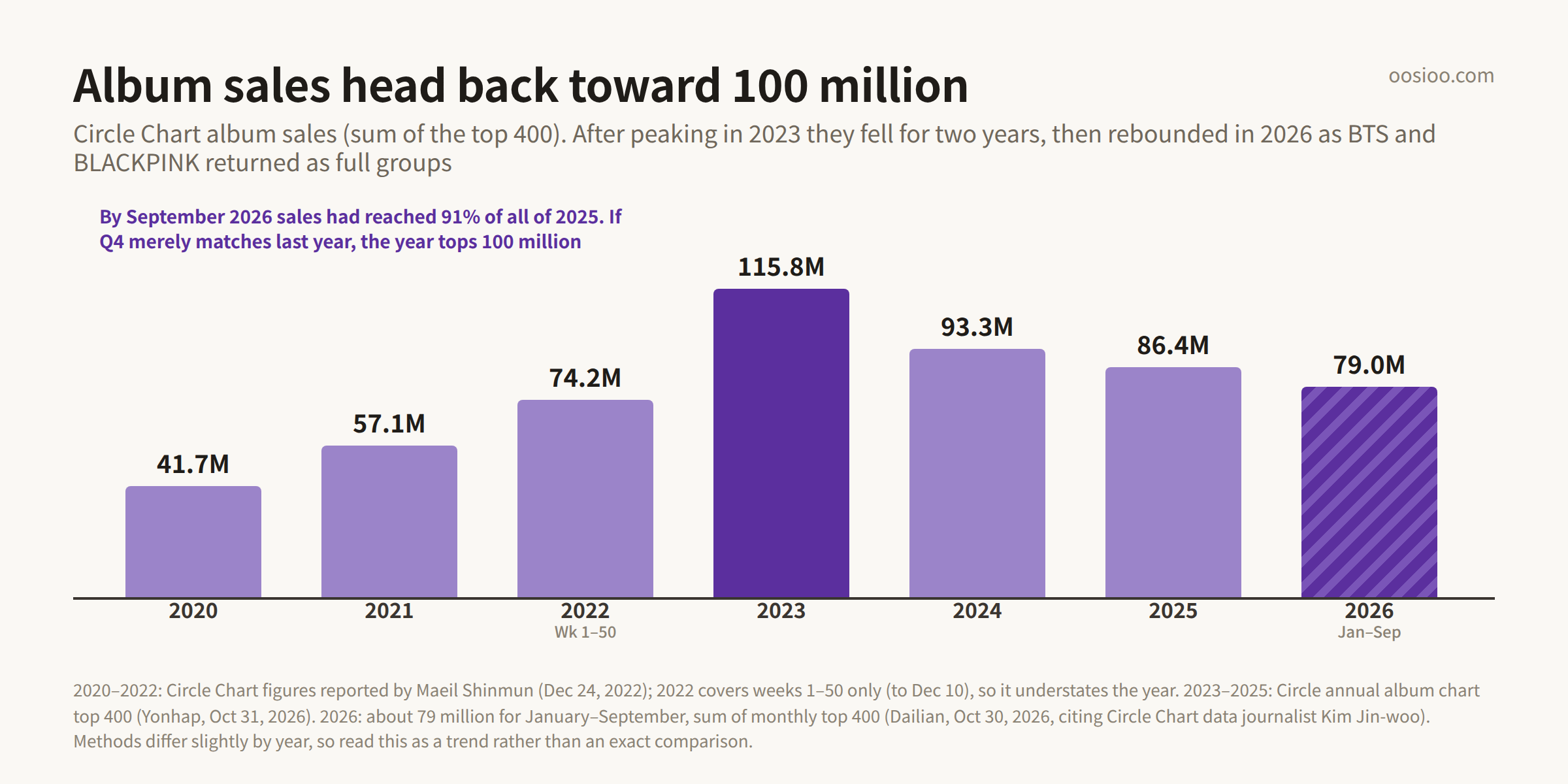
79 million. That is roughly how many albums sold in Korea from January to September 2026 by Circle Chart's count (Korea's official music chart, summing the monthly top 400). Dailian, citing Circle Chart data journalist Kim Jin-woo, puts it 7.6 million above the same period a year earlier. The album market peaked at 115.77 million in 2023, then fell two years running to 93.28 million in 2024 and 86.38 million in 2025 (Circle annual top 400, as reported by Yonhap). By September, 2026 had already sold 91% of 2025's full-year total. Kim expects that if the fourth quarter simply matches last year, sales will top 100 million for the first time in three years.
Here are the four report cards for the third quarter.
| Q3 2026 (consolidated, preliminary) | HYBE | SM | JYP | YG |
|---|---|---|---|---|
| Revenue | KRW 1,525.7bn | KRW 291.1bn | KRW 267.5bn | KRW 156.7bn |
| Change from a year earlier | +109.8% | −9.5% | +15.0% | −9.4% |
| Operating profit | KRW 188.5bn | KRW 35.5bn | KRW 48.0bn | KRW 13.5bn |
| Change from a year earlier | Back to profit (KRW −42.2bn a year earlier) | −26.4% | +17.6% | −56.8% |
| Operating margin | 12.4% | 12.2% | 17.9% | 8.6% |
| Revenue, Q1–Q3 | KRW 3,674.0bn | KRW 919.8bn | KRW 636.6bn (sum of quarters) | KRW 431.6bn |
| Operating profit, Q1–Q3 | KRW 162.9bn | KRW 126.9bn | about KRW 112.4bn (sum of quarters) | KRW 43.8bn |
| What moved the quarter | BTS world tour (concerts KRW 726.8bn) | New releases sold 1.67m copies (5.5m a year earlier) | Stray Kids albums and merch; concerts −31.1% | Costs of BIGBANG's tour; BLACKPINK tour in the base |
A few notes. HYBE's nine-month operating profit is smaller than its third quarter alone because it lost KRW 196.6 billion in the first quarter. Chairman Bang Si-hyuk gave the company shares for free, the company handed them out to employees, and KRW 255 billion of share-based compensation was booked as an expense in one go. HYBE says its adjusted operating profit for the first nine months, excluding that charge, was KRW 417.9 billion. No cash left the company, but the income statement still records the cost.
HYBE's Q3 net profit was only KRW 11.3 billion. With KRW 188.5 billion of operating profit, the gap came from KRW 148.2 billion of non-operating expenses. As the won strengthened against the dollar, dollar assets held abroad were worth fewer won (Money Today). SM booked a KRW 1.1 billion net loss for the same reason. The more an agency earns overseas, the more a strong won eats into net profit.
JYP beat expectations on both revenue and operating profit, coming in 19% above the Yonhap Infomax consensus of KRW 40.2 billion. The next day, November 12, JYP shares jumped 16.54%, and HYBE, SM and YG rose 5 to 6%. Look inside JYP's quarter, though, and concert revenue fell 31.1% to KRW 43.6 billion because there were fewer shows. Overseas sales of Stray Kids' August mini album THIS & THAT lifted album revenue 18.2%, and light sticks and character goods lifted merchandise 46.7%. Event appearance fees rose 138.4% to KRW 26.4 billion. Other revenue filled the space concerts left empty.
SM and YG went the other way, held back by a high base from a year earlier. Album and streaming revenue at SM's parent company fell 51.3% to KRW 47.1 billion, and SM's new releases sold 1.67 million copies in the quarter, less than a third of the 5.5 million a year before. YG made KRW 50.8 billion from concerts in Q3 2025 thanks to BLACKPINK's world tour. This year BIGBANG began its first solo tour in nine years in August, but venue costs, sales commissions and freight for the American and European shows were booked first. Analysts expect profit to recover in the fourth quarter as the tour moves to Southeast Asia and Japan, where venues are cheaper (Hana Securities, as cited by the Financial News).
Where the money in this business comes from
Four drawers
A K-pop agency's revenue sits in four drawers. The labels vary by company but the structure is the same.
- Albums and streaming. Physical album sales and streaming royalties.
- Concerts. Tickets for concerts and fan meetings, and passes for online concerts.
- Merchandise and licensing. Light sticks, clothes, photo cards, character goods, and fees other companies pay to use an artist or character.
- Management and other. Advertising fees, TV and event appearances, fan club memberships, video content.
HYBE calls the first two drawers "direct participation" revenue and the rest "indirect participation." The distinction is between money that only appears when an artist performs or records, and money that comes from the artist's name and image alone. Of HYBE's KRW 1,525.7 billion in Q3 revenue, KRW 1,075.3 billion (70%) was direct and KRW 450.4 billion indirect.
The distinction matters because of artist dependence. Direct revenue stops the moment an artist stops. Military service, an expiring contract or a rest between tours can leave a quarter empty. Indirect revenue swings less. Light sticks and character goods sell without a concert, and fan club fees arrive once a year. Agencies have spent years building merchandise, licensing and fan platforms because they want revenue that is less hostage to artists' calendars.
Gross margin: each drawer keeps a different amount
Subtract the direct cost of producing revenue (cost of sales) from revenue and you get gross profit. Divide that by revenue and you get the gross margin: how many won are left from every 100 won of sales after paying for the goods or the service. Subtract selling, general and administrative expenses (SG&A) such as office rent, head-office salaries and advertising, and you reach operating profit.
What goes into a K-pop agency's cost of sales? For albums, manufacturing, photo-card printing, distribution fees and the settlement paid to artists. For concerts, venue rent, stage production, sound, lighting and video equipment, security and on-site crew, freight, and again the artists' settlement. Concerts carry far heavier physical costs than albums. You rent a 60,000-seat stadium for more than a week, ship tens of tons of stage equipment between continents and pay hundreds of crew.
So 100 million won of concert revenue leaves less gross profit than 100 million won of album revenue. None of the four discloses gross profit by segment (as far as I could find in their filings and IR materials). But you can watch the company-wide gross margin move with the revenue mix quarter by quarter.
Take HYBE's 2026. Calculated from the quarterly income statements filed with DART (Korea's corporate disclosure system), gross margin moved like this.
| HYBE | Q1 | Q2 | Q3 |
|---|---|---|---|
| Revenue | KRW 698.3bn | KRW 1,450.0bn | KRW 1,525.7bn |
| What was big | Arirang released (albums and streaming KRW 271.5bn) | Tour begins (concerts KRW 647.7bn) | Tour in full swing (concerts KRW 726.8bn) |
| Gross margin | 42.8% | 31.8% | 30.3% |
| Operating margin | Loss (share-based compensation) | 11.8% | 12.4% |
In the album-heavy first quarter, about 43 won of every 100 won of sales was left. Once the tour started it fell to 31, then 30. Analysts likewise pointed to the growing share of concerts as the reason gross margin fell (Financial News, November 12). In the third quarter cost of sales rose KRW 74.1 billion from the second quarter to KRW 1,062.7 billion, while gross profit rose by only KRW 1.6 billion (Financial News).
Yet operating margin went up. SG&A fell KRW 16 billion from the second quarter to KRW 274.5 billion. HYBE said it cut costs by manufacturing merchandise locally in North America and reworking logistics. Much of SG&A is head-office staff and offices, which do not double when revenue doubles, so as revenue grows SG&A shrinks as a share of it. A rising cost ratio pushed one way and a falling SG&A ratio pushed the other, and in the third quarter the second force won by a little. On the earnings call HYBE's chief financial officer stressed that the company held a 12.4% margin despite unfavorable exchange rates, fewer album releases and a heavier mix of large concerts.
The third quarter a year earlier is the counterexample. HYBE's gross margin in Q3 2025 was even lower at 27.7%, and it posted a KRW 42.2 billion operating loss. Concerts had grown as a share of revenue, and on top of that came early investment in new artists and one-off costs from restructuring its North American business. The company said the North American restructuring alone took about six percentage points off its operating margin (News Tomato). Even with the same revenue mix, profit depends heavily on what other costs land in the same quarter.
The cost structure of one show
Let me break concert costs down further. Agencies do not publish the profit and loss of individual shows, so brokerages build models to estimate them. In "BTSnomics 2.0," a report published on March 17, 2026, just before the BTS comeback, IBK Securities assumed the following for a 65,000-seat stadium show.
- An average ticket price of KRW 300,000. Korean list prices ran from KRW 198,000 to 264,000 and Japanese from KRW 235,000 to 423,000; North American and European prices were estimated at KRW 216,000 up to a top of KRW 600,000, and the whole was weighted. That is 60% above the roughly KRW 190,000 of the previous tour (2021–2022).
- Stage production equal to 30% of one show's revenue. This tour puts the stage in the middle of the stadium, visible from every side, so the report set the stage cost ratio at 1.7 times that of an ordinary end-stage show. However many shows play in a city, the stage is built once.
- Venue rent for the show days plus six. The stadium has to be rented for the days the stage goes up and rehearsals run.
- Operating costs of 5% of revenue. Crew, security, freight and the like.
- Artist settlement of 80% of the settled amount. The artist and the agency split what is left of revenue after the costs above. Because this is BTS's third contract, the report gave the artists a high share and called its own assumption "quite conservative."
Here is what those assumptions produce.
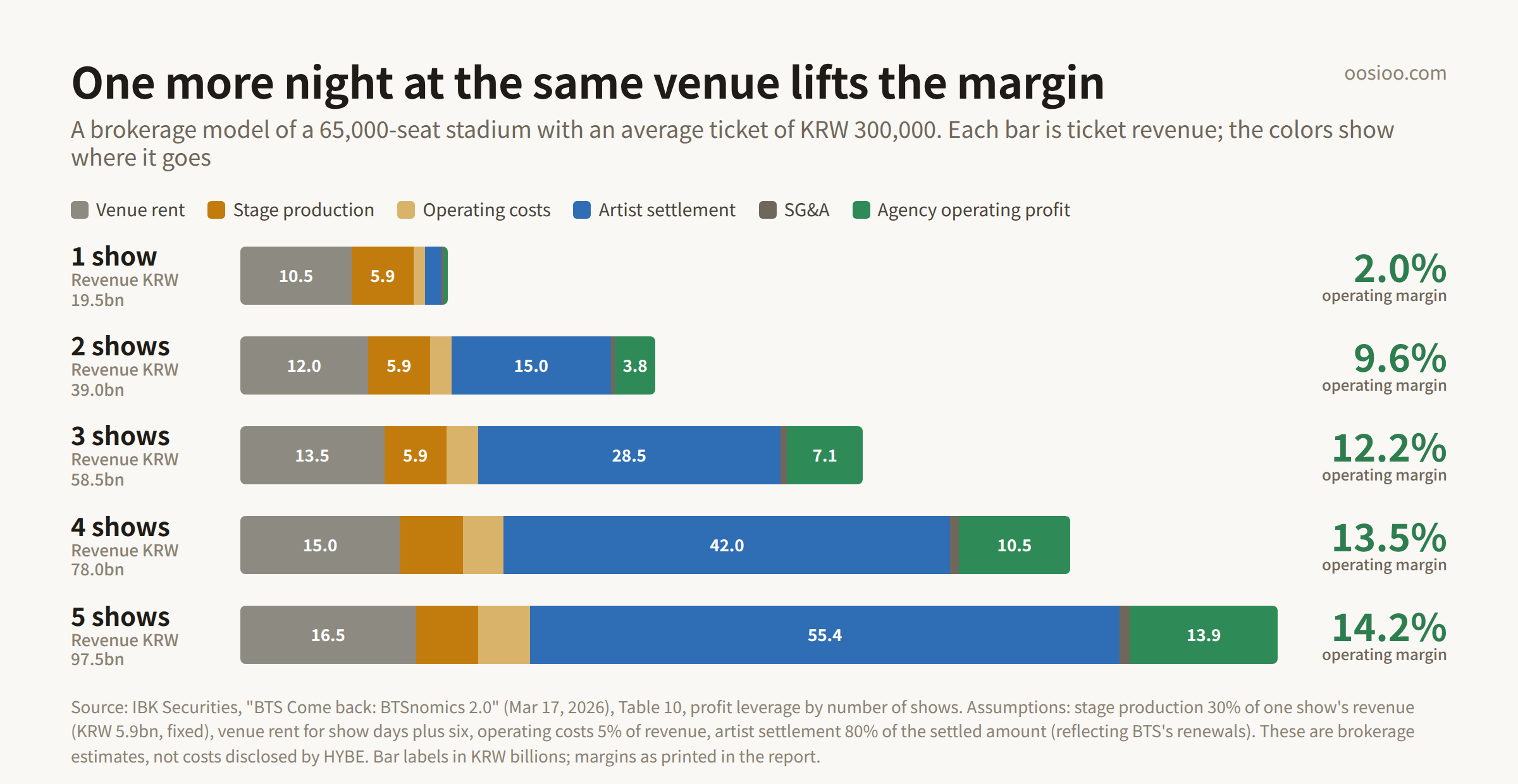
Play just once and rent (seven days, KRW 10.5 billion) plus the stage (KRW 5.9 billion) eat most of the KRW 19.5 billion in tickets, leaving a 2% operating margin. Two nights at the same stadium give 9.6%, four give 13.5%. The stage and the setup-day rent are paid once; each extra show adds only one more day of rent. The more shows you spread fixed costs over, the lighter each one becomes. It is the same arithmetic as dividing a chicken shop's rent by the number of chickens sold a day in episode one.
The report puts the average margin on stadium shows at around 20% and says it set BTS lower, at 12%, because of the 80% settlement and conservative rent. These are not HYBE's actual costs, and the company has not published them. But they give a rough sense of why gross margin falls as concert revenue grows, and by how much.
How a one-off mega tour shakes a quarter
Now the split among the four agencies in Q3 is easier to read. A big world tour leaves its mark on quarterly results in three ways.
First, revenue piles up in particular quarters. Concert revenue is recognized on the day of the show. Tickets sold in advance sit on the balance sheet as advances received until then. When BTS's North American and European stadium shows cluster in the second and third quarters, revenue soars in those quarters and drops away when the tour ends. That is what BLACKPINK's tour did to YG in Q3 2025, and it is why YG's Q3 2026 looks smaller year on year.
Second, costs can arrive before revenue. Stage production and tour preparation are paid before the first show. YG's third quarter booked the early operating costs and sales commissions of BIGBANG's tour, plus about KRW 2 billion of bad-debt expense on a subsidiary's merchandise receivables (Samsung Securities, as cited by Alpha Economy). Operating profit fell 56.8% year on year.
Third, the shift in mix lowers margins. That is the fall in HYBE's gross margin we just saw. In a big tour quarter, revenue grows and the cost ratio rises with it.
So "year on year" alone says little about an agency's quarter. Who toured in that quarter last year, and who released an album this year, can change the numbers enormously. That is why analysts start their agency forecasts by drawing each artist's activity calendar.
Playground: split two stadium shows yourself
The calculator below works out the profit and loss of one tour city. Set seats, share of seats sold, average ticket price and number of shows to get ticket revenue. Subtract stage production, venue rent and operating costs, give the artist their settlement rate, and what is left is the agency's share. Add merchandise spend per attendee and a merchandise margin to include what the goods line brings in.
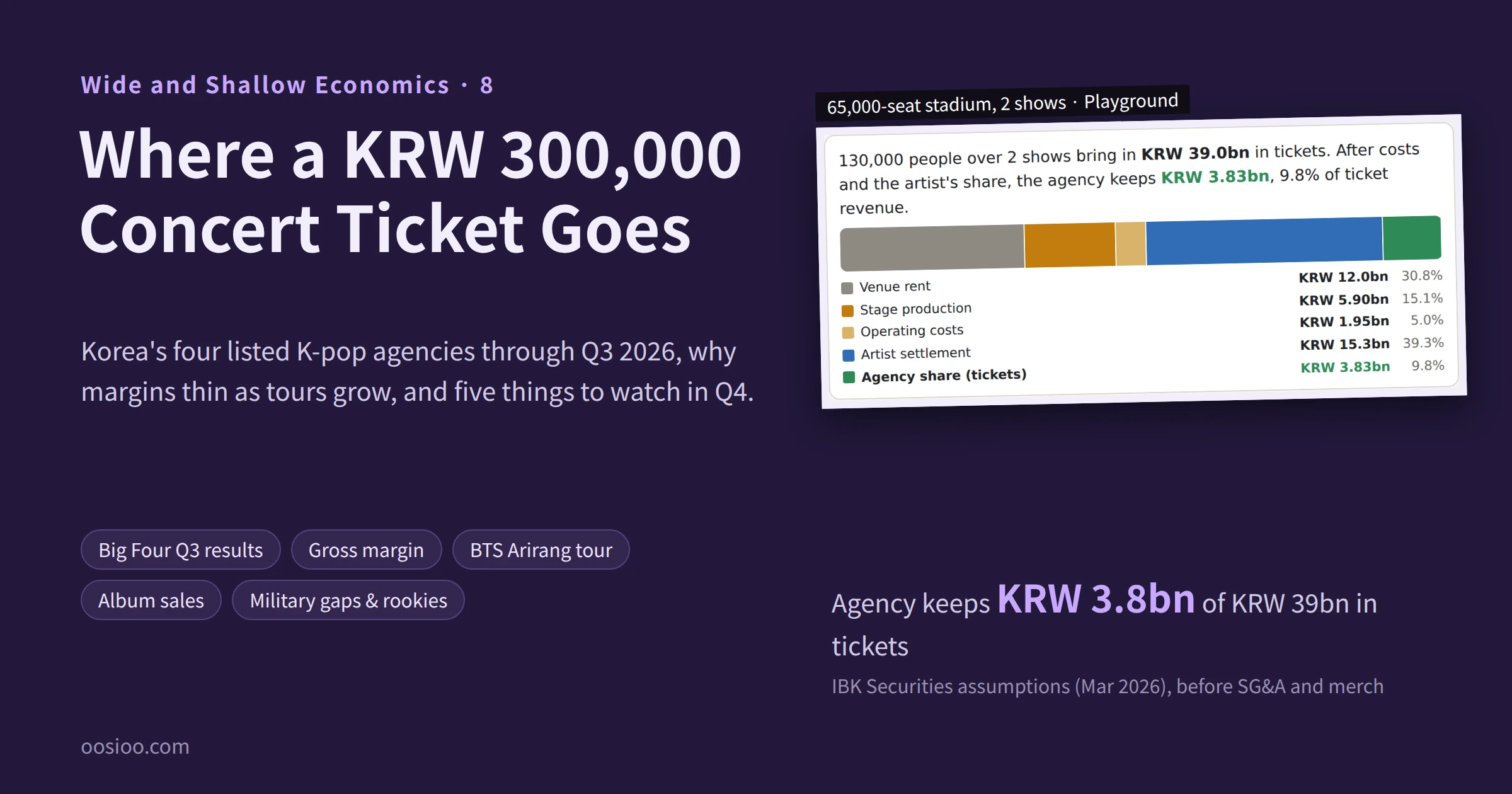
The defaults are IBK's two shows at a 65,000-seat stadium. 130,000 people pay KRW 300,000 each, for KRW 39.0 billion in tickets. Take away KRW 12.0 billion of rent (eight days), KRW 5.9 billion for the stage and KRW 1.95 billion of operating costs and KRW 19.15 billion remains. Eighty percent of that, KRW 15.3 billion, goes to the artists and KRW 3.83 billion stays with the agency: 9.8% of ticket revenue. It is a little higher than the report's 9.6% because the calculator leaves out SG&A.
Merchandise changes the picture. If each attendee spends KRW 140,000 on goods (the report's assumption, online sales included), merchandise revenue is KRW 18.2 billion, and a 15% margin adds KRW 2.73 billion. The agency's share becomes KRW 6.56 billion, 11.5% of the KRW 57.2 billion in tickets and merchandise combined. That second line outside the stadium, the merch line, matters to the agency.
Try changing a few things.
Press "Same venue, 4 shows" and revenue doubles to KRW 78.0 billion while the agency's share nearly triples to KRW 10.6 billion, a 13.6% margin. The bars below climb from 2.2% for one show to 14.9% for six. When BTS played four nights each in Las Vegas and Los Angeles, demand was part of it, and so was this arithmetic.
Now drop the settlement rate from 80% to 50%. On the same two shows the agency's share jumps from KRW 3.8 billion to KRW 9.6 billion. Settlement rates differ by artist and by contract year, and agencies do not disclose them. In one idol group's settlement statement examined by the outlet Bizhankook, the contract split was 70/30 for the first five years and 60/40 afterwards. Rookies leave the agency a bigger share but play smaller rooms; big groups that have renewed several times play huge venues but leave the agency less. Slide the settlement rate and you can see why K-pop agencies have to keep producing new groups.
"Arena, 2 shows" uses my own assumptions with no source: a 12,000-seat indoor arena, 90% sold, an average ticket of KRW 150,000, a KRW 1 billion stage, KRW 150 million a day in rent and a 50% settlement. Revenue is KRW 3.24 billion, a twelfth of the stadium case, but the margin is higher at 22.8% because the stage and rent are small and the settlement rate is low. In absolute terms it is a fifth of the stadium's two nights. It is there to compare structures, not to stand for real figures.
What the calculator leaves out: SG&A, sponsorship income (the report assumes 10% of ticket revenue), ticketing fees, exchange rates and tax. The KRW 1.5 billion daily rent is not stated in the report; I backed it out of the report's table (KRW 10.5 billion for one show, seven days). Real rents vary by venue and are not disclosed.
Five threads from the quarter
BTS returns, and the Arirang tour
The last BTS members finished their military service in June 2025. Arirang, the group's fifth studio album, came out on March 20, 2026 and sold 3.98 million copies on its first day and 4,169,464 in its first week by Hanteo Chart's count. It was the first time BTS had passed four million in a first week. In Circle Chart's half-year tally Arirang sold more than 4.2 million copies, and 22 BTS albums together took 10.2% of top-400 album sales. That album is why HYBE's first-quarter album and streaming revenue doubled to KRW 271.5 billion.
The next day, March 21, BTS played a free show, "BTS Comeback Live: Arirang," in Gwanghwamun Square in central Seoul. About 22,000 people had official spots, and Netflix streamed it live to some 190 countries. The world tour opened on April 9 at Goyang Stadium. When announced in January it was 79 shows in 34 cities; dates added in the Americas, Australia and elsewhere have taken it past 80 (counts range from 85 to 88 depending on the source), and it ends in the Philippines in March 2027. The 132,000 seats for the three Goyang shows sold out as booking opened. IBK Securities expects about 6 million attendees across the tour, roughly 4.7 million of them in 2026.
In its Q3 results HYBE said about 1 million people visited its merchandise stands during BTS's 45 days in North America and bought about 2 million items (SBS Biz). There is no plan yet for after the tour. HYBE says only that it is discussing group and solo activities once the tour ends. The empty second half of 2027 on the BTS calendar is the biggest question mark in HYBE's outlook.
Military gaps and renewals: where the next hole opens
The industry calls the stretch when male idols serve in the military gunbaekgi, a blend of "military" and "hiatus." HYBE's 2023 to 2025 was the BTS gap, and newer groups carried HYBE's revenue in the meantime. Now the gap is moving to other agencies.
Stray Kids, JYP's largest source of revenue, were the top-selling act on Circle Chart in 2025 with about 6.98 million albums (through the second week of December). But reports say the enlistment of Lee Know, the oldest of the group's Korean members, is approaching (Star News, September 2026), and Yuanta Securities expects a gap from the second half of 2027 (as cited by Sports Kyunghyang). A 2027 world tour comes first; Hana Securities expects about 46 shows in Japan, North America and Europe.
TWICE has a contract question. Member Jeongyeon announced on August 10, 2026 that she had left JYP and signed with another agency. The group as a whole remains with JYP and is reportedly negotiating a second renewal. Citing uncertainty over when the full group returns and how big its next world tour can be, analysts cut their price targets for JYP one after another in August. That is why a fourth-quarter profit decline is expected even after JYP's surprise third quarter.
Rookies: the groups meant to fill the gap
HYBE's CORTIS is a five-member boy group that debuted in August 2025. Its debut album has sold 2.15 million copies on Circle Chart, and its 2026 second mini album GREENGREEN sold about 3.1 million by mid-July (Segye Ilbo). Passing three million with a second album in the group's second year is rare. KATSEYE, the girl group HYBE formed in the United States, starts an 11-city arena tour including Seoul in January 2027.
SM has been releasing pre-debut content for a new boy group but has not announced a debut date; Hearts2Hearts, which debuted in 2025, has a single coming in the fourth quarter. YG's BABYMONSTER is on its second world tour, and Samsung Securities expects YG's next boy and girl groups in 2027. JYP has NMIXX, KickFlip and NEXZ, but analysts say they have not yet proven themselves in big concerts and merchandise.
The settlement-rate slider makes the point plain. A big group that has renewed brings in large revenue but leaves less for the agency. A rookie costs money for its first few years, then, if it takes off, produces revenue the agency keeps more of. HYBE itself cited early investment in debuting artists as one reason its 2025 operating profit (KRW 49.9 billion) fell 72.9%.
HYBE and former ADOR CEO Min Hee-jin
The dispute between HYBE and Min Hee-jin, former chief executive of its subsidiary ADOR, began in April 2024. What remains in court is money. Min exercised a put option, the right under a shareholders' agreement to require HYBE to buy her ADOR shares; HYBE argued the agreement had already been terminated.
On February 12, 2026, Civil Division 31 of the Seoul Central District Court rejected HYBE's claim that the agreement was terminated and ordered HYBE to pay Min about KRW 25.5 billion. HYBE appealed and deposited KRW 29.25 billion with the court to suspend enforcement. The first appeal hearings at the Seoul High Court are in December (Tenasia reports December 9 for the share-price claim and December 17 for the termination claim). The case is not final.
In the separate dispute over NewJeans' exclusive contracts, a first-instance court ruled on October 30, 2025 that the contracts were valid, and the ruling became final when the members did not appeal. Some members have returned to ADOR, and ADOR has filed a separate damages suit against Min and others, which is ongoing. In accounting terms, the first-instance award sits within the amount HYBE has already deposited, but the appeal will decide when and how much reaches the income statement.
Kakao's SM, and China
SM ended up with Kakao after a fight for control in 2023. HYBE bought founder Lee Soo-man's stake and tried to become the largest shareholder, but in March Kakao and Kakao Entertainment secured 39.87% through a tender offer and took that position. At the end of March 2026 Kakao held 21.61% and Kakao Entertainment 19.89%, or 41.81% including related parties. HYBE sold its remaining SM shares to Tencent Music Entertainment (TME) in May 2025 (just over 9% by press accounts), making TME the de facto second-largest shareholder.
The acquisition is still in court. Kakao founder Kim Beom-su was indicted on charges of manipulating SM's share price in February 2023 to block HYBE's tender offer. He was acquitted at first instance, and prosecutors sought 15 years in prison on appeal. The Seoul High Court is scheduled to rule on November 20. Kakao will put a plan to split the company in two before an extraordinary shareholders' meeting on December 17. The ruling could change the direction of talk about SM's ownership.
China is still closed. Since South Korea deployed the THAAD missile-defense system in 2016, large concerts by Korean idols have effectively not taken place in mainland China, an informal ban known in Korea as hanhallyeong. Beijing has never officially acknowledged that the ban exists. Hopes rose in April 2025 when the city of Fuzhou approved a solo show by the boy group EPEX, and in December 2025 there were reports that the government had asked the four big agencies about concert dates in China, but the presidential office said nothing had been decided. The BTS Arirang tour lists no mainland dates, only Hong Kong (three shows at Kai Tak Stadium in March 2027). In what I could find, no large concert by any of the four agencies' artists took place on the mainland through November 2026.
SM has chosen a detour. With TME it set up a joint venture in Beijing, STE, and plans to debut a Chinese idol group within two to three years (MTN, August 2026). It says it has no immediate plans to support Korean artists' activities in China. It is preparing on two tracks: move quickly if the ban lifts, and enter the market through a local group if it does not.
Three companies with interesting strategies
HYBE: a record label that became a concert company
In 2025 HYBE staged 279 shows (250 concerts and 29 fan meetings) and earned KRW 763.9 billion from concerts, almost exactly matching its album and streaming revenue (KRW 772.9 billion). Billboard ranked it the world's fourth-largest promoter for 2025 (as cited by Herald Economy). In other words, it rents the venues and sells the tickets itself instead of handing that job to someone else. In the second and third quarters of 2026 concerts made up nearly half its revenue.
What comes next is the interesting part. HYBE cut SG&A by making merchandise locally in North America and changing its logistics. It is growing Weverse, its fan platform, to sell fan club memberships and online concerts inside its own app; monthly users reached 14.22 million in the third quarter. The picture is of a company trimming costs elsewhere and growing higher-margin indirect revenue to offset what concerts do to its cost ratio. What replaces concert revenue after BTS finishes touring in the first half of 2027 remains unanswered.
SM: albums halved, merchandise held
Revenue at SM's parent company fell 22.8% year on year in the third quarter. Albums and streaming (KRW 47.1 billion) lost more than half, and concerts (KRW 34.5 billion) fell 34.2%. Merchandise and licensing, however, rose 23.5% to KRW 62.1 billion and became the parent's largest revenue line. Artist appearance fees rose 21.3% to KRW 29.2 billion. These are drawers SM has built to carry it through quarters with few comebacks.
SM's other distinctive feature is its subsidiaries. Dear U, which runs Bubble, a subscription service for messages between fans and artists, made KRW 22.8 billion in revenue and KRW 9.2 billion in operating profit in the quarter, with 1.97 million subscriptions. But Dear U booked an impairment on minimum guarantees it had prepaid and posted a KRW 7.4 billion net loss, one of the reasons for SM's consolidated net loss. SM has announced eight new releases for the fourth quarter, including studio albums from Yesung, Taeyeon and NCT DREAM, and a RIIZE studio album for Q1 2027. Overseas tours by aespa, NCT DREAM and NCT WISH ramp up from the fourth quarter.
JYP: filling a quarter without concerts from other drawers
JYP's concert revenue fell 31.1% in the third quarter, yet operating profit rose 17.6%. Albums (KRW 79.2 billion), streaming (KRW 19.8 billion), merchandise (KRW 58.6 billion), event appearances (KRW 26.4 billion) and advertising (KRW 16.0 billion) all grew. Stray Kids drove merchandise through online fan-meeting goods, light sticks, character products and pop-up stores, and a festival appearance in South America in September showed up in event revenue. Domestic revenue (KRW 131.1 billion) rose 29.5%.
This quarter is the mirror image of the gross-margin story. With costly concerts down and albums, merchandise and appearance fees up, JYP's operating margin reached 17.9%, the highest of the four. But Stray Kids filled almost every one of those drawers. When one group enters its military gap, the drawers empty together. That is why analysts remain cautious about the fourth quarter even after third-quarter results lifted JYP's shares 16% in a day.
Three marketing moments
A free show in Gwanghwamun, streamed by Netflix (March 21, 2026). The day after its comeback, BTS played a free show in Gwanghwamun Square. No tickets meant no revenue that day. Instead Netflix streamed it live to some 190 countries, followed by a Netflix documentary on March 27. Before the tour went on sale, BTS put a show in front of the world for free. It was marketing paid for with a concert rather than an ad budget, and for Netflix it was also a test of its ability to stream a big live event (MTN).
KATSEYE and Gap's denim ad (August 2025). In August 2025 the American clothing company Gap ran its "Better in Denim" campaign starring KATSEYE, the girl group created by HYBE and Geffen Records. A short clip of the members dancing spread across social media, and Gap's management credited the campaign with more than 500 million views, 8 billion media impressions and double-digit growth in denim (Marketing Dive, November 2025). On the agency's income statement it is one line in the advertising drawer, but for introducing a new group to the American public it did more than any concert.
A world tour announced on the Coachella stage (April 19, 2026, local time). BIGBANG played two weekends in a row at the Coachella festival in California. At the second set, G-Dragon announced a world tour starting in August to mark the group's 20th anniversary. In June YG confirmed 31 shows in 18 cities from August 21 to 23 in Goyang through February 2027. A stage watched live by music fans worldwide became the tour's trailer. The tour's early costs cut into YG's third-quarter profit; from the fourth quarter on, it is the revenue's turn.
What to watch next quarter
Here are five things to watch in the fourth quarter (October to December) and the first quarter of 2027, written so they can be scored. Starting next episode, I will check each one.
- HYBE's Q4 2026 consolidated revenue will exceed Q4 2025 (KRW 716.4 billion). The BTS tour continues through Taiwan, Thailand, Malaysia, Singapore and Indonesia in November and December, and the fourth quarter of 2025 was light on concerts. Scored on the preliminary results filed in February 2027.
- HYBE's Q4 2026 gross margin will not exceed 35%. Concerts will still be a large share of revenue, so a return to album-quarter margins like Q1's 42.8% looks unlikely. Scored from revenue and cost of sales in the March 2027 annual report (or the February results materials).
- JYP's Q4 2026 consolidated operating profit will be lower than Q3 (KRW 48.0 billion). This follows Hana Securities' forecast of lower profit with no new Stray Kids or TWICE releases. Scored on the preliminary results filed in February 2027.
- YG's Q4 2026 consolidated operating profit will be higher than Q3 (KRW 13.5 billion). BIGBANG's tour moves to Japan and Asia, where venues are cheaper, and its early costs were already booked in Q3. Scored on the same filings.
- Circle Chart's 2026 album sales (top 400) will pass 100 million. With about 79 million through September, the fourth quarter needs another 21 million. Scored on Circle Chart's annual summary in January 2027.
A few things I will not score but am watching: the appeal ruling for Kakao founder Kim Beom-su on November 20 and Kakao's shareholders' meeting on December 17, the appeal between HYBE and Min Hee-jin starting in December, an announcement on TWICE's renewal, and BTS's plans for the second half of 2027. All of them will fill blanks in next year's agency results.
Closing
The KRW 300,000 spent outside the stadium scatters like this. By the brokerage model, for two stadium shows about a third of the ticket price goes to venue rent, 15% to the stage and 5% to crew and freight. Most of what remains goes to the artists, and a little over 10% of the ticket price stays with the agency. What fans spend in the merch line enlarges that share a bit.
That is why, in the quarter BTS came back, HYBE's revenue doubled while its gross margin sat 12 percentage points below its album quarter, and why JYP, with fewer concerts, saw its margin rise. Growing numbers and growing profits are different stories. When you read a K-pop agency's quarterly results, put next to the revenue who was on stage, who released an album and who was resting.
This piece summarizes public information and is not a recommendation to buy or sell any stock.
Sources
- HYBE Q3 2026 preliminary results (filed Nov 3, 2026, as reported): SBS Biz · stockhub summary · Financial News (cost of sales, SG&A) · Money Today (non-operating expense, FX) · Investing.com results summary
- HYBE Q1, Q2 and full-year 2025: Newsis Q1 · Bizhankook Q1 segments · Asia Economy Q2 · Newsis FY2025 · Digital Daily FY2025 and put option · News Tomato Q3 2025
- HYBE quarterly cost of sales and gross profit (compiled from DART income statements): stockanalysis
- SM Q3 2026 (filed Nov 4, 2026, as reported): Newspim · Issue Insight (parent segments, subsidiaries)
- JYP Q3 2026 (filed Nov 11, 2026, as reported): Asia Economy · Q2 Sports Kyunghyang · Q1 stockanalysis
- YG Q3 2026 (filed Nov 9, 2026, as reported): Supple · Alpha Economy (Samsung Securities analysis)
- Combined results, share moves and Q4 outlook: Financial News, Nov 12, 2026 · Q3 2025 segments for the four Herald Economy, Jan 1, 2026
- Concert cost model: IBK Securities (Kim Yu-hyeok), "BTS Come back: BTSnomics 2.0" (Mar 17, 2026) pp. 13–17 · settlement statement example Bizhankook
- Album sales (Circle Chart): Circle Chart 2025 annual chart review · Yonhap (via Supple), Oct 31, 2026 · Dailian half-year review, Sep 1, 2026 · Maeil Shinmun, Dec 24, 2022
- BTS Arirang and the tour: Herald Economy first-week sales · SBS Biz Gwanghwamun stream · MTN on Netflix live · Money Today Goyang shows · tour dates Wikipedia
- Military gaps, renewals and rookies: Star News on Stray Kids · Wikitree on TWICE's Jeongyeon · Segye Ilbo on CORTIS
- Min Hee-jin litigation and NewJeans: Tenasia, Nov 4, 2026 · Newsis on the appeal and deposit · Daum Q&A, Jan 6, 2026
- Kakao, SM and Tencent: Bizhankook on Kim Beom-su's appeal · ZDNet on the sentencing request · SBS Biz on TME's SM stake · IB Tomato on ownership · MTN on the SM–TME joint venture · 2023 acquisition timeline Wikipedia
- The informal China ban: Segye Ilbo on the EPEX permit, Apr 2025 · Digital Daily on concert inquiries, Dec 2025
- Marketing: Marketing Dive on Gap × KATSEYE · Digital Daily on BIGBANG at Coachella · Newsis on BIGBANG tour dates