
Leading While Walking Together (3) — Direction Matters More Than Perfection
Putting off a decision for lack of information is the worst option. At 70%, decide, and fill in the rest while executing. A fast direction beats a perfect decision.
There is one thing I value most as a leader. A fast direction matters more than a perfect decision.
Putting things off is the worst option
In the course of work, countless moments arise where you have to decide with insufficient information. This way or that way, each has its pros and cons. Researching more might lead to a better decision. But time passes while you research. The worst thing you can do here is put off the decision. "Let's look into it a bit more before deciding" turns into a week, two weeks, a month. Meanwhile the team stands still. Walking in any direction is better than standing still. You can correct course while walking, but standing still teaches you nothing.
Decide at 70%
Of course, this doesn't mean act recklessly. Some people have struck this balance well. Amazon's Jeff Bezos divided decisions into two kinds: reversible decisions and irreversible decisions.
| Irreversible decisions | Reversible decisions |
|---|---|
| Once you open the door, you can't go back | Or you can just close it again |
| Careful, slow | Fast, bold |
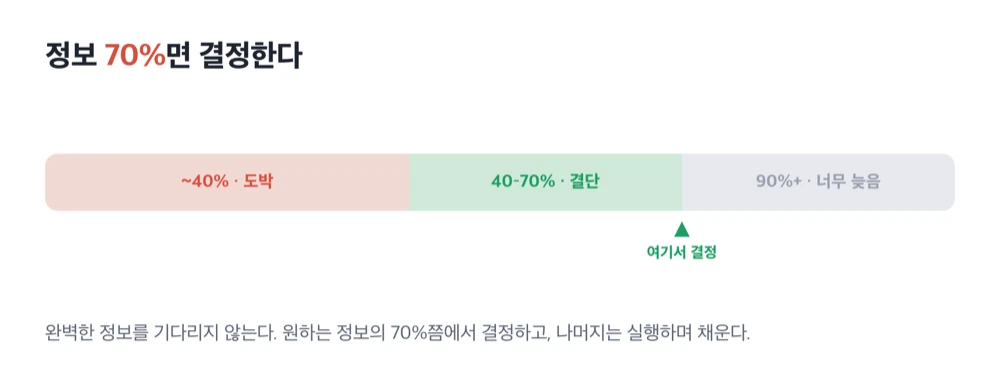
Irreversible decisions call for caution, but reversible ones should be made quickly. The problem is that as organizations grow, even reversible decisions start getting handled with the same weight, and everything slows down. He also said that most decisions should be made at around 70% of the information you'd like to have. If you wait for 90%, it's usually already too late. A principle attributed to an American general makes a similar point: with less than 40% of the information, it's a gamble; wait past 70% and you're already too late; decide somewhere in between.
The same person left behind another principle: "disagree and commit." Even if I don't agree with the team's decision, once the direction is set, I push it forward with everything I have, without second-guessing it. He was personally skeptical about one of his own company's ventures, but told the team, "I disagree. Let's do it anyway," and threw his weight behind it. Just as important as setting a direction is not undermining it once it's been set. If the leader keeps hesitating to the end, the whole team ends up hesitating too.
We've had moments like this ourselves. One company's founder, at a time when the world's leading semiconductor firms were mocking the idea as "delusional," publicly declared in Tokyo that the company would enter the semiconductor business. Once the judgment was made, he announced the direction first and aligned the organization behind it. A few years later, that company stood among the world's top players. Another person, facing a situation with no clear right answer, used the resources at hand in a completely different way to push the direction through. When the final closure section of a seawall kept collapsing under the force of the current, he sank a decommissioned supertanker in that spot to kill the current's force and complete the dike. It wasn't a method found in any textbook, but it cut the construction timeline dramatically. Instead of waiting for a perfect plan, he redefined what he had and moved forward.
I shared this principle with my team as well. "It's fine to be wrong. Moving forward while being wrong is better than standing still. If you're wrong, you change course." This shifted the whole atmosphere of the team. People grew less afraid of mistakes, attempts increased, and as attempts increased, learning sped up too.
In the next piece, I'll talk about why a leader who sets direction this way doesn't need to be perfect.