
Leading While Walking Together (5) — Not by Title, but by Heart
A title can move people, but it can't move their hearts. Not someone who pulls from the front, but someone who walks alongside. The final chapter on leadership.
In the early days of the company, I thought the title "CEO" would lead the team for me. I would make the decisions, I would set the direction, and the team would simply follow. I felt that way all the more because, technically, I knew the most.
Their Hearts Didn't Follow
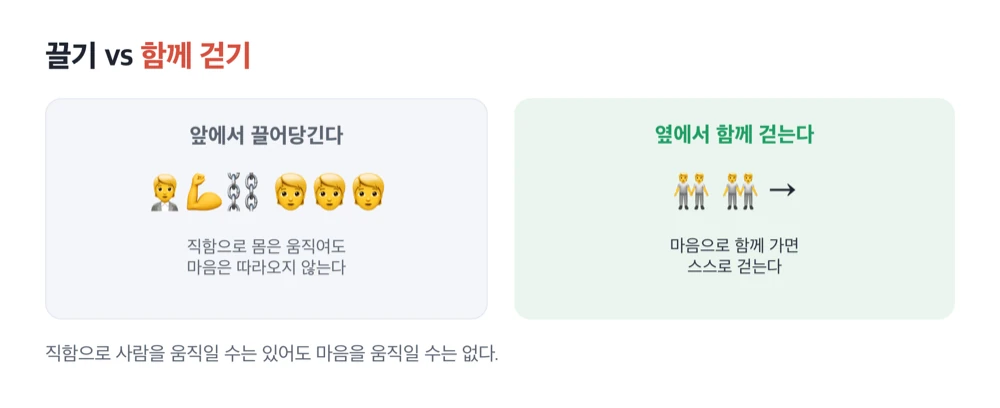
But the team didn't follow. To be precise, they did what they were told, but their hearts didn't follow. No sparkling ideas came up in meetings, and when a problem arose, instead of solving it themselves, they came to ask, "What should we do?" We had become a passive team waiting for my decisions. That was when I realized: a title can move people, but it cannot move their hearts.
The One Who Serves First
A scholar who studied leadership for many years defined a good leader this way: "a servant first." Someone who starts not from the desire to lead, but from the desire to help. Whether the people under that leader grow as persons, he said, is the true test of leadership. One writer introduced a long-standing custom of the US Marine Corps. At mealtime, the lowest-ranking Marines eat first and the officers eat last. It isn't written in any regulation, and no one enforces it. Real leadership, it seems, shows itself in putting privilege last.

Our own history has leaders like that too. Admiral Yi Sun-sin showed with his own body before he gave orders, and he debated through the night with his commanders, folding their voices into his battle plans. On cold nights, he wrote in his diary about his worry that the sailors out on the water might freeze. With the trust built up that way, at Myeongnyang he held off an enemy more than ten times his strength with just thirteen ships. The founder of one shipping company, instead of handing the company down to his children, gave his shares to an employee welfare fund and entrusted the business to professional managers. Rather than passing the company on, he shared it with the people who had worked alongside him. Our history also had a king who led by listening. Throughout his reign, King Sejong personally attended more than a thousand sessions of scholarly debate with his ministers. Even ministers who opposed him he did not cast out; he called them into his council hall and debated them head-on, with the court historians looking on. In a position where he could have crushed dissent by force, he chose to be the one who listened. A business leader who built a steelworks in Pohang told his people, "If this plant, built with money as precious as our ancestors' blood, fails, we will all turn right and walk into the sea," cutting off his own line of retreat. And yet he took almost nothing for himself from that company. He set the direction by burning his bridges, and protected the legitimacy of that direction by giving up personal gain. Serving showed itself in taking up the load first and taking one's share last.
The One Who Walks Alongside
How to become a good leader is actually simple. It's to keep doing what the previous five chapters talked about: set small goals, build your own value, speak in the listener's language, give first, and share together. There is no such thing as born charisma. A good leader is someone who keeps doing the basics.
A leader is not someone who pulls from the front, but someone who walks alongside. You don't have to be perfect. You just need the right direction, and to show that you're heading that way. Even in an age when machines take over much of our work, moving people's hearts so that they walk together will remain a human job. I'm still on that road myself. I try to get a little better every day. I believe that's enough.