Light a Fire Before You Buy the Fire Pit — Running Six Popular Fire Pit Designs Through a Combustion Simulator
The best part of winter camping is staring into a wood fire. But fire pits differ in smoke, flames and where the heat goes. Can you see that in advance from shape and structure alone? I drew the published dimensions of a double-wall cylinder (Solo Stove Bonfire 2.0), an inverted pyramid of solid plates (Snow Peak Takibi M), a mesh pit, a thin folding sheet (Picogrill 398), a fan-forced pit (BioLite FirePit+) and a tent wood stove (Winnerwell Nomad M) into a cross-section grid, and ran 60-odd trials of a 2D simulator that computes airflow, the burning of wood gas and charcoal, and radiant heat rays together. With the same wood (3 kg per hour), radiant heat on a person 1 m away was 246 W/m² for the inverted pyramid and 64 W/m² for the double wall, a fourfold gap. Unburned smoke was 1.4% for mesh, 1.7% fan-forced, 3.5% double wall and 4.2% inverted pyramid. Widening the double wall's gap from 1.25 to 3.75 cm dropped its outer wall from 314°C to 79°C, while the top secondary-burn holes only cut smoke (3.6% to 2.6%) when the wood was tripled. I also summarize the history of calculating fire (Franklin stove, Rumford fireplace, rocket stoves, EPA rules) and how well-known simulators work (FDS, Rothermel, Stable Fluids, EmberGen).
The thing you do longest on a winter camping trip is sit in front of the fire and stare at the burning logs. Koreans even have a word for it, bulmeong — "fire-zoning-out." So people weigh a lot when they pick a fire pit. Does it smoke less? Do the flames stand up nicely? Does the heat reach the people sitting around it? Will it scorch the grass underneath? Fire pit ads almost never leave out "secondary combustion" and "smokeless." Korean beginner camping checklists even advise buying a pit that does secondary burning.
But you usually only learn these differences after you buy one and light it. If you know a fire pit's shape and where its holes are, could you calculate the smoke, the flames and where the heat goes in advance? Building fire safety and stove design already compute fire on computers. I decided to try that approach, lightly, on camping fire pits.
What I set out to do
- Sort popular fire pit designs into six types and collect the published dimensions of one representative product for each.
- Build a cross-section combustion simulator that computes airflow, the burning of wood gas and charcoal, soot and radiant heat together.
- Feed the same wood at the same rate into all six and compare: smoke, where the flames burn, heat on a person 1 m away, and ground and outer-wall temperatures.
- Close holes, widen gaps, add more wood and turn on wind to find out what each part of the structure actually does.
- Summarize the history of things designed by calculating fire, and how the well-known fire simulators work.
An AI agent wrote and ran the research, the simulator, the 60-odd runs, the figures and the interactive playground below on a laptop. The places it went wrong are listed separately under "Where it went wrong."
Six types of fire pit
| Type | Representative product (published specs) | How the air gets in |
|---|---|---|
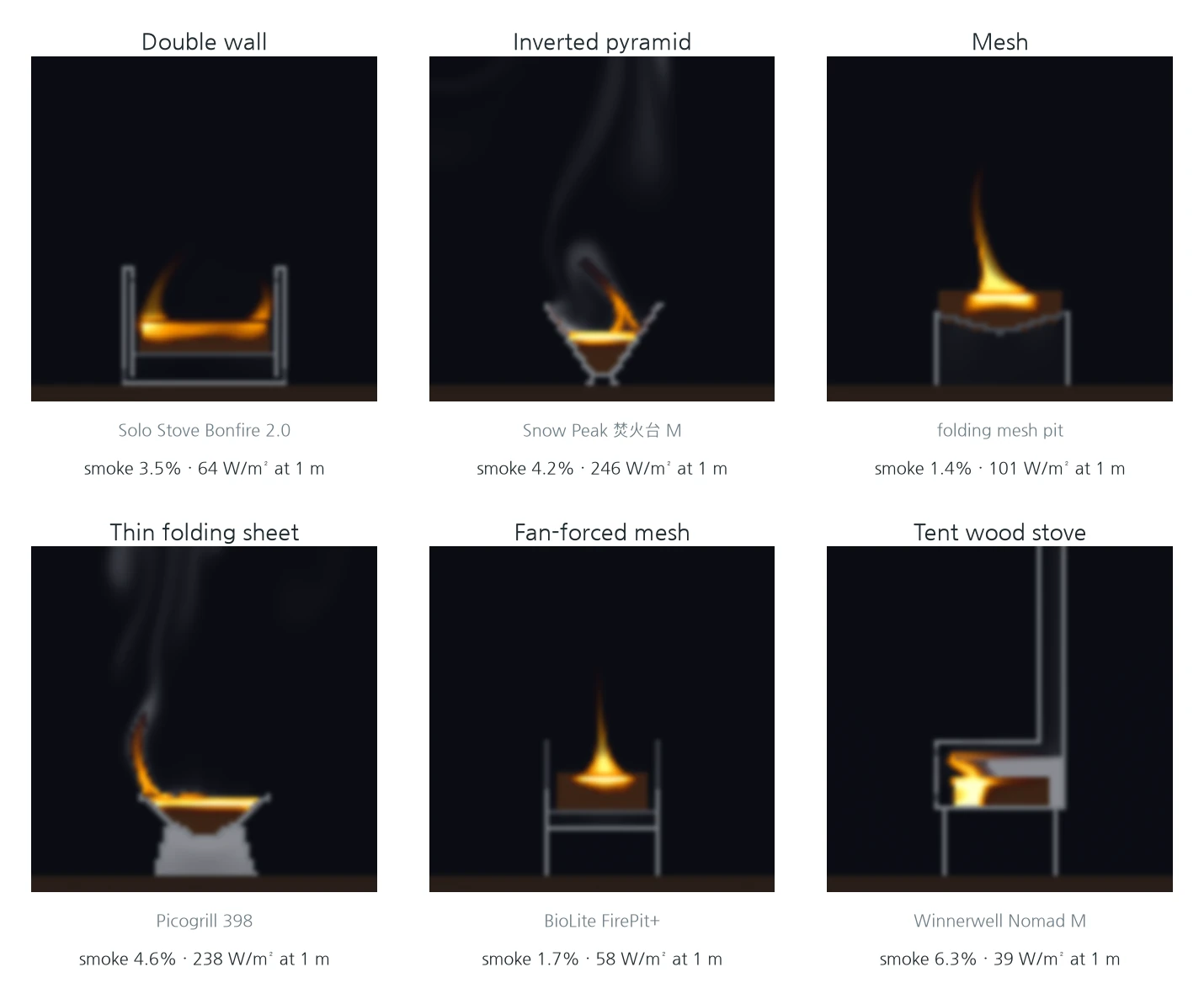
| Double-wall cylinder | Solo Stove Bonfire 2.0 — 49.5 cm across, 35.5 cm tall, stainless steel | Air enters holes low on the outer wall, then ① goes up through the base plate holes under the wood, and ② rises through the gap between the walls and jets out of holes near the top of the inner wall (secondary air) |
| Inverted-pyramid solid plates | Snow Peak Takibi (焚火台) M — 35 cm top edge, 24.8 cm tall, plates about 1.5 mm, launched 1996 | The side plates are closed, so air only comes from above |
| Mesh | Folding mesh fire pit — about 40 cm wide when open | Freely from under and beside the mesh holding the wood |
| Thin folding sheet | Picogrill 398 — 38×25×24.5 cm, a single sheet hung on a frame | From above, and through a slot in the middle of the sheet |
| Fan-forced mesh | BioLite FirePit+ — 68.6×33×40 cm, 51 air jets | A battery fan pushes air through a tube along the bottom. The body is mesh |
| Tent wood stove | Winnerwell Nomad M — body 38×20×21 cm, 63 mm flue | Primary air under the door, secondary air above it, and the flue pulls the draft |
Many values are not published: the number and size of Solo Stove's holes, the gap between its walls, whether Snow Peak's side plates have air holes. I assumed these from photos and made them adjustable in the playground and the experiments. The numbers are best used to compare the types, not taken at face value.
Wood burns twice
To talk about fire pits you first need to know how wood burns. Heat dry wood and the water leaves first. Then 75–80% of the wood's weight comes off as gas (volatiles). The remaining 20–25% is charcoal (fixed carbon). The yellow flames we watch are not the wood itself but this gas burning where it meets air. Charcoal burns without flames, glowing red.
Smoke is that gas cooling off before it has finished burning. If there's too little air, if the air doesn't mix in well, or if it mixes but the temperature is too low, the gas flies off unburned. That's why "secondary combustion" fire pits jet pre-heated air in above the wood. The idea is to burn, up top, the gas that didn't finish burning below. Cold air would cool the gas and actually stop it burning, so the air is warmed on its way up through the gap between the walls.
A fire's heat leaves by two routes. Convection is hot air rising. Radiation is what flames, embers and hot metal throw out in every direction, like light. Nearly all the warmth on a person sitting by a fire is radiation, because the hot air doesn't pass by the person; it goes straight up into the sky. This is the same idea Count Rumford held on to when he reworked fireplaces at the end of the 18th century (see "Things that calculated fire" below).
1. Building the simulator
I cut a vertical cross-section through the middle of the fire pit and divided it into a grid of 112 by 136 cells. Each cell is 1.25 cm, so the space is 1.4 m × 1.7 m. Each cell is painted as air, steel plate, perforated plate, wood pile or ground. Then, every 0.01 s, five things are computed.
- Airflow. It includes the force that lifts hot air (buoyancy) and the resistance air meets passing through holes and between logs, and it keeps air from appearing or disappearing anywhere. It starts from "Stable Fluids," a method used in film visual effects. It uses a staggered grid, with velocities on cell faces and temperature and concentrations at cell centers.
- Wood. I assume the same wood goes in at 3 kg per hour (1.5 kg for the stove). 80% of it comes out as gas, and 20% becomes charcoal, which burns only as much as the oxygen reaching the wood pile allows. The heat of the burning charcoal heats the pile, and the hot pile glows.
- Gas combustion. Gas burns when it shares a cell with oxygen and the temperature is above 450–650°C. It burns only as fast as it mixes. Every kilogram of oxygen consumed releases 13.1 MJ (Huggett 1980). Burning on the oxygen-poor side makes soot, and soot burns again where there is oxygen and heat.
- Radiation. The light from flames, soot, glowing embers and hot plates is shot out as rays in 72 directions. A ray that hits a plate heats it; one that escapes the fire pit is counted by direction. The heat on the front of a person sitting 1 m, 1.5 m and 2 m away (between 10 and 90 cm above the ground) is calculated separately.
- Plates and ground. They exchange heat with the air touching them, warm up by the light they absorb, and glow according to their own temperature.
Each run was computed for 40 s and the last 20 s averaged. A run took 3–4 minutes on a laptop, with 15 running at once.
2. Burning the same wood in all six
The results split into two groups.
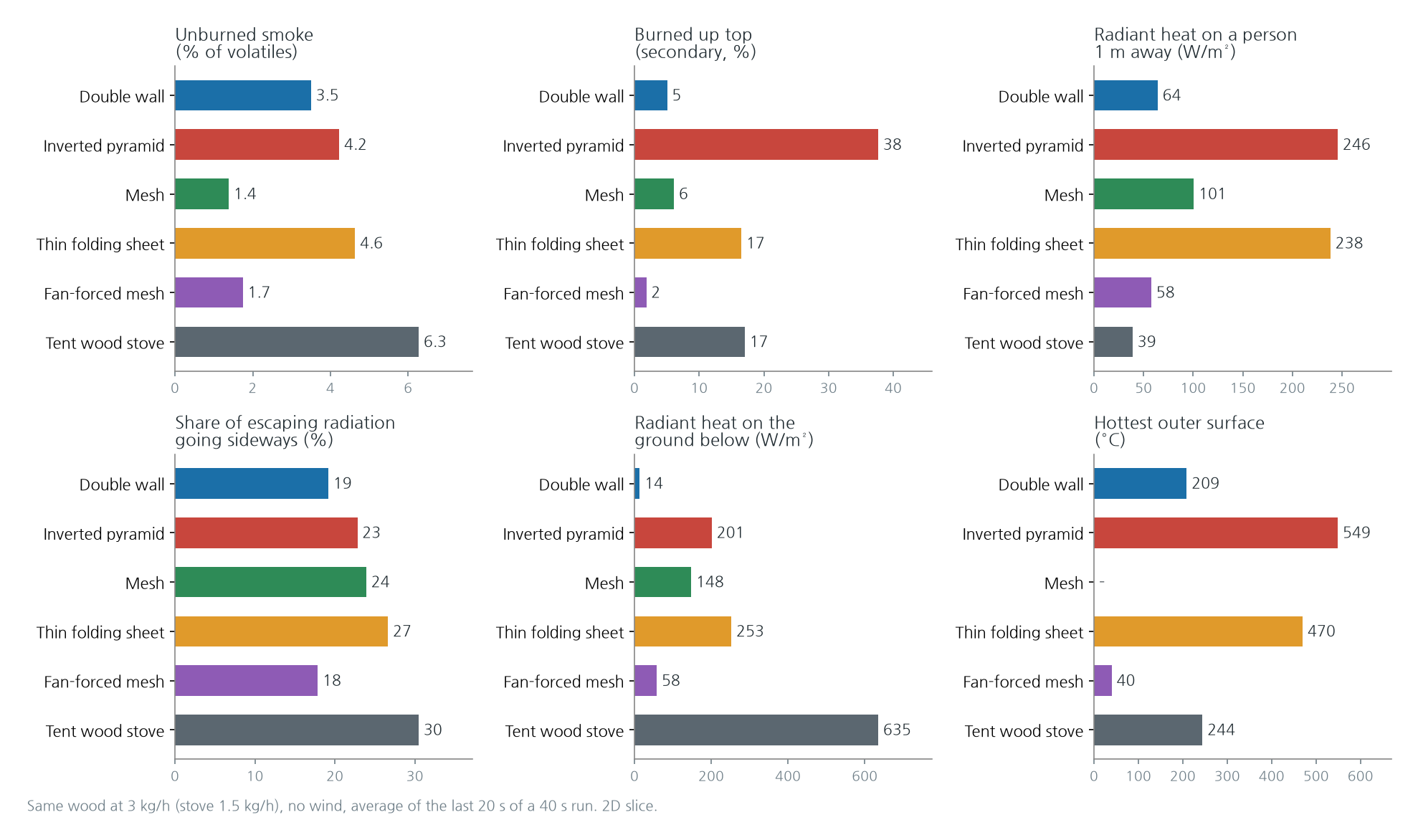
The group where air comes in from below (double wall, mesh, fan-forced) smoked little. Unburned smoke was 1.4–3.5% of the wood gas, and almost no soot got out. They also burned all the charcoal coming in. But radiant heat on a person 1 m away was low, 58–101 W/m².
The group where air only comes from above (inverted pyramid, thin sheet) had 4.2–4.6% smoke. Soot leaving was 13–14 g per kg of wood gas. Only 30–40% of the incoming charcoal burned; oxygen couldn't get down under the wood pile. In real life that means charcoal and ash piling up at the bottom. So the heat released from the same wood was 11.4 kW, less than the bottom-air group's 15.2–15.3 kW. Even so, radiant heat at 1 m was 238–246 W/m², nearly four times as much.
The difference came from two places.
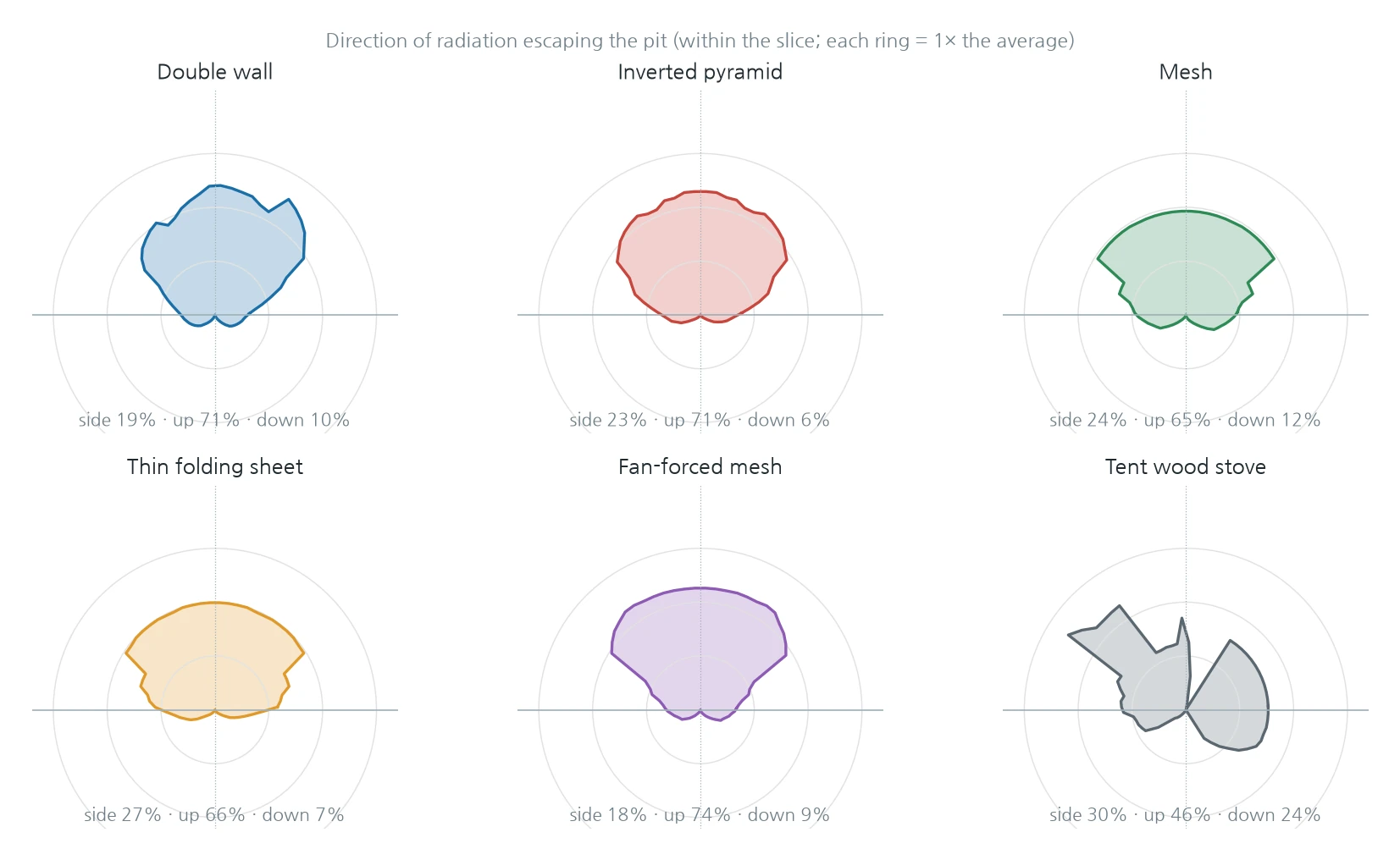
- Whether the flame carries soot. When air only comes from above, the gas rises looking for oxygen and burns in a long flame. The share burned more than 5 cm above the wood pile was 38% for the inverted pyramid and 2–6% for the bottom-air group. Flames burning short of oxygen are full of soot. Soot particles glow like hot embers, making big yellow flames. Great for fire-gazing, and lots of radiant heat. In the calculation, radiation escaping the pit was 29% of the wood's heat for the inverted pyramid and 25% for the thin sheet, versus 7–8% for the bottom-air group. In the bottom-air group the flame has plenty of oxygen, so soot burns as soon as it forms and the flame is short and clear.
- What the wall hides. In the double wall, the wood pile sits buried low behind the wall. The light of the glowing embers can't get out sideways; the inner wall blocks it. That heat warms the air between the walls and sends it up. Heat leaving by convection was 14.2 kW, 93% of the wood's heat. For the inverted pyramid it was 3.8 kW.
So the less a fire pit smoked, the less warm the people sitting around it were. That fits Solo Stove selling a separate Heat Deflector that sits on top and, in the company's words, redirects heat that would escape upward out to the sides. An OutdoorGearLab review also found the wider Yukon radiated heat sideways better than the Bonfire.
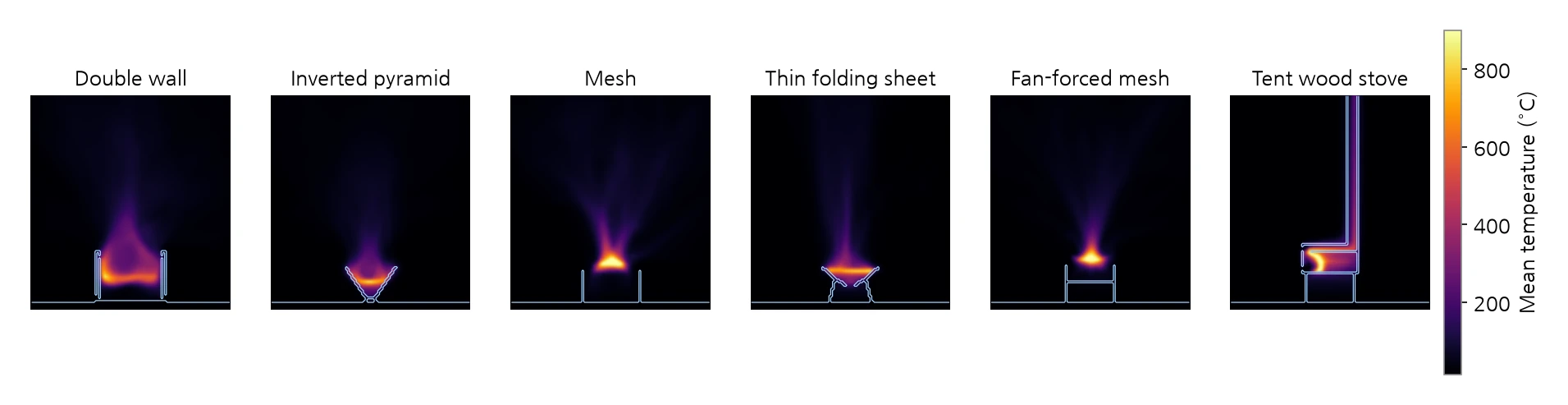
The temperatures where hands can touch also differ. The hottest outer surface was 549°C for the inverted pyramid, 470°C for the thin sheet, 209°C for the double wall and 40°C for the fan-forced pit. The double wall's outer wall is cooled by cold air coming in through the bottom holes and passing between it and the inner wall, but it is still too hot to touch for even a second (the PopSci hands-on review gave the same warning). Radiation on the ground directly below was more than ten times larger for the designs with mesh or plate right under the wood — mesh (148 W/m²), thin sheet (253) and inverted pyramid (201) — than for the double wall (14), which is shielded by two layers, the base plate and the ash pan. But this calculation has no heat flowing directly into the ground through the legs and base plate. The warning not to put a Solo Stove straight on a wooden deck is about that conducted heat.
The wood stove is a different thing. It burns inside a box, and the heat comes out through the steel box (244°C) and the flue. At 1.5 kg/h of wood it gave 39 W/m² at 1 m. On the other hand, for warming the air inside a tent it is in another league from a fire pit, and since this calculation has no tent walls it can't show that. The radiation on the ground (635 W/m²) is because the floor is right under the wood and the ground 20 cm below the legs faces the hot floor plate. A tent floor needs a heat shield.
3. Is it really the top holes that make a double wall work?
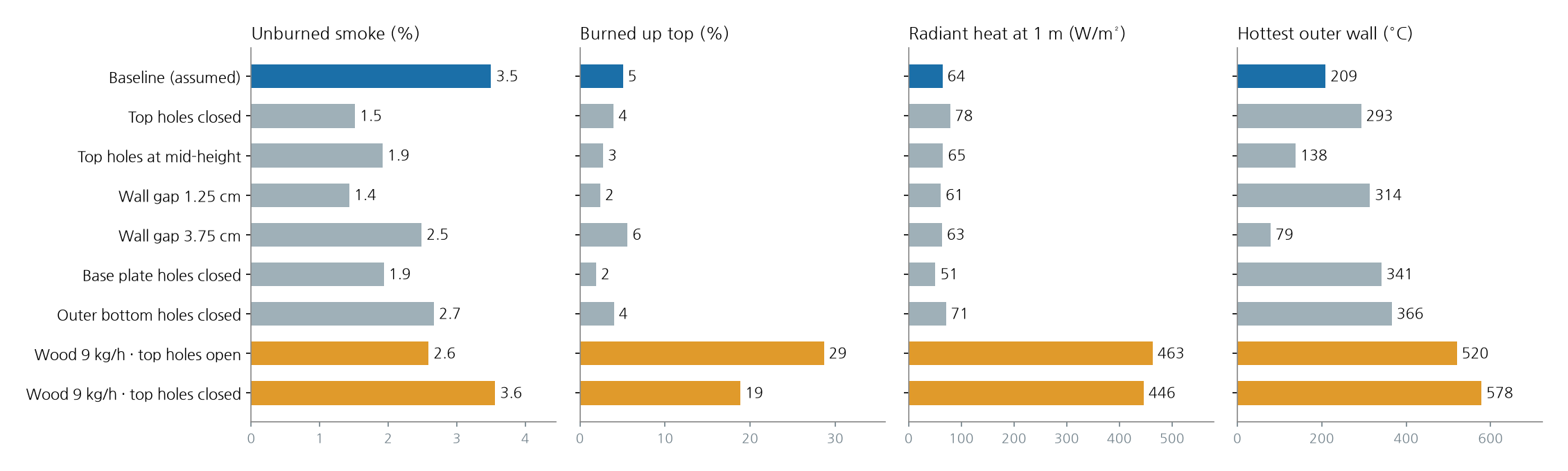
I closed the top holes (the secondary-burn holes), supposedly the heart of a double wall. At 3 kg/h of wood, closing them did not increase the smoke (3.5% → 1.5%). The runs that changed hole height, gap width or base plate holes also bounced between 1.4 and 3.5%. A difference that size is within this calculation's wobble, so it's right to read it as "no difference." At 3 kg per hour, the air coming through the base plate alone could burn almost all the gas.
At three times the wood (9 kg/h) a difference showed. With the top holes open, smoke was 2.6%; closed, 3.6%. The share burned more than 5 cm above the wood pile was 29% versus 19%. When the wood is heaped high and the gas comes off faster than the bottom air can handle, the top holes burn the leftover gas. "Secondary combustion" does its work when you build a big fire.
What changed a lot, unexpectedly, was the outer wall temperature. Widening the gap between the walls from 1.25 cm → 2.5 cm → 3.75 cm dropped the hottest outer wall temperature from 314°C → 209°C → 79°C. A wider gap lets more cold air pass and cool the outer wall. Closing the top holes stopped the air in the gap from flowing and raised the outer wall to 293°C; lowering the top holes to mid-height gave 138°C. The gap in a double wall behaved more like a device for burnt hands and ground heat than for smoke. Solo Stove's actual gap width isn't published, so treat these numbers only as a trend: "with a gap this size, you get this."
4. Adding more wood
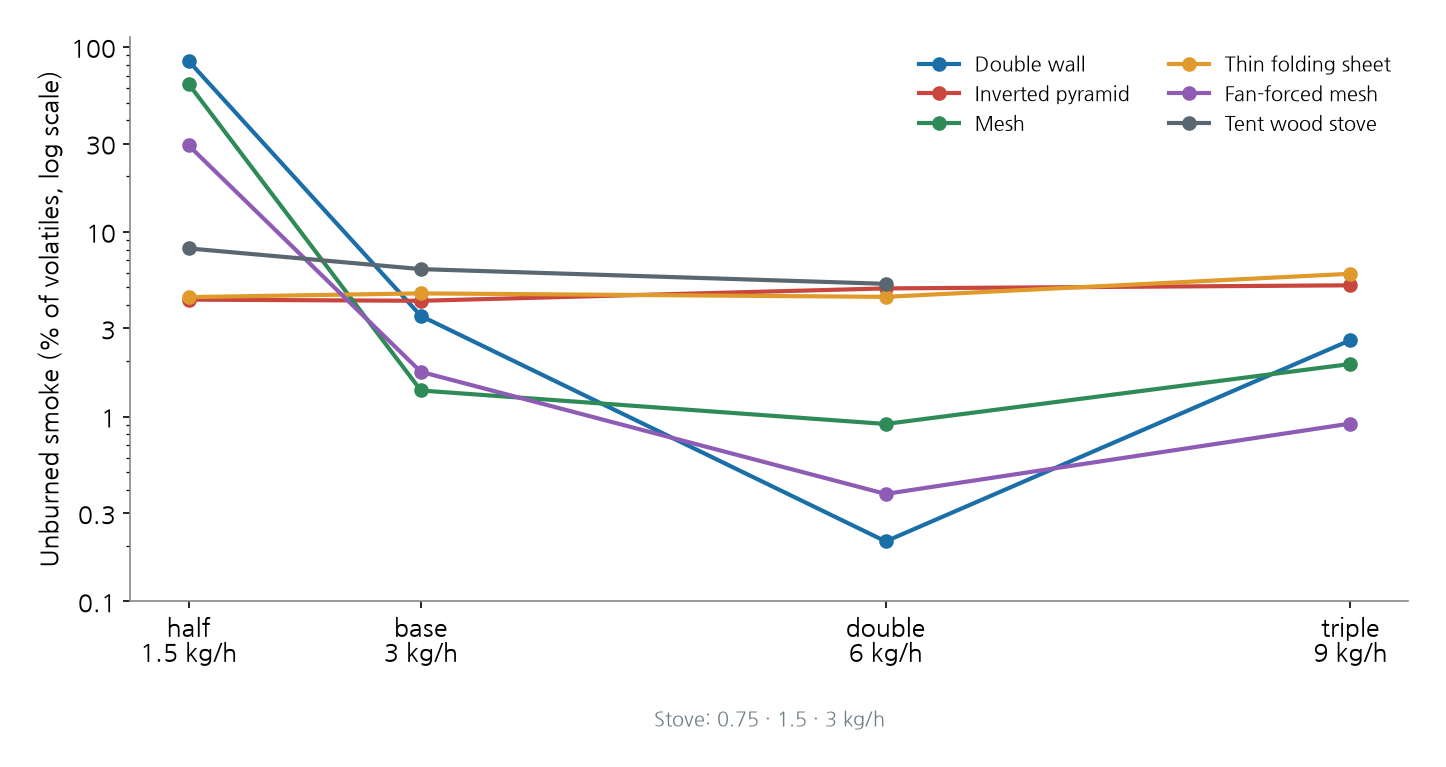
- The bottom-air group burned cleanest at double the wood (6 kg/h): double wall 0.2%, fan-forced 0.4%, mesh 0.9%. A bigger fire makes the wood pile hotter and pulls air in harder. At triple, smoke rose again (double wall 2.6%); now there was more gas than air. Radiant heat at 1 m jumped from 64 → 160 → 463 W/m². The inverted pyramid at triple the wood gave 1,297 W/m² at 1 m — above 1 kW/m², the level at which bare skin starts to hurt in about two minutes (NOAA table).
- The air-from-above group stayed at 4–6% regardless of wood. With only one way for air to get in, making the fire bigger leaves the smoke ratio unchanged.
- Halving the wood made the bottom-air fires go cold: double wall 84%, mesh 63%. Too much cold air flowed into a small fire and the embers cooled. That a small fire smokes is true in itself. But I take 84% as an exaggeration caused by this calculation's simple heat balance for the embers (see "Where it went wrong").
5. When the wind blows
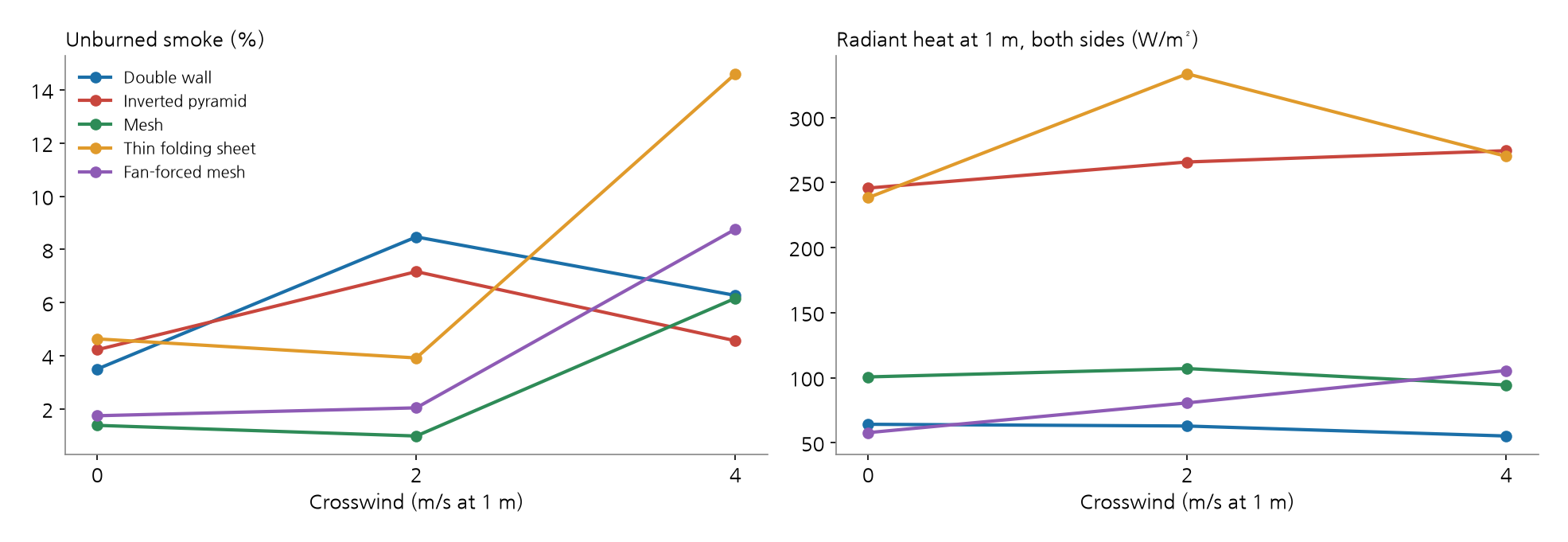
I blew a campsite-strength wind (2–4 m/s at 1 m height) from the side. At 4 m/s the thin sheet's smoke went from 4.6% to 14.6%, and the fan-forced pit's from 1.7% to 8.8%. The flames lie down and cold air sweeps sideways across the wood pile, so the gas cools before it finishes burning. The double wall and inverted pyramid, burning inside a deep vessel, were shaken less. Still, the points in this chart jump around from run to run, so it's hard to rank them. In a 2D cross-section the wind can't flow around the pit, so it hits harder than in reality.
6. Wood stove: baffle and glass
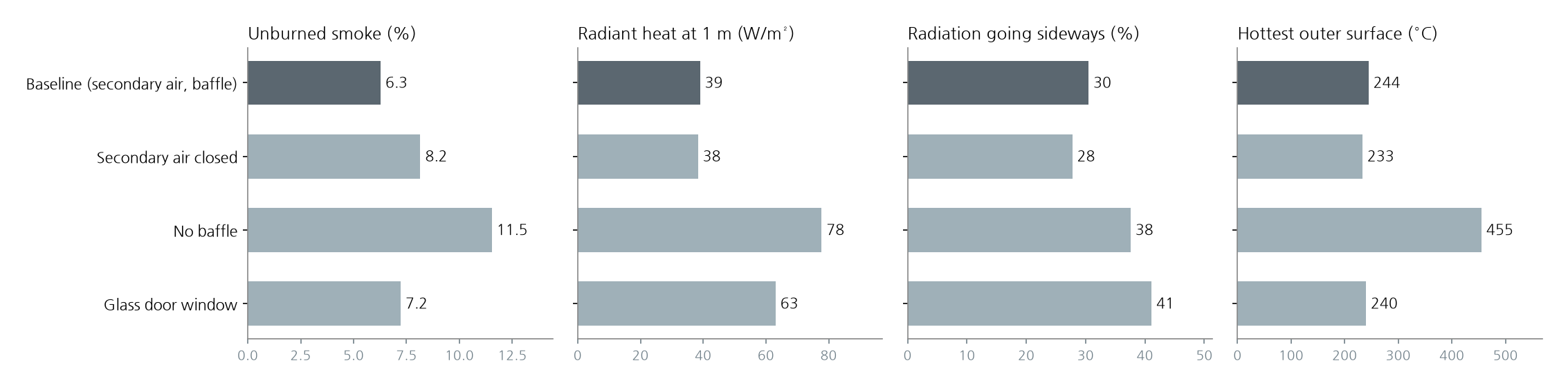
- Removing the baffle raised smoke from 6.3% to 11.5%. The baffle is a plate under the ceiling of the firebox. Without it, gas above the wood is pulled straight into the flue and has less time to burn. Instead the flames hit the ceiling and the base of the flue directly, and the surface reached 455°C. This is why the EPA lists "a large baffle that creates a long, hot gas path" among the conditions for a clean-burning stove.
- A glass window in the door raised radiant heat at 1 m from 39 to 63 W/m². Light from the flames and embers comes straight through the glass. So there's a heat reason, too, for buying the glass-window model to gaze at the fire in a stove.
- The secondary air holes gave mixed results at this size. At 1.5 kg/h, closing them raised smoke from 6.3% to 8.2%, but at 3 kg/h the closed version had less (5.2% → 1.1%). I think the secondary air, represented as a single 2 cm band above the door, doesn't meet the wood gas properly in a cross-section calculation.
Try it yourself
On a narrow screen, open it in a new window. The first 20 seconds or so are the fire settling in, so the numbers wobble. A few things worth trying:
- Inverted pyramid → Holes low in the sides: charcoal burning rises from 1.6 kW to 4.5 kW and smoke drops from 4.2% to 2.9%. When air reaches the bottom, charcoal doesn't pile up.
- Double wall → wood 6 kg/h → Top holes closed: you can see the band of flame from the top holes disappear.
- Thin folding sheet → crosswind 4 m/s: switch to "View: Smoke" and white smoke trails along the ground downwind.
Where it went wrong
- Fuel multiplied by itself next to slanted walls. The first fluid calculation kept both velocities and concentrations at cell centers. Next to slanted walls like the inverted pyramid's, the air was computed as if it came out through the wall, and the fuel value at that spot kept getting rewritten. In 10 seconds, 50 g more fuel appeared than had been put in (6.7 g). That's how a nonsense result came out: the inverted pyramid producing 109 kW from 3 kg of wood per hour. I rewrote it with a staggered grid that puts velocities on cell faces, and a conservative calculation that adds and subtracts exactly what cells exchange. Mass error over 10 seconds is now under 0.03 g.
- More charcoal burned than the wood could make. I had let charcoal burn without limit as long as there was oxygen, so the mesh produced 25 kW from charcoal alone. Charcoal is only 20% of the wood's mass, so 3 kg/h of wood can't give more than 5.5 kW from it. I tied charcoal burning to the rate charcoal is made.
- Radiation was counted twice. At first I added up everything, including steel plates re-emitting the light they absorbed, and got "58–65% of the wood's heat is radiation." Real wood fires are around 20–40%. I changed it to count only the light that escapes the fire pit.
- The wood pile cooled off quickly by radiation. When I made the whole surface of the pile glow like red embers, it lost more heat as light than the charcoal produced, and the surface cooled to 170–200°C. The fan-forced pit's fire went out, with 87% smoke. A real wood pile's surface is covered by charred bark and ash, with only parts glowing red. I set the glowing share of the surface to 30%. For the fan-forced pit, the jet speed (3 m/s) was also too strong and wind swept under the mesh body, so I changed the bottom 12 cm to a solid body. That is also an assumption.
- I counted "secondary burning share" by a different standard for each pit. At first each shape had its own height cut-off, which made the inverted pyramid look like the biggest secondary burner. I switched to one standard for all shapes: "more than 5 cm above the top of the wood pile." Even counted this way the inverted pyramid is highest, at 38%. It has no top holes, but since the air is only up top, it burns up top. "Burns up top" and "burns cleanly with secondary air" are different things.
- The stove's secondary air holes were closed from the start. After drawing the 1.5 cm secondary air band, drawing the neighboring wall covered its cells. So the "secondary air closed" result was identical to the baseline down to the decimals. I made the hole band cut through the wall and reran.
- The hypothesis that the double wall's top holes reduce smoke was wrong at 3 kg/h. See section 3.
- I couldn't fix the fire going out at half the wood. See section 4.
So how do you choose a fire pit?
Translated into usable advice, the results say this:
- If fire-gazing and warmth come first: open-topped plate designs (inverted pyramid, thin sheet) sent nearly four times as much radiation to 1 m with the same wood. Big, sooty yellow flames stand up. They smoke a bit more (4–5%), charcoal and ash pile up at the bottom, the plates get above 500°C, and the ground underneath heats up too. Holes in the side plates or a raised grate cut the smoke.
- If you hate smoke: choose a design where air comes from below (double wall, mesh, fan-forced). But most of the heat goes up. The double wall was cleanest with a moderately big fire (around 6 kg per hour in this calculation); a fire that was too small actually smoked.
- Secondary-burn holes do their work when you load a lot of wood. Within the same double-wall design, the gap between the walls changed the outer wall temperature a lot. With kids around, the wider gap is better.
- On windy days, the thinner and lower the fire pit, the more it smoked. A windscreen may matter more than which pit you pick.
- For a wood stove, check for a baffle and a glass window. Without a baffle there's more smoke and the surface gets hotter. Glass gives you both fire-gazing and radiant heat.
What it can't do
- It's a 2D cross-section. Real fire pits are round or square and three-dimensional. Air converging from all around a double-wall cylinder, or wind flowing around the pit, can't be captured in a slice. Heat and radiation were counted by multiplying the slice by a depth.
- Air doesn't expand when heated. Real air in a flame swells four to five times. This calculation applies temperature only to buoyancy and keeps the volume fixed. Flame heights and speeds may differ from reality.
- Wood is assumed to burn at a fixed rate. In reality wood burns faster in a strong fire and slower when air is short. This is a comparison "with the same wood fed at the same rate." So charcoal in oxygen-starved pits only shows up as "burned less," and the charcoal that piles up isn't tracked separately.
- Wet wood made almost no difference. I only included the heat needed to warm and evaporate the water, not wet wood igniting late or steam cooling the flames. So I left it out of the figures.
- Hole sizes and gaps are assumptions. Manufacturers don't publish them; I set them from photos without measurements.
- It hasn't been checked against real measurements. I couldn't find an independent test measuring a fire pit's sideways radiant heat at various distances. Read the numbers only as comparisons between types. That the heat at 1 m comes out at tens to hundreds of W/m² is the same order of magnitude as a rough estimate from wood heat and radiant fraction.
- There's no heat conducted into the ground through legs and base plates, no sparks and no carbon monoxide. The biggest danger of a wood stove inside a tent is carbon monoxide, and this calculation says nothing about it.
- Every run wobbles. Flames flicker, so even under the same conditions the smoke ratio moves up and down by about 1–2 percentage points. I didn't read smaller differences as differences.
Things that calculated fire
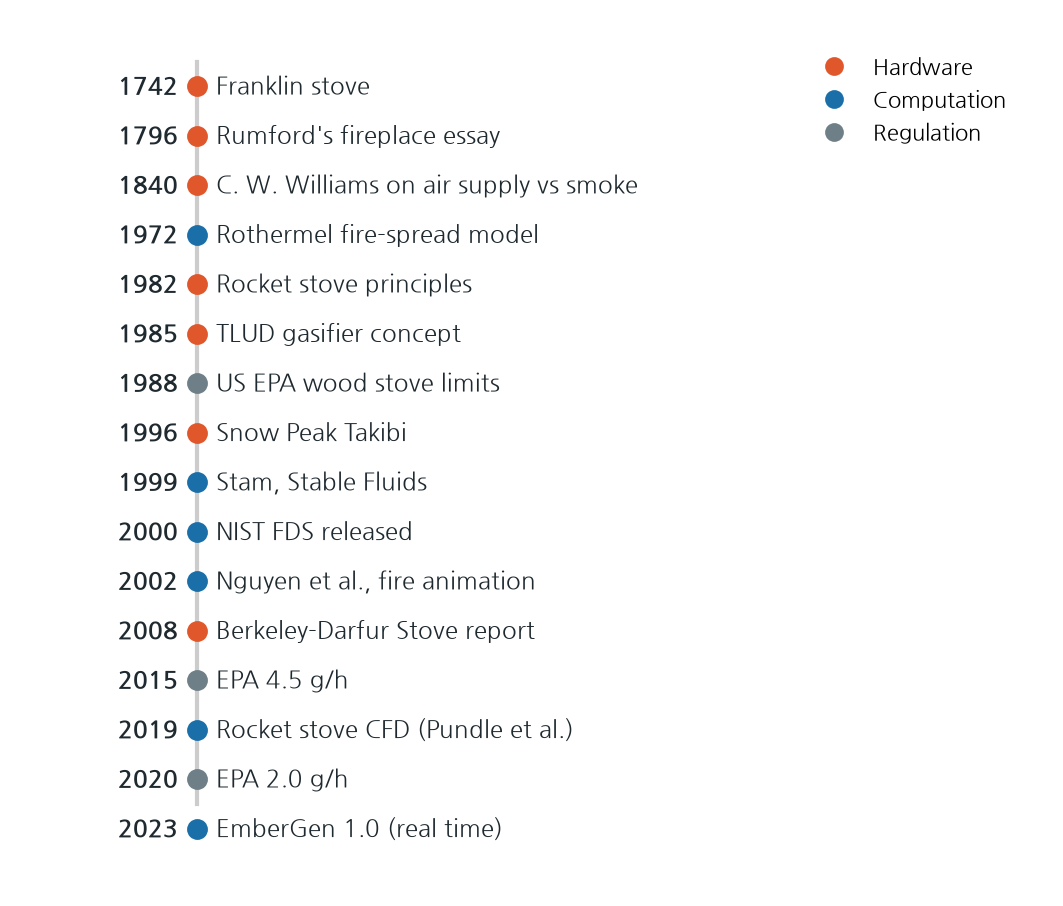
Changing the shape of a fire vessel to tame smoke and heat is an old idea. At first it was done by hand and eye, later with test rigs and calculation.
- Braziers and hearths. Japan's hibachi (火鉢) is thought to go back to the Heian period (794–1185). It's a vessel with charcoal on a bed of ash, used more to warm hands with radiant heat than to heat a room. The irori (囲炉裏), a hearth sunk into the floor, handled heating, cooking and lighting together. Wood tar in the smoke protected the beams and thatched roof from insects and water, so even the smoke had its uses.
- Franklin stove (1742, by his autobiography). It put an iron firebox inside the fireplace and warmed room air with a hollow baffle at the back. Because it routed smoke under the floor to the chimney, the smoke cooled and the draft was weak, and it didn't sell well. An improved version spread instead.
- Rumford fireplace (1796). Count Rumford held that "the only useful heat is radiant heat; heated air leaves up the chimney with the smoke." So he narrowed the chimney throat to about 10 cm, made the firebox shallow, and splayed the side walls to turn radiant heat toward the room. He is said to have reworked 250 fireplaces in London in two months. Counting "radiation going sideways" separately in this experiment follows the same thinking.
- Secondary air. When coal smoke became a problem in 19th-century Britain, the argument arose that rather than trying to burn smoke, you should supply enough air from the start so smoke doesn't form (Charles Wye Williams, 1840). Today's standard solution for wood stoves follows the same line. The US Environmental Protection Agency (EPA) lists three conditions for a clean non-catalytic stove: an insulated firebox, a large baffle that creates a long hot gas path, and pre-heated air introduced through small holes above the wood.
- Rocket stove (1980s). Larry Winiarski developed it from 1980 at the nonprofit Aprovecho. Its principles — insulate the combustion chamber, make the chimney above it 2–3 times its diameter, keep the cross-section nearly the same from the fuel opening to the chimney — are still the reference for cookstove design.
- TLUD gasifier stove (1985). Thomas B. Reed came up with the concept. You light the wood pile from the top and let it burn downward, and the pyrolysis gas it releases burns above with secondary air. It's the same principle as a camping "secondary burn" fire pit.
- Berkeley-Darfur Stove (2008). Ashok Gadgil's team at Lawrence Berkeley National Laboratory designed it for refugee camps in Darfur, Sudan. It used 72% less wood than the traditional three-stone fire (2008 report).
- Designing by calculation. Envirofit, which started in 2003 in a Colorado State University lab, designed cookstove combustion chambers with computational fluid dynamics (CFD) and heat-transfer modeling. In 2012 a US Department of Energy project did stove CFD with detailed chemistry. Papers piled up too: a study predicting rocket cookstove performance with 2D axisymmetric calculation (Pundle et al., 2019), and one computing wood-stove combustion over time and matching it to emission measurements (Scharler et al., 2020). But researchers at Norway's SINTEF wrote in 2014 that "very few published papers solve log-wood combustion numerically." Logs come in all shapes and change shape as they burn, which makes them hard to compute.
- Regulation pushed design. The US EPA set the first wood stove emission standard in 1988: up to 7.5 g of particulates per hour for non-catalytic stoves and 4.1 g for catalytic ones. It tightened to 4.5 g/h in 2015 and 2.0 g/h in 2020 (2.5 g/h under the cordwood test method). Catalytic stoves coat a ceramic honeycomb with a catalyst, lowering the temperature at which smoke starts to burn from about 540°C to 175–315°C.
Camping fire pits sit at the tail end of this line. Snow Peak's Takibi is an inverted-pyramid fire pit from 1996. Double-wall fire pits, which draw air through bottom holes, send it up between the walls and jet it from holes near the top, spread later under the "smokeless" label. It has become a buying criterion — Korean camping checklists advise buying a pit with secondary burning.
How the well-known fire simulators work
Programs that compute fire fall broadly into three groups: engineering tools for safety, wildfire tools for large landscapes, and visual tools that only need to look good.
| Name | Who and when | What it solves | How |
|---|---|---|---|
| FDS + Smokeview | US National Institute of Standards and Technology (NIST), released 2000, latest 6.11.1 (July 2026) | Building fires, smoke control, sprinkler activation, fire reconstruction | Low-Mach Navier–Stokes with LES turbulence. Combustion is a single-step reaction of three lumped species (air, fuel, products), limited by mixing. Radiation by finite volume method over about 100 directions (about 20% of compute time). Rectilinear grid |
| FireFOAM | FM Global, based on OpenFOAM | Warehouse and factory fires, sprinklers | LES, unstructured mesh, massively parallel |
| Rothermel model → BehavePlus, FARSITE, FlamMap | US Forest Service, from 1972 | How fast and where a wildfire spreads | An empirical formula for spread rate from fuel type, moisture, slope and wind. FARSITE propagates the fire front like a wave at that rate |
| WRF-SFIRE | Mandel et al. (2011) | How wildfire and weather affect each other | Attaches Rothermel spread to the WRF weather model; the fire's heat changes the wind in turn |
| Stable Fluids → fire for film | Jos Stam (1999), Fedkiw et al. (2001), Nguyen et al. (2002) | Plausible-looking smoke and fire | Semi-Lagrangian advection so large time steps don't blow up. Vorticity confinement to bring back small swirls. Fire treats fuel vapor and hot products as separate flows that expand at the reaction front |
| Houdini Pyro, EmberGen, NVIDIA Flow | SideFX, JangaFX (1.0 in 2023), NVIDIA | Film and game visual effects | Sparse grids (compute only where there's fire). EmberGen and Flow run in real time on the GPU |
For engineering tools, being right comes first. FDS publishes its comparisons with experiments in a separate validation guide, and a single run can take hours to days. For visual tools, fast and plausible comes first, so it's fine if energy isn't conserved. This simulator sits between the two. Its skeleton is borrowed from the visual-effects Stable Fluids, with a few engineering ideas on top: limiting combustion by mixing rate, counting radiation as directional rays, and separately checking that fuel and oxygen mass add up.
Sources
- Product dimensions and structure: Solo Stove Bonfire 2.0 (GearJunkie, PopSci and Bob Vila reviews, retailer specs), Snow Peak Takibi (hinata, BE-PAL), Picogrill 398 (BE-PAL), BioLite FirePit+ (BioLite blog "How smokeless fire pits work," Bob Vila), Winnerwell Nomad M (Rodastjarnan specs), Breeo "How We're Smokeless," OutdoorGearLab reviews of Yukon 2.0 and Breeo X24.
- Combustion and heat: Huggett, C. (1980), "Estimation of rate of heat release by means of oxygen consumption measurements," Fire and Materials 4; wood volatiles and heating value (Baker, USDA Forest Products Laboratory; COFORD); radiant exposure time table (NOAA ALOHA, originally FEMA/DOT/EPA 1988 Handbook).
- History: Franklin stove, Hibachi, Irori (Wikipedia); Rumford, "Chimney Fireplaces" (1796, rumford.com); Aprovecho and Winiarski (Wikipedia, Aprovecho); Reed TLUD (woodgas.com); LBNL Berkeley-Darfur Stove report (2008); Colorado State University and Envirofit press releases; US EPA Burn Wise, "Choosing the right wood-burning stove"; CRS report R43489.
- Stove CFD: Pundle et al. (2019), Biomass and Bioenergy 131, 105402; Scharler et al. (2020), Renewable Energy 145, 651–662; Bugge, Haugen and Skreiberg (2014, SINTEF).
- Simulators: NIST FDS User Guide and GitHub releases (6.11.1), FM Global FireFOAM, Rothermel (1972) INT-115, Andrews (BehavePlus), Finney (FARSITE), Mandel et al. (2011) GMD 4:591, Stam (1999) "Stable Fluids," Fedkiw, Stam and Jensen (2001), Nguyen, Fedkiw and Jensen (2002), SideFX Houdini documentation, JangaFX EmberGen, NVIDIA Flow.