How Does an AI Umpire Call a Strike?
The only thing in my notebook was the word "strike." Since 2024 the KBO, Korea's top professional league, has had a machine call every ball and strike in every game. I walk through how it works, with numbers: cameras track the pitch and produce coordinates, a ratio applied to the batter's height builds the zone, and the call goes to the plate umpire's earpiece as audio. I also look at why MLB brought in the same technology in a different form, the challenge system; which calls are next in line, from checked swings to balls near the foul pole to close plays at first, and what makes them hard; and how far machine officiating has come in tennis, soccer, cricket, gymnastics and F1. There's an interactive tool for placing pitches yourself and watching the zone move as the batter's height changes. The eighteenth piece in A Page for Today.
When I opened my idea notebook today, a single word sat alone on the page.
Strike.
Not a sentence, just one word and a period. I have no idea why I wrote it. Still, anyone who watches baseball knows how much feeling hangs on that word. Bottom of the ninth, full count, one pitch low and away. If the umpire raises his arm, the game is over. If he doesn't, another runner takes first. Over the same pitch, one dugout erupts and the other starts throwing caps. The strike zone is an invisible box, and a few centimeters at its corners decide who wins.
Now a machine draws that box. That's what I want to talk about today.
The invisible box
The strike zone in the rulebook is tied to the human body more closely than you might think. The top is the midpoint between the top of the shoulders and the top of the uniform pants. The bottom is the hollow beneath the kneecap. Side to side, it is the width of home plate: 43.18cm, or 17 inches. And it is measured from the batter's stance as he gets ready to swing.
The trouble is that this standard is different for every batter. A 165cm hitter and a 195cm hitter don't have knees at the same height. A hitter who crouches and one who stands tall aren't the same either. In the 0.4-odd seconds it takes a 140km/h pitch to arrive, the plate umpire had to draw the box in his head, factoring in the stance of a batter he might be seeing for the first time that day. And by the rules, that box isn't a flat rectangle. It's a solid standing over home plate. If the ball grazes any part of that solid, it's a strike.
How well did people do at this? By the KBO's estimate, plate umpires in Korea's top professional league were about 91.3% accurate in 2023 (OSEN). Wrong about one time in ten sounds harsh, but for a human eye it's an impressive number. Still, a plate umpire has to rule on roughly 150 pitches a game that the batter doesn't swing at, so it also meant more than ten pitches every game went the "other way." That's why the arguments never stopped.
In the KBO, the machine sees every pitch
Many people assume the KBO brought in AI calls "partially." It's actually the other way around. Since the 2024 season, every ball and strike in every top-flight KBO game has been called by machine. The official name is the Automatic Ball-Strike System, or ABS. It came after four seasons of testing, about 300 games, in the second-tier Futures League starting in 2020 (Nocut News). The league's board confirmed it in January 2024, and it was used from Opening Day on March 23 (Seoul Shinmun). Independent and minor leagues had tried it earlier, but the KBO was the first case of a country's top league handing every game over to machine calls. The partial adoption is on the Major League Baseball side, which I'll get to shortly.
It's easiest to understand in three steps.
One: follow the ball. Cameras installed around the ballpark film the pitch from the moment it leaves the pitcher's hand, and the footage from several angles is combined to produce coordinates for where the ball passes in three-dimensional space. Sports2i runs the system, which is called PTS, a pitch tracking system (News Seoul, KBO press release). People call it an "AI umpire," but at its core it isn't an artificial intelligence imitating a human. It's measurement. Measure where the ball went, then check whether that point is inside a box. It uses a ruler instead of an eye.
Two: build the box. This is the most interesting part of the system. The machine doesn't look at the batter's stance. If stance were the standard, some hitters would crouch on purpose to shrink their zone. It uses height instead: barefoot height plus the average height of a spike, multiplied by a ratio (OSEN). In 2024 the top was 56.35% of height and the bottom 27.64%. From 2025 the league kept the zone's size but lowered the whole thing by 0.6 percentage points, to 55.75% at the top and 27.04% at the bottom. For a 180cm batter that's about 1cm lower, and the KBO said the change flips the call on about 1.2% of all pitches (OSEN). The width is the plate's 43.18cm plus 2cm on each side: 47.18cm.
Set it up this way and height drags the zone around with it.
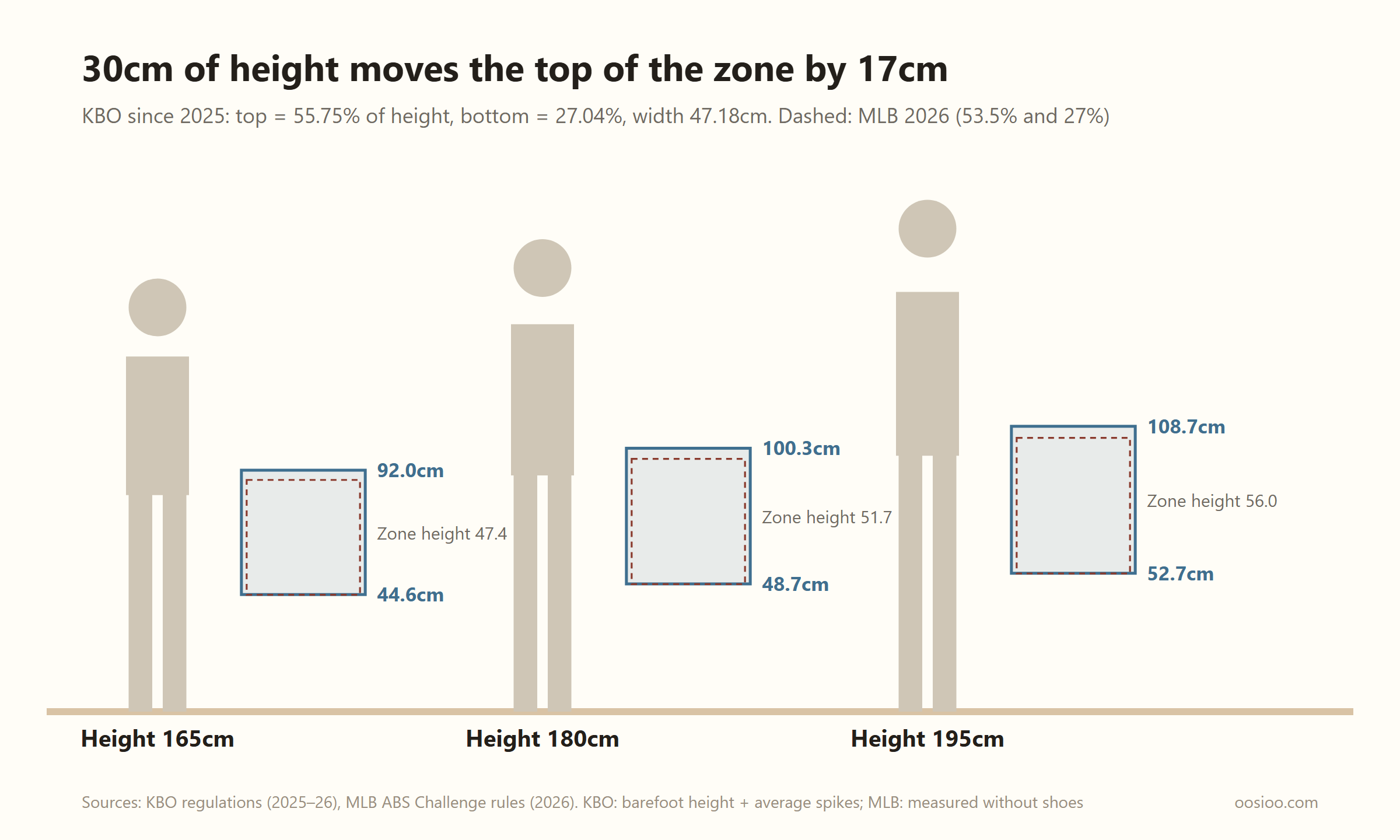
The tops of the zones for a 165cm batter and a 195cm batter are almost 17cm apart, and the zones themselves differ in height by 8.6cm. A baseball is just over 7.3cm across, so that's more than one ball's worth. The adjustment human umpires used to make by feel, "tall hitter, higher zone," the machine makes with a single number. Notice too that in the picture the zone sits around the standing figure's waist. The ratio is applied to standing height, but batters actually stand with their knees bent, so the zone is set low enough to fit the body in that stance.
The call uses two planes. Seen from the side, home plate is 43.18cm deep from front to back. The KBO counts a pitch as a strike only if it meets the height standard both at the middle of the plate (the middle plane) and at the very back (the back plane). Pitches are dropping as they come in, so near the bottom edge of the zone the back plane is the stricter test. A curveball that is at knee height at the middle plane but has fallen below the zone by the back plane is a ball. It approximates the rulebook's "solid box" with two flat planes.
Three: tell a person. Once the call is made, it's converted to audio and sent to an earpiece the plate umpire wears. The umpire simply calls what he hears (Nocut News). The machine makes the call, but raising the arm and shouting it is still a person's job.
It's quite accurate. During the 2024 preseason the ball-tracking success rate was 99.9%. That April the KBO fired balls from a pitching machine at nine ballparks, marked where they actually passed with foam boards, and compared: the average error was 4.5mm side to side and 4.4mm up and down (News Seoul). That's about one-sixteenth of a ball's diameter.
You can try it yourself below. Change the height and the zone moves; tap the screen and a pitch goes through that spot. Fastballs and curves drop at different angles, so their positions at the back plane (the dashed circle) differ. Press "You be the ump" and pitches only come in near the edges of the zone. It's harder than it looks.
Once the machine came in, the calls really did change. Researchers at Yonsei and Hanyang universities analyzed pitches from the first half of 2024 and found that the share of high pitches inside the zone called strikes rose from 57.28% to 79.77%. The share of pitches outside the zone called strikes dropped from 10.49% to 0.58%. Curveballs inside the zone went from 46% strikes to 85% (arXiv 2407.15779). In other words, human umpires had been stingy with high pitches and big breaking curves. To the human eye, those pitches came into the zone without ever "looking" like strikes.
Of course, there was noise. In April 2024 Ryu Hyun-jin, the former MLB pitcher, publicly complained that the ABS zone was inconsistent, and the KBO pushed back by releasing the tracking data for that at-bat (Kyunghyang Shinmun). A few days later Hwang Jae-gyun was ejected for throwing his helmet after a pitch the catcher couldn't even hold was called a strike (Kyunghyang Shinmun). To a human, a pitch that gets past the catcher looks like a ball. The machine only asks whether it went through the zone.
The biggest scandal came from the human side, not the machine. On April 14, 2024, in a game in Daegu, the plate umpire called a ball on a pitch the ABS had ruled a strike. He hadn't heard the call in his earpiece properly. Instead of correcting it, the crew chief was caught on the broadcast microphone saying, "Say the audio said it was a ball." The crew chief was fired and two other umpires were suspended for three months. Afterward the KBO put receivers for the call audio in the dugouts too (OSEN). Now managers hear the machine's call in real time as well.
Fans, on the whole, welcomed it. In an 8,000-person survey the KBO released in January 2025, 88.7% said the ABS had been good for the league (News Seoul). Complaints that the zone is too big or too small are still around, but the complaint that the zone changes depending on who's behind the plate has almost disappeared.
Why Major League Baseball chose "challenges"
The United States tested it before Korea, but adopted it later and in a different form. The first real game was the independent Atlantic League's All-Star Game in July 2019. TrackMan, a radar system, made the call, and the plate umpire heard it through an earpiece connected to an iPhone in his pocket and announced it (ESPN/AP). It's almost exactly how the KBO works now.
Over several years of minor league testing after that, MLB put two systems side by side. One was "full ABS," where the machine calls every pitch. The other was the "challenge" system, where humans make the call and you can ask the machine if you disagree. Triple-A alternated between the two by day of the week. In a 2024 survey, 61% of club staff and 47% of fans preferred the challenge system, while 11% and 23% respectively preferred full ABS (KSL/AP). From June that year, Triple-A used challenges only.
Then in September 2025, MLB decided to use the challenge system starting with the 2026 regular season (CBS Sports). The rules work like this.
- Each team starts the game with two challenges. If a challenge succeeds, the team keeps it.
- Only the pitcher, the catcher and the batter can ask. Managers and the dugout can't get involved, and the request has to come immediately after the call.
- The signal is a tap on the cap or helmet. The pitch track and the zone then appear on the scoreboard and the broadcast.
The calls come from 12 cameras made by Hawk-Eye, a Sony company. The zone is also defined a little differently from the KBO's. The top is 53.5% of height and the bottom 27%, and the call uses only one plane, at the middle of the plate. On the other hand, if any part of the ball touches the zone, it's a strike. Players' heights are measured in person at spring training, shoes off. When they did that, 225 of the 430 hitters on 2026 Opening Day rosters turned out to be at least an inch (2.54cm) shorter than their listed heights (Wikipedia). Profile heights, it seems, had always been a little inflated.
The first season just ended. I couldn't find an official MLB season summary yet, but according to reports citing Baseball Savant, MLB's data site, there were 10,557 challenges in the regular season, and 5,686 of them, 54%, overturned the call. That's 4.35 per game, and each review took about 15 seconds. Catchers had the best success rate at 59%, followed by batters at 49% and pitchers at 40% (Yahoo Sports). The person catching the ball from closest up had the sharpest eye. On September 30, a Wild Card game ended on an overturned call, the first time that had happened in the postseason.
MLB had reasons for not handing every pitch to the machine. Commissioner Rob Manfred said players strongly preferred challenges to full ABS. Catchers were the most worried. "Framing," catching a borderline pitch so it looks like a strike, has been a skill that drove catchers' salaries for more than a decade. If the machine sees every pitch, that skill is worth nothing. Under the challenge system the human umpire still makes the first call, so framing survives. Manfred himself said challenges "dramatically" reduce the loss of framing's value (AOL/AP).
There's been an amusing side effect, too. One analysis found that as umpires, wary of challenges, raised their arms less often on close pitches, the share of fastballs just above the top of the zone called strikes fell from 54.3% in 2025 to 40.8% in 2026 (it's a blog analysis, so take it as a reference only). Pitchers complained the zone had gotten smaller (SI). Even without the machine making every call, the mere fact that it was watching changed how people called the game.
Other leagues are moving as well. Taiwan's CPBL ran its first challenges at the 2026 All-Star Game and is aiming for its top level in 2027 (according to local reports). Mexico's league has had the machine call every pitch, KBO-style, since May 2026. Japan's NPB is still studying it. It wasn't used at the 2026 World Baseball Classic, and when the USA–Dominican Republic semifinal ended on a disputed strikeout, Vladimir Guerrero Jr. asked why, if they were going to use it in the regular season, they weren't using it at the WBC (TSN).
| League | System | Since | Zone height |
|---|---|---|---|
| KBO (Korea) | Machine calls every pitch; umpire hears it in an earpiece and calls it | 2024 | 27.04–55.75% of height (2025 on), two planes |
| MLB | Humans call; two challenges per team | 2026 | 27–53.5% of height, one plane |
| Mexican League | Machine calls every pitch | May 2026 | — |
| CPBL (Taiwan) | Challenge trial | 2026 All-Star Game (top level targeted for 2027) | — |
| NPB (Japan) | Under study | — | — |
Beyond the strike: what comes next?
With the zone sorted out, baseball fans turned their attention to other calls. Plenty of calls besides the strike zone can flip a game. Which ones are next, and which will stay with humans to the end? I think the answer becomes clear if you split calls into three kinds: calls that only need measuring, calls that need to catch an instant, and calls that need to read intent.
Calls that only need measuring are already made by machine, or soon will be. The strike zone is one. The pitch clock is another. MLB introduced the pitch clock in 2023 and cut the average nine-inning game by 24 minutes (NBC New York). The KBO made it official in 2025, and this year it cut the time between pitches by two seconds, to 18 seconds with the bases empty and 23 with runners on. The clock keeps the time; a person just declares the violation.
The checked swing is moving into this category too. Whether a batter who started his swing and stopped actually swung has long been left to the feel of the first- or third-base umpire. On August 19, 2025, the KBO began video review of checked swings in its top league. The standard is whether the end of the bat passed 90 degrees relative to the batter's box. Each team gets two separate requests, and by mid-September 86 requests had overturned the call 32.6% of the time (Seoul Shinmun). In the minor leagues, MLB is testing automatic measurement of bat angle with Hawk-Eye: if the line from the bat head to the knob passes 45 degrees, it's a swing, and from May 2026 it became challengeable in Triple-A (WTOP/AP). The two leagues' numbers differ, 90 degrees versus 45, because they measure from different reference lines. Don't compare the numbers on their own.
Home run versus foul near the pole is also a measuring call. Surprisingly, people still decide it by watching video. In an Orioles–Yankees game this August, a ball Pete Alonso hit passed near the foul pole, and the replay center kept the foul call, saying it couldn't confirm the ball had left in fair territory. The Orioles' manager said the review should use the ball-tracking data that already shows up on the dugout tablets, and Alonso suggested putting cameras or lasers on the poles (theScore). A high fly leaves the field of view of the pitch-tracking cameras, and every ballpark's poles are built differently. The obstacle is cost and installation more than technology.
Calls that need to catch an instant are hard. In a close play at first, did the foot touch the base first, or did the ball reach the glove first? Did the tag beat the runner's hand? Did a pitch graze the batter's jersey? All of these are decided by people watching replay, and I found no evidence of a machine making these calls on its own. Hawk-Eye in MLB ballparks tracks many joints of each player's body 30 times a second (Sony), but at 30 times a second there are 33 milliseconds between frames. A runner going at the major league average sprint speed of 8.2 meters a second covers 27cm in that gap. Close plays at first are usually decided by far less than that. On top of that, the hands and feet at the moment of contact are hidden by a sliding body, a fielder's glove and dust. More cameras and higher frame rates will solve it someday, but it's many times harder than following a single ball.
Mistakes in this category have left the most painful marks in baseball history. On June 2, 2010, Detroit's Armando Galarraga was one out away from a perfect game. The 27th batter hit a grounder that anyone could see was an out, but first base umpire Jim Joyce called him safe. After the game Joyce watched the replay, admitted his mistake and choked up, and the next day Galarraga personally handed him the lineup card. The commissioner did not reverse the call (ESPN). At the time MLB used video review only for home runs. Review didn't expand to what it is today until 2014.
Calls that need to read intent look likely to stay with humans for a long time. A balk asks whether the pitcher made a motion meant to deceive the runner. Interference and obstruction come down to whether it was deliberate, or could have been avoided. Whether to eject someone after a beanball dispute means reading the whole flow of the game. A machine can measure the body's movement more precisely than a person can, but what meaning that movement carried is an area the rules deliberately left to human judgment in the first place. For a machine to handle this, being more accurate isn't enough. The rules themselves would have to be rewritten in terms that can be measured.
On other fields
Baseball wasn't the fastest, either. Other sports brought in machines in ways that fit their own needs.
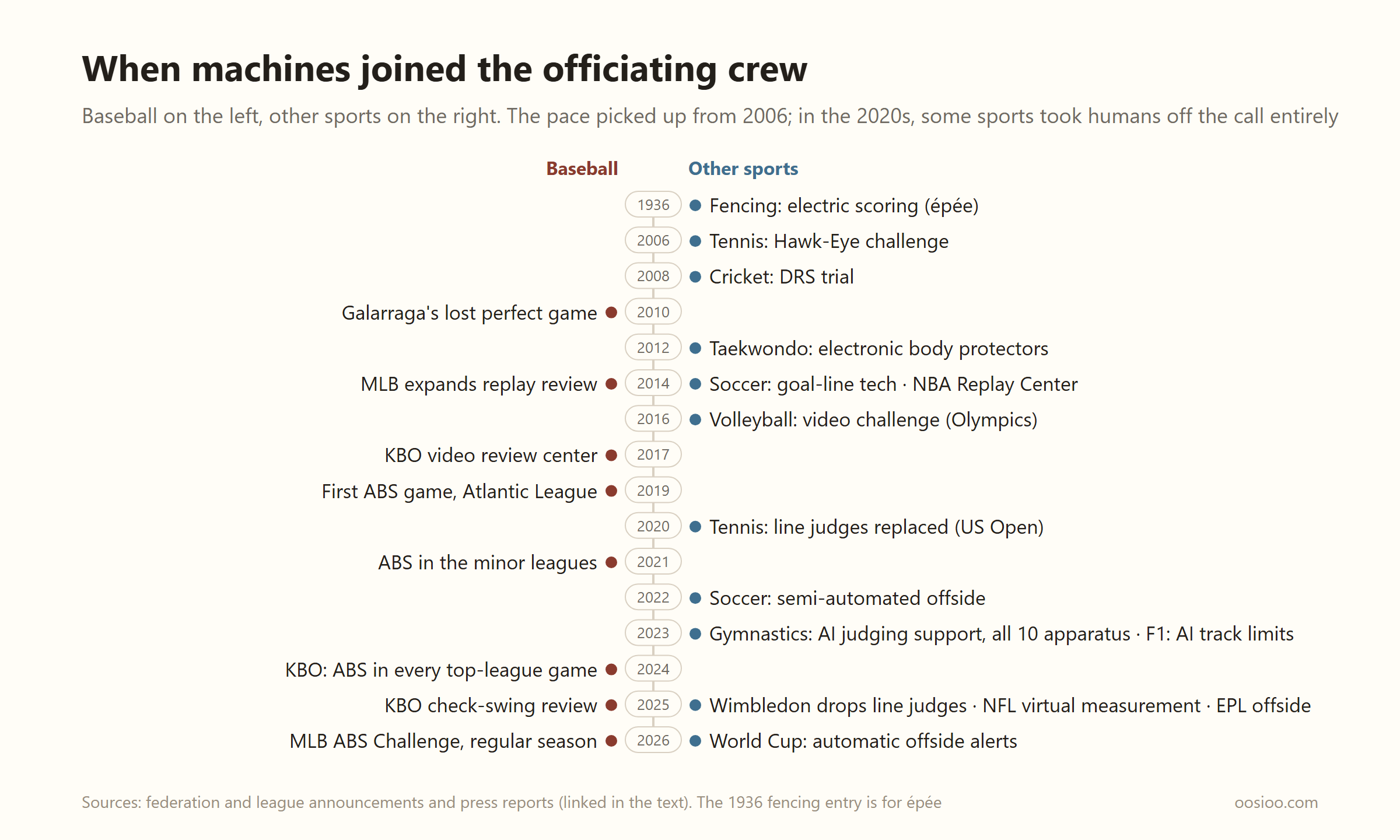
Tennis took the path most like baseball's. The Hawk-Eye challenge entered the Grand Slams at the 2006 US Open. When a player disputed a line judge's call, the screen showed the ball mark as reconstructed by cameras, the same idea as today's MLB challenge. At the 2020 US Open, which had to cut staff because of COVID, line judges were removed entirely on 15 of 17 courts and the calls left to Hawk-Eye Live (CNBC). It jumped from challenges to full automation. In 2025 Wimbledon did away with line judges on all 18 courts for the first time in its 147-year history, and the ATP Tour switched to electronic line calling even at clay events (Al Jazeera).
That first year at Wimbledon, something went wrong. In a fourth-round match a ball that was clearly out wasn't called, and the point was replayed. It turned out the system on one side of the court had been accidentally switched off for an entire game. The club apologized, and the player who lost out said the game had been "stolen" from her (Flashscore). A machine may not make mistakes, but it can be switched off. And a machine that's off doesn't tell you it's off. Roland-Garros still uses human line judges. Balls leave marks on clay, so a person can just walk over and look.
In soccer, the turning point was the England–Germany round of 16 at the 2010 World Cup in South Africa. With England down 2-1, Frank Lampard's shot hit the crossbar and came down inside the goal line, but the goal wasn't given. Germany won 4-1, and FIFA president Sepp Blatter, who had opposed bringing in technology, changed his position (SI). Goal-line technology arrived at the 2014 World Cup in Brazil.
Offside is harder. You have to see whether any part of the attacker's body was ahead of the defender at the moment the pass was played. At the 2022 World Cup in Qatar, semi-automated offside used 12 cameras under the stadium roof to track 29 points on each player's body 50 times a second. A sensor inside the ball, measuring 500 times a second, pinned down the moment of the pass (FIFA). It's the same problem as baseball's safe-or-out, catching an instant, solved with a sensor in the ball. At the 2026 World Cup in North America, clear offsides were sent straight to the assistant referee without going through the video room (FIFA). England's Premier League has used semi-automated offside since April 2025.
Cricket's DRS began with a trial in 2008. It tracks the ball to predict whether it would have hit the wicket had the batter's leg not been in the way, and it matches sound from a microphone near the bat with the video to tell whether the ball grazed the edge of the bat (ESPNcricinfo). In judging by predicting something that never happened, it goes a step further than other sports.
Gymnastics is different because it's a scored sport. Fujitsu and the International Gymnastics Federation started building a judging support system in 2017, and from the 2023 World Championships it was used on all 10 apparatus. AI reads the gymnast's skeleton from camera footage to measure body angles and rotation, and judges refer to it or check it when a score is disputed (MIT Technology Review). Humans still give the scores. Figure skating is running similar trials, but at the 2026 Milan Cortina Olympics the system was used only for broadcast.
There are many more.
| Sport | What the machine does | Since |
|---|---|---|
| Fencing | An electric circuit registers a touch when the blade tip lands | 1936 (épée) |
| Swimming | Touchpads record finish times | 1960s on |
| Taekwondo | Electronic body protectors score by impact force | 2012 London Olympics |
| Volleyball | Video challenges on lines and net | 2016 Rio Olympics |
| Basketball (NBA) | Replay Center review; skeletal tracking since 2023–24 | 2014 |
| American football (NFL) | Six cameras measure first-down distance, replacing the chains | 2025 |
| F1 | AI pre-screens possible track-limit violations | 2023 trial |
| Track and field | Photo finish at 40,000 frames per second | 2024 Paris Olympics |
The F1 story is worth remembering. At the 2023 Austrian Grand Prix there were about 1,200 possible track-limit violations, and four people had to review them. So the FIA started using computer vision to screen out the obvious cases first. The official in charge described it as "like cancer screening": the machine clears the obvious 80% so humans can focus on the remaining 20% (ESPN). The machine doesn't replace people. It reduces what people have to look at.
Swimming has a famous moment where the machine's call and the human eye disagreed. In the men's 100m butterfly at the 2008 Beijing Olympics, Michael Phelps beat Milorad Čavić by 0.01 seconds. Plenty of people said that in slow motion, Čavić's hand seemed to touch first. But a touchpad only triggers when it's pressed with a certain force. Phelps took one more stroke at the end and hit the pad hard; Čavić glided in and touched it (SwimSwam). The machine defined "touching" as "pressing," and the race ended on that definition. A machine call being fair doesn't mean the machine knows the truth. It means everyone accepted the same definition.
So, someday, every call?
Will machines make almost every call in the distant future? I think the "measuring calls" will go that way. The strike zone, checked swings, balls near the pole, someday even close plays at first. Cameras multiply, frame rates go up, prices come down. It took tennis 14 years to go from challenges to full automation. MLB, too, might one day hand every pitch to the machine the way the KBO has.
But I think two things will remain. One is the calls that read intent. Balks, interference, ejections: areas the rules deliberately left to human judgment won't pass to machines just because machines get more accurate. The other is the person who announces the call. Even though the machine sees every pitch, the KBO keeps an umpire behind home plate. He relays the call he hears in his earpiece to the ballpark with a gesture and his voice. MLB went further and lets the human call first, with the machine answering only when asked. Part of why players and fans in tennis liked challenges was those few seconds when the whole stadium waited together for the ball mark to appear on the screen.
What people wanted, I think, wasn't a perfect call. It was a call they could accept. Bad calls were hard to bear not so much because they were wrong, but because everyone knew they were wrong and no one could fix them. Galarraga's perfect game still isn't in the record book. The machine removes that "no one can fix it." In that sense, the machine can be a rescue for human umpires too. If Jim Joyce had had a challenge button in 2010, he wouldn't have had to carry that play with him for the rest of his life.
Back to the word in my notebook. "Strike" originally means "to hit." In early baseball a batter could wait as long as he liked for a good pitch, so umpires began calling "strike" on batters who let hittable pitches go by, in effect telling them, "Swing." From the start, a strike wasn't about where the ball was. It was something said to a person. Now the machine measures where the ball is. But calling the word out across the ballpark is still something a person does.